bearing blog


bear – ing n 1  the manner in which one comports oneself;  2  the act, power, or time of bringing forth offspring or fruit; 3 a machine part in which another part turns [a journal ~];  pl comprehension of one’s position, environment, or situation;   5  the act of moving while supporting the weight of something [the ~ of the cross].


  • How does she do it?!?

    Arwen has a reflection up at F&FL that I found was a good reminder:

    “A mom with four kids five and under does not have time to bake her own bread.”

    If someone had told me that before I was a mother, I would have agreed emphatically. That woman must be so worn out! She doesn’t need extra work. She should buy bread.

    Well, guess what? I have four kids; the oldest is barely five; the youngest two are twins, for heaven’s sake. I am worn out and I don’t need extra work.

    I still bake my own bread. (Not always, but regularly.)

    If I find myself with ten minutes where both babies are calm and the older kids are busy, I pull out the mixer and dump in yeast, water, flour, salt. I keep an eye on it as kneading happens, add more flour as necessary, prep the dough-proofing container. Later I carve minutes out of my day to de-gas the dough, to form it into loaves, to bake it.

    I do it because, as strange and possibly cheesy as this might sound, it soothes me. 

    Remember:  One person's "OMG how can you possibly find time to do that, you must be insane" is another person's "thing that keeps me sane."


  • Portable: Pseudo-pain au chocolat.

    On Tuesdays I leave the house by eight in the morning, to drive out to the suburbs so we can spend our co-schooling days with Hannah's family.  This school year I've been driving even a bit earlier, picking up the daughters of another family as well before swinging north.  The trip is not quite an hour long.

    The kids have to eat, of course, and usually in the car.  Normally if someone won't eat breakfast I shrug and say "Guess you'll be hungry later, then," but I had to put my foot down some time ago about refusing to eat breakfast on Tuesday mornings.  Hannah is happy to feed hungry kids a snack, but I wasn't so happy about my children snarfing up all her bread and milk once a week.

    Furthermore, my daughter is one of those people who can't bear to look at food before about 10:00, so her breakfast has to come along and be saved till later.  

    The emergency food is granola bars, of course, which I keep in my car.  And if we are really desperate (defined by:  I somehow wasn't able to secure a cup of coffee any other way), I am not above hitting a drive-through.  But I really do prefer making a portable real food.

    Now if it was  just me, it would be easy.  I love hardboiled eggs, that quintessential portable protein, or sticks of string cheese; and in the summer I would be perfectly happy to drop a pint jar of hulled strawberries and almonds into my cupholder (one of the cupholders; the other one has my coffee) and go.  Kids:  not so much.  Eating what's available because you have to get yourself fed is apparently a learned skill.

    Muffins are one solution; they are a bit crumbly, sure, but there are already so many crumbs in my car that I don't worry about it.  At least they don't drip, unless they are chocolate-chip.  I used to make them fresh on Tuesday morning, but these days I tend to bake them the night before.   I used to be intimidated by muffins, but now I can make them practically in my sleep.

    Another is quesadillas or their cousin, breakfast burritos.  I typically make plain cheese for one child, egg-cheese-salsa for another (and for me), and a pepperoni-and-cheese quesadilla for another.  They don't take very long and they are all right even after they have gone cold.

    I don't favor peanut butter sandwiches because the crusts tend to get left behind in the seats and then get smooshed.  Also, then everyone wants milk.  Which is banned from my car.

    Here is a new idea I haven't tried yet, and a new idea I tried this morning.

    First:  stuffed buns.  Yes, I know, there is nothing particularly creative about what is basically a sandwich.  Still, I like her nifty method of sealing the bun to keep things from falling out of it.  Check it out at The Big Red Kitchen (where there be photos):

    Go to your nearest bakery that bakes up the freshest and most tender Kaiser Rolls. Slice the rolls open leaving one edge intact- like a clam shell, and pull out some of the tender innards saving them for another recipe. Now here is the trick to getting those buns put back together and holding the filling inside. Ready for this?

    Fill the bottom well with your filling of choice and pipe beaten egg whites around the lip of the bottom bun, close bun, press lightly to be sure that glue has sealed the bun closed, and top with a slice of cheese of choice. Bake in a 375 degree oven for about 8 minutes. The meringue will seal your fillings in the bun…. 

    Brilliant.  Just brilliant.  I am a little bit afraid to try it first with a fresh, tender Kaiser roll, however, because I fear that if the kids get a hold of that, they will never eat one made of a leftover whole wheat dinner roll, which is exactly how I would do this for breakfast.   

    Now, on to my other new thing, with a little background.  The bread machine is sniffed at by many "real" bakers, including, sadly, some otherwise inspiring cookbook writers (Mark Bittman, I'm talking to you).  Yes, yes, if you are the sort of person who tosses about  "poolish" and "sponge" without a thought, or even if you are a devotee of the considerably more convenient no-knead Dutch oven breads or Artisan Bread in Five Minutes a Day, then perhaps bread machine bread will never be up to your standards.  But hey, if your family eats sandwiches or toast, especially if they eat a LOT of sandwiches and toast, it's hard to beat a constant supply of homemade sandwich loaves.  I think at this point I would do without my microwave, food processor, and blender all together before I would give up my bread machine.  

    So, given that I have a bread machine, it's really pretty easy to have fresh breakfast buns of all sorts, because the dough can be ready to shape when you get up.  I stumble down the stairs, turn on the oven, shape the buns or what have you to the sound of the coffee maker starting to hiss and burble, set them on top of the warming oven to rise, and stumble back up the stairs (it's harder than going down; try it sometime) to get dressed or shower or nurse the baby or whatever.  Twenty or thirty minutes later I come down, pop the pan in the oven, and drink a cup of coffee.  Most yeast buns only take ten minutes or so to bake, so breakfast is ready.  And since that (and maybe a cup of milk) is all the kids need to eat, well, it's actually pretty simple.  I think you can maybe get a similar effect with certain doughs that will willingly rise in the refrigerator overnight, but it takes longer for them to do their second rise.

    This morning I tried a version of pain au chocolat.   Yes, yes, it is traditionally made with croissant-type pastry, but my children don't know that, do they?  Milo was inspired to ask about it yesterday when we were reading a book called Let's Eat:  What Children Eat Around the World.  One of the children was a French boy, and a photo showed him and his restauranteur-parents sitting around the breakfast table drinking hot chocolate out of bowls.  "Why aren't they using a mug?" asked Milo, and I read the caption to him, which indicated that the family had dipped their pain au chocolat in the hot chocolate and then when the pain was done they drank the hot chocolate from the bowl, much as we order our kids to finish their milk after they have spooned up all the cereal.

    Well.  Hot chocolate with chocolate-stuffed bread sounded like a fine breakfast to Milo, so that's what's on the menu this morning.  And I mention this in the "portable" category because without the hot chocolate, the chocolate-stuffed bread is indeed quite portable, as you will see.

    (A side note before we go on:  Why haven't I ever thought before about serving, say, cookies and milk with the milk in a bowl instead of a cup?  Whenever they're going to dunk something in the milk?  It would be a lot less messy and it doesn't impede the drinking afterwards.)

    I searched for "bread machine pain au chocolat" and found this lovely British recipe, with the flour measured in grammes, and adapted it.  (The quantity of yeast looked ridiculously small, so I used the amount of yeast I would normally put in a cinnamon-roll type dough).

    Here's what I put in my bread machine for six pains.  Next time I'll increase it by fifty percent, I think, and try using a bit more whole wheat, since it turned out nicely with 40% whole wheat.

    • 2 eggs beaten (right in the machine pan) with 3 Tbsp milk
    • 2 Tbsp sugar
    • 2 Tbsp butter
    • Pinch salt
    • 150 g bread flour (sorry; I have a scale, so I went with her grammes)
    • 100 g Dakota Maid whole wheat flour (DM is a finely ground, hard winter wheat that is excellent for bread.  I don't think this would work with a coarse whole wheat)
    • 1 tsp bread machine yeast

    I cut the dough, which was smooth and elastic, into six pieces, rolled each gently out into an oval, and deposited eight Ghirardelli 60%-cocoa chocolate chips (that's a quarter of an ounce; I think a bit more would have worked okay) into the center of each.  Then I folded them over (like a business letter), pinched them to seal, and tucked the ends under like a little loaf of bread.

    I put four of them in mini-loaf pans as suggested in the recipe, and put two on a baking sheet to see if that worked okay.  Then I covered them and let them rise 20 minutes before baking 10 minutes at 425 degrees F.  

    Results:

    1027110641-00

    Aren't they cute?  They looked just a teeny bit overly browned; I might try 400 degrees next time.  And I don't really think that they needed the mini-loaf pans, as they all look about the same.  

    (Slight mistake:  I probably should have put them seam side down.  I was worried about the chocolate leaking.  I think seam side down would look nicer, although mine turned out kind of interestingly rustic-looking.)

    Of course anytime you have something stuffed with chocolate, you should have an interior shot.  Here is one that I managed to catch with my cell phone before Mark ate the other half.

     1027110710-00

    I thought the rich bread was lovely, but the chocolate was a bit much for seven in the morning.  Chocolate is good for you, insisted Mark, as he ate one and a half buns plus the chocolatey middle of mine.   Maybe next time I will fill my little bun with something else, like plum jam or cream cheese.

    Once they cool completely, the chocolate will solidify, and it will be a very nice, not-messy, quite portable breakfast bun.  


    UPDATE:  Oh yes.  Well-received.  And not perfectly un-messy, but not bad either.


    1027110850-00


  • Fifteen minutes to blog about the Marian consecration.

    I know, I know — where have I been for the last couple of weeks? The last post on trouble with weight maintenance was a desperate ploy to get something, anything, up on the blog. Else I would have gone nearly two weeks without posting.

    And there should have been plenty to blog about. The Ig Nobel awards came out, and I had a blast staying up late with my husband and a friend from grad school (himself an alumnus of an Ig Nobel-laureate's research group), reading about some poor researchers who spent six months training tortoises to yawn on command. My daughter started in American Heritage Girls, which brought back lots of fond memories of Girl Scouting. My husband's tibial stress fractures cleared up and he may start running again soon. I finished the Neal Stephenson book. I went to Iowa City for the weekend. I discovered a new way to feed nine picky children. Somehow, though, when I sat down to blog I was always too tired to think straight. Now, too. But I am determined to stick it out for fifteen minutes.

    + + +

    So, let's talk about that consecration. I did it. I aimed for Our Lady of the Rosary but wound up doing it on the day after, which was a Saturday, and which made it easier to get to Mass. This is unusual for me. Normally I am all about the Sticking To The Plan. But I decided that I needed to embark on a new campaign of Good Enough spirituality, and if that meant arriving 24 hours late to a Marian consecration, so be it.

    I got up early and went to breakfast at a neighborhood restaurant that opens at 6 a.m. And has wifi. I wrote out the act of consecration in my general-purpose notebook for keeping track of things. I went to Mass, I went to confession. I lit a candle and put all the folding cash from my wallet in the box — I don't think it was very much, but it should cover the candle with some to spare. St. Louis recommends an alms or a fast or a mortification: I went for the alms because it was easy and I, who overthinks everything, couldn't possibly overthink this.

    Then I sat in the church and read the consecration and signed it, and that was it.

    No, scratch that, in the middle of my reading, a confused elderly woman, wearing a set of keys on a pink lanyard around her neck, approached me and asked when Mass was. I told her it had finished some time ago and she looked disappointed enough to cry. "But Father is still hearing confessions," I told her cheerfully, "so you could go, if you wanted, and then you wouldn't have made the trip for nothing." She liked that idea, so I showed her to the reconciliation room and then returned, picking up where I left off. I finished it, signed it, and that really was it.

    I put on a cheap little chain bracelet I had ordered a couple of weeks before — thinking I would get something more permanent, maybe a medal or something — and then I went about my day. Wondering if anything would be different now.

    + + +

    The first few days afterward, I felt strangely light inside — porous, like sea foam, or more like pumice. A stone matrix, full of airy holes. And I didn't feel any desire to pray, not rosaries, not the LOTH, not even an Our Father. Nor — and this is odder — did I feel a duty to pray. I almost felt as if I had been given a few days off.

    But after three or four days, I resumed my normal sorts of spiritual life. And here is what I think about the consecration: for me at least, it doesn't (so far) add anything extra to my life. I have no desire, for instance, to take up saying the Little Crown of the Blessed Virgin, or to add any particular fasts and mortifications. What it does seem to do is transform, if only slightly, all the things I already did do. I find myself approaching the rosary, or the breviary, with a little fascinated trepidation each time. Will I see something new now that I am consecrated? Will it mean more to me today?

    One difference: I never was a huge rosary enthusiast, but now I definitely appreciate that form of prayer far better than I did pre-consecration. Another is that I have really taken to Montfort's formula: I am all thine, and all that I have is yours, O my sweet Jesus, through thy holy mother. I rather like repeating it. It has taken the place of the other things I used to blurt out for no apparent reason, such as My God, my God, why have you forsaken me?

    My cheap metal chain bracelet, supposed to be a physical reminder to me of my consecration in the service of Jesus through Mary, turned out to be a poor fit for me; the toggle clasp kept coming apart, and it fell off several times. So during one of the times when it was missing, I ordered a slightly less plain metal chain bracelet with a lobster clasp, not too expensive, from an etsy shop (link here). Besides the metal it is made of, it has one glass bead that adorns a small Miraculous Medal. So not perfectly plain, even a little troublingly in accord with my taste in jewelry, but not ostentatious either. The dangly end gets in my way a little while I am working, but that may be a feature rather than a bug. I decided I would try alternating the bracelet with a silver necklace I already have, with a Madonna and child pendant, depending on which was more practical for the particular day. Either should work as a "little chain" to wear according to the suggestion of St. Louis. At any rate, I find that seeing and feeling the little bracelet on my arm does recall my mind, does prompt me, to live my consecration in the moment.

    I am working, too, on some related projects. Writing out a prayer for before and after communion, for example, so as to follow the Montfortian method, but in my own words. But also watching and waiting. I have taken the step of saying, "here I am, I come to do your will," without knowing what that will is. I still don't know. I wonder if this feeling of expectancy is permanent.


  • Maintenance blues II — re-establishing on the new “default day” plan.

    I stayed up late for two nights finishing Reamde and now I'm paying for it.  There is not enough coffee in this pot.  

    + + +

    I just went back to my archives from May of this year and read through the "Maintenance Blues" post.  (It's number four of a short series on "accepting your body:" First post Second post.  Third postFourth post (maintenance blues). Fifth post.  Sixth post.  Seventh.)

    I wrote then:

    It's three years this week since my successful weight loss began.  And lately?  Weight maintenance has been hard.  

    I feel as though I'm slipping, right on the edge.  I weigh myself every day and faithfully plot each point on a chart.  The paper charts stack up in a drawer in my bathroom, one for every month since I reached my weight loss goal in November 2008.  The zigzag lines rise up through my pregnancy and back down again after the birth of #4, not quite as low as I was pre-pregnancy but back to where I decided to be.

    And lately I don't like what I see.   It's not that I'm not still at a healthy weight.  I am.  But after reaching my postpartum target, my weight crept back up, and I've been on the high side of it for months now.

    Worse, I can't seem to bring it back down.  Several times since just before the baby's first birthday, I have tried to lose just one pound.  Not because I needed to but because I wanted to see if I could still do it. 

    I haven't done it.  I haven't sustained the effort for more than a few days.  After about three days of sticking to my habits, I start feeling hungry and cold all the time, and shortly thereafter I find myself helping myself to a third plate of dinner, or eating all the kids' sandwich crusts.    I recognize this as classic "body defending its fat stores."  Still, it's frustrating — I managed to overcome it once, what's wrong with me now?  Have I lost my hard-earned habits for good?

    I thought maybe it was worth highlighting that now, a few months later, I seem to have finally gotten a handle on it.  Seriously, it took almost four months of false starts.

    Weight maintenance is not easy.  It is difficult.  It was especially difficult over this past summer, mainly (I think) because my husband had a lot of business travel.  That generally makes it harder for me to run the household, and I don't have much energy left over either for willpower or for necessary tasks like meal planning.  Also I tend to rely on packaged food and carryout more when he's gone, and those foods tend to be less satisfying in smaller portions.   And it makes it marginally more difficult (though more appealing) to get to the gym.

    So a lot of my strategies that require advance planning were not as helpful as they have been in the past.  I was seeing my weight stay about three pounds higher than I wanted it to be.  At the same time, I was waking up every morning and recommitting to following my good habits, then only marginally managing to follow them.  Would I be gaining weight, if I wasn't trying?  Maybe. 

    Back when I was losing the 40 pounds, there came a point when I sort of got into a groove with it.  It was still physically uncomfortable to resist gluttonous behaviors.  I felt hungry, I felt cravings, and it didn't feel good to resist them; but it felt mentally easy to resist them.  I had bought into the idea that I had already made my choices.  "I don't do that anymore" was all it took — I didn't like the experience of self-control, but I could do it and I did do it.

    But back in May, the groove just refused to come.  I kept "forgetting" that I was trying to practice good habits and self-control.  I would sit down in front of, say, a plate of pasta at a restaurant, and it would suddenly and quite literally seem not at all important that I was trying to reboot my good habits.  I wouldn't exactly make a fully conscious decision to abandon the habits — it was really like I was forgetting what I was trying to do.  And I wouldn't remember until afterwards, when I felt the overfull sensation.  And then I would feel awful.

    + + +

    I kept plugging away at the attempts, though.  (Like ChristyP says: It's a new day every day.)  I tried some different strategies, because it was plain that many of my old reliable ones were not working in the particular family dynamic that we had going at the time.

    And I think I finally hit my stride.  We'll have to see if it lasts, but I think I have gotten a mental handle on myself again.  I have stopped "forgetting."

    + + +

    The new strategy that has been most helpful in this season has been a radically simplified calorie-counting technique.  

    If you are a longtime reader, you may remember that periodically counting and journaling my daily calories (I used SparkPeople) was a very helpful strategy for me during my 40-pound loss.  I didn't do it every day, but doing so once every few days helped me maintain realistic expectations of appropriate portion size and of reasonable tradeoffs (an egg or a blueberry muffin, or half of each?).  I do think that having this realistic understanding of my body's needs helped me understand the line between gluttonous behaviors and non-gluttonous variations.  And, of course, on days I did it, following the plan literally controlled the calories.   I tended to count the calories the night before and make a plan that I would try to stick to, rather than counting things after I ate them.

    But even occasionally performing the calorie-count was too time-consuming for me in this season.  It takes about half an hour to sit down and make a calorie-controlled plan for a full day.  I just could not scrape together the time to make it stick.  Other things were higher on my priority list.  I worked on other important behaviors (not taking seconds, for example) but I couldn't shake the feeling that the calorie counting was a missing piece of the puzzle.  On the few days when I managed to squeeze it in, I found it much easier to keep my intentions in mind.

    Finally I found a technique that worked, because it eliminated the need to sit down and plan the whole day.  Essentially, I went from "It's a new day every day" to "It's a new meal every meal."  Here's what I did.

    1 – I identified a maintenance calorie target.  

    For me, the target that maintains weight reliably is about 1600 calories per day.  Probably I actually eat more calories than that (my guess is something like 1700-1900), but I have found that if I pretend that I'm trying to eat 1600 calories a day, I stay the same.  I guess you could say that a buffer of a couple hundred calories — the nibbles off the kids' sandwich crusts, the tasting the soup to check the seasoning, the "just one more" potato chip — must be built into that number.  

    Please remember that the 1600 calories is me-specific.  I am not a large person, and as I said, that number is probably lower than my "real" maintenance intake.  If you don't know what your maintenance level is, start with an online calorie needs estimator — don't just use mine.

    2 – I subtracted some calories. 

    I happened to be a couple of pounds heavier than I would like to be; my bad habits had caused my weight to creep up.  So my new target (temporarily) became 1450 calories per day.  This was roughly the target during my 2008 weight loss, by the way. 

    3 – I divided the calories among the meals and snacks that I would like to eat.

    I thought about the "meal" and "snack" habits that I would like to reinforce.  I do better if I have a couple of  snacks; I find that I am going to eat between meals anyway, so "no-snacking" is not a realistic goal.  But I would prefer to be in the habit of  keeping those snacks small.  I have also found that I do nicely on a fairly light breakfast, a medium lunch, and a heartier dinner.  So that's how I split things up.

    I made a little text file called "A Default Day" and wrote this in it:

    • Breakfast — About 250 calories
    • Lunch — About 400 calories
    • Dinner —  About 600 calories
    • Two snacks — About 100 calories each

    4 – I started to try to stick to those targets one meal at a time.  

    I didn't bother with trying to make up at dinner for overshooting at lunch.  (Just like during my weight loss I didn't try to starve myself on one day to make up for overshooting on the previous day).  

    This really is easier than trying to do the whole day at once, especially with years of calorie-counting under my belt.  I can use various rules of thumb plus the nutrition labels to estimate calorie counts while I'm preparing food.  I can tell you off the top of my head that one piece of toast with a little bit of butter, coffee, and a boiled egg will come in at about 250 calories for breakfast, for example.

    (quick fact check using SparkPeople:  1 egg = 70 calories, 1 slice whole wheat bread = 128 calories, 5 cups coffee = 12 calories, 1 pat salted butter = 36 calories, total = 246 calories.  CHA CHING.)

    5 – When I had time, I thought about the sorts of meals I like to eat, and I calculated the portion sizes necessary to hit the targets.

    So,  for example, I often have eggs and toast for breakfast, or a fried egg on top of leftover rice pilaf.  I sometimes make biscuits for the family and usually have bacon with them.  I like cottage cheese or yogurt with fruit.  If I'm in a hurry, I might have peanut butter on an apple or on toast.  I make pancakes and waffles from time to time.  And, let's face it, once in a while I have to hit a drive-through.

    So I made this list of 250-calorie breakfasts — it's almost like a list you might find in a magazine diet plan, except that it only has stuff I actually make and eat regularly (plus an emergency drive-through option).  No mini frittatas here, nor breakfast cereal (since I don't much like it at breakfast and tend to eat it for dessert instead), nor prepackaged items (another thing I don't rely on much at breakfast time).  But if you eat those things, then they could be on your list.

    • boiled egg, tomato juice, one slice toast, half a tablespoon butter OR jam
    • egg fried in 1 tsp butter, plus 100 calories of bread or leftover grains
    • 2 small biscuits and 1-1/2 strips bacon
    • Mix and match:  2/3 cup cottage cheese or 3/4 cup yogurt or 1 cup oatmeal, plus 1-1/4 cup blueberries or 1 cup applesauce or 1 sliced banana or 2 cups sliced strawberries.
    • 1-1/2 tablespoons peanut butter on either 1 apple or 1 slice toast.
    • Two pancakes (1/4 cup batter each) or half a waffle, topped with either one pat butter and one tablespoon syrup, or 2/3 cup berries.
    • McDonald's oatmeal without the extra brown sugar, or an egg McMuffin with no cheese.

    I made a similar list for 400-calorie  lunches.  Two examples:

    • Pile of veggies, 100 to 150 calories of bread or crackers, and one can of sardines.
    • Drive-through option:  One or two side salads with one packet of vinaigrette dressing and six chicken nuggets or a grilled chicken sandwich.

    And another one for 600-calorie dinners.  One example:

    • 3.5 ounces of pizza, plus a bowl of homemade salad.

    You see that I got less precise about the portions as I went later in the day.  I didn't specify the sort of pizza, or how big a pile of vegetables.  This kind of meshes with how I roll in calorie counting anyway.  In 2008, I had success even though I often would count the breakfast and lunch very precisely, and then (assuming I followed my plan) reward myself by eating whatever at dinner, just not more than one plate.

    And I didn't bother making a list of 100-calorie snacks.  It is not so hard to figure that out, especially since many of the snacks I have are prepackaged with labels.  Like ice cream.  (1/3 of a cup is roughly 100 calories for most of the flavors we buy).  And I can always get one of the six billion "100-Calorie Portions" that are out there now.  I have become particularly fond of 100-calorie ice cream bars, which we keep around anyway to give to the baby instead of the big ones his siblings are eating.

    + + +

    Anyway, this technique, for some reason, seems  to have done the trick:  I am back to not being as much of an idiot at the dinner table (mostly).  And my weight has come back down within the bounds it is supposed to be.  I think the reason it's working, where large-scale whole-day calorie counting did not, is simply because the effort fits into my day better right now.  It also makes the "yes! I did it!" reward of having stuck to my plan just a little bit more immediate.  And when I don't stick to my plan — when I eat four peanut butter sandwich crusts for dessert after lunch — it isn't too disheartening because the chance to try again is very soon.

    One caveat:  I decided not to bother counting alcoholic beverages in the calories as long as I waited to have them until after dinner.    I just had this vague idea that it would create a better incentive structure for me, since the biggest problem I have with alcohol is that I tend to overeat while I am consuming it.  This seems to have worked pretty well.  I tend to drink beer about three ounces at a time, though (I split beers with Mark), so maybe it just wasn't enough volume to make a difference.

     Key to the whole structure is something I learned in 2008:   I refuse to carry my failures over.  Not from day to day, and not from meal to meal.  My dinner goal is still 650 even if my lunch was 700 calories.  Because it is ultimately not about the calories, but the habit of moderation.  And alternately stuffing and starving is not moderation. 


  • A language-learning idea.

    So I was sitting with Melissa and we were commiserating about how to teach our children Spanish — a language that none of us took in high school or college.  

    "The problem is basically that I don't think I can teach myself Spanish adequately," I summed up.  "With Latin, there's no need to worry about slang or idiom or accent or conversation.  It's all on paper.  I've always been confident I could teach myself Latin, and because of that I've always been confident I could help the kids learn it.  And I have taught myself Latin, and I think I'm doing a pretty good job with the kids.  But I can't teach myself Spanish.  Or at least I'm not confident that I could do it well enough to pass it on."

    All the available Spanish curricula start with basic words and conversation skills.  The equivalent of what I learned in beginning French:  "Je vais au cinéma avec mes amis."  But the conversational approach is exactly what I feel I can't do.  I think people should learn to speak a language from a native speaker, or at least an expert speaker.  

    Now, Latin is different.  Nobody is even pretending that we are trying to learn to speak Latin.  We are learning to read it and translate it and write it.  That's what you do with Latin (and the writing is optional; several older Latin texts that I found in the library contained zero emphasis on turning English into Latin, apparently because teachers didn't think you'd ever want to express yourself in Latin; they must not have listened to any kids, who love to express themselves as many ways as possible).  All this requires is for me to stay a few steps ahead of the kids, which is not only doable but fun.  And so it was not hard to find a Latin curriculum that I could use to teach myself and teach the kids.

    "Maybe," I said hesitatingly, "though, maybe we could just accept that we cannot really teach how to speak Spanish.  What if," I went on, gaining momentum as I considered it, "what if we decided to teach writing and reading Spanish, and didn't bother with speaking and listening comprehension except, you know, just what was necessary to discuss the words we were learning?"

    Melissa nodded.  "That would be better than nothing," she said, "and it could prepare them for taking a real Spanish course later on."

    "I guess I would want to teach it just as we taught them Latin," I mused, "very grammar-based.  But there definitely aren't any curricula for Spanish that follow the same pattern.  That one DVD-based course* was okay, it started with grammar right at the beginning; but it was aimed at much younger children."

    As we talked, though, the germ of an idea began to form between the two of us.  And at one point, I got out my tablet and started taking notes, so I wouldn't forget anything.  Because I realized it was a good idea.

    The Memoria Press Latin programs that we are using — Prima Latina, Latina Christiana, and First Form Latin — all have a component that examines Latin-derived words in the English language.  It has seemed like a bit of a waste of time, sort of an afterthought, and we really haven't used it much at all.  But what if instead of learning about Latin-derived words in English, we looked at Latin-derived words in Spanish?  What if we studied Spanish as a specimen of late Latin — very late Latin?  What if learning Spanish became an extension of our Latin study?

    All the beginner's Spanish programs start from scratch.  But we're not starting from scratch:  we're starting from a few years of Latin.   Why can't we build on what they know already?  After all — a great deal of the effort that English speakers have to make, when they learn their first Romance language — we've already been through that.  Verbs are conjugated.  Nouns have gender.  Adjectives can come after nouns.  Adjectives agree with nouns.  And we've already talked about tense, and principal parts, and negation and interrogation… a lot of concepts that take up time grasping for the first time have already been grasped.  They just need to know how to do in Spanish what they already know to do in Latin.

    We could learn the Spanish equivalents of the Latin words we have already learned, and notice the ones which are cognates and the ones which are not.  We could look at the differences in pronunciation of the different letters (and talk about language-development phenomena like consonant shifts and loss of inflection).  

     Just as we now recite amo, amas, amat, amamus, amatis, amant, we could recite amo, amas, ama, amamos, amáis, aman (or maybe it would be amamos, aman, aman — we want Latin American Spanish, not Castilian.  Those of you who took high school Spanish with an emphasis on American Spanish, did you bother with vosotros?).  

    Spanish nouns don't decline, but we could introduce Spanish prepositions in the context of the Latin cases that encompass their meanings.

    And all that time, we could try to make up for our lack of emphasis on speaking and listening by using Spanish-language music, cinema, TV, radio, in our homes.  Maybe I'll splurge and get Rosetta Stone at some point.

    As for vocabulary, we could start with the same lexicon that we use in Latin — not colors and days of the week and numbers, but charioteer and soldier and commander  and hill  and river and eternal  and heaven and lamb and law and slave and ally and message and envoy – that mishmash of military and ecclesiastical terms that you learn when you're aiming to read, not a menu or a bus schedule, but the Pater Noster and the Gallic Wars.

    And we could use those words and find out how to make Spanish sentences as well as Latin ones.

    But later, when we already have some grammar learned, we could use a "vocabulary-builder" program to begin learning those basic Spanish words.  Maybe it will all go faster when we know from the beginning how to put the words into sentences.

    And eventually, perhaps we will be able to dispatch our charioteers to the cinema with their friends — in Latin and Spanish.

    ______________________

    *I have found one Spanish curriculum that is grammar-intensive despite being aimed at elementary school kids.  That is Spanish for Children sold by Classical Academic Press.  Its methodology is very close to Memoria Press's Latin. 


  • Quit wasting.

    Here's an article in the NYT putting food waste into perspective:

    The Londoner who walks home with three bags of groceries will never eat the contents of one of them: One-third of all the food bought in Britain is thrown away every year. Americans discarded a staggering 33 million tons of food in 2009, according to the U.S. Environmental Protection Agency — making food the single largest component of solid waste in U.S. municipal landfills and incinerators. It costs the United States nearly one billion dollars a year to dispose of food waste.

    The countries of South and Southeast Asia produce less food per capita than industrialized countries in the West, but they waste roughly the same proportion, 30 to 35 percent. Although tiny Singapore needs to import more than 90 percent of its food supply, in 2008 it nonetheless threw out some 570 million kilos, or one-fifth of the total — mostly edible scraps.

    One thing I found interesting is that different places waste food in different ways.  This suggests that an approach to decreasing waste will have to be tailored to local economies and infrastructures.

    In industrialized countries, much of the loss occurs at the consumer level, after the food has reached supermarkets and stores. This is partly because food expenses as a percentage of a family’s income have come down significantly in the West, especially relative to transportation and housing costs, which have gone up. People don’t throw away designer clothes or iPhones; these have what economists call “scarcity” value. Food does not.

    The issue is different in the developing world. Some 35 to 45 percent of the food produced is also lost there every year, but typically well before the supplies even reach buyers. Most waste occurs during and just after harvesting and at the distribution stage.

    India, the world’s second-largest producer of fruits and vegetables, loses about 40 percent of that production because of mismanagement, inadequate infrastructure and storage, poor transportation, shoddy supply-chain logistics, and underdeveloped markets. It also loses more than one-third of its cereals.

    I've said this before and I'll say it again:  the "eat local" movement can only take you so far towards reducing food-related energy and land consumption.  And it has the potential to hurt economies that depend on shipping their specialities to where they are wanted and where they can command premium prices (for example, South American fruit and vegetable growers that supply North America's winter cravings).

    Concentrating on reducing consumption by reducing food waste is really a win-win alternative.


  • Third post about science and faith: Three ways to approach the problem of “lack of scientific evidence for the divine.”

    This is the third in a series of post in response to a reader’s request, asking me to write about the “lack of scientific evidence for the divine,” from the perspective of a “scientifically-minded” individual who began Church practice as an adult.

    In the first post, I offered a working definition of “scientific evidence” and explained why I wouldn’t expect there to be any such evidence for the divine anyway.  In my second post, I considered why a so-called “scientifically-minded individual” would be expected to be less likely to become a believer.  In that post I suggested that it is less a matter of such individuals coming to belief in a special, er, scientifically-mnded way, than it is a matter of finding a way around particular obstacles to accepting the possibility of the divine.

    In this post, I want to describe three fundamentally different ways that the scientist who is also a believer deals with the lack of scientific evidence for the divine.

    + + +

    1.  “What lack of scientific evidence?  I see scientific evidence for a Creator everywhere.”

    In my first post, I wrote that I, personally, do not believe that there is any scientific evidence for the divine, and in fact I don’t expect that there ever will be any.

    But that’s me.  

    You will, of course, find people with scientific or technical training who are deeply impressed by the mathematical laws of the universe, or the structure of the human eye, or the workings of the transformation of species.  They see the handiwork of the Designer there.

    I would not call this “scientific” evidence.  What I would call that is an intuitive reaction to realities that required a scientific or technical education in order to fully appreciate.  Perhaps you could fairly characterize it as an accumulation of apparently supporting evidence, or at least of evidence that fails to argue against the divine.

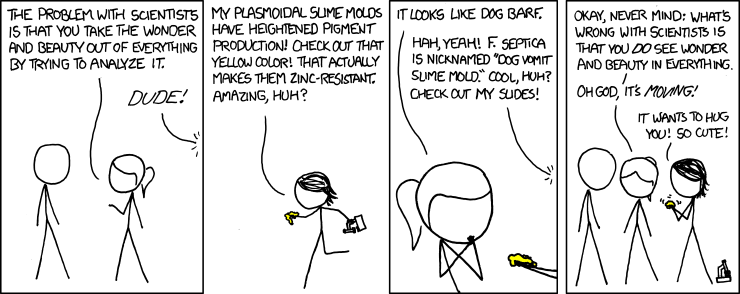
    Maybe xkcd captures the spirit I’m talking about best:

    Beauty

    Just substitute “evidence for the divine” for “wonder and beauty” and that is pretty close to what we’re talking about.

    In this category you could also include any people who are seriously into the various philosophies that fit under the umbrella of “intelligent design.”  I confess that I am not very current on the details of what the philosophical leaders (as opposed to the political leaders) of the ID movement are discussing right now.  It strikes me that the fundamental philosophical prerequisite is twofold:

    • It is possible that a rational being created the laws of the universe, and it cannot be proved otherwise;
    • The benefit of the doubt is given to the proposition “There is a God who created the laws of the universe,” and it is the opponents who must prove their case.

    The latter is arbitrary and, I think, largely a matter of personal non-rational processes.  There is nothing wrong with the yes-to-God proposition, from a purely philosophical standpoint.  But there is really no arguing for or against it in a purely logical way.  Some people (scientists or no) think it better to give the benefit of the doubt to the no-God proposition.   Some refuse to give it to either.   


    2.  The philosophical approach:   Evidence from within the interior experience of the human person.

    Just because a person is a scientist or an engineer or a technician or a computer programmer or an applied mathematician does not mean that she necessarily subscribes to the “scientific evidence is the only important kind of evidence” view.  Pure philosophy, in other words, is accessible to logical thinkers whether or not they possess particular scientific interest or expertise.

    Besides the kind of evidence that can be reproduced experimentally or demonstrated to others, so that those others may directly evaluate them, every human being has access to a certain set of direct observations which cannot be demonstrated or reproduced to others.  To the individual, they are experienced as reality, even though they cannot be transferred. 

    I’m speaking here of observations of one’s own powers of reason and insight, or of the existence of an internal moral code.  

    A fact that is unappreciated in our society:  There is absolutely no way you can derive a moral conclusion, a “what ought to be done,” from purely natural knowledge (“what is”) or from technical expertise (“what could be done”).  Scientific and technical expertise is immensely useful in contributing to the discussion of “what ought to be done,” because knowledge of what is, and knowledge of what could be, is relevant to narrowing down the choices:  that kind of expertise helps us predict the likely consequences of our actions.  That is why it is useful to have specialists in scientific and technical fields on policy committees.   But even if the consequences of our likely actions could be perfectly predicted by the technical experts, and perfectly explained by them to the public at large. we are still left with the question of which consequences ought to be preferred.  And that question belongs to all humans, not just to the ones with technical expertise.  

    I look inside myself and I see a moral code.  Other people tell me that they look inside themselves and see moral codes (they can’t prove it to me, but for the purpose of this argument I will assume they are not lying).  It is in this personal moral code that many people are forced to conclude that they really do believe in free will, in the existence of “right” moral decisions and “wrong” ones, and through a philosophical chain of reasoning conclude that all this must be discarded unless the proposition “God exists” is accepted.  Not wanting to discard the propositions that the will is free and that certain decisions are right and others wrong, they choose to accept the “yes to God” proposition.

    A basic outline of this essentially philosophical basis for the “yes to God” proposition can be found in the opening pages of C. S. Lewis’s popular work Mere Christianity.  (“Look inside” the book and you’ll get the gist of it.  There’s nothing about being “scientifically minded” that would make a person any more or less likely to accept Lewis’s argument, as it’s accessible through propositions and logic, not through technical expertise.  Whether the propositions are accepted or not is, I think, personal.)

    A different interior observation on which to found belief in a Deity could be observation of the self’s powers of reason.  I know that some have argued that rational thinking (which can’t be demonstrated or transferred, only observed within the self) must arise from rational, not irrational processes.  I haven’t explored this line of thinking myself; but I know others who have.


    This category of “interior, personal human experience” could also refer to a person who believes he has received a personal communication or revelation from God.  Ultimately, this too is an interior experience (in the sense that it cannot be shared directly with others).  It can’t be transferred.  And yet the individual who is confident in its authenticity has what can be called direct experience that, depending on its strength, could easily trump all arguments.

    + + +

    3.  Historical evidence.

    I mentioned historical evidence in the first post, because I wanted to point out that it is a common category of evidence which is not scientific.  (Because not reproducible — by definition.)  And yet most people, even scientists, commonly accept propositions which are based on nothing but this kind of evidence.  Historical evidence includes hearsay, accounts from witnesses long dead, scraps of copied and recopied text, minor details in works of fiction, damaged artifacts, and oral histories.   And yet we are still confident in many of our conclusions. We have a list of the names of the Egyptian pharaohs. We teach kids that Leif Ericson led the first European expedition to land in North America.  We know that William Shakespeare of Stratford, England wrote Othello, even though a small group disputes that.  Well:  certain arguments for the existence of God also rest on what are essentially historical claims.  Disputed?  Yes.  So are other widely-accepted historical events, and not always by a small fringe group.  
    Christianity, at least, is a faith which turns entirely on a single historical claim.   Christians claim that just outside Judea, on a Sunday morning around Passover time, during the governorship of Pontius Pilate, this particular guy who had been executed by the Romans the previous Friday, and buried by some Jewish friends of his, rose from the dead of his own accord.  

    It is this claim, and nothing else, that (if true) would lend credence to the rather outlandish ideas that the guy had been spouting in the months leading up to his execution.

    We moderns tend to lose sight of the fact that the Christian claim is fundamentally about a historical event that either did or did not happen.  This is because the Christian claim leads its followers down some startling philosophical paths, and the conclusions necessarily conflict with those arrived at by people starting from different beginning points.  Consequently, many layers of questions and answers have been built up around that claim in defense of the conclusions.  

    So:  A good many modern believers approach the question in the opposite direction — first asking, Do I believe there is a God? and then asking What ought God be like?  and finally Which faith seems to me to have the right claims about God?    If that question leads them to Christianity, then they have to consider whether they believe the Resurrection really happened.  There’s no doubt that the moral and theological teachings of Christianity are appealing to many folks.  Presumably a great many are pleased enough with Christian practice and teachings that, once they burrow to the center of it, they are ready to assent to the historical question too, if only to prevent cognitive dissonance.  

    (Others don’t bother with the Resurrection thing.  It is not hard to find Christians who regard it as largely symbolic.  I assume they find other ways to deal with the cognitive dissonance.)

    </p?

    But the ancients who converted to the new faith necessarily went in the opposite direction.   Did you hear about this guy who hinted that he was God and then when they killed him he rose from the dead? And people saw him walking around and eating at cookouts and showing off his death wounds and explaining stuff to people?  And:  So what else did this guy say about God before they killed him?  And:  So what are they saying he said after that?

    First the historical claim, which must be judged on the same merits as all historical claims.  Then the implications.  And this chain of reasoning, however rarely followed, is accessible to moderns as well.
    Since we are talking about so-called “scientifically-minded” people, it is necessary to stipulate a fundamental philosophical prerequisite for accepting a historical claim that a miraculous event occurred:  The individual must first admit the logical possibility of miracles.  He need not admit the necessity of miracles, or of the supernatural.  He need not admit the truth of any particular miraculous claim, either.  Rather, the prerequisite is the much simpler proposition:

    That such-and-such has never happened  in our experience,
    does not logically imply “Such-and-such cannot happen.”

    I think that proposition is blindingly obvious, and anyone who says otherwise is committing a logical fallacy, but you will find plenty of people who do say otherwise.  Well, everyone is entitled to his own irrational beliefs, I suppose.

    + + +

    But if you take anything at all away from this post, it should be that there is nothing particularly new, or even modern, about the believer who is also a scientist.  Mendel was a friar, remember?  (The monastery’s experimental garden had been producing research results long before he got there.) Copernicus was a priest.  Look, here’s a whole list.  

    And there are many other places to look for an understanding of what thoughtful believers are writing about the reasons for their faith. Here’s a blog with a philosophical approach; the link goes to a sample post about original sin and modern biology.  Here’s a blog about science and the Catholic faith with many posts relevant to this topic.  Of course, if you want a sobering reminder that these questions have been carefully considered for a long time, you could delve into Summa Theologica: Prima Pars.  (And remember that St. Tom turned out to be correct about that whole “yes, the universe has a beginning” thing.)


  • Crosses, crosses everywhere.

    So today is the feast of Our Lady of the Rosary, and it is the one I was aiming for at the end of the Montfortian consecration. Tomorrow's the day I can get to Mass and confession, though, so even though St. Louis says "Make it a feast day," the Saturday after will have to do.

    This week seems not to have gone well on the preparation front. I missed several days of the recommended prayers, and am behind on the readings. As for the readings, I guess I will shrug and make them up next week. As for the prayers, well, a missed opportunity is just that.

    You will remember that (after days 1-12) the first week is meant to increase knowledge of the self, the second to increase knowledge of the Virgin, and the third to "apply themselves in the study of Jesus Christ." I wasn't surprised that I learned a few things about myself during the first week. I knew I had plenty of material to chew on for the second week, what with only recently digging into that whole "co-Redemptrix" thing. But I entered the third week with some curiosity and not a little disbelief – disbelief that I would be able to grow "in knowledge of Jesus Christ" in any significant way over the course of the week. It isn't that I don't have a lot to learn; it's more that, since I have a grasp of the basics (more, apparently, than I did about the Blessed Mother) it wasn't obvious where to start studying, and it seemed presumptuous to think that I would certainly be able to command some insight to enter my mind about it. If there is obviously something new to learn, and you know what it is, you can seek it out, and chances are good that it will give you something new to think about. But it wasn't obvious which aspect of Jesus I had to consider for the week.

    So I just went with the recommended readings, most of them from the Imitation of Christ, and waited for something to strike a chord.

    Only one aspect did strongly. It has to do with the command "Deny thyself, take up thy cross, and follow Jesus."

    The citation is from the Imitation, Book II, Chapter 12: Of the Royal Way of the Holy Cross.

    "Take up, therefore, thy cross and follow Jesus, and thou shalt go into life everlasting.

    He has gone before thee carrying his own cross; and he died for thee upon the cross that thou mayest also bear thy cross and love to die upon the cross.

    Because if thou die with him thou shalt also live with him, and if thou art his companion in suffering thou shalt also partake in his glory."

    I am familiar with this language. But as I have written before (the exact links escape me for now), it troubles me, because, well, I don't get much in the way of crosses around here. I am living a life that is comfortable and happy (although I still find things to complain about, or at least to make snarky Facebook vents about). I have no physical disabilities, nor am I currently bereaved, nor struggling to feed, clothe, and educate my family. I am surrounded by my loved ones and other friendly people most of the time. I cannot imagine a marriage partner better-suited to me than my husband.

    Sometimes when I am laughing with friends, or lazy and content with my husband, or solitary and sensing the first surge of well-being and energy from my morning coffee, I think to myself: Where is this cross I am supposed to be carrying? Is there even a cross here in this moment? Because I can't see it.

    I am afraid that there must be some cross lying around that I have failed to pick up because I have not recognized it, or maybe have refused to consider it. Being a control freak, I think I understand why people used to go in for self-flagellation: it lets you create a cross to bear, on your own schedule.

    + + +

    Sometimes I tell myself that this is the fulfillment of "My yoke is easy and my burden light." I must be bearing my cross, see, because here I am doing pretty much everything I am supposed to do. I got married and devoted myself to raising children, and gave up my career (not that I was exactly headed for greatness) because I could tell it was the right thing for our family, and here I am doing the homeschooling thing and getting to Sunday Mass every week and stuff like that, and it has all turned out to feel pretty good. The reason the cross doesn't feel like a cross must be that I got used to it (because I admit that it didn't look like it was going to be quite so fun at first, and it was definitely difficult to fully commit, back in the beginning).

    Of course, that is the easy way out. My burdens are light, and Jesus says his burdens are light, therefore my burdens must be his burdens? I think I know my logic better than that.

    Still, let's say that you are carrying your cross, whatever it is, and with time it really does get easier to carry, so that after a while it is hardly difficult at all. Does it still count as a cross then?

    + + +

    Here is the Imitation again.

    "Dispose and order all things according as thou wilt and as seems best to thee, and thou wilt still find something to suffer, either willingly or unwillingly; and so thou shalt still find the cross."

    Even if I manage to make everything go the way I plan it?

    "For either thou shalt find pain in the body, or sustain in thy soul tribulation of spirit."

    "Sometimes thou shalt be left by God, other time thou shalt be afflicted by thy neighbor, and what is more, thou shalt often be a trouble to thyself."

    Ouch. That last bit. Yes, I believe that I might be my own cross. I certainly don't have any trouble believing that I am a cross for other people. No wonder it is so hard to see sometimes; got to look in the mirror.

    "Neither canst thou be delivered or eased by any remedy or comfort, but as long as it shall please God thou must bear it."

    "For God would have thee learn to suffer tribulation without comfort, and wholly to submit thyself to Him, and to become more humble by tribulation."

    "…Thou canst not escape it, whithersoever thou runnest; for whithersoever thou goest thou carriest thyself with thee and shalt always find thyself."

    Well, it's kind of sobering when you put it that way.

    This strikes a chord with me because I frequently wish I could ditch myself, or at least get away from the sound of my own voice. That is one of the reasons why I need to escape into solitude for a little while every week or two: I don't have to talk to anyone, and that means I don't have to listen to myself anymore.

    Probably by even writing this it means I am failing to bear the darn thing, shoving it off onto somebody else, you poor sods who only happened to be stopping by. But hey, there is some precedent for that too, so I am hoping it is okay.

    The Imitation makes it sound as if we can't really leave the cross lying around, as I sometimes wonder if I do when there seems to be nothing to suffer. There is always a cross of some kind, and we must bear it. Therefore we are bearing it. The only choice, it seems, is between bearing it willingly or unwillingly.

    How odd to think of willingly bearing myself as a significant portion of my cross.


  • Lepanto.

    Here is a reflection on the feast of Our Lady of the Rosary, reminding us of its roots as Our Lady of Victory.

    …[I]n this feast we have an opportunity to consider with a contemplative mind the Spirit of Lepanto or what Professor Roberto de Mattei calls a “category of the spirit”:

    As heirs of Lepanto, we should recall the message of Christian fortitude which that name, that battle, that victory have handed down to us:  Christian fortitude, which is the disposition to sacrifice the good things of this earth for the sake of higher goods—justice, truth, the glory of the Church, and the future of our civilization.  Lepanto is, in this sense a perennial category of the spirit.

    It seems to me that this category of the spirit is transhistorical.  It is the recapitulation of the protoevangelium:

    I will put enmities between thee and the woman, and thy seed and her seed: she shall crush thy head, and thou shalt lie in wait for her heel.

    It is all right there.  That is why Genesis 3:15 is called the first gospel (protoevangelium).  Everything that comes after is all fulfillment, partially at first by way of types (Judith, Esther and the Ark, for example), and thenin the fullness of time the Woman and Her Seed bring all things to fulfillment, waging war against the Dragon on the top of the world in the greatest eucatastrophe of all time.

    St. John’s vision on Patmos of the Woman gloriously arrayed with the lights of heaven, but militantly in travail, projects into the past, present and future the tribulations of the People of God.  The birth pangs are not of Bethlehem, but of Calvary.

     Go read it.  And if you're not familiar with the historical Battle of Lepanto, you might read up on it.  

    The last bit of highlighting is mine:  The birth pangs are not of Bethlehem, but of Calvary.  That is a new thought to me.  It does seem to make a little more sense that way.


  • Couple’s success story.

    Rachel at grasping for objectivity in my subjective life tells a story of a most effective friendly competition between spouses.

    Six short months ago, two people sat on the couch.

    One, a woman in her late 20s, two kids down the road, feeling antsy about how to get rid of the baby weight.

    The other, a man in his mid-30s, who had been stuck in a continuously yo-yoing range of chubby to walrus since the 2nd grade [his words not hers].

    She asked about Lose It, one of the tools he had used on the downhill side of the waistline roller coaster in 2009. He acknowledged its usefulness and potential for success.

    Inspiration was born.

    A bet was made.

    Fat was in the crosshairs of competition.


    Teaming up with a partner to lose weight may not be for everyone, but it sure seemed to work for these two.   


    (Rachel's blog is great.  If you've never read her two "Mom Jeans" posts, you should:

    two Mom Jeans posts, you should:

    You'll thank me.)


  • Perspectives on temptation.

    I plan to spend my lunchtime recess reading the new Neal Stephenson novel instead of blogging, so instead I'll link to The Mom's great post from today.  I haven't written about gluttony for a while (and am probably due) but I'll leave you with this instead.  

    She writes about the difficulty of food restriction to suppress heartburn:

    My eldest daughter asked me yesterday, "The carbs and sugars hurt you, but you still eat them.  If they were bad for the baby would you give them up?"  Of course, I told her, I love the baby.  "But you don't love yourself?"  I simply sat dumbfounded by her question.  If I were my child I would do a better job of protecting me.

    I try not to sin because I love God and because I love the people my sin would harm.  I don't want to hurt anyone, and so I pray and ask for help with my areas of weakness.  I work and pray on it daily.

    I've never asked anyone in my family to help me deal with the physical side effects of pregnancy.  I choose to carry this burden alone.  Why shouldn't I ask them for help?  They could be the food conscience I have obviously not formed well in myself.  Because these kids can nag like nobody's business.  I just have never wanted to ask the whole family to change the way they eat for me.  I've seen that as somehow selfish, which is ridiculous.

    The food on my table is something which is completely within my control.  I am the master of the pantry, and yet I still fail daily to avoid temptation and the suffering which results from it.  How much more difficult it is to maintain my fear of the fires of Hell.  The truth of it all is that I am a weak human being and am not so great at avoiding temptation.  I couldn't even avoid the bite of doughnut my 2 year old offered me this morning.  Temptation doesn't come in ugly packaging, it comes wrapped in sweetness, covered with sprinkles and delivered with a smile.  The trick, I think, is to know our weaknesses and avoid them at all costs (like not buying the doughnuts to begin with) and to fight our failings not with fear but with love.

    Read the whole thing.