Alice Bradley of Finslippy
lists the 75 things she learned from her mother.
bearing blog

bear – ing n 1 the manner in which one comports oneself; 2 the act, power, or time of bringing forth offspring or fruit; 3 a machine part in which another part turns [a journal ~]; 4 pl comprehension of one’s position, environment, or situation; 5 the act of moving while supporting the weight of something [the ~ of the cross].
-
Someday I hope somebody writes such a list about me.
-
Science “curricula.”
I frequently get questions from other homeschooling parents about how I teach science. I suppose this is not terribly surprising. Most people (including most elementary school teachers) don't have heavy specialization in science and math. I can make the analogical leap: I don't have much education in art or music, and so I am often interested in how truly creative and knowledgeable people train their children in these fields.
(Although sometimes I avoid asking, because I periodically feel guilty about how little art and music we do in our homeschool.)
When it comes to science curricula, I'm afraid that I suffer from Expert Paralysis. That is, I know enough science to hate every elementary school science curriculum I've ever seen. NONE OF THEM ARE ADEQUATE. There. That is my opinion. They all dumb things down. They are all nonrigorous, insufficiently mathematical, and generally artificial in the way they set up so-called "experiments." Probably they dumb things down in entirely appropriate ways. But I can't bear to teach from them. So I don't.
I think of it this way: The academic goal of teaching elementary school science is to ensure that they are prepared for high school science, which can be rigorous and not dumbed-down. And this is what I think kids need in order to be prepared for high school level science education (physics, chemistry, biology):
- Strength and comfort with mathematics.
- Memorization strategies and skills.
- Strategies for acquiring unfamiliar vocabulary.
- Practice in making direct observations and accurately describing them in writing.
- Logical thinking, especially in classification and identification of cause-and-effect.
- A grasp of the scientific method and why it represents an ideal process for learning from observation. (A historical approach can work for this, I believe, even better than an experimental one.)
- Wide-ranging reading and/or documentary film viewing on topics of the natural world and of human technology (again, a historical approach can work for this), to build a broad base of information and vocabulary.
- Deep interest in any one aspect of the natural world, or a few, and the opportunity to have developed it freely.
- An understanding of the value of scientific inquiry among the various fields of human endeavor: its powers and limitations.
None of this requires a science curriculum. None. You can certainly borrow units from textbooks; probably there's something out there that does a great job of teaching the scientific method, for instance. And you could certainly use textbooks to help a child develop his or her deep understanding of a subject that is dear to him or her. And of course most people will choose a math curriculum of some kind. Some will choose a logic curriculum, or will rely on some other subject (say, Latin grammar or proof-based geometry) to develop logical skills.
My kids aren't in high school yet, so I can't say whether my approach is "working" or not. (I'll define "working" as "they succeeded in high-school level chemistry, physics, and biology.") But this is the form my approach has taken:
- Lots of books around on various science-type topics.
- The kids are encouraged to watch nature documentaries and other similar videos — pretty much freely.
- I do pick a topic or two each year — but I have taught it by getting living books out of the library, reading aloud from them, and talking about it. I'm a scheduler by nature, so I tend to plan ahead what books I'll check out and what topics to discuss, but there's no reason why this couldn't be done more spontaneously.
- Science kits are great, but I think that unless you have a fairly methodical kid, then the sort of thorough learning that I consider to be school-worthy won't happen on its own. (It's fine to use science kits as free-exploration toys. I'm just saying that I wouldn't necessarily count that kind of play as "school.") So I use science kits but assign the projects from them in a specific order.
I need to get ready for my co-schooling day, so I have to stop here, but I will make another post with a detailed description of one "electric circuits" unit study I did for a third-grader using the Snap Circuits kit and some other resources.
UPDATE some years later. I’ve now moved to introducing some consumable worktexts in upper elementary and middle school, mostly because I’m finding it useful to have the kids think about and write the answers to questions about their reading.
-
This hypothesis makes some sense to me.
For the amateur sports enthusiasts among us, here's an interesting article at WaPo about the possibility that panic attacks may cause numerous unexplained deaths in the swim portion of triathons.
The rate of deaths isn't large — nine people in one summer, out of 243,000 competitors in a year. But from the sound of the article, non-fatal panic attacks aren't rare in the swim portion of triathlons.
In the swim event, a combination of stresses can lead to a panic attack (or something like it): the excitement of the moment, the chaos of swimming into and over other people, the chest constriction of the wet suit, the darkness and coldness of the water, competitiveness and the desire not to quit when friends and family are watching. On rare occasions this leads to drowning.
Discussion threads on blogs suggest that panic attacks are common even among experienced athletes, although apparently nobody in the triathlon industry has attempted to learn how common they are. Some coaches mention them, but many triathletes train without coaches. Race directors in general don’t name panic attacks as potentially lethal but manageable hazards, though they do warn about wet roads for cyclists and high temperatures for runners.
There are also some quotes from triathletes that support the hypothesis.
Every once in a while, someone who knows I like biking and swimming and tolerate running well will suggest that I try triathlons. I have absolutely no interest in triathlons because while I love swimming in pools, I don't enjoy swimming in open water, and the idea of swimming in a crowd in open water is absolutely repulsive. (I feel a little claustrophobic just sharing a lane with more than one other person.) So the idea that some people might suffer panic attacks doesn't surprise me.
(h/t the Agitator)
-
Into the trenches, er, pews.
Mark doesn't feel well this morning so it's off to Mass for me and the three older kids. (He'll keep the baby home, which will make things considerably easier for me.)
#1 will be serving at Mass, so I won't have to worry about him, of course. Now, if I can just keep #2 and #3 from poking each other… and poking… and poking… and hissing "Stop poking me!…" and poking…
Fortunately, it's Doughnut Day, so I do have a threat in my pocket. Not my favorite way to roll, but if necessary, I can exercise the nuclear option…
-
The cost of shouting.
You know, I had a sort of "McQueary moment" a few years ago, when I was driving. I witnessed what I assume was an episode of extremely dangerous domestic violence.
I, instinctively, yelled out the window of my car.
If I had been thinking instead of reacting instinctively, if I had intellectually known or even reasonably predicted what was going to happen next, maybe I wouldn't have gotten involved. The immediate aftermath was to put myself and my three children (and an unknown number of nearby pedestrians) in serious danger. Thankfully — briefly.
I told the story in a blog post later that day. I can remember my fingers shaking as I typed. I can remember peeping out the window for a few weeks afterward, senselessly afraid that somehow the danger would follow me home.
I can imagine the scenario, post-shout unfolding in a few different ways, none of which was "safe" for me or for my kids.
But I keep thinking now about the instinct to yell. It was immediate and involved no thought. I saw violence — someone endangering someone else.
I shouted.
I had my own young children with me. I had reason to have physical fear for all our own safety.
And I still shouted.
-
” I’d call for all the chemists who’ve ever worked with a hexanitro compound to raise their hands, but that might be assuming too much about the limb-to-chemist ratio.”
Organic chemist Derek Lowe has another edition of "Things I Won't Work With."
This post includes a description of how the organic chemist goes about deciphering compound names, which makes it worth a look if you like language. He also gets in a reference to Verdi opera, incidentally.
I hope he writes a book called "Things I Won't Work With" someday… I would pre-order it NOW.
-
Spanish from Latin – more information.
Hannah's Google-fu proved worthier than mine this week: when she typed search terms into the box looking for useful information to support our current project of building Spanish onto Latin, she found this in-depth article: "Spanish for Speakers of Latin." The author (who is not the site owner) appears to be a hobbyist rather than a professional linguist. Probably for this reason, the article is concise and user-friendly (at least for me, a would-be language nerd).
(Because, really, I'm a would-be everything nerd who has not quite enough time on her hands.)
So the paper begins like this:
This page is intended to introduce an English speaker familiar with Latin and learning Spanish to the correspondences and differences between the two languages and the skills necessary to apply knowledge of Latin in studying Spanish.
- The Historical Background
- Orthography & Pronunciation
- Patterns of Phonetic Transformation
- Grammatical Development
- Essential Derivatives
- Portuguese
I am by no means an expert on the matter. I am not even fluent in Spanish. This is just my own set of observations, which may not be wholly accurate.
Come on — doesn't that just make you want to keep going? It does me!
Here's a bite from each section:
Historical background:
[lots of stuff preceding it]
This is how Spanish has come to establish itself today. By a series of lucky coincidences, it has become more and more like English. First, note that the Goths, Franks, Saxons, and Vikings all spoke related Germanic languages. When these various tribes began to learn Latin, they naturally preferred ways of saying things that were closest to what they already knew. When the English were conquered by the Normans (Vikings from Normandy who spoke Old French), they subsequently replaced over nine tenths of their language with Norman French, and later imported a slew of words directly from Latin. Thus both Spanish and English derive from a base of Germanic language speakers learning dialects of vulgar Latin from adjacent regions. The upshot is that the feel of Spanish, including the structure, the vocabulary, and the very way of looking at things, is very much like English, much more so than Latin is, and far more so than, say, Sanskrit. But because Spanish is directly derived from Latin, whereas English has had Latin grafted on somewhat gradually and haphazardly, a knowledge of the original Latin still contributes a great deal more to understanding Spanish and is very helpful for dealing with both languages.
Orthography and Pronunciation has subsections on accents, vowels, and consonants. Here is a bit from the vowel section:
The vowels of Spanish are the same as in Latin, except that all distinction of quantity is lost, and y is treated as identical to i. They are pronounced like the Latin long vowels but are generally held for only a very short time. This feature of the language allows Spanish speakers to comfortably speak at nearly twice the rate of English. English speakers should particularly be aware that there is no y sound at the end of the vowels e and i, nor a w sound at the end of o and u.
e.g.: lego as Latin lego (not as leygow)
Diphthongs are basically as in Latin, but ae and oe are written ai and oi, with the former no longer forming a diphthong.
e.g. traer as tra-ér, two syllables
e.g. traigo, as trai-go, two syllables
The letter u, when following g or q and preceding e or i, is silent, unless it has a dieresis (¨). This is the only silent vowel in Spanish. Otherwise u follows the same rules that apply in Latin, as for becoming a w sound. Note that instead of writing qü, Spanish simply changes to cu. Therefore remember that unlike Latin, qu always equals k.
The Patterns of Phonetic Transformation section includes vowel shifts, consonant shifts, initial letters, final letters. For example:
A word beginning with a voiceless consonant followed by l, i.e., cl, fl, or pl, would usually change to begin with ll (likewise in Portuguese to ch and in Italian to chi, fi, and pi). This seems to be the origin of nearly all Spanish words beginning with ll. But in Latin, these combinations did not exist within a word, except in compounds; ll there usually derives from palatized ll within a Latin word.
e.g.: clamare → llamar
e.g.: flamma → llama
e.g.: planum → llano
e.g.: illa → ella
Grammatical Development covers a number of topics. I thought the development of the Spanish adverb ending –mente was particularly cool, especially since it parallels the development of the English adverb ending –wise.
Vulgar Latin developed a new, simple way to form adverbs from adjectives. It was to use the adjective (in the ablative feminine singular, of course) to modify mente, in the ablative, to form the phrase with — mind, or rather with — manner. This is paralelled in English with the suffix -wise, as in likewise, clockwise. In Spanish, the -mente forms a suffix on the adjective.
e.g.: timida mente → tímidamente, fearfully (originally, with fearful mind)
e.g.: frecuenti mente → frecuentemente, frequently
Essential Derivatives tells you, among other things, how to spot a non-Latin word:
First it should be pointed out that about a fifth of all Spanish words were not derived from Latin. Most of these came from Gothic and Arabic (see the history above), though of course many others are from Basque (a peculiar little non-Indo-European language that somehow survived in a little pocket of the Pyrenees), French, English, etc.
The fortunate thing about Gothic words is that they tend to have old or everyday English cognates.
e.g.: norte = north
e.g.: guerra = war
And Arabic words tend to bear the distinctive al- prefix (Arabic for the), sometimes assimilated.
e.g.: al-manākh → almanaque
e.g.: al-roz → arroz
…and provides an extremely useful list of corresponding particles:
ille → el
ad → a
altero → otro
ad horam → ahora
illa → (el)la
de → de
nos alteros → nosotros
deunde → donde
illos → (el)los
in → en
vostra mercede → usted
inter → entre
uno → un(o)
cum → con
multo → mucho
magis → más
una → una
sine → sin
pauco → poco
minus → menos
sic → sí
per → por
tanto → tanto
tam → tan
ad sic → así
pro → para
bene → bien
tam bene → también
non → no
super → sobre
illic → allí
tam paucum → tampoco
si → si
quem → quien
jam → ya
toto → todo
et → e → y
aliquem → alguién
heri → ayer
tota via → todavía
aut → ot → o
quid → que
hodie → hoy
post → (des)pues
nec → ni
quando → cuando
semper → siempre
vice → vez
quam → que
quanto → cuanto
numquam → nuncuan → nunca
facit → hace
qui → que
qualis → cual
quomodo → quomo → como
And finally a word of encouragement:
Once Spanish and Latin are learnt, it is no great feat to pick up at least a reading knowledge of Portuguese…
After reading through all that, I think I believe him!
This article pretty much gives me all I needed to make my "learn a little Spanish based on your Latin" project into a full-on introduction to practical linguistics. What isn't included here, can be tracked down based on what is included here. I'm feeling more and more optimistic about this actually working.
-
Choosing peace, or something like peace, anyway.
ChristyP sent me a link at just the right time for me yesterday. The post, from a blog I'd not seen before (Steady Mom: On the Journey toward Intentional, Professional Motherhood) is short enough that I'm just going to repost it. Here you go (permalink here):
A few days ago I sat down in the morning, per my usual routine, to make my daily to-do list. As often happens, there were more items to do that day than there was time for the doing.
Anxiety and overwhelm began to threaten me, though I tried to ignore their taunts.
Still the nagging thought kept creeping back, "How exactly am I going to get all this done?"
Suddenly God whispered to my heart. What He said surprised me, changed my outlook, and altered the entire direction of my day–of all my days. He said,
"Choose peace over productivity."
Peace is the goal of our days.
Peace is THE goal of our days.
At the top of your to-do list, write it – Peace.
If anything tries to threaten your goal, it gets crossed off immediately. Don't worship at the altar of busyness and allow the very heartbeat of your family to suffer.
Let me spell it out as a reminder for us all:
Laundry isn't more important than peace.
Cleaning isn't more important than peace.
Homeschooling isn't more important than peace.
The family budget isn't more important than peace.
We're better off getting only one thing done in an atmosphere of peace than crossing off multiple tasks weighing fretfully on our shoulders. I know, because just this morning I forgot the lesson already, and paid the price by handing over the mood of our home. It wasn't worth it.
What will our children remember when they leave our homes–how busy Mom was or how joyful she made them feel?
Choose peace over productivity.
Yes, this is nothing new. Yes, this is absolutely a message I've heard before in one form or another and attempted to assimilate. Something about the way it's put, though, makes me want to tape it to my bathroom mirror. Well, I'll do the next best thing and stick the blog in my RSS reader for a probationary period to see if she says anything else I like!
She has a followup post, on What Choosing Peace Does NOT Mean:
Here's what choosing peace does NOT mean:
– staying in your pajamas all day
– reading blogs when you should be playing with your kids
– feeding your children chicken nuggets every night
– spreading piles of laundry around the house
– leaving dishes to pile up in the sink all day
– ignoring your children because you just can't take the bickering anymore
[cough, erm, yeah]
– letting mess accumulate while you chant "I'm peaceful, I'm peaceful."
…
Choosing peace does mean:
– That people are more important than tasks
– That you have adequate expectations of yourself, depending on what season of life you're in
– That you try to stop what you're doing to look your children in the eye when they interrupt you…
We will not find peace at the end of our to-do list. That effort has a name: striving. It promises peace, but in the effort required it steals the very promise away.
This is one of those things that I, personally, need to be reminded of again and again and again.
Once for a friend's wedding shower I gave her a little hanging tile, made up of mosaic bits that spelled out, "Peace begins at home." I was thinking mainly of raising children "peacefully" at the time — I think my oldest couldn't have been more than two — I was still developing my style of discipline (aw heck, aren't I still?) and I'm sure that's what I was thinking about, about raising kids nonviolently in an atmosphere of love so that they wouldn't grow up to perpetuate senseless violence. I wasn't at all thinking about serenity in the home in the moment. Only about somehow engendering "peace" there and sending it out into the world to do its work.
Even at the time, I'm not sure that "peace" is the word I would have used, precisely, to mean what I sought then and what I still wish I had. (I thought it was a good choice of word for what my friend would want, though.) It is too worn from overuse, especially in world affairs; connotes too much the relationships between and among large groups of people, and not quite enough the relationships between individuals. Connotes for me, too much, the state of avoiding conflict rather than the state of dealing productively with conflict or even the state of living blissfully without conflict.
"Peace" isn't, I think, the name of the thing that is the goal of my days. However, either Steady Mom and I are both longing for the same thing, to which we choose to give different names, or else her reminders are bound to produce both peace and the thing that I want.
I'm still not sure what word would be better. Maybe I am just looking for "love" in its active sense.
Anyway, I'm going to mark this blog and read more.
UPDATE: Melanie responds with a very insightful post. Go read!
-
Handwritten thanksgiving.
I approach my prayer life rather in the same way I approach housecleaning. Which is to say:
Clearly, I like to think about ways of doing it, systems, etc. much more than I like to do it. So a lot of times, when I decide "It's time to clean house!" what I really do is sit down and make a list of what needs to be done and a schedule by which I should do it, and before long the time is up and I have to do something different.
Also, my living space looks pretty tidy enough most of the time, except dead in the middle of the school day or when we're having a party. It's 7 am and the kids aren't up yet, so my evening routine still hasn't been disturbed. The floor is more or less clear of clutter, the kitchen counters are mostly empty except for a tray of chocolate-filled breakfast buns and a coffeemaker, the children's books aren't all in the shelves but they are at least in a neat pile on the floor by the couch. I'm pretty sure there isn't a bunch of junk on the bathroom counters, and the schoolroom is fairly orderly.
But if you looked closely at the kitchen counters you'd find some sticky stuff and crumbs, if you looked closely at the floor you'd find more sticky stuff, if you looked around the couch you'd find it had been a long time since the last vacuuming, and please don't open any cabinets or closet doors, nor look too closely at the rim of my toilet.
Somewhere in one of those drawers there's an old schedule reminding me that I was going to swipe the toilet with a brush every Wednesday morning. Or maybe it was "make a kid swipe the toilet." I don't remember. It felt good to write it down. Much better than actually doing it.
So. My prayer life is like that too.
+ + +
A humorous analogy suddenly comes to me: The Liturgy of the Hours is like Flylady for slobby prayer.
Do with that what you will.
+ + +
Oh, and one more thing: I like blogging about cleaning more than I like cleaning. And I like blogging about praying more than praying. And apparently, blogging about cleaning and blogging about praying makes me feel a sense of satisfaction similar to what I imagine I might feel had I actually cleaned, or prayed. Remember that next time you get impressed at my organizational skills. They are really just a finely tuned means of procrastination.
+ + +
But I never will be cured, I think, of the attempt to fix my sloth/acedia through better planning. Since I did the Marian consecration last month, I have been trying a number of new things. Or maybe it's more accurate to say that I have been trying to look at the old things through a new lens.
I hit upon this idea to make myself a handwritten prayer-book.
Last year, when I read through Introduction to the Devout Life (lots of posts on that here), I wound up carrying a well-dog-eared copy around everywhere and using it as a prayer manual for a while. The many sections are not organized as a prayer book, but they give a method of morning prayer, a method of evening prayer, recommendations for confession, recommendations for preparing to attend Mass, etc., and I found it useful to refer back to the book often. Note that the book didn't actually provide "prayers" as much as it did a "method of prayer." But I like to have "prayers," so eventually, I sat down with de Sales's method of morning prayer and I wrote out a formula that followed the method but was in my own words. Well, some of St. Francis deS.'s words and some of my own. I kept that sheet of paper next to my bed, which freed me up to keep the book in my handbag.
I used that morning prayer for quite a long time. I still use a memorized short excerpt from it many days. ("Behold, O Lord, my poor heart which has conceived many good desires yet is too weak and wretched to put them into practice unless you grant Your heavenly grace. This I beg, O Merciful God, through the passion and resurrection of Your Son, in whose honor I consecrate this and all my days.")
St. Louis de Montfort's book True Devotion to Mary contains a method called "This Devotion at Holy Communion" which suggests some ways to pray before, during, and after Communion. I tried to follow along in the book a couple of times while I was in Mass but found it too cumbersome. Because it doesn't exactly contain prayers but more an instruction on how to pray, and it's wordier than it has to be. So finally I sat down and wrote out some pithy prayers that, if I prayed them, would be in accord with de Montfort's method. (It was a little better, but I still need to tweak it. The Mass follows a different rhythm now than it did in the saint's time, and it's harder to slip long personal prayer into it. The intent of the vernacular Mass is, after all, for us to pray along with the Mass.)
I looked around at Mass and of course I always see many people thumbing well-worn prayer books and Magnificat issues and breviaries and things during the wait to go up for Communion or after communion or just before or just after Mass. (I wonder how long before people will dare to use their Kindles and iPhones to access prayerbook apps in Mass? I've seen people do it in the adoration chapel.) But I know from experience that I get distracted by a thick book of prayers. What I need is a book of just exactly the prayers I am working on using. A morning prayer, an evening prayer, a short method of meditation before the Blessed Sacrament, a thanksgiving after Mass.
So I got me a little Moleskine, the cheaper, thinner, brown-paper-covered kind, and began writing prayers down in it.
I like it. There are dozens of "morning prayers" to choose from; I can put in just the one or two I really am likely to use, plus I can write out my "own" one that I developed from St. Francis's method. I can copy out prayers in Latin that I would like to learn. (Working on the Anima Christi right now.) I can write out an examination of conscience that leaves out the sins I am not likely ever to commit, and thus saves time.
I think once I have it filled up I will want to do another draft. Already I have crossed out and rewritten a few sections that turned out not to sound right, that I kept wanting to say differently. But in the meantime I am finding it fruitful to have my own words, or at least words chosen by me, at my fingertips.
Let me give you one example. So, one thing I've never been in the habit of doing is kneeling to make a prayer of thanksgiving after Mass. (I was never catechized to do it, and although there are always some people that I see praying after Mass in the pews, of course most people are up and socializing, even at my solidly orthodox parish.) I went looking for something, and OH MY they are loooong. There is no way I could realistically do any of that with the four kids all wanting to get downstairs before the best doughnuts are gone. So just as a practical matter I needed a short one.
For the time being I used the "Hail Holy Queen" as a placeholder while I tried excerpting some of the longer ones, and I tried composing my own. But what kept popping into my head was a musical antiphon from one of the psalms: "How can I make a return to the Lord for what he has done to me?" I didn't know which psalm, so I googled it, and found that it comes from Psalm 116.
The whole psalm isn't really what I was looking for, but the second half is. So I used just a few verses from that Psalm as my Thanksgiving After Mass:
How can I repay the LORD for all the great good done for me?
I will raise the cup of salvation and call on the name of the LORD.
I will pay my vows to the LORD in the presence of all his people.
Dear in the eyes of the LORD is the death of his devoted.
LORD, I am your servant, your servant, the child of your maidservant; you have loosed my bonds.
I will offer a sacrifice of praise and call on the name of the LORD.
I figure it works as well as anything else. Having looked for a prayer with a Marian flavor, I liked the "child of your maidservant" bit.
Anyway, I have a number of more prayers to add to the little book before it has everything I need on a daily basis, but it does seem like a good start, and I'm already using it regularly. I'm totally going to recopy it more neatly, though, when I've got it all together. Because that will be something I can do one of these days to put off actually praying. Naturally.
-
Santa Francesca Romana… the saint of traffic?
My eight-year-old was maybe thinking about how he’s going to be picked up to go to a slumber party this afternoon, just before rush hour, and so he asked me: “Who is the patron saint of traffic?”
I was (and am) sitting at the computer, having my coffee, so I googled it. Didn’t find the patron saint of traffic, but I did find the patron saint of automobiles and driving, Saint Frances of Rome.
Turns out she is pretty interesting and cool, and would be a fine saint to recommend to your daughters.
Saint Frances of Rome, Obl.S.B., (Italian: Santa Francesca Romana) (1384 – March 9, 1440) is an Italian saint who was a wife, mother, mystic, organizer of charitable services and a Benedictine oblate who founded a religious community of vowed oblates.
I’m a sucker for any saint who was a wife and mother. It’s not that virgin martyrs aren’t cool, too, but at this point I have some difficulty relating to them. Also the wives and mothers stand out because there seem to be so few of them among the famous saints.
Frances was born in 1384 in Rome to a wealthy and aristocratic couple…When she was eleven years old, she wanted to be a nun, but, at about the age of twelve, her parents forced her to marry …Although the marriage had been arranged, it was a happy one, lasting for forty years, partly because Lorenzo admired his wife, and partly because he was frequently away at war.
I’m also a sucker for arranged marriages that turn out to be happy. Unlike the virgin martyrs, I can relate to that. All true marriages are arranged marriages, because our younger selves set them up for the older men and women we will become.
Frances experienced many sorrows in the course of her marriage with Lorenzo. They lost two children to the plague. In their case, it sensitized them to the needs of the poor….During the wars between the pope in Rome and various anti-popes in the Great Schism of the Catholic Church, Lorenzo served the former. However, in his absence during a period of forced exile, much of his own property and possessions were destroyed.
Political intrigue and infighting within the Church: you think it’s bad now, how do you think it was in the early 1400s?
Here’s a miracle story with some provoking subtexts. (Wondering about the term “superstitious” used here? It’s from Wikipedia.)
According to one legend, their son, Battista, was to be delivered as a hostage to the commander of the Neapolitan troops. Obeying this order on the command of her spiritual director, Frances brought the boy to the Campidoglio. On the way, she stopped in the Church of the Aracoeli located there and entrusted the life of her son to the Blessed Mother. When they arrived at the appointed site, the soldiers went to put her son on a horse to transport him off to captivity. The horse, however, refused to move, despite heavy whipping. The superstitious soldiers saw the hand of God in this and returned the boy to his mother.
There’s more of those back at the article. Moving on,
Although a mystic, Frances was not oblivious to the civil chaos which ruled the city …With her sister, Vannozza, as a companion, Frances prayed, visited the poor and took care of the sick, inspiring other wealthy women of the city to do the same. She turned part of the family’s country estate into a hospital.
On 15 August 1425, the feast of the Assumption of Mary, she founded the Olivetan Oblates of Mary, a confraternity of pious women, attached to the Church of Santa Maria Nova in Rome, but neither cloistered nor bound by formal vows, so they could follow her pattern of combining a life of prayer with answering the needs of their society.Okay, now there’s something I’m really a sucker for: finding some way to blend life in the world with the devout life. Sounds like she and St. Francis de Sales would really have gotten along well.
Eventually the group of oblates got more organized and even obtained a monastery-like community house that is still active. Here’s a picture from the outside:
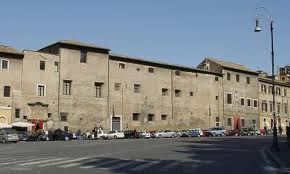 (source)
Such community life, complete with white veils and black habits, seems kind of unusual for people calling themselves Oblates:
In March 1433, she founded a monastery at Tor de’ Specchi, near the Campidoglio, in order to allow for a common life by those members of the confraternity who felt so called. This monastery remains the only house of the Institute.
On 4 July of that same year, they received the approval of Pope Eugene IV as a religious congregation of oblates with private vows, under the authority of the Olivetan monks who serve at Santa Maria Nova. The community thus became known as the Oblates of Saint Frances of Rome. When her husband died in 1436, she moved into the monastery and became the group’s President. She died in 1440 and was buried in that church.
According to this site run by Benedictine Oblates attached to St. Scholastica up in Duluth, “Some consider St. Francis of Rome to be a patron saint of all Benedictine Oblates.” Her feast day is March 9.
This site has some photographs of the frescoes in Rome’s Tor de’Specchi depicting Santa Francesca’s life. Here is one that shows the saint pouring out grain for the poor. The writer of the site points out the lovely detail of the last of the grains spilling out, white “against her dark habit.”
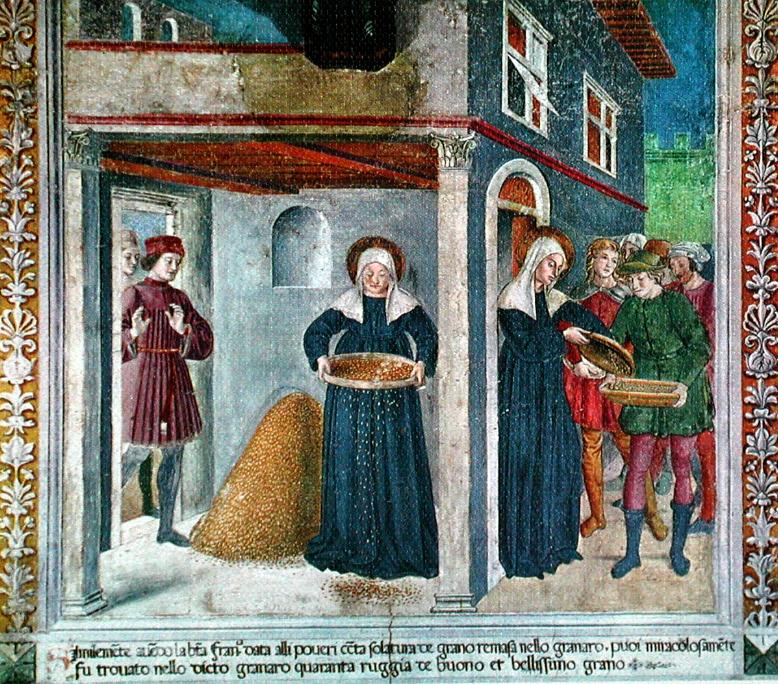
From that site:
Santa Francesca Romana’s Tor de’ Specchi is very strictly cloistered, only opened to the public on two days of the year. ‘We are not a museum’, they sternly and rightly said. But their work of charity continues, their cloister filled not only with themselves but the elderly poor and poor young students with whom they share their wealth. As Oblates they ask for no privileges from the Church, they pay all taxes, and hence are loved down the centuries, theirs the only convent not subject to attack by angry mobs. They continue Benedict’s Rule of work, study, and above all, prayer. Their faces today have the same contemplative beauty that is seen in these frescoes.
She was canonized in 1608 even though nobody knew where her body was buried because it had been hidden to protect it. A search ensued, and her body was eventually found — I would like to know more about that particular mystery! — and reburied later. Since 1869, when she was exhumed again, her body has been displayed in a glass coffin in the Church of Santa Francesca (was: Santa Maria Nova).
So after all that, why is she the patron saint of automobiles and driving, and presumably of traffic? What could have led to this situation, in which every March 9, Rome gets a little more congested as cars drive past the Church of Santa Francesca to get a special blessing? Wikipedia sez:
In 1925 Pope Pius XI declared her the patron saint of automobile drivers because of a legend that an angel used to light the road before her with a lantern when she traveled, keeping her safe from hazards.
Because the Pope said so, capisce? Nevertheless, I bet you won’t forget Santa Francesca the next time you are stuck in traffic, fuming about the chaos in the city, the car in front of you no faster than a stubborn horse. And remember: however bad the traffic is here, it’s probably worse in Rome.
-
Staying crunchy in oil.
The busier I get, the more my standards erode. Or maybe I just get better at seeing clearly what is important. Or maybe sometimes I actually start to make more sense.
In a post from a couple of months ago, called "Staying crunchy," I wrote,
I was reflecting with Hannah the other day on how, as your family grows (and you as parents learn and grow with it), perspective and experience gradually clarifies your approach to how you live out your values. Some ways of living, you get even more and more confident and sure you need to do as time goes on. Some preferences, though, turn out to be more situationally dependent than you realize, and when you find yourself in a different situation, you may make different choices than you imagined you would. Other times, a tension appears between two values and you must choose between them or somehow make the best balance you can.
And then, of course, occasionally you turn out to have been simply wrong-headed about something.
At age 25, I was a fairly crunchy, "continuum-concept"-minded mother-to-be. Four children and twelve years later, which of my crunchy practices have I stayed committed to? Which have yielded to a less-crunchy (or perhaps differently-crunchy) lifestyle?
The post got a fair number of page views and inspired a couple of responses, notably from Jamie (I am sure there was another one out there, but can't remember it — lmk if you did one).
This morning I was thinking less about parenting practices and more about cooking and baking. I love food and I love trying new recipes, but have had to cut back on my adventuresomeness these days.
An aside — If you want to feel really fulfilled and useful and thoroughly enjoy the vocation of homemaker, it does help to enjoy cooking, to love food, to be interested in good nutrition, and to get excited about trying new things. Most days I'm happy to reach the end of the day and to get a chance to spend time in my kitchen, chopping and stirring and tasting. But sometimes it can be a double-edged sword, because kids usually go through a long period where they just don't appreciate all of that, and you realize that you have to find a way to keep it all interesting to you even as you make the same (nutritious, tasty) things over and over again because that is what will make your family thrive happily.
So anyway. Standards. For a very long time now, I have been extraordinarily firm about cooking oil. I am not, you know, a low-saturated-fat person. You might say that I drank the coconut-oil kool-aid. For years now I have had the following oils in my kitchen and pantry:
- virgin raw coconut oil (I buy it by the five gallon bucket from here but OMG I swear it didn't cost $250 the last time I bought some AAACK! need to start saving now because my bucket is almost empty!)
- extra-virgin olive oil (I buy whatever's on sale, usually $19 for a 3-L can of Greek or Spanish stuff, from here when I am in Ohio. Check out the website, you'll want to go to Fairfield, OH just for a trip)
- butter
- lard
- occasionally, home-rendered duck fat. That reminds me, now that the holiday season is upon us I need to tell Mark to watch for ducks on sale.
No shortening (except a partial can that I think my mother-in-law might have bought to make cookies while she was here), no peanut or soybean or canola oil, definitely no margarine.
But then last week I was craving Christy's gingerbread, and I decided to make it for afternoon snack for the day that the kids are all here for co-schooling — it's a pretty easy recipe. Normally I melt coconut oil for the recipe, but for some reason that just sounded like too much trouble for a co-schooling day, so I told Mark to buy me some canola oil or something at the store.
The gingerbread was lovely, and the oil method is easy. There is no doubt about that.
So for today, having half a bottle of oil left, I decided to try cake. Now, you need to know that while I am happy to make muffins and to use my bread machine to make all manner of rolls and bread, I do not generally make cake except for a birthday. Many good cakes require a stand mixer (or a strong arm) because you have to cream butter and sugar together.
But my experience with the gingerbread had emboldened me. I googled "yellow cake vegetable oil" and found a one-bowl recipe, which I made (with 100% whole wheat) very quickly this morning — I made the whole cake from start to finish while my rolls were rising. (We haven't eaten it yet, but since I topped it with chocolate ganache I'm not too worried that it will be unpopular).
Wow. It's not that it's really all that much harder to make a cake with butter — but it does usually mean getting out the stand mixer, which I don't keep on my counter, and having to wash an extra bowl or two. Apparently this slight change makes, for me, the difference between "Cake, who has time for that?" and "Sure, why not bake a cake?"
So I found myself contemplating… gasp… keeping highly refined liquid vegetable oil on hand in my kitchen.
And I started to feel guilty.
And then I remembered that, if I do use the veg-oil method to make more cakes, I will mostly be making them for afternoon snacks.
Which are currently dominated by packaged cookies.
So. Maybe it isn't so bad. I think I will store the oil way back in the pantry, next to that old half can of my MIL's butter flavor Crisco, however. So it does not forget its proper place.
-
Spanish from Latin, update.
So I decided to move forward with my idea and experiment with building on Latin to learn about Spanish. Or perhaps you could say I am trying to explore Latin by looking at how it appears in the Spanish language. We're not really sure which it will be.
The first thing we have to talk about is basic pronunciation. We have to know, at least in theory, what the Spanish words should sound like, or else we will reinforce the wrong pronunciation even when we talk about them.
By "what they should sound like" I mean at the most basic level. Accent on the correct syllable; a recognizably appropriate consonant sound (e.g., pronouncing the letter "z" as /s/ and not as /z/); vowels approximately right. I'm not talking about accent, just avoiding mispronunciation.
So I made a little chart of Latin words and Spanish words that are their cognates and that demonstrate the differences and some of the similarities between ecclesiastical Latin and Spanish pronunciation rules. For example:
- In Latin gens (tribe), the g is pronounced like English /j/. In Spanish la gente (race, nation), it's pronounced with a throaty /h/.
- In Latin hora (hour), the h is pronounced as in English. In Spanish la hora, it's silent.
- In Latin signum (sign), the gn is pronounced as in English "lasagna." In Spanish el signo, the g sound and n sound are distinct.
- Vowels are similar: A: pater/el padre (father), E: cena/la cena (dinner), I: vita/vida (life), O: oculus/el ojo (eye), U: mundus/el mundo (world) and aqua/agua (water).
So I figured I would work my way down the chart with the kids. The emphasis is on similarities and differences between ecclesiastical Latin and Spanish. I thought maybe Hannah, who knows more about linguistics than I, could talk to the kids a little bit about consonant shift and things — why filius became el hijo, why pax became la paz.
But I am taking seriously the need to hear a native Spanish speaker pronounce the words, so I went looking for an online audio dictionary. I think I will be pleased with this one: SpanishDict.com . It has audio pronunciations for most every word I tried, and short video examples for quite a lot of words. The interface should be easy for the tween/teens to manage.
One useful tip: For most nouns, you can get it to give you audio with the definite article if you type in the English and ask it to translate (e.g. if you type in "rey" it will just give you an audio file that pronounces "rey," but if you type in "king" it will give you an audio file that pronounces "el rey."
I think we'll start with just a few words at a time — maybe some with "b" and "v" in them, just so that we attack a tricky phoneme right away. My plan is to recite the list of cognates in Latin first, and then listen to the recordings for each equivalent (or closely related) Spanish word, and then recite the Spanish words. So we'll start like this for b's and v's:
bonus, ambulare, laborare, vox, convocare, novem;
(listen) bueno, (listen) ambulante, (listen) laborar, (listen) la voz, (listen) convocar, (listen) nuevo.
(Yes, I know that ambulare is a verb meaning "to walk" and ambulante is an adjective meaning "mobile, traveling." Ambulare was the only word having an "m-b" combination in the kids' Latin lexicon and ambulante is the closest Spanish cognate.)
I'm going to incorporate these lists into our twice-weekly Latin oral drill sessions to begin.
Recent Comments
Recent Posts
- “I may not be Catholic anymore, but I still got a guy I consider my guy.”
- Lifelong conversion.
- The conversation.
- “Unprofitable servant”… of God.
- Mardi Gras recipe hack: Bread Machine king cake.
Categories
…more to come later
 bearing blog