bearing blog


bear – ing n 1  the manner in which one comports oneself;  2  the act, power, or time of bringing forth offspring or fruit; 3 a machine part in which another part turns [a journal ~];  pl comprehension of one’s position, environment, or situation;   5  the act of moving while supporting the weight of something [the ~ of the cross].


  • Offering up joy.

    (note: links and formatting will be updated later)

    Blogger Betty Duffy and I have been lazily exchanging posts in a sort of open conversation about our Marian consecrations, which we each completed independently in the fall. I have been chewing on this post of hers for a few weeks, namely, the notion of "offering up" little joys, pleasant experiences. Catholics are accustomed to the idea of offering up our sorrows and sufferings and sacrifices; it makes sense to us, because we understand that suffering has meaning and worth, and therefore God can use ours somehow. In the Marian consecration, the benefits derived from any such sacrifices and sufferings belong to Mary to distribute; but both B.D. and I discovered early on that along with consecration came a surprising inclination to offer joys as well. Here is Betty:

    My friend Irene consecrated on the same day I did, and she was laughing about how one night, she was having a glass of wine and a bath before bed, and it occurred to her to offer it, "All for!" She felt weird about it at first, but why not offer up our rest, our comfort, our blessings as well as our suffering?

    I think one source of the anxiety I've felt in the past is some sense of shame about the goodness of my life. Am I undeserving of Heaven because my life hasn't led me to any significant suffering? The pleasures of having a good marriage, good kids, good friends, reading good books, eating good foods, seem to offer little in the way of salvific value. So rather than offering up those good things, I would discount them completely, choosing to focus my emotional and spiritual energy on the minute discomforts of a relatively privileged life. If nailing oneself to the Cross is the only way to Salvation–I had no idea what to do with my blessings–blessings that God, in his goodness, made it impossible for me to escape.

    Offering ALL of it, the good and the bad, has redeemed the mostly good things that constitute my life. And without seeking suffering, looking for it, wallowing in it, I'm free to administer to those who really do suffer.

    I should add that at this season in my life, there are far more happy moments, far more joys large and small, than sad moments and suffering. I feel a need to offer these up, if only because there is so much more to offer from that reservoir. I would have to look pretty hard to find a suffering to off that is larger than getting cut off in traffic, or maybe having a migraine. If I look for joys to offer, well, there is one every moment. And all the moments are there for the offering. So it makes sense to say, "All for you — Totus tuus!"

    But I still wonder — what does it mean to offer up joy? Possibly the problem is that I am not actually very clear on how to offer up suffering either.

    I asked myself the other day in the pool — I was enjoying the swim, and thought to offer it, and in the same moment thought, "But what does that mean to offer this enjoyment?" and one answer came back immediately: it means to receive it with true gratitude, understanding that this joy is a gift. To be pleased with the pleasure and to refrain from being pleased with myself; to acknowledge that even the powers I have to obtain and to choose and to accept such good things are powers gifted to me.

    I asked myself again when I was on the treadmill this afternoon (yes, there is a pattern there, it hasn't escaped me) and another answer came back immediately: the obvious example to look to, the perfect example of offering up a joy, is the mystery of the Presentation. Because after all, Mary and Joseph did not offer the baby boy in sacrifice, Isaac-style, nor leave the weaned child behind in the temple like Samuel; they got to take him home at the end of the day. The Presentation was an acknowledgment that the child belonged to God.

    Remember that when Mary and Joseph brought Jesus to the temple, they did not expect it, but they ran into two different people who prophesied concerning their gift. The news was not devoid of foreboding.

    And so I think there is an implied willingness to relinquish the gift in such offering. If you offer something to God, there is always a risk that you will be forced to admit that the pleasure isn't rightfully yours. If I take a moment to thank God for this pleasurable cup of cappuccino, I risk that it may become obvious that I ought to finish it up and go home and help my husband with the housework instead of finishing up a blog post here in this quiet caf?.

    Finally, another part of offering up a joy is a resolution to use the joy, somehow, according to God's wishes rather than our own. If I am rested and refreshed after (say) a good hot shower, maybe I need to take that happiness and energy back and use it for others, rather than keep it selfishly to myself. We all know that various pleasures are good for the soul, but the degree of good largely depends on what we do with the joy and its aftereffects.

    Can these insights suggest others that can help us understand more deeply how to offer up sufferings and sacrifices? What they all have in common is that to get in the habit is to remain ready to offer each moment as it arrives, whatever it may bring.


  • Religion, politics, and money.

    Loved this quote from Riparians at the Gate's seven quick takes this morning:

    Any suggestions for good conversation starters?  Mixed company, so religion, politics and money talk are right out.  Also, education (mostly), childrearing (mostly), childbearing (mostly), because those are basically religion, politics, and money, Parenting Edition

    That's all.  I just liked the turn of phrase.

    (This is why polite, socially savvy SAHMs have so much more trouble than I do answering the "So what do you do?" question.)


  • Agency and personhood, more.

    I wrote in my post about babies and young children that before I lived with and loved babies of my own, I didn't really see them as full persons — couldn't have, because I couldn't imagine that they had agency of their own.  But of course, they do; their world may be limited, there are tools yet to be acquired — but they can use the tools they have to shape their environment as much as they can according to their needs to respond to it.  

    (Even if that means building a toy double boiler to meet their need to imitate, all part of the drive to attach to a parent or other loving figure, itself a survival skill.)

    I tossed off a little note at the end of that post about other "others" —

    It's as if we are programmed to generalize about people, and not really to know in our depths the personhood — the agency, the will, the decisionmaking capability — of "that kind of people" when "that kind of people" is one we don't have direct experience with.

     I'm sure this goes beyond young children, to every other kind of "other" there can be.  Being surprised by people —  in the unpleasant sense, instead of the sense in which I discovered my own babies' innate abilities –sets this off vividly.  Whenever we can't understand, really cannot understand, why someone does the thing they do, or when they act in a way we could not predict, and we write it off as senseless instead of trying to see the sense — that's when we ought to see that we weren't seeing them as whole and real persons, but instead a caricature, a simpler story to tell, like swaddled plastic on TV.

    I know of at least three really good posts out there that attempt to explain certain kinds of "otherness" from the inside, to people who don't understand it because they haven't had to deal with it, to people who might blithely say, "Well, if I was in that situation, I'd…"

    First off, the "spoons theory of illness."  A young woman living with lupus tries to explain to her friend what it's like to go through your day with a debilitating illness:

    As I went to take some of my medicine with a snack as I usually did, she watched me with an awkward kind of stare, instead of continuing the conversation. She then asked me out of the blue what it felt like to have Lupus and be sick….

    I quickly grabbed every spoon on the table; hell I grabbed spoons off of the other tables. I looked at her in the eyes and said “Here you go, you have Lupus”. She looked at me slightly confused, as anyone would when they are being handed a bouquet of spoons… 

    I explained that the difference in being sick and being healthy is having to make choices or to consciously think about things when the rest of the world doesn’t have to. The healthy have the luxury of a life without choices, a gift most people take for granted….

    I asked her to count her spoons. She asked why, and I explained that when you are healthy you expect to have a never-ending supply of “spoons”. But when you have to now plan your day, you need to know exactly how many “spoons” you are starting with. It doesn’t guarantee that you might not lose some along the way, but at least it helps to know where you are starting. She counted out 12 spoons. She laughed and said she wanted more. I said no, and I knew right away that this little game would work, when she looked disappointed, and we hadn’t even started yet. I’ve wanted more “spoons” for years and haven’t found a way yet to get more, why should she? 

    …I asked her to list off the tasks of her day, including the most simple. As, she rattled off daily chores, or just fun things to do; I explained how each one would cost her a spoon. 

    The name of the website that I found this on is "But You Don't Look Sick."  That's a great name for a general problem:  If you don't understand that people may have obstacles or ensnarements that aren't apparent to you, you're going to have trouble developing empathy (or sympathy) for anyone.  

    "Be kind, for everyone is fighting a great battle."  

    Next, Megan McArdle writes about poverty, and the folly of non-poor people saying, "If I was a poor kid" (actually in the piece she's responding to  it was "if I was a poor black kid") "…I'd do this and that…"  basically assuming that they could teleport themselves, with the skill set that they developed to adapt to middle- and upper-class society, into someone else's situation and use it to escape, so why doesn't everyone?  

     Yesterday, I was writing about an argument for an environmental intervention (more jobs) that was supposed to be a "silver bullet" for the problems of educating poor kids.  And when people have proposed such silver bullets for obesity (menu labeling, sugar/calorie taxes, restrictions on fast food restaurants), I've made approximately the same argument as I did yesterday: heavy people are choosing to eat because they want to, not because there aren't enough carrots available at McDonalds. 

    But when people blithely say "They're fat because they're lazy/greedy/insert bad character trait here", I point out that the people making the accusation have a much easier time making "good choices".  Their bodies are not insistently demanding food in the same way that obese bodies are, so of course it's easier to pass up that big helping of pasta.


    I'd say the same thing about people who are poor.  They could be middle class if they made a series of hard choices.   But those choices are really hard–much harder than they are for the people who are already there.  Chances are, you would also have a hard time making those choices.


    Ms. McArdle then goes on to list 16 "constraints that strike [her] as powerful."  I would urge you to read the whole thing.  I think she argues very effectively that some of the "constraints" that keep people out of the middle class are difficult to root out not because of lack of values or poisoned culture, but because they are adaptations to life outside the middle class, or, ironically, because they come from strongly prized virtue (such as being unwilling to save money for college because of a felt need to be generous to others, or being unwilling to move away because of loyalty to friends and duty to family).  

    Finally, Ta-Nehisi Coates (like Ms. McArdle, writing for the Atlantic's blog) responds to Megan's piece, adding some more points of comparison to the struggle against obesity, and finishes up:


    Culture is a set of practices which people adopt to make sense of their environment. I was raised in a house where the memory of going hungry had not faded. I never went hungry, but I was raised around people who'd grown up with that. Moreover, all of my friends and relatives were raised the same way. Everyone I knew for the formative years of my life was raised in the culture of "Finish Your plate." And given the environment our parents had come up in, it made perfect sense. As Megan says, I didn't know anything different. Moreover my peer group didn't know anything different. I would actually go further then Megan and say that there wasn't even a sense that we were making "bad decisions"–even if objectively we were.

    "Culture of Poverty" is a poisonous phrase, mostly because it's employed be people who are being glib and attempting to duck a difficult conversation. But, as I've maintained, surely there are practices which may save you on the block, but could also keep you from getting a job. And then there are practices which are, in fact, neither, which time and circumstance have rendered irrelevant.

    The point here isn't that rich white people are culturally superior. It's that there was something in a particular set of practices which I found valuable. (I assure you that there are many elements in the culture I was raised which they would also find valuable.) And that value is not an Absolute Good. It's something that worked (and continues to work) for me in a specific context. It is not a Great Moral Truth. It is set of practices which yield great results in one context, but could yield disastrous ones in another. 


    I find all of these points very thought-provoking.  I think it's important to note that the tendency to "If I were in your shoes, I'd…" is not endemic to one side of the political spectrum or the other. Some social conservatives might identify the failure to raise oneself out of poverty as a "values problem" and blame a bad culture of values, or blame individuals for being lazy or sexually promiscuous or otherwise morally shallow.  This is inadequate.  Is it a moral failure to have trouble saving because you're always spending your money helping out family members?  Is it a moral failure to choose caring for your own baby over using government child care so you can hold down a job that pays enough?   Is it a moral failure to buy a car you can afford, but that keeps breaking down and requires constant maintenance?  

     Some progressives might fall into an equally inadequate error on the other side, imagining that individuals are merely passive victims of their environment, or  assert that government intervention in the form of education is the ultimate solution such that, if it's not working well enough, what's needed is always more of it.

    (As Ms. McArdle put it in her fourteenth point, "Not everyone likes school," 


    …the mania to get more and more people into college is the brain child of people who think that school is fun, and that anyone who doesn't go is being deprived of something like a trip to Disneyland packaged with a job guarantee.  

    Lots of people think school is rather miserable, and they wish to leave as soon as possible. Unfortunately, the "school is fun" crowd has made an education a virtual pre-requisite for a stable and well paying job in this century.  If you don't like school, and aren't good at it, what do you do?  Spend the rest of your life popping chicken tenders into the deep fry at Popeye's?  Or deal drugs?)


    A better step towards dealing with poverty is to assume that people in general are, in most cases, acting in their own best interests given the situation that they live in and have lived in — sometimes not only their own best interests, but the best interests of those around them.  That the "bizarre" or "anti-social" behaviors of people who live "somewhere else" are adaptations to an environment.  The occasional rare individual excepted, human beings neither pull themselves up by their own bootstraps nor submit passively to the culture around us.  Culture and environment shape us and we respond and shape it to the best of our ability.  

    The obesity comparison rings true to me.  There is this constant false dichotomy between "dieting and exercise don't work, so don't bother, just learn to be happy with yourself as you are" and "why don't those greedy fat people just take a daily walk and lay off the chips."  The reality is that it's possible to permanently lose weight, but it's very, very difficult.  And there's also this weird assumption you find from time to time, that fat people are only fat because they don't know it's bad for their health or because they don't know that vegetables are good and cheeseburgers are bad (this is the "more education will solve everything" theory).  

    If you really distill the "education solves everything" theory down, I fear you will find an assumption of "those people are different from me because they don't know as much as I do, and if they only knew more, they would choose to be more like me."

    You don't honor a struggle by denying that it should be a struggle and suggesting that only moral failure keeps the strugglers from success.  Nor do you honor a struggle by denying that there's any point in struggling.   Reality is so much more complicated that I would even oversimplify by stating "Reality is somewhere in between those two extremes."  It's on a whole different plane.

    But we are so addicted to simple stories we can tell about others.  


  • Real people.

    Once upon a time, before I had children, I didn't really have a working knowledge of what babies and young children were like — day in and day out — at different stages.

    I had seen TV depictions of families with babies, of course.  Infants on TV are often played by dolls wrapped in blankets, which quite sensibly circumvents any problems with child labor laws, but tends to give a funny impression of "baby" to the impressionable.  Babies seem to be either senselessly crying and motionless or reassuringly silent and motionless.  They convey nothing of importance.  They have no agency.

    When I read in the newspaper some ghastly news item about something happening to a toddler, I vaguely imagined something babylike, only bigger and perhaps able to walk around and get into trouble.  If a twenty-one-month-old child were reported to be fatally harmed in an accident or crime, or to have gone missing, I'd make a sad face and feel sorry for the parents; but I imagined the loss of a passive, voiceless small one.  I never examined my prejudices, but it's clear, looking back, that I thought what was really lost was a potential life.  My memories don't really begin until age three or so; I couldn't really empathize with a child of two; I didn't really know any such children.  I never imagined them as having agency, or creativity.

    It's really amazing how quickly you get schooled in this when you are living with a child every day, especially when — because he or she is your own — you are motivated to pay attention.  I remember being enchanted with my first newborn.  Yes, of course, he was cute and beautiful and all that — but what really enthralled me was to realize all these things he could do!  He could see a toy and become interested and grab it.  He wasn't motionless — in fact he could move surprisingly fast across a bed by wiggling and pushing with his feet, and he moved towards warmth and away from cold, and towards me and away from his dad.  He could do that cool newborn trick with mimicking facial expressions, which I had read about but really didn't believe until I had my own newborn to play with and saw it for myself.  Carried upright in a sling from birth, it was not many days before he could mostly hold his head up.  He learned within days to lift his bottom when we laid him on the table for a diaper change.

     I know now that there is nothing particularly special about this — ordinary healthy babies can do all these things and more — and so I laugh when I look back at myself, wondering at this astonishingly freaky genius baby I seemed to have.  Now I know that I was comparing my baby to my own poverty-stricken idea of what a baby can do.  I thought, I guess, that they weren't really people of any importance.

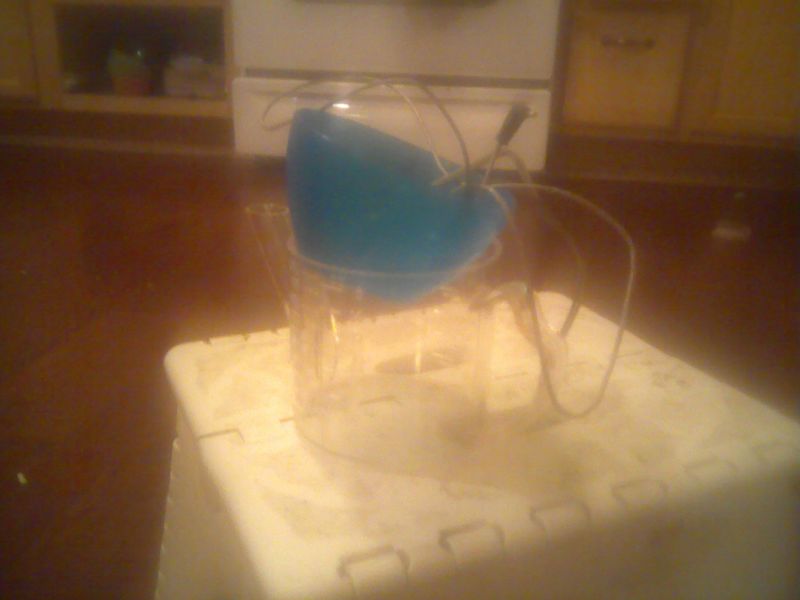
    Yesterday I was making peppermint bark with my daughter, while the big boys were at church with Mark and the 22-month-old was meandering around playing with things.  I'd never tempered chocolate before and we had spent some time watching the Chocolate Tempering video at the Ghirardelli website before trying it ourselves (an aside: thanks to the video,  I now see the point of having an expensive granite countertop).  Not long after my daughter and I had finished the chocolate bark, I noticed this little assembly atop the stepstool on the floor of the kitchen, which I snapped (blurrily) with my cell phone:

    1214111954-00

    Get it?  It's a "double boiler" — the saucepan is represented by a gravy separator, the melting container by a blue IKEA cereal bowl.  That wiry thing is the probe of my instant-read thermometer.

    The blue plastic bowl contained bits of candy canes scavenged from the floor and countertops.

    He wasn't playing — he was watching and learning, imitating, and making substitutions where necessary.  And there's nothing special about him, except in the "everyone is special" sense.  He is a full human being. He is my fourth, of course, so I have already learned this lesson a few times over — but it still takes my breath away, though mostly over the repeated realization of how clueless I once was.

    It's as if we are programmed to generalize about people, and not really to know in our depths the personhood — the agency, the will, the decisionmaking capability — of "that kind of people" when "that kind of people" is one we don't have direct experience with.

     I'm sure this goes beyond young children, to every other kind of "other" there can be.  Being surprised by people —  in the unpleasant sense, instead of the sense in which I discovered my own babies' innate abilities –sets this off vividly.  Whenever we can't understand, really cannot understand, why someone does the thing they do, or when they act in a way we could not predict, and we write it off as senseless instead of trying to see the sense — that's when we ought to see that we weren't seeing them as whole and real persons, but instead a caricature, a simpler story to tell, like swaddled plastic on TV.


  • Chemicals.

    Dooce has a post up today that for me was timely:

    Oh, hey. Hi there! Remember last week when I wrote on my Internet Website Blog Thing about suicidal ideations? Yeah. Those were fun times. No? Not really? What, did my mom call you? MOMS. We really know how to ruin a good party.

    I had someone write to tell me to stop whining, and I'm not going to complain about that criticism. Because I get it. I understand it…

    … I own two cars, a large home, and a business in a free market economy. My family enjoys excellent access to healthcare. My daughter goes to school. I get paid to write about my feelings on the Internet. Am I seriously going to whine about aimlessness?

    Yes, I am…

    And why shouldn't she?

    I do not suffer from chronic or recurring depression, but I woke up this morning feeling remarkably blue for no apparent reason at all. Actually it started last night, on our way home from a fun family activity. No reason that I could see at all to be sad.

    You know, I don't have a clotting disorder, but occasionally I find a bruise on my knee or arm, from some trauma I don't remember. I don't have chronic joint pain either, but sometimes I wake up with a stiff neck for no good reason. So I figure it has got to be possible to wake up with something — just off — in my mental health, something that will pass and leave me normal in a day or so, if a little frazzled from trying to catch up from a day in a mild fog.

    I am practiced at compartmentalizing. I stand a little aside from myself and examine the heavy feeling in the chest and the sense of being a bit out of control, and run down a checklist of sorts. I haven't had a disagreement with my husband. The house isn't bringing me down with any particular messiness vibe. The children are in ordinary temperaments. I didn't generate the dark mood by reading a bunch of political blogs before I could finish my coffee. I *have* coffee. I have not recently been forced to confront any feelings of inadequacy. All is, objectively, well. Thus reassured, I am mostly able to get on with my day, without letting the sad feeling *worry* me. The way I could get on with a stiff neck, once (by looking for other symptoms and finding none) I satisfy myself it isn't the onset of meningitis or a heart attack. I am confident that, like a run-of-the-mill stiff neck, the blue feeling will pass and leave me healthy again soon.  

    But I still have to *endure* it until it has run its course.

    I give myself a little extra leeway on days like this. I take it for granted that I will not be able to summon the energy for a full day of school. I do something different. Today instead of spelling and music, we attempted to make peanut brittle all morning, an excuse for me to talk about boiling point elevation. The peanut brittle failed miserably: crystals nucleated and grew before my eyes after forty minutes of watching a hot sugar syrup bubble away. "Quick, throw the peanuts in before it all hardens!" exhorted my eleven-year-old, so I did, and we wound up with stuff that looked like freezer-burned corn niblets. It tasted pretty good though, so maybe I will use it for an ice cream topping. I can't really be sure, but it is tempting to diagnose the problem. Maybe if I had oiled the pan better, or scrubbed it harder, the syrup wouldn't have crystallized.

       Is there a point to these recriminations? I learned what I wanted to learn: it is not feasible for the kids and I to make pounds of peanut brittle for Christmas presents this year.

    The same with my mental state. Do I feel like this today because I ate too much junk food yesterday? Does it have something to do with that migraine in the early afternoon? Hard to say. But again, it doesn't matter much.

    This much is true: even if everything is fine, no amount of reminding myself that it is fine will make the sad feeling go away any faster. It is still there, and it takes time to fade, just as bruises and stiff muscles do. It just is. Most likely I will feel better tomorrow, but that does not change the feeling of today. 

    Perhaps the compartmentalizing leads to that belief. I really think of this occasional sadness as a brief disruption of brain chemistry, kind of like my migraines. It isn't my fault, and the feelings don't necessarily reflect the reality outside myself, but they are part of the reality inside me. Thus it is best to deal with them as a piece of reality.

    Heather of Dooce, writing about those who would accuse her of "whining" when she writes candidly about depression:

    …and that's where I invite anyone who agrees with the valid criticism above to sit here with me and let me have it. I will listen to you curse me. I'll nod and offer you a tissue when things really heat up. I'll let you talk about your friend who died or the job you lost or the meals you've had to skip, and then I'll fix you dinner and invite you to stay the night.

    Like I said, even if you know everything is fine, even if it is utterly obvious that your feelings are irrational…. The rational thing to do is to accept that irrational feelings exist and that they cannot be rationalized away.

    Heather:

    Sometimes the only way to quantify our own suffering is to compare it to what we think is the happiness of others. It's human. As human as reflexively wincing when hearing the chorus of a song you once played over and over in your bedroom because of two blue eyes.

    So I offer up my humanness if, instead of a place to stay for the night, you need to hear that even with everything in its right place it's okay if you still don't know why it doesn't feel that way.

    Note, in that last paragraph, the usage of the term "to offer up." She means it differently from the Catholic jargon… but maybe, on second thought, not so differently.


  • Hardship.

    After what seems like months of watching people stare forlornly at the empty squeeze bottle, and saying I was going to do something about it but not getting around to it, I finally — yesterday — made it to the co-op and bought THREE QUARTS of real Grade B maple syrup from the bulk bins.

    I would have bought more but I couldn't find any more clean Mason jars.

    This morning there was much rejoicing.

    As God is my witness, I will never go pancake-less again.


  • Cheater’s deep dish pizza. I mean, maybe only sort of cheating.

    So I've been meaning to get around to learning to make Chicago-style deep dish pizza.  I even had friend and commenter ChristyP , who I guess had to learn to make it as a condition for staying married to her husband or something, email me a recipe for crust, like, ages ago, and it has been sitting around waiting for me to pick it up and learn a new crust technique all that time.

    This is not the story of how I took ChristyP's recipe and learned to make the authentic Chicago-style crust.  This is the story of how I was leafing through my mother-in-law's back issues of Family Circle and saw a recipe that used ordinary frozen pizza dough and thought to myself, "That picture looks pretty good, and I can do better than the frozen pizza dough.  And I won't have to learn how to do anything new, which is good, because I've been putting off the authentic Chicago-style crust because I don't have time to innovate these days."

    Here's the story.

    So, there I was, leafing through my mother-in-law's back issues of Family Circle, and I saw a recipe that used ordinary frozen pizza dough and thought to myself, "That picture looks pretty good, and I can do better than the frozen pizza dough…"

    …okay, you get the picture.

    Anyway, I figured that if refrigerated pizza dough would work, so would the usual dough that comes out of my bread machine.  So I made a pound of 50%-whole-wheat pizza dough and proceeded with something that was kind of like the Family Circle vegetable-pepperoni deep dish pizza, only I substituted the vegetables with a mix I thought would go better around here (eggplant isn't super popular), and I said "to hell with reduced-fat cheese and turkey pepperoni.")

    Also, since I don't own a deep dish pizza pan, I used my 10" springform pan, which has straight sides and so isn't perfect for the job, but it worked fine once I got everything inside it.

    Cheater's deep-springform-pan vegetable-non-turkey-pepperoni pizza

    • About six ounces button mushrooms, chopped medium-fine (around here, mushrooms can't be in big visible pieces)
    • 3 small-to-medium zucchini, sliced in half-moons
    • Half a red onion, chopped 
    • One big red bell pepper, chopped 
    • One cup of any tomato sauce — I used leftover homemade spaghetti sauce that I'd cooked meatballs in
    • 1 and 1/2 cups shredded asiago-parmesan mix from a bag (it was on sale last week — use any combination of shredded cheese, I would think, but make sure that a significant fraction is parmesan)
    • Two ounces of pepperoni, chopped fairly finely.  Probably Genoa salami or sausage or bacon would be good instead.  I liked the pepperoni and we always have it on hand for kid pizza.
    • One tomato or maybe three roma tomatoes — whichever looks better this time of winter — thinly sliced
    • 2 tsp dried oregano and maybe some basil
    • Salt and pepper
    • Olive oil for the pans
    • One pound of pizza dough*

    Preheat the oven to 450°F.  Brush a rimmed baking sheet with olive oil and scatter the mushrooms, zucchini, onion, and bell pepper on it; sprinkle with salt and pepper.  Roast at 450°F for about 20-30 minutes, stirring once.  

    Brush a deep 10-inch pan (like a cake pan, for instance; I used my springform) generously with olive oil.  Roll the pizza dough out into a circle wide enough to go into the pan and up the sides most of the way.  It doesn't have to splay over the top edge of the pan unless the pan isn't super-deep.  Then put it there.  (With a straight-sided pan it's a little tricky to get the dough to stay on the sides of the pan while you fill it, but I managed with some pinching and holding it out of the way).

    Layer about a third to a half of the cheese on the bottom of the crust, followed by the roasted vegetables, followed by the cup of tomato sauce, followed by the diced pepperoni.  Make sure the crust extends at least a half inch above the toppings so it doesn't overflow into your pan; if not, pinch and stretch it as you fill.  It's okay if the crust folds back down over the toppings on the edge.  Bake 15 minutes at 450°F.  

    (At this point the crust edges looked sufficiently brown to me, so I made a little ring of aluminum foil to go around the edge of the pizza and protect the crust. Then  I proceeded:)

    Top the pizza with the remaining cheese, the slices of tomato, and a sprinkling of oregano and basil.  Return to the oven for 15 minutes.  Remove from the oven and allow to stand for 5-10 minutes before cutting.

    Full disclosure:  Three of my kids wouldn't touch the stuff.  They got peanut butter sandwiches.  

    Fuller disclosure:  I'm not sorry, as the rest of us ate the whole thing.  What I liked about it, compared to a regular flat pizza, was that we got a much higher ratio of vegetables to bread than usual.  And it was really beautiful coming out of the oven.  Smelled great.  And it seemed easier than normal pizza — probably because I could fit all the pizza we were going to eat in the oven at the same time, instead of having to do it in thirds one pizza at a time.  I did the vegetable chopping ahead of time, and the bread machine made my pizza dough, and the vegetables roasted in the time it took for me to get the deep pan prepared and the dough rolled out and a fruit salad made.  Definitely a fine pizza for a weeknight.  Families much larger or less picky than mine will have to make two.


    ——————–

    *Make your own or buy it.  One pound means you start with about two cups of flour.  Here's the bread machine pizza dough recipe I used.  Usually I put some olive oil in, maybe 1 Tbsp, but this time I forgot to.  Worked fine anyway.

    • 3/4 cup water
    • 1 Tbsp honey
    • 1 cup Dakota Maid whole wheat flour (something you would actually use to bake 100% whole wheat bread)
    • 1 cup bread flour
    • 1 heaping tsp salt
    • 1 and 1/4 tsp yeast

  • Saint Nicholas the badass.

    A day late, but (thanks to Taylor Marshall of the blog Canterbury Tales) here is some stuff about St. Nicholas I didn't know:

    …the good Saint Nick allegedly "h-slapped" ("heretic slapped") the heresiarch Arius. You see, Arius wrongly taught that Christ was not fully divine. Rather, Arius taught that Christ had been created by God the Father.

    During the First Ecumenical Council of Nicea (AD 325), Arius was called upon to defend his position on the inferiority of Christ. Saint Nicholas just couldn't listen to all of Arius' nonsense and so he stood up and laid in to Arius with his fist.

    The Emperor Constantine and the bishops present at the Council were alarmed by Nicholas' act of violence against Arius. They immediately stripped Nicholas of his office as a bishop by confiscating the two items that marked out a man as a Christian bishop: Nicholas' personal copy of the Gospels and his pallium (the vestment worn by all bishops in the East)…

    See, I didn't even know that St. Nick was at the council of Nicaea, let alone that he personally punched Arius in the face.  The things we leave out of our tales to children these days!  

    (We could have been promising the kids a stocking if they were good, and a socking if they turned out to be filthy little heretics.)

    More at the link, including the story of the miracle that gives us the traditional Eastern iconography for St. Nicholas, and a painting of St. Nick waving his fist (and undoubtedly going, "Why, I oughta…bam! To the moon, Arius!")

    Now, I happen to own a children's book called The Miracle of Saint Nicholas, and it's really quite a sweet one too, about a small village whose church has lain disused and empty since the soldiers came, and how (after the soldiers have gone) the villagers reveal one by one that they have preserved its treasures.  The "miracle" in the book is just the "miracle" of human ingenuity, memory, service, and charity.  And there's nothing wrong with that; it certainly seems like a miracle sometimes.  

    But I can't help but think that a kid's book based on this episode would be pretty darn cool.

    He knows if you've been good

    He knows if you've been rotten

    He knows if you've been teaching that Jesus Christ was created, not begotten

    SO you better not spout Christological lies,

    You better not flout, I'm telling you why,

    Santa Claus is taking YOU doooooown!

    I wonder how this would fly if my eight-year-old performed it at the annual parish "Saints and Scholars" pageant.  

    SO SO TEMPTING.


  • Why I am not posting much. Maybe.

    I could pretend that I'm sequestering myself with my family for a cozy, prayerful Advent, but that would be a big fat lie.   The truth is I don't know what's going on.  Today I will give you …


    TEN THEORIES WHY I CAN'T SEEM TO GET ANY POSTS UP, AT LEAST NOT ANY GOOD ONES


    1.   It's too cold in the house and I'd rather wrap at least one hand permanently around my coffee cup, leaving only one hand free to snake out of my sleeve and click the mouse once in a great while.  Perhaps if I turned the thermostat up I would feel more creative.

    2.  Deep down, maybe, I know that the minute I get engrossed in writing a post the baby (ack!  he will be two next month!  must start calling him something else!) will start crying.  Just can't face the frustration of having my train of thought interrupted.  Even now I feel panicky just knowing that at any moment someone will wake up.  

    I am a classic introvert, and if there is anything I miss about being single, it is the ability to choose to be alone whenever I crave it.  

    3.  Perhaps I am more in the mood of being… like… a passive consumer of media rather than a creator.

    4.  An effect of the Marian consecration that I perhaps didn't foresee.  Getting what I asked for, maybe.

    5.  Feeling sorry for myself because it's slowly becoming clear that all the business travel my husband's been doing for his "new" (last few months) job within the same company is not merely an artifact of learning the ropes at a new job but is in fact the new normal.  I know lots of people have to deal with their spouse being gone more than 4-8 days per month, and so I mostly don't get grumpy about it because I'm thankful that there is a job, especially one he likes that's well suited for him and pays well, but on Day 3 of a four-day stretch of putting the kids to bed by myself, I do, in fact, sometimes get grumpy.  And then I have trouble thinking of non-grumpy things to write.  Which means I post nothing.  Also, putting them to bed by myself cuts into my blogging time.

    6.  Haven't even been cooking anything very interesting lately (see #5), so my old trick for climbing out of blogger's block — post recipes until I get back in the habit of writing again — is not working for lack of inspiration.  

    7.  I know it's not for lack of topics.  I do think of post topics I would like to write about.  I remember having a political thought a few days ago, for example.  It would have made an okay post.  Maybe something about the rhythm of life right now is maybe preventing me from getting to a computer in time to put it into words.  Most of what seems interesting to me slowly evaporates as time goes on and seems not at all interesting by the time I sit down at the computer.

    8.  I do a lot of my blog thinking and composition mentally in the pool, swimming laps.  And lately, it's been hard to arrange things so I can get to the gym two or three times a week, for perhaps the last 5 months (see #5).  Could be that I just don't have time to think underwater right now.  

    9.  But maybe it's a symptom of something good.  Teaching the kids always has its small frustrations, of course, but right now school is interesting and intellectually challenging and even fun.  Busy, but fun.  It's quite possible that because I'm busy with fun parts of school right now, I'm not looking around for something to help me procrastinate.   Maybe that's all the blog ever was.

    10.  It's the holidays, and there are cookies everywhere, so I can't bear to write weight loss posts (another old standby for digging out of blogger's block).  If that's some January, when it will draw a lot of traffic — and face it, probably be on my mind for personal reasons — I'll probably feel like writing about (sigh) my most popular topic again.

    11.  ARGH.  SOMEONE IS COMING DOWN THE STAIRS NOW.  


  • Negotiation and gender.

    I'm really intrigued by Megan McArdle's description (okay, it's third-hand, hence the multiply nested blockquotes) of a study on gender norms in negotiation situations:

    [MEGAN McA.]: One of the reasons that women are paid less than men is that they don't negotiate.  The advice that follows is usually, "Well, negotiate!"  But in fact, women don't negotiate for very good reason, as Kevin Drum points out:

    [KEVIN D.] I apologize for sticking around, but there's a reason. I've run into this before myself, and have always told women "Just ask! The worst that can happen is that they say no." But that's not actually the case. Here's a bit of research on the subject:


    Their study…found that women's reluctance [to negotiate] was based on an entirely reasonable and accurate view of how they were likely to be treated if they did…."What we found across all the studies is men were always less willing to work with a woman who had attempted to negotiate than with a woman who did not," Bowles said. "They always preferred to work with a woman who stayed mum. But it made no difference to the men whether a guy had chosen to negotiate or not."


    [Back to MEGAN McA.] When I was in business school, I learned about a case that had been run experimentally.  I may hash some of the details, but the gist is that half the classes that used it read about "John" facing a tough management problem, while the other half read about "Jane" facing the same problem.  No detail other than the names had been changed.

    But what a difference a name makes!  "John" was a strong, thoughtful leader making tough choices about what was best for his group.  "Jane" was a headstrong bitch who was wildly overstepping her authority and generally making a mess of things.

    No woman is unaware of these dynamics. 

    Let's see if I can sum this up correctly — negotiation is in reality a riskier game for women to play, so they act in their own interest by doing it less often (or perhaps less directly).   Instructing women to negotiate, then, perhaps may meet with one measure of success (more women will attempt to make gains by negotiating) but maybe will be repaid by biteback (some may be "punished" for the effort).  

    I would really like to write about this subject from personal experience because it intrigues me, but I am spectacularly disqualified to comment on my own ability to negotiate or on my response to other people negotiating, as I have historically been an opinionated yet socially awkward introvert with a fixation on facts rather than feelings, probably somewhere on the Asperger's spectrum, and am therefore among the "no" women whom McArdle says are "unaware of these dynamics."

    As the commenters on the thread take the time to point out, it would be a mistake to assume that the hostility toward women who negotiate is conscious and overt.  It would also be a mistake to assume that it's primarily men who unconsciously punish women who attempt to negotiate; probably women and men both do it.    

    One thing I find particularly fascinating is the notion of a person who lacks natural social gifts, or who is hampered by prejudices around them, creating sets of rules to mitigate the situation.  That is, deliberate behaviors that attempt to create the social interactions that we imagine a truly successful or powerful or gregarious or friendly person can conjure up naturally and without having to think about it.  Ways to manipulate people!

    (Kind of analogous to a colorblind person imposing a rule on herself to always dress in basic black with a single colorful accessory.)

    One commenter writes,

    I had read the study Drum references before, and after I saw it I started using two strategies that work well so far: (1) When I'm disagreeing with a man who has a moderately to very high opinion of himself, I smile while I disagree. (2) If I'm giving a presentation with a man, and he speaks first because of the way our presentation is structured or something, I take a step in front of him to address the group.

    Small body language things, not threatening, that still allow me to be assertive without offending anyone's subconscious. It's not the way it should be, but it works: I have good relationships with and respect from co-workers and management in a majority-male environment.

    Boy, I could have used a lot of tips like this in my past life.   There's no need that they have to be laden with judgments about which sex is friendlier or more open or more assertive and whether that's better or whatever, or whether our expectations are good or bad.  It seems not unreasonable just to accept that human nature is what it is, and many cultural forces are what they are, and women and men live (typically) under different sets of unconscious expectations and have therefore evolved (typically) different common strategies to meet their goals.  Encouraging women and men to adopt each other's apparently successful strategies will likely backfire when it turns out that the unconscious expectations in the environment are not so mutable.

    Thoughts?


  • Wrong message.

    The kids' chocolate Advent calendars, which they will get to start tomorrow, have Nutrition Facts labels that read:

    Serving Size:  24 Pieces

    Servings Per Container:  1

    Hmmm.