bearing blog


bear – ing n 1  the manner in which one comports oneself;  2  the act, power, or time of bringing forth offspring or fruit; 3 a machine part in which another part turns [a journal ~];  pl comprehension of one’s position, environment, or situation;   5  the act of moving while supporting the weight of something [the ~ of the cross].


  • Quotable Ace on scientific overconfidence.

    Here’s Ace of Spades writing about the latest study to show, in the face of the establishment, that low-carb dieters burn more calories:

    When evidence and data are thin, Narrative and Theory rushes in to take their place. Nature abhors a vacuum, and so too does natural science. Science — or, I should say, scientists — human beings with human flaws which science isn’t actually burdened with — do not like saying “I don’t know.” Even when “I don’t know” is actually the proper, most scientifically-valid answer.

    “I know” is much more satisfying. The funny thing is that we only hear “the science is settled” in the precise cases where it’s not settled. No one ever says “the science is settled” as to whether the earth revolves around the sun. It is settled, of course; so no one has to attempt the Appeal to Authority to establish it.

    A growing consensus says they know, you know.

    So, for 50 years now, the medical establishment and the government have been telling fat people to do the exact opposite thing they should be doing.

    Ace is also drawing a comparison to what he thinks of as the overconfidence of much of the man-made artificial global warming crowd; it doesn’t much matter the specific policies, though, as his point stands whatever the appeal to authority. It is a common logical flaw (or a very shrewd tactic, as it works so well on the gullible who don’t see their own weakness), and the point is well put.

    Every once in a while, when I write against… oh, what shall I call it… “scientism,” perhaps… that belief that scientists are people with special moral authority to set policy… I wonder if I look like I suffer from sour grapes.

    I trained for, and used to aspire to working in, academic scientific research (well, engineering, but to most folks it looks pretty much the same). I don’t anymore, mostly because of a series of choices our family made to secure our overall happiness. So you could say that membership in the Authoritative Class was within my grasp, and I let it slip away, and now I have sort of a grumpy habit of poking at Oz’s curtain.

    I like to think that the training I did have prepared me to recognize the argument from authority in many of its guises, but perhaps that thought is just the argument-from-authority in another form.

    Maybe if I were a working scientist instead of a nonworking one, I would be just as vulnerable to belief in the superrational powers of my own authority (at least in my own field) as journalists often are to belief in the powers of people whose work they don’t understand.


  • No time to do this one justice.

    Somebody needs to rewrite this article, but for homeschooling blogs instead of Pinterest wedding boards.

    It might have seemed like my Pinterest Wedding was coming along nicely, but in reality the anxiety was mounting….You see, every time I planned a small detail, I would see someone do it better, with more whimsy, on Pinterest.

    A few weeks before my wedding date, I’d had enough of being out-twee-ed and out whimsy-ed. I developed acute bridal apathy and quit Pinterest in a huff. After going cold turkey, I realized that Pinterest only shows us the good side of weddings. It shows a glowing example of how weddings can look when everything goes as planned. In reality? It rained all day leading up to our ceremony. 

    The piece is pretty amusing, and the analogy works.  Don't spend too much time looking at other people's ideas.  If you have to seek inspiration from other people, use what you learn from them to become a better *you,* not to compare yourself to other people's best-projected version of themselves.


  • Fascinating update on grocery store munching.

    Remember back when I asked readers whether they thought it was acceptable to eat your groceries in the store before you paid for them?

    Check out this comment from Angela C.:

    I work as a cashier for the world's #1 retailer, and I see some things that people do that would make you want to douse your hands and shopping baskets in hand sanitizer. Case in point: there is a homeless man who brings a live turkey into the store with him sometimes, and has it sitting in the child's seat of his basket. I live in a major metropolitan area so this is not a normal thing, at all. I see people with their dogs and kittens. Customers who leave the bathroom without washing their hands. I could go on but I won't. Suffice it to say, it might be better for those more inclined to eat at the store to wait till they get home and wash their hands first.

    My kids don't ask to eat food in the store because they know I won't let them, but believe me, if they ever ask, I will now say "Are you kidding?  For all we know the last person to touch this food was carrying his pet turkey around with those hands."

    Perhaps we could make Angela's story go viral, and then everyone would be AFRAID to eat in the grocery store.  A moral victory!  Without even ruffling any feathers.


  • Beer for beginners, part II.

    part I is here.

    So one of the first things I did as I read through The Brewmaster's Table, taking notes, was to try to get a handle on the "family tree" of beers, so to speak — all the classifications and sub classifications.

    It started out fairly simple, with the world of Lambic:

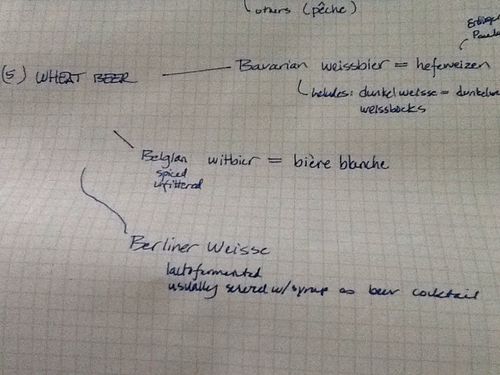
    Then things got a little more interesting, when I turned to the chapter on Wheat Beer:

    But then I turned to the chapter on the British Ale Tradition, and my family tree sprouted suckers all over the place:


    Let's just say that things didn't get any simpler when I got to Belgium. I have a few more pages like this.

    This was all very overwhelming. I got myself a lab notebook:

    I made myself a little Beerwatching List, so I could check off each variety as we tried at least one bottle of each:

    But it was still kind of overwhelming, with 59 different kinds of beer, and that doesn't even count the fact that you can generally buy more than one brewery's version of each sort of beer.

    Clearly I needed to prioritize.

    After fussing around a bit considering what made the most sense (start with easy-to-find and move towards rarer? Tote the notebook to restaurants and order the most obscure draft beer on the menu every time? Geographical organization?) I decided to start with the most useful beers, by which I mean the beers that were listed in the book as being quite versatile and going with a lot of different kinds of food. Theoretically, from among that set we would find something that we wanted to keep in the fridge all the time.

    The Brewmaster's Table has a handy lookup table to answer the question, "What should I drink with my food?" Conversely, one can use this really cool pairing chart to answers the inverse question, "What should I eat with my beer?" Turning back and forth between the two and taking notes, I came up with the following list of "Beers that supposedly go with lots of stuff:"

    1. Hefeweizen
    2. English-style porter
    3. Belgian saison
    4. Pilsner
    5. Helles
    6. Vienna lager
    7. American pale ale
    8. American amber lager
    9. Altbier

    Ah, nine. What a nice short list to start with. Much better than 59.


    Mind you, these aren't "beers that go with everything," they are just "beers that showed up a lot in the list of food pairings." Whatever. I went with it.


    Tune in next time and I will regale you with Adventures in Hefeweizen. Hint for fellow northern plains staters: Not at all like Leinie's Honey Weiss.


  • Kids on the bus.

    Jamie has a good post called "Kids and the Low-Car Lifestyle," about how to navigate public transit with kids in tow.  

    I confess that I don't really know how I would manage without two cars, but I am aware that the only reason I don't know is that I have not made it a priority to figure it out.  If it were high on my list to downsize to two cars, I think we could do it.   

    It isn't high on my list right now, though.


  • Beer for beginners.

    This post also functions as a test of the Blogsy app to post from the iPad.

    I grew up (part-time anyway) in a wine-drinking house. From the time I was sixteen I was allowed a glass by my plate at dinner, and always some of the dinner conversation was devoted to the bottle on the table, where it came from, who recommended it, and always how well it matched with the food. I like to think I picked up at least a working understanding of wine-and-food matching there in my dad's kitchen, and I usually still don't make any gross errors when choosing a glass of wine in a restaurant. Although I am a bit rusty, as I will explain.

    I was only of legal age to buy alcohol for three years before I got married, and of course I didn't buy many bottles while I was living on my own. When Mark and I married, we spent part of our honeymoon skiing and part touring the Sonoma wine country. When I came home and found myself browsing Surdyk's to put together a little bottle collection, I became aware of a rather steep mismatch between my appreciation training and my grocery budget. Also, the layout of Surdyk's emphasized a major tradeoff that had never really been apparent at home: the more expensive wine I bought, the less cheese I would be able to eat.

    I always keep a couple of "good" bottles around just in case, and a bottle or two of bubbly in the fridge. But the short version of the long story: I learned to drink cheap (well, good-value) wine and like it.

    Anyway, I sort of missed the whole serious wine-food-matching snobbery thing, because it's fun. We have a bit more disposable income now, and I suppose I could have started buying more expensive wine, but old habits die hard. I am not a penny pincher by any means, but when I heft a $30 bottle, I can hear a little voice whispering in my ear: "you can feed your whole family of six for this money at the family restaurant around the corner, the one with the $1.00 pie special."

    Enter beer. Beer has a lot going for it. Let's review:

    • You can buy really great beer for a fraction of the cost-per-serving of upper-middle-class wine.
    • It usually comes in smaller containers, meaning that there aren't leftovers oxidizing in your fridge all the time, and it is always worth opening a container even for one person.
    • It often (not always) has lower alcohol content, so you can enjoy a flight without necessarily landing under the table, and that is particularly good if you are a lightweight like me.
    • There's plenty of variety to explore, both locally and globally.
    • Some kinds of food match better with beer than with wine.

    And finally — I didn't actually know much about beer, let alone about beer-food matches, so I would get to learn about it. To tell you the truth, I didn't really know the meaning of words like "lager" and "porter" and "ale" and "stout." I could recognize a pilsener and that was about it. I could identify a few specific local beers I liked, and I knew I did not like the bitter IPAs with which Mark filled our fridge, but other than that I didn't have a working knowledge even of my own taste. I decided I needed to rectify this situation. And for this…. I needed a BOOK.


    The trip to the beer store would have to wait. I must first acquire the theoretical underpinnings, and then move on to the practical applications.


    The book I chose was The Brewmaster's Table: Discovering the Pleasures of Real Beer with Real Food by Garrett Oliver. It proved to be a good basic introduction to the world of beer.


    It begins with a basic overview of how breweries produce the different kinds, what the various ingredients do to the product, and a history of the developments in beer-brewing. There is also a basic explanation of the principles involved in matching beers to food — the basic equivalent of knowing whether to choose red or white, demi-sec or dry, when you select a wine to go with your dinner. In that chapter, by the way, he argues that it's much easier to match beer than wine to your food, because there aren't really any foods that clash with every beer the way that some foods fight with any wine you want to pair it with — eggs, vinaigrette salad dressings, certain desserts.


    Then it goes on to describe different "brewing traditions" around the world, each tradition divided up into specific styles, explaining what sort of food each goes with, and recommending individual beers that are good representatives of the styles. As a beer novice hoping to learn about the world of beer, this was exactly what I needed. Mark and I began working through the book immediately. (I'll write another post telling you about our process, which has only just begun.)


    The "brewing traditions" chapters in the book, by the way, are lambic, wheat beer, British-style ales, Belgian-style ales, and Czech-German lagers, plus a chapter on American craft beers and one that pulls together three "unique specialties" (altbier, Kölsch, and smoked beers, in case you are curious) that don't fit into the other categories. Each chapter covers several styles: for example, the lager chapter has sections on pilsner, helles, Dortmunder export, dark (dunkel) lager, Vienna/märzen/Oktoberfest lagers, bock/doppelbock, and schwarzbier.


    The book finishes up with a few short notes on glassware and serving temperature, neither of which we have bothered with much yet, except to note that if we decided to buy special beer-tasting glassware, a lot of the different shapes can be found at IKEA.


    I will post later on what we have learned so far (some) and what we still have left to learn (a lot). For the time being, I will just note that as self-improvement projects go, you could certainly find many that are less fun than resolving to drink better beer.



  • The Paleomom: Unmasked.

    She's no longer just a stick figure.  Go read her story.

    (A link I was saving for a slow day.  Paleo Mom is a well-written blog, mostly nutrition-related, by a self-described "scientist turned stay-at-home mom."  If you like me, you'll probably like her.)


  • Charting unmarried.

    Simcha is defending teaching cycle-charting to the unmarried, including teens, here:

    I responded in the comments with my story of learning fertility tracking in college:

    “I was in college and unmarried when I first even heard about NFP. I was a fairly new Catholic and I knew the Church opposed artificial contraception but it took a while before I found out that there was any kind of effective family-planning alternative. (Somehow, they never covered this in RCIA—either that the Church opposed contraception or that any licit recourse existed for married couples who judged it prudent or necessary to space children).

    As you can imagine, the months between finding out (a) that contraception was not, in fact, an option ever and (b) that NFP exists were somewhat freaked-out ones.

    When I did learn about NFP, probably from the little baby internet we had back then, my first thought was: “You have got to be kidding me! I have to try this!” Sort of in a “how cool is that?!” sense. So I tried to order a copy of a NFP textbook from a nationally known NFP teaching organization, and they wrote me back to tell me it was a BAD IDEA for a young unmarried woman to fall into the temptation of knowing how her cycles worked.

    I knew perfectly well where to get free condoms—I was a state university student, after all, they practically leave them like mints on your pillows at the dorm—so I concluded that whatever assumptions the NFP teaching org adviser was making didn’t apply to me, and persisted in my search to find out how to do this cool trick where you could find out when you would have your period.

    So I went to the library, where I found a slightly out-of-date edition of the same textbook (hint: it had daffodils on the cover), made myself a chart in Microsoft Excel, and about seven weeks later experienced the twin sensations of WOW IT WORKED THAT IS SO COOL and I HAVE BEEN LIED TO MY WHOLE LIFE ABOUT MY OWN BODY. The experience was faith-strengthening. I continued to chart until I was married several years later.”

    I am still about 6 years away from my second trip through female puberty, but it probably won’t surprise you that I am an advocate of teaching young people about NFP in adolescence. The details aren’t worked out yet, though, and so far none of the kids have thought to ask about the charts on the bathroom counter, which I would be too lazy to hide even if I were of a mind to hide them.

    (That is probably an exaggeration. I manage to put them away every month before the house cleaners come.)


  • Amy Welborn on why she is switching to un/home/roamschooling.

    From Charlotte Was Both:

    I highly recommend having babies in your mid-forties.  Being the parent of a second grader when you’re 52 is an awesome way, not only of working with @God to make more @humanbeings (always fantastic), but also of tricking yourself into thinking you are pretty much the same as the hot little 28-year olds driving their Rav4′s and XC90′s  to carpool and that you are not actually, you know, so freakin’  old.

    But, that wasn’t my point.

    My point was that I have been doing the – (deep breath)  – school supplies  - does your uniform fit? – your teacher wants what? we just bought all the school supplies – book covers? Why do we have to do bookcovers?  - welcome to our SCHOOL FAMILY –  parent/teacher meeting – beginning of the year orientation – parent/teacher conferences – giftwrap sales – please return these papers signed on Tuesdays – please return THESE papers signed on Mondays – I have to find an article for music class – but I get extra credit if you go to the PTO meeting! – make an adobe model out of sugar cubes – is your field trip shirt the green one or the blue one? – yes, I signed your planner – wait,don’t throw that away, we need the box tops – SCHOOL FAMILY – you need a check for what? – do you have hot lunch today or not? – candygrams – wait, is it a jeans day today – boosterthon? Try not to run too many laps, okay?  - please send cupcakes/cookies/goldfish but NO PEANUTS – POSTERBOARD – SCHOOL FAMILY.

    – thing for twenty-five (25) years.

    I get tired just  reading that!  

    Occasionally you will run into a woman who says she won't have kids because of what it does to your body. I'm sure there are other reasons for which this is just shorthand or representative small talk, but I've always found the comment silly.   Of course, one's body will eventually break down and quit on you whether you have children or not.  

     Similarly, I sometimes meet people who tell me that homeschooling "sounds exhausting."

    You've got to raise your kids somehow.  Frankly, all of the ways are exhausting.  You get to pick the way you want to be exhausted, not whether you have to get exhausted.

    I like my way.  

    I hope you like yours, too!


  • Just in case.

    In the "and now for something completely different" category — I always thought of the Swiss as having a military that was mostly good for ceremonially guarding ceremonial things.  

    But apparently that's just a front, because Switzerland's military has been busy building booby traps:

    [T]he Swiss military has, in effect, wired the entire country to blow in the event of foreign invasion. To keep enemy armies out, bridges will be dynamited and, whenever possible, deliberately collapsed onto other roads and bridges below; hills have been weaponized to be activated as valley-sweeping artificial landslides; mountain tunnels will be sealed from within to act as nuclear-proof air raid shelters; and much more. 

    From a 1984  book by John McPhee called La Place de la Concorde Suisse:

    "To interrupt the utility of bridges, tunnels, highways, railroads, Switzerland has established three thousand points of demolition. That is the number officially printed. It has been suggested to me that to approximate a true figure a reader ought to multiply by two. Where a highway bridge crosses a railroad, a segment of the bridge is programmed to drop on the railroad. Primacord fuses are built into the bridge. Hidden artillery is in place on either side, set to prevent the enemy from clearing or repairing the damage."

    And you thought the little knives were clever:

    McPhee points to small moments of "fake stonework, concealing the artillery behind [them]," that dot Switzerland's Alpine geology, little doors that will pop open to reveal internal cannons that will then blast the country's roads to smithereens. Later, passing under a mountain bridge, McPhee notices "small steel doors in one pier" hinting that the bridge "was ready to blow. It had been superceded, however, by an even higher bridge, which leaped through the sky above—a part of the new road to Simplon. In an extreme emergency, the midspan of the new bridge would no doubt drop on the old one." 

    By the time you get to the end of the blog post, you'll be convinced that the Swiss intend to singlehandedly repopulate the planet after the doomsday device goes off — and that they have some chance of succeeding.  But the book is Cold-War era; maybe they haven't been keeping it up for the last 20 years, who knows?


  • Five days into the schoolroom cleanout…

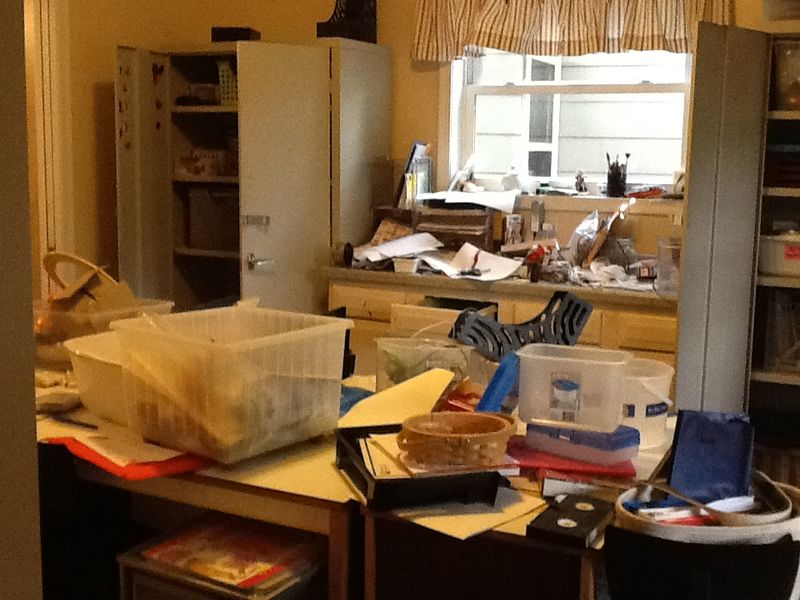
    Photo-20

    …this is what is staring me in the face.

    I finished emptying the tall cabinet you can see at left, as well as its out-of-the-frame twin.  

    There is a big pile of stuff on the floor of Mark's basement shop, on the grounds that it's one spot in the house which he will eventually insist that I reorganize.  Theoretically I will be pulling items from the basement and putting them into the schoolroom to use next year, and this will make room for the pile on the shop floor.  We shall see.

    Regardless, this kind of work, though tiring, and creating a demand for chocolate, is immensely satisfying.  I love emptying shelves of all their crud and getting in there with a dust cloth and then putting new things in.  I feel like going in with masking tape and marking the outlines of everything I put in there.  

    The children are watching a lot of movies.  Whatever.  It's the first week of vacation and they're spending the first three hours of the day at Catholic Vacation Bible School and by the time they get home it's really hot.  Could be worse; could be seals escaping and roaming the streets.

    OK.  Back to work.  


  • Mwahaha!

    Amy Welborn is one of us now!

    I will be really interested to hear about this "roamschooling," which is a great word that I never heard before but that I wish I had thought of.  Every once in a while, the possibility flutters to the surface that Mark may get sent to a plant start-up in some interesting place for many weeks in a row, and we muse about swooping the whole family off to Australia or France.  Then it flutters away again.  One of these days we may catch it.

    The nature of co-schooling, such as I do it, is that it pins us down a little more than I might otherwise like.  We have created ties to other families in our area, and so I turn down field trips and such if they happen on the wrong days of the week, etcetera, because I'm committed to teaching Latin and history to some kids who aren't mine.  But we are getting better at weaving in and out of our different family vacations and things, what with e-mail and Skype and the History Backup Plan, which can be summed up as:  "Uh — sorry we can't get together.  I was going to do Louis XIV today.  Google something for them."  

    (Here's an old post on what to do when you can't get together on a co-schooling day.

    Anyway, head over to Charlotte Was Both and be encouraging!   There are times when I think it would be so horribly hard to be a single parent homeschooler, and other times when I think — if I was a single parent, it would be soooo much easier to homeschool than to send the children away, if I could possibly manage to make it happen.  I cannot wait to hear how the story unfolds in her own family.  I hope she writes a book about it.