bearing blog


bear – ing n 1  the manner in which one comports oneself;  2  the act, power, or time of bringing forth offspring or fruit; 3 a machine part in which another part turns [a journal ~];  pl comprehension of one’s position, environment, or situation;   5  the act of moving while supporting the weight of something [the ~ of the cross].


  • More quick takey things.

    I talked to H. this morning about pivoting, like I wrote about in the last post.  It does sound like it's time for us to re-imagine and re-invent our school days together, and probably the rest of the year will be spent figuring out through trial and error how we are going to manage it.

    I imagine a great deal of "can you believe this?!?" laughter will ensue.  

    The photo below was snapped right after H. said to me:  "Can you believe we now have TEN children between us?"

    1959507_3893538555043_1934011350_n

    (Please ignore my weirdly distorted, huge baby-holding arm.  I believe it is an artifact of the cell phone picture.)

    + + +

    We have started to think about curriculum.  

    • Next year, the ninth-grade boys will be studying modern world history (History Odyssey, Level Two, Pandia Press).  
    • I'll still be teaching them (and maybe our friend's daughter, too) proof-based geometry, since we're doing it at half speed and have missed a bunch of weeks anyway.  
    • H. will surely be teaching them English composition and literature, somehow.
    • The elementary school kids will all study geography for social studies next year, because none are developmentally ready to move on to the next level of the history curriculum yet.   H. and I just settled on the curriculum Mapping the World with Art by Ellen Johnston McHenry.  It remains to be seen how we'll adapt it to our situation.

    Beyond that, I'm going to keep an open mind until we evaluate realistically what we can do together.

    + + +

    In the just-our-family department, my 13yo — who will be 14 and a freshman in high school next year — has made up his mind which courses he wants to take.   

    For his science credit, he decided on evolutionary biology.  This sent me on a wild goose chase to find a high school biology textbook that 

    (a) was not creationist and

    (b) was not hostile to religion.

    Never found one, so it looks like I'm going with introductory college textbooks.  I decided to use two:

    I found used copies of the student book easily.

    + + +

    And then I discovered how the college textbook publishers are making it hard to be an independent student these days:  

    You can't buy used  instructors' editions or printed copies of the answers anymore.

     Instead, institutions pay hundreds of dollars to the publisher to purchase subscription-only access to web-based content, including all the answers to the questions in the textbook.

    In many cases no print version of the instructor's content even exists.

    While the best is to buy used books at used-book prices, I would be fine with paying full price for a new student textbook that included, say, one year's access to the web content.   Some K-12 publishers are making that option available for the homeschool market (for instance, my 8th grader is using ScienceFusion by Harcourt this year, and I'm pretty pleased with it.) But that isn't available, as far as I can see, for college textbooks at any reasonable individual price that I can find.

    Which means I will have to find the answers on my own.  I guess there's no free lunch, or used lunch, or whatever.

    + + +

    Speaking of lunch, I had a fruit salad and a very nice wrap-type sandwich made from a whole wheat tortilla, goat cheese, and roasted vegetables (red bell pepper, portabella mushrooms, red onion, and zucchini).  The packet has four ounces of goat cheese, so I roasted a quadruple batch of veggies, and I plan to eat this for lunch for the next three days.  I do not think I will get tired of it.

    Since I started my postpartum/nursing experiment of spreading my calories equally throughout the day, plus ice cream after dinner, I have lost about eight pounds of post-baby weight.

     Also, I have not had any episodes of lightheadedness or low-blood-sugar crabbiness, except on the way home from the eleven o'clock Mass, which always happens no matter what I eat.

    Since it seems to be working, I will stick with this regimen and not try to innovate until it stops working.  If this rate continues, I'll be back to the old me by mid-August, which would make me deliriously relieved as then I will not need YET ANOTHER new fall wardrobe.


  • Pivoting.

    Once I heard a very, very good piece of homeschooling advice, perfectly tailored to my besetting character flaw of Stick-To-The-Schedulism.  You know, the kind of thing that makes me inordinately upset about unexpected changes of plan.

    It was this:

    When the s#!t hits the fan,

    or something entirely unexpected (good or bad) falls into your lap,

    and your entire day is knocked off kilter,

    and you're unhappily surveying the list of Stuff I Was Supposed To Do Today,

    at the same time that you are looking at the clock and wondering how on earth you will catch up,

    particularly if, against all reason, you are tempted to try to cram the whole day's work into the remaining hours…

    … that is the time to pivot to a new mission for the rest of the day:

    The remaining hours of this day will be spent putting tomorrow in order,

    so that tomorrow will be the best it can possibly be.


    Look at  it this way.  The few hours you have left in this "ruined" day must be spent one way or another.  You can take them as "extra time for tomorrow" or you can take them as "remnants of today."  Extra time for tomorrow is much more fun, more relaxing, and probably more valuable in the long run, at least for me. 

    Sometimes, when I've written off Today in favor of a head start on Tomorrow, we clean the schoolroom.  Sometimes I catch up on records.  Sometimes I make a meal plan or precook tomorrow's dinner.  Sometimes I do long term planning.  Sometimes I read to the kids or cue up a good movie.  The next morning always feels like a fresh start, and usually it really is a good day.

    + + +

    I bring this up because recent turns of events have led me to apply this same principle to the entire third quarter of our school year.   Maybe the fourth quarter too, it's hard to tell.

    Our baby was born Christmas week, just before the start of what I would call the third quarter, and three weeks earlier than expected.   Then just as we were starting up again, H., my partner in co-schooling, pregnant with twins, had to go on bed rest.  She delivered the twins five weeks early, around what would have been week 21 of my school year.

     A month later, of course, we are still nowhere near starting up our "together" subjects again.   My oldest hasn't quite stopped completely; he's working his way through Robinson Crusoe on assignment from H., and he's keeping up with history, but Latin and Geometry have been indefinitely suspended.  H.'s twins (one beautiful girl and one beautiful boy) are doing pretty well, but feeding them is a round-the-clock job for her right now and for who knows how long?  

    So it's make-the-best-of-it territory.

    •  I have been experimenting with an unschooling approach on the two free days, while I take the extra time to work on next year's curriculum and organize thoughts for the overall high school program.  
    • We are using some of the time to polish up our Italian and French for our planned trip in the fall.  
    • In a similar vein, we're working through a DVD lecture series on Greek and Roman engineering which we bought last month ($250 would have been steep, but it's been completely worth the $70 or so that we paid to get it on sale.)
    • My seven-year-old has rediscovered our favorite chess-learning program.  And she's decided to work towards a sports pin (Bowling) for AHG, so we've checked some books out of the library so she can learn the scoring system.  (Now she wants her own bowling ball, which might not actually be a bad idea since there are never any 6-lb house balls at the local lanes and I have two smaller children coming up behind her.)
    • My thirteen-year-old has been building computer circuits out of redstone in Minecraft, which must set some kind of record for meta.
    • I've had some time to sit down with my four-year-old and start working on letter-sound correspondence.
    • And we're working on handwriting again using a new-to-me program that everyone is much happier with, especially me, because the exemplar font is not unlike the way I really write when I'm writing neatly but comfortably — a sort of joined-italic-printscript.  (I've had it with handwriting programs that don't have as their primary goals speedy and legible writing.)  One thing that made this program, BFH, good for our family is that you can purchase a "handwriting intervention" program (Fix It Write) for older students.  So my thirteen-year-old is using that, while the younger kids are doing beginners' sheets.
    • Finally, I'm still working on my new time management resolutions (see previous posts starting here).

    And you know, I think it's going all right.  The truth is, with a new baby myself, I'm not really feeling all that energetic right now.  I'm physically well, but I'm out of shape and tired, and having decided to take it a bit easy is turning out to feel like a better and better idea as the weeks go by and it gets more and more impossible to "catch up."

    At some point, we'll just have to declare it Starting Over time.

    + + +

    I have a feeling that when H. and I come back together again, we're going to be putting together something entirely new, based on our new needs.

    But we've done that before, and it worked out beyond our wildest dreams.   So I'm pretty sure that starting over again will work just fine.


  • Quick takey things.

    Once again, I am not giving up Facebook for Lent, nor blogging, nor Twitter, nor email, nor (snort) snail mail, nor Morse Code.  

    But holy smoke, a lot of people I look forward to seeing on FB are.  So — *I* should suffer?

    + + + 

    Not giving up any food or drink either.   Usually I do the required fasting and abstinence but no more; this year I'm excused from either, nursing a newborn as I am, and I'm not even looking twice at the fasting.

    Meatless is easy enough, so that I can do on Fridays and Ash Wednesday, no problem.  Except when I forget and start to eat a Thai chicken wrap left over from dinner, and get halfway through it before I notice the chunks of chicken falling out of it onto my plate and think, "oh yeah, I forgot what was in this."

    But I didn't really have to abstain from it, so I didn't even bother feeling guilty.  I did stop eating it, though, and put the rest of it back in the fridge.

    + + +

    I've found it's not really a great idea for me to give up ANYTHING for Lent that would be "good for me to give up" in general.  Before you know it, I'm skipping sweets because I need to lose the baby weight and I'm getting up early because I need to get extra stuff done.  I am the queen of mixed motives sliding into Nice Enough Motives.  Lent is not just a self-improvement program, and if I try to make it a both/and then I will quickly make it into a Nothing More Than.

    I really have to give up something pointless for me to get the point.

    + + +

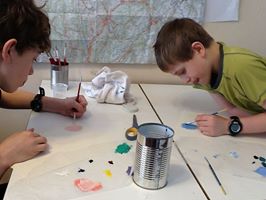
    Highlights of today included our first-ever day of working with oil paints.

    1656355_3888947000257_1427303580_n 1978864_3888947320265_2056808649_n

    Two of my kids have been gifted little suitcase-shaped art boxes in the past year, boxes that included a set of oils.  

    I forbade them from using the oils until we could systematically learn about oils.  And then they had to suffer through a semester of watercolors first, because my painting book suggested that it was good to learn basic watercolor techniques first.

    1925272_3888947120260_1129505463_n 1656203_3888947200262_576468662_n

    I've never played with oils either.  They're so different from watercolors, it was really a treat.  These are special student oils that are formulated to be miscible with water, so you don't have to mess around with linseed oil and turpentine.

    Today's lesson was:

    1. Me lecturing them on the properties of oils and how they differ from those of watercolors (cheating by reading two sentences ahead from my paint book as I wrote things on the board – I wonder if all those people who think homeschooling is Too Hard realize that parents are allowed to use the teacher's manual?)
    2. Looking at my collection of postcard art prints to see the variety of different effects that oil paints can produce
    3. Explaining how the water-miscible oils will make our lives easier
    4. Mixing a few new colors using wax paper as a palette and painting the newly mixed flat colors thickly into a row of circles on a piece of canvas paper

    Next time they'll blend colors on the paper.

    + + +

    A couple of days ago I related on FB  a Minnesotan homeschooling story:  my three oldest children, ring-led by the 13-year-old, decided to have a "Who Can Stand Barefoot In The Snow Longest?" contest while I was upstairs nursing the baby in the bed and they were supposed to be cleaning up the lunch dishes.

    It would have been smart of them to check the status of the knob-lock on the door first.  

    Eventually I stopped yelling "Stop that awful pounding!" from my bedroom and went downstairs to investigate, where I discovered some unhappy children.  My seven-year-old daughter fared the worst, since just as I was coming down the stairs she had run around to the front (barefoot, in about two feet of snow) to try to ring the doorbell, and then she ran back.  She had to have a very weepy, painful, warm footbath.  No one was damaged and everyone learned a lesson. 

    Foresight-related winter exposure is a risk that is not borne only by Minnesota's homeschoolers, though, as this bit someone posted on my wall shows:

    Teen:  Teachers Made Me Stand Outside In Wet Bathing Suit, Barefoot

    It happened around 8:30 a.m. Wednesday at Como Park High School in St. Paul. Fourteen-year-old Kayona Hagen-Tietz says she was in the school’s pool when the fire alarm went off.

    While other students had gotten out earlier and were able to put on dry clothes, Hagen-Tietz said she was rushed out with just her towel.

    On Wednesday morning, the temperature was 5 below, and the wind chill was 25 below.

    “So the alarm went off, and I thought it was like just a drill, like: Do I  have to go outside?” Hagen-Tietz said. “And then he was like no, we usually don’t have fake ones in the winter.”

    There's a lot wrong with this story.  So…

    This is Minnesota, where we can easily have snow on the ground in 7 out of the 9 months of the school year, and you don't have fire drills in the winter?

    So… do you expect everything to, you know, go okay when there's a fire in the winter?  Or do you only expect fires to occur during the 22 percent of the school year that is somewhat reliably NOT cold and snowy?

    And you typically allow students to ignore fire drill alarms because they're "like just a drill" and it would be inconvenient to practice? 

    Greeeeeeeaaat.

    + + +

    I must be doing something right.  My 13-yo today:

    "Maybe 42 is the determinant of a matrix that stores all the data in the universe." 

    Could be, son, could be.


  • Mardi Gras recipe hack: Bread Machine king cake.

    Reposting from 2012.  (Original post is here)

    + + + 

    Back just after Epiphany, I received this great email from a reader named Jenny:

    I just wanted to let you know that I tried your faux cinnamon roll recipe… but not for cinnamon rolls. 

    Down here in New Orleans, Epiphany heralds not so much the end of the Christmas season as the beginning of the Mardi Gras season. The famous parades don't really happen until a couple of weeks before Mardi Gras itself–but the balls and banquets begin on "Twelfth Night". An important (hee) part of this whole Mardi-Gras-season is, of course, King Cake. Every local bakery makes them–you can get them at coffee shops, grocery stores–just about anywhere, in this town, at this time of year.

    King Cakes are usually a brioche made into a circle and decorated with icing and purple, green, and gold sugars (the "official" colors of Mardi Gras). I tried my hand at making one a few years ago, but I find brioche difficult to work with. And then I started having babies. And I stopped trying to get a handle on homemade brioche and started using a bread machine. 

    But your bread-machine cinnamon roll recipe has saved me! It makes a delicious King Cake bread!

     I used your recipe…

    [added by bearing:  here's what you put in the bread machine, taken from the link above]:

    •    2 and 1/4 cups whole wheat flour
    •    1 and 1/2 tsp bread machine yeast
    •    1/2 tsp salt
    •    1/2 tsp cinnamon (cardamon is also nice, as is chai spice)
    •    3/4 cup plus 2 Tbsp milk (or you can use apple juice; omit the sugar)
    •   3 Tbsp sugar
    •   1 Tbsp coconut oil (or butter)
    •   1/2 cup raisins or currants


    ….but when I took the dough out of the machine, I sort of stretched it into a long snake–which I then flattened out and dotted with small pats of butter and an additional sprinkling of cinnamon and white sugar down the center. I folded up each side to enclose the cinnamon/sugar/butter and then laid the whole thing in a ring on a baking sheet.

     [After the second rise of about 30 minutes, bake it at 350 degrees for 30-35 minutes — edited by bearing].

    When it came out and had cooled a bit, I did a simple powdered sugar/milk/vanilla glaze and then added the colored sugars.

    Everyone loved it. My husband, an actual New Orleans native, proclaimed it "the best King Cake he'd ever had", even after I'd accused him of just trying to get in good with the chef (ha).

    Anyway, thanks for the recipe! The good/bad news is that now we've decided that since it is, in fact, better than store-bought King Cake, I am now assuming the role of Official King Cake Baker from now until Mardi Gras… 

    I've attached some photos of the cake, in case you're interested.

    Am I? Am I?

    6a00d8341c50d953ef016760aeeae5970b-800wi


    .

    6a00d8341c50d953ef0168e5b015b9970c-800wi


    I almost feel bad about this because… this is a reasonably healthy recipe!  That's why I use it for an everyday, if fun-to-eat, breakfast bun.  It's made from 100% whole wheat flour, a little bit of coconut oil, milk (or apple juice if you want), and not even very much sugar.  No eggs even.  Heck, you can make this recipe vegan if you want!  Not exactly in the spirit of Mardi Gras!

    It is possible to make non-faux cinnamon rolls in the bread machine, with a brioche-style dough, if you want a richer version (e.g. with eggs and milk and butter and not so much whole wheat flour).  But Jenny is right that brioche dough is harder to work with, so this may be a lower-stress version as well as a lower-sugar-buzz version.

    Traditionally you're supposed to hide a trinket inside the cake, and the person who gets the trinket has some kind of obligation or wins a prize or is lucky or something like that.  Be careful not to choke on it!  


  • “The secret to not getting overwhelmed”

    This post by Jen Fulwiler fits nicely into the “new baby’s resolutions” series I have been working on.

    It occurred to me that Mother Teresa must have had more demands on her time than she could ever even come close to addressing — and considering the type of work she did, serving the poorest of the poor all over the world, she must have often felt daunted by how many important things needed to be done compared to how little she could do.

    So I asked Fr. Langford: What did Mother Teresa do when it seemed that there was more work than she could possibly handle?

    His response was simple and wise, and it marked a turning point in my life.

    Go and read.


  • Correction

    I noticed an error in my bread machine chart from the last post, so I updated the file just now.  If you downloaded, you might want to re-download.


  • Task-switching (with bread machine recipes).

    I've been keeping up with my practice of making shorter to-do lists on index cards very well.

     (Recall that I do have a master to-do list of ALL THE THINGS!!!! out of sight on my Wunderlist account.  So I'm not losing track of those things that don't make the cut today, but still need to be done sometime.  And I have a calendar, of course.)

    So, today I made my little index card list, and it had eight items on it:

    • Review evolutionary biology textbook for next year
    • Check if high school Excel tutorial matches version on laptop
    • Blog post
    • See if we can use new geometry curriculum
    • Help 7-yo with her AHG sports pin
    • Grade papers on counter
    • Put laundry away
    • Clean out a shelf of china cabinet [so we can get rid of the cabinet when it's empty]

    Later I thought of one more thing I wanted to put on my list, and as luck would have it, there was one line remaining on the index card, so I added it below:

    • Print science quizzes for next module

    So far so good.  Nine items on my list, including some for school, some for housework, some for personal creative outlet.   By lunchtime I had crossed a few of them off.

    • Review evolutionary biology textbook for next year
    •   Check if high school Excel tutorial matches version on laptop
    •   Blog post
    •   See if we can use new geometry curriculum
    • Help 7-yo with her AHG sports pin
    •   Grade papers on counter
    • Put laundry away
    • Clean out a shelf of china cabinet [so we can get rid of the cabinet when it's empty]

    Then I got on Facebook and was reading a discussion about bread recipes.  It started in a post by  Melanie about bread machines, how she doesn't have one but relies on her stand mixer, and how I don't ever bake bread except using my bread machine.  Melanie posted her sandwich loaf recipe yesterday (scroll down to the second recipe), and I adapted it for the bread machine last night and tried the loaf this morning, and it was really good.  

    That got me thinking it was time to update the chart of bread recipes that has been hanging on my fridge for a while, and that has accumulated Post-it notes and wedged-in index cards with new recipes, as well as layers of added notes scribbled on since I hung up the chart.

    So I sat down at the computer and made a nice new chart, and printed it up and hung it on the fridge.

    1964845_3859908954324_1176867563_n

    Lovely isn't it?  Ingredients down the left (in order of addition to the pan), recipes across the top, measurements in the grid.  Those are the eight recipes we make most often.  The bottom row has added instructions, such as which cycle to use.

    Only of course this project was not something that had been on my index card.  So I had to sacrifice some other task from the card.  Out with grading papers:

    • Review evolutionary biology textbook for next year
    •   Check if high school Excel tutorial matches version on laptop
    •   Blog post
    •   See if we can use new geometry curriculum
    • Help 7-yo with her AHG sports pin
    •  Grade papers on counter  Bread machine spreadsheet
    • Put laundry away
    • Clean out a shelf of china cabinet [so we can get rid of the cabinet when it's empty]

    I guess I'll grade the papers another day, or maybe on the weekend.  The lesson here:  when you add one thing, something else has to give.

    And hey!  I can now check off "Blog post."

    P.S.   Download Bread machine spreadsheet

    You're welcome!

     NOTE:  The file was updated a few hours after posting to correct the pizza dough recipe:  2 cups each of whole wheat and bread flour.


  • Here we go again.

    The baby is eight weeks old, and that is how long I promised I would wait before buckling down to trying to lose the weight I put on to support my pregnancy.

    Some people advise waiting six months. That does make sense — often the work of mothering a baby takes the extra weight off without conscious effort, so why not enjoy that while it lasts? And self-starvation is not good for milk supply, itself doubleplusungood for newborns. I am not planning on self-starvation. I am planning on being intentional instead of mindless, and on attention to portion sizes, and room for ice cream after dinner and a beer with Mark after the kids go to bed, and on a great deal of roasted Brussels sprouts. Also on adapting as I go along.

    One thing I have already figured out and adapted: the daily rhythm that felt best and most sustainable before I got pregnant (light breakfast, medium lunch, afternoon snack, hearty dinner) now makes my blood sugar go haywire. Distributing my calories more evenly throughout the day keeps me from falling over. I need medium breakfasts and medium lunches and medium dinners now.

    And so — I resisted it for a while — I have had to hang up my good old mantra “one egg is enough eggs for breakfast.” Two-egg veggie and cheese omelet, please. (Technically I hung that up while I was pregnant and eating a lot of steak and eggs specials. But I really thought I would be dusting it off again after the birth. Not quite yet, I guess.)

    + + +

    I put on about 40 pounds while pregnant, and about 25 remain. Here at the outset, I feel fairly confident I can deal with the problem; already I am practicing waiting till mealtime, and hitting that happy spot where I feel confortably satisfied after a meal, but still reliably feel good and hungry a little while before the next one.

    Getting hungry several times a day seems to be the key. Not “eat when you’re hungry,” as if hunger is a serious problem that must be immediately corrected; nor “hungry all the time,” which probably isn’t good for me or the baby; but periodically hungry for a little while before each meal.

    I find that going to bed just a little bit hungry is effective, too, but it is possible to overshoot; if I am lying awake at 2 a.m. listening to my stomach growl, I probably need some peanut butter toast, and that is okay.

    + + +

    So, what are the habits I am concentrating on right now?

    • Watching portion size and sticking to one helping
    • Vegetables or at least fruit at each meal
    • A scoop of ice cream for dessert after dinner (instead of second and third helpings)
    • A beer or a cocktail right before bed (instead of an endless Bedtime Snack Binge)
    • Weighing in every five days or so “officially,” but also weighing in the evening to strengthen my resolve against the Bedtime Snack Binge
    • Preferring fruit, cheese, and nuts over bread- or cracker-based afternoon snacks
    • Asking Mark to select snacks for the children that don’t leave behind a quarter of a package of leftovers

    I am generally aiming for 450-calorie meals, plus a smaller afternoon snack and the aforementioned ice cream and cocktails, but I am not really counting the calories up just yet. That is something to save for if I hit a plateau later on.

    Here’s a handy resource with 400-calorie meal plans in it. I ignore the word “low-fat” wherever it appears, so my meals are typically more than 400 calories, but they won’t be crazy off the charts. It’s 400 Calorie Fix by Liz Vacciarello and Mindy Hermann. It contains a refresher on estimating portion sizes, numerous recipes, a two-week meal plan, and suggested side dishes. This is particularly useful for a household that, like mine right now, is relying on shortcuts like packaged meals and takeout, because it rather nonjudgmentally makes suggestions for how to eat 400 calories’ worth of movie theater junk or vending machine snacks or fast food burgers, right alongside 400-calorie homemade meals like Couscous and Vegetable Salad (with a side of tuna and mayo) or Speedy Fish Tacos or Lentils with Zesty Tomatoes (with a side of pita bread).

    Not that I am saying one ought to substitute vending machine snacks (e.g., Wheat Thins and a Snapple) for a meal, but at least this particular book is light on the Good Food/Evil Food dichotomy, which I appreciate right now. And it’s good for practicing the habit of learning to have reasonable portions of things, and for accepting tradeoffs like, “if I want extra meat, I will get more calories unless I take less rice.” Which I am rusty on after the ravages* of pregnancy.

    *ravages (n. pl.): state of having to eat cheeseburgers or steak-and-eggs whenever one wants, because iron.

    + + +

    The psyche rebelled at first, but I am already remembering what it’s like to have self-control, and that peculiar satisfaction of being able to notice that I am kind of hungry, while also knowing that Disaster will not befall me if I wait till lunchtime. It is satisfying because I know I did not always have that ability, and I learned it, and I still have it now when I wish to call on it.

    I get hungry. I think to myself what I know from experience: “This is my body telling me it’s about to switch over to burning the stored calories. In a little while the sensation will go away, and then after a while it will be time to eat again.” And this message works, I find, as long as the things that I eat are generally real food with a decent amount of protein, fat, and fiber.

    So, for example, today for breakfast I had

    • Fresh-baked berry muffin
    • A half cup of plain yogurt with a sliced banana and a bit of toasted coconut
    • Coffee coffee coffee

    And for lunch I had

    • Homemade Niçoise salad with half a can of oil-packed tuna, a boiled egg, a potato, green beans, olives, tomato, and lemon-mustard dressing
    • Another one of those muffins
    And for dinner I plan to have

    • Fajitas with chicken (3 oz) and peppers and onions and a bit of guacamole on 1 whole wheat tortilla and lettuce
    • Some good pilsner
    Hopefully we’ll start to see some results before long, but for the time being I am going to try to simply enjoy having some control and predictability to my sensations of hunger and satiety again, and relax and feed myself (as well as the baby!) well and intentionally.

    And try not to think about how in October I need to get a new drivers license.


  • New baby’s resolution five: Quit multitasking.

    I have been writing about a few resolutions I'm making in the wake of bringing a new baby out into the world and into our lives. (The series starts here).

     + + +

    I decided I have about six categories of things that I do during a typical day:

    • rest
    • self-care
    • meals
    • learning time
    • activities
    • work (which itself can be subdivided — more on that later)

    I have a vague idea of about how much time I have available to do each of these things, but I am resolved to keep that idea vague and flexible from day to day.

     The main point is that it's finite and not all that much; so I shouldn't get bogged down in endless, super-long to-do lists that get carried over because they are never finished.  

    It's okay to keep a master to-do list with ALL THE THINGS on it, and consult that while making the day's list.  Right now I'm trying out an app called Wunderlist, and I'm using it for the ALL THE THINGS list.   But I'm copying a few things from that list onto an index card each morning.

    + + +

    I also had some all-the-time goals:  for example, one goal is to demonstrate to my children, interest in the things they had to say to me, and delight in each one as a person.  I feel these things far more often than I make them known, and I wanted to work on communicating that love, interest, and delight all day long through all the things I do.

    But I've found that a major obstacle to that is constant multitasking.  I'm always trying to do two things at once.    If I'm resting, I'm answering email on my iPad.  If I'm running a spelling lesson, I'm tidying my countertop while I wait for kids to write down each word.  While I'm chopping onions, I'm supervising my seven-year-old's math homework.  While I'm lecturing my son about the boots that I keep tripping over in the mudroom, I'm photocopying worksheets for the afternoon's school.

    + + +

    Somewhere, I know, there is a homeschooling parent with the opposite problem who is resolving to learn how to multitask.  I can be quite effective, it's true.   BUT I can't multitask like that AND demonstrate love, interest, and delight.  Rather, such effectiveness tends to give me Resting Bitchface.  Not a good look on a mom.

     So here's resolution five:  Decide what I'm doing, and do that one thing.  

    Leave room in my attention for that love, interest, and delight.

    Leave room in my attention to be reasonable, to be kind, to be generous.

    Leave room in my attention to stop and guide a child back on task before the urge to yell sets in.

    Leave room in my attention for …intention.

    + + +

    So what kind of practical change can I make that will bring this about?  I think one of them is simply to look at what I've asked the kids to do, and to be doing that same thing.  

    So, for instance, if the kids are working on schoolwork, I want to try to stay there with them instead of thinking, "Oh, they're working, I'll go get a head start on lunch."  

    When it's time to make lunch, I am going to try to stop their schoolwork, and then we should all leave the schoolroom and start setting up lunch together.  Alternatively, if I need a little quiet time in my own head, I should send them on "break," while I set up lunch by myself or with just one child helper.

    This also amounts to "quit multitasking," but on the family level.  My thirteen-year-old is really the only one who can reliably be sent to do something — be it his algebra or scrubbing a toilet — and finish it without getting distracted.  It's going to be fine to let him do his own thing.  The rest of them really do need attention and guidance whenever they are given instructions.

    So I'm going to try that today, just as soon as I make my to-do list.

    Good thing I never count "…and nursing the baby" as multitasking, or I'd never get out of this chair.


  • How those resolutions are going, and a nifty to-do trick.

    I have been writing about a few resolutions I'm making in the wake of bringing a new baby out into the world and into our lives. (The series starts here).

    Yesterday, although I am not quite done writing them out yet, I decided to bite the bullet and actually follow them.

    In a way I cheated. It was Monday. Mondays are usually the days I spend entirely at H's house, co-schooling and then shuttling kids to scouts and AHG. However, for the last couple of weeks and for a Very Good Reason, we have not been doing school together. So Mondays and Thursdays have been freed up, and I have been using them to catch up on resting, thinking, and once in a while doing a neglected chore or two. Monday's task list was a clean slate.

    So. The first thing I did was make a to-do list. Nothing new there. Except that it was a very SHORT to-do list:

    (Actual to-do list from yesterday, taken near the end of the day)

    I thought to myself, "I only have four hours to do tasks. What tasks should I do?" And that is what I came up with. I used an index card on purpose; it's like eating dinner off a smaller plate. I felt "full" with fewer tasks!

    When I was making the list I tried to include some work from each of my four categories:

    • Work for school (prepare a Latin translation; buy some curriculum; send an email about history homework)
    • Work for the family (buy a gym bag; sort laundry till I find my daughter's AHG uniform; make the kids shovel snow; grocery list)
    • Work for others (read some bylaws that I have to vote on this week for an organization that I help lead; remind Mark to move forward on a family service project)
    • Creative work (okay, I left that off, but what it amounts to is this blog post that I am writing now).

    And look! It is almost all crossed off! I actually got most of that done yesterday.

    This felt good.

    Here is another thing that felt good: During learning time — what I really call "school time," I guess, but I am trying to change its name — I forced myself not to try to do any of the tasks on my list. Instead I sat down and stayed with my kids.

    I watched a video about Frederick the Great of Prussia with my 10- and 13-year-olds. I watched the whole thing. And when my 10-y-o had questions about the video, I was right there to hear them, and I wrote them down and afterward we looked up the answers.

    I got out the nine-note recorder book and the recorders for my daughter when she suddenly decided it had been too long since she practiced, and let her use them freely all morning.

    I let the boys make lunch and clean it up.

    I read a picture book to my four-year-old for the first time in weeks.

    I led a handwriting lesson and a spelling lesson for all three school aged kids, and I wasn't rushed so I didn't yell at anyone.

    I watched another video with the kids about Roman cities (one of those PBS David Macauley ones).

    I helped my daughter get ready for her AHG awards ceremony and drove her across town, and took her and her friend out to dinner before the ceremony.

    I visited H at her house for a little while before coming home.

    It was a good day.

    I am in the middle of another day that is so far good, too. I will report back on that one later.

    + + +

     In the comments, a reader pointed me to this post at Amongst Lovely Things. It's a homeschooling blog, which is why I don't read it regularly, but this post suggests a different way of thinking about the to-do list that I rather like. She calls it "looping:"

    The concept is simply this: instead of assigning tasks to certain days of the week, list tasks and then tackle them in order, regardless of what day it is.

    Looping can be used wherever there is work that needs to be done regularly. …Right now I use a looping schedule in our homeschool, for my housework, and for my writing.

    Right now this is how I schedule our morning time read-alouds. For example, we're reading All the Swords in England, St. Patrick's Summer, and various plays by Shakespeare. Those are looped during our morning read aloud time (with Shakespeare having a more prominent place on the loop- twice for every once that we're reading the others). Next term I expect that loop to change because I want to read Father Brown, Bible stories, and Our Mother Tongue during morning time.

    Another way you could use a looping schedule is to loop various activities within a subject. For example, many homeschoolers have "Fine Arts Fridays." Picture study, composer study, crafts, art instruction, and poetry could be looped to offer a little variety while still making headway through a particular book or curriculum.

    Basically, take anything you would otherwise be inclined to schedule into certain days of the week (Monday: history, Tuesday: science, Wednesday: literature…. etc.) and put them on a loop instead. Now instead of feeling behind when the baby gets sick or you are running around putting out life's fires, you still make progress across the curriculum.

    I could see this working pretty well for me for household tasks, younger kids' school subjects, and maybe for readalouds, if I ever get back to doing them again. I will think about it. Maybe you will too! 

    More resolutions next time.


  • New baby’s resolution four: Don’t get bogged down in scheduling specific tasks.

    Part of a series that starts here.  We're coming up with resolutions — not in honor of the new year, but instead of a new baby's arrival and consequent disruption of all the routines that had been serving us well.

    Resolution zero:  to acknowledge our family's most important priorities and give each their due

    Resolution one:  of these, designate four as "all-the-time" intentions:

    • Serve God
    • Show love, interest, and delight in one another
    • Model reason, generosity, and kindness to resolve conflict
    • Teach diligence

    Resolution two:  Simplify the list of things we must "make time for."  I got it down to this:

    • Rest
    • Self-care
    • Meals
    • Learning time (since we're homeschoolers)
    • Activities
    • Work (a.k.a., the to-do list)

    Resolution three:  to accept the limits on my time, spending it on a few choice tasks and letting go of the rest of the to-do list

    + + +

    In the last post  I calculated that, on a typical weekday, I have somewhere between 4 and 5 hours to accomplish tasks of the sort that I might put on a to-do list. 

    I don't say, "I have 4-5 hours to knock all the items off my to-do list."  That's because Resolution Three requires me to accept that I will never get them all. 

    (I'm thinking that the "to-do" list needs a different name.  "Could-do" list?  No, still implies possibility of completion.  "Might-do" list?  "Task menu?"  Will have to think more.)

     This kind of work includes

    • work for the children's schooling including long-term planning, yearly curriculum selection and purchasing, weekly lesson preparation, evaluation and record-keeping
    • work for the familyincluding laundry and clothes-buying; dishes; tidying; meal planning and grocery shopping; cooking dinner; and maintaining the family appointment calendar
    • work for others including volunteer commitments, helping friends, and any paid work;
    • creative work including hobbies, blogging, self-improvement, and other satisfying personal projects

    When I made schedules in the past, I thought I had to "do everything" at least once in a while.  That meant that I had to find a time for each task on my list.  If there wasn't enough time to do each thing as often as I needed, I would just have to do everything less frequently:  instead of mopping every week, I'll mop every two weeks.

    I did all this by slotting many tasks into specific times of the day or week or month.  For example, Thursday mornings between the end of breakfast and the start of co-schooling was Time To Put Away All The Accumulated Clean Laundry.   Time For Weekly Lesson Planning was Wednesday evening while the children were at church for catechism class.  Set Up All The Week's School Materials Time was Sunday night right before bed.  Blogging Time?  Mornings, before kids get up.

    But I didn't always do what I said I was going to do, either because another task felt more urgent or because I thought of some other task I preferred. 

    (Often, blogging.)

    And then I would berate myself for departing from the schedule, particularly later when I couldn't find any matching socks or graph paper.   I would do this even if it turned out to have been a good trade-off.  There wasn't any room for flexibility or forgiveness. 

    I'm just not a flexible sort of person; I'll probably always feel kind of bad about changing my plans.  I therefore conclude that I ought to make less specific plans.  If I don't get around to a particular task now, because it's not so urgent, well — sooner or later it will become urgent and command my attention.

    + + +

    But I don't want to get carried away doing only housework, or only school planning — the two categories that often masquerade as SUPER URGENT MUST DO for days at a time.  I need to use some of my time for creative outlets as well, so I can stay recharged and sharp.  Also, I owe at least a little bit of work to other people.

    + + +

    Resolution Four is about the moment of choosing which tasks will and won't happen in the four hours and change that I have available for it every day. 

    I resolve to regularly choose tasks from the categories of creative work, work for the family, work for others, and work for the kids' school. 

    I'm not promising equal time for each category and I'm not promising to hit every category every day.  But I am resolving to hit them all in their turn, each day choosing what makes the most sense for that day, and — what's harder — letting go of what doesn't.


  • New baby’s resolution three: Know how much time I have in the day.

    Continuing a series that starts here.

    + + +

    I figured out in the last post that there are about six basic ways I can slice up the hours in my day.

    1. Rest and sleep
    2. Meals
    3. Self-care
    4. Learning time
    5. Activities
    6. Work

    "Work" encompasses a lot of different things, but I found one easy way to figure out if a thing is "work:" might I put it on a to-do list and then procrastinate it, possibly for days, while feeling guilty about not getting around to it? If so, it is work.

    I do not tend to do this with, say, taking a shower or eating lunch or going to the gym. That is how I know that showering is not work, but self-care; and lunch is not work, but a meal; and going to the gym is not work, but an activity.

    I do tend to do this with housework or school planning or home improvement projects or even many hobbies that I enjoy, such as writing blog posts. So they all count as work of one kind or another.

    I suppose instead of "work" I could call that category "My To-Do List." That isn't a bad idea. I will consider that.

    Anyway, it's all the stuff in "work" that tends to dog me.

    I. Cannot. Do. It. All.

    I need to let some of it go. But how much to let go? Do I even know how much time I have to do these things?

     Let's figure it out, roughly.

     + + +

     "Roughly" is the best I can do right now. I have a 6-week-old baby and my efficiency is consequently unusually low, plus it swings widely from day to day depending on his nursing pattern. ( I am taking advantage of the resulting low postpartum schooling and housekeeping standards to write these blog posts while the kids play poker downstairs.)

    If I was in a more stable pattern, I might try another time study like the one I did a few years ago, only with the time categories chopped up a little differently. That was a lot of fun, and I recommend the exercise to anyone who is curious about how they spend their time. But that measure takes a week, and I need something a little more quick and dirty — just an estimate.

    + + +

     We start with 24 hours in the day. I estimate generously that I should sleep for about eight hours — about 10:30 pm to 6:30 am. That leaves sixteen hours.

    Meals — this does not include real cooking, just serving and eating and putting away — are variable. Breakfast is fairly self-serve and not messy, so let's say I spend half an hour on that (including unloading the dishwasher from the night before). I take longer, maybe an hour, for lunch and post-lunch cleanup — that's because I have helpers. The same for dinner. Then we have two snacks in our day that probably add up to a half hour. That's about three hours in a typical day at home. Remaining balance: Thirteen hours.

    A day's bathing, dressing, grooming, and getting ready for bed — let's say 45 minutes. I think that's pretty generous. Remaining balance: Twelve and a quarter hours.

    + + +

    Let's pause here to notice that activities, learning, and work — plus any extra rest I might need — have to fit into twelve and a quarter hours. From day to day, the allocation of that time among those three categories probably fluctuates quite a bit. But I am looking for a reasonable, realistic estimate of how much time I have for the to-do list. So let's truck on with estimates of time spent on activities and learning.

    I allot about five hours a day (9:30 to noon, and 2 to 4:30) that at least one of my children is doing schoolwork, and I really should be engaged with them for most of that time. So let's say that I am busy that whole five hours with "learning time." Remaining balance: seven and a quarter hours.

    That time gets divided up between work and activities (unless it's used for extra rest). Sometimes there isn't any special activity at all, of course, leaving the whole 7.25 hours free.

    (Did I say "free?" Ha. It is telling that I am now beginning to think of the "knock-things-off-my-to-do list time" as "free time." Can we say, "workaholic?" Can we say, "defines self-worth in terms of accomplishments?")

    Anyway, typical evening activities are swimming lessons at the Y, or religious education classes at church. The swimming lessons take us about two and a half hours when you count travel time, changing, and showering. Religious ed is two and a quarter. So let's estimate generously and say that two and a half hours go to activities, when there are any.

    Remaining balance that I can count on having for "work" on this typical, imaginary day:

    4 and three-quarters hours.

    Well, now. That isn't so bad. It is less than I would like, and it's true that it needs to be broken up throughout the day — a half hour here, an hour forty-five there — but it isn't like there is no time at all. And when there isn't a scheduled activity, or if I get out of it for some reason (say if Mark volunteers to take the kids to RE) — there's bonus time. And any time I don't spend that time working, it could be used for resting.

    + + +

    That calculation being finished, we come to the resolution part of the post: to accept that those 285 minutes in each day are what I can expect to use for work, give or take a little.

     So here is resolution three, in full. I resolve

    • to stop pretending I can somehow stretch those 285 minutes out;
    • to value them, and try not to waste them;
    • to quit berating myself for not doing more than I could reasonably have done in those minutes;
    • to decide what tasks to use them for, and then to delegate the rest or let them go.
    Easier said than done, of course, but by counting them up (roughly) I am at least a bit closer to having my eyes open.