bearing blog


bear – ing n 1  the manner in which one comports oneself;  2  the act, power, or time of bringing forth offspring or fruit; 3 a machine part in which another part turns [a journal ~];  pl comprehension of one’s position, environment, or situation;   5  the act of moving while supporting the weight of something [the ~ of the cross].


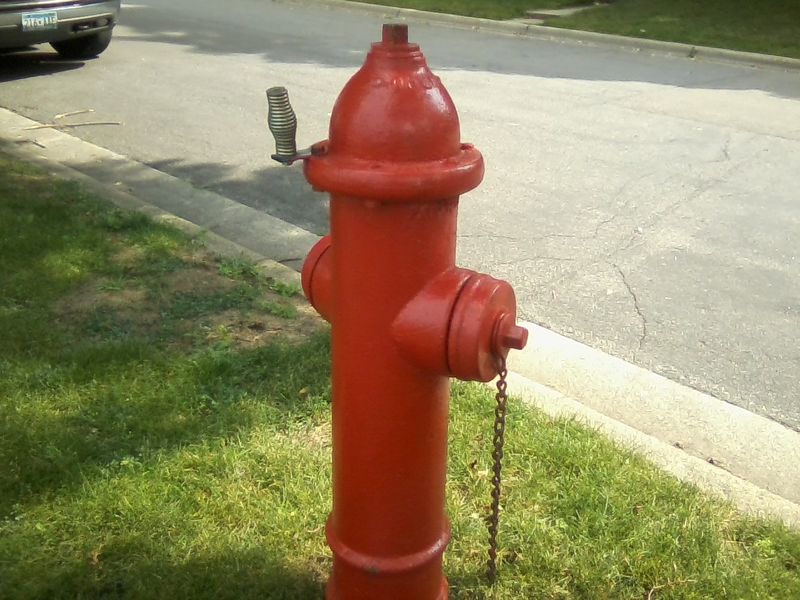
  • Detachment, fire hydrant edition.

    The weather was lovely high summer this morning as I walked from the car into church.

    However — as is usual when I have to park more than a half-block or so away, I was confronted by this reminder of the coming storm.

    0810141101-00

    I kind of hate Minnesota fire hydrants in the summer.  

    Memento mori

    no, not quite… 

    Memento ninguat, they seem to whisper as I pass.

    Are you from warmer climes?  Do you know what that funny spring-like protrusion is, bolted to the upper flange of the hydrant, on the left?

    I'll tell you.  Round about mid-October, someone from the city will come by and they will insert into that springy thing a "hydrant marker," which is a tall, red-and-white striped, flexible pole.  I grabbed this photo of a Minnesota hydrant  from pinterest here:

    49cc5f5244c2072d025bf570f5271524

    And you know what that's for, right?  

    So we can find the darn things come November or December when the first sparkly flakes come wafting down, followed by a few trillion of their closest friends.

    I wish they could make the springy holder thing blend into the background a little better.  I don't want to think about the impending doom, not now while the sun is shining and I have my sandals on.


  • Token economy: Little-kid edition.

    I have been writing about using a token economy (most recently here) to link allowance to chores, at least temporarily to build better habits among my three older children. The kids start each month with a jar of popsicle-stick tokens; each day they miss doing one of their chores, they lose a token; and at the end of the month, the lost tokens are deducted from their allowance payout.

    My four-year-old is not quite ready to handle the abstract idea of “allowance” and “deduct,” and I am choosing not to give him regular chores. Instead we are offering him little jobs here and there: fold the napkins, pick up the baby’s toys from the living room rug, put shoes away in the mudroom.

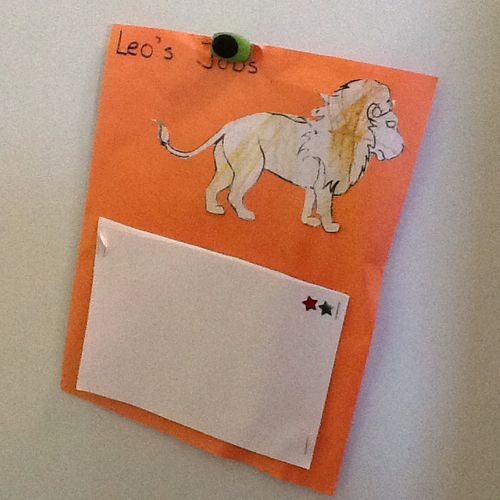
    When he does a job that we asked, he gets a star:

    (He designed the star page himself, complete with lion.)

    At the end of the month, when his siblings get their allowance with the appropriate deductions, the 4yo gets a nickel for every star on his page. He rushes up to put the precious nickels in his froggy bank. Then the page is ripped off (see the staples?) to reveal a blank one for the next month.

    He still often declines to do a job, but not every time. What I hope will happen is that he will start looking for jobs that need to be done and offering to do them. If he starts getting really useful I will give him a raise. Maybe to a dime per job.

    Last month he got nine nickels. It is a start.


  • Pleasant summer salad meal.

    Sometimes a  lot of crunchy vegetables can be the star of the show, and a very plain protein source is all you need.  And summer is the best time for that.

     On a summer weekend night we were suddenly invited to dinner — not "we'll make dinner for you!" but "let's get together and eat our dinners near each other!" and I threw my ingredients into a grocery bag and headed out the door.

    It was a funny jumble for sure.  A head of romaine lettuce, a tomato, three carrots, an English cucumber still in its plastic wrapper, two stalks of celery peeled off the bunch and tossed into the bag, a handful of parsley, a couple of lemons.   My bottle of olive oil was within a few tablespoons of empty, so I just stuck it in there. 

    For protein, I opened a two-pound package of frozen, Extremely Boring Skinless Salmon Fillets — the kind where each serving is individually sealed in plastic — pulled out six fillets and tossed them in the bag too.  And then, as an afterthought, I added an unopened jar of olive tapenade.  (Mark's parents had re-gifted it to us a couple of weeks ago.

    I opened up a plastic baggie and dumped in about a cup of couscous, and then added a handful of pine nuts from the bag in our freezer.  Off we went.

    + + +

    When I got to our friends' house, I chopped up the vegetables into large dice, and chopped up the lettuce and parsley too, and put it all in a big bowl.  (Romaine is absolutely the best lettuce for this — the perfect combination of tender and crunchy.)  I oiled a baking dish and put the salmon in.  I used the rest of the oil and most of the lemon to make a lemon dressing, which went on the salad; a squeeze of lemon went on the frozen salmon, and into the 400° oven it went.    I put the couscous and pine nuts in a bowl and added hot water for it to soak.   

    When the salmon was all cooked, the salad and couscous and fish all went on one plate.  I added a generous dab of the olive spread on top — some kind of pesto or salsa would probably have worked great too — and jumbled it all up into a salmon-salad-couscous mess.

    It was SO good.  Even though the salmon was terribly, terribly boring on its own — surely the meal would have been better had it been fresh salmon thrown on the grill, or seared skin-side down and finished under the broiler?      

    Maybe.  But it was good enough, and the salad was the star.  The salmon completed the meal, and together with the olive spread added its rich strong flavor, to make it all more interesting than it would have been alone.

    Sometimes "okay" is good enough.  Really good enough.


  • The token economy: slowing down? And, adding bathrooms.

    It's the end of another month, and I thought I'd check in about the token economy.

    Starting in April I wrote a few posts about using a "token economy" to link my kids' allowance to certain housekeeping chores.   

    Things fell off a bit this month because of some travel:  all of us out of town for a week, various children gone with grandparents and for scout camp; I was even out of town for a bit.  It was hard for me to remember to check rooms, and sometimes there weren't any children there to check.  They'll get more money than they deserve this time!  

    I did settle on one procedure:  If you go to camp for a week, and you put your room in order before you go, you'll get to keep your token for every day that week (even if a sibling messes up your room while you're gone, or if Mom cleans the house and tosses all the belongings she finds in through your room door).  If you don't tidy before you go, you'll lose the token for every day that week.  

    The schedule has been so weird that only two family dinners have been made by kids this month.  But we should get back to that in August, most of which we'll be home for.

    + + +

    August's new chore will be daily bathroom maintenance.  

    Our house has two and a half baths.  One full bath is part of the master suite, and the kids aren't supposed to use it unless the other two are occupied, so we won't have them clean it either.  The other two are a tiny main-floor powder room and an upstairs bathroom/laundry room combination.

    Three kids, two bathrooms, what to do?  I want to keep it simple:  both bathrooms presentable enough for guests every day, and have it be really clear whose job is whose.  The idea is that the bathroom task and the bedroom task must be done for each child to avoid losing his day's token.  Because it's all-or-nothing, the tasks must be simple, a daily minimum that will keep the room from getting out of control.  

    But, at the same time, I'm going to give them a fifty percent raise:  each of the 30 tokens will now be worth 75¢, but it'll be easier to lose.  (Making dinner for the family will earn an extra "bonus" dollar for the day).  So each child could get up to $26.50 in the month, if they made dinner once a week and never missed a chore.

    + + +

    I decided to assign my 13yo — who will turn 14 soon — sole responsibility for the powder room, which of course is what guests see most often.  It's to be cleaned up last thing before going upstairs to bed at night, and will be checked in the morning.  Every night he'll have to confirm that

    • trash is not full
    • there is TP on the roll and there is a spare roll
    • there is nothing on the floor
    • there is nothing on the counter, except the soap dispenser
    • sink is wiped, mirror is wiped, toilet is wiped, light switch and doorknob are not messy
    • there is a hand towel ready to be used.

    My 7yo, who is to turn eight next week, will share responsibility for the kids' full bath/laundry room with her 10yo brother.  I don't want a complicated alternating-days schedule; instead we'll have a clear division of tasks.  The 7yo's job, which has to happen after she has brushed her teeth and bathed, will be to ensure:

    • all bath toys are in the basket
    • there are no other toys
    • there is no laundry on the floor (if she finds her big brothers' dirty socks and such, she gets to fling them into the boys' room for them to deal with as part of their room-cleaning tasks)
    • the towels, bathing suits, gym bags, etc. are hung up, not on the floor
    • the shower curtain is pulled closed

    The 10yo's job, which has to happen after the 7yo is done, will be to check that 

    • trash is not full
    • no detergent is spilled on the floor
    • there is TP on the roll and there is a spare roll
    • the sink is wiped, the mirror is wiped, the toilet is wiped
    • the toothbrushes, toothpaste, and soap are neatly arranged
    • nothing else is on the sink
    • there is a hand towel ready to be used 
    • there is a clean bath mat neatly placed on the floor


    I bought two big bottles of Windex All-Surface cleaner, which is supposed to be good for both glass and countertops, and stowed one in each of the two bathrooms.  The kids know where cleaning rags are to be found.  I'll put up a checklist in each bathroom.

    + + +

    "Where are you going with this?" Mark wanted to know yesterday when I sought his opinion on how much to raise the values of the tokens.  "Are we going to be doing tokens forever, or is this just a learning tool?"

    I don't actually know yet.  Mainly, I needed to cut down on my daily workload and set clear expectations.  Perhaps we can toss the tokens later; I hope so.  Or perhaps we can keep them just for the younger children and the older children can "graduate" to a less rigid system.  I'm not sure.  But for now, it really is working; and there are still tasks left to add.  I've noticed since we got a new computer and put the old one in the upstairs office, the upstairs office keeps accumulating piles of pillows and blankets and extra chairs and odd pieces of paper with notes about upcoming Minecraft buildings on it.  And there's the game room, where the Wii and all the board games are:  constantly cluttered.  And the basement climbing gym is constantly acquiring new socks and hoodies on the floor…

    What I think this is doing for me is serving as a way to communicate my expectations.   Instead of fuming about a problem, or worse, resignedly fixing it myself, I want to be able to delegate without nagging.   I want kids to be in the habit of looking at a room and seeing if something needs to be done, and not assuming that some other person will make the problem disappear.  Picking up after themselves.  

    And — hey — I want to live in a tidier house without having to be the one to do all the tidying.  I — quite literally — have enough other things to do.


  • Weight bearing II: Adding deadlift.

    I must be feeling gung ho about the new weight training program I started, because for the first time in quite a while, I dragged the kids to the gym in the middle of the day to avoid missing a workout. My teenage son carried the baby around for me while I took my time squatting and relearning the deadlift.

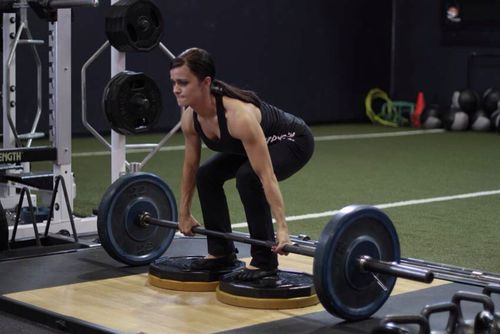
    The deadlift trains the back, with a bit of legs and grip-strength thrown in. It is tricky, because you need to have a neutral back, not rounded or hyperextended, and because you must take care not to get off balance. It is the lift where you “bend over and pick the bar up off the floor.” All you have to do is stand up, with the bar hanging from your arms. Nevertheless, it is easy to screw up.


    I hear it is not a popular exercise. You do not see many people deadlifting at my Y. But that is kind of funny, because it is hard to think of a move that builds a more useful kind of strength. It’s the move that trains you to pick up a heavy object from the floor without hurting your back. Think a big sack of rice or dog food or potting soil, there on the ground at the store, that you’ve got to get into your shopping cart, or a crate of full wine bottles that has to go in the trunk, or a 75-pound kid with a sprained ankle.

    Think deadlifts might be dangerous? Someday you are going to have to pick one of these things up, and it will go better if you know how to deadlift a bar that is even heavier.

    I started with the empty barbell lifted up on blocks to approximate its height when loaded with standard plates. I took my time with the first lift, carefully going through the steps of a sort of form checklist that appears in the book:

    • stand with heels 8-12″ apart and center bar over arch of foot
    • bend knees slightly so shins touch bar without pushing it forward
    • bend at the waist without dropping hips and grip the bar just outside of legs
    • rotate chest upward between arms and contract back to normal arch position
    • use back to drag bar up shins and past knees, then straighten up and drag bar up thighs.

    But I was pleased to note that the motion felt natural and easy to me. It is still in my motor memory from the time I tried to learn it some years ago (using this online resource).

    Come to think of it, I never really forgot it because after I learned to deadlift, I always and ever after used deadlifting form to lift heavy stuff; at least when lifting with the legs was impractical, such as getting a heavy box out of a deep car trunk, or certain kid-lifting scenarios.The key is first, to get the center of mass of you and the object close to being directly over the arch of your foot, and then, in the contraction of the back muscles: after grabbing the object, you take an instant to, as Rippetoe writes, “rotate your chest upward between your arms” and put a normal (but not hyperexteded) arch in your back. Just enough to make sure it isn’t rounded. Then go slowly so that if it turns out the load is too heavy, or too far from your body (= too much torque) you can stop before you hurt yourself trying.

    So without thinking, I have been practicing the deadlift for years.

    I lifted the 45-lb bar five times, then added 10 lbs and lifted another set of five, then added 5 more pounds for a third set of five, and called it good. So my starting deadlift is 60 lbs. I also added five pounds to my squat weight. (Still squatting outside the dumb, too-tall, fixed-height rack.)

    Next time will be the first lifting workout where I will do all three lifts. Then, after that, I am going to figure out the bench press.


  • Weight bearing (sometimes these titles write themselves).

    So… having got medical clearance last week, I went to the Y on Tuesday evening, not to swim, but to start a weight training program.

    Now.  If you know anything about me at all, I'm sure your first question is, "Erin!  What book are you using?"  So let's save time.  I'm using a pair of books authored by Mark Rippetoe:  

    Some googling will let you know that this author's style is not to everyone's taste (sample quote:  "The only legitimate use for a glove is to cover an injury… If your gym makes a lot of money selling gloves, you have another reason to look for a different gym.  And if you insist on using them, make sure they match your purse.")    

    Given that, I can recommend another educational and inspiring source that is similarly no-nonsense but much less likely to bring back PTSD from high school gym class:  stumptuous.com , written by Krista Scott-Dixon, who is only one inch taller than me.  If nothing else, her article "Don't Fear the Free Weights" is a great place to start.   

    + + +

    Nevertheless, the Rippetoe books are thorough, detailed, and — this part is important – simple in their approach for the novice.  I compared the advice in these books to another very popular weightlifting book The New Rules of Lifting for Women by Lou Schuler, and my impression was that the latter contains a lot of unnecessary shuffling around of many different exercises.  This might keep it from getting boring, but it also means a lot of time spent on the learning curve.  So:  not for me.

    Rippetoe suggests starting with four barbell exercises (links go to stumptuous.com so you can see what I am talking about):  

    The press and the bench press alternate, so you only do three at each workout.  That's it.   Alternate, three workouts a week.  Cardio not required.

    + + + 

    Speaking of books, there's one more in this history.  Of late, Mark's been implementing some of the principles in Training for the New Alpinism:  A Manual for the Climber as Athlete by House and Johnston.  I read through some of that book, and I liked its attitude of goal-specific training:  not so much making the motions of training match the motions of your sport, but training for the particular mix of endurance, strength, and technical skill that your sport calls for.  

    Mark's interested in skiing and ice climbing and rock climbing, maybe running a 5 or 10k here and there, always looking about three months ahead to the next trip.  My sport, on the other hand?  Life with kids, and staying mobile and strong and able to choose many activities as I get older.  I have modest but long-term goals.  

    + + +

    So, we read through the theory in the programming book together.  While I had waited for my doctor's appointment, Mark started re-acquainting himself with overhead press, bench press, and pullups (which make an appearance a bit farther along in Rippetoe's program but are nevertheless known to be a good exercise for climbing).  

    I spent a long time Tuesday afternoon, while the kids were messing around with some new Minecraft feature, carefully taking notes about the squat and the overhead press.  I've done both of them before, but it's been a long time; I think the last time I did weight training at all was before my 7yo was born.  

    I don't have any special weight lifting clothes or tape or anything.  I wore my running capris, my cross-country racing flats, and a tee shirt.  Mark wore the baby in the Boba carrier; I met him at the stairs after a few minutes warming up on a rowing machine.  "Thanks for coming with me," I told him.  "I know I've done this before, but I still feel like it's obvious I don't know what I'm doing."

    "Why don't you do the overhead press while I've got the baby here, and then I'll take him down to the child care while we both work on the squat."

    "Okay."

     I went to the A-frame rack of small barbells, because I knew I would not likely to be able to start with the empty Olympic bar; it weighs 45 lbs all by itself, and most people can't lift as much in the overhead press as in the other lifts.    "I'm only pressing fifty," Mark pointed out by way of reference.  The small bars weigh twenty pounds, and the smallest plates are 2.5, meaning that the lightest barbell is 25 pounds.  That is where I was to start.

    Mark pointed out that the top peg of the A-frame was just about the right height for me to take the barbell into the correct position.  And that is where the 25-pounder happened to be resting, so I gripped it and took it out of the rack, resting it at my collarbone.

    It wasn't that heavy.  I checked my notes:  elbows forward, overhand grip, thumbs encircling, wrists straight.  I rocked my body back and forth a couple of times, muttering, "Let's see…"

    "It's not that complicated," said Mark, "just push it up till you lock your elbows."

    I pushed it up to the ceiling and felt what it was like to be stable under the bar.  Once it is all the way up, it isn't hard to hold it there; your elbows lock and that's it, you are a pillar in compression.  The tough part is getting your face out of the way as the bar goes up and down around it, but that's harder-looking on paper than it was in the gym.   

    I brought it back down, and repeated it for a set of five.  I didn't need to slow down; I could do more weight than that. We switched it out for the thirty-pound bar, and that was more difficult; I could tell I would not be able to lift five additional pounds, but I could press thirty pounds for three sets of five with only a little slowdown.  So.  Thirty pounds.  I wrote it down.  

    Time for the squat.  Mark toted the baby downstairs while I performed a few bodyweight squats.  I am naturally quite flexible, my one genetic advantage, so it isn't hard for me to drop all the way down ("ass-to-grass," or ATG, as they say in the creepy bodybuilding forums).  My heels stay down and my knees don't hurt, and I don't have any bad habits like looking at the ceiling or arching my back.  

    When Mark returned, we headed over to the squat rack — and I instantly saw a problem.

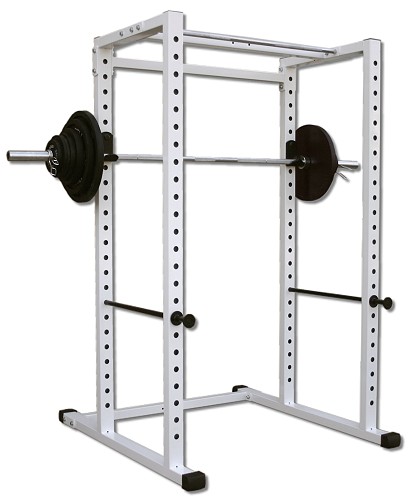
    Eight years ago I squatted at the gym in a proper squat cage, aka "power cage."  These look like this:

    Squat_rack

    The cage has three functions for the squatter (or the bench presser).  

    • First, it holds the bar for you while you change the plates.  
    • Second, it holds the bar for you on a pair of hooks, the height of which you can adjust, while you get into position under the bar.
    • Third, it has a pair of adjustable safety rails that you set just below your range of motion.  They are supposed to catch the bar if you drop it or crumple under it, so it doesn't destroy the floor (or, in the case of the bench press, crush you to death).

    Unfortunately, in the intervening years, the Y got rid of the squat cage and replaced it with a squat rack.  These look like this:

    Legend-3138-Squat-Rack

    Ostensibly they perform the same three functions for the lifter who wishes to safely execute a squat.  The hooks hold the bar for you while you change plates and get into  position.  And there are safety rails to catch the barbell if you drop it.  

    However, the safety rails are not adjustable; they are fixed.  And guess what?  They're too tall for me.   If I were to squat inside such a rack, I'd get partway down and then the bar would go BANG and stop while I went the rest of the way down.

    And probably too tall for a lot of other people, too.  Even though I'm unusually short and unusually flexible, it seems to me that you only need to be unusually one or the other to hit the rack.  I googled around and found lots of complaints from below-average-height males about the squat racks at their gyms.  How annoying.

    I talked to a staff member named Joe who agreed that it was a major bummer and added that he heard they were going to get rid of it and replace it with a squat cage sometime in the fall.  

    Putting an aerobic step inside the cage felt very unsafe, and I couldn't easily stop partway down.  What I wound up doing was stepping back outside the safety rails, which is a stupid thing that nobody should ever do with a really, really heavy weight.  At this point I'm only lifting the 45-pound bar; if I drop it, nobody's likely to get hurt.  

    If I'm lucky enough to progress so fast that  the cage isn't here yet and I can't justify doing it without the safety, I'll just have to rope a couple of staff members into helping me — because the squat requires two spotters, one on each end of the barbell.  Either that or get Mark to spot from behind, a method which requires a certain level of comfort and/or intimacy with your spotter.

    WiscFit_SquatSpot1 Not a job for some random guy I just met at the cross cable machine.


    Three sets of five, and that was enough for the day.   

    When we fetched the baby back from his 20-minute stint in the child care, he wanted to go straight to me.  I tucked him in the crook of my arm and instantly felt the fatigue I'd given myself.  I was glad to transfer him to his car seat back at the van.  The next morning everything felt warm and just a wee bit sore:  not an unpleasant feeling, and I can tell that I worked hard.  A completely different feeling from the post-swim sensations I am used to.

    Next time, I learn the deadlift.


  • Bearing on bearing.

    Rebecca Frech at Shoved To Them is writing about playing the self-presentation game, something that's become necessary as she has searched for a diagnosis for the apparent degeneration of her  ten-year-old daughter's lower-body strength.

    All morning, I've been thinking back to the girl I was in junior high and high school. I was a little bit hopeless. While my friends could execute the eleborately sculpted hairstyles of the 80s and 90s, and perfectly swipe on the latest make-up trends, I couldn't. I wanted to, but I always ended up looking as if I'd gotten ready in a very dark room. I would slide back to my comfortable default of tomboy, and hang out there. 

    As a young mom, my go-to look became either a naked face and simple ponytail, or the bare minimum of mascara and lipgloss. I wanted to look pulled together, but it was really a lot more work than I was willing to do. Which makes mornings like this amusing and a little sad to me. 
     
    In the time since Ella's arthritis journey began, I've become an expert with a flat iron. I've learned more than I ever wanted to know about the nuances of eyeshadow, and have debated the merits of different mascara brands. My jewelry box overflows with accessories, a far cry from the few funky pieces I once owned and loved.
     
    Part of my transformation is due to maturity and the influence of one very style savvy friend, but more so to the quest for credibility.
     
    Two years ago in a rheumatologist's office, I realized that my intelligence is tied into the perfection of my eyeliner. The more put-together I look, the more seriously medical professionals take what I have to say. My naked face makes me invisible, while a full face of make-up makes me worthy of being heard. It's a game of perception.
     
    Authority figures are perfection. That's what I've learned in the past two years.
     
    If all the world is a stage, and we are merely players, I'm playing my part today. I've painted on the mask of rational and reasonable motherhood. I put on my visible intelligence along with my jewelry. I spritzed on confidence along with my perfume. It's an act, a carefully fashioned persona. It's ridiculous and maddening, and dead necessary.
    One last check in the mirror, and a final tug at the shape wear that's smoothing out my imperfections. My two year old pats my leg and smiles up at me, "Pretty mama" comes from behind her paci. And I know I'm done.
     
    The flawless image of calm perfection this morning is all part of a absurd game, but it's the most important one I'll ever play. I didn't make the rules, butI've learned how to play by them, and I'm going to win.

    I don't have an urgent reason to put on a mask, the way Rebecca does right now.  But I relate to a lot of what she says here anyway.  I understand defaulting to a not-wanting-to-bother-with-all-that crud.  I couldn't quite figure any of it out, either, and couldn't see the point.  Ridiculous.

    I didn't want to play some stupid game of presentation.

    Much later, I understood that other people are going to play the game of perceiving whether we want them to or not, and opting out of that game is … not exactly impossible… but let's say, it's a privilege to be able to  opt out of it.

    You sometimes don't run up against it until, all of a sudden, a gatekeeper of some kind finds a reason to interpret their perception of you in the worst possible way.  

    Rebecca needs to look like an intelligent adult, concerned for her child because of a non-imaginary reason.  Above all she needs the professionals she deals with to be able to see themselves in her place:  concerned that time is running out, frustrated by a diagnosis because it is difficult to pin down, not because it is not real.  For her daughter not to be dismissed, she needs to be undismissable. 

    + + + 

    As for me, I don't have the urgent problem that Rebecca is facing; but in a way that seemed a bit backward at the time, my morning self-care routine started to get slightly more complicated the more children I had.  

    As I finished up graduate school in the wake of having had my first baby (and my second), and as I realized I wasn't likely to be looking for a job anytime soon after graduate school, I neglected "professional" behavior:  I skipped out on every seminar and extra duty I could get away with, I brought the baby with me to my office and to conferences,  I worked from home, I dropped to part-time.  All this worked well enough for me given my priorities — we kept the kids out of childcare, I graduated — but I could feel the air turn just a bit colder.  I developed a strong aversion to the sense of not appearing to belong.    I still carry that aversion with me.  

     I do not have a "personal style" to speak of.   When it comes to dressing myself, I'm constantly waffling between two mostly-false personae:  

    • the Deliberately Low-Maintenance, Vaguely Athletic (Tevas, performance-fabric hoodies, quick-dry skorts — see the Title Nine catalogue for what I'm going for) ; and
    • Simple, Classic, A Bit Retro (less-outrageous John Fluevog shoes, tailored pants and fitted dresses, lots of black, jeans carefully selected at considerable time and expense, a curated closet of a few versatile pieces).   

    What these two personae have in common is only what they are not:  Sloppy Mommy.  

    They are the two things I can somewhat convincingly be — in order not to be Sloppy Mommy.  

    I felt that Sloppy Mommy was somewhat forgivable, early in my parenting years.  But nowadays, when I am liable to show up at the art museum at noon or at a local family restaurant late on a Tuesday evening with five children, I'm very, very determined to avoid it.  

    + + +

    Sometime during my fifth pregnancy, I went from Bare-Faced But With Decent Hair to  mascara and tinted lip balm.  

    I can't decide if this is an advance or a retreat.

    + + +

    As time goes on, though, it's less about who I don't want to be, and more about who I want to be.  And there's another thing those two personae have in common, another thing that separates them from the specter of Sloppy Mommy:  they look like they did it on purpose.   Athletic Me, at least in my mind, might have just came from the gym (wet hair, therefore, is totally okay) or is about to go kayaking or something.  Simple But Classic Me might be on her way to work, or to meet her husband for a dinner date.  

    Both personae appear to have plans.  Options.  I'm choosing to be here, where I am, with you.  

    + + +

    In college sometimes, a classmate here or there, normally unshaven in a grunge shirt and jeans full of the tiny holes that mark you as having done your time in organic chemistry lab, would suddenly show up to class in a pressed button down shirt and suit-pants, the coat hung carefully in the back of the classroom.  Or if it was a woman, the Birks traded for heels and pantyhose.  Everyone knows what that means:  Job interview today.  We accept it.  But everyone knows, yes even the interviewer knows, that The Suit is not who we really are. 

    It's necessary, I guess, so we can prove that we can play the game if it's called for.  Because unwillingness to play the game is one thing, but inability is another.  

    + + +

    How to maintain a belief — simultaneously — that invisible character is far more important than appearance — at the same time as conceding the practical advantage of cultivating a useful appearance?  These questions never seemed to matter too much until I had children to teach.  We are trying to teach them to see beyond appearances while, simultaneously, teaching them to give no one else a reason to dismiss them because of their own appearances.  

    Does the one lesson undermine the other?

    I can grasp at a few ways to reconcile the disconnect.  Rebecca has found one, an adversarial interpretation:  it's a game she didn't choose to play, but having been dropped into the arena, she intends to win.  Those polished nails are sharp.

    I tend to take a fake-it-till-you-make it approach, dressing as the woman I would like to be (only I'm a bit schizophrenic about exactly who that is).  Self-confidence is good to have, I might say, and it's the kind of thing that travels both directions:  when we feel confident we look polished, or at least purposeful; and when we take time to be deliberate about appearance, we feel more confident.   

    Opting out is a possibility, too, but I fear it only really works when it's authentically radical:  St. Francis of Assisi, Frida Kahlo.

    How about you?  Is that a mask, or is it real?


  • (Two-)Armed and ready.

    I mentioned a few days ago that I was going in to see a sports medicine specialist about my old wrist injury to find out whether it had any implications for starting a strength training program.

    I had called my dad and asked him if he still had my medical records from the surgery; indeed he did, and Fed Exed them to me in time for me to carry them to my appointment. It was interesting to read the surgeon’s report and compare it to my memory of the event. Yes, the medial nerve (which goes to the thumb, first, and second finger) had been completely severed and reattached; the ulnar nerve had not been severed. Two tendons completely severed, one partly severed. I had really done a number on that one.

    “Was your injury a fracture?” asked the nurse. He was clad in scrubs that were doing their best to imitate a Hawaiian shirt and beachcomber pants. “No? Oh good then, we won’t need an x-ray.”

    “I have my medical records,” I said. I was carrying them in a yellow folder that the baby kept grabbing for and trying to eat; I shifted them, plus the carseat and the diaper bag, to the other arm and disentangled my hair from his grip as I followed the nurse down the hall.

    “That will help a lot,” he said. We had reached the examination room and he was sitting down at a computer, executing a rapid, practiced password entry. “Now, let’s see… how to put this… you’re not here for an injury exactly…Patient about to start exercise program… needs consultation…”

    “You could maybe put that I am concerned about whether I should modify my exercise program because of my old injury?”

    “I have to decide which category to put you in. I don’t write the categories, it’s whoever came up with this data entry program.” He scanned down the list. “Let’s call this a ‘consultation prior to beginning exercise program.’” He chucked the baby on the chin, said “Two shakes” and headed back out the door to fetch the doctor.

    I bounced the baby on my lap and looked around. The sports med doctor’s office displayed two shadow boxes on the wall; each contained a race number and a marathon finisher’s medal. There wasn’t anything else to look at. I set the carseat on the floor, buckled the baby into it, and played peek-a-boo with the baby from behind my yellow folder until the doctor came in.

    She was a slight woman, with dark pixie cut hair and a Spanish last name, no taller or older than me. She listened to my story, how the injury happened, how I easily drop things in my right hand, how I am afraid of re-injuring the wrist every time I lift something heavy. She took the surgeon’s report and read it all the way through in front of me — which is, now that I think of it, the first time that a doctor has ever read any material that I brought along with me, and it isn’t the first time I have brought any along.

    Then she scooted her chair over to me and said, “Show me your hands. No, not that one, both of them.” She put out her own hands expectantly.

    I put my hands out. She examined them together, the normal, dominant left one, the injured right one. She pinched the muscles at the bases of the thumb. She asked me to spread my fingers, and resisted them by applying force with her own fingers. She had me touch each finger to the thumb in turn, and resist her as she hooked her own finger in mine to pull finger and thumb apart She moved each finger, murmuring approvingly: “They did a good job with you. Where was this hospital?”

    “Dayton, Ohio. Well, a bit south of there.”

    “They must have got you in soon after the injury. The tendons…”

    “I think so… I think maybe six hours or so afterward. It was a Friday afternoon, after school.”

    “Your range of motion is almost totally normal. At least, it is the same as the other. Squeeze my hands.” I did. “Grip strength is the same too.”

    I stared, and tried again, this time one hand at a time. Same. “You’re kidding. I was sure it was much weaker!”

    She rummaged in her desk drawer and took out a tiny probe, nothing more than a wand with a single plastic fiber emerging the tip. “Can you feel this? No, don’t look. Tell me when you feel this.” She pressed it into my fingers, asking. Then she put it away and brought out a business card. “Pinch this between your left index finger and thumb. Hold tight.” I gripped the card as she tugged, my three other fingers outstretched in an OK sign. “Okay, other hand.” She tugged and laughed: “There’s the difference.”

    I watched: when she tugged at the card I was gripping between my right index finger and thumb, my middle, ring, and pinky fingers snapped down and clutched involuntarily at the card, silently assisting, a reflex I didn’t know I had.

    She took a couple of paper clips out of her desk and started to unbend them. “Is this the do you feel one or two pokes test?” I asked. I looked at the ceiling while she prodded the pads of my fingers with one paper clip point, then with two of them at the same time. I could distinguish two on all five fingers of my left hand, and on my right pinky finger and my ring finger. Two felt like one on my middle finger and thumb, and the index finger could not even feel a poke, just a gentle pressure, as if she had put her fingertip on my fingertip and pressed. I looked down to see the paper clip pressing deeply into the pad of the fingertip, leaving a dent.

    “So. That’s different too.” She quizzed me about the sensations, about heat and cold, pressure and pain and texture. And then she asked about my plans.

    I told her that I was hoping to start training with free weights. She said, “The wrist isn’t any more likely to be injured than your other wrist because of strength or flexibility. But the neurological damage, the loss of sensation, the proprioception, that could cause a problem. So.

    “I don’t want you to try to do pullups or chinups or negative pullups. Too easy for you to lose your grip, and you might drop yourself. Now, the lat pulldown, that is a machine, but that will be an okay substitute. The weight is too heavy, you just let go. It’s the weight that falls. You can’t hurt yourself.”

    “What about the pain I used to get with the lat pulldown?” I asked, remembering the shooting sensation that scared me off that machine several years ago.

    “You just back off the weight, stay at the same weight till you are stronger and the pain doesn’t happen. You are afraid of hurting yourself. But you will let go before you hurt yourself. It isn’t going to tear.

    “Another thing. I want you to tape your wrists, both of them. For support.”

    I didn’t understand; I encircled my right wrist with my left thumb and forefinger, squeezed, wondered, “How does that help?” it isn’t as if my wrist will come apart by bursting outward.

    “It will keep your wrists from flexing forward.” She demonstrated a biceps curl, with a straight wrist. “You want all the work to be done with your arms.” Then she repeated it, curling her fist inwards at the wrist: “But some people will involuntarily try to lift by bending the wrists. The tape keeps the wrist stiff. This is a way to avoid wrist injuries.”

    “What about pushups?” I asked. “Do I need some special handle thing because I can’t put my hand flat on the floor?”

    “You can put your hand flat on the floor.”

    “I can?”

    “Yes. The range of motion is the same. Go on, see.”

    Drop and give me twenty. (Okay, one.) I set down my bag, knelt next to the carseat on the carpet in the examination room — the baby looked at me quizzically — and put my hands down flat on the floor for a girlie pushup.

    “Your arms aren’t parallel,” she pointed out.

    I corrected that, then lowered myself to the floor, bending at the elbows.

    She was right. The range of motion was the same. The right felt tighter, harder to flex. But although the left one didn’t hurt or feel stretched, it stopped flexing at the same place.

    I had been saying I couldn’t do pushups because of the range of motion limitation for 25 years longer than I needed to.

    I began to wonder if this idea had originated as an excuse to get out of trying too hard in gym class, and if it had been that long ago that I started to believe it.

    She advised me not to increase the pulling force on the wrist by more than 5 lbs. every two weeks (meaning I will have to get some one-pound plates to bring to the gym), and sent me on my way clutching a card full of notes from the appointment.

    I mused as I left that it was possibly the single most valuable “well adult” exam I’d ever had. And here I am, cleared to start lifting, sooner than I expected. I don’t even have a notebook yet, let alone micro plates and some tape. Looking forward to it, though.


  • Looking for the magic words to push back with.

    This was going around on FB the other day:  Two parenting stories from the country that used to be America:

    Hardened Criminal #1: Stay-at-home suburban mom lets kids ride scooters on her cul-de-sac. Pain-in-the-ass neighbor calls to complain. Idiot cops fail to tell neighbor to get bent, and instead arrest the mother for child endangerment: overnight in jail, orange jumpsuit, 18 hours behind bars and all.

    Hardened Criminal #2: Working, lower-income mom gets daughter a laptop so the daughter has something to do while she waits in McDonald’s for mom to finish her shift. Laptop gets stolen. Daughter asks if she can play in a nearby park with fresh air and cool water rather than soaking up the atmosphere in the nation’s primary fat factory. Mom gets daughter a cell phone so she can check on her and then let’s her go play. Mom is arrested for child endangerment and daughter is given to social services. 

    I passed it on, too, mostly because I liked the following comment from Tom McDonald, who put together the post:

    People are acting like every child is assigned a stalking kidnapping pedophile at birth who follows him around waiting to pounce.

    And people are letting their desire to feel comfortable trump parents' right to make reasonable judgment calls.  

    Once a meeting my nearly-12yo was at, at church, was running late, so his dad and I gave him a cell phone and went to run a quick errand 1/4 mile away, telling him to call us when he was done and wait outside in front of the church — in broad daylight, I might add, on a suburban street with plenty of foot and vehicular traffic.

    My cell phone rang all right — from one of the other parents, who called me to let me know that he had arranged for someone to babysit my 12-year-old inside the youth group room because he just didn't Feel Right about letting my son call us on the phone from outside the church to say "I'm done with training, come pick me up now."  

    This annoyed me on several levels, some of which you will no doubt be able to come up with on your own.  I found myself really at a loss on the phone to come up with the right language for this situation, which was not, I believe, "Thank you for your concern."  In retrospect, I wish I had handed the phone to my husband and let him deal with it.

    I just didn't know what to say that would help.

    Isn't this what we are all most afraid of, the thing that keeps us from letting our kids develop responsibility and self-reliance?  Not the nasty kidnapper, but the nosy neighbor?  The person who "just couldn't forgive herself if something happened and she didn't say something?"  The person who then gets to go about her day thinking of herself as a swooping rescuer, and doesn't have to live with the long-term consequences?

    Jamie, however, says:  "Push back."  I quote her in toto:

    You guys, things have gone too far. I just saw this link on Facebook, followed by a bunch of worried comments. It is time for a Sane Mom Revolution, in which we decline to take any more of this crap.

    In case you have forgotten or are new around here, I was the subject of a full-on investigation by CPS. I can attest that it is NO FUN to be asked how many of your children tested positive for drugs at birth. (I have wondered, in the years since I wrote those posts, if I would have been less agitated in a non-pregnant state.) I can also attest that my husband's words were true: we are not living in a Kafka novel. I can attest that you can have a calm conversation with a CPS representative about why you let your kids out of your sight now and again, and you can be persuasive. Declaration: unfounded.

    You can have an awkward conversation with a neighbor who thinks your kid shouldn't walk around the block, and it can go smoothly. You can talk to the cops when the cranky neighbor calls them about a lemonade stand, and the cops will probably be reasonable.

    We can't live in fear that our kids will be kidnapped, and we can't live in fear of the people living in fear that our kids will be kidnapped either. CPS and the police need to hear from American parents: we are not going to expose our kids to unnecessary risks. In keeping with this commitment we are going to stop driving them all over the damn place because that's the thing most likely to kill them. Let 'em walk — save a life!

    There's a lot at stake here. Independence and good judgment do not suddenly descend upon 18-year-olds who have spent their lives being driven about from place to place — kept safe from mustachio-twirling strangers, perhaps, but not from their own stupidity. 

    She's right.  

    I'd wager that the number of children whose parents are investigated by CPS because they let their kids play outside is preeeeeeetttty small, even if it seems that we all know someone who know someone that happened to, including witty and popular Catholic mom-bloggers.   

    Are we letting ourselves be ruled by that fear?  It's a poor substitute for being ruled by the fear of kidnappers or pedophiles or dingoes, you know.

    The truth is, I have been.  There may not be that many CPS investigations, but there are a lot of nosy people who are worried about their sensitive ability to forgive themselves, it seems.

    This past Saturday I was taking a walk with my four-year-old.  I had the baby in a carrier on my back.  We were on our way home, chatting happily, and as we approached the last crosswalk before our block, the four-year-old said to me:  "Mama, I want to try walking next to you without holding your hand."

    "Okay, we can practice that," I said as we got closer.  "Remember to walk right next to me the whole time, just exactly as if you were holding my hand, because the cars can see taller people like me better.  And don't go until we both see the little walking man light up."

    He hopped with excitement and let go of my hand as we waited on the corner, and when the little walking man lit up, we started across the street.  He took carefully timed steps to stay close, and I touched him lightly on the top of his head, pleased at his idea.

    Just as we stepped up onto the opposite curb a big SUV slowed down abruptly next to us and a bit in front, and the driver shouted something that I didn't quite hear.  Was he asking for directions?  I tilted my head inquiringly — he shouted again — I walked forward with my sons and said "I'm sorry?"

    "You holding that boy's hand?" demanded the man behind the wheel.

    Oh, I get it.  "It's okay!" I shouted back cheerfully. "We're practicing!"

    "All right then!" shouted the driver, and accelerated away.

    I stood there for an instant watching him go, wondering what had come into my head to say We're practicing! and also wondering what about those two words, or about us or about me, had given that neighborhood stranger the message that he was looking for, to feel that he had seen enough to stop shouting at me.  I felt a tug at my hand:  my son was grinning from ear to ear and asking, "Mama, did you see me?  Did you see I stayed close to you?"

    "I saw it all right," I said, and we went home.  Later at dinner he bragged to his dad about what he had done, proud and happy.  

    We're practicing.  

    It may not make all the specters fly away, but it's a start.


  • Newfangled language learning.

    My name is Erin.  My husband's name is Mark.

    Je m'appelle Erin.  Mon mari s'appelle Mark.

    Mi chiamo Erin.  Mio marito si chiama Mark.


    We live in Minneapolis, Minnesota.  It's in the north of the U. S.

    Nous habitons à Minneapolis dans l'état de Minnesota.  C'est dans le nord des États-Unis.

    Abitiamo a Minneapolis nello stato di Minnesota. È una città nel Nord dei Stati Uniti.


    There are no mountains there.  Only hills and river bluffs.

    Il n'y a pas de montagnes chez nous. Seulement des collines et des falaises le long des rivières.

    Non ci sono montagne in quel luogo. Solamente delle colline e scogliere lungo le fiume.


    We have five children:  four sons and a daughter.

    Nous avons cinq enfants:  quatre fils et une fille.

    Abbiamo cinque figli:  quattro figli maschi e una figlia.


    The older children are homeschooled.  

    Les enfants les plus grands reçoivent l'instruction en famille.

    I figli più grande sono insegnati a casa.   


    First we are going to Chamonix for two weeks, then we are going to Rome for ten days.

    D'abord nous allons à Chamonix pendant deux semaines, puis nous allons à Rome pour un séjour de dix jours.

    Dapprima andiamo a Chamonix-Mont-Blanc nella Francia… 

    let's see…

    …do I want to think "during two weeks" as it would be in French, or "for" or "through?"  Prepositions are so tricky.  

    + + +

    I learned how to translate with a pair of dictionaries, French ones:  the big hardcover Harper-Collins-Robert dictionary, all five pounds of which I lugged in my suitcase to France when I did my study tour in college; and a paperback Le Robert Micro Poche dictionary that I bought while I was there, French words with French definitions.    I have pulled them out a few times since finishing college, mostly because Mark wanted to read ice climbing trip reports.  

    There is a trick to doing this with dictionaries, especially when you're trying to go from your native language to a target language.  You have to look everything up twice, because the target language side of the dictionary is often where the specific examples are.  So, taking the Cassell's Latin & English dictionary for an example, if I want to say I don't speak fluent Latin, and I look up "fluent," I find,

    fluentvolubilis, disertus; adv. volubiter

    The "adv." bit means that volubiter probably means the adverb fluently, which makes me think, "I bet it would be more likely to come out okay if I try to translate speak Latin fluently instead of speak fluent Latin."  I turn to the Latin side and look up the first word and get

    volubilis, -e rolling, revolving, turning round; changeable; inconstant; of speech, rapid, fluent; adv.  volubiter, fluently.

    The -e tells me for sure how to decline the adjective so I can apply it to a noun that's (as in this example) a feminine direct object (linguam Latinam volubilem), and the definition here with its note "of speech" confirms that it's the sort of meaning I want.  It also tells me that, while in English the adjective literally means something that water does, in Latin the adjective literally means something that, say, a spool does.  

    (Now I will remember it:  deleting the idea of a rapidly flowing river, I substitute  the mental image of an old audiocassette, the spindles revolving, spooling tape from one side to another as Latin phrases burble  from a speaker.)

    I pick the adverb form because I have to fuss less with word order that way, and write Linguam latinam non volubiter loquor.  (Choosing loquor itself requires several lookings-up, as "speak" in the dictionary gives me three choices and I need to check them all to see if one is more correct than the others; imagine someone telling you, "I don't talk fluent English" or, worse, "I don't lecture fluent English"  and you see what I mean.)

    + + +

    So, French is the only language that I have been taught in a formal setting, but I was fortunate to have had fantastic teachers who gave me exactly the right foundation for springboarding into self-teaching other languages — Romance languages anyway; I haven't tried it on anything else.  I'm guessing my grasp of Latin is about equivalent to two years of high school Latin by now, which is certainly enough to teach younger kids to go "amo, amas, amat" and is usually enough for me to assist my high-school-aged kid to navigate a textbook.  

    (People are always asking me why, since I already speak it pretty well, I'm not making the kids study French.  My thought is, if I'm going to spend all this time working with my kids on a second language, why waste it on something I already know?  I want to learn a new one!  So we learn it together.)

    I do make mistakes from time to time, most of which I can blame on the textbook.  So, for instance, the primary-school Latin curriculum doesn't bother to mention the natural-gender rule:  although nauta, nautae, "sailor," belongs to a class of nouns that are nearly all feminine, you always use a masculine adjective to describe a male sailor.  (It's terra bona, good earth, but nauta bonus, good sailor.)   The primary-school curriculum doesn't get as far as attaching adjectives to nouns and making them agree with each other, so it isn't in there.  But of course the minute that the children have bonus and malus they want to be able to talk about good barbarians and bad barbarians, good bears and bad bears, good sailors and bad sailors.  

    And that's when the parent decides that it's okay to depart from the curriculum and reads a little bit about adjective agreement and thinks they get it and teaches the kids to say "barbarus bonus et barbarus malus, ursa bona et ursa mala, nauta bona et nauta mala" and then about eight months later when next year's textbook arrives has to say "Guess what, I taught you wrong.  We have to unlearn something now."

    (For the record, I have also had to backtrack concerning various points of word order and the entire list of I-stem nouns of the third declension.  I made a game of it with the high school age kids.  If they catch me making a mistake, they win a piece of candy.)

    + + + 

    Anyway, I am now trying to teach myself as much Italian as I can before traveling to Rome with the family later this fall.  It's probably not entirely necessary; Mark, who never had a particular interest in languages, gets by happily with a phrasebook wherever he goes on business (well, there was the one time when he glanced too quickly at the dictionary entry and ordered "deaf coffee" instead of "decaf coffee").   It's more of a personal challenge:  how well can I do with a few months' preparation?  

    My oldest son has also embraced the challenge.  He's mostly using Duolingo online, and has gotten farther with it than I have.  I'm dabbling a little bit in Duolingo but I'm mostly using Pimsleur audio lessons in the car.  The result is that he has more vocabulary than I do, but I feel more comfortable with the flow of conversation.  I'm pretty sure I can make decent cognate-based guesses about vocabulary.  I'm also studying lists of prepositions (before, after, around, across) and common adverbs (left, right, more, less, always, never) because in my experience these are extremely helpful cues to the meaning of entire sentences.  And are good for asking directions, a useful skill when you visit an unfamiliar place.

    And then, I'm writing out the "who are we and what are we doing here in Europe" script.  I want to have the vocabulary for our names, our kids' ages, where we are from, what we hope to see in town, how we managed to get away for a month during the school year, that sort of thing.   I managed most of the French without lots of research, but the Italian is trickier.

    And you know what?

    Foreign language dictionaries?

    You don't really need them anymore, if you have an Internet connection.  I'm discovering that the English-Italian resources at Wordreference.com and Wikibooks.org have everything I need to figure out — closely enough — how to write what I want to say in Italian.  It's very easy to look up fluently and get two examples:

    • (language:  with ease) fluentemente, correntemente
    • (motion:  gracefully, smoothly) in maniera aggraziata, agilmente


     followed by links to the entry for the English word "eloquently" and the Italian phrase parlare correntemente, which would give me a clue that the "to speak" verb I want is parlare (if I wouldn't have already guessed that from the French parler).  Not only that but there are links to a forum where people are discussing several different ways to say "she speaks fluently" and "we should speak Italian fluently by year 12"; the words fluentemente and correntemente are themselves links to the Italian-English "side" of the dictionary; and if you click the "in context" link on the fluentemente page you'll go to Google News articles that contain the word, for example, an obituary in America Oggi about an orchestral conductor:

    "…oltre al francese, parlava fluentemente anche l'inglese, l'italiano, il portoghese, lo spagnolo e il tedesco."

    I can tell you what that means:  besides French, he also fluently spoke English, Italian, Portuguese, Spanish, and… er…

    (back to WordReference.com)

    … German.  (Tedesco?  Really?  What does that have to do with Germania?  Or  Deutsch?  I guess I can kind of see it in there somewhere.  The cognate approach can only get you so far.)

     Which brings me to an interesting question.  

    How does this change teaching translation?

    Last year I gave the 8th- and 9th-graders an introduction to Spanish (another language that I've dabbled in self-teaching).  I approached it experimentally, to see if we could use what we'd already learned in Latin to save time on grammar; they already knew about masculine and feminine nouns, for example, and adjective agreement, and verb conjugations.   I was really pleased with it — we got through a year's worth of grammar in about three months, and then we settled into a routine of listening to audio lessons and translating paragraphs from a YA novel.  (Here's the novel, by the way.)

    I gave them all English-Spanish dictionaries and showed them how to use them, including teaching them the look-it-up-twice technique — but it did not take long for them to discover that they could do better with a website called Spanishdict.com .  I checked it out and I had to admit it was much faster to decipher text with a web-based dictionary tool (including conjugation tables at a glance) than with a paper dictionary.  I forbade them from typing entire sentences into the machine translator box and made them proceed word-by-word, which seemed to have the effect I was going for.  But I wondered if the different technique would somehow change the way they incorporated new words and grammatical structures into their mental model, and if so, whether it would be for better or for worse.

    The whole experience reminds me of teaching my kids how to use the library.  When I was a child, I intuitively understood the threefold mapping of the shelves of books — author, title, subject — onto the cards in the card catalogue.  The orderliness of it satisfied me deeply, and like so many bookish people my age and older, I can instantly recall the scent of the cards and the feel of the thumb running along the edge of the stack, and remember taking slips of paper (cut-up sheets that had been printed on one side) from a tray and writing down the call numbers with a pen chained to the massive oak cabinet. 

    Of course now we don't have a card catalogue and in many ways it is much easier; you type in a search field and the call numbers are returned from a databas.  But in my mind the idea of the online library database is a superstructure built on the idea of the card catalogue, with its neat nested subjects, its titles and authors.  (Ask me how often I use this newfangled 'keyword' field to find a book.)  So I found it difficult, pedagogically speaking, to explain how the whole thing works.  I wound up starting with a history lesson explaining how the old card catalogues worked, and then going from there to say, "but today we type the subject we are looking for in the 'subject' search field."  

    Nobody has to alphabetize anything anymore; is that an unadulterated advance, a saving of time spent on tedium, or is it a lost chance to develop the mental circuits that help us organize all kinds of information?

    I wonder the same thing about language learning.  It's faster and easier to translate because of the web-based tools we have on hand.  This is great for quickly understanding a news article or quickly composing a message so that the content will be understood (especially if you don't care too much about getting the grammar precisely correct).    I wonder how to take advantage of the new tools while still getting the benefits, whatever they might be, of having to puzzle through sentences the old-fashioned way.  

    There aren't nearly as many online tools available for Latin as for languages of the non-dead variety, so I'm guessing my kids will be forced to do some things the old-fashioned way, at least for a while.  But our forays into Spanish and Italian have looked very different from the way I learned French il y avait une fois.  


  • Upcoming consultation.

    Last night I made an appointment with a sports medicine doctor, the same one Mark has been seeing ad libitum to deal with his assorted chronic injuries.

     I've never had a single sports-related injury in my entire life.   

    For the first 34 years of my life, I attributed this to having assiduously avoided the number one risk factor for sports-related injuries:  participating in sports.

    The last six years, since I took up swimming and running, I've been attributing my aging yet injury-free lifestyle to, variously, luck; naturally flexible joints; and a reluctance to go very fast when trying new things.  

    Swimming didn't really scare me, since it's famous for being the thing you do when other sports hurt you.  But running is different — believe me, I surprised myself when, the first time I hesitantly raised my speed on the treadmill above "trot," my knees did not immediately swell up and fall apart.  I really thought that Never Having Done That Before would make me liable to break an ankle or something the first time I tried it.   I pictured that RUN FORREST RUN scene, only in my imagination it wouldn't be a bunch of metal leg braces that would be coming apart and sending shrapnel in all directions, but my actual legs.

    Granted, I may have gotten this impression from observing my husband, who has been dealing with one bodily pain after another since he was in about eighth grade:  spinal compression fracture, pulled hamstring, pulled quads, plantar fasciitis, tibial stress fractures, some thing that happened once when he played racquetball too hard, and the inevitable Just A Flesh Wounds that come with rock and ice climbing.  

    After a while Mark had an epiphany.  He stopped going to see doctors who would tell him that he should quit doing things that hurt him.  He started going to see doctors who would tell him how he could keep doing things that hurt him for as long as possible, up to and including banging his head against a wall.  Enter sports medicine.

    + + +

    So what is my appointment for, if I'm not hurt yet?  Well, actually I am, sort of, just not because of sports.  Check out this scar on my right wrist (it extends just down to where the bracelet rests):

    Wrist_scar

    I have had that scar since I was about twelve years old.   Faded now, once it was an angry purple, with the stitch marks like railroad tracks. The story goes like this:

    Once upon a time I started down the steps of my friend's front porch with a pint mason jar of ice water in my hand, and I tripped.

    [Sensitive to gore?  You've been warned.]

    I caught my weight on my palms on the concrete.  The glass went SMASH and big old shards of that pint jar (along with a hell of a lot of teeny splinters)  were thrust up into my wrist.  The glass sliced right through the flexor tendons and nerves servicing my index and middle finger, while severely damaging (but not quite severing) the thumb's flexor and nerves, and nicking the connections that travel to the ring finger and pinky. 


    Hand_anatomy_6

    Commence dreamlike sequence:

     Blood everywhere, and my friend's mom's dishtowel around my forearm, and my friend running to get my mom, and the front seat of the car on the way to the hospital, and waiting for the doctor, and the horrible horrible moment when he turned my arm from palm down to palm up and my hand went FLOP BACKWARDS A LOT FARTHER THAN HANDS ARE SUPPOSED TO FLOP and that's when I started screaming my head off.  Then the big needle with the local anesthetic, which to this day is the thing I say was the worst pain ever, and yes I have had five natural childbirths thankyouverymuch, and eventually the mask and the darkness as they sent me in for orthopedic surgery, which besides the effort that went into the  reconstruction of my wrist, must have involved a great deal of tweezing.

    End dreamlike sequence.  Commence many weeks of physical therapy,  months of wearing a series of casts and braces on my arm, and years of fascinating neurological symptoms as my body dealt with linking up the nerves that the surgeon had reattached.    

    + + +


    I write with my left hand anyway, so that has never been a problem.  I took typing the year after the accident and I can type quite fast and almost normally, as long as I don't think about what I'm doing (which means that this paragraph is not going very fast).

    This wrist is the reason why I never even tried to find out if I would share my husband's love of rock climbing.

    + + +

    Some years before I took up swimming and running, I tried weightlifting for a while.  I enjoyed it, especially squats, but there were a number of exercises that I never could get very far with because of that damn wrist.  

    —-I can't do a pushup, even a girlie pushup, because I can't put my palm flat on the floor.  

    —-I can't do a chinup, even a negative chinup.  I just drop down and hang there.

    —-I can only do the very lightest of lat pulldowns.  The muscle strength is there, but the fear of my wrist coming apart has always stopped me.

     I have been favoring this wrist for twenty-seven years.   I take extra care in the kitchen with hot things because I never have developed complete sensation in the ends of my thumb, index finger, and middle finger.  If I must button a shirt or manipulate a small object, you'll see me use my thumb in opposition to my third and fourth finger rather than the first and second.  I'm afraid to lift anything really heavy, like a suitcase, because once the weight gets too big I feel these odd little shooting twinges deep in my forearm, and I have a mental image of that hand FLOPPING BACKWARDS, and I have to drop the suitcase. 

    Anyway, it occurred to me that I don't actually know whether I can, in fact, lift weights without my wrist coming apart.  I'm afraid of it happening, but it isn't actually based in any knowledge.  I haven't had the wrist examined since my last PT appointment as a teenager.  I don't know if weightlifting is even dangerous for the wrist at all.  I don't know whether it would be possible to strengthen the wrist and improve my grip and make the shooting twinges go away.  I don't know whether there are ways I could modify barbell exercises and lat pulldowns to make them work even with one bad wrist.  I have heard of ways to modify pushups, but I don't know whether it might be better to try to regain enough range of motion to be able to do a normal one.

    And I think I'd like to try getting stronger, doing more with my hands and arms.  Maybe the wrist is a real obstacle to that.  But the truth is that I've never run up against that obstacle, because I've been running up against my own ignorance about it instead.  Time to change that.


  • Quick one-liner: wedding advice.

    We attended a wedding this past weekend on Mark's side of the family.  

    0705141700-00

    Afterward, as we arrived at the reception, we encountered a table where guests could leave a thumbprint, in our choice of several shades of green, on a black-and-white image of a bare-branched tree — leafing the tree — that would form a framed memento.  I thought that was a nice variation on the guestbook idea.

    As I struggled in with one teenager and four more children in tow, my eye was caught by a glass container and a stack of notecards and a pen, with a sign inviting us to write our advice for the newlyweds on a card and drop it into the container.

    This is not such an unusual variation, and I might have expected it, after all.  

    As Mark and the kids went on down the hall towards the kids' room with the movies and coloring pages and the grownups' room with the open bar and the trays of hors d'oeuvres, I was the only one who paused to write something, but I did not have time to think for more than a few seconds.  On the other hand, I take questions like this rather seriously.

    A number of things went through my mind.  I summed them up with this one line:

    Never try to get even.

    If I had had more time to think, I would have added:  "Interpret that as broadly as possible."

    What one line would you write?