bearing blog


bear – ing n 1  the manner in which one comports oneself;  2  the act, power, or time of bringing forth offspring or fruit; 3 a machine part in which another part turns [a journal ~];  pl comprehension of one’s position, environment, or situation;   5  the act of moving while supporting the weight of something [the ~ of the cross].


  • Tuesday to Wednesday: History, art, and a stroll with my two big boys.

    Of course, I am already home by now, and the title's Wednesday was eight days ago. I still find myself thinking, "One week ago I was in Rome," and feeling the sensations slip back into the past. They are still, barely, in the immediate memory — I can still hear the ear-piercing tones peculiar to Roman ambulances, taste the supplì, feel the slick basalt of dinner-plate-sized Roman paving stones under the soles of my sandals. But they are quickly retreating into the fog of interpretation and selection.

    For some reason, I keep thinking of those cobblestones — not the ancient ones, but the rough, recent, square-cut ones, palm-of-hand-sized, that pave so many modern Roman streets in a pattern of overlapping arcs. I would like to hold one in my hand.

    + + +

    Tuesday after the Scala Santa trip, I gathered my energy, hoisted myself off the bed, and went with my Two Big Boys (with a younger sister and then two younger brothers, the 14- and 10-year-olds are going to be stuck to that moniker) to hop the bus to Trajan's Market.

    We learned about Trajan's Market well in advance of our trip, and it was one of the ancient constructions the boys had talked repeatedly about visiting in person.  Said to be the Western world's first shopping mall, it did not disappoint.  

    It's hard to tell, when you're in it, which parts are truly ancient and which had been altered afterwards.  Such a large and versatile building — it couldn't help but to be used for various purposes over the years, and its various users changed it.  For example, a religious order used it as a convent for some time; while the nuns had it in their possession, they put a floor across the second level of the great hall's atrium, acquiring more floor space.  The floor has since been removed.

    10711042_10203035358472596_1839884836329523911_n

    Furthermore, it's had some restoration work done to it — missing blocks of travertine sidewalk were replaced, for instance.

    And still furthermore, one of the old tabernae (shops) still serves its ancient purpose — it hosts a cash register, shelves of coffee-table books, and racks of souvenirs.

    Still, I believe the bones of the building are there.

    I was struck by how much sunlight and air streams into the building.  The windows in the great hall are aligned with the upper windows in the tabernae to let a great deal of light into what otherwise would be dark little cells.

    10698430_10203035358952608_5721974233220565320_n

    There are three levels of Roman roads in the market — they pass over and around it.  One is called the Via Biberata, possibly because beverages were sold in many of the shops that line it.  The sidewalks make it feel, well, very like a modern street; our bodies felt at home strolling along the second-level road.  

    The low partial walls show that once the road was not so airy, but enclosed on the other side by a rank of shops mirroring the opposite ones.

    10409053_10203035359952633_3464422136051008387_n

    On the upper levels there are sunny terraces, where we felt a fresh September breeze, and could look out onto the pavement of what once was an interior space.  The floor-tiling pattern of circles and squares resembles the one in the Pantheon.

    10456038_10203035360592649_3283400117186829049_n


    The boys and I wandered around, wondering.  We agreed that, though we had learned about the architecture of the market and knew quite a bit about it, there was really nothing that could replace the experience of walking through and around it.  We could see how the light came in to the little shops, how the great hall filled with people, how steps led from one level to another and how one might stroll down the street, checking out the contents of the shops. 

    (In one, roped off, were stored stacks of child-sized chairs and folding tables.  In another, ranks of pottery and statue-parts, numbered and labeled.  Others were empty except for sunbeams, and the dark quiet air inside that carried a strange and mildly unpleasant odor.  Still others were closed off with wooden doors.)

      10711043_10203035359512622_3540399673853608758_n

    We couldn't stay too long because I had left the baby back at the apartment with Mark and the other two children.  We were sorry Mark had missed it, but he really needed to rest, and was glad to have had the rest.

    + + +

    The next morning I was off early in a cab with the same two boys, plus the baby, to the Galleria Borghese. I barely managed to get tickets for the gallery in time to see it before we left.  The Galleria Borghese is a jewel of a museum, and its handlers strictly limit entry:  360 visitors at a time, and the visits are limited to two hours.  In between they empty the museum.

     We encountered many paintings that we enjoyed that day — we were all struck by Raphael's Entombment (here) and by an unknown artist's Judgment of Solomon (pic here) as well as a number of other things.  There are a lot of  the Madonna-and-Child, some of which are really innovative and sweet, and a number of the Holy Family:  the gesture of Joseph in this one touched my 14yo.  

    But we were really there for the Berninis:  the four great commissions of Apollo and Daphne; David; The Rape of Proserpine; and Aeneas, Anchises, and Ascanius.  Each time we encountered one, we walked around and around and around it for many minutes, marveling at the way they each fit together as a whole.  A high-quality photograph is good enough to appreciate most paintings; it is reasonably good as a means of communicating a single detail of a sculpture, if the lighting is well-chosen; but there is no substitute for walking around a sculpture to grasp it as a complete work.

    + + +

    I experienced one important first in the Galleria Borghese.  There aren't many chairs or benches in there.  This was the first time I asked someone to move off the only available chair (she was perusing a guidebook, and didn't catch a hint) so that I could sit and nurse a baby who badly needed it.

    + + +

    After the gallery, we considered catching a taxi back (buses and trams were on strike), but since it was a lovely day, we instead walked the whole way south through Villa Borghese and then continued south to our apartment near the river.  It was pleasantly hot, so that the shade of the enormous green park was welcome, and so too were the Cokes and gelatos we stopped for along the way.  

    First we stopped at Piazza del Popolo, where we entered into the church that hosts the famous Caravaggios, St. Peter's Crucifixion and St. Paul's conversion.  I love that particular pair, how they work together:  each an inversion, with Saul off his horse reaching up, and Peter being upended on his cross; the haunches of the horse, the haunches of the figure bending under Peter's cross; one a Christian life's beginning, the other an end; the cramped horizontals, suggesting  subjects too big to cram into a single side chapel.

    The boys and I took our time.  We looked into the expensive designer shops along the Via del Corso; my sons were interested in pocketknives, I in leather goods.  We passed the Spanish Steps, crowded with tourists even on this day out of season.  

    At one point the road was blocked off by tape, except for a narrow sidewalk on either side.  They were repaving the street.  First we passed a gaping hole in the dirt (and couldn't help but peep in, imagining we might see some ancient artifact); then a place where the dirt was filled in; later, where it was smoothed over, a level bed; finally, the place where the workmen, now perhaps at lunch, had been setting rank after rank of those rough cubes of gray stone that make the cobbles of the streets all over Rome.  

    The cobbles were loose in the last rank, and they lay about in piles.  The piles were unattended and I temporarily entertained the idea of bending over, picking up one fist-sized cobble, and slipping it into my handbag.  I would take it home with me in my carry-on luggage, and at home I would unpack it, and leave it lying about on my schoolroom counter.  A paperweight, a relic, a piece of the streets.

    + + +

    I didn't steal a paving stone that day.  But here at home, surrounded by my own belongings, I'm not entirely sure I don't regret it.

  • Tuesday: Scala Sancta.

    After our beach day at Santa Marinella, it seemed as if we all got a second wind.

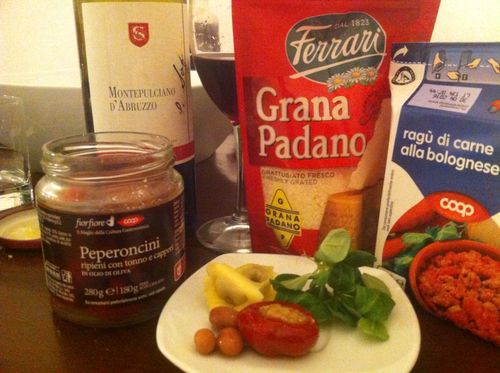
    We came back to a lovely dinner of Italian convenience food from the grocery store across the street:

    Refrigerated ravioli stuffed with proscuitto. Boxed store-brand pasta sauce (the ragù is shown, but the best was arrabiata). Bagged grated cheese. Jars of little sweet red peppers stuffed with a tuna-caper mixture. A jar of borlotti beans for the baby. A bagged salad with all sorts of beautiful mixed greens.

    With three days left in our trip, I bought a three-day bus pass for everyone over the age of 10. And…

    The next day we hopped the bus and headed for the Scala Sancta. It is over near St John Lateran and is the original “stairs that you go up one at a time on your knees” indulgence. It is a marble stairway, encased in wood for its protection (although there are a few portholes cut in the wood so you can see and touch the marble). Reputedly they are the 28 steps that once led up to Pontius Pilate’s praetorium in Jerusalem, so: they are, if it is true, a physical part of the Way of the Cross. Since the Middle Ages at least it has been said that St. Helena brought them to Rome from Jerusalem in the 300s. And the legend has a nice long history of annoying people like Martin Luther (possibly) and Charles Dickens (verifiably).

    The map was a little confusing and the building was so nondescript (at least compared to the nearby basilica) that I wasn’t sure I had the right place until I got in front of the door and saw the stairs with about a dozen people kneeling on them. (See the Wikipedia article, from which I took the historical information, for a picture not unlike what I saw. I did not feel comfortable photographing people there, although it is allowed from the bottom of the stairs.)

    I explained to the children that no particular prayer is prescribed for the stairs, so they could pray something as simple and short as the name of Jesus, or something longer if they wanted. As for me, I had downloaded a set of devotional prayers on my iPhone, the kind that gives you something slightly different to meditate upon for each step. Mark went up the stairs with the 4yo in his arms and I went up with the baby in a front carrier. At first it was not hard, but around the tenth step the wood started to press uncomfortably on my knees and the baby began to stir.

    About step 19, the baby started crying loudly, so for the sake of the other pilgrims, I quit with the iPhone prayers and went with something MUCH shorter as I crawled up the remaining nine steps. (You aren’t allowed to step on the stairs, so there wasn’t really a faster means of escape for me, other than tumbling down them, I suppose). At the very top, hands reached down to help me up, and pulled me, sweaty and flustered, to my feet. I stroked the baby’s head and apologized in Italian, and the other strangers who had also just finished their ascents shook their heads, and smiled, and cooed at the baby, and told me it was not a problem, that it was a great blessing.

    I believe I was reasonably well disposed, but this was not a time when I was granted any special consolations. I made it up the stairs; it was physically uncomfortable; I was rather focused on my crying baby.

    Are they really the steps Jesus walked on? They might be. They might not be. Regardless, they represent the whole via dolorosa; my downloaded prayers don’t say, for example on the sixth step, “O my Jesus! By this 6th step,” etc., they say things like

    O my Jesus! By the patience thou didst exhibit amid the outrages and mockeries of which Thou wert the object throughout the night preceding Thy death, have mercy on me!

    They take you through the whole Passion. The physical object of the Holy Stairs — there likely were once some holy stairs, whether these are they or not — is not the object of our worship. Replica “holy stairs” have been built for other pilgrims in other places, and none of those pilgrims believes that the stairs they climb are really the stairs Jesus climbed; in at least one sense, it is the thought that counts. Or rather, the intention, allied with the action.

    The stairs inspire the faithful to suffer, voluntarily, for a time.

    Speaking from experience as someone who hardly ever voluntarily suffers, despite holding a fervent belief that voluntary acceptance of suffering has meaning and bears fruit — this is a valuable thing. I climbed them because they were there. If they weren’t, doubtless there is no other voluntary suffering I would have substituted that day.


  • Beach day.

    Okay — so we’ve been tired. So very tired. We go out in the morning, we see stuff, we have lunch, we come back, we zonk out for three or four hours, we go to the store, we come back and eat food from the store, we clean up, we go out for gelato, we come back, we go to sleep.

    I hope to come back and fill in some of the last few days. Friday, Vatican. Saturday, Pantheon, St. Ignatius, San Luigi dei Francesi, and lunch; Mass at Santa Maria in Trastevere before bed. Sunday, attempted to go to Angelus, wound up at Papal Mass followed by Pope Francis riding around in his cart, unexpectedly; then, lunch, rest, clean up, gelato.

    Today, everybody needed a break from the routine. You just can’t keep going and going and going to churches and museums, however much you might want to, if you have a bunch of kids under 15.

    You need… a beach day.


    First step: figure out how to buy bus tickets (easy, there is a tobacco shop on the corner, and that is where you can buy them).

    Second step: Figure out which children are free (not so easy, half the sources say “kids under ten” and half say “kids ten and under;” we paid for the ten-year-old just in case. Buy four single-voyage bus tickets.

    Third step, made much easier with the advent of Google Maps: Find bus, any bus, that goes to Roma Ostiense train station. There are four within walking distance. Go to bus stop. Attempt to ask advice of young lady who turns out to be an Argentine tourist trying to take her own first bus trip in Rome. Wing it.

    Rush to train station. Figure out which children are free and which are half price. Buy three full price round trip tickets and three half-price round-trip tickets. Rush to platform. Await train. Ask little old lady, “È questo il treno per Pisa?” just as the announcement starts to come over speaker, causing her to irritatedly make shushing noises before confirming it. Get on train. Collapse into seats.


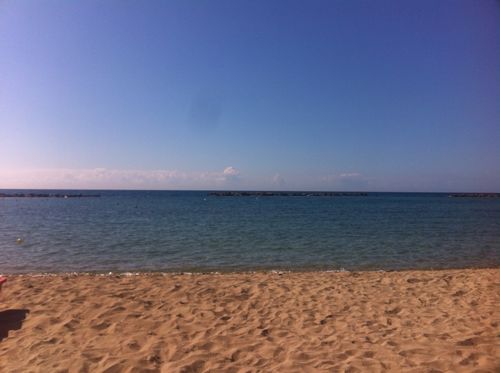
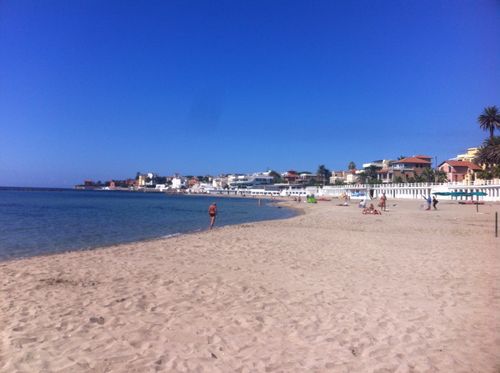
    Ride 38 minutes to Santa Marinella, nervously following progress on Google Maps so as not to miss stop. Get off at tiny station. Walk about three blocks. Arrive here:

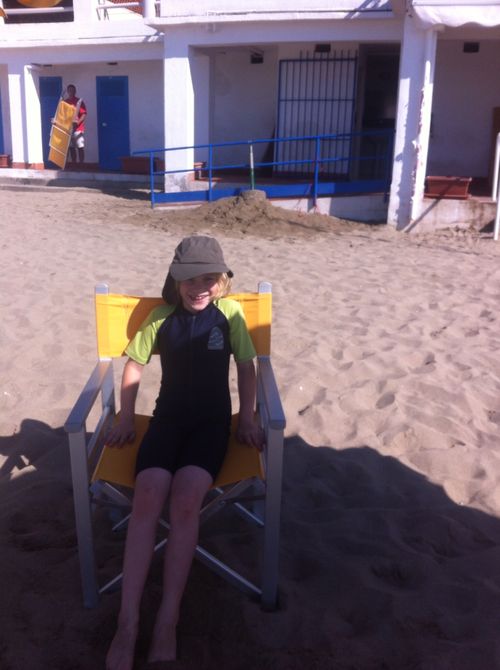
    Pay a bunch of money to rent two umbrellas, three chairs, and a chaise longue.


    Rejoice. Take it in.

    Put iPhone away so as not to get it wet and fail to take any more pictures. Fill day with splashing children, four-year-olds brandishing chunks of driftwood, moat-digging, babies with pirate bandanas tied on their heads and sand-stubble sticking to their faces, and a good deal of sitting in a chair under an umbrella next to one’s spouse watching the children and the sparkling sea and the gulls wheeling overhead, and thinking, “Damn, it could definitely be worse.”


    Don’t get the iPhone out again until it’s time to pour drinks after staggering tired and rosy through the front door.


    Such a good day. The kids are excited that they swam in the Mediterranean. Me too.


  • I have taken 3 children under age 9 to the Vatican Museums and lived to tell about it.

    This morning it was up at 5:50 a.m., dress, breakfast, coffee, hurry children into clothes, and hurry shivering in the chill of dawn to the taxi stand at the Largo del Torre Argentina. Mark and the two big boys got into one taxi, headed for St. Peter’s to see it first thing in the morning. Me, I was going somewhere else. I helped the 4yo and his 8yo sister into the back, then bundled myself and the baby in.

    Alora, ingresso dei Musei Vaticani, per favore.”

    + + +

    I had prepaid for a private tour from a company called Walks Inside Rome, recommended by a friend. WIR features several tours intended for children and families, including the “Treasure Hunt In The Vatican” tour. (We had also taken a private tour of the Colosseum and Forum from them on Wednesday). This was not cheap, mind you, but I could not think of a better way to include the younger children in this trip than to hire someone who had already done the legwork of identifying things that would interest them and guiding us quickly from one to the other.

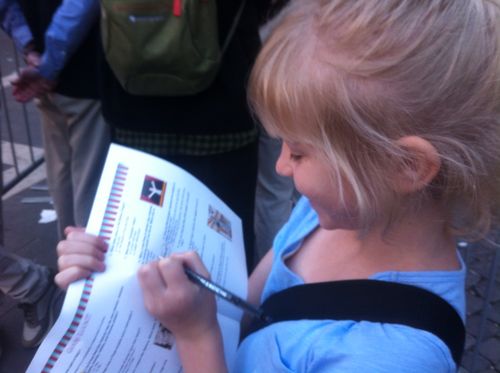
    Outside the walls we met our guide, Luisa. She brought with her a little quiz book of questions for the 8yo to work on while we waited. Luisa entertained the 4yo with questions (“Do you know we are going to another country just on the other side of this wall? Do you know who is the president, or the king, of this other country? Do you know what colors are the flag of this other country?”) I contemplated the great metal doors embedded in the city walls, still looking as if they are ready to resist the sack of the barbarians.


    It is a bit jarring when the doors open, finally, to reveal a ticket office. Of course everything is all friendly now, and good for business, but I can’t help but remember that it wasn’t quite so long ago that these walls meant business. They really are fortifications, after all.

    Inside our first stop was in a lovely courtyard, the Cortile della Pigna, with a great brass sphere in the center. “Can I run?” asked the 4yo, and took off before Luisa could say anything.

    “Come right back,” I called after him, and looked to the guide nervously, but she said that now, before there were really any crowds, it wasn’t a problem.

    “Stay off the grass though!” she called.

    He made the circuit of one rectangular grass plot and came back to us, and I caught his hand.

    “This courtyard contains some very old things, and some very new thing,” she said. “Can you be a detective and solve the mystery of what is the very old thing and what is the very new thing?”

    The very old thing turned out to be an Egyptian lion, which delighted my 4yo, who knows well what his first name means. And the new thing, my daughter picked out: the brass sphere in the center of the courtyard. Luisa led us there. She stepped over the rope, put her shoulder against a crevice in the sphere, threw her weight into it, and slowly the sculpture began to rotate. As the hidden side came into view, we could see a second, concentric sphere revealed within the first. The sculptor, Arnoldo Pomodoro (“Mr. Tomato,” she said), meant for the great sphere to be the world, “a great world with much evil,” she said, “and a smaller, good world that is hidden inside and bursting out of it.”


    more to come…


  • A change of plans that turned out all right.

    Last night we finally accepted that the late-night Roman dinner schedule was not going to make for a peaceful night out with our four-year-old, and we vowed to switch to a lunch-out-dinner-in-the-apartment schedule. There was a really nice all’amatriciana involved, but Mark and I had to take turns eating it and coddling the baby out on the Trastevere cobblestones. Which wasn’t so bad because lots of people come and say hello to the baby, and that is kind of fun.


    The best thing on the table, besides the pasta all’amatriciana, was a single piece of deep-fried baccalà (cod) on the platter of fritto misto. I remembered having passed a tiny place that offered carryout fried stuff, fish and artichoke hearts and potatoes, around the corner from our apartment. I suggested that the next night (Thursday) we plan on having Mark go fetch fried stuff and eat it in the apartment. So that’s our plan for tonight. I have already been to the grocery store and bought lemons, ketchup, and wheat beer.


    + + +


    Mark very much wanted a slow start this morning, so we decided not to try to get to St Peter’s first thing in the morning. As we were getting ready, around ten, someone turned the TV to a channel that appeared to show a live feed from St. Peter’s Square, and the square was full of empty chairs; a long line of people snaked around the edge.


    We walked there anyway, with a backup plan: if the basilica wouldn’t work for us, we’d go to Castel Sant’Angelo. Supposedly it was pretty interesting for kids.


    + + +


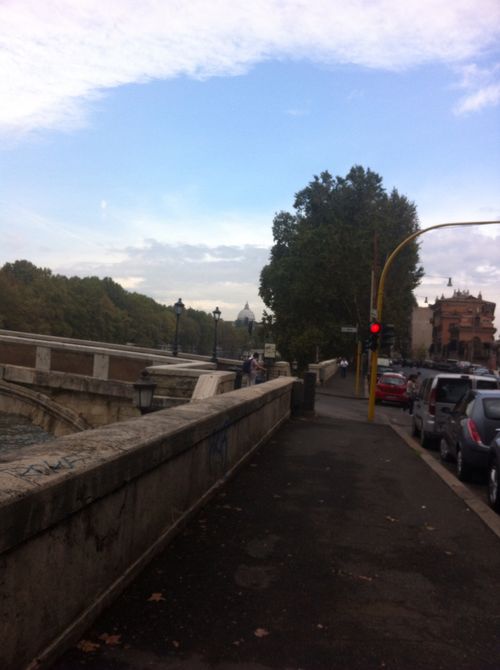
    Mark had the brilliant idea to walk along the river instead of the most direct route, because we wouldn’t have to cross any streets. Seriously, that was smart. It was so much more peaceful to walk the continuous sidewalk, and only have to pause and gather everyone up and make a run for it when we came to the occasional bridge. I carried the 4yo on my back most of the way, my arms under his butt, and Mark carried the baby.


    After a while of walking along the Tiber, lined with smooth-trunked, broad-leaved trees, we caught our first glimpse of the great dome of St. Peter’s:

    But when we got to the piazza, we could see right away it didn’t make sense for us to try to go in. The piazza was filled with empty chairs (someone told us later that Mass had been celebrated in the square the day before, and it wasn’t cleared away yet), so it wasn’t possible to stand on the porphyry disks that mark the centers of the colonnade or find the red one that marks where St JPII was shot. And the line to go through security wrapped all the way around the square.

    So, instead, after admiring the colonnade from off-center, we ducked through the line on the right, passed through the wall, and headed down Borgo Pio to find lunch.

    Six plates: caprese, antipasto misto (with very yummy grilled red pepper), risotto pescator (tiny mussels and a plump little octopus), veal marsala, and a steak. Mark and I each had a beer (which Mark, to my amusement, accidentally ordered in German). Baby liked the risotto. We finished with cappuccino.

    Here is a free tip for taking babies to Rome. Every restaurant so far has had the same kind of high chair: tall, straight-backed, wood, with a wicker bottom and a bar across the arms but no belt. Mark and I have been taking turns gripping the baby’s arm so he doesn’t fall out of it. Today the 4yo was wearing a nylon webbing belt, the kind with a plastic click buckle, just in case he had to carry a sword in it or something. We borrowed it and used it to strap the baby to the chair. Hands free dining!

    + + +

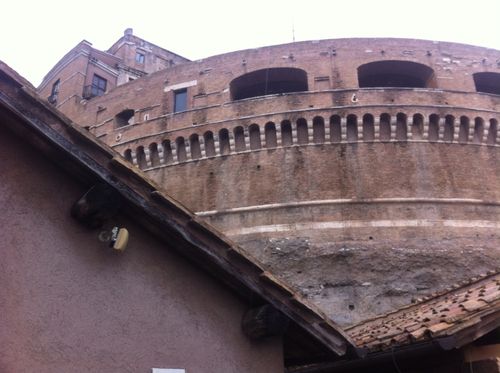
    After lunch we continued on down Borgo Pio to the tomb-fortress that is Castel Sant’Angelo. It is really quite impressive close up.


    Kids are free and adults are €10.50. We paid and then went in.

    The boys were very impressed by the physical structure of the fortress. Both talked animatedly about the value of the thick inner wall surrounded by the outer wall, its utility in resisting siege towers and cannonballs, and the ingenuity of the many hatches for pouring hot oil on attackers as well as the arrow slots and such things. Patches remain of the original flooring from the era of Hadrian, although the castle has been modified many times over the years. There is a long spiral ramp winding upwards, and then a long, slant-stepped stairway, and then you arrive at several sumptuous papal rooms. Fantastic ceiling frescoes depicting the life of Alexander the Great, and a cool trompe-l’oeil decoration that makes an otherwise plain room look as if it has an elaborate fireplace hearth flanked by a curtain being pushed aside to reveal a (real) door.

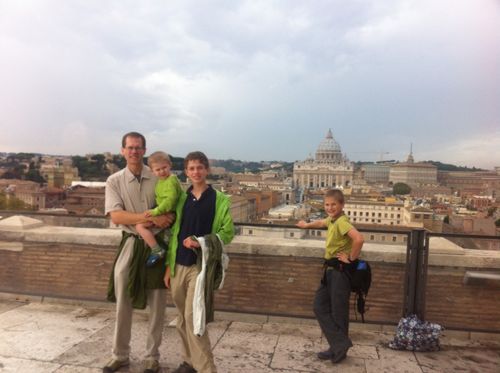
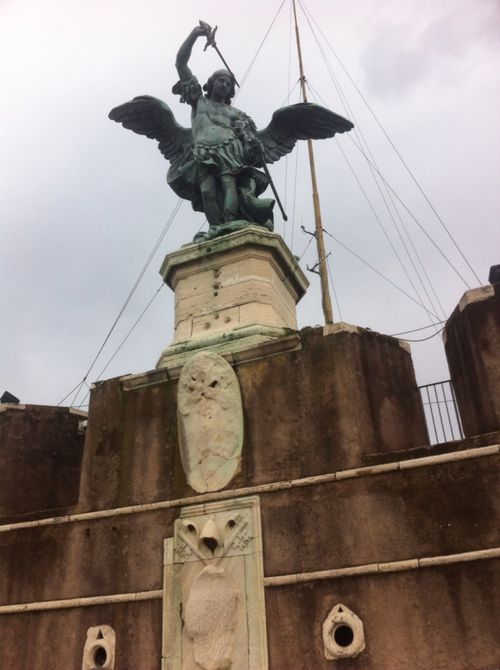
    There is an exhibit of weaponry near the top, but the real reward is the rooftop view.

    It almost feels as if you are standing on board a ship, what with the angel looking like a sort of figurehead, and the flagpole looking like rigging. The parapet has a very gunwale-like feel.

    We finished the castle tour with a trip around the four-sided top of the fortifications, anchored by four bastions at the corners named after the four Evangelists. The boys were impressed (interlocking fields of fire!) and amused (hey, there’s a crest up there for Alexander VI! That’s the Borgia Family pope from Horrible Histories!)

    Once down, I shifted the baby to my back and plotted a course that would take us down the narrow and charming shop-lined Via dei Coronari and then to the Piazza Navona, coming out near the Four Rivers Fountain. We bought gelato on the way (fior di latte and peach, yum) and then while the four- and fourteen-year-olds finished theirs outside with Mark, I took the 8yo and 10yo into the Church of St. Agnes to say hello.

    This church is a jewel box. We admired the beautiful dome inside and scrutinized some of the marble bas-reliefs, then found our way around a corner to the chapel in which the saint’s skull rests behind glass in a reliquary. A woman was there taking pictures with her iPad held up in front of her face; at first I stayed back with that impulse to not ruin someone’s picture, but then changed my mind and decided it would make a better picture with my kids and me praying in the chapel. I walked through the open-gated railing, knelt down, and greeted the Saint with a petition or two. My two children followed (three actually, since the baby was strapped to my back) and did the same.

    We continued on past the Campo dei Fiori and back to the apartment, ready for several hours’ rest. It’ll be carryout for dinner, then an early bedtime, because tomorrow morning we must be at the Vatican Museum for early entry.


  • Colosseum and Forum, followed by decompression.

    Sometimes you want to do something that’s difficult.

    Not necessarily because it is difficult, mind you. We’re not talking about things like, say, climbing a high mountain or running a marathon, things that would almost not be worth doing except that they are difficult to complete.

    No, I mean activities that have real intrinsic value — you want the experience for some other reason — but nevetheless you can easily foresee difficulties. You know they are coming. You want to do the thing anyway. But wanting the thing, deciding to do the thing, will not make the difficulties go away. They will still be there.

    And so will the reasons you had for doing the thing in the first place.

    + + +

    So it is with taking five children to Rome. I wasn’t exactly sure what we were in for, but there were some parts I expected would be hard. The flights, for one thing. The late-night dinners. Walking long distances. I expected a sore back from carrying the baby. I expected some squabbling.

    All this has come to pass.

    I knew it would.

    And yet we chose to come, to set aside money for six years, to leave school and work for a month. We chose for reasons, reasons that have not expired. We are here. This is what we make of it.

    + + +

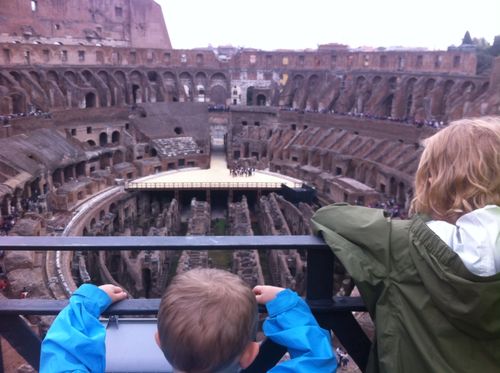
    I tried not to schedule much, preferring flexibility, but there were two items that had to be scheduled in advance or not at all. The first was a tour of the Colosseum and Forum. We did that today.

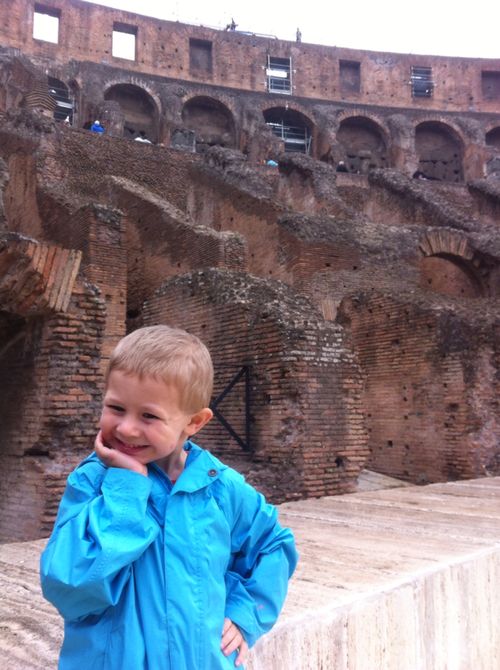
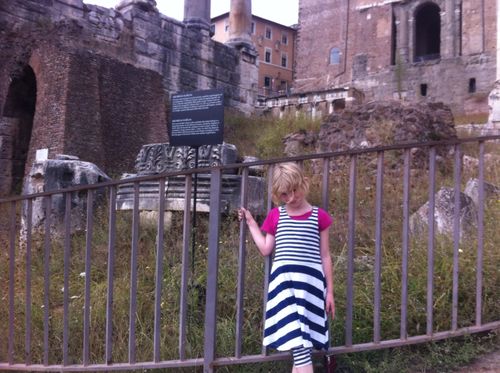
    I have good pictures of smiling kids.


    The tour was truly interesting. It was also gruelingly long for my four-year-old and baby. The baby had a long time in the middle of screaming in the carrier until I got him settled down and he slept. The four-year-old started misbehaving on the top level of the Colosseum.

    Right after this he was climbing steps he shouldn’t have been.

    Sara, our guide, really did a great job engaging the kids with quiz questions and with a book of pictures showing what the buildings might have looked like many centuries ago.

    But there is only so much you can do. Eventually the 4yo had to be carried, and the 8yo (who had refused to eat breakfast) trudged groaning forward with glazed eyes.


    i really should have gotten a picture of that, but I did ‘t know how without insulting one of them.


    The whole experience, from leaving the apartment to walk to the Colosseum, to getting back in the apartment for lunch, was about four and a half hours.

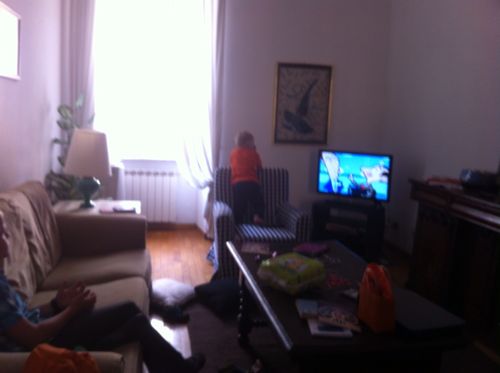
    And we were so tired. So tired that we could not even stop for gelato. We got back, the kids turned on the TV and collapsed on the couch, I asked Mark to go out and bring back sandwiches. And Cokes. I specially requested Cokes.


    At lunch I turned the usual question on its head by asking everyone to name the worst thing that happened to them today so far. This cheered people up a bit. The four-year-old gave an answer that, in a roundabout way, meant “The part where we were on the tour.”

    But then we did the usual thing and asked about everyone’s best thing, and it turned out that there was a best thing. Even though for one kid it was “This sandwich.”

    (For me it was the Vestal Virgins’ house.)

    Because you know, we are here for reasons, and the difficult — the expected difficult — doesn’t take them away.


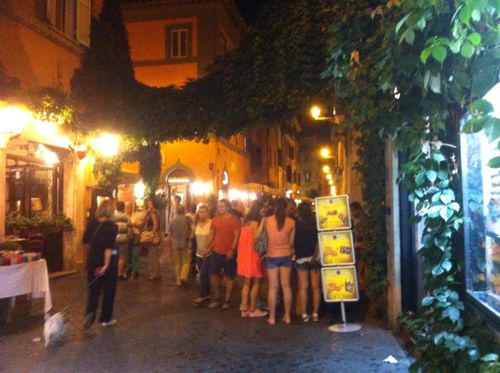
  • Trastevere gelato, 9 pm.


    The 10yo wins for best flavor combo: pear and ginger.


  • Settled in Rome.

    This morning we woke up, had a leisurely breakfast and coffee in the apartment, and then ventured out around 11 am with a modest goal:

    1. Get to the Campo dei Fiori

    2. buy a snack, and lunch if necessary

    3. get back to the apartment

    Dining room in Roman apartment. We told the kids not to touch or tip Caesar.


    I carried the baby in the cloth carrier, with my wallet and phone zipped into the pockets therein. The 10yo carried a man-bag I bought many years ago in Paris, just the right size for a guidebook and a map. Mark carried the diaper bag. We headed north away from the river on Via Arenula, clutching the smaller children tightly by the hand for fear of buses and garbage trucks and motorbikes. I had to tug my daughter along, she was so taken by the contents of shop windows. I paid close attention to nearby pedestrians and tried to cross the street when the other people crossed the street, causing Mark to yank me back sharply a couple of times when I started with them against the signal that I hadn’t noticed.

    We turned left at Piazza Cairoli, a little oasis with a wrought iron fence around it, to put us on Via dei Giubbonari, and took this as far as the Campo dei Fiori (after a slight detour for a bakery, to buy a pastry each, and to devour it standing outside). We could see the openness from a block or so away — the impression is that of a sunlit clearing in a forest, where the brightness caused by the sunlight coming down where the trees have thinned out is visible ahead, even if the sunlight itself doesn’t yet come down upon you, still deep in the forest and not to the clearing yet. Anyway, the impression was gray in the foreground, yellow in the background, and we could catch a glimpse of Giordano Bruno in his hooded metal cloak, up on his pedestal.

    Once there we walked around slowly, looking at all the market stalls with their white awnings and umbrellas. Fortunately, the market at Chamonix had desensitized me a little, and I was able to walk around and admire things without hyperventilating.

    I have been relying on a guidebook called Rome with Kids: An Insider’s Guide, by J. M. Pasquali. It suggested having the children choose a piece of fruit to buy, wash it in the fountain, and eat it there in the Campo for a snack. And we did this: only, two of the children were enchanted by pre-cut fruit in a plastic cup, so they had that. The rest of us had lovely white peaches, which I did not photograph, because the juice was running down my arm.


    What my daughter really loved — and I admit it, so did I — was a stall selling leather goods. Keychains, coin purses, handbags. There were clever little coin purses that closed elegantly, by folding the top in half, bringing a pair of slender metal rails together, and sliding a little bangle along the rails to hold them together at the end, where the little bangle snapped down to a place sewn to the leather. These were in colors that indicated they were feminine coin purses; there were also egg-smooth little masculine coin cases with a leather hinge, which stayed closed by friction and were meant to slide deep into a front pocket.

    After finishing our fruit and washing up, I chose a few fresh vegetables to bring back to the apartment — the seller offered to my daugher a chunk of watermelon on a skewer, she said she was full, I said, “È piena,” and so the seller gave the melon to me — so good! Then we stopped at the bakery in the corner with the sign “Forno” to buy a loaf of bread for dinner, and continued to Piazza Farnese. There I sat with the 10- and 8-year-olds on a bench attached to the façade of the palazzo, and watched the police providing security for the French embassy there, while I nursed the baby. We admired the two giant, ancient granite bathtubs in the fountains there (salvaged from the Baths of Caracalla) and waited for Mark, the 4yo, and the 14yo to return with ice cream treats and espressi. One of the security officers came over to ask how old was the baby, and where we were from, and smiled and cooed at him.

    It cannot be overstated how enthusiastically people here will admire a baby, and congratulate a mother of five children. (The dad doesn’t get quite so much attention if mom is right there.) Bravissima! At least twice I have encountered a grandmotherly type who I feared might eat the baby if she had the chance. È bello, che bella testina, è solido, mangia!* and many other exclamations. Even after I make it clear that I barely speak any Italian, they go on, talking now to the baby, now to me, animated, and almost always a little bit… melancholy? I don’t know what to say except at the appropriate time to answer “nove” (how many months old) and “grazie, grazie.” I guess I should arm myself with phrases like, “yes, he loves to eat,” and “indeed, he is quite friendly,” and “he enjoys attention,” and “no thank you, I will hold the baby myself.” Maybe “And you, do you have children or grandchildren?”


    *not guaranteeing I transcribed this correctly

    Next we went on to the Galleria Spada, a good introduction to museum behavior since it has only four rooms (although the walls are covered top to bottom with framed paintings — it is a lot to take in). My 14yo noticed many cool details in the frescoes near the top of the wall — hidden faces, with beards that curl up and become the capitals of trompe l’oeil Corinthian columns.

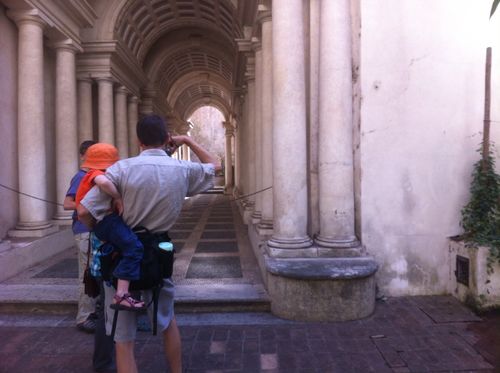
    What we were really after was Borromini’s perspective gallery:


    The floor comes up and the ceiling comes down, and the columns come together, so that isn’t a large statue far away, it is a small statue rather close. Visitors cannot walk down the hall to see the illusion, but a docent stationed there will walk to the statue, revealing it is only half her height. (No photos of the docent allowed.)

    We decided to have a big sit-down lunch off the Campo, since we were hungry and the four year old seemed fresh. Mark picked the trattoria, Ai Balestrari di Campo de’ Fiori, and we sat at two tables outside. (Later Mark regretted this choice when the tables wobbled on the cobblestones and my 10yo nearly overturned it, glasses and water bottle and all, twice; he has since vowedto test tables before sitting there in the future.)

    Here is our strategy: order roughly six items, some small and some full size, with water for the children and due birre piccole for the two of us. Allow the kids to peruse the menu and — not order for themselves — but recommend something for the table. Put all the plates in the middle and share everything. Today we ended up with bruschetta (some olive, some artichoke, some fresh tomato, surrounded by a generous garnish of arugula and basil leaves); spears of raw carrot, fennel, red pepper, and leafy celery, with a bowl of olive oil for dipping, dregs of salt and pepper piled at the bottom of the bowl; battered fritters of zuccini flower and of tomato-sauced rice; two fat, fried-out patties of pure white cheese; a cracker-thin pizza sauced with cheese and (no kidding) hot dogs; a second pizza, cheeseless, topped only with a bright, pure tomato sauce and a dusting of oregano.

    After that we were quite full. While waiting for il conto we noticed an accordion player setting up, so I gave the 4yo a half-euro coin for him. I totally knew what would happen next: the 4yo went over in front of the acordionist and danced a little dance while he played, which amused the other diners greatly. He also tried to pocket the coin himself, another thing which I predicted, so I had to remind him to offer the musician a coin when he was done.

    And now back to the apartment to rest, and dinner in the dining room here!


  • Terrifying ride.

    For about half an hour today, I sat in the passenger seat of the trusty Fiat Scudo staring at Google Maps calling out things like, “In 70 meters turn left, it will be the second left, after the light — no not that one — oh man, this is hard — wait! it doesn’t know where we are! it’s rerouting! I think you actually need to go straight!” while Mark made high-pitched whimpering noises and gripped the steering wheel.

    That’s right, folks: we had elected to return the rental car to the Avis location that, despite being called the location associated with the Roma Termini train station, isn’t actually at the station, but buried in a parking garage at the end of a dead end street in the middle of Central Rome. And we had elected to do so at 4:30 pm on a Monday.

    Theoretically, the people on the motorcycles and the pedestrians must know how this all works. The double white line that serves as the center divider on major Roman streets seems to have an oddly wide gap down the middle; I theorized that it actually serves as a skinny motorcycle lane.

    “In both directions,” observed Mark through clenched teeth.

    What can I say? There was a traffic jam caused by fresh asphalt being laid right at the merge of an off ramp. There was a bus on the left and a motorcycle on the right. There were pedestrians who stepped right out in front of us. There was the obligatory stalling-of-the-car-on-an-uphill and the frantic shifting and key-turning and clutch-stomping. There were roundabouts.

    Mark later told me that he hadn’t had such a high level of continuous anxiety for twenty straight minutes in years.

    + + +

    But we did it, and we split up into two cabs — Mark with the 10- and 8-yos, me with the baby and the 4yo and the 14yo — and I messed up the address (“dieci-sei” instead of “sedici” — it’s the French) but the cabbie corrected me (“uno-zero-sei? o uno-sei? Alora, sedici”) so we got where we were going. Mark told me later that he found the cab ride nearly as troubling as the driving, but not me — I trust the Roman cabbies know what they are doing. The only scary bit was the giant piazza where all the cars appeared to be going in random directions, witn pedestrians weaving among them, a huge fraction of them too busy taking pictures to watch where they stepped.

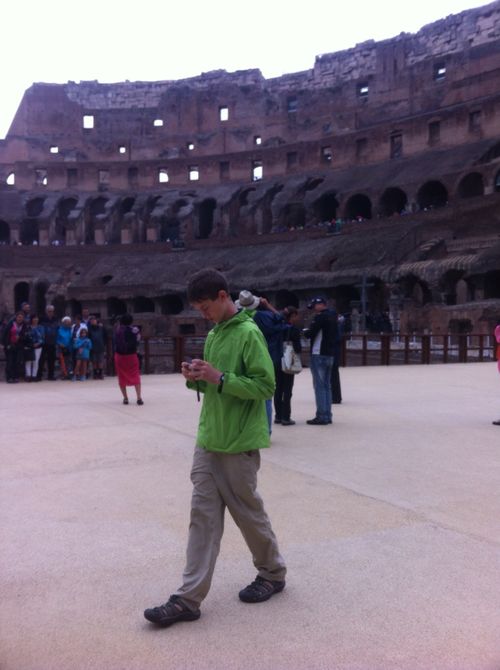
    The advent of handheld mobile devices has not made Rome any less frightening.

    + + +

    Alora, we came to our apartment, met the landlady, received instruction on how to separate the recyclables and how often to empty the pots of condensate from the different air conditioners and which appliances not to run at the same time. She showed Mark the washer and dishwasher and said, “I will show your wife how to use them.”

    Mark said, “You could just show me how to use them.”

    “I forgot,” sne said, “you are American. Italian men do not do laundry or dishes.”

    She complimented me on my Italian, which since she spoke pretty good English consisted mostly of my spitting out isolated words and phrases if they happen to come to mind at the right time: solamente, non ci sono, adesso, píu buono, and lots of numbers because (despite the earlier “dieci-sei” faux pas) I am fairly handy with those. I explained that I had been working on it for about six months but that it wasn’t so hard because I speak pretty good French and also some Spanish and Latin. “Where are you from?”

    “Minnesota. È nel nord degli Stati Uniti —

    “No, originally. Australia, maybe?”

    No… born in the States. Because Americans don’t ever learn any Italian, she explained, they aren’t very interested in languages. So, thanks, I guess?

    + + +

    There is a grocery store literally across the street, thank goodness, and the 14yo and I went there right away, bought cured meat and bread and cheese and fruit and some token greens and milk and yogurtand chocolate and cereal. The family sat down and ate, and then we sent the younger kids off to watch Horrible Histories DVDs in the living room while we did laundry, drank wine, and caught up with social media.

    Oh, and put away all the breakable stuff. Why do apartments we rent insist on having nice things? Really? A basket of porcelain spheres? A set of ceramic horses? Glass vases everywhere?

    + + +

    My daughter is homesick.

    My four-year-old is too, I think; he is more obstinate than usual. We have had to separate him from his sister; instead of them sharing a room, she is on the couch in the living room (by her choice) and he is with Mark. I just have the baby with me.

    My two big boys are doing better. They are used to sharing a room. The 14yo is tired of having to have his siblings with him wherever he goes; he is a little bit bitter that we couldn’t finish either of our long hikes because of small children’s limitations, but he truly appreciates the chances he had to go climbing three times. He doesn’t quite believe that Rome requires as much caution as we have been stressing we need to take. In Cham he could walk all over town by himself. Here in Rome we will be sticking together more, and need to check out the neighborhood before letting them go look around.

    My 10yo is just raring to go. No complaints from him, except that I snagged his USB charger and haven’t given it back yet.

    And the baby is asleep. And so should I be. We shall see what tomorrow brings.


  • Driving day.

    After a Friday spent alternately packing and shopping in town, and a Saturday spent climbing again at Les Gaillands — with a brief detour for me and the younger kids to McDonalds because they wanted to see what that was like — and Mass on Saturday evening in Les Houches —

    Sunday morning we headed out of town. It was raining in Chamonix as we waved goodbye to France; cloudy, but not raining, as we emerged from the Mont Blanc tunnel into Italy.

    Mark drove and I navigated. It was not difficult navigation. We followed Google Maps on a smooth highway to Genoa, hugged the coast almost all the way to Livorno, then swung around Florence to stop and spend the night outside a small city called Arezzo, so we could come into Rome fresh in the morning instead of exhausted by several hours’ drive.

    + + +

    The countryside is really beautiful. When you come out of the tunnel you are in the Valle d’Aosta, in which despite the lack of large cities, you could easily stay busy in for two weeks or more. Aosta itself is worth a couple of days, and then there are castles, and the St. Bernard pass with the hostel/hospital at the top — you know, the one with the dogs — and lovely hiking and climbing and skiing if you are into that kind of thing.


    Once out of the valleys you enter a plain — Mark was impressed by a sharp, high, and long ridgeline that marked the end of the Alpine landscape — but it is not long before you come to hills again, green hills with lusher vegetation, palm trees, and steep bluffs. And where those hills plunge down to the Mediterranean Sea is nestled the city of Genoa.

    All we did was drive through it on the highway, but Genoa amazed me. It looks as if a giant tossed it by the handful onto the steep green hillsides, where it rolled like so many marbles and settled thickly into the crevices and cracks, leaving some especially forbidding hilltops green, encrusting others with dwellings; but all of them, all of them, story upon story, craning to look toward the sea. And the surface of the sea a mess of wharves and boats and shipping cranes, and beyond that, sparkling, with the shadow of some great vessel just visible through a foggy mist.

    If you had asked me before yesterday what I knew about Genoa, I could have talked about city-states and Christopher Columbus, and rattled off a few recipes maybe. I did not know it had such a striking landscape. No wonder they became a maritime power; I marveled at those hills. How else could they have gone anywhere at all?

    If we were having a See All The Things kind of trip, I would have taken us to the new maritime museum in Genoa, but we are not, so we drove on.

    Lunch and snack were in two gas stations along the toll road. I split a sandwich with Mark in one, and ate an Italian species of Lunchables in the other.

    My oldest, who was seated behind me, was disappointed that we weren’t stopping in Florence. “You mean we’re just going to drive around the outside of it?” he said incredulously. “Why aren’t we going there?”

    “Because your mom and I decided to keep this trip simple,” said Mark, eyeing his side mirror for speeding Ferraris before changing lanes.

    “Will I at least be able to see the big dome when we go past?”

    “I don’t know,” I said. “We will be swinging pretty wide of the city center.”

    He leaned forward in his seat and watched as Mark and I turned our attention to not missing the highway exit. Suddenly he shouted in my ear: “I see it! There it is!”

    “Ow! Not so loud!”

    “No shouting in the car!”

    “Sorry.”

    “Where?”

    He pointed and described where to look. I hunted, among the outlines of the industrial buildings hurtling by, and I caught a glimpse of it too, just for a second,. I had forgotten how very large and impressive that great red cathedral dome is. Even though we were quite a ways outside the city, it rose above, unmistakable. The 14yo sat back satisfied.


    + + +

    Arezzo is a smaller city south of Florence. Mark had booked us one cheap night in an agriturismo “camping” resort that mainly serves locals who want to get out of town for a week. It is two kilometers up a winding road at the top of a hill overlooking the town. The lodgings are in little individual cabins lined up in rows in the middle of a grove of —

    “Olive trees!” exclaimed my 14yo, who had a look on his face that said “I can’t believe my crazy dad found the cheapest place possible and it’s an agriturismo embedded in a Tuscan olive grove.”

    The sun was setting and the city lights below us were twinkling. I remembered flashlights; the kids dug a couple out of the van, and we walked up the dirt path to the resort buildings. The 4yo picked two poppies for me from the side of the path, and I admired them. The children asked to taste an olive from the trees; we acquiesced, and they picked, bit, spat (and spat and spat). “Not ripe yet!” said Mark.

    The center of the resort had a patio and a pool. There was a foosball table that took half-euro coins, so the kids played for while. Only two other families — actually, couples, no other kids — were staying here on this Sunday night in late September; the staff was standing around, and enthusiastically began exclaiming over our baby. Bellissimo!

    I need to learn how to say “No, it scares him,” because strangers in Italy keep wanting to take him out of my arms.

    The restaurant did not open for dinner till 7:30 so the kids ran around until then, and then we went in and sat down — there were high chairs for the baby! “Non ci sono in Francia,” I said to the waitress, pointing at the high chair — she laughed and said, “But in Italy, yes!” — and we ate pizza. One of the cooks came out, made a show of counting the children, then went away and came back with five lollipops. The 4yo got to keep the one for the baby. We turned on our flashlights and made our way back to cabin number six, in the dark, the lights of Arezzo now brightly twinkling below us, and the baby reaching his arms up into the night to grab hold of the stars.


  • Aosta (part 2)

    Part 1 is in the previous post.

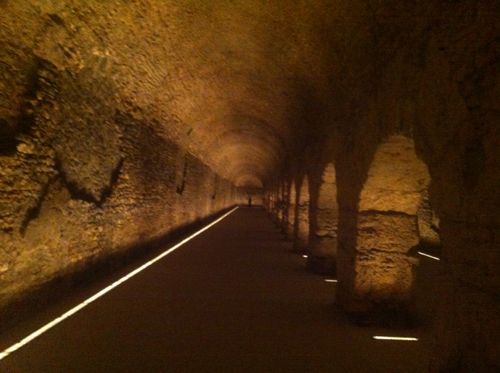
    After exploring the theater we moved on to the Cryptoporticus. I wasn’t sure what to expect of this except that it would be underground. We passed by a wooden door in a wall, a side entrance into Aosta’s cathedral that leads to the “Treasure Museum” kept inside; the sign there informed us that the cathedral and its treasure museum would not re-open until three. (Lots of things in this region close for two or three hours around lunchtime.) We walked around the corner of the church to the façade, which was Neoclassical — pillars and a pediment — but which framed a porch that was ornately bedecked with painting and statuary. The porch and façade were set at an angle to the rest of the building, giving it a crane-necked appearance.

    A little garden on the other side of the church hosted signs directing us to the cryptoporticus. It was a charming little French-style garden with a graceful spreading tree in the center, red flowers and shrubbery, and a circular path of crunchy, dark-gray pea gravel, and a few benches. The four year old promptly started to run in circles around the path. But the 14yo was already starting down the stairs in the back of the garden, down to the Cryptoporticus. I followed.

    Down below: an arcade. It wrapped around the corner and continued much farther than I expected — a vast double hallway. The younger children immediately began to race back and forth among the columns. I could not think of a reason why I should hush them and yet I felt the impulse to call them back. The air had a stale scent, the up-lighting cast a creepy glow, and the ancient concrete seemed to swallow up their laughter.


    The 14yo had found a brochure that explained the structure and gave a map of the original layout showing the extant parts in red. The cryptoporticus was around the Forum of Augusta Praetoria. French Wikipedia tells me it originally formed a rectangle, 89 meters long by 73 meters wide, and that two temples were situated atop the area it surrounded.

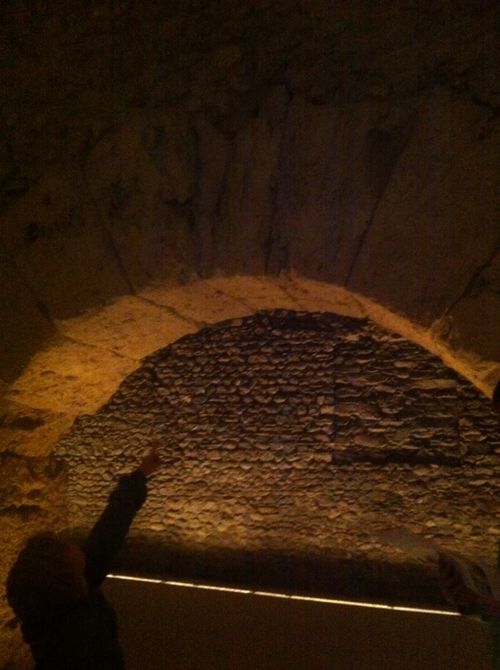
    These arches being fairly low and accessoble, it was a good place to examine their construction, and ask the 8yo to find the keystone of the arch.

    Back outside, I nursed the baby in the garden while we let the 4yo run in circles and waited for the cathedral to open. Then at three we went in.

    + + +

    The Aosta cathedral turned out to be totally worth the trip. You can’t get enough information from the English Wikipedia page, but the French one is sufficiently detailed.

    Aosta had quite an early Christian community. There has been a significant Christian building there going back at least as far as the 4th century — by then, it was 40 meters long and had two baptistries and several annexes — and before that there was an even older building backed right up against the cryptoporticus. In the 11th century, the bishop St. Anselm likely was the one who called for a new church. It was built in a nordic style and frescoed. Successive centuries added their mark: marvelous floor mosaics date to the 13th century, gothic choir stalls to the 15th, stained glass windows and the frescoes in the portico to the 16th, an altar in the 18th, the façade in the 19th, and most recently, the organ.


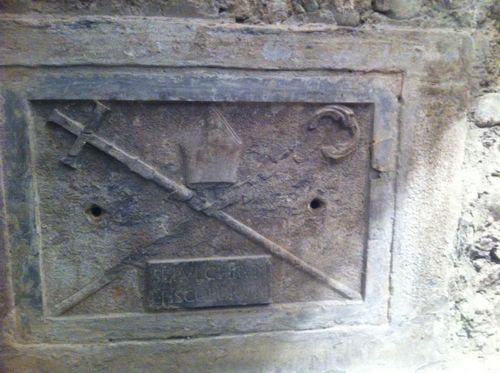
    Bishop’s tomb in the undercroft:


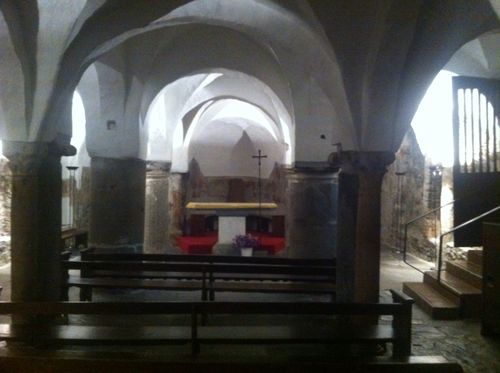
    Undercroft, including repurposed Roman columns:


    Ceiling frescoes:


    We finished up with ice cream. If we’d had more time and fewer tired children, there would have been castles to see, too; there are eight or ten castles from various periods scattered around the region. But by then we were exhausted, so instead headed back to France.


  • Aosta (part 1)

    Thursday was supposed to be drizzly and gray — as good a day as any to drive through the Mont Blanc tunnel and emerge into Italy for a day trip.

    Hannibal and his elephants never had it so good. The tunnel is more than 10 km long, right through the mountain; it’s only one lane in each direction. Driving is tightly regulated. You must travel no faster nor A slower than a certain range of speed. The sides of the tunnel are illuminated by white lights interspersed at regular intervals by blue ones; the distance between two blue lights is the minimum following distance. All trucks must be inspected before entering the tunnel; the inspection points are in towns some distance away. The authorities also control commercial traffic entry times so as to smooth out usage peaks.

    A lot of these controls, as well as extensive physical safety features, were put into place after the 1999 truck fire that killed 38 people and closed the tunnel for three years. We read about that from the Wikipedia page — I translated the French page on the fly for Mark, because it was more extensive than the English one — after I noticed a memorial marker near the tunnel entrance.

    + + +

    You can get completely different weather on the opposite side of the mountains, but it was just as drizzly and gray when we emerged in Italy. It’s about an hour to Aosta altogether. Even with the drizzle it’s a lovely drive with the mountains rising up all around you, many of them terraced and quite built up.

    Aosta was once Augusta Praetoria Salassorum, a Roman camp-turned-planned-city strategically located near two mountain passes. It had a squarish layout crossed by two main roads that exited the city at four main gates. One such gate, the Porta Praetoria, remains in very good condition.

    I wish I had a better picture. The gate is truly awesome. It is double-walled, and each wall is doubled in thickness. There is a beautiful, ripply stone on the outside, and some of the marble facing remains. There are niches on the outside for statues. It is still embedded in the Roman city wall, much of which continues around the city.

    We stopped near the gate at the tourism office, where an English-speaking staffer gave us a nice big paper map and circled the specifically Roman sites on it, pointing out a path to walk from east to west through the city that was once the Roman castrorum.

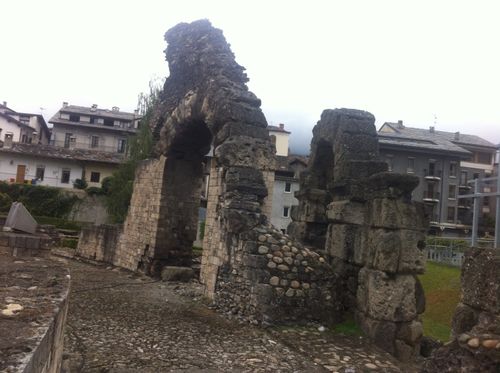
    Not far down we came to the remains of the theater:

    They have erected scaffolding all over the site so you can walk through and around it. You can get quite close to the Roman brickwork that went under the stage.


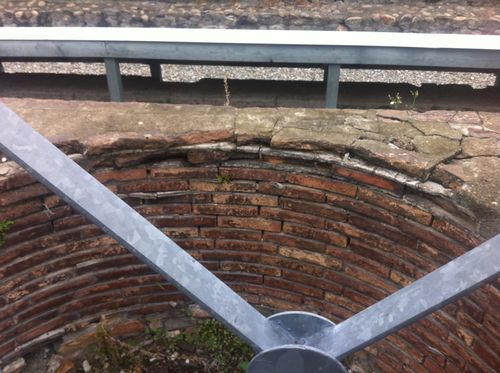
    And see the wall stones, cut into triangular shapes so as to present more surface area for adhesion to the concrete.

    Rows of “bleachers”


    Underneath the theater floor

    An entrance


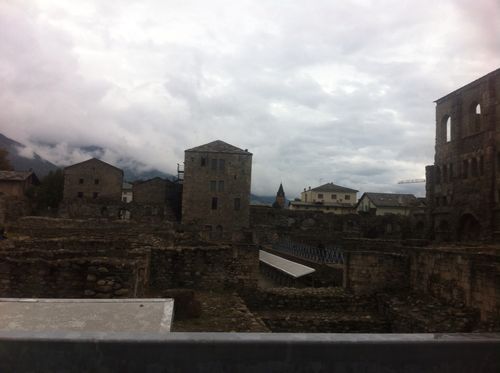
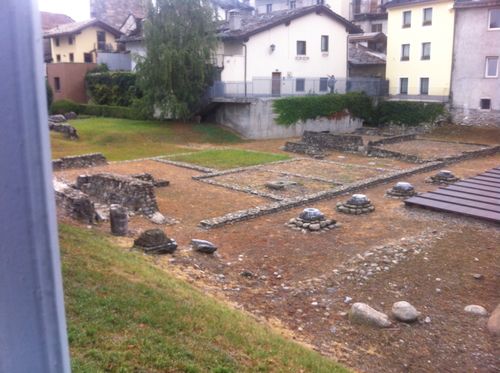
    Remains of buildings outside the theater


    more…