bearing blog


bear – ing n 1  the manner in which one comports oneself;  2  the act, power, or time of bringing forth offspring or fruit; 3 a machine part in which another part turns [a journal ~];  pl comprehension of one’s position, environment, or situation;   5  the act of moving while supporting the weight of something [the ~ of the cross].


  • Not very far into my book before I had to blog it.

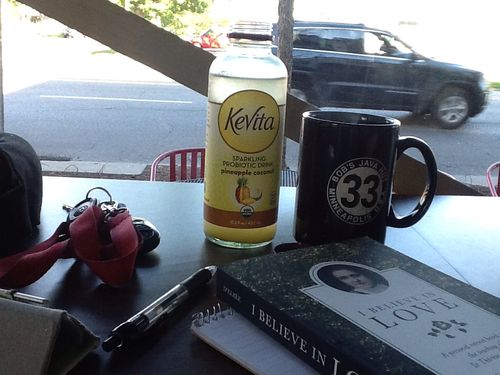
    I was gifted a book yesterday from someone who thought it would help me with some issues I've been having.  The book is I Believe in Love:  A Personal Retreat Based on the Teaching of St. Thérèse of Lisieux, by Fr. Jean C. J. D'Elbée.

    51+Mvc43+JL._SX321_BO1,204,203,200_(1969; English translation, 1974, by Teichert and Stebbins; this edition, Sophia Institute Press, 2001.)

    The giver assured me that this would be an unsentimental look at St. Thérèse (I've no time for the pursed-lips, porcelain-skinned holy-card version of this audacious and daring young woman), so I settled down to read some with an open mind this morning.

    + + +

    Anyway, I didn't get very far in — not even far enough to reach a single mention of St. Thérèse! — before finding something that I wanted to remember.  I find the turns of phrases provocative and I hope you do too.


    In the first pages of the very first meditation, "Love for Love,"  Father D'Elbée writes:

    Jesus bought a twofold right on Calvary at the price of all His Blood:  the right, for Him, to love us in spite of, or even because of our sins, our unworthiness; and the right, for us, to love Him from the depths of our immense misery and to contemplate His divine attributes, including His justice, within His infinite mercy.

    …At Gethsemane He appears before His Father, covered with our sins — He, who "bore our sins in His body" [1 Pet 2:24].  He obtains for us the right to appear one day before the Father covered with the Blood flowing from every pore of His body under the pressure of His agony and shed on Calvary to the last drop.  Then the Father will not recognize us as sinners, but as His children, regenerated and renewed by the baptism of this Blood; He will take us for His beloved Son.

    See this sublime exchange:  Jesus takes our sins upon Himself, and we make His merits our own.  And the Father receives us as if we were His beloved Son, through infinite mercy, but in all justice.

    After a retreat in which I had preached this with great conviction, a retreatant said to me, "I want most especially to retain one thought from your retreat:  my sins on Him, His Blood on me."

    I read this, and I instantly thought:

    What a remarkable spin on "His Blood be on us and on our children."  No?


  • The Righteous Mind. Inside out with the rider and the elephant.

    Last weekend Mark and I took our three youngest children to see the new Pixar movie Inside Out. Without spoiling too much, the movie is an imaginative look inside the human mind: a landscape of “islands of personality,” deep chasms of the subconscious, rows of storage banks, and the like; linked by somewhat a somewhat unpredictable “train of thought” on a track that is laid down as it chugs from place to place. “Headquarters” in the human mind in question (an 11-year-old girl) is occupied not by any kind of rational thinking — that’s represented only by the train, I think — but by five anthropomorphic emotions. They are Joy, Disgust, Fear, Anger, and Sadness. They sometimes work together and sometimes squabble for control, but the movie’s theme is to elucidate that each one of them has a vital job to do to protect the host mind. Rejecting one of them as a troublemaker nearly has terrible consequences.

    The themes and imagery of Inside Out meshed well with a book that Mark and I read recently on our last driving trip. The Righteous Mind: Why Good People Are Divided by Politics and Religion by Jonathan Haidt is also a peek inside the human mind, the tasks of which he divides up into metaphorical “workers” in a way that is a bit similar to Pixar’s five anthropomorphic emotions — but on several levels.

    The first division is into two different kinds of cognition which we use to make judgments — the controlled cognition of language-based reasoning, and the automatic cognition of rapid response to pattern recognition. Haidt pictured these as a rational “rider” on the back of an intuitive “elephant.” (We have met the rider and the elephant before — the metaphor was co-opted by Chip and Dan Heath in the book Switch, about which I blogged a few years ago.) Haidt marshals evidence from psychological experiments to argue that our moral and ethical judgments — our philosophies of life and of right and wrong — and in fact a lot of our daily decisions — are mostly governed by the big, powerful elephant. Then, our rational mind — the rider — leaps into action with a post hoc rationalization of what we have already started to decide.

    This isn’t an argument that our “emotions” are more important than our “cognition.” What was new to me was the understanding that intuitive leaps are a kind of cognition — just one that operates outside of our conscious control. To appreciate the power and the importance of such unconscious judgments — to give them the respect they deserve alongside reason — consider the example of visual processing. We do not have to reason to discover patterns in the photons that are projected onto our retinal tissue and then to extract useful information from them. We simply see, automatically, like any higher mammal, and our elephant-brain handles the intepretation most of the time without bothering our rider-brain.

    Visual processing is obviously cognition — a constant work of pattern identification, coupled to evolved snap judgments that prepare us to respond appropriately to the patterns in a variety of physical environments. Haidt argues that our moral processing, also taking place largely at this subconscious level, is a kind of cognition that uses pattern recognition to make rapid “snap judgments” that prepare us (often by means of emotions) to respond appropriately to patterns in a variety of social environments.

    Evolutionarily speaking, the elephant has been around for a long time; we are the descendants of many, many generations of organisms, reaching back beyond primate history, whose elephants kept them alive. The intuition which the elephant represents is the process by which “a judgment, solution, or other conclusion appears suddenly and effortlessly in consciousness without any awareness by the person of the mental processes that led to the outcome.” It is the kind of cognition that all mammals have — including primates like ourselves. And evolution has sharpened it into something exceedingly well designed.

    I found this concept really thought-provoking. I have been as guilty as anyone of arguing that someone-or-other comes to a faulty conclusion because of “emotion-based reasoning.” If someone cannot articulate a logical reason for his or her judgments, I have been inclined to dismiss them out of hand. Having read Haidt’s book, and grasped the analogy to visual processing, I am now somewhat more open-minded about the value of intuitive judgments. They are not always correct — just as vision is not always correct and can be fooled in unusual or artificial physical environments (remember the ambiguously photographed dress? or any well-crafted optical illusion?). But they are powerful, and can handle a huge amount of information without taxing our resources. Anyone who has tried to work with visual recognition software has to come away with a renewed respect for what the human mind can process without our conscious help. So we should probably also grant some respect to other kinds of automatic judgments, while appreciating their limitations in a world that is sometimes different from the one our intuitions evolved to expect.

    Haidt argues that “the rider evolved to be useful to the elephant.” The rider, who represents language-based reasoning, is a human thing; if other primates have one, it isn’t very far along. The rider is capable of long-term forecasts, of mastering new skills and technologies, and — crucially — of “fabricating post-hoc rationalizations” to explain, supposedly, why the mind came to the decisions and judgments that it did. No matter who we are — educated or uneducated, Eastern or Western, liberal or conservative — many of our judgments and decisions occur very rapidly at the intuitive level, and then we take time to tell ourselves a fairy tale in which we came to those decisions through a process of conscious, logical reasoning. This is kind of a disturbing notion if you value (or think you value) logic and reason. But Haidt gives plenty of examples of psychological laboratory experiments that appear, over and over again, to demonstrate that the elephant acts first, the rider justifies afterward.

    So what’s so useful about this? Well, we live in societies, in networks of relationships. Humans are distinguished by language-based reasoning because we use that language to influence each other. Our post-hoc rationalizations are articulated in order to convince other people. What’s funny about this is that the riders do not appear to speak most effectively to other people’s riders — rather, it’s the elephants who are listening! We do hear or read people’s arguments, and the argument itself becomes part of the whole pattern that our automatic cognitive processes take in and rapidly judge. We take into account our snap judgments about the deliverer of the message — do we know him? trust him? is he one of us? — as well as the elephant’s particular “buttons” that the other rider has managed to push with the content of his message.

    And then — after we have made a rapid unconscious judgment about the message — our own rider takes over, and explains our judgment to ourselves with that post-hoc reasoning — all the better to justify ourselves to some other person’s elephant. It turns out — and this is also supported by some of the psychological experiments detailed in the book — that the main benefit that we unconsciously seek, in telling our stories to other riders, is actually to make ourselves look good — to protect our status in the network of relationships to which we belong. The collective outcome of all this post-hoc rationalization influencing other people’s snap judgments which in turn create more post-hoc rationalization is — well — human society. And we might be better able to understand ourselves, and each other, if we appreciate the roles that both rider and elephant play in the human mind, and let them do the jobs that they are both well-suited for.

    Haidt does not stop at this two-fold model of human cognition, but digs a little bit deeper into the “elephant.” He identifies six distinct adaptive elements of the automatic cognitive processes — a couple of which correspond closely enough to some of Pixar’s anthropomorphic emotions that I have to wonder if the screenwriters were familiar with Haidt’s own influences. Like each of the the five emotions in Inside Out, each of the six elements has its own particular “job” — navigating a particular social challenge that was encountered over the millennia of primate and human evolution.

    Haidt argues that our moral judgments stem from our own particular combination of these six elements, whicb he calls “moral foundations.” I will pick these up in a future post.


  • Laudato Si’: Finally finished it.

    Sometimes, when we're on a long drive, I read to Mark while he drives.  We pick some nonfiction book that we think will spark an interesting discussion — usually something we think we'll like, sometimes a work that we'll have more fun attacking and poking holes in.    On our recent trip to Ohio, our book for the way down was a 2013 book called The Righteous Mind:  Why Good People are Divided by Politics and Religion by Jonathan Haidt.  That was a really thought-provoking one, which emerged with only a few holes in it, and I hope to blog a review pretty soon.  On the way back up, we read Laudato Si' from start to finish.

    As I read it, I "took notes" by posting little paraphrases on Facebook.  I mostly didn't quote, but tried to distill it down to my own takeaways from the document.  It wasn't by any means a comprehensive summary.

    Mark and I are using the long drive to finally read Laudato Si', the ecological encyclical. Chapter 1 tl;dr: Humans can't just do anything they feel like doing. The consequences hit the poor hardest. There are many possible solutions, but only some respect human beings and put the poor first.

    ___

    Laudato Si' ch2.I tl;dr: So if this encyclical is for everybody, why am I writing about Christian doctrine? 1. Cultural diversity means our thoughts count! 2. Don't you think if I can call on faith to motivate millions of Christians to steward the earth, I should? (not mentioned: because I am the pope and it's totally in my wheelhouse)

    ___

    More Laudato Si' ch2 tl;dr: Actually, we *don't* steward the earth just for the benefit and use of all the peoples of the earth and future generations. The earth and its creatures are a good worth stewarding for its own sake as well as humans'. "Till it," AND "keep it."

    ___

    LS ch2: Neither absolute property rights, nor renunciation of them. "If we make something our own, it is only to administer it for the good of all."

    ___

    LS ch3: The bad kind of technocratic paradigm is: all problems worth solving are solved by completely controlling material objects, and by the way, everything is a material object.

    ___

    LS ch3: The throwaway culture that wastes resources and pollutes the planet is the exact same throwaway culture that disposes of inconvenient human beings and buys and sells the bodies of the poor.

    ___

    LS ch3. Better laws aren't going to save you in a culture immersed in utilitarianism, because the powerful will always see the utility of subverting the law.

    ___

    LS ch3. Genetic modification techniques are to be judged case by case, depending on their impact on human relationships, labor, and well being.

    ___

    LS ch4. One problem with trying to solve problems via high-level regulations binding equally everywhere is that their inflexibility limits the flourishing of local institutions and cultures. Consumerism also levels differences instead of allowing them to flourish.

    ___

    LS ch4. Overcrowded cities might make people live in uprootedness and chaos, but if people weave strong networks of human bonds this can be transformed into belonging and closeness instead.

    ___


    LS ch5: proposals. Developing countries get to prioritize development and quality of life; let the rich countries bear the heavier burden of environmental restrictions.

    ___

    LS ch5: Somehow, we need both to respect national sovereignty and local conditions, while instituting a real global transnational political structure to make rules about global problems — with the teeth to enforce them, somehow. Meanwhile, lots can be accomplished by local projects.

    ___

    LS ch5: The burden of proof should be on the proposers of a new project, that it will not cause serious irreversible damage to the human ecology of an area — not on the local inhabitants to show incontrovertible evidence that it will.

    ___

    Cell phone coverage prevented me from liveblogging the sixth chapter of Laudato Si' as I read it, which is too bad, because that is where the advice is. Here goes: "Purchasing is always a moral, not simply an economic, act."

    ___

    LS ch6, my paraphrase: Environmental education needs to mean drawing out an *ethics* of ecology, instilling not just info, but habits of solidarity, responsibility, and compassion.

    ___

    LS ch6, my paraphrase. For those who can afford to consume a lot, it is meaningful to instead make small daily acts of conservation (turn down the thermostat, reduce food waste, turn off lights). It's a sort of "little way" of simplicity and self-control wth respect to resources that are not unlimited, and may pay off in ways we can't see immediately.

    ___

    LS ch6: "Christian spirituality proposes a growth marked by moderation and the capacity to be happy with little… That simplicity which allows us to stop and appreciate the small things, to be grateful for the opportunities which life affords us, to be spiritually detached from what we possess, and not to succumb to sadness for what we lack."

    ___

    LS ch6. One way to restore the right attitude, on several levels, towards resources is the traditional thanksgiving/blessing before and after meals.

    ___

    LS ch6, my paraphrase. Encouraging beauty locally, by joining together in groups to preserve a building, a landscape, etc., also is meaningful.

    ___

    LS ch6. My paraphrase. To do away with intentional rest is to do away with the most important thing about work: its meaning. In resting we enjoy the fruits of our labor, experience gratitude, and see that it (what we have made) is good.

    ___

    LS ch6. Interestingly enough, the encyclical ends with two prayers, one of which is a Christian prayer (i.e., a Trinitarian one) and one of which is suggested for non-Christian believers in God to use, a "prayer for the earth." They are long, so I recommend checking them out yourself.

    ___


    Then after I finished paraphrasing, I went back and recorded a few thoughts on the encyclical as a whole, and on our family.


    LS thoughts (1): Utilitarianism is the wrong way to calculate which policy and personal decisions to make. You could read the whole encyclical as "the state of the planet is evidence that utilitarianism is wrong."

    ___


    LS thoughts (2). If I have a lot of resources, and can spend more of my resources (money, time) to reduce damage or impact, I should. E.g. If it costs me more to repair an item than to buy new, but I can afford it, maybe I pay for the repair instead of discarding the item and buying new.

    ___

    LS thoughts (3). We do the traditional blessing before meals, but maybe we ought to incorporate the blessing after meals, like before we excuse the children from the table so we can finish the wine and talk together.

    ___

    LS thoughts (4). Private property's purpose is the common good. I think this is a "parable of the talents" situation. You can have stuff to use it, to restore it, to share it, to protect it for later, to turn it into more stuff that can be spread around — lots of possibilities. But if you can't use that item in some way that furthers the common good, why acquire it?

    ___

    LS thoughts (5). Be glad for what you have, that's an easy way to start.

    ___

    Yeah, I know, the last one is a quote from a Veggie Tales song.  It's from"Madame Blueberry," which I maintain is the most relevant Veggie Tales episode ever.  But I digress.

    I have to say, and a couple of my FB friends also had this to say, that the repeated calls for transnational governing bodies to take up the problems of global environmental health and to enforce agreements make me a bit… uneasy.  Reckless, was the word that one of my FB friends used for it, and I think I actually agree with that designation.  We all know how willing powerful people are to take things out of context to justify doing things the way they want to do them.  

    When we hear "transnational governing bodies" we think of the UN, and of the UN often the best thing that can be said of it is that its intentions were good, once.  It hasn't just been a corrupt body; it's been a body bent on calling evil good and good evil, off and on throughout its history.  

    If you take the document as a whole, it is pretty clear that Pope Francis is not calling for organizations that operate the way the UN does, with the kinds of goals and governing principles that the UN has.  He is calling for massive conversion of heart at all levels of society including the transnational.  But:  the sound bites will never reflect that.  One can argue that the media will never stop taking Popes (and anyone else who is invested by enough people with moral authority) out of context, and that there are no words which cannot be twisted to suit someone else's purposes.  And Francis does seem to be more "reckless" than his last few predecessors, in a lot of ways.  He's not as precise.  He seems to be more easily taken out of context.  

    This is a high-risk situation for a Pope to be in, to be sure, that's what "reckless" means, but high risk might also bring high reward, and I'm hopeful.  St. Francis was himself reckless in many ways and is still taken out of context all the time, and yet, those who look beyond the popular image and deeper at the ascetic, at the historical St. Francis, the holiness of the man himself (not either the pious legend or the impious legend) will find something that calls to conversion of heart and of life.

     + + +

    Besides the bits that I summarized above, I took away from the encyclical some concrete advice at the level of family life.  We are squarely in the class of people who have plenty of resources to live a life that is in accord with human dignity, and then some, and so it's that advice for people who live in rich countries that speaks more to us.

    We can afford not to externalize the costs of our lifestyle.  It is a false economy, for example, to buy cheap junk which breaks, can't be repaired, is landfilled and then must be replaced with more cheap junk.  Even if a thing costs more to be repaired than to be replaced, perhaps it is more fitting to pay a worker to fix it than to landfill it and cheaply replace it.  We should continue to use a thing until it becomes unusable, and then try to recycle it, rather than get a new version just because a new one is available.  This is frustrating with electronics, which are subject to a system in which they are designed to become functionally obsolete and to force us to replace them before they are "broken;" but we can use them longer than we might, if we are willing to put up with minor irritations for a while, and over a lifetime we might consume significantly fewer electronic devices than if we had listened to the culture of new-and-shiny.

    We are tempted to use climate control unnecessarily.  Mind you, climate control isn't evil; we are having a heat advisory right now, and I have the air conditioning on.  Climate control saves lives, in fact, especially in the case of the elderly and sick, and people who suffer from windborne allergies and can't function well with open windows.  But I have found myself over the past few winters slipping into a "doggone it, I can afford to turn the heat up" mentality, and stabbing the button to take it from 68 F to 73 F.  It's true, I could put on a sweater and a pair of fingerless gloves.  It's a small sacrifice, which means that the turning-up of the heat is a very petty luxury.

    We can choose to maintain beautiful things no matter where we are, either as individuals or as communities.  One of the things that I really liked about this "ecological encyclical" — it really isn't an "environmental" one so much as an "ecological" one — is that it included manmade beauty as well as natural beauty as worthy of preservation.  Pope Francis mentioned buildings and fountains and city squares, along with landscapes and rivers, as worthy for human beings to rally around, form an identity of place around, and preserve.  I have a bias toward cities and the beautiful and useful things that people design and build, the way that we transform the earth into something new and the ways that we concentrate in urban areas and build social networks that have a sense of unity and identity despite a diverse population, and I was delighted to find that this human ecology has received plenty of attention.  So yes, we can join together in civic groups to preserve wetlands and forests, but it's also good to join Friends of the Library, a local historical association, or any number of other civic groups that strengthen human bonds and keep the city from becoming impersonal and ugly. 

    We could all do with a little more gratitude for the good things we enjoy.  The Holy Father reminded us that the blessing before and after meals is a fitting way to pause and exercise that gratitude; we do, as a family, regularly give thanks before meals, but we haven't really done the after-meals thing.  We tried for a little while some years ago, but trailed off as we couldn't really find a good time that was the "end" of the meal, as kids asked to be excused one by one.  Mark and I talked about that and we decided we would try to bring that back.  I left it up to him to figure out exactly how it's going to work.  Maybe instead of excusing the kids one at a time as they finish, we'll excuse them all at once, say the after-meal blessing, and then they'll run away and we can finish the wine together.

    We could be careful only to acquire the things that we can "administer for the good of all" — where that might mean for the genuine benefit of our family (the education of the children, the care for each member's bodily needs) or might mean to care for it so it can be enjoyed by others.  (I'm struck by how this resonates to the same frequency as the Marie Kondo book that I read a couple of months ago.  It feels pretty wasteful to get rid of so much unused, non-joy-sparking stuff, but once you've done it, an a-ha! goes off in your head and there's a reluctance to allow any more non-joy-sparking stuff back in.)

    We can do all those small things that, we are told, add up to making a difference:  reduce food waste, reuse and recycle containers, cut down on unnecessary car trips, live more simply.  Sure, it's annoying, and it seems to be a drop in the bucket, but in a spirit of sacrifice it may do some good; like fasting, it has worth beyond the value of the food not consumed, if the sacrifice is made as an offering.  Purely technological solutions that do not ask any sacrifice from us don't have the same dimension of value; self-gift is always effective somehow, even if only interiorly, but technical solutions might have unforeseen consequences and risk becoming just a signifier, a status symbol.  Also, small acts of self-sacrifice are available to everyone.  

    In our family, one of those drop-in-the-bucket things might be to change our patterns of meal planning so that we don't waste so much food (I throw out SO MUCH RICE it's ridiculous) and consume a more sustainable mix of protein sources.  

    • Meatless Fridays are just a starting point (and of course, there are lots of reasons to choose that as a starting point, here in the US where meatless Fridays are optional — the primary reason one being to take up the penance that belongs to the rest of the Church as a matter of course).  
    • We can recognize that in some countries the people must rely on ocean fish as a primary protein source, and it's a limited resource, and we can abstain from it to leave enough for them — in economic terms, to keep its price low.   (Similar logic might need to be applied to some imported plant foods, such as quinoa, but the economics are complicated.)  
    • We can think of poultry meat as more "expensive" than eggs and dairy protein, pork as more "expensive" than beef, and beef as the most "expensive" of all — not just based on the dollar value at the supermarket, but based on the amount of agricultural land required to support it.  Maybe a three-pound chub of ground beef on sale is not actually as great a deal as it looks.  I'm not saying never eat beef — if you're in need of dietary iron, for example, it's very hard to beat it — but it seems a reasonable sacrifice to regularly abstain from it, save it for legitimate feasts.  Some of the costs of that sale beef have been externalized, and if we pay more for less (as we would if we restricted ourselves to, say, grass-fed small-farmed animals) maybe we can take up more of the responsibility for the real costs as well as supporting family farms.

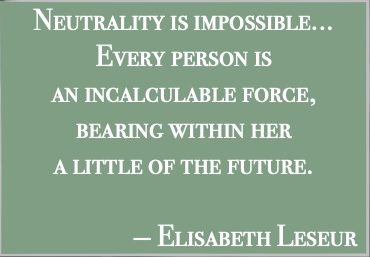
    I think that we have a lot to think about here, as a family, and even more to do.  Fundamentally, though, Laudato Si' recommends a change in attitude.  I think that it's very compatible with the spiritualities I have become most interested in over the past few years:  for example, Elisabeth Leseur's ideas that our tiniest actions and words may affect others in ways that we could never fathom, spreading outward like ripples through time and from person to person, which means that we never have the luxury of apathy.   If Elisabeth Leseur's special gift was to integrate her married life with her spirituality, then I think what Pope Francis is calling here is to integrate our economic lives with our spirituality.  Too often we separate them, but in fact we must integrate all of ourselves into Christ, and that means every decision we make is a moral decision.  Yes, even a choice of taste, like whether your ice cream is chocolate or vanilla or strawberry – or maybe that's a bit extreme; how about, whether your tacos are  carne asada or pollo or frijoles. 


  • Put up or shut up (III): lunch edition.

    I know this isn’t the most fascinating of post series to read, but at least it isn’t going to upset anyone. I guess.

    So, a few days ago I mentioned that I’m about to make a six-week push to get back on maintenance habits, and started out by making a list of meals — first dinners, then breakfasts. I really never do the whole-month-at-a-time meal planning, so this is kind of a first for me. Especially in the middle of all the preplanning I have to do for school, which starts right after the six weeks is up.

    But… moving right along, in my six weeks of summer lunches I can expect

    • 17 ordinary weekdays at home with the kids
    • 10 lunches out with the kids on our way to or from somewhere
    • 8 times I can expect to come home hungry at lunchtime and will need something quick
    • 6 times I might host other families for lunch
    • 5 times I will come home from the grocery store and need to have lunch ready soon.

    I categorized the lunches at home with kids according to the kind of thing I typically have ready for the kids to eat. I’m afraid they are going to have to go without macaroni and cheese for a few weeks, though, except maybe on date night.


    • When the kids have sandwiches, I’ll have the same: 3 oz ham/0.5 oz cheese or 2 oz turkey/2 oz roast beef on whole wheat with mustard, lettuce, and tomato. Fruit on the side.
    • When the kids have quesadillas, I’ll have a roasted veggie wrap with 1 oz goat cheese and fresh fruit. (The roasted veggies are the kind of thing that you do ahead of time and freeze in portions. Eggplant, bell peppers, zucchini, mushrooms, onions. I have made this before, it is really easy to do about 6 portions at once.)
    • When the kids have tuna salad, I will too, made with white beans and parsley and sun-dried tomatoes, packed in a whole wheat pita with fruit and baby carrots.
    • When the kids have hot dogs on homemade wheat buns with corn, I will cook a frozen white fish fillet and have that on a bun with lettuce and pickles.
    • When the kids have frozen pizza and fruit, so will I, but I’ll choose a thin-crust vegetable pizza like Amy’s roasted vegetable or Amy’s pesto or DiGiorno thin and crispy.
    • When the kids have spaghetti, so will I, with red bell peppers and a lean smoked sausage to flavor the sauce.
    • A random emergency lunch is an entire bag of frozen vegetables with whatever protein is handy and a slice of bread.

    Hosting another family calls for kid-friendly meals that scale up to a crowd. My ideas are:


    • Mini bagels with turkey and cheese, lettuce and tomato, fresh snap peas and apples.
    • Spaghetti and red sauce — it stays warm in the crockpot — with sliced smoked sausage and red bell peppers. Plenty of breadsticks and cheap grated Parmesan for the kids, but not for me.
    • Poached chicken, brown rice, steamed broccoli, and pineapple chunks with assorted sauces. For me, soy sauce, rice vinegar, and sesame oil.


    Expecting to arrive home hungry calls for some planned ready-to-eat meals. My ideas are:


    • Half a cup of hummus, half a pita, and some red bell peppers, carrot, and celery.
    • Veggie burger patty on a bun with lettuce and tomato and a scoop of avocado or guacamole.
    • One of the Amy’s vegetarian Indian food entrées with some Greek yogurt and cucumber.
    • Half a package of a Birds-Eye Steamfresh Protein Blend.
    • As a last resort, any ~400-calorie frozen entrée will do, or a combination like a frozen sandwich and a can of vegetable soup.

    Coming home hungry right after grocery shopping is a bit less grim, since I can bring something nice from the store. The kids often opt for bagels and cream cheese or a rotisserie chicken. For me, how about

    • A premium bag salad topped with a pouch of tuna or salmon, or maybe some of that rotisserie chicken, plus bread.
    • A bowl of fresh berries and a hot container of some hearty take-out soup.


    Lunches out with the kids — there always seem to be a lot of these in the summer as we go back and forth to day camps and the like — are a pretty important part of rebooting my habits, I have found, because they offer excellent opportunities to practice portion control.


    • The Chinese buffet — a pretty good deal since they charge less for younger kids, and one of my kids’ favorite places — can be dealt with by measuring 1 8-ounce bowl of hot-and-sour soup and 1 equally-sized bowl of all other choices put together, as long as enough of the latter is vegetables.
    • There are several workable choices at a Bruegger’s Bagels: an egg/cheese or spinach-cheddar omelette bagel, any eight-ounce soup plus the “bagel bites” that come with it, any café salad, a “skinny” veggie bagel sandwich.
    • Noodles and Company has some new bowls where they have swapped out the noodles for a pile of spinach. Highly recommended. Similarly, salads at Chipotle with no rice work well.
    • At least one kids’ meal choice at most fast food restaurants is within limits, e.g., hamburger Happy Meal with apple slices, fries, and a water bottle. Other places make it pretty easy to put together something under 400 calories — Subway is a decent example, thanks to good menu labeling and a custom-order culture.
    • It is even possible to navigate newfangled burger places such as Smashburger if I am willing to split the burger with someone, or have a small one with lettuce wrap instead of bun.
    Here’s hoping this is a start for a well-planned six weeks.


  • Put up or shut up (II): Meal planning, breakfast edition.

    A few days ago I explained my upcoming 6-week habit reboot, intended to put the last annoying pregnancy weight behind me for good. I started general meal planning by making a list of dinners that would work with the kind of schedule I will be keeping over those summer weeks. I didn’t assign dinners to dates yet, though — I will do specific meal planning week by week when I make my grocery lists.

    Today I attacked the same problem, only for breakfast. Normally I do not plan breakfasts ahead of time. I usually just have whatever I feel like having, typically some combination of eggs or yogurt, toast, and fruit or V-8. I probably don’t have to do this, because I rarely have an excessive breakfast, but I thought I would make a list anyway and then I would at least have portions all figured out.

    I figured that I have four kinds of mornings coming up:

    • Five breakfasts out by myself, early on a Saturday morning.
    • Seven weekend breakfasts at home with the family. This calls for muffins, pancakes, or similar.
    • Thirteen weekday breakfasts soon after shopping, when we still have fresh fruit around.
    • Twenty weekday breakfasts after I can expect all the fresh fruit to be gone.

    Breakfasts out by myself need a strategy, not a plan, and I already have such a strategy. At the Ordinary Breakfast Place I always have buttered pumpernickel toast, one egg, and a big glass of tomato juice. At the Fancy Breakfast Place I usually order the delicious breakfast quesadilla, on a house-made sprouted tortilla with black beans, spinach, and guacamole, and take half of it home for later.

    I raided my cookbooks for some good weekend-morning breakfasts, around 400 calories, and came up with this list:

    • Lemon-blueberry muffin (150 cal), scrambled egg + eggwhite + onions + mushrooms, 2/3 c whole milk
    • Coffee cake muffin (220 cal), 1/2 c plain yogurt, 1 c berries
    • Chocolate-chip scone (160 cal), 1 c strawberries, 1/2 c yogurt or cottage cheese, 1 Tbsp sliced almonds
    • 1 waffle with blueberries and 1 Tbsp maple syrup, 2/3 c whole milk
    • 2 cornmeal pancakes (1/4 c batter each) with 1 c blueberries and 6 oz blueberry yogurt

    Why the 2/3 cup of whole milk everywhere? Well, published meal plans always call for 1 cup of skim milk. Bleah. I like whole milk, so I only pour 2/3 of a cup.

    I think the best plan for weekday breakfasts is to eat the same breakfast a few days in a row; change it to something else when I run out of fresh fruit; then, change it again when I buy more fresh fruit a few days later.


    My “there is fresh fruit in the house” weekday breakfasts might include


    • Toasted whole wheat English muffin, 2 tsp whipped butter, 2/3 cup plain yogurt with a teaspoon of honey, and 1 cup sliced strawberries
    • 1 egg scrambled with bell pepper, tomato, 1.5 oz turkey kielbasa, red onion, garlic; 1 slice wheat toast, 1 cup blueberries
    • 2 eggs scrambled with cream and spinach or broccoli and bell pepper, half an English muffin, butter
    • Ham, egg, and cheese (or bacon, egg, no cheese) sandwich on an English muffin with tomato and a cup of fruit salad
    • 3/4 cup plain whole Greek yogurt, 3/4 cup chopped fruit or berries, 1/4 cup granola or other crunchy cereal, drizzle of honey


    After the fresh berries run out, I could have one of these:

    • 2-egg frittata with green pepper, onion, cheese, and salsa; 1 slice toast; half a grapefruit or some canned mandarin oranges
    • Toasted English muffin with 4 tsp peanut butter, half a banana, and 2/3 c whole milk
    • Toasted English muffin half, spread with a wedge of Laughing Cow cheese; hard boiled egg; fruited yogurt cup; tomato juice or V-8
    • 3 ounces of bagel (e.g., mini or half), 2 Tbsp hummus, cucumber and tomato, 1/2 c canned fruit
    • 2 soft-boiled eggs, (six minutes for me), 1 slice of toast with plenty of butter, glass of V-8 or tomato juice
    • 2 scrambled eggs with cream and butter, half an English muffin with a bit of honey, glass of V-8

    You might notice the total absence of bowls of cereal in this breakfast plan. This is because once I start eating bowls of cereal, I usually fall into an iterative loop of “Oops, I ate all the cereal but there is still milk in the bowl; add cereal” followed by “Oops, there is no more milk in the bowl but I still have cereal; add milk.” I do better with oatmeal, but I don’t really want that in the summer.


  • The fundamental vision of the human person.

    I'm thinking these days that it rarely makes sense for Catholics, even dialogue-minded ones, to engage — on the specific details of any controversial issue — with the average person who holds the mainstream accepted view. 

    I say "average person" for a reason, to exclude a special case where it does make sense.

    If the two interlocutors, are good friends, if they respect each other, if there is a spirit of mutual curiosity, if each is willing to say things like "Gosh, I don't know the answer to that one" and "You know, that is a really good point," and "You might be right about that," if they can spend an entertaining evening buying one another drinks and having what used to be known as a good argument – well, a lot of things are possible.  And even if nobody's mind is changed the world becomes an incrementally better place at the end of such an evening, because two people met, grappled with truth, understood each other a bit more.  

    The reason that works, and why it can make for such a satisfying way to spend one's leisure time, is that it involves treating one's opponent as a fellow human being — not as a symbol of Everything That's Wrong With The World Today.  As a person, not as a thing.

    Not to be destroyed; not to be manipulated; not to be owned (or pwned); not to be used; not to be discarded; because, not a thing, but a person.

    + + +

    People are people, and not things.  This is a good thing to remember when we do engage with the mainstream; and it ought to be easy to remember, because this is exactly the firm ground that we need to retreat to and stand on.  People are people, and not things.

    This is the unshakeable platform on which all of the complicated details are built, every way in which the Catholic vision of What People Can and Cannot Do To And With Each Other differs from the mainstream one.  The structure atop this platform can appear awkward and gangly and intricate, like a child's jungle gym.  The structure is built upon the platform, not the other way around.   It's possible to start in one place, follow it back to its origins where it is rooted in the base, and from there work your way back up to any other spot; or to zoom out and take in the whole as a coherent structure.  It is all connected.  

    But that's asking a lot of somebody who encounters you on Twitter, or for a couple of hours at a family picnic.  To put it bluntly, most people just are not going to go there.  Following you all the way down that structure is something that real friends and fellow-thinkers might be reasonably expected to do.  The reality is that we cannot expect it from most people.  Scoring points in an argument with a bigot is fun and memorable; reading lengthy quotes from Thomas Aquinas is not attractive. You can't dissuade somebody from going cow-tipping by inviting them to a lecture on bovine physiognomy instead.

    Some people who think more about thinking than I do have offered detailed philosophical reasons for the mutual incoherence.  It may be simpler to observe that the Catholic worldview and the jumble of popular public worldview start from different assumptions, postulates if you will.  A less optimistic view is that the popular public worldview does not hold to any one set of assumptions, leaping to whatever is the most useful at the time.  Of course, that view is consistent with the notion that there is no "popular public worldview" to engage with; there are only individual human persons, none of whom are symbolically representative of anything, and who must be engaged with one at a time.

    + + +

    And so, because we want to engage with people as people and not as symbols, we have to accept that often we won't be able to usefully engage on the specifics.  A lot of public discourse is completely dominated by utilitarianism or sentimentality (sometimes both at the same time), neither of which are compatible with the Catholic vision of the human person.    

    It would actually be refreshing to meet someone, discuss the politics of the day, and hear her say "Well, actually, I subscribe to the philosophy that the most moral action is always the one that maximizes the total amount of happiness and decreases the amount of suffering in the world."   Or perhaps, "I hold that the best moral guide is one's feelings:  the moral action in any unpleasant situation is the one that relieves the actor's feelings of discomfort and dissonance and produces soothing feelings of satisfaction and catharsis."  One might disagree with such people, ideally at great length and over a few drinks, exploring each one's structure all over from the ground up, and trying to understand how they all fit together, testing the parts for soundness.

    This doesn't seem to happen very often on Twitter.

    + + +

    I propose a retreat to the fundamentals — this fundamental vision of the human person, articulated by Karol Wojtyla in Love and Responsibility, a notion upon which that same man as Pope John Paul II would build most of his Christian anthropology known as the Theology of the Body:

    A human person is "a good toward which the only adequate response is love."

    This notion is itself rooted in the Christian understanding of God and nature, so it isn't absolutely fundamental itself.  It is, I believe, as far back down the structure  as we can go without being forced to debate the nature of God or pit holy books against one another.  But it is fundamental to us in the sense that it is really not up for debate.  

    It is also a useful foundation because, I believe, it commands a certain amount of respect in the abstract.  So even someone who rejects it in specific instances (How can you say that we have to respond in love to that monstrous child-murderer?  He doesn't deserve love from us!) can be persuaded that it is a reasonable philosophy to start from, or perhaps an ideal to strive for even if it is terribly impractical.  A die-hard positivist may reject it, but most people we may speak with are not die-hard anything.

    + + +

    That statement of the human person sounds good to a lot of people, and a very large number of them might say they agree with it, when asked.  But the meaning to which they are agreeing depends very much on their definition of the two key terms in that statement:

    1. human person
    2. love

    And this is a place where we have a chance to make some commentary that might shed light.   Because very often, our differences have to do not with people rejecting the statement that a human person is a good to which the only adequate response is love, but with people 

    1. excluding some humans from personhood (either because they do not meet some criterion for inclusion, or because they have committed some act which has revoked their status) 
    2. using a different definition of "love" 


    We can anticipate #1 by changing "human person" to "human being;" we regard the one as identical to the other, even if others do not, and do not believe that a human's personhood can be revoked.  We can anticipate #2 (which is entirely understandable given the vagaries of the English language) by being more specific up front, combining John Paul II with Thomas Aquinas:

    A human being is a good toward which the only adequate response is agape-love, that is, "willing the good of the other."

    That is grammatically clunky, so

    The only adequate response to any human being is to will his or her good.

    From there we can derive almost everything there is to say about how human beings should behave towards one another and with one another.  It does remain to point out that by "good" we must emphasize "ultimate (eternal) good," but this never excludes willing temporal good as well.

    It doesn't mean that there will never be moral dilemmas; it does mean that we can't resolve them by retreating to utilitarianism or to sentimentality, but instead have to work to resolve problems where the good of one "other" appears to conflict with the good of another "other."  Sometimes a larger perspective is needed.

    Anyway, the statement above is not what you would call an argument-winner.  It invites discussion from the interested, maybe.  It does not solve policy problems all by itself, but then, neither does anyone else.  It is mainly about how people treat each other, not how social policy is constructed; social policy could be judged in its light, by considering whether it encourages or discourages people from willing each other's good, but it won't provide answers on its own.

      It has the advantage of being true, and easy to remember.  It will not steer you wrong, either as an argument — or as a style of argument, which might even be more important as we navigate the world of ideas, which is only an oblique way of saying the world of human persons.


  • Put up or shut up: early meal planning.

    The baby turned 18 months old yesterday.  His babbling is peppered with "Mine!" and "'Elp-bee! 'Elp-bee!" and "DOG DOG DOG DOG DOG."  He answers Yes and No, tells us when he needs a new diaper, uses forks and spoons and regular cups like an expert.  He is coming right along.

    It is time for me to stop making off-hand remarks to Mark and other people about how frustrated I am that I have not yet gotten back to my pre-pregnancy weight.  I think it is happening kind of on its own, but very slowly.   The number of pounds left to lose is not terribly large — about eight pounds — and honestly, it isn't a bad place to be; I think I look fairly normal.  But I'm longing to get back into my old clothes, which are tantalizingly, only one size away.  I've held off buying a new wardrobe in the larger size that I've been wearing for most of a year.  

    But these yoga pants are not going to last forever.  Eventually I either have to get back to the old size, or buy clothes that fit me now.

    + + +

    It isn't so much the need to go on a crash diet as it is the need to refocus on my lifetime maintenance habits, with strict enough attention to calories that I can't fool myself.  I never really have emerged from the "eating for two" mindset, and if I want to eat for one in the future, I need to remind myself exactly what it looks like and feels like.

    I know what this takes:  single-minded attention that prioritizes the Calorie Project above all else.  (See this category if you don't believe me.)  Mark knows what it takes too:  a lot of support from him.  For example, I'm going to cut out alcohol with dinner for six weeks, and he will help by not opening bottles of wine or offering me a beer with dinner.

    So together we looked at the calendar and picked out a roughly six-week period this summer:  July 21 through September 3.   There's not a whole lot going on for us in there, and it seems like a good time to try.  

    I have been thinking of it as the "put up or shut up" block.  It isn't good for me to be constantly fretting about still carrying around extra weight, but not making the commitment to do something about it.  At the same time, I'm not ready just to say "oh well, I guess this is my size now" until I've achieved some closure by taking a real stab at it.  

    So, I keep saying:  "I'll work on it for six weeks, and then I'll stop complaining about the extra weight."

    And Mark keeps reminding me:  "You know, if you really do work on it, you might actually lose the weight."

    And I reply:  "Well, then, I hope I do stop complaining about it."

    + + +

    I must prepare for this.

     I have so much less disposable time than I did the last time I focused.  I need a strategy that does not rely on me laboriously counting each day's worth of calories the night before.  Hence, I am going to try for meal-at-a-time counting, which I can do pretty well on the fly, and shooting for 400 calories at each meal.

    And I need serious meal planning, ideally of all six weeks at once.  I started by sitting down with a calendar and methodically working out the following information:  there will be

    • 11 evenings that we have to eat quickly and then go to the gym
    • 6 Sunday cheese-and-cracker suppers
    • 5 date nights
    • 5 ordinary Saturday evenings
    • 4 ordinary Friday evenings (similar to Saturdays, but meatless)
    • 4 consecutive evenings with Mark out of town
    • 4 weeknights after busy days
    • 3 dinners I take to H's house
    • 3 dinners provided by H

    Then I considered family favorite meals and consulted a couple of 400-calorie-meal-plans to come up with ideas.  I rejected all meals that I usually compulsively eat more of (e.g., homemade garlic-bread-crumb-topped macaroni and cheese).  

     Repeats are okay, and some things can't be planned, so I came up with something less than the corresponding number of dinners for each type.   

    Gym nights:

    • Chile cheese egg bake, salad, and a cooked green vegetable
    • Sweet and sour cabbage salad, kielbasa, and mashed potato
    • Skillet gyros (it's just ground beef and oregano), pita bread, and Greek salad
    • Turkey BLTs (that is, deli turkey plus real bacon — no turkey bacon), broccoli, and apples
    • Slow cooker tortilla soup, limited chips, and fruit salad
    • Southwest corn and bean chowder with ham, limited cornbread

    Ordinary Saturday evenings:

    • Yogurt-marinated chicken on the grill, sliced cucumber salad, pita bread, cooked greens
    • Grilled steak, corn on the cob, tomato salad, melon
    • Moroccan-spiced grilled chicken, couscous, salad of sliced radishes and oranges
    • Hamburger patties, on buns for everyone else, cooked green vegetable, carrot salad

    Ordinary Friday evenings:

    • Minestrone soup, fruit salad, and a limited supply of parmesan pita toasts.  
    • Cheese tortellini with red/yellow/green peppers.
    • Tilapia fish tacos with pineapple chunks, cabbage slaw, and guacamole.

    Mark out of town:

    • Grilled cheese sandwiches and homemade tomato soup for kids.  Soup, cheese, crackers for me.
    • Roasted chicken legs, fruit salad, bread and butter, and cooked green vegetable.

    Busy-day weeknights:

    • Baked teriyaki chicken breasts, white rice, kale, oranges.
    • Rotisserie chicken from the grocery store, sweet potatoes, broccoli.
    • Deli turkey sandwiches with asiago cheese, apples, almonds, and chips.

    Meals taken to H's:

    • Crockpot hili over whole wheat spaghetti with shredded cheddar, french-cut frozen green beans
    • Crockpot salsa chicken in brown rice bowl with cheddar, cilantro, beans, corn, lettuce.

    Date nights and cheese-and-cracker suppers don't need a plan as much as a strategy:

    • For the date nights, it has always worked well to split everything with Mark in about a 2-to-1 ratio.  
    • For cheese-and-cracker suppers, I'll make sure I have my own little three-ounce portion of some nice blue cheese, a couple tablespoons of fig preserves, and some Triscuits, and not touch any of the other stuff.  I know my blue cheese is safe from everyone else at the table, so that should work.  Or I'll have my own three ounces of lox and a couple tablespoons of cream cheese.   A pot of decaf coffee already brewed will help, too, for the end.

    I'll plan each week in more detail when I sit down to make the grocery list, but at least I have already done the work of identifying meals.  For breakfast and lunch I will probably employ the same-thing-every-day-for-a-week strategy.  I guess I'll check in on that later.  For now, it's business as usual.


  • Sunday morning run, in bad cell phone photos.

    Yesterday I did paperwork at the gym while I was waiting outside the 8yo’s aikido class. Normally I am not a watching-the-lesson mom; I am a getting-my-own-workout-in mom. But yesterday I just couldn’t face going round and round the track eighteen times in a mile, when I knew there would be nice weather today. (My daughter has not yet reached the age where I am allowed to leave the premises while she is in the Y.) So I told myself, “Tomorrow I will go run around the lake. I will get up early and be back in time for breakfast. That will be so much nicer than being inside.”

    And this morning I did. It wasn’t hard to roll out of bed at all, because I was looking forward to it. I enjoy running around the lake so much more than running indoors, it really is a treat.

    I drove Mark’s car to the western side of South Minneapolis and parked about three blocks away from the lake. Sometimes I feel a little ashamed of the fact that I usually drive somewhere in order to go for a run in a pleasant urban environment. Unfortunately, I live in something of a running-path desert. Any out-and-back run of the lengths that I have time for would be at least fifty percent sidewalks-and-intersections. Annoying!
    (Biking, on the other hand, would make a lot of sense. I really need to buy a bike lock.)
    I could have parked closer to the lake, but I have two good reasons for parking here. One of them is that it is a pleasant walk through a residential neighborhood to get there. The street I park on dead-ends here, but the sidewalk doesn’t.
    The sidewalk looks almost as if it is going right into someone’s yard, but eventually it turns right (heading north) and passes directly in front of the wide porch of a big, pretty yellow house that faces the lake. A couple of summers ago, I was watching it be renovated, a little bit of progress each time I went for a run.
    This summer, the house next door is getting an overhaul. I can smell freshly sawn lumber, possibly even cedar. It looks a little blocky and ad hoc — not, I think, faithful to the architectural bones of the house — but you can’t deny that these two stories of front porch will take advantage of its excellent lake view, at least in three seasons. Love those little casement windows on the first level.
    At this point I have not yet started running. Down a sloping sidewalk in front of these two housew, and a third house that is the home of the Minnesota Zen Center, and a left turn, and across the helpfully placed crosswalk. Careful, there is a bike path at the bottom of the steps. Look both ways!
     
    l
    The bike path is one-way (commuters can bike the other way on the road), but the walking path is not. Today I turn left:
     
    And off I go, running easily. I don’t feel like working super hard. I feel like having a nice easy morning run. So easy that I can stop and take photos from time to time, with the camera in my cell phone that I keep zipped into my little performance-fabric wrist wallet along with the car key and a twenty dollar bill.
     
    (Once, on the theory that you should give gifts that you would like to receive, I wrapped up one of these extremely useful wrist pouches for the $15 women’s random Christmas gift exchange in our extended family. Mine was the last present unwrapped. It was obviously a disappointment. The next year I went on a different theory and brought a bottle of some kind of alcoholic chocolate mint truffle drink. That appeared to go over somewhat more successfully. Go figure.)


    Not many people running around the lake today. But there are anglers on the dock!


    I like to start out running south in the early morning, because of the sight of my own shadow stretching out before me, taller than life, running on ahead. It is curiously uplifting. If I am ever entertaining the slightest reluctance, if the inner whiner complains that the end is too far off, the shadow-runner seems to say, “Just put one foot in front of the other. Follow me; I do this kind of thing all the time.” By the time I pull ahead of her, partway around the lake, I will have left the complaining voice far behind.

    (unfortunately it is hard to get a shot of the shadow runner in action)


    Rounding the south side I am momentarily startled by this silhouette:

    It is a statue or something of a lake monster. I have seen it before, but not here. The last time I remember seeing it, it was in Lake Nokomis, visible from Cedar Avenue where it crosses the water. I think there must be someone in the city parks department whose job it is to move this enormous figurine around from lake to lake so that each year it is found in a different place.

    Given that the city does a competent job (seriously) with things like snow removal, I suppose I can find it in my heart to approve of a few of my tax dollars going for, uh, whimsy.

    At seven on a Sunday morning there are not many boaters out.

    Shouts come over the water from a chaperoned group of kids who are doing something with a sailboat, not very far from shore, that has its sails down. Maybe they have just finished a sailing lesson? Are just starting one? Anyway, the lifejacketed kids and adults on the shore are yelling “Paddle! Paddle!” at the kids in the boat. Not in an emergency kind of way, but in a this-is-hilarious kind of way. There may be a story here, but I do not stick around to find out about it. I pass the dock, pass the always-staffed booth where we can find out more about aquatic invasive species, and leave that story behind.

    I walk back from the lake, admiring the gardens here and there. This neighborhood’s residents love their gardens.

    And come to the other reason I parked three blocks from the lake:


    I am thirsty. Large iced cold press in hand, no flavor but a shot of cream, I sit down for my post-run selfie so I can model my favorite running shirt. I call it the “Plausible Deniability” shirt:

    The word “Half” before the word “Marathon” and the tiny afterthought “& 5K” in the fine print testify to the truth. Especially the afterthought.

    Have a great Sunday!


  • Post-Obergefell.

    This morning you get unformed notes, because I have stuff to do and lately a bad habit of never sitting down at all to write anything because I don’t have it all put together in my head.

    1. I’m aware that there’s a substantial bloc of thoughtful Catholics who would peg this as the wrong attitude, and I fully admit that they might be right, but my primary feeling towards the issue of SSM on the national level has been, for years, for better or worse: Look people, this is going to happen. Might as well learn to deal with it now. And by “deal with it,” by the way, I don’t mean “accept SSM in all its okayness,” but “resume the work of loving our neighbor, and speaking the truth about the human condition with word and action, in a society where we are a distinct religious minority with respect to this issue.”

    2. Also, I can’t help but wonder if the Right as a whole and Catholics as a group had entertained the idea of civil unions a long time ago, which were apparently inconceivable back in the day but all of a sudden seemed like a much more reasonable idea as soon as SSM looked like it had a shot of gaining real support, we would already have learned quite a bit about living as said religious minority.

    3. Tl;dr: I believe that the American public’s shared civic understanding of the purpose and meaning of marriage diverged from the sacramental understanding two or three generations ago. The main difference is that before, it was possible for Christians to pretend otherwise.

    Corollary to (1) and (2) and (3): I am aware that this attitude made me significantly less-than-fervent in the efforts to forestall acceptance. I am aware that I promoted a pragmatism that left no room for hope. I think I made the minimum effort that a voting, Mass-going Catholic should make, no more. Failure of hope? Probably. Premature pragmatism? Yes. Rooted, at least partly, in a desire to be seen as a Voice of Reason by everybody? Yes. I have taken it to confession, this very morning, that I closed my mind to more defense-minded, hope-minded people and arguments, that I spoke reasonably (I like to think) as a means to the end of seeming reasonable. Lord have mercy on me, on us all.

    4. Yet, here we are, and I have renounced my imperfections in the advocacy of pragmatism, but I don’t actually reject the pragmatism itself. Consequently, my emotional reaction to the outcome of Obergefell is, for better or worse: Now that we’ve gotten that over with, we can get on with the real work. And by “real work” I mean the stuff that the Christian Church is good at, which is many things, but which is emphatically not trusting in governments to maintain the culture to our specifications.

    5. In other words, we are back to personal conversion and spreading the Good News, which sounds as if it is increasingly ironically named the Good News, but which in fact is not ironic at all, which means that we are at a bit of a linguistic disadvantage here in the affluent West. We have to be, I don’t know, speakers of a kind of creole. And really, has it ever made sense to try to convince the dominant culture to conform to Christian standards of behavior while declining to preach, first, Christ crucified?

    Corollary to (5): I believe we are now able to admit that we are in the position of the early Church in places like Rome or maybe the missionary church in places like the British Isles. We are a religious minority that has one understanding of the purpose and meaning of marriage (of human nature, really), living in a civic society that holds an understanding that is mutually exclusive with ours. We hope to worship without fear, and also we hope to make of all disciples. We have an advantage of being less miniscule in number; but we also have a new disadvantage, namely, that almost everyone around us has heard quite enough, thank you, of an extremely garbled version of our message.

    6. Speaking of garbling the message. Probably because of what has been going on in my home archdiocese, I am feeling a bit like the institutional Church is reaping what many of her priests and bishops have sown for fifty-odd years. Let me put my attitude in context, again in full disclosure: I’m disgusted with our archdiocesan leadership. Our credibility as an institution has been squandered on coverups, and promises that we have now all put it behind us, and then more coverups. The archdiocesan child protection policy is apparently little more than what in a different context we call “security theater.” It would indeed be good for us all to sacrifice some convenience to secure real protection of vulnerable people. Sadly, here in Minneapolis-St. Paul, I have a strong impression that while ordinary folks are waiting barefoot in a long line to be frisked, the VIPs are letting each other past the line through the side door. Who will listen to us now on issues of marriage and the family? Whose fault is that?

    7. I may not have had resolve to fight before, but (because, I guess, we are now in the place that I wanted to jump ahead to) I have a measure of resolve to fight today. The culture war is sure to continue. I expect a long string of First Amendment lawsuits, some of which will have legal merit and some of which will not, some of which will win and some of which will not, and time will tell whether First Amendment protections of dissenting opinions will remain robust. We will each of us, as always, have a duty to defend our own family, and to defend the truth.

    8. And yet I can’t stand with the (understandable) impulse to self-defense. We are stuck with many inconvenient words of Jesus that appear, oddly enough, to predict that neighbors will say nasty things about his disciples, that family members will reject them, that they will be thrown in jail, etc. Oddly enough again, these words appear to endorse accepting this situation. As if it were a blessing or something. This is obviously folly. Someone’s folly, anyway.

    9. I saw a lot of celebration yesterday, and that is something I understand. People who feel victorious celebrate; it is a natural, basically good impulse. I also saw a lot of spitefully gleeful rhetoric. This is not a basically good impulse. It saddens me. There is a lot of work to be done in engaging hearts and minds.

    10. There is conversion to be called for, too, among people who hold to the sacramental understanding of marriage, because — face it — from time to time the dominant rhetoric betrays an outright false understanding of the dignity of all human persons. End derogatory slurs now. End ridicule now. End code words now. Shut it down. Clean up our own house. There is a lot of work to be done engaging hearts and minds.

    11. We are supposed to act in ways that so that we are confident no one can misinterpret our actions as approving of sin. Obviously we cannot totally control how another person will perceive our acts, but we are supposed to refrain from acts that give the impression of endorsing falsehoods. We should also be trying to refrain from acts that give the impression of rejecting persons. We might be in a better position today if we had worried as much about giving the impression that we do not love people if they are the wrong sort of people. For there more ways than one in which we can give an impression of endorsing falsehoods about the nature of the human person.

    12. So, #LoveWins was the hashtag of the day yesterday. This is two-thousand-year-old news. May I suggest #LoveHasAlreadyWon? Be not afraid, folks.


  • Sister things.

    I started to read Laudato Si' last night, in bed with an iPhone, and didn't get very far into it before I was too sleepy to go on and had to put it down.  The dim rectangular afterimage of a glowing screen danced before my eyes for a few moments as I rolled over, snuggled in next to a baby, and let my mind wander.

    Occasionally it's at this time that my brain makes odd connections.

    + + + 

    I've written a little bit recently about Japanese author Marie Kondo's The Life-Changing Magic of Tidying Up.  Mostly I wrote about the practical advice on getting rid of stuff.  I haven't written so much here about what a deeply foreign book it seems to be.   I don't think the content must have been updated very much for an American audience.   Kondo is Japanese, and wrote for Japan.  

    She takes for granted, for example, that the reader's home is laid out like a Japanese home.  Here she is on closets:

    If you have built-in closets in your home, most of the things in your house can be stored inside them.  

    Japanese closets are ideal storage spaces.  They are deep and wide, are divided into top and bottom by a broad and extremely sturdy shelf, and have a cupboard built into the wall above.

    And on the "fatal mistake" of storing things near where they are to be used:

    For people like me who are naturally lazy, I strongly recommend focusing storage in one spot… If it only takes ten to twenty seconds to walk from one end of your home to the other, do you really need to worry about the flow plan?

    Yeah, she's not thinking about American ramblers, or four-level urban homes with detached garages.

    And then there are little tidbits like this:

    I once worked as a Shinto shrine maiden for five years.

    A very noticeable feature of the whole book, one that is central to her concept, is a relationship with inanimate objects that can seem a little bit bizarre.  It fits right into my personal preconception of Japanese household culture, which I admit is heavily and almost exclusively influenced by Studio Ghibli movies such as My Neighbor Totoro, populated with strangely alive, anthropomorphic objects, down to spidery, googly-eyed balls of soot.

    Anyway, to sum up, Ms. Kondo describes the process of selecting, storing, and using possessions as almost a dialogue between herself and the objects.  Here are a few selections from different parts of the book.

    When you come across something that's hard to discard, consider carefully why you have that specific item in the first place.  When did you get it and what meaning did it have for you then?  Reassess the role it plays in your life… [If] that particular article of clothing has already completed its role in your life,… you are free to say, "Thank you for giving me joy when I bought you," or "Thank you for teaching me what doesn't suit me," and let it go.

    Can you truthfully say that you treasure something buried so deeply in a closet or drawer that you have forgotten its existence?  If things had feelings, they would certainly not be happy….Let them go, with gratitude.  Not only you, but your things as well, will feel clear and refreshed when you are done…

    When you are choosing what to keep, ask your heart; when you are choosing where to store something, ask your house.

    This is the routine I follow… First, I unlock the door and announce to my house, "I'm home!" Picking up the pair of shoes I wore yesterday and left out in the entranceway, I say, "Thank you very much for your hard work," and put them away… I put my jacket and dress on a hanger, say, "Good job!" and hang them… I greet the waist-high potted plant by the window and stroke its leaves.  My next task is to empty the contents of my handbag … Before closing the drawer, I say, "Thanks for all you did for me today." 

     So, this stuff is kind of weird.  A few amateur reviewers I've run into have described it as "delusional."  I think it's more that this comes from a culture, and a way of relating to inanimate objects, that most of us are not familiar with.  

    It's not like Westerners don't anthropomorphize objects; it's just that we mostly do it when we're annoyed with them, as in "OUCH! Damn this car door!" when we slam our fingers in it, or "This stupid shopping cart doesn't want to roll straight!"  or sometimes when we need to pretend we are explaining them, like "This material won't dissolve in water because it's hydrophobic."

    + + +

    So I had kind of brushed off the Kondo-isms as "probably just a Japanese thing."  And then I encountered something small and almost entirely unrelated that made me reconsider it in a slightly different light.

    I only got a little way into Laudato Si' where there is a short discourse on St. Francis of Assisi.  In par. 11, Pope Francis briefly described the saint's attitude toward non-human things:

    He communed with all creation, even preaching to the flowers, inviting them “to praise the Lord, just as if they were endowed with reason”.  His response to the world around him was so much more than intellectual appreciation or economic calculus, for to him each and every creature was a sister united to him by bonds of affection….

    His disciple Saint Bonaventure tells us that, “from a reflection on the primary source of all things, filled with even more abundant piety, he would call creatures, no matter how small, by the name of ‘brother’ or ‘sister’”. Such a conviction cannot be written off as naive romanticism, for it affects the choices which determine our behaviour. If we approach nature and the environment without this openness to awe and wonder, if we no longer speak the language of fraternity and beauty in our relationship with the world, our attitude will be that of masters, consumers, ruthless exploiters, unable to set limits on their immediate needs.

    By contrast, if we feel intimately united with all that exists, then sobriety and care will well up spontaneously. The poverty and austerity of Saint Francis were no mere veneer of asceticism, but something much more radical: a refusal to turn reality into an object simply to be used and controlled.

    Mind you, Francis (the pope) is mostly writing fairly narrowly here, about Francis (the saint)'s attitude towards "nature" — by which we often mean plants and animals and the sea and the air and the earth, not always the collection of all objects around us.  That Saint famously called natural objects "brother" and "sister" because they, like us, are created by the Father.  His words remind us that in many respects, though we are persons and not objects we are more like to the rest of creation than we are to the Godhead.  They are words of humility.  But that's not all they are words of.

    Some of what St. Francis was getting at, when he preached to birds and addressed "brother sun, sister moon,"  is gratitude.  Because that is what a Catholic vision of "respect for the natural world" must, in the end, be reduced to.  Respect is actually something owed to persons, and all "respect" for objects, natural or man-made, is really a respect for persons; the object is merely a means of transmission.  Example:  we show respect for, say, an American flag, not for its own sake, but because it's a way to visibly respect people who also share that flag, sometimes (as at a military funeral) very specific people.  

    And we "respect" the natural world, not for its own sake, but (practically speaking) to steward it and share it for the sake of other people's livelihood, and (more fundamentally speaking) out of gratitude to God for making a gift of it to all of us.  Wastefulness and an attitude of total control risk us taking for granted this world of objects for which we should give thanks every day.

    + + + 

    So, I told you that I sometimes make really odd connections when I'm drifting off to sleep.  I realize this is kind of a corny one.  I am not putting The Life-Changing Magic of Tidying Up on the same level as a papal encyclical.

    But the slight cross-cultural glimpse into Kondo's world of paying little homages to her possessions connected in my mind with St. Francis calling creatures "brother" and "sister."   I think that there is something to be said for "speaking a language of fraternity and beauty" — not just about blades of grass, vast canyons, colorful birds, cherries in bloom — but even about the mean little things that we surround ourselves with, the things that we make, buy, and use.  

    Kondo recommends addressing our excess things personally as a literal act that frees us from needing to cling to them.   She has you looking your possessions in the face, so to speak, and intentionally choosing which to let go.  It is not hard to imagine that, having practiced this small asceticism, one might find it easier to choose not to acquire so much in the first place.  To avoid waste not by keeping many things that "someday" you might use, but by never buying up so many things in the first place.  Treating useful or beautiful possessions "the way they want to be treated" — that being a sort of shorthand for "the way that will keep them functioning for a long time."  Passing on things that still have some use in them, without dumping unwanted items on people.  While acknowledging that this is a bit of a corny connection to make, I wonder if it might not be a good practice to behold and handle each of our possessions with some spark of gratitude for each one to the God from whom all blessings flow.

    John Paul II's life's work, one could argue, was spent teaching us not to treat persons as if they were objects.  

    I could quip here that in this introductory part of Laudato Si', Francis is teaching us not to treat objects as if they were objects, either.   At least:  not objects "simply to be used and controlled."  

    May we use objects?  Yes!  That is one of the things that separates them from persons.  We are not allowed to use persons.  We are allowed to use objects.

    May we control objects?  To the extent that we can do so, yes.  Again, this is one of the things that separates them from persons.  We are not allowed to control persons all the way to their innermost being, who retain  their free will and capacity to use reason absolutely, and no one has the right to interfere with those.  We are allowed to control an object.

    So the problem is in "simply" using and controlling them, I think.  There is at least one other thing we must do with all objects:  receive them with gratitude.  Not really for the sake of themselves, but for the sake of the one who gives them to us as gifts.


  • Happy Father’s Day…

    10409123_4838985790633_3195758393916569373_n

    …to someone who makes a gift of himself to us every day.