bearing blog


bear – ing n 1  the manner in which one comports oneself;  2  the act, power, or time of bringing forth offspring or fruit; 3 a machine part in which another part turns [a journal ~];  pl comprehension of one’s position, environment, or situation;   5  the act of moving while supporting the weight of something [the ~ of the cross].


  • Claim the mys!

    Everybody knows by now that Amazon.com has a new feature called "Statistically Improbable Phrases" (a name that for me recalls The Hitchhiker’s Guide to the Galaxy, but that’s another story).  I suspect these are more gadgetry than usefulness. 

    Amazon.com’s Statistically Improbable Phrases, or "SIPs", are the most distinctive phrases in the text of books in the Search Inside!™ program. To identify SIPs, our computers scan the text of all books in the Search Inside! program. If they find a phrase that occurs a large number of times in a particular book relative to all Search Inside! books, that phrase is a SIP in that book.

    SIPs are not necessarily improbable within a particular book, but they are improbable relative to all books in Search Inside!.

    This morning I was looking on Amazon for a copy of the hymnal our parish uses.  The list of SIPs is kind of fun, strewn with lyric-shrapnel from the impact of all the hyphens:

    stored our life, fore your throne, ceive our prayer, stroyed our death, claim your death, have mer, your glo, claim the mys, est heav, day our dai, dore thee, dore him, sus lives, all glo, ing spir, lis pec, nal rest, com pas, our mak, ver flows, qui tol, his glo, thy mer, our tres, gels sing

    Most of the bits are not from hymns, but from parts of the Mass.  At least two of them (at first glance) are from the Our Father.  Little bits of the Latin Agnus Dei too. 

    I guess that makes sense.  There are a lot of Protestant hymnals, after all, so those would tend to share language with Catholic hymnals, making those phrases not particularly "improbable."  Except for the Mass parts, which are unique to Catholic hymnals.   


  • Finslippy birth story!

    Alice at finslippy finally got around to writing and posting a birth story for Henry (who’s three).

    I am not usually a fan of hospital birth stories, but this one is fun to read.

    Because of the epidural that had robbed me of all ability to feel what was happening to my poor vagina, I was spared the so-called Ring of Fire sensation, in which the baby’s head stretching everything to its outermost limits and beyond, causing you to believe your vestibule may in fact be aflame. Nonetheless I still had Johnny Cash in my head as I pooshed. And pooshed. Love is a burnin’ thing. Doo doo-doo doo-doo doo doo doooo. And it makes a fiery ring. “Look at his eyelashes!” the nurse exclaimed, and my husband looked down and said, “Oh my god,” and I said, “Are they longer than his head? Is he some kind of fringed freak? Will he make us some circus money?” Only I didn’t say any of these things because I was mooing.

    Read the whole thing


  • Defying the critics.

    Ann Althouse pointed to this quote by Jean Cocteau:

    "Note just what it is about your work the critics don’t like, then cultivate it.  That’s the part of your work that’s individual and worth keeping."

    There’s some discussion in the comments to her post about whether this is always, sometimes, or never true, and under what conditions.   I think it’s probably sometimes true.

    How do you know?  Perhaps it has to do with how much you respect the critics in question (and if the only reason you don’t respect them is because of what they say about you, you should probably re-evaluate that.) 

    I put this post under "New paradigms in homemaking" because that’s my main work right now.  In general, after all, a mother’s choice to stay home attracts a great deal of criticism (to be fair, so does the choice to work outside the home).

    Of course, I don’t have too many critics of my homemaking in specific, and the ones I do have (at least the ones who would say so to my face) are uniformly critics I respect.  I am picturing the following conversation:

    MARK:  I think you should wash the quilt on the kids’ bed.  It smells like pee.

    ME:  I suppose I shouldn’t expect someone like you to understand my art.

    Nevertheless I think I’ll keep the quote in mind…


  • Actions and intentions.

    I saw a quote today (I don’t know who originally wrote it) that I liked:

    We see our actions in light of our intentions; we see others’ intentions in light of their actions.

    Seems like a good thing to keep in mind as a parent and as a spouse, doesn’t it? 

    We should try to ‘see’ the intention that the other sees when acting or responding.


  • “To be any more Trad, you’d have to be Jewish.”

    The website for the Society of St. Pius I.  Make sure you read the disclaimer at the end.

    Welcome to the fledgling website of the Society of St. Pius I (SSPI). Unlike other so-called “traditionalist” Roman Catholic groups, we adhere to the ORIGINAL Roman Catholic Mass of A.D. 40-200, and described by St. Justin Martyr and the Apostolic Constitutions, and used by Pope St. Pius I of happy memory.

    Don’t be fooled by PHONY “Vulgate” neotraditionalists, who claim to protect tradition, and yet still defend the RADICAL and totally UNCATHOLIC reforms of the 4th century A.D.

    So-called “trads” pretend to be against the modernism of the last hundred years, but where were they when the original Rite of Rome, the Greek rite USED BY ST. PETER AND THE APOSTLES was being totally gutted and revised by unknown scholars and translated into the vernacular language of Latin?

    Unlike other wimpy neotraditionalist groups who attach themselves to various other Piuses, we at the SSPI make absolutely ZERO compromises with modernism. We reject not just one, but BOTH “Novus Ordos”—the Novus Ordo of 1970 promulgated by Paul VI, and the Latin Vulgate Mass of 400 A.D. promulgated by Innocent I and Pope Gregory I, which we call the “Vulgar Mass.”

    Thanks to the miracle of the internet, we can now spread the TRUTH about the REAL Roman liturgical tradition which is being kept alive only by a brave remnant of faithful Catholics: myself and whoever else wants to join.

    (Don’t get the joke?  The short explanation:  The Society of St. Pius X is a well-known group of traditionalists.  Whether they are in formal or material schism is apparently a matter of debate.  I am no expert in this. Suffice it to say that they are somewhat more conservative than the Pope.  The writing style of the website linked is a parody of some of the writings of the SSPX adherents — not of their official website, which is more measured.)

    I think it’s hilarious.  H/T to Eric for pointing it out.

    UPDATE.  I also like this part:

    Above ground churches are a LATE development in the Roman church which date to the legalization of Christianity by Constantine. They were NEVER part of the original Roman rite!

    In accord with holy tradition therefore, we must reject any and all above-ground church structures, in accordance with the true traditional practice of the Roman church. Unfortunately, funding issues and zoning laws in our locality have so far prevented us from excavating new catacombs in our area, so we are temporarily headquartered behind the water heater in our basement.

    Hee hee.


  • What obsolete skill are you?

    I rather like how mine turned out:

    a vegetable garden
    You are ‘growing one’s own food’. You are guided by two words: ‘Live simply.’ You
    value quality over quantity in most things, and
    you have little use for the materialism and
    consumerism of modern culture. You know the
    value of hard work and try to be
    self-sufficient as much as possible, and what
    you do you do well. Unfortunately, no man is
    an island, and you cannot do everything
    yourself. Your puritanical work ethic makes
    makes people think that you are weird, and not
    much fun. Your problem is that growing one’s
    own food has been obsolete for a long time.

    What obsolete skill are you?
    brought to you by Quizilla

    Try it yourself here.  H/t On the Other Foot.


  • Discrimination against the handicapped.

    "One woman’s choice," in the Washington Post today:

    While I have no doubt there can be joys and victories in raising a mentally handicapped child, for me and for Mike, it’s a painful journey that we believe is better not taken. To know now that our son would be retarded, perhaps profoundly, gives us the choice of not continuing the pregnancy. We don’t want a life like that for our child, and the added worry that we wouldn’t be around long enough to care for him throughout his life.

    …I’m sure pro-lifers don’t give you the right to grieve for the baby you chose not to bring into the world (another euphemism, although avoiding the word "abortion” doesn’t take any sting out of the decision to have one). Only now do I understand how entirely personal the decision to terminate a pregnancy is and how wrong it feels to bring someone else’s morality into the discussion.

    Articles like this upset me. I can’t even begin to imagine what it’s like to read it for the parents who welcome, raise, and love children who have Down’s Syndrome.

    And what does it feel like to have aborted such a child, when you happen to see the rare family that includes and loves a child exactly as yours might have been?

    Ninety percent of these children, by someone else’s choice, never see the light of day.


  • Robert Browning and “twat.”

    This is a very funny, and apparently true, story of a bit of a mistake.


  • House.

    It’s 6:30 and still pretty dark. 

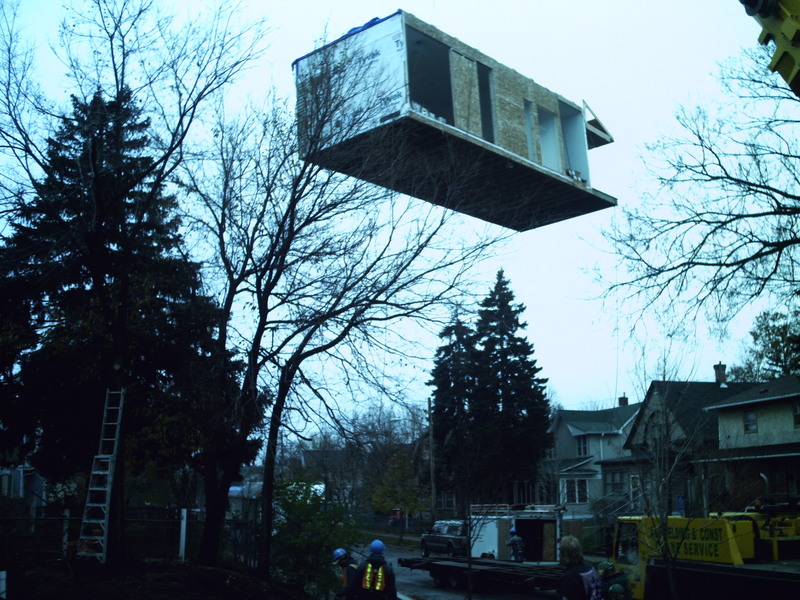
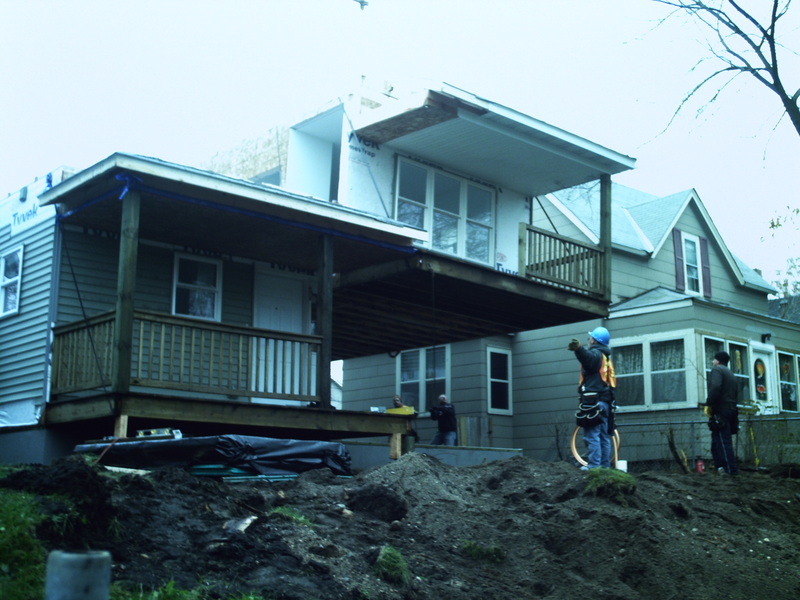
    Out my front window I can see two semi trucks.  They are the front of a caravan of five — maybe six, I’m still not sure how the roof is going to be put on.  The first two trucks are each bearing half of the first floor — the left half and the right half, so to speak. 

    The pieces have siding on them, except in some places where you can see printing:  Tyvek House Wrap.  The wooden porch, with shingled roof, is already built and attached, in halves, to the front of each piece.  Over the top of each is stretched a blue tarpaulin, or perhaps it’s just plastic sheeting.  The outlines of roofing shingles on the porch are visible through the tarp. 

    Three men in winter coats and hats are talking in the street.  I think they are the truck drivers.  One of them paced off steps at the curb, deciding if there is enough room for… another truck?  The crane that will lift the house pieces in place?

    A neighbor walked her dog past.  She was cradling a young child, wrapped in a blanket, on her shoulder.  She walked away with turned head, staring back for a long time, pulled by the dog on its leash.