"Mrs. Anonymous Teacherperson," religion teacher in a Catholic high school, describes a creative classroom simulation to drive home the importance of the "which gospels are canonical" question.
bearing blog

bear – ing n 1 the manner in which one comports oneself; 2 the act, power, or time of bringing forth offspring or fruit; 3 a machine part in which another part turns [a journal ~]; 4 pl comprehension of one’s position, environment, or situation; 5 the act of moving while supporting the weight of something [the ~ of the cross].
-
-
No more Number Two Pencil.
Kimberly Swygert of Number Two Pencil, one of my favorite education-related blogs, is moving on:
N2P was intended to be a place where readers could come to peruse, at a leisurely pace but a reasonable depth, discussions of the basics of psychometrics and statistics, the myths and realities of testing, and the media’s attitude towards testing at the K-12 and college level…. As much as I would like to keep this blog active, I don’t feel it’s the right thing to do, given the limitations of my time.
However, I do still have some time to lend my expertise and opinions to the lively discussions in the edublogging world, and I would like to stay involved as much as my life and time permit. Thus, I’ve decided to join the staff of The Education Wonks as a guest blogger. I feel very honored that they’ve agreed to have me in a guest spot on their site, which I consider to be one of the brighter new stars in the edublogging world. My psychometric knowledge and my general opinions will, I hope, add something meaningful to the discussion there.
Best wishes to Kimberly! I’ll be checking out the Edu-Wonks over the next few days…
-
No experiments here.
I was helping Hannah pack boxes in her living room when I came across a plastic box containing what looked like someone’s forgotten snack. "Ew, what’s this?"
She came over and peeked in the box. "Oh, it’s the mummification project!" I looked at her quizzically and she took it from me and showed me how one piece of apple, which had not been mummified, had shriveled and dried up and turned brown, while the other, mummified apple slice, although dried, was not nearly as shriveled and retained a youthful, pinkish glow, at least as much as a slice of mummified apple can. She explained the steps of the process, which included burying the apple in salt among other things.
"Sounds like a good experiment," I said as we went on with our work.
"It was a good experiment," she agreed, heading back to the kitchen with the packing tape.
"Although," I called out to her in the kitchen, "that’s not really the right word."
"Yeah, yeah, I know," she said, sounding as if she’d heard it before.
Doubtless she has. We both know better — I’m an engineer by training, and we’re both married to one, I mean we’re each married to one, that is. But it’s hard to break bad habits, even if you detest them.
Most (ahem) "science experiments" aimed at children — such as the ones here ("28 page booklet includes 12 experiments!"), here (The Everything Kids’ Science Experiment Book), here ("Potato Clock — Kids Science Experiment"), here ("180 Experiment Kids Science Fair Kit") — are NOT experiments. Neither are most "science lab" activities performed in schools, whether grade schools or high schools.
Wikipedia has a good definition of "experiment:"
In the scientific method, an experiment (Latin: ex-+-periri, "of (or from) trying"), is a set of actions and observations, performed in the context of solving a particular problem or question, to support or falsify a hypothesis or research concerning phenomena. The experiment is a cornerstone in the empirical approach to acquiring deeper knowledge about the physical world.
But most of the "experiments" that parents buy in kits or that teachers set up for classrooms of children are carefully contrived, not to acquire deeper knowledge about the physical world, but to demonstrate some principle or law that is already well known. Thus, the correct word for these is not experiments, but demonstrations.
There is nothing wrong with this, of course. A demonstration is an excellent way to teach those principles, along with laboratory skills such as proper technique and appropriate safety precautions. Some of the best demonstrations are re-enactments of important experiments from the past, and so they are good history lessons as well as lessons about the natural world. And many demos are lots of fun to set up and discharge. (Of course, many others are tedious and repetitive, which — if you ask me — is also a useful introduction to the realities of a career in scientific research.) I’d rather call it what it is, though, and teach accurate concepts of what is and isn’t "science."
Mind you, it’s perfectly possible to perform true experiments in the home or school setting. Here’s the key: If whoever planned the activity knows in advance what the outcome is "supposed to be," it’s a demonstration; if not, it may be an experiment. If my kids and I decide to plant seeds in different parts of my yard to find out which will grow fastest, that is an experiment. If, however, I encourage them to lean out the window with a stopwatch, dropping marbles and bowling balls and feathers onto the sidewalk, hoping that they will discover the wonders of gravity, that’s a demonstration.
I know a few people who even refuse to apply the term "science" to children’s study of the natural world. I usually don’t go that far, but I don’t blame them. People can get some weird ideas with that slip of usage: Somehow my kids have picked up the word "scientist" as a verb, as in "Give me that sharp stick, I’m going to scientist that dead bird."
Science is, appropriately, reserved for original work that adds to the body of human knowledge. A child who’s "doing science" is, generally, one who’s doing real experimentation.
("Studying science" is a little more broad; that would include learning about the history of science, reading the biographies or writings of scientists, and practicing laboratory techniques, among other things.)So what words can we use instead? Well, all of the -ologies and associated words are available, and (bonus!) are much more precise: biology, zoology, chemistry, anatomy, physics, geology, paleontology, and the like all appropriately mean "the study of" or "the practice of the arts of" a particular sector of human knowledge. If you’re looking for a generic term to replace "science," as in "What are you doing for science for your third-grader this year?" you could try "natural phenomena" or "nature study" (for some reason we typically use this to encompass only botany and zoology, maybe rocks, but it’s properly applicable to any of the so-called "natural sciences.")
Bringing back the term natural philosophy might not be a bad idea either.

-
More art from today.
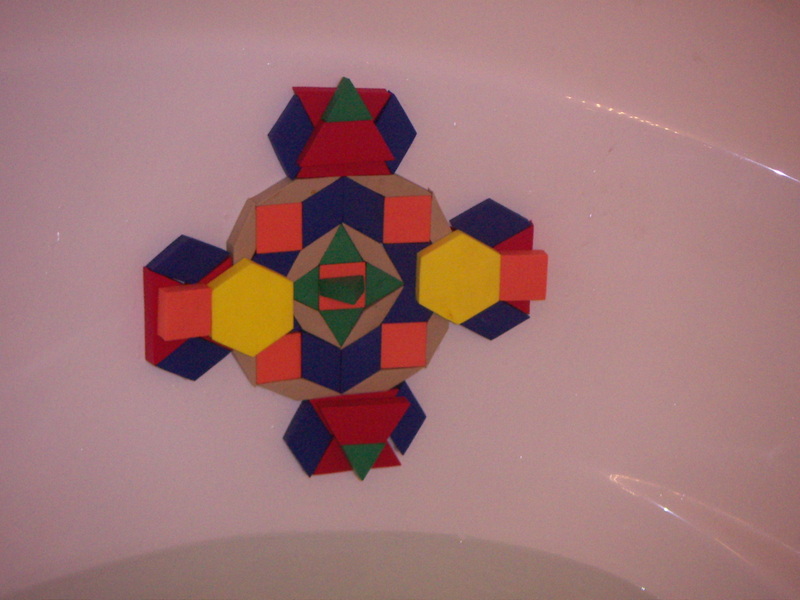
Okay, I know it was kind of geeky to give my kids a set of closed-cell foam pattern blocks for bath toys. But they were really cheap, and… I don’t know what got into me, honestly.
Still, I think it was a good present:
He says it’s "Jesus’s cross."
I never imagined it with the multicolored marquetry, but it speaks to me, somehow.
-
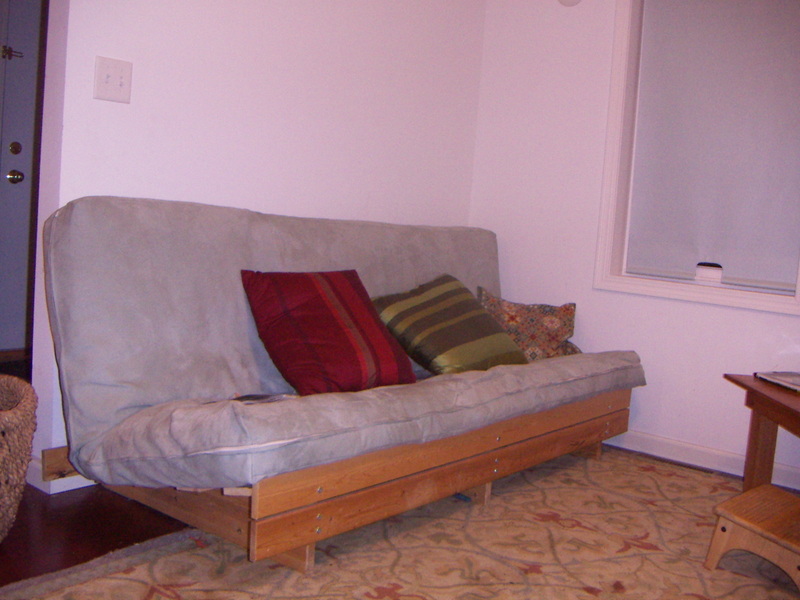
Art imitating upholstery.
This is our living room futon:
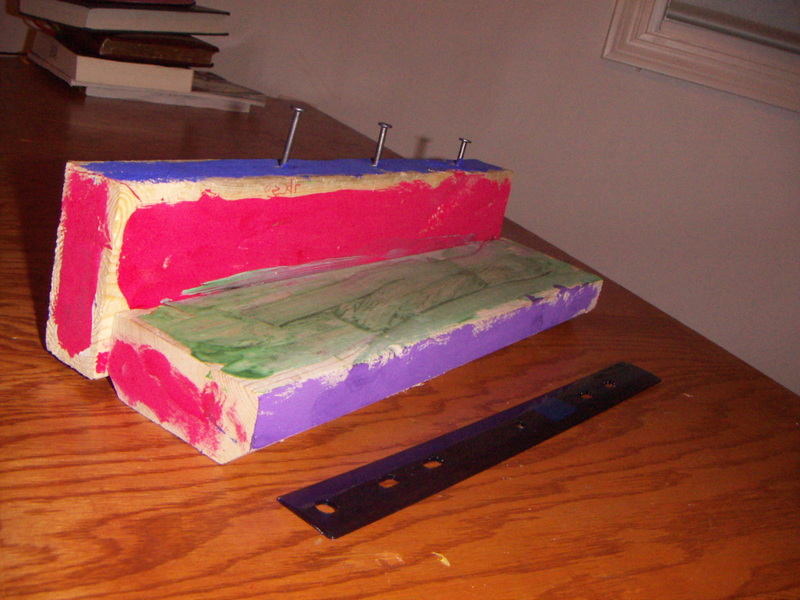
This is a spontaneously produced sculpture of our living room futon:
The three nails represent the three throw pillows, according to the artist.
-
Divine Mercy, complete with eggrolls.
Our parish, it turns out, throws a pretty big bash for the Feast of Divine Mercy. I had no idea.
We’ve only been members for a little over a year, and last year on Divine Mercy Sunday, I was in Salt Lake City for a ski trip (and let me tell you, Salt Lake City is a disconcerting place to be when CNN is in all-Pope-death-watch-all-the-time mode — the biggest news in the local paper was the Latter Day Saints’ General Conference being held that weekend, and on the Feast Day itself, the morning after John Paul II passed away, the front page of the religion section featured President Gordon Hinckley). I went to Mass that morning, including confession for the plenary indulgence, in a tiny neighborhood church. (It was one of those confessions where I take both kids into the confessional with me? You know, because my husband is off skiing? That kind?) The priest, almost apologetic, announced at the end of Mass that the ladies of the church had prepared tea and sandwiches and cake to celebrate his birthday that morning.
Anyway, this year we went to the late morning Mass so that I could stay after for the DM celebration while Mark took the kids home afterwards. It turned out that people showed up from parishes all over, squeezing us to standing-room only — I think it was less crowded at any of the three Triduum services. We were lucky to get two chairs in the back, right next to the door that goes downstairs to the bathrooms. Miraculously, the kids did fine, didn’t block the floor too much.
Afterwards I went downstairs for the box lunch and had the good fortune to find a seat next to Desperate Irish Housewife, whom I will get around to adding to my blogroll one of these days. The lunch featured egg rolls, which were apparently being deep-fried by the thousand in the kitchen by a team of devout Filipinas. The way Father told it, it sounded as if the egg roll idea had been cooked up specifically by them to lure lots of people to the parish for Divine Mercy Sunday, starting a few years before John Paul II officially re-inaugurated it as a major feast day. It sure would have worked on me. Who knew that the way to the Sacred Heart is through my stomach. Or something like that.
The celebrant, also the event guest speaker, was Father Thomas Sullivan of the Congregation of the Fathers of Mercy. On his way up to the podium, he stopped to talk to three sisters wearing the distinctively recognizable sari-style habit of the Missionaries of Charity — you know, Mother Teresa’s religious society — and convinced them to move to the front pew. I think they must have accompanied Fr. Sullivan, as I don’t know of any MoC houses locally.
Anyway, the place was packed. The confessional lines on both sides stretched the length of the aisles, all before and during Fr. Sullivan’s talk. Also the Eucharist was exposed for adoration the whole time. And the Parish’s large painting of the Divine Mercy image was taken out of its alcove and set up in a place of honor. And we had incensing, and blessing of religious articles (I had brought a little medallion bearing the Divine Mercy image, which had been sitting in m dresser drawer ever since I forgot to bring it with me to Salt Lake City last year), and the Divine Mercy chaplet, and a litany of St. Faustina, and a rosary with meditations taken from St. Faustina’s memoir, and finally Benediction. Quite a full day!
I’m glad that last year I happened to choose St. Faustina’s writings as my Lenten reading. Anyone who wants to understand the Divine Mercy devotion would do well to read them, of course, but last year it seemed particularly well-timed — because, of course, Lent and Easter culminated in the passing of her countryman Karol Wojtyla, i.e. John Paul the Great, who had done so much to bring the Feast of Divine Mercy back into the Church year and for whom that day’s anticipatory Mass was the last Mass of his life. I wrote this last year on Palm Sunday:
I thought of how singular it is that Palm Sunday Mass contains both Hosanna and Crucify him, how close together they are, how quickly popular sentiment can change. St Faustina writes in her Diary:
March 21, 1937. Palm Sunday. During Mass, my soul was steeped in the bitterness and suffering of Jesus. Jesus gave me to understand how much he had suffered in that triumphal procession. "Hosanna" was reverberating in Jesus’ heart as an echo of "Crucify."
What reverberates in our hearts?
I was an unchurched kid, a converted adult. It took me a very long time — years — to assimilate a mental picture of a Jesus I could feel that I knew personally, one that didn’t come laden with baggage or treacle. Even that came long after I formed one of God the Father, and even long after I formed one of the Blessed Mother. The mental picture that works for me has turned out to be an interior image of the Divine Mercy. I prefer the older painting, seen here on this page.
-
Kids and Tuscany.
After having read and enjoyed Amy Welborn’s Rome-with-kids travelogue (see the heading "Rome Trip" in the left sidebar on her main site), it was nice to see a similarly positive article and related sidebar in today’s Star Tribune by Jenny Deam, who with her husband took her three small kids to Tuscany.
We haven’t attempted that sort of vacation yet (we did manage Maui a few weeks ago), but I hope we do sometime, and she really makes it sound fun. And she pulled ’em out of school for the trip — even better!
I second some of the recommendations she made, including the one about bringing the portable DVD player (me, I’d rather have my laptop). It’s not that it has to be DVDs, it might be some other absorbing thing, but I’ve noticed that the stimulation of a trip needs to be offset by "down time" that includes something familiar. Letting the kids watch a video in the evening or before naptime would work for my family; for other kids, it might be books on tape or card games.
I wouldn’t have skipped Rome though!
-
How to stop being Catholic.
UPDATE ADDED 12/15/09: Some of the information in this post is now out of date. See this post by Jimmy Akin. Original post follows.
Jimmy Akin and Ed Peters The Blogging Canon Lawyer are all over the story about the new clarifications to the rules about formal defection from the Catholic Church.
That is, the rules under which the Church considers a person who was baptized Catholic to be Catholic no longer. They're much stricter than you might think. What does it take? How about if you stop going to church and never get confirmed? If you were baptized as a baby and are then re-baptized in another denomination (say, Baptists, who don't accept infant baptism as valid) are you then no longer Catholic? How about if you start confessing the faith of Islam? What if you stand on a soapbox in public and loudly renounce the beliefs of the Church one by one? What if you merely spend forty years saying "I used to be Catholic but now I'm not?" Will the Church call you a "former Catholic?"
Nope. I'll let Jimmy summarize:
The upshot is that in order to formally defect one must:
- Decide to leave the Church (which supposes an act of heresy, apostasy, or schism)
- Put this decision into effect ("realize" it),
- Manifest this decision externally by submitting it in writing to the Ordinary (normally the bishop) or one's pastor, and
- Get the Ordinary or pastor to agree that you really have performed the act of will to leave the Church described above and thus committed heresy, apostasy, or schism.
It is then to be noted in the parish baptismal register that you have so defected.
If any of those things is lacking, you haven't defected. You're still Catholic, according to the Church.
Why does it matter? Who cares if the Church bureaucracy knows that Joe Schmo calls himself a Baptist now?
To the average Catholic or person-calling-himself-a-former-Catholic, the most likely ramifications have to do with marriages and declarations of nullity (commonly referred to as "annulments.") One example: Annulments for defect of form are probably going to be easier to obtain. Ed Peters puts it this way:
Because it is now clearly harder to prove that a given Catholic has defected formally from ecclesiastical communion, that means that the number of Catholics still bound by the requirement of canonical form (1983 CIC 1108 and 1117) for marriage is higher than some might have thought, which in turn means that more "marriages outside the Church" can be found null for violating canonical form.
Why's this? People who are Catholics are not able to contract a valid marriage outside the Catholic Church without obtaining a dispensation. If you're Catholic, and years ago you got hitched at City Hall or at Good Book Baptist Church without proper permission, that marriage isn't canonically valid. Consequently, obtaining a declaration of nullity is really straightforward and easy, should you wish to marry someone else who happens to be a practicing Catholic.
On the other hand, if you're not Catholic, and you got hitched outside the Church to another person who is also not Catholic, that marriage is presumed to be valid until proven otherwise. Consequently you have to prove there was something else wrong from the beginning. Obtaining a declaration of nullity is thus more involved and perhaps impossible.
In other words, it's pretty important to know whether either party in a union was Catholic at the time of the wedding or not.
Ed goes on:
My impression is that US tribunals had already adopted a narrow reading of "formal defection" to begin with, so the actual impact of this Notification on raw numbers in US marriage cases will be small, but to the degree the Notification has any effect in this area, it would be to increase, not decrease, the number of annulments.
Ed also points out that the clarification raises some more questions. Maybe the clarification needs a clarification.
The explanation may give more information some people who are confused about a common, yet sticky etiquette situation: Whether they should, or shouldn't, attend weddings outside the Church when bride and/or groom is "formerly Catholic" and the proper dispensations haven't been sought.
To my knowledge there's not automatically a moral imperative to avoid giving the appearance of support in such situations — it probably depends on one's relationship to the bride and groom and the likely consequences of visibly withdrawing one's approval — but I'm sure that for some people, a question that likely confuses the issue is "Is this guy really even technically Catholic anymore? I don't even know if canonical form applies here." Well, now you know.
But Jimmy points out that the pastoral situation — created not so much by the clarification itself as by the failure of the Church hierarchy to be clear in the first place — is itself quite sticky.
As a result of doing this at this late date, there is a pastoral problem that has been created. To wit: Lots of people left the Church by what appeared at the time to be a formal act (e.g., getting baptized in the Mormon church) and got married without observing Catholic form and then they came to their senses and came back to the Church and some of them were told, "Oh, you don't need to get a convalidation. You had formally defected."
If the … linked document is judged to be retroactive then guess what: Those people do need a convalidation and they're not validly married to each other right now!
Fortunately, according to Jimmy, canon law as written appears to forbid bishops or tribunals from applying the clarification retroactively in this way.
Incidentally… yes, it can be very weird, being me, to attend a wedding of a formerly-identified-as-Catholic-person outside the Church, or any other wedding in which I have enough inside knowledge to know that the union probably doesn't constitute a valid marriage. (I say probably because I'm not a tribunal — I don't have authority to judge. Just the intelligence to suspect.) It always feels really strange and foreign to me.
-
Safety vs. well-being.
Selkie says:
When I spoke to those college students early last month about childbirth, I used an analogy that occurred to me during the Winter Olympics: I said that hospital birth is like ski-jumping and homebirth is like cross-country skiing. Ski-jumping is more dramatic than other events — there are ambulances standing by for a reason. Cross-country skiing has its own risks. It’s unusually hard work, and you could have a heart attack and die on the trail. But out there in the stillness some of us find an extraordinary beauty.
A significant consideration, of course, is that in childbirth you’ve got a passenger along for the ride, dependent on you for protection. Your decisions matter, because we’re talking about the potential for injury to or death of a baby. But I think most people hear "homebirth" and imagine ski-jumping solo, with no helmet and no EMTs, when it simply isn’t like that. In both events you’ve got skis on your feet and you’re heading to the finish line. But when you deliver a baby at home, the spiral of interventions that too frequently culminates in an emergency surgical delivery just doesn’t get started.
I also liked this graf:
So these are my questions, gentle readers: one, should I call my confessor for an appointment tonight or can it wait until morning? Two, should homebirthing women be held to a higher standard with regard to informed consent? (By which I mean, if most women laboring in hospitals don’t know that the shot of Nubain they gratefully accept can impede a baby’s subsequent respiratory effort, should a woman at home be expected to be more conversant with the literature?) Three, Dr. Amy assures me she has a list of references as long as her arm to demonstrate the hazards of planned attended homebirth by low-risk women — does this mean she is an amputee or just a person with unusually short arms?
One of the commenters’ lines got me thinking. He or she wrote,
I agree with your statement that patients should get to make their own choices when each option is equally proven to be safe ….
which made me wonder, in what other "medical" situation are patients only allowed to make choices between options that are proven to have precisely equal safety?
How ridiculous, how arrogant. Can you imagine speaking this way (since the writer thinks of pregnant women as "patients") to someone weighing chemotherapy vs. radiation, or surgery for a chronic condition vs. physical therapy? "I’m sorry, you’re not allowed to opt for the limited radiation course. Even if all your hair falls out and you can’t taste your food for the rest of your life, you have to take the full chemo course because our studies show that it gives better outcomes."
And as for the argument that a baby’s health and life are at stake too, which is true of course — isn’t it traditionally the parent who makes medical decisions on behalf of a minor child? I swear, the hospital maternity department is the last holdout of the women-are-chattel contingent.
But let’s dispense with the medical analogies… Look, there’s a lot of ways to measure "risk" when it comes to birth choices. Perhaps it’s true that hospital birth is in certain important senses safer than home birth. Maybe the risk of death really is several times higher in a planned home birth than in a planned hospital birth. Before you object, note this: if it’s not true today, it might be true tomorrow (should hospitals win the battle against staph — it could happen — or should competent homebirth midwives disappear from the earth).
So what if? What if? What if hospital birth instead of homebirth were proven to reduce the risk of death?
Look. So is walking instead of driving. So is one daily glass of wine instead of zero or three. So is camping instead of boating. So is cross-country instead of downhill skiing.
And, since we’re talking about little ones too, so is kids’ soccer instead of kids’ hockey. So is letting your kid play video games in the basement instead of making your kid go ride his bike around the neighborhood.
Even if hospital birth were proven to be TEN times less likely to end in somebody’s death than homebirth, they’d still be basically low-death-risk activities. We’re talking small, less than 1 in 1000 risks, maybe even much, much smaller for women who are healthy and strong to begin with and for their babies.
So, given that the chances of a seriously horrible and tragic outcome are, really, low in both places —- it makes complete sense to respect the right of the individual to make her choice based on the costs and benefits that are much more likely to actually be encountered in the typical situation. No doctor has the right, moral or otherwise, to tell me I have to drink a glass of wine every night if I don’t like the stuff. No doctor has the right, moral or otherwise, to tell me to hang up my skis. And can you imagine if the state medical association (this is Minnesota after all) insisted that parents who let their kids play hockey were criminally negligent and that those whose children were seriously injured ought to be prosecuted?
Look — we know our own family. Take Selkie’s skiing analogy. Mark loves downhill skiing. Is it riskier, on the face of it, than cross-country skiing? Sure. Much, much higher chance of striking a tree at great speed if you involve a steep slope than if you don’t. But — if he weren’t allowed to fly out west for a downhill ski trip several times a year, do you really think he’d replace that time with cross-country schlepping? Would he be motivated to go to the gym once or twice a week and lift weights all winter to stay in good condition for… shuffling around the (flat) lake path on a snowy evening? For him, not skiing is probably riskier than skiing, for the simple reason that knowing that ski trip is coming up in a few months keeps him motivated to stay in shape. Not only that, but he’s planning for the future: he wants to be in shape to use the senior-citizen lift ticket discount a dozen times a year.
So, throw death out the birth-choice window. It’s just not very likely to happen — the chances are so small that it counts as "freak occurrence" whether home or hospital, and you can’t live in fear of that kind of thing — it would be like avoiding the hospital solely for fear of accidental baby-switching. Instead, concentrate on stuff that’s much more likely to be encountered. Like the chances an unnecessary C-section, with all its complications. Or the chances that nursing will or won’t get off to a good start. Or the chances of a medical mistake. Or the chances of postpartum infection. Or the chances of more minor birth-related injuries, like pelvic floor dysfunction.
Or — dare I say it? — consider personal beliefs about what’s good for human beings to experience! Safety is one thing; well-being is another. It’s my right and duty to seek well-being for myself and my children, at all times. Some minimum standard of safety is part of that, but safety itself is not well-being — elevating absolute safety above all other considerations decreases well-being.
-
Grading.
Thursday, like every other Thursday, there were three other women friends and their seven children (plus my own two, so nine children all together) at my house from about 10 till 4. I made mini-pizzas for lunch.
The kids were all down in the basement playroom and we were just getting settled into our coffee — those of us who had schoolwork to do with our older kids hadn’t started it yet — when I heard a diesel engine idling out front and turned to see a Bobcat parked just outside my front windows. I ran out front and there was Archie the excavator, here a day early, shouting at me over the rattling engines, could we please move all our cars?
Well. No letting the kids play outside today; they’d have to make do with the basement, which turned out to be okay because it had apparently flooded to a depth of several inches with HOT LAVA THAT MUST BE AVOIDED BY STEPPING ON TOYS AND SCRAPS OF CARPET REMNANTS LEST THE HAPLESS VICTIM BE SUBJECTED TO AGONIZING TORTUROUS DEATH ACCOMPANIED BY PROLONGED SHRIEKING.
It also afforded opportunities for watching out the window. Later, when Oscar jumped up and fled his math worksheets for the third time, Hannah said to me pointedly, "Erin, you have to have recess when a dump truck arrives in your back yard." She has a point. Otherwise, why homeschool?
-
“How do we learn to die?… How do we practise dying?”
A brief and powerful post by John da Fiesole at Disputations.
(Much of the credit goes to Fra’ Lawrence at Fruit of Contemplation, whose post John excerpts.)
I’ll not look at Compline ("Night Prayer") the same way again.
-
The myth of the inventor: A somewhat fictionalized account of a discussion.
Mark was musing last night about something he learned at a training seminar. "Who invented the light bulb?" he asked.
Rhetorically, I assumed, staring up at the ceiling (I was putting my feet up after a pretty long day). "I suppose I am supposed to say Thomas Edison."
"Right," said Mark. "So why, then, if Edison invented the light bulb, did he have to buy out the rights to an existing patent for a light bulb?"
"I suppose," I said, "that someone else came up with the idea for the light bulb, and consequently got a patent for it, but never managed to actually make one. At least not one that worked. You don’t have to have a working prototype to get a patent, just the idea."
"So why do we say that Edison invented the light bulb?" pressed Mark. "Why don’t we say that he improved on the light bulb?"
"Or engineered it? Or marketed it? Or made money off it? Where are you going with this?" I asked.
"Could it be," he speculated dramatically, "because the original patent was a Canadian patent?!"
"Is that so?"
"Yes!"
"I don’t really care. Who cares who had the patent? They didn’t do anything with it. Edison tried something like hundreds of different designs, with different filaments."
"Still," insisted Mark, "the word inventor isn’t appropriate."
"Are you suggesting that the light bulb myth is an example of American exceptionalism?" I asked. He indicated that, yes, he did.
"Because I don’t think so," I said. "I think it’s an example of our need to have the myth of the inventor."
"Ah yes," Mark said. "The single inventor."
"We have to have a hero," I continued. "We have to have a single person that we can pin the whole thing on. Nobody ever improves on the work of previous people."
"Nothing is ever developed, by, say, a committee."
"Yes. James Watt," I raised my voice as Mark left the kitchen in search of a broom and dustpan, "JAMES WATT, AND NO ONE ELSE, INVENTED THE STEAM ENGINE. Philo T. Farnsworth invented the television. Alexander Graham Bell invented the telephone. And so on, and so on. And why do you think this is?" I continued. "We need to believe that science, engineering really, is the work of heroes. Geniuses!"
"Who sit in their laboratory until the inspiration strikes, and then… they invent something." Mark shook his head. "It gives people wrongheaded ideas about how engineering works."
"When really, everything — just about — that is invented, I mean developed, engineered, is part of a whole chain of innovation. But we only pick out the most prominent person in the chain, whether they’re some rich guy who funded the project, or the one who got interviewed on the news, or just the most personable of a whole bevy of potential ‘inventors.’"
"Yeah — And ‘inventor’ hardly describes the most significant role that Edison played. He founded a company. General Electric."
"But ‘company founder’ doesn’t sound as snappy." We sat in silence for a while. "I blame elementary school teachers, I think. Everything’s got to be so simplified."
Later we decided that the whole myth of the inventor comes from the same sort of simplification and desire for a tidy, engaging story that gives us, say, patriotic legends about American historical figures (e.g., Washington/cherry tree, Lincoln/log cabin). The secular hagiography, I call it.
(Mark liked that term, but it ended our conversation, because he went off on a tangent trying to come up with a good line about "I’m writing my autohagiography.")

Recent Comments
Recent Posts
- Boundaries and whom to set them with.
- Neighborliness.
- Seventeen years later (part II): looking back at a series I wrote about “Gains.”
- Seventeen years later: Looking back at a series I wrote about “Gains” .
- The sudden sensation of “the good life,” part II: what do they all have in common?
Categories
…more to come later