bearing blog


bear – ing n 1  the manner in which one comports oneself;  2  the act, power, or time of bringing forth offspring or fruit; 3 a machine part in which another part turns [a journal ~];  pl comprehension of one’s position, environment, or situation;   5  the act of moving while supporting the weight of something [the ~ of the cross].


  • More on the windows.

    I blogged a few days ago about little Laela Shaugobay, who fell from a fourth-floor window in Minneapolis, in part (apparently) due to fire codes that require minimum-sized windows that are easy to open from the inside.

    Laela is likely to survive, according to today’s Star Tribune.  She’s a lucky girl. 

    But her story highlights some serious problems with the city’s fire code.

    The exact circumstances of her fall are unclear to Shaugobay, but she said it appears that Laela had gone to the open window and may have been trying to look out or to put her face against the screen. The window sill is low, coming to just below Laela’s waist.

    That’s too low for safety.  That’s also where the window sills are in my house, because the city required it.  See my post, which includes pictures of my two-year-old son standing next to the window in his future bedroom.

    As she leaned over, the window screen popped out and she fell.

    Residents of the Many Rivers apartment complex along E. Franklin Avenue have expressed concerns that the window screens in the building are too loose.

    Building officials said they share those worries, and plan to explore efforts to better secure the screens.

    According to the previous Strib article, when the building manager had tried to secure the screens (in a different building) prior to the accident, city inspectors stopped him.

    Besides, window screens are not meant to prevent a fall. 

    There is no city regulation addressing the security of window screens, in part because screens, even if well installed, are not meant to be strong enough to keep people from falling, said Minneapolis Fire Marshal Dave Dewall.

    He cautioned residents or landlords who might try to place some kind of barrier, such as security bars, in front of the screens that the city fire code requires any barrier to be easily removed from the inside so that the window is a readily accessible escape route, he said.

    Dewall stressed that the best safety measure is simply to stay clear of windows.

    And people are supposed to keep their small children clear of windows…. how?   

    What about simply keeping the windows closed and locked?  That works for some kinds of windows, but trust me, not all.  My toddler could easily operate the casement windows (again, we were required to put in the casements instead of the originally-planned double-hung windows, by city code) in our bedroom; the only latch or lock is within his reach.

    What about training your children to stay away from the windows?  Maybe … but it wouldn’t have helped Laela, who fell from her aunt’s apartment, not her own.


  • “It says something about the state of visual arts today.”

    Life imitates The Onion.

    In this year’s summer show at London’s Royal Academy of Arts, "Exhibit 1201" is a large rectangular tablet of slate with a tiny barbell-shaped bit of boxwood on top. Its creator, David Hensel, must be pleased to have been selected from among some 9,000 applicants for the world’s largest open-submission exhibit of contemporary art.

    Nevertheless, he was bemused to discover that in transit his sculpture had gotten separated from its base. Judging the two components as different submissions, the Royal Academy had rejected his artwork proper–a finely wrought laughing head in jesmonite–and selected the plinth.

    The Royal Academy claims the selection was not an error, because the pedestal (but not the actual sculpture) was "thought to have merit."  Click the link to see the accepted work.

    h/t DarwinCatholic.


  • The Heimlich maneuver.

    I was trying to herd the boys out the door of Melissa’s house just as she finished cooking dinner for her family — pancakes and bacon.  Melissa’s youngest was wailing, having awoken grumpily from his nap, and I was snapping at the boys about shoes and wet clothes and things, and we were all pretty hungry. 

    Oscar, unbeknownst to me, took a large piece of not-terribly-crisp bacon off the serving plate and stuffed it whole into his mouth.  I was trying to pull a dry T-shirt over Milo’s head when I heard a strange noise behind me and turned to find Oscar choking on the bacon.  He was bent over, making little gurgling sounds, turning red — and simultaneously trying to stuff the trailing end into his mouth.

    "Spit it out," I said sharply, and he only cupped his hand more tightly over his mouth.  "Spit it out!" I said again, then shouted, "SPIT IT OUT!"  For some reason, this (the fact that Oscar wouldn’t spit it out even when I yelled at him) pissed me off more than worried me, which was probably good because when I came around behind him I performed a Heimlich maneuver that just about had the character of child abuse.  It lifted him off the floor.  He took a whistling breath and I screamed "SPIT IT OUT!" again because I could just see him using that breath, or the next one, to inhale the big blob of bacon right back into his throat.  (I started to do it again but Melissa’s husband Chris pointed out that he had taken a breath and I should stop now.)  Finally he ejected a chewed, rubbery blob onto the rug.  Chris picked it up and threw it in the trash.  I sat down on a nearby chair.

    Oscar started to wail and threw his arms around my neck and sobbed.  I held him and said I was sorry that I had yelled at him. 

    Oscar wailed:  "Chris threw my bacon in the garbage!"

    And then he wailed:  "Stop laughing at me!"

    And then he wailed:  "I want some more bacon!"


  • The conversation ended rapidly after that.

    Mark came into the house, sweaty from his Monday-night game of ultimate disc, and the boys squealed and piled into his lap.  He had a big smile that lingered long after the boys unpiled and clattered back downstairs to the playroom.  He’d already expressed gratitude that I encouraged him to start playing frisbee with a few guys after work once a week.

    ME: (from a horizontal position on the couch; I’m pregnant and tired):  Life’s pretty good, huh?

    MARK (still grinning):  Yes.  Life is unreasonably good.

    ME:  You pretty much got everything you wanted, didn’t you?

    MARK:  Yup.  [taking off his shoes, still grinning]  I brainwashed you pretty well.

    ME:  Good thing you didn’t tell me your plans on our first date.

    MARK [still grinning]:

    ME:  So, like, was sending me to graduate school part of the plan?

    MARK:  Oh, absolutely.  You thought you were preparing for a professional career in academia.  But really, all along I was grooming you to be happy as a housewife.

    ME:  Don’t say that word.

    MARK:  Grooming?


  • Open windows. (Updated).

    This past week, a toddler girl fell from a fourth-story apartment window in South Minneapolis.  She’s doing better, but is still in critical condition, according to this Star Tribune story.

    An issue in this story is the conflict between fire-safety codes (bigger, easy-to-open windows are better) and commonsense child-safety principles (hard-to-open, not-so-big-that-they’re-close-to-the-floor windows are better).  As far as I know, there aren’t any requirements that upper-story windows should be difficult for children to open.  It seems that the fire-safety code wins this particular conflict.

    The building’s developer, American Indian Community Development Corporation, will do a full investigation and ask the city to review its window codes, said Jim Graham, the corporation’s development director.

    "The building conforms with city zoning codes and requirements," Graham said. "If there’s a safety issue, then we should do something about it."

    Some of the windows, which open from the bottom or top, are less than 2 feet from the floor. Development Corporation officials had tried to screw down window screens at a similar building down the block but were told by city inspectors that doing so wasn’t allowed because of the fire code, Graham said.

    Wrought-iron bars across the lower halves of some windows on the building’s third floor were put there for architectural design, Graham said. He wondered how those could be allowed but securing the screens wasn’t.

    We built a new house in Minneapolis last year.  In our bedroom, where the whole family sleeps, we planned to have three front windows over the porch roof, and two windows over the bed, just large enough for light and air, but small enough and high enough so there wouldn’t be a risk that a child standing on the bed could fall out.  All would be double-hung windows, a design that is very nice if you have small children, because you can unlock them to open them from the top for air, while still preventing the bottom from opening by wedging a dowel between the window and the frame.

    Here are our three front windows.  The porch Moth_006 roof is just below.  Perfect for escaping from a fire, right?  They are certainly the ones we will use if we ever have to escape from the bedroom (onto the porch roof).

    Except — these three double-hung windows are not large enough, according to city code, for them to function as egress windows.  (Everyone in my family could fit through them, even me, eight months pregnant.) So — instead of my high-up, child-safe double-hung windows over the bed, I have these:

    Moth_007

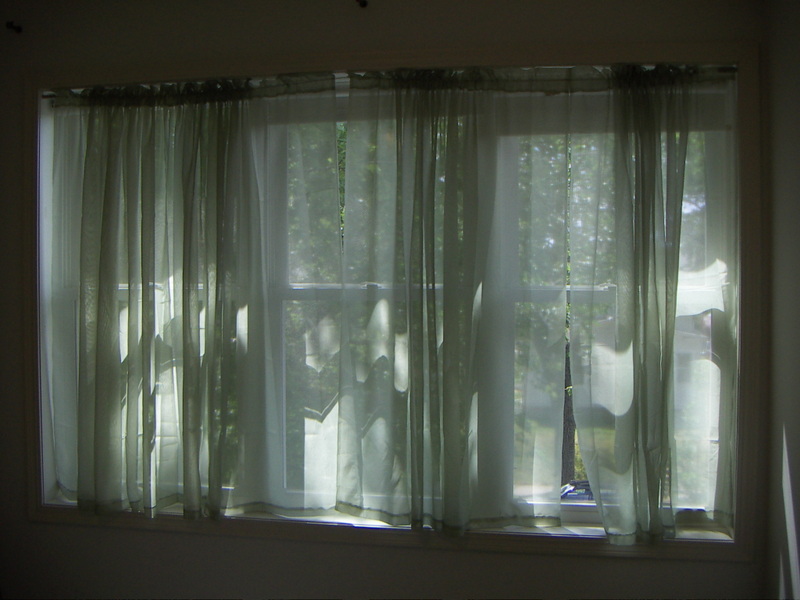
    These are our city-mandated egress windows:  Given their size, they have to be casement windows, according to code, and they have only a single lock, a flip-up latch  — you can see it faintly through the curtain at about the level of the reading lamps.  We have never opened them, because (unlike a double-hung window) it is impossible to open them just a little bit without making it very easy to swing them open ALL THE WAY.  The sill is about eight inches above the top of the bed.  The screen pops right out.  No porch roof here — it’s a straight drop to the pavement two stories down. 

    (And no, we can’t move the bed.  We designed the bedroom to be barely larger than the bed.)

    What I’ll wind up doing, of course, is bolting a steel fence over these windows, making them impossible to use as egress windows (not to worry — we can still get out the front) but at least removing my fear that my toddler will open them up and fall out.

    In our old house we had an attic bedroom.  The sill of the lone window was abut nine inches from the floor (not atypical in attics).  The frame was bent so it didn’t have a screen and the lock sometimes failed.  I saw my eighteen-month-old son toddle over to that window once and open it up almost effortlessly, standing a few inches away from a three-story drop — something I’ve seen in a few waking nightmares since!  I made my husband screw a metal screen across that window, that very night.  Good thing we didn’t have a fire.

    My point here:  Fire safety codes that don’t take into account the needs of families with small children to keep the windows secure, wind up defeating themselves, because parents will defeat the codes one way or another:

    One woman said her children’s father pounded nails into the window frame near the locks shortly after they moved into the building so that her 3-year-old son couldn’t get them open.

    Wouldn’t it have been better if the windows were simply securable to begin with?  It would be nice if they could function both as fire escapes and as barriers to children’s falling out.

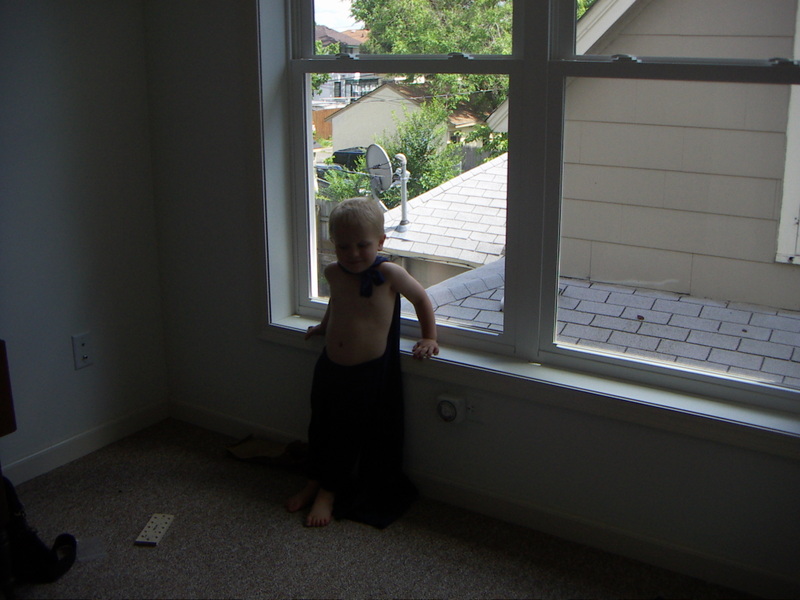
    It’s not just the master bedroom.  Here’s Superman, cape and all, standing next to the window of what will (someday) be his bedroom:

    Moth

    Yes, we were required to put the windows that close to the floor.  I haven’t the foggiest idea how to safely fit a bed in this room where jumping on it won’t risk a collision with the window.

    Fires are probably, on the whole, more dangerous to little kids than windows are.  But I would have liked some more freedom to arrange the windows in our own home, according to the needs that our family has.  If it’s harder to sell it later, fine — I’ll take that consequence…

    UPDATE:  Two commenters point out that the reason for large, easy-to-open windows is not so that inhabitants can escape, but rather, so that firemen plus all their equipment can get in.  I’ll cede that point, but I still think there’s competition of two legitimate safety principles here.  It’s because one of them is enforced by the city and one’s not that a kid fell out a window last week.

    Here are some window safety tips from the National Safety Council.  Including this one:

    Keep your windows closed and locked when children are around. When opening windows for ventilation, open windows that a child cannot reach.

    In other words, never open your bedroom windows.  Ever.  Oh, and by the way,

    Do not install window air conditioners in windows that may be needed for escape or rescue in an emergency. The air conditioning unit could block or impede escape through the window.

    never have air conditioning in your bedroom either, unless you are fortunate enough to be able to afford an apartment or house with central air conditioning.

    Set and enforce rules about keeping children’s play away from windows or patio doors. Falling through the glass can be fatal or cause serious injury.

    Keep children’s play away from windows.  Uh-huh.  See the picture from what will be Milo’s bedroom.  Above.

    Keep furniture – or anything children can climb – away from windows. Children may use such objects as a climbing aid.

    What’s the point, when your two-year-old’s center of gravity is above the windowsill anyway?  See above.

    The fire safety issue is well taken.  Yes, it’s important to have egress windows in every sleeping area (although, perhaps, if firefighters’ dimensions are the controlling factor, we should be calling them ingress windows).   But there’s clearly a revenge effect at work here.


  • Lauda Sion.

    Corpus Christi calls for Thomas Aquinas:

    ZION, to Thy Savior sing,
    to Thy Shepherd and Thy King!
    Let the air with praises ring!

    All thou canst, proclaim with mirth,
    far higher is His worth
    than the glory words may wing.

    Lo! before our eyes and living
    is the Sacred Bread life-giving,
    theme of canticle and hymn.
    We profess this Bread from heaven
    to the Twelve by Christ was given,
    for our faith rest firm in Him.

    Let us form a joyful chorus,
    may our lauds ascend sonorous,
    bursting from each loving breast.
    For we solemnly record
    how the Table of the Lord
    with the Lamb’s own gift was blest.

    On this altar of the King
    this new Paschal Offering
    brings an end to ancient rite.
    Shadows flee that truth may stay,
    oldness to the new gives way,
    and the night’s darkness to the light.

    What at Supper Christ completed
    He ordained to be repeated,
    in His memory Divine.
    Wherefore now, with adoration,
    we, the Host of our salvation,
    consecrate from bread and wine.

    Words a nature’s course derange,
    that in Flesh the bread may change
    and the wine in Christ’s own Blood.
    Does it pass thy comprehending?
    Faith, the law of light transcending,
    leaps to things not understood.

    Here beneath these signs are hidden
    priceless things, to sense forbidden;
    signs, not things, are all we see.
    Flesh from bread, and Blood from wine,
    yet is Christ in either sign,
    all entire confessed to be.

    And whoe’er of Him partakes,
    severs not, nor rends, nor breaks:
    all entire, their Lord receive.
    Whether one or thousand eat,
    all receive the selfsame meat,
    nor do less for others leave.

    Both the wicked and the good
    eat of this celestial Food:
    but with ends how opposite!
    With this most substantial Bread,
    unto life or death they’re fed,
    in a difference infinite.

    Nor a single doubt retain,
    when they break the Host in twain,
    but that in each part remain
    what was in the whole before;
    For the outward sign alone
    may some change have undergone,
    while the Signified stays one,
    and the same forevermore.

    Hail! Bread of the Angels, broken,
    for us pilgrims food, and token
    of the promise by Christ spoken,
    children’s meat, to dogs denied!
    Shown in Isaac’s dedication,
    in the Manna’s preparation,
    in the Paschal immolation,
    in old types pre-signified.

    Jesus, Shepherd mild and meek,
    shield the poor, support the weak;
    help all who Thy pardon sue,
    placing all their trust in You:
    fill them with Your healing grace!
    Source of all we have or know,
    feed and lead us here below.
    grant that with Your Saints above,
    sitting at the feast of love
    we may see You face to face.
    Amen. Alleluia.

    Want the Latin?  It’s here.


  • Waiting.

    Baby’s kicking hard this morning.  Maybe it’s all the coffee I had.  Each successive pregnancy (this is #3, for those of you who haven’t kept count), I’ve felt more movement.  I suspect it’s because my abdominal muscles have gotten progressively more lax. 

    This time, the sensations remind me of the feelings of going into early labor:  the suddenness of each bump, thump, or rollover; the take-your-breath-away; the downright weirdness of a pulling or stretching or shoving feeling that comes from inside my own guts, for pete’s sake.   A few of the sensations are the same ones that do accompany labor:   twinges from the cervix are unmistakable and very familiar.  And of course, if the baby kicks and punches for more than a few minutes, he or she stimulates my uterus to contract, at this stage painless, but startling.

    And each time it reminds me, I think something different.  I am not ready to do that again, sometimes.  Or Here it comes.  Not much longer now. Better GET ready.  Or that ominous knowledge that it’s going to come, and I don’t get to choose when, it chooses for me. 

    It’s not all looming-doom kind of feelings, fortunately.  There’s also a peculiar, remembered excitement.  Sometimes these big kicks trigger memories of those days when the contractions started to get more regular and we wondered if this is it.  Like the day (two days before The Day) when we thought #2 would surely arrive, and we pulled out the boxes of birth stuff and got them all ready and went shopping for labor food, me leaning every few steps, breathing, on the handle of the cart.  That day was a sunny, breezy Sunday, and Mark was home, and our little boy, who’s now our bigger boy, was cheerful, and we spent the afternoon taking a long walk to the playground to see if we could revive the contractions that had petered out.   It was a lovely day, even though it wasn’t the birth day.  It still had that secret excitement of knowing that it’s all starting up and that I’ll meet the new little one soon.

    Couple that with thankfulness that I don’t have to get ready to go to the hospital, a feeling best compared to the rare opportunity of going for a bike ride at 6:30 on a cool weekday morning, particularly that moment when I get to ride across the pedestrian bridge that crosses I-35W at 40th St., sailing in a gentle arc over the noisy, jammed rush-hour traffic on my way to the paths that ring Lake Harriet. 

    Anyway, I’ve still got several weeks to go, but sometimes it feels very far away and sometimes very close.   And sometimes that feels scary, even though (because?) I’ve done this twice before, but other times it feels like it can never get here soon enough.


  • Just making mothers feel guilty.

    The momosphere is buzzing about that NYT breastfeeding article, mostly arguing about whether it’s helpful or harmful to The Cause to emphasize "risks of not breastfeeding" instead of "benefits of breastfeeding."  Meanwhile, Selkie put her finger on a disturbing omission.

    [T]he article is pro-breastmilk, yes, but pro-breastmilk and pro-breastfeeding are not the same thing…   

    Human milk is the right choice for human babies (barring unusual circumstances like inborn errors of metabolism or maternal HIV or HTLV), but for some women the cost of getting the milk into the baby may just be too high.  I’m pleased that the Times was clear about the importance of breastmilk.  I wish the article had addressed the issue of making breastfeeding easier.

    It’s easy to say, about breastmilk, "There’s gold in them thar hills."  (Oil in them thar hills, I suppose I should say if I were aiming for a consistent use of metaphor, even though that’s geologically implausible.)  The evidence for human milk is overwhelming.  What I’d like to see, if I were the Monarch of Media, is more emphasis on extracting it in ways that are manageable for all concerned.

    I think, now, that I can understand the anger from many (perhaps not all) formula-feeding parents who retort, "That article/study/commentary/comment is just aimed at making us feel guilty."   

    I’ve got nothing against guilt per se.  Normal guilt is a healthy emotional response to the knowledge that one has done something wrong, or at least, sub-optimal, despite the opportunity to do the right thing.    (Feeling guilt when one has not had such an opportunity, on the other hand, is not normal or healthy.)

    Still, there’s a good point there.  Finish the sentence:  "That commentary is just aimed at making us feel guilty, instead of offering resources that assist us and inspire us to persevere with the ‘right,’ but often apparently more difficult, choice."

    My friends and I were talking about this last night.  I used to pump breastmilk when I was at the university, in a bathroom in my building (because the cozy nursing mothers room was in a different building three blocks away).  It was a pain, but I persevered!  Still — that is not such a huge hurdle.  There are nursing moms who work at Starbucks, where the only private room may be a bathroom and that bathroom is the same one that the customers use.  What are they supposed to do?    

    The answer is not to stop disseminating the information that "just" makes people feel guilty.  That information, we hope, is what motivates families to do the right thing.  The answer is to add the information that gives families the confidence — "empowers" them, to use a buzzword — to do the right thing.

    Don’t forget, either, that there are three important audiences to these articles besides the parents who are choosing breastfeeding or formula.

        (1)  There is the medical community, who don’t work hard enough to help parents breastfeed successfully, and who far too often do damage to parents’ efforts through wrongheaded advice and policy. 

        (2)  There are private businesses large and small, who — with the right motivation — could make real changes that would lead more working mothers to breastfeed for longer duration.  (Not to mention the potential impact of private insurers, specifically.)

        (3)   There are a huge number of government entities, municipalities and states and federal agencies and all that (plus the ordinary American in his or her capacity as taxpayer and voter), who already run programs designed to improve the lives of mothers and children, and who with changes of emphasis in existing programs could raise breastfeeding rates — let alone adding new programs.  If voters and policy makers decide that breastfeeding should get a higher priority than some other program — and you can’t tell me that there isn’t stuff in there that deserves to be demoted — then it can happen.   Ask any mom who happens both to be knowledgeable about breastfeeding and a client or former client of WIC or a similar state nutrition program.  (And if you think there’s not a lot of overlap between those two, you’re deluded.)  There’s a lot of room for improvement that would not only further the nutrition programs’ policy goal of improving children’s nutrition (duh), but probably save money too.

    So why not, instead of "just making mothers feel guilty," devote some column space to (a) addressing those three other audiences and making them feel a little guilty, for once, and (b) provide information to help mothers subvert the system and breastfeed anyway while the odds are still against them?


  • Rebirth story.

    Dom Bettinelli posts his brother’s story of his heart attack last year at age 40.  It’s worth a read.  Excerpt:

    I was coming in and out.  I do remember reaching over and grabbing the nurse saying, “I need to see a priest now.” She kind of brushed me off and I said, “NO NOW.” The next thing, the priest was standing there.  I said, “Father, I need confession.” He said, “you are all set.” He had just given me the Sacrament of the Sick.  My next thought was wait a minute if I am all set then God is going to take me home.  I need a sin, I need a bad thought or something, I am not ready to be “all set.”

    I hope if something similar ever happens to me, that I have the presence of mind to ask for the priest, or that my family does.


  • Tic picking.

    A reader asks Eugene Volokh what, if anything, he does to cure his law students of peppering their speech with "like" and "you know."  Prof. Volokh suggests that perhaps these tics are uncontrollable or nearly so, like a speech impediment, and solicits comments. 

    It’s an interesting thread, and I was eager to read it because, I’m embarrassed to say, I still have a problem with "like" in my speech and I was hoping for some tips to reduce it.  I don’t think I’ll take the advice given in this comment, but it made me laugh:

    I had a high school speech teacher that would keep tallies of "you knows" or "like" or any other verbal holding words and show the students. In a prior class, she had a student with a foam bat whomp the offending student on each improper filler.

    This is one way in which the verbal fillers are totally different than stuttering; whomping stutterers with foam bats results in more stuttering.

    ["Curing Stuttering: Foam Bats Don’t Work" – Wood Bat Institute Quarterly, Fall 1988.]

    Oh well, like, you know, maybe next time.  Many of the lawyers saythey were cured of this affliction eventually, after seeing transcripts of depositions and the like.  I don’t think I can afford to have a court reporter follow me around for a few days.


  • They approved it!

    Says Rocco.  But according to this, with 62 "adaptations" for the dioceses of the U. S.  Wonder where I can get the full list of changes and adaptations?   

    A few stories mention some:  "all people of good will" rather than "all men," for example.  I’m sure some people who dislike the PC Language Police will not agree, but I think that’s an appropriate adaptation.  We just don’t use generic men much anymore in the U. S., and it’s obvious that this is what hominibus means in this context.  On the other hand, it would have been okay with me either way — I just don’t get worked up about it, because men = "people" isn’t archaic yet.

    Some of them are weird though.  Apparently a lot of the bishops didn’t like the phrase "the dew of your Spirit" and replaced it with "outpouring."  Huh?  First of all, what’s so hard to understand about "dew?" How is it any less accessible a term than "outpouring?"  Second of all, how is "outpouring" not changing the meaning?  I think I know the difference between dew and a downpour.

    Rome can still reject the adaptations, so now there’s another waiting game.


  • More on the Mass translation.

    Happy Catholic links to an address by Arthur Roche, Bishop of Leeds, to the gathered U. S. bishops about to vote on the new English translation of the Mass.

    The stakes are higher than I realized.  I’ve always been comforted that it’s "just the English version" of the Mass that’s somewhat screwed up; other countries’ missals are more faithful to the Latin, right?  But Bishop Roche makes a cautionary point.  Because it’s English, we have to be extra careful, an argument that in English we should be especially faithful to the text:

    Fifteen hundred years ago, Latin continued to be used while the Romance languages were growing out of it. Moreover, Latin became a vehicle of culture and faith for those who spoke Germanic languages. It was by means of Latin that the faith was preserved and transmitted in Western Europe. It needs to be remembered now that in many parts of the world it is English that will be called upon to play a similar rôle.

    Also in many countries where English is not much spoken, the English version of liturgical texts plays an important function, because it is used as a guide to translating the Latin. …in Norway and many parts of Africa and Asia, for instance, the translators rely heavily on the English version. I imagine that may be the case here, too, when the Mass is translated into Native American languages. We clearly have a responsibility to these people. At a meeting of the Presidents of English-speaking Episcopal Conferences in Rome, in October 2003, many Episcopal Conferences requested ICEL to share with them our scholarship in order to help them with their own translations. This is readily made available.

    Whether we like it or not, the English translation from the Latin will guide people making translations into other languages.  It’s like a game of sacramental "telephone."

    He mentions a couple of examples that show how so-called "dynamic equivalence" can impoverish the language:

    For example, in the Third Eucharistic prayer when we say so that from east to west a perfect offering may be made. The proponents of dynamic equivalence tell us that from east to west conveys the same information as from the rising of the sun to its setting, which we now propose.

    And so it does, in the dry language of the cartographer. But the meaning of this phrase is richer: it has a temporal dimension as well as a spatial one. We could have made both meanings explicit by saying from east to west and from dawn to dusk, but I would claim that by staying closer to the form of expression that we find in Malachi 1:11, and I quote:

    See, from the rising of the sun to its setting all the nations revere my Name and everywhere incense is offered to my Name as well as a pure offering.

    – we have produced a richer and more evocative version, bringing to the mind of the worshipper the beauties of the sunrise and sunset and the closeness of these texts to Sacred Scripture.

    Another example is found in the Fourth Eucharistic Prayer in the phrase the fruit of the vine in the Institution Narrative. Currently we say he took the cup filled with wine, as you know, and some argue that the fruit of the vine means the same as the single word wine, and that the simpler expression should be preferred. But we hear the words the fruit of the vine on the lips of the Lord himself in all three synoptic Gospels – which I would consider as being more than enough reason to respect their form.

    … Furthermore this phrase has a powerful salvific resonance because of the symbolic value accorded to the vine plant and the vineyard in scripture, as recalled by Jesus’ elaboration in John 15 of the image of Himself as the true vine, His Father as the vinedresser, and ourselves as the branches. This picks up on an even earlier usage in Isaiah 5 – the famous “Song of the Vineyard” – and the Lord’s lament at the degeneracy of his once choice vine in Jeremiah 2.

    Of course, the word wine connects with this scriptural patrimony, but it does so less evidently, less directly than does the phrase fruit of the vine which, upon each hearing, encourages us in our imaginations to see the particular Eucharistic event as part of the unfolding of God’s universal plan within history to rescue us from the destruction and chaos occasioned by our sinfulness and bring us into communion with Himself and with each other in Christ.

    It’s like the "dynamic equivalence" people have never heard of literary allusion.  Or as if they want the language of the Mass to be poorer.  Perhaps "more accessible" is what they are going for?  But since we hear the Mass every week, some of us every day, why can’t the Mass itself be the path by which the language of the Church is made accessible to each one of us?  A large number of people living in the U. S. hear the Mass weekly or daily in their native Spanish, which is far closer to the original and far richer than what we English speakers hear.  Why can’t we have what they have?

    It seems especially pressing to remain true to the Latin when the Latin echoes Scripture.  Right now, before receiving the Lord in the Eucharist, the assembly recites:  Lord, I am not worthy to receive you, but only say the word and I shall be healed.   But the Latin text, and the proposed new translation, says:  Lord, I am not worthy that you should enter under my roof.    The magazine Commonweal calls that change "perhaps most jarring" of all the proposed changes to the responses.  But — didn’t the reporter recognize that text?  It’s the confession of the Centurion’s faith, from Matthew 8.  It’s an allusion to a story of a healing miracle.  Why on earth should anglophones continue any longer with a Mass that has literally excised Scripture?  The rest of the church hasn’t.

    Read the rest.   May the bishops’ vote be guided by the Spirit.