A very, very, fascinating 90-second animation. A good visual display of information on top of that.
h/t Happy Catholic

bear – ing n 1 the manner in which one comports oneself; 2 the act, power, or time of bringing forth offspring or fruit; 3 a machine part in which another part turns [a journal ~]; 4 pl comprehension of one’s position, environment, or situation; 5 the act of moving while supporting the weight of something [the ~ of the cross].
A very, very, fascinating 90-second animation. A good visual display of information on top of that.
h/t Happy Catholic
Somebody got to my blog by Googling
children can fix obedience with Suzuki method
They were probably disappointed.
Baked Oatmeal: "It’s like eating Christmas!"
By the way, I think it’s just peachy that my birthday is St. Faustina’s day. Ever since I read her diary a couple of years ago, I’ve thought she was pretty cool. Maybe I should have named MJ Mary Jane Faustina instead of MJ Frances.
Pay no attention to the misprint that says "Wednesday" — it’s the October 5 that counts.
Desperate Irish Housewife reflects on Yom Kippur.
It was Yom Kippur. I had almost missed it.
You may not think Irish Catholics would take much notice of the Day of Atonement. But this is not the case, at least not where I come from. Long Islanders of all stripes take Yom Kippur very seriously.
Half of them, of course, head for the synagogue and fast until sundown. The other half take their one chance of the whole year to say, Screw the buses, baby, I’m DRIVING in to the city! And when I get there, I’m gonna park– ON THE STREET!
I suppose it’s not quite the same here in Minnesota.
Today I turn 32 years old. (I almost typed 23 by mistake. Ha!)
Here’s a picture of my birthday party. Notice anything… missing?

That’s right — Me!
*I* went to a Thai restaurant with Hannah, who showed up at eleven-thirty with her kids and with Mary her mom. Mary watched all the kids (except MJ) while Hannah and I went Out to Lunch.
Since there were also burgers and fries, the children were happy. Everybody wins!
I heartily recommend something like this as a present for your favorite stay-at-home mom.
I have this eight-week-old little girl, you know. She’s my third baby, so you’d think I’d be used to it by now.
But I’m not. She’s perfect and beautiful and sweet-smelling and fresh and new and — astonishing.
If I remember right, the boys as newborns were also astonishing.
Here’s the astonishing part, the part that left me breathless and stunned anyway. They — moved. And had facial expressions: surprised, furrowed-brow-thinking-hard, quizzical, furious, delighted, all-worn-out, bored, interested. Mary Jane in particular has one expression that makes her look exactly like Buddy Hackett, and another, with pursed lips and raised eyebrows, that makes me think of Dana Carvey’s "Church Lady."
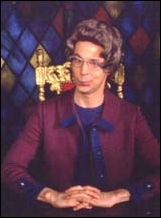 (I’ve given up on taking a picture of it, it’s gone too fast. Just imagine this look on a newborn baby girl.)
And they made sounds — not just crying or farting, no, but all three babies cooed, crowed, laughed, squealed, whimpered, grunted greedily, sighed, even mimicked the vocalizations that adults and children would make for them. Milo and Mary Jane were both taught to pee on cue, and both of them soon knew how to say "the sound" that I used to tell them to pee, a kind of throaty, croaking hum.
So what’s so astonishing about this? It’s that I didn’t expect any of it. When I had my first, I hadn’t cared for a newborn since I was thirteen or so, and I didn’t do it often even then — that baby, my youngest brother, spent most of his time in a carseat; at least, that’s how I remember it. (During family meals, to keep him quiet, the carseat was stuck in front of the TV with a propped-up bottle of soy formula.)
I’d seen babies on TV. Their parts were often played by dolls, wrapped in blankets to disguise their plastic faces, but no director tried to disguise their stiff inertness. Newborns on TV did nothing but sleep, apparently, a stiff, unmoving, silent sleep; occasionally a recorded cry was played back, and some character would pick up the otherwise unmoving package and poke a bottle at it, and someone somwhere pushed a "stop" button and the cry, the only baby sound, stopped.
Babies on TV are not much more than dolls. Is it any wonder I was so surprised to encounter a real one? Not just "encounter" (that implies a chance meeting) but actually spend most of my time with one, get to know him?
They really are people, not just stiff dolls that will someday turn into people. But you have to get to know one, spend more than a day with one real baby, to fully understand that.
Mainstream baby care in the U. S. tends to obscure it too. When most people only see babies strapped into carrier carseats, in restaurants and at the gym and so on, it’s easy to forget that newborns (at least healthy ones born to undrugged moms) usually can hold their heads up from only a few minutes after birth. That they kick their legs and wave their arms around when they’re awake. That, when their view isn’t blocked by the "blinders" that are the sides of the carseat, they look around at their surroundings and react with interest, even pleasant surprise. That they scoot around on a bed in search of mom’s breast. That they snuffle and snort and even giggle with delight when they find it. That they can track, grab at, and seize objects within their reach: often I try to put Mary Jane down only to find that she’s entwined her tiny fingers with the chain around my neck.
This isn’t a baby several months old; it’s a baby within the first several weeks of birth.
They’re born people. They really are. As soon as we meet a new baby, we can see that she is a person.
And once we spend a few hours with her, it’s obvious that she has been for quite some time.
Alice reports an infuriating incident.
Henry was having a hard time making inroads with the other children, all of whom paired off according to some mysterious, prearranged order. Then he spotted a group of older kids. They were either eight or 21. Probably somewhere in the middle. They were sitting at the top of a slide, drinking soda and chewing gum, feeling dangerous. Henry was entranced. Before I could stop him, he was right there, standing outside their circle. I watched. Sometimes older kids are nice! Maybe!
The ignoring that ensued was brief but painful, as Henry repeatedly attempted to introduce himself and I considered tearing their lungs out through their mouths. Too much?
After he walked away from them, he looked over at me and started to cry.
“No one wants to know my name,” he called out, weeping. And two women standing right by him—c’mon, guess!
Guess!
They didn’t just laugh—they laughed their asses off. They thought that was the funniest damn thing they ever heard. Such a cute little kid! So clever! With the stringing the words together! Just like a person!
Which of course set him off even more. The two of them tried to direct more commentary at me about my funny kid with his funny feelings while I dealt with my son, who was dissolving completely into the soil.
Oh yeah, this is one of my pet peeves. Where does it come from? Are people really so basically mean and cruel? I think it’s an insensitivity, as in "these nerve endings are dead," born either of (a) complete lack of regular interaction with real children as human beings that they have gotten to, you know, know, or (b) being treated like this when they were kids.
Which doesn’t make it okay, but might explain why they don’t know any better.
More on this next post.
(If you aren’t regularly reading Alice, and her commenters, at Finslippy, you should be. Even if you don’t think mommyblogs are your bag. She’s got one of the funniest blogs out there when she’s being funny, and is a great writer even when she’s not.)
Ann Althouse points to a UK poll that asked, "What song do you want played at your funeral?" Here are the top ten:
OK, everyone, it’s all quite pop and all, but do you notice the standout? That’s right, it’s Pie Jesu Requiem.
I’d like to think that the inclusion of this traditional chant as number 5 on the list is evidence that a large number of UK Catholics and High Anglicans are returning to their roots.
However, I suspect that this is an artifact of the Monty Python contingent.
Dona eis requiem *WHACK!*
(NOTE: I *like* Pie Jesu, really, but every time I hear the children’s choir sing it at Mass — fortunately to a different tune — all I can think of is their sweet little voices accompanied by *WHACK!* I fully accept that this is a result of Original Sin and I hope that it is burned out of me in Purgatory.)
(ALSO: Did you notice that the journalist appears to think that "Pie Jesu," a requiem, is actually a song called "Pie Jesu" recorded by a group called Requiem, perhaps this group?
I know journalists don’t "get religion" (that’s why this blog is so fun to read), but that’s quite a doozy. )
(ALSO AGAIN: What’s with "Every Breath You Take?" That’s just creepy.)
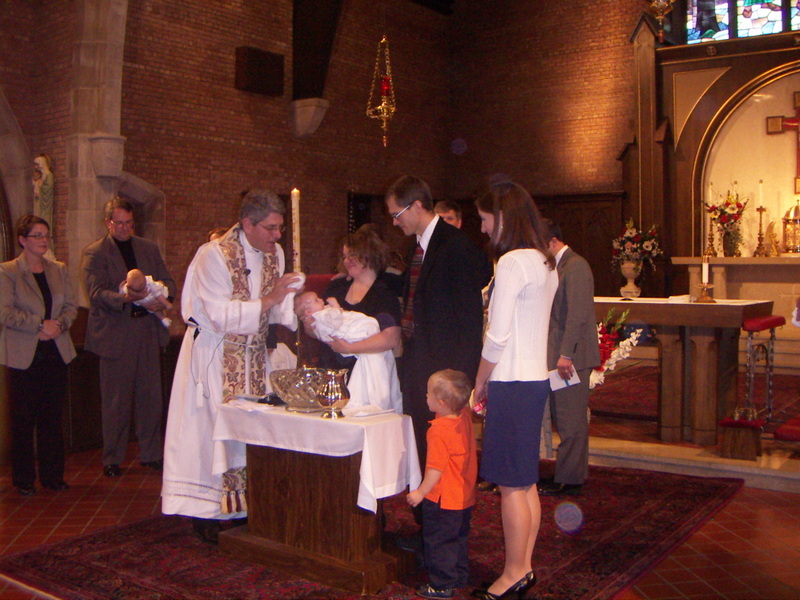 Mary Jane Frances was baptized on October 1: the memorial of St. Therese of Lisieux and also Respect Life Sunday.
Baptism was outside of Mass, and the service lasted almost an hour. Much to the surprise of our guests, whom I’d told to expect about fifteen minutes’ worth of stuff. Oops.
The only mar on the baptism service was the middle part of Father’s remarks: a pro-spanking, "kids these days don’t get enough discipline" diatribe. Did you know that kids’ ears are on their backsides? Oy.
We had a pewful of attachment-parenting friends in attendance; the seven attachment-parented children, sitting politely in a row, could easily testify otherwise. He’s an exceptional priest, but… Somebody send the man a copy of the Popcaks’ books, please. I’m perfectly aware that it’s my Christian duty to discipline my child, part of the baptismal promises; and I’m also pretty sure that I have tools at my disposal, other than whacking them, to accomplish it.
It was also, of course, Respect Life Sunday. Amy asks what we heard. The theme of the homily in the Mass that preceded the baptism was abortion as a symptom, rather than a source, of our culture’s sicknesses. That outlawing abortion tomorrow, though a reason for celebration, would not fix the underlying problems; that the culture must change first, and it must begin in our own homes.
I thought, what a blessing for MJ to be a sign of new life that day.
Blessed Virgin Mary, pray for us. St. Jane Frances de Chantal, pray for us. St. Therese of the Child Jesus, pray for us.
In the name of the Father and of the Son and of the Holy Spirit. I believe in the Father, etc.
I pray for my little girl’s father and for all fathers that they may guide their families with love and constancy: Our Father who art in heaven, etc.
That she may preserve and defend the faith: Hail Mary, etc. That she may be ever hopeful, and a sign of hope: Hail Mary, etc. That she be ever inclined to charity towards all: Hail Mary, etc.
The first Joyful Mystery is the Annunciation to the Virgin. O Mary, you responded immediately to the angel’s announcement with your full assent to the will of the Lord. Pray that my daughter know her vocation and that she respond with your wholehearted assent to the life that God asks of her. Our Father, etc. Hail Mary, etc., x10. Glory be, etc.
The second Joyful Mystery is the Visitation of Mary. O Mary, you went with haste to your kinswoman Elizabeth at the news of her pregnancy. Pray that my daughter be greeted always with joy by her kinswomen and friends and may she bring Christ in her own flesh to all of them in return. Our Father, etc. Hail Mary, etc. Glory be, etc.
The third Joyful Mystery is the Nativity of the Lord. O Mary, you brought forth your firstborn son and laid Him in a manger. Pray, O Mary, that my daughter may be physically strong and healthy, to bear children well or to do whatever other work the Lord may ask of her. Our Father, etc. Hail Mary, etc. Glory be, etc.
The fourth Joyful Mystery is the Presentation of the Lord. O Mary, you and your husband brought the newborn Christ to the Temple and redeemed Him with two pigeons according to the Law. Pray, O Mary, that my daughter may be ever faithful to the precepts of Your Son and that she may be ever grateful for His gifts, returning God to God all the days of her life. Our Father, etc. Hail Mary, etc. Glory be, etc.
The fifth Joyful Mystery is the Finding of Jesus in the Temple. O Mary, you and your husband searched for the boy your Son among all your traveling companions, and on returning to Jerusalem found him a teacher in His Father’s house. Pray, O Mary, that my daughter look always for Christ in other people, and yet return continually to receive Him where He can be found truly in His Body and Blood, Soul and Divinity. Our Father, etc. Hail Mary, etc. Glory be, etc.
Hail, holy Queen, mother of mercy, our life, our sweetness, and our hope, etc.
St. Michael the Archangel, defend us in battle, etc.
O Sacred Heart of Jesus, have mercy on us. Immaculate Heart of Mary, pray for us. St. Joseph, pray for us.
In the name of the Father, and of the Son, and of the Holy Spirit, amen.
Provocative article on corporal mortification at GodSpy.
In our society, it’s considered perfectly normal to mortify our bodies so long as the reason is secular and the goal is physical. No one bats an eye at cosmetic plastic surgery, Botox, tattoos, and body piercing. Even physical fitness taken to extremes is looked upon as almost de rigeur. I’m all for staying in shape, but when I see joggers here in Florida sweating in 95 degree heat during their run at lunch hour, I have to wonder: Are you trying to have a stroke?
… But if you perform corporal mortification for religious reasons, to achieve some spiritual good, you’re an oddball. To borrow an analogy from Boston College professor Peter Kreeft and give it a twist, if I were to announce at a cocktail party that I just got my tongue pierced, I would be surrounded by an eager crowd of spectators. But if I were to announce that each morning before work I take a cold shower as a religious ritual, I would soon be talking to myself.
h/t: Amy

Recent Comments
Recent Posts
Categories
…more to come later
 bearing blog