bearing blog


bear – ing n 1  the manner in which one comports oneself;  2  the act, power, or time of bringing forth offspring or fruit; 3 a machine part in which another part turns [a journal ~];  pl comprehension of one’s position, environment, or situation;   5  the act of moving while supporting the weight of something [the ~ of the cross].


  • Packing lunch for eight to fourteen people, twice a week.

    Twice a week, we spend most of the day at friends’ houses.  We bring our day’s schoolwork with us, and once a week we bring lunch for the children (five to ten of them all together, depending on who shows up).

    We used to cook a hot lunch for everyone, but that got ridiculously exhausting and messy as our families grew.  We finally gave it up during my most recent pregnancy.  Nowadays, one family brings a lunch already prepared. 

    Usually, that’s one or two loaves of whole-wheat bread made into sandwiches and repacked into the bread bags (don’t ask me why I never figured out that very sensible trick until Hannah showed me), plus some fruit.   Other things are possible.  The key is to bring it with all the messy work already done — all that’s left to do is maybe to cut up the sandwiches and put them on plates.  Or paper towels.

    I like to make two different kinds of sandwich when it’s my turn; it’s nice for the kids to have a choice.  And it’s not really harder or messier, especially since I always make it the night before.   The kids drink water, or milk if the host family has extra.

    Here are some of the things I have brought that need no additional preparation (beyond cutting sandwiches into quarters):

    • Peanut butter sandwiches with honey or apple butter.
    • Cream-cheese-and-salami, and cream-cheese-and-cucumber sandwiches.  (The latter is very, very popular with the kids, more than you’d think.)
    • Tuna-salad sandwiches, and egg-salad-and-watercress sandwiches.
    • Turkey-and-mustard, and turkey-and-mayonnaise sandwiches.
    • Cocktail wieners and cheese cubes and pineapple chunks — and a box of toothpicks. 
    • "Deli Tray Day" — hard salami and sliced cheese and whole-grain crackers.
    • Pre-made hummus and lovely whole wheat pitas.

    Then there are some things that require just a little bit of work once we get where we’re going.  I usually call ahead to have my friend preheat the oven.

    • Quesadillas:  the night before, I sandwich a mixture of canned refried beans, shredded cheese, and salsa between corn tortillas.  They are repacked cold into the tortilla bag.  Upon arrival, I put them on a foil-lined baking sheet and bake them for about 10 minutes at 350 degrees.
    • English-muffin pizzas:  The night before, I separate the English-muffin halves and repack them into bags.  I bring a can of pizza sauce and a bag of preshredded cheese — maybe pepperoni if I’m feeling generous.  I assemble these on foil-lined baking sheets and bake them for about 10 minutes again.
    • Pasta, pre-cooked and packed in plastic bags, and a container of pre-made tomato sauce.   Just heat the sauce and mix the two together.   I recommend against spaghetti — elbows or shells are far less messy. 
    • Variation on the above:  use chili.
    • Variation on the above:  mix the pasta with olive oil, canned tuna, peas, and a little dill.  This one’s good at room temperature.
    • A pre-assembled casserole (great if you are making one for dinner some other day of the week) — our kids love homemade macaroni and cheese, or anything taco-flavored.
    • Nachos:  just bring a bag of good-quality whole-corn tortilla chips, a bag of shredded cheese, and salsa.  Make a whole jelly roll pan (foil-lined!) in the oven.

    What goes on the side? 

    • Grapefruits or oranges, sliced, the slices cut into quarters, pre-packed in a plastic bag.  It’s easy for a child to bite the flesh off the tiny scrap of rind.  We always give the kids a second plate for the rind, otherwise the little ones throw it on the floor.
    • Whole small apples or whole clementines, one per child.  (Unlike other citrus fruit, the kids can peel their own clementines.  Same thing as above re: the extra bowl.)
    • Pre-cut chunks of melon.
    • Baby carrots or celery sticks — always pre-cut!  I sometimes bring yogurt cheese to stuff the celery with.

    It used to be that the moms ate the same lunch as the kids (except D. who can’t tolerate wheat and is always smart enough to bring a container of salami and cheese for herself).  Heaven help the rest of us if the children left lots on the plates — we’d nibble PB&J crusts all day! 

    Recently we’ve been going more low-carb.  The easiest thing to do, many days, is to make a big cheese omelet for the moms to share.  It only dirties one pan, only takes a couple of minutes, and there’s always plenty of eggs and cheese and coconut oil around.  (Our tribe believes in saturated fat.  I mean, really believes in it.)  Sometimes, if we’re not hungry, we’ll make a quick sipping-soup out of chicken stock (or canned broth) and canned coconut milk, simmered with a little ginger and Thai fish sauce or soy sauce.  If there are leftover cold greens to put in it, so much the better.

    We gather together, remind the kids to put down their forks, take a minute to quiet down.  The mother who’s hosting says grace according to her own family’s formula, everybody says Amen, and we all dig in.


  • Um… who’s “obsessed” with dirty words again?

    Whose blog rhetoric is more potty-mouthed, the dextrosphere or the sinistrosphere?  Instapunk issued a challenge recently:

    …I propose an exercise to be perfomed by those who have the software and expertise to carry it out. The exercise is this: Search six months’ worth of content, posts and comments, of the 20 most popular blogs on the right and the left. The search criteria are George Carlin’s infamous "7 Dirty Words."

    Newsbuckit responded.  Here’s his method:

    I searched Google using the following format and recorded the page results that were returned:

    site:xyz.com "search term 1" OR "search term 2" OR "search term 3"…

    Nine search terms total — the seven profanities as single words, and two of those as their own two-word variations. I then added the individual site results together and compared them.

    His results:

    this is what I found, using what I deemed — through a mix of TTLB and 2006’s Weblog Award lists — to be the 18 biggest Lefty blogs, and 22 biggest Righty blogs. I couldn’t account for the 6-month time period, and I even gave the Lefty blogs a 4 blog advantage. But it didn’t make much of a difference.

    So how much more does the Left use Carlin’s "seven words" versus the Right? According to my calculations, try somewhere in the range of 18-to-1.

    There are tables with the results for individual blogs at his post.

    Instapunk had predicted this result:

    I am absolutely certain that the left will far exceed the right in the number of usages of all these words, which will go a long way toward proving that it’s the right which is still concerned with ideas while it’s the left that’s obsessed with the lowest kind of hateful invective.

    Eh.  That would only be true if being concerned with ideas and being obsessed with the lowest kind of hateful invective were mutually exclusive.   Also if the 7 Dirty Words is an accurate proxy for hatefulness.

    It’s not always.  Example:  In some circles (not mine) it’s apparently perfectly acceptable to use "fucking" as an adverb with positive connotations.  I bet this accounts for a fair number of occurrences.  Even though it’s coarse, it’s not "hateful invective."

    We all know that political blogs are often echo chambers.  Righties read and comment on righty blogs.  Lefties read and comment on lefty blogs.  No surprise that common discourse trends might have evolved differently in the two populations.  Maybe words that play as coarse among righties don’t play as coarse among lefties.   If so, the results probably indicate that the separation is going to get worse.  I mean, I don’t enjoy reading text that’s peppered with obscenities.  I tend to avoid it.  That explains why I don’t often read the popular lefty blogs to hear their side of an issue.  Perhaps I’m linguistically challenged and not appreciative enough of cultural diversity, but I find it tiresome.

    Maybe I’m being overgenerous.  But bear in mind that the set of search criteria, the proxy for hatefulness, was selected by a righty blogger.   I doubt that the lefty bloggers would have chosen this set as a proxy for hatefulness (for one thing, anyone could have guessed that the left uses the words more).   So here’s a question I’d like to have answered:  what seven words or phrases would the left prefer to use to "prove" that righty rhetoric is the more hateful?

    And do I really have to point out that using your opponents’ individual words as a proxy for their ideas doesn’t really demonstrate  concern with ideas?


  • Christian sound bite of the day.

    I really liked this, which was quoted at Amy Welborn’s:

    [E]very true value is Christian in itself, and as such, it should be appreciated where it is seen: in art, in science, in meditation,.

    Likewise, everything that exists in Christ is a value: even suffering, failure, death, which worldly mentality does not consider to be values.

    Take that, prosperity-gospel evangelists.


  • Religious accommodation: Muslim and Christian.

    It’s been a matter of minor news around the blogosphere that our local airport has inspired a fatwa claiming that Muslim cabdrivers are not allowed to transport passengers who are carrying alcohol.   The latest story is here.  The airport commission is insisting that it will not tolerate denial of service for any reason other than safety.

    Claims that the airport is discriminating against Muslims are, to put it plainly, bunk; the airport’s punishing non-safety-related denial of service regardless of the religion of the cabdriver.   What this involves is religious accommodation.    A group of contractors want an exemption from the rules that otherwise would apply to everybody.   By requesting the accommodation, the non-booze-transporting cabdrivers are asking the airport to discriminate in favor of (some) Muslims.  That’s what accommodation is:  bending the rules for some, but not for others.

    Accommodation is relative.  Sometimes it is reasonable, sometimes it is not, and the dividing line is pretty subjective.     Add to that this:  once a particular group is accommodated, another group may demand accommodation and claim discrimination (plausibly this time).  You accommodated them, now you have to accommodate us.  So it has a way of spreading.  Which is why government should be reluctant to impose accommodation on individuals and on private enterprise.

    I side with the airport commission here.  Allowing cabdrivers to pick and choose whom they carry imposes that accommodation on travelers.  Nobody’s forcing anyone to take cab fares from the airport.  If your religion keeps you from doing the job that you signed up freely to do, you need to find another job.  It’s tough?  Yeah.  It’s called sacrifice.

    This kind of issue touches Catholics too, especially in medical matters.  I’m thinking of the pharmacists’ rights movement — groups like Pharmacists for Life who are trying to get laws passed that protect pharmacists from being fired if they refuse to fill certain prescriptions, say, birth-control pills. 

    Perhaps I put myself  in the minority among Catholic bloggers by saying so, but government shouldn’t force stores to accommodate us that way. 

    I’m not saying that Catholic employees should co-operate in evil.   I’m not an expert in canon law, and as I write this I am not sure whether filling contraceptive prescriptions could ever be permissible.  I know I’d want to be safely on the side of good.  If I were a pharmacist, I’d refuse to fill prescriptions for contraception.  If I were a nurse, I’d refuse to assist in abortions or sterilizations.   

    That would make it hard to get or keep a job.   Yup.

    If I don’t fill this prescription, it’s not like they’re not going to get the drug.  They’ll get it somewhere else.  There are plenty of people who will fill it.

    That’s right — there is no reason why it must be filled by a practicing Catholic.   None of us is tasked with preventing evil.  We are, rather, tasked with not doing evil.  And sometimes it’s tough.  Sometimes you get fired for refusing evil.  Sometimes you go to jail for refusing to do evil.  Sometimes worse things happen. 

    But if what you really want to do is prevent evil,  look at it this way — it’s sort of like going on strike.  If every Christian doctor refused to prescribe birth control, or perform abortions, or  euthanize disabled babies, well, it would get a bit harder for businesses to pick and choose whom they hire and whom they fire.  It would make it that much tougher to be in the business of selling drugs that destroy life, destroy life-givingness.   It would pressure the businesses right back.    Maybe then those providers would hear:  I ought to fire you for refusing to do your job, but …  I can’t.  Not because some government entity won’t allow it, but because there aren’t enough people who are willing to co-operate with evil.

    I will not sin for money:  denial of service.    Someone is going to get paid to commit this sin anyway, so it might as well be me:  denial of hope.    Which is worse?


  • Bewitched, bothered, bewildered…

    One of the things I love about the blogosphere is its tendency to get swept up in micro-furies.  I especially love it when the microfury is about language.  Maybe because any blogosphere discussion about language is by necessity a meta-discussion — since the Internet is changing the nature of English usage with every post.

    Take this thread about the word "beclowned" at Timblair.net, in which Mr. Blair pokes fun at an academic who criticized the use of the word and then retracted after it was found to exist in the OED.  Debate:  is he silly because he failed to check before criticizing his opponents, or is he silly because he only thinks words in the OED should be allowed?  (I say the latter.)

    Some of the commentary is great:

    "The problem with defending the purity of the English language is that English is about as pure as a cribhouse whore. We don’t just borrow words from other languages; on occasion, English has pursued other languages down alleyways to beat them unconscious and rifle their pockets for new vocabulary.”
    –James Nicoll, 1990

    I’ll bedamned.

    Your methods, Blair, are quite unsound
    And you’re no fun to be around.
    In ridicule you must be drowned;
    The words you use cannot be found.

    Is that my nose, so red and round?
    Do my feet lengthen on the ground?
    If I were not becapped-and-gowned,
    I’d say I have myself beclowned.

    I was amused, anyway.


  • Snowbound.

    We got 13 to 15 inches of snow last night. 

    We decided not to try getting to Mass this morning — it’s going to take a while to dig out the garage door, and the plows are still out.   My rule of thumb:  if the Sunday newspaper can’t make it to our porch, we probably shouldn’t try to get to church.

    I think this is the first time we have missed Mass due to inclement weather.  Still, it may be better this evening, and there are a few nearby parishes that have a Sunday evening Mass, so I’m not ruling it out for later on.


  • More on choices and punishment.

    On the "choices" thing" mentioned in the previous post:  This technique is a slight improvement on punishing because of the clarity with which it is applied, particularly if it is applied with the caveat that the parent shouldn’t pretend the child has free will beyond the child’s developmental stage.

    I believe in allowing a child to feel natural consequences, and encouraging them to feel sorrow for what they have done through empathy.  I also believe in imposing the condition that a child make restitution where possible.   But with very rare exceptions I do not believe in punishing, that is, responding to "bad" behavior by imposing a deliberately unpleasant consequence for revenge or deterrence alone.   (And we should encourage the child to experience making restitution as a good thing, a way of making it right, rather than as a mere unpleasantness.)

    I feel there’s Catholic support for this — although the Church teaches that it’s good enough to repent out of fear of God’s wrath, tellingly she calls this "imperfect" contrition.  "Perfect" contrition comes out of love.


  • Even more on AP: matching Popcak to Neufeld.

    I was spurred by comments on my two previous posts about AP and Neufeld to pull Parenting With Grace off the shelf.  This is Greg and Lisa Popcak’s guide to "Catholic AP."  I wanted to evaluate their discipline techniques, which they ground in Catholicism, in the light of Neufeld’s theory.

    The Popcaks start from the theology of the gift of self as the starting point for discipline — how God gives himself to us, how the Church mothers us through her sacraments.  So they say that they look for "loving, self-donative means" of discipline or training, and claim that corporal punishment, threats, shaming, etc., are not self-donative or are at the very least less self-donative.  (What they call "self-donative," I tend to call "get-off-your-butt parenting.")

    They divide discipline techniques into two types:  everyday techniques to teach and to build relationships, and corrective techniques.  This post is only about the first variety.  About these they say: 

    "Remember not to lead your child into temptation… A Christian parent must be careful not to give his or her child any greater responsibility than that child is developmentally capable of handling… it is our job to avoid putting our children into situations they are simply incapable of handling."

    Here are the twelve techniques of the Popcaks, considered in the light of Neufeld’s theory of the six kinds of attachment (briefly:  through the senses, through imitation, through belonging and loyalty, through feeling significant, through feeling affection, through being known).

    1.  Build Rapport.  Example given:  More hugs for a surly teenage son.  The Popcaks say that encouraging affection in this way "mirror[s] Christ" because it shows the parent generously giving of himself.  This is a technique which should build the child up to enable them to handle more situations.

    In Neufeld’s book, this would translate to "strengthen attachment to the parent."  The Popcak’s example is of attachment through the senses; the result they are going for is "attachment through feelings of love and affection."  They caution that it means being a teacher, not a friendl in this, they appeal to the God-given authority of parents, whereas Neufeld would appeal to "natural authority"  — quite obviously the same thing, viewed from a secular vs. a religious perspective. 

    2.  Write it down.  Post the house rules to make sure that everyone understands them.  The Popcaks say this works because it makes the rules clear, avoiding the child’s having to figure out the rules out for himself when he’s not developmentally prepared.  Though the Popcaks don’t articulate it like this, the Catholic connection is obvious:  God gave his people commandments before they became able to reason (with the help of the Holy Spirit).

    In Neufeld-speak, writing down house rules would provide a compass point; give cues; orient the child; "provide something to hold on to."  Because it is a very specific and clear request for obedience, it gives the child an easy way to understand how to attach through loyalty.  Furthermore the house rules (being the ones that everyone obeys) show "what we do in this family,"  fostering belonging. 

    I’ll take the next few together, keeping the Popcaks’ numbering scheme:

    3.  Redirection.  "It is not enough to tell a child to stop doing something.  We must offer suggestions for what a child may do instead…"

    4.  Restating.  "When children say something in an obnoxious way… [ask] them to rephrase their statement or ask them to repeat a more appropriate phrase that you suggest."  Two specific examples are given. 

    5.  Do-overs.  Similar to restating but for behavior — show child how to get what he wants or respond to a situation the right way. 

    7.  Reviewing/rehearsing.  Demonstrate expectations ahead of time, and reminding the children of expectations they’ve already learned, immediately prior to entering a situation (e.g. reviewing the rules on the way to church).

    The Popcaks say that these techniques model respect for kids’ needs and teach them to come to you for help figuring out what to do.  Neufeld would say these are ways to give cues and orient the children.

    6.  Choices.  "…[T]each your children that they are responsible for both the choices they make and the consequences… [P]resent your rules in the form of a choice."  To whatever consequences the parent plans to impose, this technique adds the explicit articulation of the child’s free will in the matter.   

    This technique serves as a kind of orientation, too, because it lets the child know exactly what will happen to him in the event that he makes a particular choice.   (More on this in another post.)

    8.  Transitions.  The example given is getting a child to leave a friend’s house willingly and promptly.   The Popcaks say:  "[G]ive… five-minute, two-minute, and one-minute reminders… [I]t helps kids adjust slowly to a new thing, and it teaches them to be better stewards of their time." 

    Neufeld frames this kind of thing completely differently as a passing of the "baton" of a child’s attention and orientation from one attachment (the friend, or the friend’s mom, or whatever) to another (the parent).  After any separation, physical or other, the parent has to take time to "collect" the child — to reconnect, and to step into the position of "who’s taking care of you, who’s in charge of you." 

    Neufeld suggests a few ways of doing so; the Popcaks’ suggestion to repeat the time-warnings over several minutes might work in the same way, as the parents re-assert their authority over the child with gentle persistence.

    9.  Modeling.  The Popcaks frame this in terms of the Incarnation:  God Himself modeled humanity for us.     The example:  the father of a nine-year-old opening up to family discussion the stories of his own struggles with a bad attitude, and the two of them learning how to help each other meet life more joyfully.

    Their example shows how modeling can go deeper than imitation and reach into Neufeld’s deeper categories of attachment through belonging and loyalty, affection, and being known.

    10.  Use your emotions.  The example the Popcaks give is of a mother demonstrating to her frustrated, tantrumming child her own frustration; after this the child "first felt his needs were understood."  The idea is to show the child that you have the same kinds of emotions — so you’re able to understand what it’s like to have those emotions. 

    This is clearly a kind of showing your child that he is known and understood.

    11.  Labeling:  pointing out specific virtues when we see them.  The Popcaks say this teaches the virtues. 

    This kind of explicit communcation shows our child that he is known — in this case, as a virtuous person — and it also fosters "belonging" to a community that shares a love of the virtues. 

    12.  Storytelling.  The Popcaks point out that Jesus taught through parables. 

    Storytelling is a way of passing on your culture — and it could involve all of the six means of attachment.

    More later.


  • Local color.

    I didn’t know this, but it makes sense:  The MSP airport employs a crew of snow removers who board at the airport during storms.

    It might not inspire confidence in air travelers to know that their safety at Minneapolis-St. Paul International Airport this weekend depends on a bunkhouse full of guys called Minnow, Beer Can, Floppy, Cheese and Hooter.

    But those are some of the 125 snow removal workers who will plow, shovel, eat and sleep at the airport until the promised storm has passed and whose work over the years has won the airport honors for snow and ice removal.

    "It’s a bonding experience," said Denny Lundberg, also known as Flicker, who’s in his 29th winter of trying to keep the planes moving at the airport through snow, sleet and ice.

    Friday, as when any serious winter storm approaches, Lundberg and the rest of the field maintenance crew were called in for duty-till-it’s-done, abandoning families and weekend plans to fight off a possible foot or foot and a half of new snow.

    …The boarding routine gives the Twin Cities an edge in winter storms.

    Most other airports, even in snowy cities, send workers home in shifts during storms and sometimes find they can’t get back, said Paul Sichko, assistant director for airport maintenance and operations…

    Many of the crew members have personal tales of endurance, discomfort and camaraderie. Lundberg, one of the longest-timers, said that when he started, working a winter storm meant sleeping on his jacket on the floor of a maintenance shed while the more senior workers got dibs on seats in their plows.

    Today, everybody sleeps in a bed in modern cinderblock quarters attached to the field operations center. Meals and showers are provided. Their entire time spent at the airport during a storm is paid.

    The 1991 Halloween blizzard meant five straight days for the crew at the airport. But it’s been three years since there was a similar round-the-clock call-up.

    Long hours like that, plus the grueling work, have created an unusual esprit de corps among crew members. There are the nicknames, and this winter the crew dedicated its work to John Brown, who worked with them for 18 years before his recent sudden death.

    "It’s a nice place to work. That’s why no one seems to leave here," said Jay Agger, a 24-year crew member.

    Doesn’t sound too bad, actually.


  • Antibiotics – blearghhh.

    Wednesday night I rushed MJ back to the urgent care center with a 101-degree fever.  She’d been throwing up her antibiotics all day.   I’d called the nurse hotline and explained that she’d just recovered from a UTI and hadn’t yet had her renal radiology workup; the nurse sent me to the clinic.  Another catheter, another urinalysis.  She was clean, and her ears were okay too, so I guess it’s just the same cold I’ve got.

    Have you started solids yet?  Try mixing her antibiotics in with her rice cereal.

    I don’t do rice cereal.  Mary Jane got some food when she started clamoring for what was on our plates.  She won’t put her fingers in stuff like her brothers did at that age, and another thing I don’t do is spoon-feed babies (boooooring),  so I dip her spoon in something and hand her the spoon.   She has had soft-boiled egg-yolk; yogurt; sweet potato; applesauce.

    Yesterday I tried mixing the antibiotics into applesauce, and she made horrible faces and threw down the spoon.  I was about to try yogurt when Hannah suggested that maybe I didn’t want to risk turning her off such a useful food (especially useful for a baby who might be on continuous antibiotics for the next two years, depending on what the renal ultrasound shows next week).  I looked in my fridge and found a jar of natural apple butter:  apples, apple cider, cinnamon.   I mixed it up with her antibiotics and offered her a spoon; she took it greedily.   

    I’m not totally opposed to cereal for babies.  This morning the boys ate oatmeal for breakfast (well, Milo did anyway — Oscar reheated a plate of Mexican lasagna from last night).  I tried making it in the rice cooker, which worked great, no burned oatmeal on the bottom and no stirring.  Lots was left over, so I mixed some up with some yogurt to thin it a bit, lifted up a few grains on a baby fork, and handed the fork to MJ.

    Marks_skiing_trip_feb_07_004

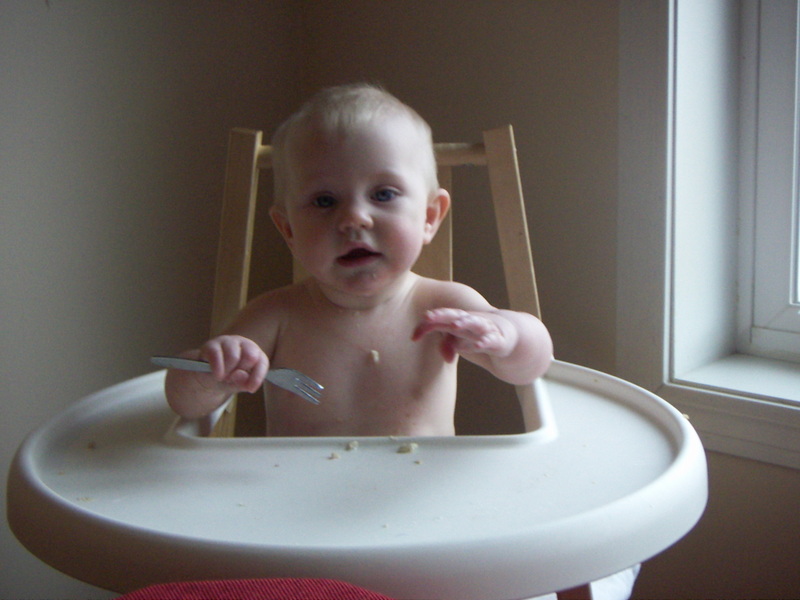
    Although it’s kind of a pain to keep handing her the fork, compared to the boys’ finger-feeding themselves, I must say she eats quite neatly for a six-month-old.  Here she’s already eaten about a tablespoon of oatmeal, maybe ten forksful.


  • More on AP’s missing pieces.

    I’ve been thinking some more about the shortcomings of traditional attachment parenting (must I start calling it "mainstream attachment parenting," distinguished from the "mainstream" parenting that AP itself rejects?), which I started writing about in this post after reviewing some more of Gordon Neufeld’s work.

    AP prompts a strong negative reaction from some people (check the comment section of that post), I think because the proponents are sometimes dogmatic about it, and also because of the usual answers they have when behavior and relationship problems do arise.    Confronted with an "attachment parent’s lament" — But I did all these things!  I breastfed, I co-slept, I wore my baby, I never left him with anyone, what do I do NOW? — the answer seems always to be "attach more," by which is meant more co-sleeping,  more closeness, and more modeling good behavior.  The subtext:  Obviously you haven’t given your child enough love, or he would be ready — ready to become independent, ready to separate from you, ready to behave.

    They’re almost right — the answer isn’t so much to "attach more" as it is to "attach deeper."  That is, to attach more maturely, beyond encouraging your child to attach to you through physical closeness, beyond encouraging your child toattach to you through imitating you — to encouraging other, longer-lived kinds of attachment.  From my previous post, Neufeld says they are:

    • Through belonging and loyalty ("I’m on your side; I want to obey you")
    • Through a feeling of being significant, important;
    • Through a feeling of love and affection;
    • Through being secure in the knowledge that they are known and understood (the deepest and most persistent and mature level of attachment).

    So, yes, in a way, if there are (non-age-appropriate) separation problems, if there are behavior problems, more attachment is needed — but it doesn’t have to come from co-sleeping and cuddling. 

    And sometimes it really can’t — especially when the desired behavior is one that necessarily involves a decrease in physical closeness — if you’re trying to help your school-aged child with behavior problems that arise while she’s away from you, for example, or if you’re hoping to help your young child make the transition from co-sleeping to sleeping in a different room.

    It is pretty obvious once you know about it — kids need to be attached, and if the only ways you give them to be attached to you are physical closeness and imitating, then in any situation that calls for them to be away from you or to be doing something different from you, they’re going to be at sea (and looking for cues from someone else, who may or may not be a good example).

    That’s not to downplay the importance of closeness and modeling.  That’s what the really young ones need.  And it’s why AP parenting really does work so well for babies and little toddlers.  They truly need closeness and modeling, the more the better while they’re so little.

    The DVD series I wrote about has some very specific ideas about how to encourage the other kinds of attachment.  But it’s not hard to imagine some, too.  Often the easiest that comes to mind is "being significant" — communicating to the child that they’re important, that you think of them often even while you’re apart. 

    I missed you while you were gone. 

    While I was out today, I saw a chickadee sitting on a fence, and it made me think how they are your very favorite bird, and that made me smile. 

    I took the birthday card you made for me and put it up in my office where all my co-workers can see it.

    That kind of thing. 


  • Stained.

    There is something truly sorrowful about a six-month-old baby, sleeping in her mama’s arms, the sweetly flushed forehead smudged with ashy black.

    It’s what I contemplated yesterday morning through the latter half of Mass.  Looking on her, marked, pierced me in some small and real and new way.