bearing blog


bear – ing n 1  the manner in which one comports oneself;  2  the act, power, or time of bringing forth offspring or fruit; 3 a machine part in which another part turns [a journal ~];  pl comprehension of one’s position, environment, or situation;   5  the act of moving while supporting the weight of something [the ~ of the cross].


  • Bewitched, bothered, bewildered…

    One of the things I love about the blogosphere is its tendency to get swept up in micro-furies.  I especially love it when the microfury is about language.  Maybe because any blogosphere discussion about language is by necessity a meta-discussion — since the Internet is changing the nature of English usage with every post.

    Take this thread about the word "beclowned" at Timblair.net, in which Mr. Blair pokes fun at an academic who criticized the use of the word and then retracted after it was found to exist in the OED.  Debate:  is he silly because he failed to check before criticizing his opponents, or is he silly because he only thinks words in the OED should be allowed?  (I say the latter.)

    Some of the commentary is great:

    "The problem with defending the purity of the English language is that English is about as pure as a cribhouse whore. We don’t just borrow words from other languages; on occasion, English has pursued other languages down alleyways to beat them unconscious and rifle their pockets for new vocabulary.”
    –James Nicoll, 1990

    I’ll bedamned.

    Your methods, Blair, are quite unsound
    And you’re no fun to be around.
    In ridicule you must be drowned;
    The words you use cannot be found.

    Is that my nose, so red and round?
    Do my feet lengthen on the ground?
    If I were not becapped-and-gowned,
    I’d say I have myself beclowned.

    I was amused, anyway.


  • Snowbound.

    We got 13 to 15 inches of snow last night. 

    We decided not to try getting to Mass this morning — it’s going to take a while to dig out the garage door, and the plows are still out.   My rule of thumb:  if the Sunday newspaper can’t make it to our porch, we probably shouldn’t try to get to church.

    I think this is the first time we have missed Mass due to inclement weather.  Still, it may be better this evening, and there are a few nearby parishes that have a Sunday evening Mass, so I’m not ruling it out for later on.


  • More on choices and punishment.

    On the "choices" thing" mentioned in the previous post:  This technique is a slight improvement on punishing because of the clarity with which it is applied, particularly if it is applied with the caveat that the parent shouldn’t pretend the child has free will beyond the child’s developmental stage.

    I believe in allowing a child to feel natural consequences, and encouraging them to feel sorrow for what they have done through empathy.  I also believe in imposing the condition that a child make restitution where possible.   But with very rare exceptions I do not believe in punishing, that is, responding to "bad" behavior by imposing a deliberately unpleasant consequence for revenge or deterrence alone.   (And we should encourage the child to experience making restitution as a good thing, a way of making it right, rather than as a mere unpleasantness.)

    I feel there’s Catholic support for this — although the Church teaches that it’s good enough to repent out of fear of God’s wrath, tellingly she calls this "imperfect" contrition.  "Perfect" contrition comes out of love.


  • Even more on AP: matching Popcak to Neufeld.

    I was spurred by comments on my two previous posts about AP and Neufeld to pull Parenting With Grace off the shelf.  This is Greg and Lisa Popcak’s guide to "Catholic AP."  I wanted to evaluate their discipline techniques, which they ground in Catholicism, in the light of Neufeld’s theory.

    The Popcaks start from the theology of the gift of self as the starting point for discipline — how God gives himself to us, how the Church mothers us through her sacraments.  So they say that they look for "loving, self-donative means" of discipline or training, and claim that corporal punishment, threats, shaming, etc., are not self-donative or are at the very least less self-donative.  (What they call "self-donative," I tend to call "get-off-your-butt parenting.")

    They divide discipline techniques into two types:  everyday techniques to teach and to build relationships, and corrective techniques.  This post is only about the first variety.  About these they say: 

    "Remember not to lead your child into temptation… A Christian parent must be careful not to give his or her child any greater responsibility than that child is developmentally capable of handling… it is our job to avoid putting our children into situations they are simply incapable of handling."

    Here are the twelve techniques of the Popcaks, considered in the light of Neufeld’s theory of the six kinds of attachment (briefly:  through the senses, through imitation, through belonging and loyalty, through feeling significant, through feeling affection, through being known).

    1.  Build Rapport.  Example given:  More hugs for a surly teenage son.  The Popcaks say that encouraging affection in this way "mirror[s] Christ" because it shows the parent generously giving of himself.  This is a technique which should build the child up to enable them to handle more situations.

    In Neufeld’s book, this would translate to "strengthen attachment to the parent."  The Popcak’s example is of attachment through the senses; the result they are going for is "attachment through feelings of love and affection."  They caution that it means being a teacher, not a friendl in this, they appeal to the God-given authority of parents, whereas Neufeld would appeal to "natural authority"  — quite obviously the same thing, viewed from a secular vs. a religious perspective. 

    2.  Write it down.  Post the house rules to make sure that everyone understands them.  The Popcaks say this works because it makes the rules clear, avoiding the child’s having to figure out the rules out for himself when he’s not developmentally prepared.  Though the Popcaks don’t articulate it like this, the Catholic connection is obvious:  God gave his people commandments before they became able to reason (with the help of the Holy Spirit).

    In Neufeld-speak, writing down house rules would provide a compass point; give cues; orient the child; "provide something to hold on to."  Because it is a very specific and clear request for obedience, it gives the child an easy way to understand how to attach through loyalty.  Furthermore the house rules (being the ones that everyone obeys) show "what we do in this family,"  fostering belonging. 

    I’ll take the next few together, keeping the Popcaks’ numbering scheme:

    3.  Redirection.  "It is not enough to tell a child to stop doing something.  We must offer suggestions for what a child may do instead…"

    4.  Restating.  "When children say something in an obnoxious way… [ask] them to rephrase their statement or ask them to repeat a more appropriate phrase that you suggest."  Two specific examples are given. 

    5.  Do-overs.  Similar to restating but for behavior — show child how to get what he wants or respond to a situation the right way. 

    7.  Reviewing/rehearsing.  Demonstrate expectations ahead of time, and reminding the children of expectations they’ve already learned, immediately prior to entering a situation (e.g. reviewing the rules on the way to church).

    The Popcaks say that these techniques model respect for kids’ needs and teach them to come to you for help figuring out what to do.  Neufeld would say these are ways to give cues and orient the children.

    6.  Choices.  "…[T]each your children that they are responsible for both the choices they make and the consequences… [P]resent your rules in the form of a choice."  To whatever consequences the parent plans to impose, this technique adds the explicit articulation of the child’s free will in the matter.   

    This technique serves as a kind of orientation, too, because it lets the child know exactly what will happen to him in the event that he makes a particular choice.   (More on this in another post.)

    8.  Transitions.  The example given is getting a child to leave a friend’s house willingly and promptly.   The Popcaks say:  "[G]ive… five-minute, two-minute, and one-minute reminders… [I]t helps kids adjust slowly to a new thing, and it teaches them to be better stewards of their time." 

    Neufeld frames this kind of thing completely differently as a passing of the "baton" of a child’s attention and orientation from one attachment (the friend, or the friend’s mom, or whatever) to another (the parent).  After any separation, physical or other, the parent has to take time to "collect" the child — to reconnect, and to step into the position of "who’s taking care of you, who’s in charge of you." 

    Neufeld suggests a few ways of doing so; the Popcaks’ suggestion to repeat the time-warnings over several minutes might work in the same way, as the parents re-assert their authority over the child with gentle persistence.

    9.  Modeling.  The Popcaks frame this in terms of the Incarnation:  God Himself modeled humanity for us.     The example:  the father of a nine-year-old opening up to family discussion the stories of his own struggles with a bad attitude, and the two of them learning how to help each other meet life more joyfully.

    Their example shows how modeling can go deeper than imitation and reach into Neufeld’s deeper categories of attachment through belonging and loyalty, affection, and being known.

    10.  Use your emotions.  The example the Popcaks give is of a mother demonstrating to her frustrated, tantrumming child her own frustration; after this the child "first felt his needs were understood."  The idea is to show the child that you have the same kinds of emotions — so you’re able to understand what it’s like to have those emotions. 

    This is clearly a kind of showing your child that he is known and understood.

    11.  Labeling:  pointing out specific virtues when we see them.  The Popcaks say this teaches the virtues. 

    This kind of explicit communcation shows our child that he is known — in this case, as a virtuous person — and it also fosters "belonging" to a community that shares a love of the virtues. 

    12.  Storytelling.  The Popcaks point out that Jesus taught through parables. 

    Storytelling is a way of passing on your culture — and it could involve all of the six means of attachment.

    More later.


  • Local color.

    I didn’t know this, but it makes sense:  The MSP airport employs a crew of snow removers who board at the airport during storms.

    It might not inspire confidence in air travelers to know that their safety at Minneapolis-St. Paul International Airport this weekend depends on a bunkhouse full of guys called Minnow, Beer Can, Floppy, Cheese and Hooter.

    But those are some of the 125 snow removal workers who will plow, shovel, eat and sleep at the airport until the promised storm has passed and whose work over the years has won the airport honors for snow and ice removal.

    "It’s a bonding experience," said Denny Lundberg, also known as Flicker, who’s in his 29th winter of trying to keep the planes moving at the airport through snow, sleet and ice.

    Friday, as when any serious winter storm approaches, Lundberg and the rest of the field maintenance crew were called in for duty-till-it’s-done, abandoning families and weekend plans to fight off a possible foot or foot and a half of new snow.

    …The boarding routine gives the Twin Cities an edge in winter storms.

    Most other airports, even in snowy cities, send workers home in shifts during storms and sometimes find they can’t get back, said Paul Sichko, assistant director for airport maintenance and operations…

    Many of the crew members have personal tales of endurance, discomfort and camaraderie. Lundberg, one of the longest-timers, said that when he started, working a winter storm meant sleeping on his jacket on the floor of a maintenance shed while the more senior workers got dibs on seats in their plows.

    Today, everybody sleeps in a bed in modern cinderblock quarters attached to the field operations center. Meals and showers are provided. Their entire time spent at the airport during a storm is paid.

    The 1991 Halloween blizzard meant five straight days for the crew at the airport. But it’s been three years since there was a similar round-the-clock call-up.

    Long hours like that, plus the grueling work, have created an unusual esprit de corps among crew members. There are the nicknames, and this winter the crew dedicated its work to John Brown, who worked with them for 18 years before his recent sudden death.

    "It’s a nice place to work. That’s why no one seems to leave here," said Jay Agger, a 24-year crew member.

    Doesn’t sound too bad, actually.


  • Antibiotics – blearghhh.

    Wednesday night I rushed MJ back to the urgent care center with a 101-degree fever.  She’d been throwing up her antibiotics all day.   I’d called the nurse hotline and explained that she’d just recovered from a UTI and hadn’t yet had her renal radiology workup; the nurse sent me to the clinic.  Another catheter, another urinalysis.  She was clean, and her ears were okay too, so I guess it’s just the same cold I’ve got.

    Have you started solids yet?  Try mixing her antibiotics in with her rice cereal.

    I don’t do rice cereal.  Mary Jane got some food when she started clamoring for what was on our plates.  She won’t put her fingers in stuff like her brothers did at that age, and another thing I don’t do is spoon-feed babies (boooooring),  so I dip her spoon in something and hand her the spoon.   She has had soft-boiled egg-yolk; yogurt; sweet potato; applesauce.

    Yesterday I tried mixing the antibiotics into applesauce, and she made horrible faces and threw down the spoon.  I was about to try yogurt when Hannah suggested that maybe I didn’t want to risk turning her off such a useful food (especially useful for a baby who might be on continuous antibiotics for the next two years, depending on what the renal ultrasound shows next week).  I looked in my fridge and found a jar of natural apple butter:  apples, apple cider, cinnamon.   I mixed it up with her antibiotics and offered her a spoon; she took it greedily.   

    I’m not totally opposed to cereal for babies.  This morning the boys ate oatmeal for breakfast (well, Milo did anyway — Oscar reheated a plate of Mexican lasagna from last night).  I tried making it in the rice cooker, which worked great, no burned oatmeal on the bottom and no stirring.  Lots was left over, so I mixed some up with some yogurt to thin it a bit, lifted up a few grains on a baby fork, and handed the fork to MJ.

    Marks_skiing_trip_feb_07_004

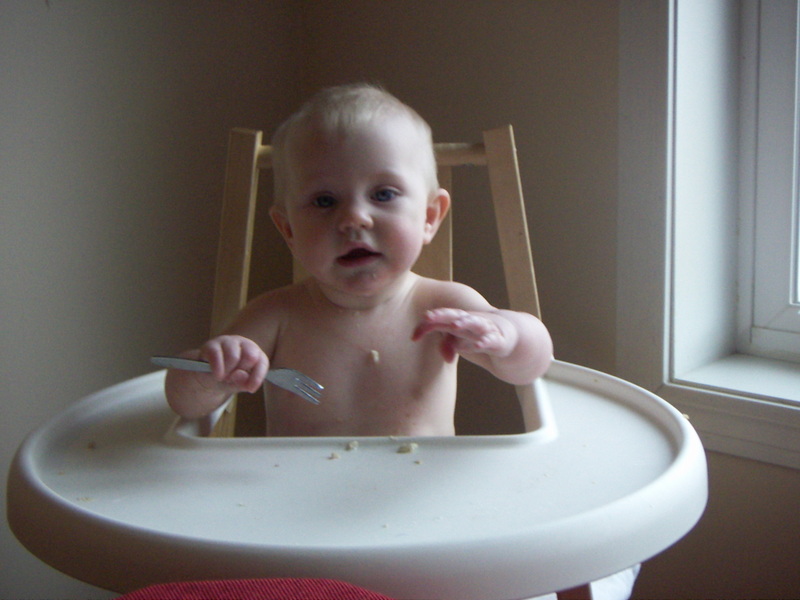
    Although it’s kind of a pain to keep handing her the fork, compared to the boys’ finger-feeding themselves, I must say she eats quite neatly for a six-month-old.  Here she’s already eaten about a tablespoon of oatmeal, maybe ten forksful.


  • More on AP’s missing pieces.

    I’ve been thinking some more about the shortcomings of traditional attachment parenting (must I start calling it "mainstream attachment parenting," distinguished from the "mainstream" parenting that AP itself rejects?), which I started writing about in this post after reviewing some more of Gordon Neufeld’s work.

    AP prompts a strong negative reaction from some people (check the comment section of that post), I think because the proponents are sometimes dogmatic about it, and also because of the usual answers they have when behavior and relationship problems do arise.    Confronted with an "attachment parent’s lament" — But I did all these things!  I breastfed, I co-slept, I wore my baby, I never left him with anyone, what do I do NOW? — the answer seems always to be "attach more," by which is meant more co-sleeping,  more closeness, and more modeling good behavior.  The subtext:  Obviously you haven’t given your child enough love, or he would be ready — ready to become independent, ready to separate from you, ready to behave.

    They’re almost right — the answer isn’t so much to "attach more" as it is to "attach deeper."  That is, to attach more maturely, beyond encouraging your child to attach to you through physical closeness, beyond encouraging your child toattach to you through imitating you — to encouraging other, longer-lived kinds of attachment.  From my previous post, Neufeld says they are:

    • Through belonging and loyalty ("I’m on your side; I want to obey you")
    • Through a feeling of being significant, important;
    • Through a feeling of love and affection;
    • Through being secure in the knowledge that they are known and understood (the deepest and most persistent and mature level of attachment).

    So, yes, in a way, if there are (non-age-appropriate) separation problems, if there are behavior problems, more attachment is needed — but it doesn’t have to come from co-sleeping and cuddling. 

    And sometimes it really can’t — especially when the desired behavior is one that necessarily involves a decrease in physical closeness — if you’re trying to help your school-aged child with behavior problems that arise while she’s away from you, for example, or if you’re hoping to help your young child make the transition from co-sleeping to sleeping in a different room.

    It is pretty obvious once you know about it — kids need to be attached, and if the only ways you give them to be attached to you are physical closeness and imitating, then in any situation that calls for them to be away from you or to be doing something different from you, they’re going to be at sea (and looking for cues from someone else, who may or may not be a good example).

    That’s not to downplay the importance of closeness and modeling.  That’s what the really young ones need.  And it’s why AP parenting really does work so well for babies and little toddlers.  They truly need closeness and modeling, the more the better while they’re so little.

    The DVD series I wrote about has some very specific ideas about how to encourage the other kinds of attachment.  But it’s not hard to imagine some, too.  Often the easiest that comes to mind is "being significant" — communicating to the child that they’re important, that you think of them often even while you’re apart. 

    I missed you while you were gone. 

    While I was out today, I saw a chickadee sitting on a fence, and it made me think how they are your very favorite bird, and that made me smile. 

    I took the birthday card you made for me and put it up in my office where all my co-workers can see it.

    That kind of thing. 


  • Stained.

    There is something truly sorrowful about a six-month-old baby, sleeping in her mama’s arms, the sweetly flushed forehead smudged with ashy black.

    It’s what I contemplated yesterday morning through the latter half of Mass.  Looking on her, marked, pierced me in some small and real and new way.


  • Sacrifice.

    Oscar, age 6, announced today, quite spontaneously, that he’s going to give up ketchup for Lent. 

    I was impressed.


  • Random observation of the day.

    Today I read two entirely unrelated posts, each of which moved a commenter to allude to Michael Faraday.

    One post about art, and the comment was about nanotechnology; one post about disability rights, and the comment was about electrostatics.


  • At Disputations:

    Reflection on the Gospel story of the boy possessed by a mute and deaf spirit:

    It might repay the time, however, to take a closer look at this mute spirit. Here are two lines of thought:

    First, courtesy of Fr. John Dear, SJ, in his book Transfiguration, note that the spirit "has often thrown him into fire and into water to kill him." In the New Testament, fire and water symbolize the Holy Spirit and baptism, sources of life. The spirit, though, tries to use them as the means of death. Jesus’ word overcomes these "anti-sacraments" (as I say, this is a line of thought; you’ll have to do the shading yourself), since He has come to bring life to the dead.

    Second, the father says that, when the spirit seizes his son, "he foams at the mouth, grinds his teeth, and becomes rigid." Do you know anyone in your own life who has a tendency — perhaps when the subject turns to religion or politics or morality — to foam at the mouth, grind his teeth, and become rigid? Perhaps, and this is offered without the implication that there is a demonic spirit at work, perhaps the way forward in truth with this person is only through prayer (and, as a variant, through fasting).

    Lots of meat there… and today’s a good day to sink your teeth into it!