bearing blog


bear – ing n 1  the manner in which one comports oneself;  2  the act, power, or time of bringing forth offspring or fruit; 3 a machine part in which another part turns [a journal ~];  pl comprehension of one’s position, environment, or situation;   5  the act of moving while supporting the weight of something [the ~ of the cross].


  • If you can take a trick, take it.

    I played euchre in college.  Euchre is a four-person partnered card game, I started to write, trying to briefly summarize the rules, but now I’m giving up — here is the Wikipedia article if you need to know more.   It’s one of those games that comes in endless variations.   Did I play Ace-no-face?  No thank you.  Screw-the-dealer?  Absolutely.   Nell-O?  Only in Kentucky.

    In euchre, as in many card games, there’s a certain etiquette, passed down in lore from player to player.  In central Ohio, for example, one emits a moo when one achieves nine points.  Message: I’m in the barn!  The most serious breach of etiquette — not including rule violations such as reneging — is summed up in the maxim Never trump your partner’s ace.   Another piece of advice is Count on your partner to take one trick.

    The bit of advice I remember most is If you can take a trick, take it.  (Wikipedia, helpfully, has an article about tricks.)  It’s an important piece of advice for a beginner who might otherwise try to hold on to the "good" cards or who might be intimidated into leaning on the partner a bit too much.  The idea is simple:  When play comes around to you, and you see that you can play a high enough card — here, in this hand, this trick, right now — play it.  You might want to consider your move carefully — Don’t, because you’re holding up the game.  You might hope you’ll look smart and strategic if you hold onto your good card and "throw off" now (play a low card that won’t take this trick), saving the good card until the perfect time.  Don’t — that time might not come, and you’re not going to look so smart when everyone finds out that you could have taken a trick and didn’t.  You might think that your partner will enjoy playing his high card here.   Don’t yield to him yet (unless you’re thinking of trumping his ace, of course) — remember, your partner is counting on you to take at least one.

    I find that If you can take a trick, take it is a pretty good rule of thumb for housekeeping, and indeed for life in general.   It’s not so overwhelming as a plan to win the whole game, or even a hand of the game (five tricks in a hand, three to ten hands in a game).   A trick is a tiny little victory.  Tricks add up to hands,  and hands add up to a win, so these tiny little victories matter.  On each one — and you rarely know while you’re in it — the whole game might turn.   At the same time, though, when you see you can’t take one, you let it go.    Just let it go.  Maybe your partner can play the card that’ll take it, but if not — it’s only one trick.

    So if I’m passing through the kitchen on my way to the stairs and there’s my husband’s shoes on the floor and I could take two steps out of my way to grab ’em and take ’em up to the closet with me — or I might not — if I can take a trick, take it.  My partner can count on me for this one.  Up they go. 

    Or if there’s a mess on the floor under the baby’s high chair, and I have a few minutes, but I’m thinking Later on I’ll be scrubbing the whole floor so why bother cleaning that up now? — I remember that I don’t really know if I’m going to have that time, I don’t know if I will win the whole hand, but I can take this trick. 

    Or if I happen to be in the bathroom and it occurs to me that while I’m in here I could get a wipe from under the sink and quickly get the worst of the spots off the floor — that realization, plus the brief seconds of extra time I could use for it, is the "high enough card" to take that trick.  No point saving it for later; when the trump cards come out it’ll be worthless.  If I can take a trick, take it.  Twenty seconds later I leave the bathroom a little bit cleaner than it was.

    Or if I happen to be in a friend’s bathroom, for that matter, if she has company, and I notice that her kids have left a little present smeared on the side of the toilet.  No, she would not expect me to clean it up.  I could go out and tell her quietly, "Hey, your toilet needs attention before your guests see it."  But the container of antibacterial wipes is just sitting there where I can see it.  So is some soap to wash my hands with.   You’ve heard the answer to But who is my neighbor?  Well, who is my partner in this game, hm?  Anybody who can count on me to take a trick, right?  Twenty seconds later I leave her bathroom a little bit cleaner than it was.

    I find myself applying it to housecleaning because those particular opportunities for tiny victories are the ones I’m both likely to encounter and likely to let slip by.  But everyone’s jobs, everyone’s relationships, everyone’s game has these little decisions.  Sooner or later play comes around to you, and you have a certain set of cards, and you have to decide whether to throw off.  If you think too hard you’re holding up the game — that’s why we have the rules of thumb.  If you can take a trick, take it.

    What kind of tricks can you take today?


  • There’s no such thing as a free lunch. How about a taxpayer-funded lunch instead?

    I recently found out that the Minneapolis School District serves federally-funded free lunches to all children ages 1 through 18 all summer long at many sites around the city:  local community centers and parks, among other places.   Our local YMCA is one such site.  Today I happened to be out with my kids and heading home at lunchtime, so I stopped by the Y to check it out.   "Where are we going?" asked Oscar, but I wouldn’t tell him, just in case they were out or something.  No sense setting anyone up for a disappointment.

    The staff at the Y knows us by sight.  I walked in and said to the woman working the counter, "Hey, we wanted to check out the lunch program — where do we go?"   She directed me downstairs.  Down we went, following the sound of children’s voices.  We found a door with a piece of paper taped to it, on which had been written — by a teenage girl wielding a whole box  of markers, I guessed — "LUNCH ROOM."  We peeked in carefully — I knew that there is also a sort of summer-camp program going on.  Several dozen kids at tables, and a handful of teenagers with matching tee shirts. 

    "Is this the summer program or the lunch program?" I asked a tee-shirted teenage boy, whom I would describe as "clean-cut" except that he was graced with a huge halo of frizzy brown hair.   

    "It’s both," he said, "how many lunches do you need?"  I decided that MJ and Milo could share and asked for two.  He retrieved two plastic-wrapped cardboard baskets from a pallet and cheerfully handed one to Oscar and one to Milo.   "All the kids here are for the summer program, so you can go upstairs and sit at the picnic tables by the pool." 

    Upstairs we opened up the packages and examined them.  The children were impressed.  Each had a half-cup of apple juice, a half-pint of two-percent chocolate milk, a banana, and a sandwich of turkey ham and American cheese on what appeared to be a soft whole-wheat bun.  Plus a packet of mayonnaise and a napkin and a straw.   Oscar was very pleased and ate up his whole lunch.  Milo ate the bun and the cheese and the juice and the milk and half his banana.  Mary Jane ate Milo’s turkey ham and the other half of the banana and a couple of pieces that I tore off of Milo’s bun when he wasn’t looking.

    Except that I hardly ever serve juice, it’s not unlike the sort of lunch I normally feed the kids in the summer, and they were very pleased.  We homeschoolers might as well get some of those tax dollars back, eh?  (If the food doesn’t get eaten, it just gets thrown away.)  Here’s some more information about the USDA Summer Food Service Program.  Maybe one is available in your city.


  • Magic dressing.

    This — specifically "Blush Wine Vinaigrette," the one with the strawberry on the label — is the magic salad dressing that gets my kids to eat raw vegetables.  (I have to hide it in the fridge though or Milo will drink it out of the bottle.)

    Just a suggestion. 


  • Technomeme.

    Light and Momentary tagged me.  She seems to think I’m likely to  repair my own PC, forgetting that I am a chemical engineer.  I did pretty well on the engineering GRE, but only after I trained myself (in practice tests) to follow a very important strategy on the electrical engineering section:  do not answer any questions involving circuits.  It’s not that I can’t get the right answer, it’s that I can get the right answer v e r y   s l o w l y .   And you only get an average of seventy-one seconds per question, you know.  At least that’s how it was back in the old days when you took it with a pencil and paper.

    OK now.  Reformatting for my pleasure and answering:

    How long have you had a cell phone?

    Since our first baby was born.  For a long time we only had one, and whoever had the baby had the phone.  This kept us from accidentally leaving the baby behind, of course, because we’d be like, "who’s got the phone?"

    Occasionally I would get business calls from Mark’s co-workers, who were always surprised, irritated, and astonished that I had "his" phone.  I forget when we got the second one.  Not till after Milo was born, I think.

    How much do you use it?

    According to the call history, in the last 24 hours I’ve made 4 calls, missed 1 and received 1.  Also 1 text message, but I don’t think that counts since it’s a number I asked directory assistance to send me.

    Do you get jittery without it?

    No.  I leave the house without it all the time.  That’s why I had to find another method to make sure I don’t accidentally leave the baby behind.

    How many computers in your house?

    You mean PC, right?  I don’t have to count the chip in my coffee maker?  Or my graphing calculator?  OK, then, two laptops and a desktop tower in the attic that we haven’t used in years.

    How much time do you spend on the computer in a day?

    Variable.  Anywhere from two to six hours.

    How does the time break down? (work/play/email/blogs/etc.)

    Probably about two parts play (including blogs) and one part work.

    If your computer malfunctions —

    I take it to the Geek Squad.  Sorry to bust yer bubble. 

    What techno-gadget would you most like to own?

    A good-looking pair of pants with a generously sized cargo pocket on the thigh.

    Oh, all right.  A Sony Reader.

    Of those you own (including PDA, iPod, etc.), which would you miss most acutely if you dropped it in the lake accidentally while canoeing?

    Why do I have my iPod with me while canoeing?

    What’s something you’ll never buy? (Careful with the nevers, though, says this brand new cell phone owner.)

    A Tamagotchi.

    I’m pretty confident on that one.


  • String theory: an optimization problem.

    This morning I placed a polyethylene bag full of fresh string beans on the kitchen counter in front of me.   I set a metal colander at my right hand.  I tore open the bag of beans.  With my left hand I picked up one bean and examined it briefly, turning it in my two hands until my left (dominant) hand grasped the stem end.  I pinched the bean just below the stem, between my index fingernail and the pad of my thumb; my left hand then held an amputated green-bean stem and my right hand held the long end of the bean.  I dropped the stem onto the counter and grasped the bean again, holding both ends, then broke it in half.  I passed the half held in my left hand to my right hand and with my right hand dropped both beans into the colander.  I picked up another bean.  The piles of stems to the left and beans to the right grew slowly.

    There were about two and a half pounds of green beans to trim.  It’s not a bad job; the mind can wander.  Today I thought about the way I was doing it.  Could I be more efficient?  I tried speeding up and dropped a bean.  No good.  I went over each step in my mind:

    1. pick up random bean in left hand
    2. grasp bean with right hand
    3. rotate bean into position
    4. pinch stem off bean
    5. throw stem to the left
    6. grasp end of bean with left hand
    7. break bean with both hands
    8. pass bean halves to right hand
    9. put bean halves in colander to the right

    Could I go faster if I pinched the stem off with my right hand?  I tried it for a couple of beans and concluded that my first unconscious choice, left-handed stem-pinching, had been the most reproducibly successful one; right-handed, I take off more stem than I usually want.  (Of course, I mused as I turned a bean between my fingers, it’s not appropriate to think of the stem-removal operation as "left-handed" or "right-handed."  One hand steadies the bean, the other hand pinches the stem, and the person that manages the hands distributes the tasks as best as she can.)

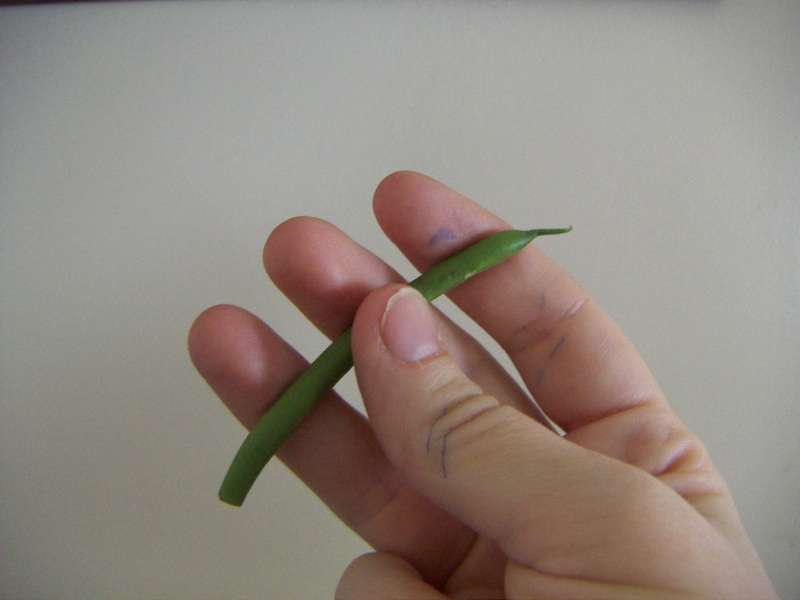
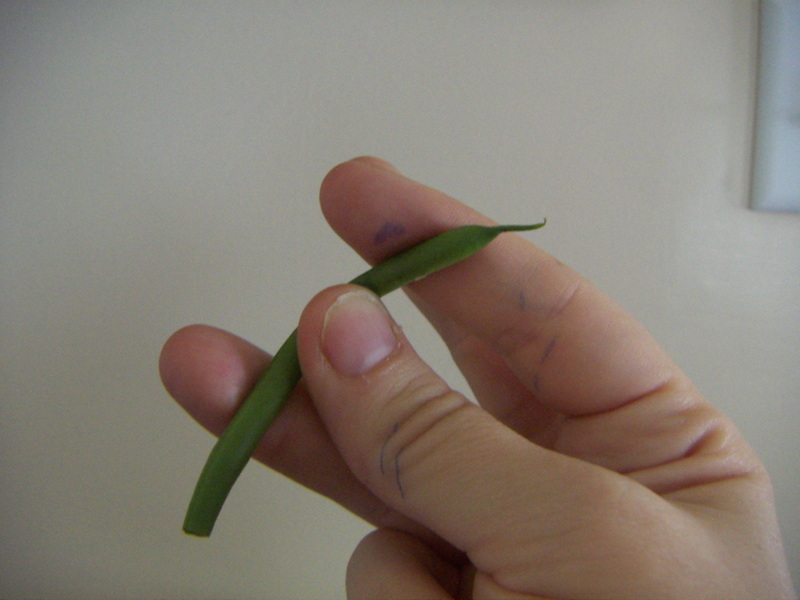
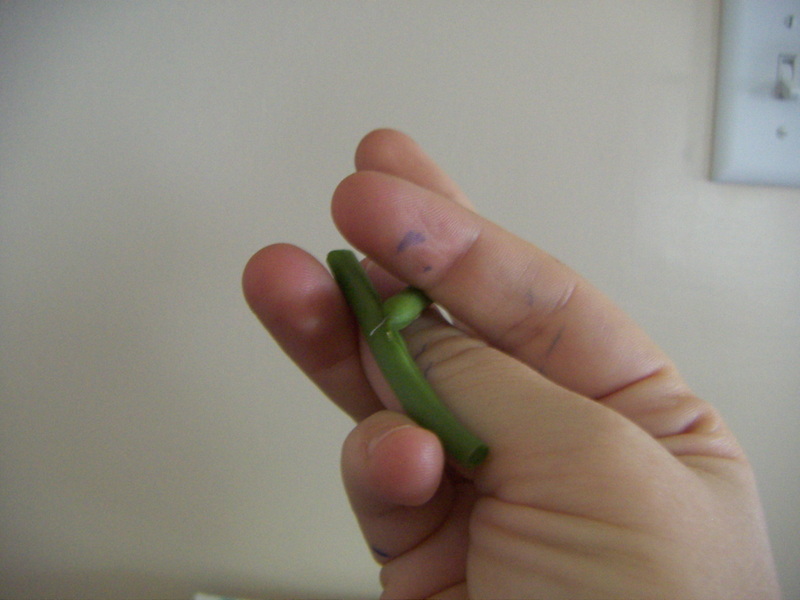
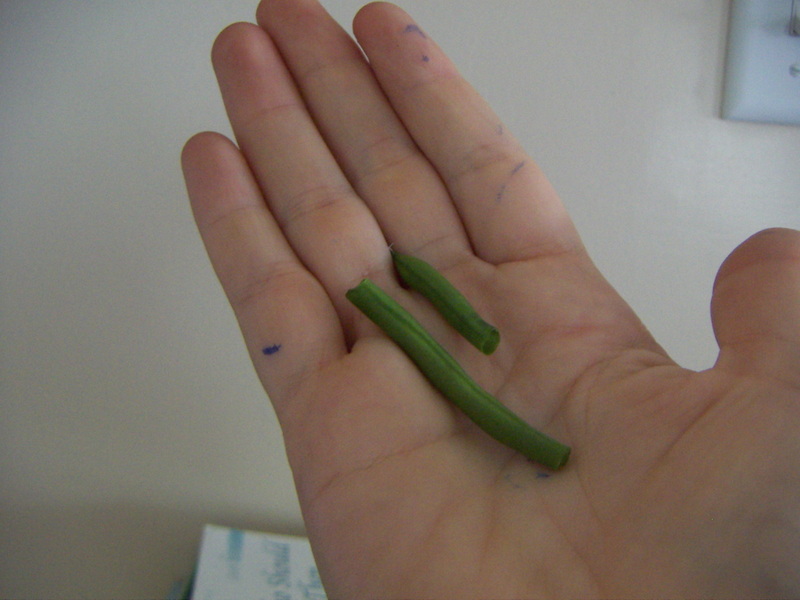
    Then I turned my attention to breaking the bean in half.  I realized that if I could alter step 7 by somehow breaking each bean in half with one hand — my right hand — I could eliminate steps 6 and 8.   After a little experimentation and practice, I was able to develop a one-handed, non-dominant-hand bean-snap.   

    Various_052_2 Various_053_2  Various_054 Various_055

    Pleased, I went on with the beans.  I did seem to be going faster.   But the question dogged me… was I going optimally fast?

    As I worked, I realized with irritation that I was needlessly over-handling the beans.  I had learned in my earlier stem-pinching experiments that I could not eliminate step 2 without undesirable results.  One-handed stem-removal was a path that I had already tried and found wanting.  But why, I thought, did I have to rotate the bean between picking up the bean and pinching off the stem?  I have some control over the bean-choosing, bean-picking process, don’t I?  Why not just pick up the bean more carefully, so that it’s already in position in my left hand by the time my right hand arrives to grasp it? 

    I happen to have a pretty good machine vision system, at least when I remember to put on my glasses, so it was trivial to develop a new bean-choosing algorithm.  It only took a little bit more attention, and less time, to watch my left hand as it dipped into the bag of beans (which I was beginning to see as an ensemble of rigid rods having a certain distribution of lengths, diameters, orientations, etc.), and to pick up each bean between index fingernail and thumb, positioned at the point where I wished to sever the stem, and with my wrist oriented in such a way that when I brought hand and wrist back to a neutral position, they would naturally rotate the bean so that at the very moment my right hand grasped it I could sever the stem.

    Grabbing the beans in position took more attention than I realized, especially as the number of easy-to-grab bean stems dwindled, but I quickly saw the superiority of the new system.  I had reduced the number of physical steps to six:

    1. pick up bean carefully in position in left hand
    2. grasp bean in right hand
    3. pinch stem off bean
    4. throw stem to the left
    5. snap bean in right hand
    6. throw bean halves into the colander

    Only one of the steps, number one, had gotten significantly more complicated, and all of the complication was in processing.  I have plenty of memory and my processor speed is high compared to my bean-handling speed, so this was hardly a trade-off.  I suppose I don’t get to let my mind wander quite as much.

    That might not be a bad thing, now that I think about it.


  • Playgroup attachments.

    I fielded a question on one of my lists today from a mom who wanted help with her four-year-old’s social skills.  The situation:  a homeschoolers’ group that meets weekly in a grassy area.  The moms chat and the children play; her son, in that situation, becomes needy, begs her to play with him, shies away from the other children, throws fits, interrupts her and the other mothers constantly and tries to dominate the conversation.  Is it normal?  All the other kids appear "fine" — why not him?  Should she insist he play with the other children?  Should she trust that "this will pass" and try to generously give herself to him for now?   Or is that too child-centered?  Should she insist on having her conversation uninterrupted?

    I remembered this happening some with Oscar too, interrupting adults and wanting to dominate the conversation.  I always felt torn because, on the one hand, it is good for a child to participate in conversations with adults, good for developing social skills and vocabulary and for feeling welcome and worthy, but on the other hand, we owe it to the other adults to gently deflect our kids from dominating the conversation.  It’s a tough balance to strike.  I want to model "we don’t interrupt" and so interrupting the child seems counterproductive.  Gently pulling him aside and reminding him feels better.  But it’s tricky to do.

    I typed a lot of advice before it occurred to me to try to answer the "Why does this happen?" in terms of attachment.   The mother had assumed, and so did I at first, that the child’s stress came from having to be around so many other children.  I realized that the tension might come as much from the presence of other adults, because they are potential attachment figures.    His mom is focused on these adults — maybe it sends a sort of message to his attachment mechanisms that "these adults are important" — his attachment mechanisms are firing up to get these "important" adults to see him and notice him and form an attachment to him.  Perhaps it is a safety mechanism, born, I think, of the expectation that an "important" adult might without warning be the person left momentarily in charge of him.  (It happens… "Watch my kids for a minute while I go get something out of my car?")

    Viewed in this light the child’s reluctance to leave the group of adults, and attempts to be heard by them,  seems understandable — even reasonable.

    I suggested she firmly present the choice "You can sit with me quietly while I talk and listen with the other mamas, or you can play."  And that she make both of those choices as attractive as possible.  For sitting quietly, bringing quiet activities, snacks, etc., and taking a break now and then (without leaving the circle) to read to him, with a murmur in his ear, from a favorite book; for playing, bringing something that he would enjoy (and plenty to share), like a box of beach balls or something along those lines. 

    I also suggested she give him a chance to meet other people from the group in a lower-pressure setting, perhaps by inviting one mom and her kids for coffee.  My first thought was that this might help because it could give him practice playing with other children.  But it occurs to me now that it might help, as much or more, because it might forge greater connection with another adult.

    And so maybe the first suggestion, about firmly presenting the choice and helping him enjoy either of the choices, though it could help, doesn’t really address the root cause of the problem, because it doesn’t deal with attachment.  Maybe what the child is really seeking is to make a real connection with the adults in the group to feel more secure.  I wonder if it would help him if his mom made a point of connecting him briefly to each one — perhaps by being the first to arrive and then individually greeting each mom in a short conversation that included her son.


  • Archimedes and history.

    This fall we’ll start a year studying ancient history, drawing from the History Odyssey curriculum (Level One).   I say "drawing from" rather than "following" because there’s far too much packed into that curriculum for us to actually do — I’ll have to pick and choose a little.  Now in the last couple of months of summer I’m reading aloud from a few books chosen to whet the kids’ appetites.  Last night we finished Archimedes and the Door of Science, a wonderfully written biography written by Jeanne Bendick.  Oscar loves biography, as we discovered last year.  (Which gave me the idea for a whole American History curriculum based entirely on biography, but haven’t had time to work on.) 

    We finished the Archimedes book very quickly.  It is engaging but avoids too much speculation and made-up dialogue, and as far as I can tell from Wikipedia, sticks pretty closely to what is known about Archimedes.  Ms. Bendick is careful to mention from time to time which discoveries are known from Archimedes’s surviving works and which are known only from accounts written by others, the Archimedean work being lost.  One bit that delighted me:  Instead of writing herself about the Roman general Marcellus’s assault on the city of Syracuse, which is said to have been foiled by various Archimedes-designed war machines, she quoted Plutarch at length, letting him tell the story.   When I read this aloud to my family, Oscar wriggled with delight and shouted "Yay Archimedes!" and Mark laughed aloud at the line "deriding his own artificers and engineers."  Here is the excerpt in full, which can be found here:

    When, therefore, the Romans assaulted the walls in two places at once, fear and consternation stupefied the Syracusans, believing that nothing was able to resist that violence and those forces. But when Archimedes began to ply his engines, he at once shot against the land forces all sorts of missile weapons, and immense masses of stone that came down with incredible noise and violence; against which no man could stand; for they knocked down those upon whom they fell in heaps, breaking all their ranks and files. In the meantime huge poles thrust out from the walls over the ships sunk some by the great weights which they let down from on high upon them; others they lifted up into the air by an iron hand or beak like a crane’s beak and, when they had drawn them up by the prow, and set them on end upon the poop, they plunged them to the bottom of the sea; or else the ships, drawn by engines within, and whirled about, were dashed against steep rocks that stood jutting out under the walls, with great destruction of the soldiers that were aboard them. A ship was frequently lifted up to a great height in the air (a dreadful thing to behold), and was rolled to and fro, and kept swinging, until the mariners were all thrown out, when at length it was dashed against the rocks, or let fall. At the engine that Marcellus brought upon the bridge of ships, which was called Sambuca, from some resemblance it had to an instrument of music, while it was as yet approaching the wall, there was discharged a piece of rock of ten talents weight, then a second and a third, which, striking upon it with immense force and a noise like thunder, broke all its foundation to pieces, shook out all its fastenings, and completely dislodged it from the bridge. So Marcellus, doubtful what counsel to pursue, drew off his ships to a safer distance, and sounded a retreat to his forces on land. They then took a resolution of coming up under the walls, if it were possible, in the night; thinking that as Archimedes used ropes stretched at length in playing his engines, the soldiers would now be under the shot, and the darts would, for want of sufficient distance to throw them, fly over their heads without effect. But he, it appeared, had long before framed for such occasions engines accommodated to any distance, and shorter weapons; and had made numerous small openings in the walls, through which, with engines of a shorter range, unexpected blows were inflicted on the assailants. Thus, when they who thought to deceive the defenders came close up to the walls, instantly a shower of darts and other missile weapons was again cast upon them. And when stones came tumbling down perpendicularly upon their heads, and, as it were, the whole wall shot out arrows at them, they retired. And now, again, as they were going off, arrows and darts of a longer range inflicted a great slaughter among them, and their ships were driven one against another; while they themselves were not able to retaliate in any way. For Archimedes had provided and fixed most of his engines immediately under the wall; whence the Romans, seeing that indefinite mischief overwhelmed them from no visible means, began to think they were fighting with the gods.

    Yet Marcellus escaped unhurt, and deriding his own artificers and engineers, "What," said he, "must we give up fighting with this geometrical Briareus, who plays pitch-and-toss with our ships, and, with the multitude of darts which he showers at a single moment upon us, really outdoes the hundred-handed giants of mythology?" And, doubtless, the rest of the Syracusans were but the body of Archimedes’s designs, one soul moving and governing all; for, laying aside all other arms, with this alone they infested the Romans and protected themselves. In fine, when such terror had seized upon the Romans, that, if they did but see a little rope or a piece of wood from the wall, instantly crying out, that there it was again, Archimedes was about to let fly some engine at them, they turned their backs and fled, Marcellus desisted from conflicts and assaults, putting all his hope in a long siege.

    The book included an illustration of Roman soldiers flinching and running away from a dangling rope-end.  Charming!

    I find myself looking forward to studying history along with my kids perhaps more than any other major homeschooling subject, perhaps because it’s the one where my own education is the most lacking.   We’ll be looking together at the books and materials, and the sources will be our teachers.  It really drives home to me the truth that, to homeschool effectively, it’s less important that you know a lot about it when you begin than that you can get excited about it and that you know where to go for what you need.

    And another thing — it’s nice to have some idea about what the subject can teach you about the nature of knowledge, about the human experience of living in the world, about your general world view.  I think I’d like Oscar to carry away from his study of history the realization that you don’t have to rely on tertiary sources and secondhand accounts — often you can go to the source.  That you can read about historical figures, or you can read what those people produced themselves.  That different witnesses record different things about the same event, and it’s partly because they saw different things, partly because they remembered different things, partly because they decided different things were important, and maybe even because both of them are lying about some of it.  That people make the same mistakes over and over again in new ways.  That whatever the context, everyone makes choices, has a chance to affect something that happens later, however small and short-lived. 



  • Fusion cuisine.

    My kids and I were the only customers in the Middle Eastern restaurant in the middle of uptown.  The teenaged boy behind the counter had just brought us our falafel lunch special.   In walked a young woman in jeans and a pretty headscarf.  She was carrying a large paper bag by the handles.  She walked behind the counter, where she and the boy exchanged a few words ("Was that Spanish?" asked Oscar.  "No, something else," I told him).  An aproned man, an older woman, and a younger teenage boy came out of the kitchen and greeted her.

    The young woman pulled out of her bag, one by one, half a dozen steaming-hot "everything" bagels from the bagel place up the street.  The family sliced the bagels in half, piled them high with gyros meat and yogurt sauce from the restaurant’s steam table, wrapped the sandwiches in squares of foil pulled from the box behind the counter, and devoured them standing up.

    The falafel was good, but I wanted some of that…