bearing blog


bear – ing n 1  the manner in which one comports oneself;  2  the act, power, or time of bringing forth offspring or fruit; 3 a machine part in which another part turns [a journal ~];  pl comprehension of one’s position, environment, or situation;   5  the act of moving while supporting the weight of something [the ~ of the cross].


  • Not an auspicious start to the school year.

    Today I start the school year.  Yeah, I know, ridiculously early.  But I was so ready to spend more time outside when spring came this past April… I am determined to finish a month earlier this year, and to have more breaks in the middle,  so we’re starting early.

    But yesterday I fell down the stairs and sprained my ankle.  At first it seemed okay and after a brief icing, I walked on it.  But then I sat down to use the computer for half an hour and when I got up it was stiff and painful — I guess as soon as I stopped moving, it had a chance to swell.  I couldn’t walk all evening.  This morning I can limp around, but Mark insisted that we ask a friend to come over to help so I can keep it elevated.  He took the little ones to music class for me.  I’m doing Oscar’s lessons now — he’s going through his math facts drill, so I got a minute on the computer.

    I’m determined to stick to my school schedule lest I start the year off on the wrong foot.   So to speak.


  • Engineering and politics.

    Expect some wind to be generated about whether engineers need more oversight by politicians (as in the 5:11 and 5:14 comments at this Althouse post) or politicians need to defer more to engineers and other experts (as implied by the 6:24 reply by "Revenant").  We’ve heard this debate before in other contexts.  He’s putting politics before science, for example.

    Perhaps you’ll be surprised to know it, but I am not a believer in technocracy.   At the end of the day, politics has to have the upper hand — or at least the legitimate political process, if not the pandering that sometimes accompanies it.  Ultimately, politics is about answering the question "What ought we to do?"  What are our priorities?  How ought we allocate resources?  What behaviors ought we encourage and what ought we to discourage, and which means of influence ought we consider too harsh?

    Experts — economists, engineers, scientists, physicians — who have relevant knowledge to this or that policy have limits.  They cannot answer the "what ought we to do question" with any special expertise.  Their expertise helps them tell us that this action will likely result in that outcome, and that this outcome will likely result in that situation; or what was the trigger that made such-and-such happen, and what we might do to prevent it from happening again.    It is important information, and the answers to one question lead to another, but one answer they will never lead to is an ought answer.  Ultimately, value judgments don’t come from expertise.   And so deferring to experts to make value judgments is not appropriate.  Value judgments belong in the political process, in the voting in and voting out of elected officials, in the sphere of public debate.

    Let’s put it simply:   Some of the people who graduate from engineering school, medical school, elite research programs, heck, theology PhDs — like some of the people everywhere — are class-a-number-one selfish jerks who can’t figure out that one ought to tip a good waitress more than ten percent.   Nothing about an elite education can make a person more compassionate, more able to decide what outcomes are genuinely right — or most right when resources constrain us to a few choices.

    And yet what is necessary for well thought out value judgments is something that not everyone has:  clarity and reason and compassion.  Does that mean that they’re best made by a kind of elite?  No — because clarity, reason, compassion are within everyone’s reach, if we only take care to form them in ourselves and in the people in our charge.

  • So what about that “sophisticated computer model?”

    UPDATE 8/6:   Confirmed that this is it.

    According to the Strib:

    NTSB investigators will use a sophisticated computer model program, updated by a former University of Minnesota student, to try to extrapolate how the bridge failed, [NTSB Chair] Rosenker said.

    I’ve been noodling around the journal indexes trying to find a publication that describes the computer model.  I heard the model described on MPR yesterday by a caller who claimed to have worked with the model in a course at the University of Minnesota.  He clarified a point that I haven’t seen reported in the news media — that the computer model that Rosenker is talking about is a model developed specifically for the I-35W bridge that collapsed.  It’s not just a generic bridge-modeling program — it’s a model of that bridge

    I haven’t found any information about the 35W bridge, but I did find an article about a project that sounded related, so I’ll throw it out here in case it helps anyone else who’s looking for the info.  Berglund EM and Schultz AE, "Girder Differential Deflection and Distortion-Induced Fatigue in Skewed Steel Bridges," J. Bridge Engineering (2006) v.11 no. 2 p.169, describes a project funded by MnDOT that modeled a bridge at I-94 and I-694.  It involved measurements of stresses as well as finite-element modeling of that specific bridge.  A pdf of the government final report is here

    Note that this bridge is different from the 35W Mississippi bridge and so the details are probably quite different, but I wonder if the two studies were part of the same 1995 MnDOT funded research project and if they use the same modeling procedure.

    UPDATE.  I think maybe this is it?  UPDATED ABOVE, yes.


  • Some more thoughts on 35W.

    We were wondering if, when a bridge undergoes repairs of any kind, it’s ever standard practice to employ accelerometers, vibrational analysis, and strain gauges to measure the loads and vibrations that the bridge experiences before and during the work.

    The more I learn about the bridge collapse the more sure I feel that some aspect of the construction project is going to be shown to be the triggering event — not necessarily the reason the bridge collapsed at all, but the reason the bridge collapsed this week instead of last year or next year.

    They were resurfacing.  That’s not supposed to affect the structural integrity because the top of the decking isn’t supposed to be load bearing.  But perhaps it was bearing some load.  Could there have been an unseen failure in the steel that had shifted a compressive load to the concrete decking — like wallpaper that holds together a wallful of rotten lath?  There were piles of aggregate here and there on the bridge, I remember seeing them.  How did that heavy, static load change the bridge?  The workers were using jackhammers.  Did the vibration propagate some crack, somewhere, far faster than it might otherwise have?  Some of the lanes were closed.  Had the shift in traffic imbalanced the bridge?

    Ordinary people have a lot of questions right now about fracture mechanics and metallurgy.   I heard a woman call into MPR’s Mid-Morning and ask:  I’m not an engineer, but in my experience, things bend before they break.  Why didn’t the bridge bend before it broke?  I saw a question on buzz.mn — Stresses triple at the edge of a hole?  Is that a little hole or just big holes?    I could pull my brittle-frac-mech book off the shelf and start rambling, but the working bridge engineers are around to answer those questions, so I won’t.   I was a little relieved to find an op-ed by Henry Petroski in the LA Times — I have long appreciated his several books on design and failure and knew he’d weigh in eventually.

    Milo made a design with rubber bands on a peg board yesterday and told me, "It’s a bridge.  Here’s where you launch the cars."  Who knows what the kids will remember from all this.

    When I first watched the video, apparently taken from a security camera at the lock and dam, I thought:  I am watching something impossible.  Not that the bridge was falling, not that the disaster itself was truly incredible, but I thought — that first viewing — that I was watching the central span drop straight and flat, as if both ends had been severed at exactly the same time.  That can’t be right.  I watched again more closely, and I could see that, from one frame to the next, the end closer to the camera had dropped a tiny bit farther.  Okay then.  No laws of physics broken here.   Still, as I pondered the  way the structure collapsed, it seemed marvelous how it failed, a lucky save.  It did not fail on one side and roll, dumping the cars into the river before falling down on top of them.    It did not fail at one end and make a ramp for the cars to pile up behind each other in a screaming slide into the water.   It fell nearly flat and straight, and the steel understructure became a crumple zone, and the cars on top of the span seem not even to have bounced.  Look at this picture taken by survivor Kristin West’s cell phone seconds after the collapse.   The cars are still aligned in the lane.   Look at the man standing next to his car gazing upwards.  Can you imagine? 


  • A few thoughts.

    I feel a compulsion to go visit the bridge site.   Not to gawk at the debris or recovery operations — that is more the stuff of my nightmares than anything I want to remember.  I think it’s because I have such a strong mental memory of the way the area used to look, I know that I will eventually have to replace that image with what it looks like now, and I’d like to get it over with.

    The Star Tribune headlined that MnDOT chose the most "cost-efficient" means of controlling the bridge’s decline.  If you’re thinking like an engineer, you might think that the Star Tribune was trying to praise them; where I come from, cost-efficient means optimizing one’s main objective within the given constraints.   But of course you need to think like a journalist, and "cost-efficient" is code for "they were thinking of money instead of our safety."  Read a little more deeply into the article and you will find that the stated reason for rejecting the first recommended solution — reinforcing the structure with steel plates — was the fear that drilling thousands of holes into the steel to attach said plates might weaken the bridge, a fear that I judge reasonable. 

    I can’t muster any blame for the people at MnDOT, at least until we know more.  Maybe if it was a bridge in the middle of rural outstate Minnesota, maybe then I could believe nefarious things about them.  But you know what, those people live here too, and they drive across that bridge, and their sons and daughters drive across that bridge.  Nobody knew the bridge was dangerous.  Perhaps they should have known, but I take them at their word when they said they did not.


  • Bridge.

    I live in a South Minneapolis neighborhood that’s bisected by the highway.  I hadn’t lived here long before I learned, like a litany, the cross-streets with overpasses, the ones that could take you from one side to the other:  Lake Street.  Thirty-first.  Thirty-fifth.  Thirty-sixth.  Thirty-eighth.  Forty-sixth.   You have to memorize the numbers, it seems, if you don’t want to come up against a dead end or a turn alongside the sound wall.  I remember when I first moved into the neighborhood I kept thinking that Thirty-fourth street would get me across, and kept coming up to the sound barrier and going Damn, I have to go down to Thirty-eighth.  There’s such a great disconnect between the two halves; the neighborhood is old, and the highway is young, a wide swath of houses having been bulldozed to make way for it, and it never quite has fit into its neighborhood.

    Not so with a river. 

    Not that long ago, I lived as close to the Mississippi River as I live now to the highway — closer, really.  And yet I never felt the need to memorize which streets would take you from one side to the other.  It’s absurd to think that you might forget where to go to cross the river…You just drive, you just walk, and when you need to cross, here’s the bridge.  The bridges are where you need to go.    Minneapolis, of course, is here because the river is here.   It grew up here.  The busy and important streets reached across, or did the crossings make them become busy and important streets?  No matter.  The bridges are just there, spanning the gorge, making the gorge unimportant, hardly ever thought about except sometimes as a lovely vantage point, or occasionally when you go for a walk down in the gorge and look up at the shockingly immense span and remember that the land of stoplights and buses is stories and stories over your head, and part of it floats dreamlike on pillars driven into the earth down here.

    From the river gorge, I always admired the Cedar Avenue bridge (also called the Tenth Avenue Bridge) that runs parallel to the highway.  It has graceful concrete arches.  Right next to it, the Thirty-five-double-you bridge was comparably ugly, a tangle of steel trusses.  Perhaps it was the contrast that kept me from noticing and appreciating the engineering feat of the long span with no piers in the water.  Or perhaps I just didn’t pass under that bridge frequently enough to notice that bit of trivia.  Nobody appreciates it today; everyone would have appreciated a nice fat pylon in the middle, I suppose, and we never would have known the difference.


  • We are safe.

    A bridge I drive across several times a day has collapsed into the Mississippi River.  Mark usually drives across it to get home, but has been taking a detour to avoid construction delays lately.  I don’t know whether he drove across it today (he left the house after the collapse but before we knew about it); if he did, he did it about fifteen minutes before it collapsed at 6:05 p.m.

    A Google Maps image of the bridge (before the collapse) is here.  It is the wider of the two bridges in the center of the photograph, the one on the left.

    More pictures of the intact bridge here.


  • Driving while married.

    Mark (reading the vanity license plate of the car in front of us):  "DOCENT. "

    Me:  I guess he’s a docent.

    Mark:  That’s one of those words that I always think sounds like it ought to have a different meaning than it really has.

    (Pause.)

    Like "nubile."

    Me:  What do you think "nubile" sounds like it ought to mean?

    Mark:  I don’t know.  It sounds like it ought to have a sexual connotation.

    Me:  "Nubile" does have a sexual connotation.

    Mark:  I thought it meant "of marriageable age."

    Me:  That doesn’t have a sexual connotation to you? 

    Mark:  No, it just means, you know, old enough to get married.

    Me:  Well, if you’re old enough to get married, you’re old enough to have a sexual connotation.

    Mark:  But you might not be marriageable.  You might be already married.

    Me:  I think it means young, attractive, and female.

    Mark:  Also a person might be nubile, as in of marriageable age, but undesirable for some other reason.

    Me:  Okay, okay, whatever.  So what do you think "docent" sounds like?

    Mark:  Like something that ought to have a sexual connotation.

    Me:  What?!  So what do you think it ought to mean?

    Mark:  I don’t know, I’m just hoping to get lucky at the Science Museum.


  • Schedule.

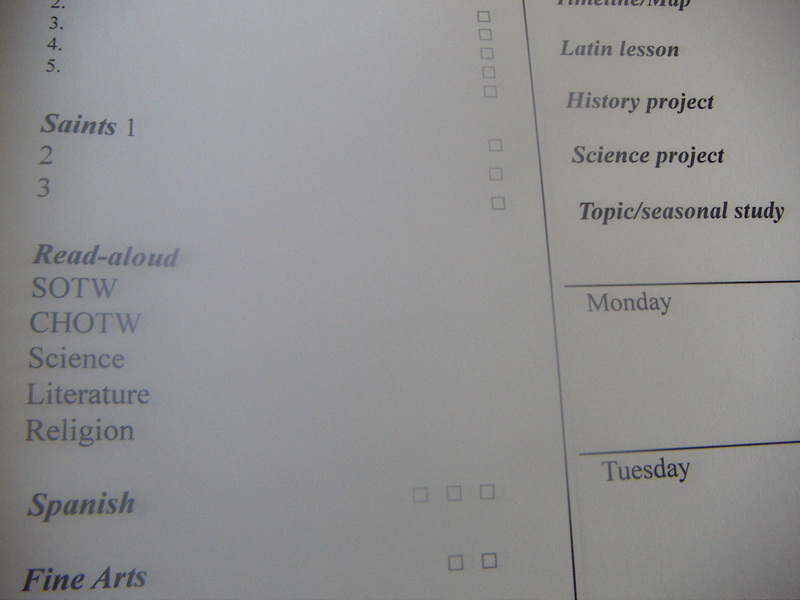
    Ten days or so before starting our new school year (I want to get it over with earlier in the spring), I’ve finished a major task:  my main record and planning book.

    Mj_and_notebook_009 Oscar provided me with the plate-billed mountain toucan on the cover.  On the back is another South American bird, the El Oro conure, and a slip with my name and phone number and an impassioned plea to Call If Found. 

    Mj_and_notebook_010

    Once I have The Notebook finished, I feel ready to start the year.  I have always been energized by new office supplies.    A trait that I find is common among homeschooling parents. 

    I have to be careful not to mistake my lovely notebook for real organization and real control.  For one thing, after Monday morning August 6, it will never look this tidy again.  It will start to accumulate cross-outs and reschedulings and notations and records of how things really went. 

    Mj_and_notebook_011 Plans can look beautiful, and yet they always have to change, if only a little, up against reality.

    I write this to remind myself.  Flexibility is not a natural virtue of mine.   I get very tense when my plans are changed for me.  Three children are starting to cure me of that, slowly and painfully. 

    No, you can’t paint today.  I don’t want to deal with the mess.    No, we can’t go to the park right now.  We have to finish math.  No, I can’t read you another story.  I have to make dinner.  Maybe tomorrow.

    I’m going to try to say those things a little less often this year.

    Mark joked last night that if it’s more flexibility and freedom I want, I need to schedule it in.  Spontaneity from nine-thirty to twelve o’clock on Wednesdays!  He thought that was funny — I think it’s exactly what I need to do.


  • Now all I need are some rounded #10 scoops.

    Regular readers are familiar with one of my lifestyle choices:  Twice a week I get together with other families for most of the day.  We take turns bringing lunch to each other’s houses, ensuring that the mom that hosts never has to prepare lunch.  In consequence, at least once a week I plan, prepare, and serve lunch for 6 to 9 children and 2 to 5 adults.  Generally we try to bring it already made, to cut down on the mess.

    (Sounds smart?  We’ve been getting together like this for six and a half years and we only just came up with the bring-an-already-prepared-lunch idea a year ago.)

    All summer the lunches have been mainly sandwiches, made the night before and packed back into the bags the bread came from, plus fresh fruit, mainly grapes or melon.  When the weather starts to turn cold in the fall, though, we’re all going to long for hot soups and casseroles and things. 

    Which is why I’m glad I discovered this index of recipes on the USDA website at the National Food Service Management Institute Website (link updated 4/2/2009).  The index is designed for child-care facilities to use in preparing meal service, 25 or 50 child-size servings at a time.  If I halve the 25-serving recipe, well, that’s pretty close to what I need for the kids I’m feeding once a week.  The recipes are nothing fancy.  They remind me (unsurprisingly) of the lunches served at my elementary school, lo these many years ago.  But they are appealing to children, simple, and inexpensive to prepare.  With a few adaptations (e.g., substituting whole-wheat flour for white flour), they are even healthful.

    And it’s not just a matter of doubling and trebling recipes for more kids — some of it is technique.  For example, the toasted cheese sandwich recipe (link updated 4/2/09) calls, not for buttering 50 slices of bread and pan-frying 25 sandwiches, but for assembling the sandwiches on buttered baking pans, brushing the tops with more melted butter, and then oven-baking the sandwiches.  I will use this technique next week, as Oscar has requested grilled cheese sandwiches and tomato soup for his birthday party.  And then I may use it again this winter — bringing a dozen sandwiches pre-assembled in pans ready to pop into Melissa’s or Hannah’s oven.

    Their very nature means that these recipes will also travel well.  Many of these recipes are designed to be held in steam tables for hot service.  That means that they can be put in a casserole dish and re-heated in somebody else’s oven.    I expect this winter I’ll try making "Tiny Meat Loaves," "Pizza-in-a-pocket," and even "Stir-fry chicken" (although nothing is messier than nine children eating rice, I’ll tell you.)


  • Language learning observations.

    Latin’s going well — Prima Latina is just right for our family to get started with.  Our modern language, Spanish, isn’t going quite as smoothly.  Note:  I’m not worried about it because I didn’t want our study of Spanish to be "formal" until we’re well into the Grammar stage.  Right now I mostly wanted the children to develop an ear for the language and learn to say a few things.  That’s why I chose Phrase-a-Day Spanish, because it’s an audio course, because it’s short and simple, and because it familiarizes the child with everyday utterances.

    Prima Latina is the traditional, "formal" type of study.  It uses a workbook, vocabulary drill, grammar rules.  ("Habito.  I live in.  Habito.  Specto.  I look at.  Specto.  Judico.  I judge.  Judico.")  Phrase-a-Day, on the other hand, is casual, no drill, no-grammar, just a whole phrase presented along with a picture to color while listening to it.  ("Tengo calor.  Salgo para afuera."  Picture of an electric fan blowing and a child headed out the door.)  When I chose these, my thought was that it would be okay to use the formal study method with Latin, since we were using it more as a thing to exercise our brains on and a method of learning grammar, and since it wasn’t a language we needed to, you know, speak with native speakers or anything.  So it wouldn’t hurt to use the formal method, even with our kids this young. 

    But you know what?  It’s the Latin that I hear Oscar trying to use and speak and form new sentences in, not the Spanish.   (And we’ve been doing Spanish for twice as long as we’ve been doing Prima Latina.)   When we drive past a Catholic church he yells, "Salve, Deus!  Salve, Jesus!"  (And pronounces the latter Yay-zoose, by the way.)  He loves to recite the one prayer he’s learned all the way through, the Sanctus.  He’s been saying "Valete!" to random people we meet as we part.

    I happen to be a big fan of formal, traditional, drill- and immersion-based styles of language learning.  I achieved a high fluency in French in high school thanks to my most excellent and very hardass French teacher, who would take "hardass" to be a complement, je pense que oui.  But somehow I didn’t think that would hold true for little kids.

    Anyway, I’m mostly going to stay the course with the Spanish, and introduce a formal course later on.  But I think I’m going to include some other ideas, too.   This week I purchased a copy of Oso pardo, oso pardo, que ves ahi? , a Spanish translation of Eric Carle’s board book Brown Bear Brown Bear, What Do You See?  It involves various animals of various colors and is quite repetitive.  I started teaching the kids the individual words in the book (un oso means a bear, un pato means a duck, etc.)    When they’ve learned everything, I want to show them the book. 


  • Preschooler serving sizes.

    Sometimes I wonder if part of the problem with "picky eaters" is that we expect them to eat too much at a time.  Here are some suggested serving sizes for preschoolers:

    Vegetables and fruits:

    • One-quarter cup of chopped raw vegetables or cooked vegetables
    • Half a cup of leafy raw vegetables
    • Half a banana or apple or orange
    • One wedge of melon
    • One-quarter cup of canned, cooked, or dried fruit

    Starches:

    • Half a slice of bread, roll, biscuit, or muffin (probably a quarter of a modern bagel)
    • Four crackers
    • One-quarter cup of cooked cereal, rice, or pasta
    • One-third cup of dry cereal

    Protein:

    • Half a cup of milk or yogurt
    • Three-quarters of an ounce of natural cheese
    • One ounce of cooked meat, poultry, or fish
    • Half an egg
    • Half a cup cooked beans
    • Two tablespoons peanut butter