I’m now redirecting from http://www.bearingblog.com .
bearing blog

bear – ing n 1 the manner in which one comports oneself; 2 the act, power, or time of bringing forth offspring or fruit; 3 a machine part in which another part turns [a journal ~]; 4 pl comprehension of one’s position, environment, or situation; 5 the act of moving while supporting the weight of something [the ~ of the cross].
-
-
“Love means the keeping of her laws.”
Today’s Office of Readings contained a lengthy and beautiful passage (6:1-25) from the Book of Wisdom, which is retained by Catholic Bibles but not by Protestant ones. As I read the opening passages, my first thought was of the old-fashioned idea of the "divine right of kings," the concept that a monarch’s right to rule comes from God or is delegated by God, so to speak. Most of the writing that I remember about this idea disdained it as a Christianized excuse for tyranny. But this passage contains some hefty warnings:
Hear, therefore, kings, and understand; learn, you magistrates of the earth’s expanse!
Hearken, you who are in power over the multitude and lord it over throngs of peoples!
Because authority was given you by the LORD and sovereignty by the Most High, who shall probe your works and scrutinize your counsels!
Because, though you were ministers of his kingdom, you judged not rightly, and did not keep the law, nor walk according to the will of God,
Terribly and swiftly shall he come against you, because judgment is stern for the exalted–
For the lowly may be pardoned out of mercy but the mighty shall be mightily put to the test.
For the Lord of all shows no partiality, nor does he fear greatness, Because he himself made the great as well as the small, and he provides for all alike; but for those in power a rigorous scrutiny impends.
Even though my first thoughts were about kings and other powerful political leaders, which is the plain meaning of the text, as I read on I started to consider that really, nearly all of us who reach adulthood become magistrates of some expanse (even if it be only a patch of garden), receive power over some multitude (even if it be only a couple of entry-level employees, a queue of customers to be served, or a houseful of children). Judgment may be sternest for the exalted, but surely all of us shall be put to the test — tested on the material at our hands, no?
And really, it’s not such a lowly thing to oversee even one other person’s experience earning his family’s livelihood; it’s not such a lowly thing to have the power that a service-industry employee has over the pleasantness of people’s lunch hours and afternoons, dozens daily; it’s certainly not a lowly thing to have the power of a mother over her children.
(You will be tested on this material.)
It’s a good thing we have some help, as the passage continues. Read all talk about "princes" and such to apply to every person in the measure of power that he or she possesses:
- To you, therefore, O princes, are my words addressed that you may learn wisdom and that you may not sin.
- For those who keep the holy precepts hallowed shall be found holy, and those learned in them will have ready a response.
- Desire therefore my words; long for them and you shall be instructed.
- Resplendent and unfading is Wisdom, and she is readily perceived by those who love her, and found by those who seek her.
- She hastens to make herself known in anticipation of men’s desire;
- he who watches for her at dawn shall not be disappointed, for he shall find her sitting by his gate.
- For taking thought of her is the perfection of prudence, and he who for her sake keeps vigil shall quickly be free from care;
- Because she makes her own rounds, seeking those worthy of her, and graciously appears to them in the ways, and meets them with all solicitude.
- For the first step toward discipline is a very earnest desire for her; then, care for discipline is love of her;
- love means the keeping of her laws; To observe her laws is the basis for incorruptibility;
- and incorruptibility makes one close to God;
- thus the desire for Wisdom leads up to a kingdom.
- If, then, you find pleasure in throne and scepter, you princes of the peoples, honor Wisdom, that you may reign as kings forever.
The nature of Wisdom in Scripture is elusive. I read the device of personification, which reads here almost to recommend goddess-worship (Sophia, natch), as foreshadowing of the other Persons of the Trinity. But the plain meaning of Wisdom here seems only the natural knowledge, habits, and attitudes that are essential for correct, just judgments and for carrying out of duties. In other words, the natural understanding that’s available to anyone who loves truth; no special grace, no special supernatural gift. The "laws" are the natural laws, of physics and of biology and of human nature.
For the first step toward discipline is a very earnest desire for her; then, care for discipline is love of her; love means the keeping of her laws…
A more concise meaning of "love" — natural love, that is — is hard to find.
The passage seems to say that anyone who loves Wisdom and seeks Wisdom, who strives to understand nature (including humanity) and observes the laws of nature, is exercising love, real love, and can make a very good start. I like it because it holds humanity to a high natural standard, and at the same time encourages us that we are capable of stepping up to it. The grace and sacrament, the other Wisdom, that comes later, holds us to a higher standard at the same time as it lifts us up; but the natural standard is still there underneath, an absolute good, one accessible to all.
-
Balance.
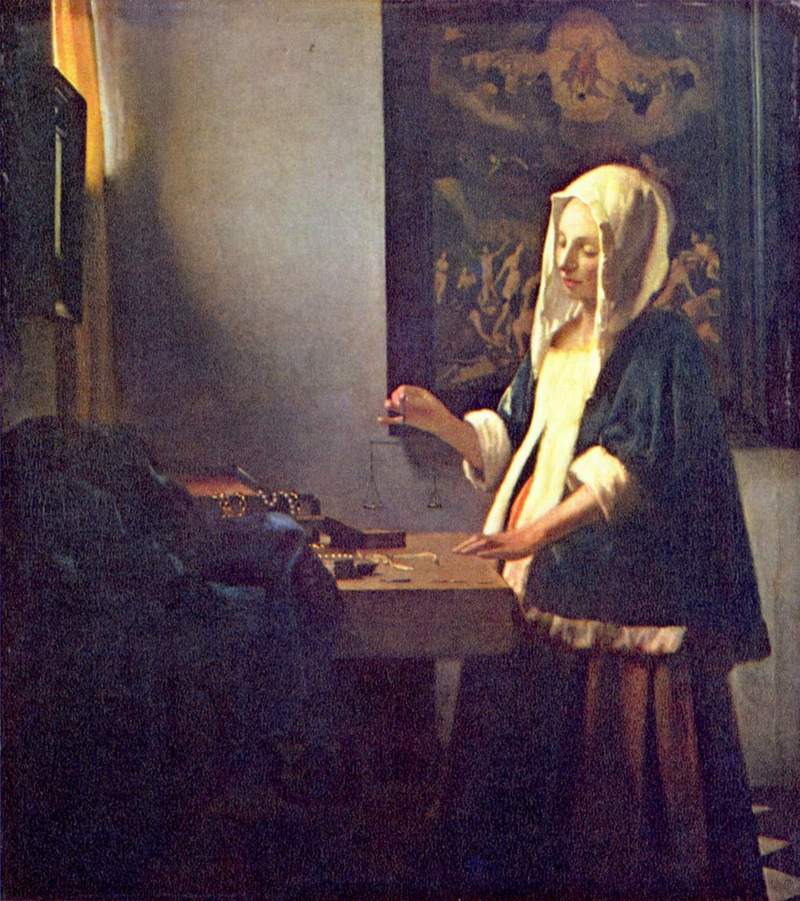
We’re studying Vermeer for six weeks, one painting a week, and we came around to my favorite of the group: Woman Holding a Balance.
In second grade, I focus on developing three very basic skills: noticing the details and attributes of a work of art, recalling them, and describing them orally.
When we started art last year, I had Oscar look at a painting for two minutes; then I would turn it over and he would tell me as many things as he could remember about it; then we would look at it again and try to find a few more details he had forgotten.
Now I let him study the paintings longer, make notes about them, then dictate to me a narration describing the art. After he’s done I sometimes point out additional details and we discuss them.
At the National Gallery of Art website, I found an interactive online presentation about Woman Holding a Balance. Oscar and I looked at it together for a while. I thought it was pretty good except for a bit of psychobabble on the first page of the "Composition" section:
Woman Holding a Balance embodies a spiritual principle that is often manifest in Vermeer’s work: the need to lead a balanced life.
Um, yeah. The balance is all about "the need to lead a balanced life." That’s why there’s a painting of The Last Judgment on the wall behind her head.
Is "the need to lead a balanced life" really a major theme of Vermeer’s work? I’m no expert. There are only 33 paintings certainly attributed to him; you decide.
-
If there wasn’t already a MrsDarwin, I’d be suspicious.
Darwin, are you channeling my husband?
(No, I don’t find him boring. I’m just saying.)
-
Testing… testing.
Ever been stymied by the difficulty of understanding why Scripture implies God sends sufferings to "test" a person, when presumably He knows how much we love him? Yes, I know we can mutter that He knows better than we do whether it’s good for us in the long run to suffer or not, but that doesn’t answer why the term "test" keeps coming up. You can try to explain it away by saying that it really means something like hardening us for battle, but the plain meaning of "finding out" — whether we have faith, whether we love God, what kind of stuff we’re made of — is there and still has to be dealt with.
One answer hadn’t occurred to me till I read it today. From the Office of Readings today, a letter by Saint Augustine:
Scripture says: He [the Spirit] pleads for the saints because he moves the saints to plead, just as it says: The Lord your God tests you, to know if you love him, in this sense, that he does it to enable you to know.
That is St. Augustine for you: good at pointing out the obvious answers — obvious in retrospect, that is. It had never occurred to me that one "tests" a thing not just to find out of what stuff it’s made, but to lay plain the evidence for others to know and see.
-
More than 500 American school teachers per year…
…are disciplined for sexual misconduct. Granted, schoolteachers are a pretty large pool of people.
Still: Yech. h/t Rich, who adds: "If only government school teachers could marry. If only women could be government school teachers."
That makes me wonder how the breakdown falls between male and female schoolteachers. There are vastly more women than men teaching primary and secondary school in the U. S. Are the genders proportionately represented among the teachers who are also sex offenders?
-
Not so profound thought for the day.
The best way to combine the strengths of contemplation and of action is not to contemplate action.
-
How to make a kit for testing hardness and streak of minerals: a narration by the 7-year-old.
The things that you are testing are streak and hardness. To make a kit, you need a little purse or bag that has no holes. You will need in the bag these things:
- You will need a copper penny.
- You will need a piece of glass.
- You will need a piece of quartz.
- You will need an unglazed porcelain tile.
- You will need a steel knife.
Also, do not put this in your bag: you will need your fingernail.
Scratch your fingernail on the mineral. And if the fingernail scratches the mineral easily, then the mineral’s hardness is 1. Or if you can scratch it barely, its hardness is number 2.
Then, if your fingernail does not scratch the mineral, take your copper penny and scratch it on the mineral. If you can just barely scratch the mineral with a copper penny, the hardness is 3.
If you cannot scratch it with a penny, take your steel knife. Take its point that’s on the very end of the knife and scratch the mineral. If you can easily scratch it with the knife, its hardness is 4.
If you can barely scratch the mineral with the knife, you should also take your piece of glass and see if the mineral will scratch the glass. If it scratches the glass, its hardness is 5.
If you can’t scratch the mineral with the knife at all, but it will scratch the glass easily, then its hardness is number 6.
You will need the knife and the glass for this one. If the mineral will scratch both the glass and the knife, then its hardness number is at least 7.
You will need the quartz for this one. If the mineral can scratch the quartz, then its hardness number is at least 8, and you can’t be sure if its number is 8. Because other rocks can scratch quartz too.
You will need the unglazed porcelain tile for testing the streak. Take your mineral and take your porcelain tile. Take the mineral and then scratch it on the tile. It will make probably a mark that is a different color from the color of the rock.
I used a book from the library to help me make these instructions for finding out what minerals it is. The book is called All About Our Changing Rocks and the author is Anne Terry White. It was made in 1955.
-
Where are the men’s voices?
Much discussion in a long comment thread at Danielle Bean’s blog about being open to life, or giving your fertility over to God, and what that means. (h.t. Minnesota Mom, who offers her own p.o.v.)
I’ve read many such threads over the years. For the first time, though, scrolling down through name after name, I was struck by the absence of … half the human race.
Many of the women wrote eloquently. Some wrote about their spouses’ points of view, but by necessity we got those points filtered through the women’s voices too.
It’s not that there aren’t men out there writing about NFP. But they’re few and far between, and writing mostly as individuals.
I’d love to see, someday, a comment thread 118+ posts long, all in the voices of the husbands and fathers, telling what "being open to life" means to them, what it means to trust God with their own fertility.
Or it would be okay to not see it, to give the guys their privacy, a room of their own, but it would be nice to know that it’s out there somewhere.
UPDATE: Darwin points me here. I am not sure this is what I was thinking of.
UPDATE: Link fixed.
-
Something I like.
When I was teaching Oscar to read, I would sit down with him, a long list of words that he should be able to read by that point (I made the lists myself with the help of a curriculum-designer friend — long story), and a dry-erase board. I had switched from made-ahead-of-time worksheets to the DE board because with it I could adapt on the fly. If he needed more practice reading a particular sound, I could give him more of those. If he was discouraged and needed some easy words to warm him back up to the challenge, I could do that.
There are some drawbacks to the dry-erase board. For one thing, it uses markers. Somewhere between teaching Oscar to read and teaching Milo, I went on a grand spree of throwing away every marker in the house. I am not kidding. I relented after a while and got some Sharpies — can one run a household without Sharpies? — but I literally keep them locked up. For another thing, some children cannot concentrate on lessons when there is a dry erase board and marker in front of them. They are thinking: Must … get … marker! Must… scribble!
That’s where the Doodle Pro comes in. It is a staple for long car trips, waiting rooms, etc., but it is also a wonderful tool for the homeschool. The big size is comfortably large enough to write reading words or math problems, or for a child to practice letter formation. The mini sizes work in a pinch when school has to happen on the road. And it’s mess free.
-
Among great ones.
I really owe the blog Shell Speed a link, if for no other reason than because it feels weird to be listed on somebody’s blogroll with exactly three other mommyblogs… Dooce, Finslippy, and breed ’em and weep.
That is beyond being a compliment and I only wish I could deserve it…
-
Today’s reading: Naaman.
Normally when it comes around in the liturgical year, the Old Testament story of Naaman seems to serve only as a backdrop for the Gospel: among the ten miraculously cured, the lone foreigner among them is the one who returns to Jesus with thankfulness and so to earn His praise. It caught my eye on its own today.
Naaman is a valiant and respected man, ill with leprosy. He travels to Israel to be cured on the counsel of a Jewish child, a serving-girl.
Bearing riches and a letter of introduction, he seeks his cure first from the king. The king offers no help, only suspicion.
On the prophet’s invitation, Naaman travels next to the prophet, expecting the prophet to cure "the spot" with his own hands by the power of God.
To his shock the prophet instead sends him to wash in the river and be clean, something so ordinary he cannot believe it will help. Persuaded by his own servants to try anyway, he does so; and not only is "the spot" taken away, but he is practically reborn from the water in a new skin: "his flesh became again like the flesh of a little child."
As I listened this morning to the reading — which begins halfway through the story, just as Naaman plunges in the river — most of what struck me was the overabundance of the cure. He hoped for a simple cure, a removal of "the spot;" he didn’t really expect anything from this washing; and what he got wasn’t a simple excision but a second birth.
This is a good image to have in mind when you hear the abused words "born again;" you have to be ready for it and not shrink away from the complete rebirth, the complete overhaul of self, because when you go to Christ seeking help with a troublesome spot, He is not satisfied except to scrape the whole thing away and start over.
Going back to the extract later to read the context, I saw again the intrigue of the many characters involved here. Leading up to the moment when Naaman plunges in the river are the Jewish slave girl; not one king but two; the silent wife, mistress of the servant-girl; the prophet; the commander’s servants. None is there by chance. Together they make the story of Naaman a surprisingly rich text for meditation.

Recent Comments
Recent Posts
- “Unprofitable servant”… of God.
- Mardi Gras recipe hack: Bread Machine king cake.
- Minnesota furious.
- Contemplation of the work.
- Boundaries and whom to set them with.
Categories
…more to come later