bearing blog


bear – ing n 1  the manner in which one comports oneself;  2  the act, power, or time of bringing forth offspring or fruit; 3 a machine part in which another part turns [a journal ~];  pl comprehension of one’s position, environment, or situation;   5  the act of moving while supporting the weight of something [the ~ of the cross].


  • Policy over person: Information consumer.

    A couple of days ago, I wrote a little bit about the choice of emphasis on person, or emphasis on policy, when evaluating presidential candidates.  I prefer to emphasize policy in national elections, but I respect people who hold the opposite view.

    What does it mean, though, to emphasize policy?   What information should you be seeking out?  

     Information is here defined as any and all media about political candidates and about their policies: speeches, writings, news reports, polls, wisecracks, sound bites, voter's guides, debates, interviews, outtakes, scandals, opinion pieces, blog articles, blog comments …. even real-life discussions you engage in with other people, by email or face to face.  (Like commenter Cathie's potentially friendship-destroying email debate.) 

    All of this stuff is stuff you make a choice to consume, or not to consume, to engage in or disengage from, by the way.  So…. When should you choose to engage, and when to quit?  The answer to that depends on how you'll use the information.  Like it or not, you consume political info for one of three purposes:
    1. To decide how to vote.
    2. To repackage it so that it can be used to influence other people's decisions.
    3. To make you feel good.

      Let's take these one at a time.

    1.  Deciding how to vote.

    If you, like me, prefer to emphasize policy, then a huge amount of bandwidth spent on the campaign season is completely irrelevant to your vote.  Negative campaigner or insufficiently aggressive?  More or less experienced?  Smart or stupid?  Was he kidding when he said that, or serious? Kids in trouble?  Cheating on his wife?  Military veteran?  Supported by weirdos or by reasonable people?  Religious?  America-hater?  Shady friends?    Man of the people, or  backwoods dummy?  Polished specimen or out-of-touch elitist?   Too old, too young?  "Liberal" or "conservative?"  Same as the last one?  Too radically different? 

    None of that matters for your vote, if policy's your thing.   What does matter is what he's supported in the past and what he says he'll support now, combined with what power he'll likely have to push his pet projects.  Plus, maybe, which interest groups endorse him.   You can probably gather all the information you need in a single web searching session;  it will not change much from week to week.  So, if you are a policy person, don't fool yourself:  If you're reading about personal qualities, it's not because you are trying to be an informed voter.  

    The nice thing about this:   Paradoxically, the more important the issues are to you, the less you need to watch the political news!  So you can skip it.  No need to feel guilty about it.   

    On the other hand, new information constantly spools in that might change the evaluation of "what kind of person" is this candidate.  Depending on what personal qualities you value, this could require a lot of homework.  If you're stuck on something like race or gender or military service or age or political experience, it may not matter; but if you're determined to choose the candidate who's the most "trustworthy" or "warm" or "eloquent" or "concerned," you will be stuck watching a lot of interviews with Katie Couric.

    2.  Repackaging information to influence others' votes.

    OK, policy voter, so we've established that most of the news out there is likely irrelevant to your vote.  But wait!  Maybe you still have a good reason to consume it.  Maybe you can use it to influence other people.  And maybe those people are "person voters."  

    This leads to an obvious and perhaps painful question:  who do you think you are going to influence, anyway?  And how are you likely to influence them?

    Answer me that, and that ought to tell you what information you have business consuming. Maybe you don't care whether such-and-such-a-candidate is a good speaker or not… but your best friend is all about the appearance of smart vs. stupid.  So maybe emailing her the latest video of your opponent's misspeaking, with the subject line "Sooooo scary that this person might actually become President!!!!!" will change HER vote.  That's rational, I suppose.  A little bit disingenuous, since you're actually scared of the person's opinions on the banking bill or on abortion laws, but rational nonetheless.

     But… Are you not going to repeat this to anyone?  Are you only going to repeat this to people who already agree with you?  Then that's not what this info is for.  Face it, it has just one purpose: 

    3.  To make you feel good.

    Face it, policy voters:  We choose to consume a lot of this stuff purely because it makes us feel good.  Why else read up about the stupid stuff the other guy said, or the deer-in-the-headlights look of that candidate when faced with a certain tough question, or the shady way that marriage ended, or the church he used to belong to, all that stuff?  It's not going to change your vote, right?  

    All it's going to do — assuming it appears to confirm what you've already decided — is soothe your troubled emotions.  Hey, it's hard to vote against that apparently nice, smart, qualified person just because he has some really bad ideas.  Or it's hard to vote for that really unlikable person just because he has the right views on the most important issues.

    So you consume stuff, on purpose, that makes you like your guy more and like the other guy less.  Stuff that makes you feel you're in the right crowd.  Stuff that makes you feel angry-with-a-helping-of-righteous.  Maybe stuff that sounds smart, so you can repeat it and sound smart too.

    I'm not saying it's wrong to do this.  But let's be clear about it.  Why do you consume the information you consume?  Why do you repeat what you repeat? 

    It may tell you something about what kind of person you are.
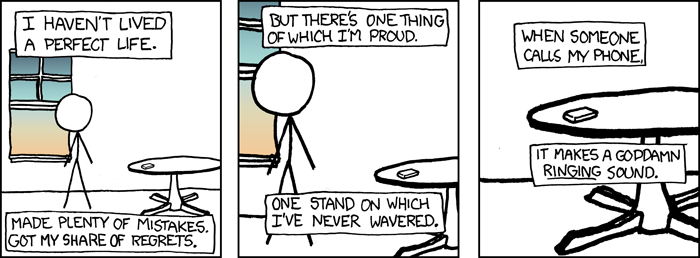
  • “A must read.”

    That's what Heather of Dooce titled her post linking to this story, and I agree.  Check it out.


  • Political affiliations.

    You know, I like political blogs.  I read a bunch of them, some on the left, some on the right (admittedly, more on the right).   I like to read bloggers who have real expertise and have a gift for teaching what they know. I like to read anybody who lays out his position clearly and persuasively, so that I come away maybe not agreeing, but  understanding: "Yes, some reasonable people think that way."   I also like to read anybody who explains his position in a way that acknowledges different points of view, respecting the reasonableness of his opponents.  

    Not very many bloggers hit all three (expert teacher, clear and persuasive, respectful of opponents.)  2 out of three's not bad; I settle for that a lot.

    —-

    So now that the debates are starting and the Gov. Palin honeymoon is mostly over, I got to thinking about why I don't really plan to watch any debates, and why I am pretty sure I will be putting zero more thought into how I'll be voting for the presidential ticket in November. Am I cynical and apathetic?  A mindless party-line voter?  What's wrong with me?

    Yes, I have an attitude.

    Reasonable people can and obviously do disagree not just on policy but on political attitude.   My positions on two key spectrums combine here.  

    Pragmatism or idealism?   Faced with two deeply flawed — maybe even INHERENTLY EVIL! — front-runners, do you 

              (a) hold your nose and choose the "least bad" option, reasoning that you might help limit the bad stuff or at least get to choose what kind of bad stuff befalls the country

              (b) decline to vote for either, and stay home, or vote for The Good Candidate Who Will Never Win, reasoning that you should at least do no harm, and that one good thing you can do is send a message to the major parties

    I'm a pragmatist myself.  I had to do the nose-holding thing pretty seriously in 2000.  At the same time I respect political idealists.  I don't agree with idealism, but it's not unreasonable.  Reasonable people differ about this.

    Person or policy?  Where's your emphasis?  When weighing candidates, do you 
     
             (a)  give the most weight to some skills, personal qualities or abilities, reasoning that proper performance of the office requires certain qualities, and personal qualities are more fundamental and enduring while policies can change with the moment?  

            (b)  give the most weight to the policies the candidate is likely to support, reasoning that a candidate might choose advisers and other people who could make up for his or her personal deficiencies, but no candidate will voluntarily work against his or her own policies?

    And yes, for the purposes of this discussion I lump all personal qualities together:  eloquence, intelligence, experience, debate performance, honesty, warmth, moral character, race/gender/sexual orientation/marital status, kindness, courage… all of this.  But some traits are a lot more important than others!  Sure.  And people rank their importance in different order.  Still, there's a philosophical distinction between person and policy.  It should be obvious that sometimes voters are stuck with a choice between a smart candidate with bad ideas and a dumb candidate with good ideas.  (Or an experienced candidate with bad ideas and an inexperienced candidate with good ideas.  Or a lying cheater with good ideas and an honest, forthright person with bad ideas.)  The question here is, do you choose "the better person" or do you choose "the better policies?"

    Me, in the national elections, I emphasize policy.   I respect the choice to emphasize the person, and even though I reject it, and I understand that desire.  In fact, I often have to suppress my impulse to go with the candidate I simply "like" better — I recognize that impulse in me as emotional, not rational.  My reason-based strategy is to choose policies, not politicians.

    (Primary elections are a little different, of course, because "electability" enters into the equation; I may be a "policy" voter, but millions of people are "person" voters, and that has to be taken into account; policies are more likely to be enacted if they come attached to a person that voters like.  )

    So I'm a pragmatist, not an idealist or a message-sender, which means I am going to vote for the Republican ticket or the Democratic ticket — I won't be staying home, and I won't be voting for the Libertarians or the Greens or the Constitution Party or any of the other folks.  I'll be doing the best I can with my one vote here in the (supposedly) potential swing state of Minnesota.

    And  I'm a policy emphasizer, not a person emphasizer.  Would I like a candidate who's smart, experienced, a proven leader, a biting wit, honorable, all that?  Sure.  More than that I want to see the policies I like promoted.  And that's how I'll vote.

    So, in the end, I don't really care how any of the candidates perform in debates.  I don't really care how they look on TV.  Face it:  I don't really care, at this point, if they are intelligent or dumb as a post.  I know their policies already, and their policies are very, very different from one another in many ways, and I've long ago decided which policies I prefer and want to see promoted, and I've long ago decided which of those to weight most heavily, and given that and these two tickets, there's not much more information that could come in that could change my mind — unless the environment changes radically and the weighting factors change.  But that's a matter of watching the news about other things than the presidential race.

    But that's me.  I respect people who look at person, and I respect idealists.  Really.  Tell me you're either of these types, and I might try to convert you to my position, but I won't think any less of you.  It's just a different set of priorities, and that is truly okay with me.

    —-

    (One more note.  Some people say that the distinction between policy and person is a false one — that the holding of certain bad or unreasonable policy opinions is proof of character flaws.   Personally, I think that people use this argument mainly to organize their opinions, or to be able to claim they put personal character first when really it is simply that there is one policy issue that they believe is more important than anything els
    e.) 

  • Fish on the way home.

    Much foodblogging this week!  I must be obsessed.

    Here's the deal with fish at our house:  

    1. Some time ago I put my foot down and said, darn it, I'll cook fish once a week, but it has to be good fish.  Fish from a reputable fish counter, where we can ask whether it's been frozen or not and when it was caught and whether it was wild-caught or farmed and whether it is being sustainably managed or not. 
    2.  We shop on Saturday, but we want to eat fish on Friday.  A day when my fridge and pantry is especially empty; a day too long past shopping day to keep fresh fish.
    3. The cheap grocery store where we shop on Saturday doesn't carry especially good fish anyway.
    4. Therefore, the plan is for Mark to pick up some fish on his way home from work on Friday, either at the co-op or at the expensive grocery store (motto:  "Costs a lot more, but WE have baggers").
    5. But!  These places have different fish for sale each week!  And at different, unpredictable prices!  And you don't really know what you want to buy till you get there and are standing in front of actual fillets and steaks!
    6. It's me, not Mark, who carries an extensive many-branched decision tree of recipes in my head.  He is a smart guy; he knows that if he's coming home with fresh fish, buying a baguette, some salad greens, and a couple of lemons is a satisfactory solution.  A safe solution.  An engineering solution.  Works for any fish.  But if we're going to do this every week, we'll get bored with lemon fish/bread/salad.
    7. Enter The Fish Buying Decision Tree.  (Download fish_on_the_way_home.doc)  

    With this document, printed out, slipped in a page protector, and kept in the glove compartment or bike bag, Mark can bring home useful additional stuff that, with the fish, I can turn into dinner.

    Caveats:  The document is written for my family, not yours.  The combinations are not guaranteed to please you.  Also, it assumes the presence of certain pantry staples:  canned broth, herbs and spices, soy sauce, wine, onions.  

    Finally, the document doesn't actually contain any recipes.  If you want to try reconstructing them, try Google, possibly including the search term "Mark Bittman," who wrote the three cookbooks I drew on most heavily to construct the chart.

    Of course, everyone should have a couple of fish recipes that rely on tinned fish for those days when stopping on the way home isn't practical.  My quick one is a pasta salad with tuna, mint, tomatoes, and capers; the more involved one is fried salmon patties with succotash and pot greens. 

  • An unusual sight.

    This morning coming out of the coffee shop, I saw a man portaging a canoe along 34th Street West, a block or so west of Hennepin.

    It wasn't wet on the bottom though.  That would have been more interesting.  

    Now that I think about it, it's sort of surprising we don't see urban portaging more often around here.  If he was planning to put it in a lake, he only had a few blocks farther to go.

    View Larger Map

    See?

  • Lunch: A weekday repertoire.

    I do lunch at home for the kids the same way I do breakfast, which is to say, I decide at the last minute fro a limited repertoire of really easy meals.  

    Here are the things that I can make any day in a few minutes from stuff that's always in my house.   I balance the meals with milk and with fruit or baby carrots if necessary.

    • Peanut butter sandwiches.
    • Cheese, and sometimes cheese-and-bean, quesadillas on corn tortillas, with salsa. 
    • Simple tuna salad (tuna/mayo/pickle), on bread or with whole wheat crackers.
    • Toasted cheese sandwiches.
    • Canned vegetable soup with whole wheat crackers. 
    • Pasta with tomato sauce (leftover or canned — I don't make it from scratch for lunch) and Parmesan.  
    • Mini pizzas (on whatever I've got — tortillas, pitas, mini bagels, or English muffins) with tomato paste, shredded cheese, and sometimes olives or pepperoni. 

    That's Monday, Wednesday, and Friday.  Like my breakfasts, all are meatless, the kids accept all of them, and I can make any of them with what's on hand.  (Me, I tend to eat leftovers, salads, steamed vegetables, and cans of kippers or sardines.)

    On Thursdays, Hannah and Melissa come to my house for the day with their children, and they are in charge of bringing lunch  for all the kids.  So I don't have to worry about it.

    On Tuesdays, I go to Hannah's for the day, and I am in charge of bringing lunch for six kids.  
    • Warm weather:  Pre-made sandwiches and pre-cut fruit. 
    •  Cold weather:  Three-hour crock-pot stuff that isn't soup, like chili-cheese casserole,  mac and cheese,  sloppy joes.  Plus applesauce or canned fruit.

      The only lunch I have to plan is the one at Hannah's, and you see that none of them are very hard to do.  The crock-pot lunch is always something I can put together in the crock the night before, which is no harder than making a half-dozen sandwiches.


  • Breakfast: Weekends.

    A follow up to my weekday breakfast post:  Weekends sometimes call for one of two "special" breakfasts.  

    The first is fried goetta [ADDED – a recipe's here], a regional specialty of Cincinnati, OH; Mark's grandmother makes pounds and pounds of this pork-and-pinhead-oat-based, sliced loaf-stuff, and gives it to us for our freezer.  You defrost it and put it in a dry nonstick skillet and cook it till it's crispy and brown on the outside and soft and creamy on the inside, and eat it plain or with ketchup.   I like runny eggs on top.

    The second is chilaquiles, which is entirely dependent on whether we have leftover chips and salsa around:

    Erin's Chilaquiles

    • Some eggs
    • Some oil 
    • Some tortilla chips 
    • At least half a cup of salsa or enchilada sauce 
    • Around half a can of refried beans (optional)
    • Some chopped vegetables, especially onions and bell peppers (optional)
    • Some cheddar or Monterey Jack cheese, grated (optional)

    Sauté the chopped vegetables in the oil, if using.  Scramble the eggs in the same skillet, leaving them a bit moist.  Scrape the cooked eggs (and veg if any) to a bowl.   

    Pour the salsa or enchilada sauce into the hot skillet, thinning with a little water if it's thick salsa; when it bubbles, roughly crush the tortilla chips into the skillet and stir to moisten all the chips, adding more liquid if necessary.  Stir in refried beans.  

    Turn the heat down. Return the egg/veg mixture to the skillet, stir, top with cheese, and cover the pan for a minute or two to melt the cheese.  Scoop big plops onto plates with your spatula and eat while it's hot.

  • Breakfast: A weekday repertoire.

    For me?  One boiled egg and a glass of tomato juice.  

    For my kids?  Most weekday mornings, one of these things. I put the coffee on, and then I decide which to make.  

    • Peanut butter sandwiches.
    • Cinnamon toast with a big glass of milk.
    • Microwaved old-fashioned oatmeal with brown sugar, cinnamon, and a splash of milk.
    • Eggs any way.  
    • Extra-eggy French toast with maple syrup. 
    • A bowl of plain yogurt with jam, honey, or maple syrup (their choice).
    • Buttermilk drop biscuits, 50% whole wheat (see note below), with peanut butter and honey or jam

    Once a week or so, I  make one of these slightly more involved breakfasts.  They are fine for a weekday, but much more streamlined if you prep them the night before.
    • Whole-wheat buttermilk pancakes
    • Steel-cut oats
    • Whole-wheat raised waffles 
    • "Boston" brown bread,  made with maple syrup not molasses

    Isn't it de rigueur for homeschooling mothers to be more organized and deliberate about breakfast than this?   One friend of mine has a schedule: "If it's Tuesday it must be waffles," and so on.  Another friend of mine has a rotation of breakfasts, thirteen or seventeen of them (I forget which, I think it was a prime number though, and in any case not divisible by 5 or 7) which she runs through one at a time and then repeats.  

    I thought about setting one of these up because it seemed so much more organized than my method, but then I decided not to mess with it, because decide-at-the-last-minute-from-these-limited-options works for my family really well. Every single one of those breakfasts is made entirely from things that I always have around.  All are meatless, and each is balanced enough, considering that my kids snack on fruit all day long.

    NOTE:  Hannah taught me only yesterday that biscuits are really, really easy.  This morning I tried some drop biscuits on the fly.  She's right — it took all of 20 minutes to make them, start to finish, and the boys loved them, so as of today I am adding them to my "decide at the last minute" repertoire.   Note to self:  Get a pastry cutter. 

  • A bit from a review of Anathem that made me smile.

    I like to read reviews of books after I've finished them, to see if the reviewer saw what I saw.  So I grilled my friend Hannah after I lent my copy of Anathem to her (she finished it in, like, a day and a half!  I know she's a fast reader but ?!$&?!$#!!)  and we had a great discussion.  

    I also went looking online for reviews.  This passage caught my eye:

    Stephenson suggests a new way of looking at science: Not as a bunch of guys hawking operating systems, but as a group of holy people whose work is profound enough to transcend time. It's impossible to convey how gorgeous and bewildering this view is for those of us who've been trained to view laboratories as the opposite of monasteries. And yet it works, and is a beautiful way of exploring what can only be called the spiritual aspects of rationality.


    Because, of course, if it is that, it is also a beautiful way of exploring the rational aspects of spirituality.  The insight (or upsight, as Stephenson's characters would say) goes both ways.  

    In the world of this book, within the walls that segregate thinkers from the rest of society, physics-religion-philosophy-mathematics all overlap and bleed together at the edges, a continuum, a single body of thought.   Here, Stephenson's just making obvious a reality that's often obscured.  He clears it up by setting a separate distinction between "enthusiasts," who when thinking about these things believe what theywant to believe, and "theors" who think about them rationally and dispassionately.   

    Along the way there's a lot of exploration of the meaning and the utility of discipline, of ritual, of self-sacrifice and devotion, since in the book's world, physics and mathematics and most other material knowledge are served by structures that echo what in our world serves religious belief and practice.  One reviewer I saw thought the book might be seen as anti-religion; I can't fathom that. If anything, it looks to me to be an apology for discipline, ritual, and self-sacrifice, showing that they can't be dismissed as superstitious nonsense.  The only question is whether they are placed at the service of something intrinsically valuable.

  • Sweet and sour beef borscht.

    I have made borscht exactly once: an icy-chilled vegetarian beet soup topped with sour cream, raw minced onion, and a sprinkling of fresh dill. I liked it, but Mark said "never again."

     Not long ago, though, I was served in a restaurant a sweet, steaming hot, strongly beefy version, thick and glossy with cabbage and onion and a good rich stock. I tried to duplicate it last night. It still didn't quite reach the restaurantversion, but it was good enough to have the whole family asking for seconds. 

    "This one," Mark said, "you can make again."

    Changes to try that next time: use the crockpot, and use lots of red cabbage for its mellow sweetness.  And maybe use brisket, something that'll fall apart into shreds in the pot.   I should note that I had a head start, since I already had several quarts of 72-hour beef stock chilled, strained, and defatted in my fridge.  The soup would not be the same without it.

    Erin's Sweet and Sour Beef Borscht

    • 1 bunch well-scrubbed beets with greens, about 1 1/2 pounds 
    • 2 Tbsp olive oil
    • 2 medium carrots, peeled and diced 
    • 3 stalks celery, diced small
    • 1 large onion, diced small
    • 1/4 head green cabbage, finely shredded
    • 4 cups homemade beef stock strained, chilled, and defatted
    • 1 lb lean beef cut into chunks for stew
    • 1 15-oz can whole tomatoes
    • 1/3 cup currants or raisins
    • 2 T or more lemon juice
    • 1 T or more brown sugar
    • Salt and pepper to taste

    Trim the greens from the beets and pare off the root end. Place in medium saucepan with the stock and the meat, bring to a boil, and simmer 20-30 minutes. Remove beets, slip off and discard skins, and dice the beets small.  Return the diced beets to the pan.

    Meanwhile, in a deep pot, saute onion, celery, and carrots in olive oil till tender and beginning to brown. Wash and finely chop beet greens (including stems) and add to skillet, tossing with vegetables till well wilted. Add tomatoes and break them up well with spatula. Add stock, beef, beets, currants, and cabbage, return to a boil, lower to a simmer, cover, and cook for the rest of the day (I put the pot in a 300-degree oven).

    Before serving, add 2 Tbsp lemon juice and 1 T sugar, plus salt and pepper. Taste and correct the seasoning, including adding more lemon and sugar if necessary. 


  • This method wouldn’t work in my house.

    Sippican Cottage moves a big box into his basement:

    Do you know how to move heavy things? I see all sorts of educated people that can't fathom how people built the pyramids. They'll believe aliens did it, but not regular people. When you become far removed from everyday things, you'll believe anything but the truth. Construction workers don't watch Mythbusters.

    If I told you you had to move that 439 pound box down a flight of stairs, could you do it? Here's what's at your disposal: A thirteen year old boy, his mom, and whatever you have laying around. Easy. By the way; you're in a hurry, because the item is made from cast iron, and it's going to rain. And you can't drop it — it's precision machinery.


    Nice job.   Our stairs have a 180-degree turn halfway down, which is at least part of the reason why Mark's table saw lives in the garage.