bearing blog


bear – ing n 1  the manner in which one comports oneself;  2  the act, power, or time of bringing forth offspring or fruit; 3 a machine part in which another part turns [a journal ~];  pl comprehension of one’s position, environment, or situation;   5  the act of moving while supporting the weight of something [the ~ of the cross].


  • A different kind of story, from the Strib: Resourcefulness.

    Talk about thinking outside the box.

    As he [the author's coworker Ryan] darted back out to the car, a woman stopped him: "Three guys just stole your briefcase out of your car and they went THAT way." He raced off toward the Nicollet Mall.


    Everything was in that briefcase…. 


    He ran back to his car and drove to Block E, the former clay cast for urban decay that has become a model for gussied-up decay.


    He searched for "the biggest, baddest guy I could find" and called him over. The man walked up, tentatively, and Ryan made his pitch: Find my briefcase and I’ll pay you $100 cash, no questions asked. Here’s my cell-phone number.


    The author of the article draws some odd morals from the story, involving Garrison Keillor, but the story's still pretty good.  Makes you hope it's true.


  • Things are looking up around here.

    Back in August on National Night Out, our inner-city block party attracted a phenomenal number of people.  The firefighters who stopped by to let the kids climb on the truck commented that they'd already made a dozen stops (remember, lots of block parties on the same night) and ours was the most crowded.  Kids all over the place, neighbors chatting — some of us doing our best to navigate a couple of different languages — kids jumping in a rented inflatable thing.  "We have to do stuff like this more often," we said to each other.

    You know what?  Slowly it's starting to happen.  Two or three households stepped up to the plate.  One young couple with a baby, and a lovely old remodeled house on a corner lot, apparently decided to be the house that always hosts the block club meetings.  They got a big wooden sign for their yard and started sticking it out front:  "NEIGHBOR MEETING 8 PM SAT HERE."  Another couple down the street, also with a young baby, started going door to door and dropping flyers.  "Litter Pick Up Saturday/Ayudanos Limpiar Nuestras Calles Sabado.  Doughnuts and Coffee Afterward/Despues compartiremos pastels y cafe."  We're lucky that each of those households has one adult who speaks fluent Spanish — maybe that's why they were the ones who stepped up to the plate and really made it happen.  (Me, when I volunteered to drop flyers for National Night Out, I borrowed a neighbor girl to come along and speak Spanish for me.)

    Yesterday I skipped my usual breakfast out and went to the litter pickup.  At least a dozen households showed up:  families with young children, a hairnetted elderly lady named Odessa — I remembered her from the block party because she reminds me of my own grandma MJ, a Spanish-speaking couple with two little kids and Abuelita, being pushed in a wheelchair, herself pushing the stroller with the baby in front.We went all around four city blocks.  Along the way we collected a few new e-mail addresses.  At the end, after the coffee and doughnuts were gone, there were still four or five families left in the backyard we had retired to, all with little kids, and Mark and I invited them to our house for a grill out the first Monday in November.  (Political talk to be banned in the interest of neighborliness.)

    I took on the job of trying to get an email list set up.  Not everyone on the block is interested, but it seemed like a good idea to try for a dozen or so.  Slowly it's going.  Also I started bugging the city about speed bumps.  Maybe it'll happen.

    The foreclosed homes on our street have been standing empty for longer than I can remember.  Mark, who had been talking about moving west to the suburbs, has lately gotten more resigned to staying in our house for longer than he'd hoped; he's been talking about finishing out the attic, building a climbing wall in the stairwell (he says it's so he doesn't have to drywall it.  hmm).  I'm glad to stay here; I wish someone would open a coffee shop a couple of blocks away, of course, but hey, a Family Dollar and an auto parts store just went in less than a mile away; that'll be good for the neighborhood.  And with neighbors working together — even if it's just a few households — to know each other, to know the kids, maybe in time it will be a place where our children can roam the sidewalks, at least as far as the end of the block.

  • God does not exist.

    I mean, depending on how you look at it. 

    (Which could be restated as "it depends on what the meaning of the word 'is' is.")

    In one sense, "God does not exist" is an accurate formulation of a very specific piece of Judeo-Christian doctrine, using a materialist's set of definitions.

    Google "universe definition" and you will find that in several places — though it's not the only definition — the universe is defined as something along the lines of

    "the totality of all the things that exist."

     There is no reason why you can't use such a definition of "universe" for the purposes of your argument.  It's just one way of drawing the boundaries around your system.  Draw it one way to solve Problem 1, draw it another way to solve Problem 2, just make sure you draw it usefully each time.

    OK, what's that mean then to Christians?  If you find yourself in a discussion with someone where the ground rules of your discussion — you did  bother to lay out some ground rules, didn't you? – include the identification of "existence" as "part of the universe?"  

    Isn't it obvious?  You cheerfully and clearly state that God does not exist.  Right?

    Because you, being Christian and not pantheist or atheist, believe that God made the universe and is not, therefore, a part of it.  We have always maintained that.  If the universe is the set of all things that exist, then, God doesn't exist.

    God must, then, do something else.

    Transcends existence, maybe?  

    Anyway, my point is that there's no reason a Christian can't have a discussion about the existence of God with a materialist on the materialist's terms.  Just be clear about it.  You will get nowhere, either of you, if one has in his head "existence = physical existence and membership in the physically observable universe" and the other has "existence = all physical things and also metaphysical truths and spiritual entities." 

    This is so even if what you are arguing about is the existence of, say, right triangles.

    Pick one and argue on those grounds.  "If existence is defined as 'membership in the universe,' then, no, God doesn't exist.  I believe God's not part of the universe; God made the universe and everything in it.  So a more fundamental question is, could there be — using the  term broadly, mind you — anything besides the universe?"  (Good luck trying to construct your discussion, I might add, without using the verb 'to be.'  I suggest you have recourse to some other languages.)

    Redefining your terms can have interesting results, at least in your head.  If existence is membership in the physical universe, then God doesn't exist (He does something different — and why not?  Maybe that whole three-and-one-at-the-same-time thing works out better that way), and then, of course, neither do geometrical entities exist (have you ever seen a sphere?  I mean, a real sphere?), nor do emotions, or will, or ideas of any kind.  All those things, instead of "existing," do something different.  What is it they do?  Unwrap, and wrap your mind around it a new way, through a new use of your language.  Old familiar things look new:  the Incarnation, for instance.

    Sooner or later, though, you're bound to come up against something that reminds you that you're really playing a game with words — a profitable game, I think, and a fun one, but a game nonetheless.  Wait a minute.  Remember the divine NAME?  "I am who AM?"  Didn't He kind of, you know, make a point of saying "Existence is mine?"  Huh.  Maybe it's better to say it's the universe that does "the other thing."   Still, next time I find myself discussing Life, The Universe, and Everything with a materialist, it might be edifying to step onto his semantic grounds.  

    P.S.  Yes, I was thinking about this before I read Anathem.  


  • Dumb headline of the week.

    Or perhaps "of the weak."  From the WaPo:  "New Guidelines Make It Easy To Get Fit"

    Because you know, what's been holding us all back all this time has been those outdated old guidelines.


  • Reconnection.

    Late in the afternoon on Tuesday I plopped down onto the couch next to Hannah with my cup of tea and asked, "So… is this working, the way we're doing this lately?  Does it feel like we're doing it… right?"  Discomfort flashed across her face – I'd hit some kind of nerve, I knew she felt it too.  A moment passed by, and then we both said at the same time, "We need to have a meeting!"

    Nearly eight years we've been getting together with our kids one or two times a week to share our days.   Back when we each had one baby boy, we set out to create a "tribe:" a tiny network of relationships, a new, chosen, extended family,  to stand in for the one we didn't really have in town.  We (and our husbands) committed to spending a huge amount of time together, far more than is usual in our culture; we committed to trust one another and to be trustworthy; we committed to heavy entanglement.  We committed to going beyond the level of playdates and Moms Of Tots groups, to creating real connection, shared work, shared purpose.  

    It's paid off.  But it does take work.  As our families have grown and our responsibilities have changed, we've tweaked our schedules, revised our expectations, gone back again and again to the reasons we started doing this in the first place.  And so this isn't the first time we've had to have A Meeting. 

    What's going on now?  School.  Everything's been subsumed by School Time.  

    Last year and the year before, our highest priority was Get the School Work Done.  We and our two biggest boys had to learn to Do School side by side.  This year the boys are in third grade, and their workload is much heavier; and our next two boys, kindergartenerish, are coming up behind them.  It was important work, while we were learning it, but… is it still the most important investment we can be making during the hours we are together? 

     As we drained our tea cups and moved to the kitchen to unload the dishwasher together, we thought over the past few weeks… 

    "We haven't been sitting down together for a cup of tea when I first arrive!  We've just been jumping right into the work!"  

    "And have you noticed — we're not cooking together.  We're not doing housework together.  We're not teaching together.  We've been dividing up the work.  'You read to the girls while I teach Oscar.  I'll make the dinner while you teach Silas.'  We started doing this so we could work side by side.  I can do things ALONE at my OWN house."

    "And we've been classifying the kids — especially the little ones — as jobs that need to be taken care of, like the laundry.  And we keep shooing them away so we can get done whatever is on our list right now."

    "And it's never going to work because at any point in time there are only two of us and there are six kids."

    "All schedule and to-do list.  No flow."

    "And have you noticed that when we say 'you do this and I'll do that,' when something comes up, like if Mary Jane comes and says she needs something, we are each trying to send her to the other mom for help?"

    "And have you noticed that we aren't at all involved in each other's kids' schoolwork, except for the one subject we're doing together?  I mean, I don't have the slightest idea what your boys are studying for science this year, even though we've been doing school together for weeks now."

    "And I've been feeling so exhausted at the end of my days with you.  I've just been telling myself 'It's school, it's that my house isn't organized.'  I've been accepting that it has to be that way."

    "It doesn't have to be that way.  We are doing this for a reason, and it's not 'get the schoolwork done at all costs.'  We need to go back to our principles."

    "Yes.  We need to go back to the reasons we do this, and change things so that they give us what we need.  What we are looking for."

       *  *  *

    That was Tuesday.  Yesterday we were together at my house.   Our Meeting (dinner and coffee out while the men play chess care for the children) is scheduled for early next week, but even without a plan, we both know it would be dumb to spend even one more day doing things the same.  So as Hannah was pulling her bags out of her car I called from my porch, "Hello!  What say we SIT DOWN and have a CUP OF COFFEE.  TOGETHER."  And she laughed.   And we did have that cup of coffee.  And then we plunged into our day, trying a little harder to do it together instead of separately.

    * * * 

    "How was it today?  Better?"

    "Just as busy."  (Sip of tea.)  "But… more human."


  • Monday I did something I’ve never done before in my whole life.

    I tried to get faster.

    Since winter I've been swimming "endurance" workouts, which are supposed to strengthen me and steady my pace, and "form" workouts, which are supposed to improve my strokes.  I have also had a "speed" workout ready to go, written in my little waterproof notebook, but up till now I've been kind of afraid to try it.  

    For one thing, all the swimming stuff I read seemed to indicate that form was most important, and endurance next most important, and I only have time for two workouts per week.

    For another, the speed workout is, well, sprints.  "Swim one length as fast as you can and then rest for 30-40 seconds.  Repeat."  Later, the same with two lengths.   The other workouts are vigorous but they don't make me push myself — there's no "as ____ as you can" in them.   So they're relaxing at the same time.  Push myself to go fast?  When I was a kid I hated running.  Come to think of it, I still hate running.   I thought sprint-swimming would probably be as unpleasant as sprint-running.

    For a third thing, it's not like I'm entering any races.  What's the point?

    Anyway, on Monday I happened to have extra time for my work out, so it seemed like a good day to try something new.  I turned to the "1200 yd speed" page and got started.

    Three 25-yard sprints into it, I thought:  This really, really sucks.  There is no way I am going to make it through 9 more of these, let alone 10 50-yard sprints.

    Eight 25-yard sprints into it, I was huffing and puffing.  Thirty seconds' rest between sprints was starting to go by alarmingly fast.

    After I finished the twelve 25-yard sprints, I looked at the clock.  Wow.  Speed drills take longer than the other kind, because of all the resting.  I would definitely not finish this workout in forty minutes.  Hurray! I thought.  I'll have to quit early!  And then I remembered that I chose this workout because today I happened to have extra time.   Darn it.

    Two 50-yard sprints:  This really, really sucks.  There is no way I am going to make it through 9 more of these, let alone 200 yards of cool-down.

    And it went on like that, and I hated every yard of it.  (Especially because I had to share the lane.  That always makes me really self-conscious.)  But at one point, I realized that I was swimming the last sprint.  

    I swam 200 more yards, slowly, marveling.  Did I really just do that?  Did I really voluntarily keep doing these sprints, even though I really hated every minute of them?  

    The workout took fifteen minutes longer, and it's true that I might not always have time to swim twelve hundred yards of it.  I might have to make my speed drills shorter than my other ones, at least till I actually get faster.   But I'm glad I finished it at least once.  I'm glad I won't be able to dismiss myself with "Oh, I could never swim the whole 1200 yards anyway."  

    I still probably look like a doofus when I swim (although Mark claims I look like a real swimmer now), but… inside for sure, something is getting better at it.


  • My birthday present?

    From Mark, dinner at an Uptown Italian restaurant.  He gamely split everything with me so I could have lots of different things and not completely blow my diet: garlicky, caper-studded beef carpaccio; roasted red pepper crostini with tons of parsley and olive oil; spinach salad with fresh goat cheese, onions, and oranges; pasta with a sauce of tomatoes, zucchini, mushrooms, and carrots; tiramisu and carrot cake.  And he drove us home, so I could finish that second glass of Montepulciano.

    From my kids?  Excellent behavior while they ate their pepperoni-and-onion-pizzas and drank their Shirley Temples, right next to us.  (Perhaps the Legos I brought in little plastic trays helped, just a bit.)

    You know what?  If I can be promised that nobody'll throw any forks, I'd rather have my kids with me on any birthday dinner.  I'm 34 today and life is great.  To all my readers, may your next year be as satisfying as my last one has been.  Believe me, that's a good wish.


  • Malnourished: a head game.

    I posted some time ago that I'd given up bedtime snacks for good — after dinner, I'm done with solid food.  Last night I learned a little more about that

    I had a late afternoon/early evening bit of volunteer work to do at church, so I made dinner for my family and left it in the oven, dropping the kids with Mark on the way, and headed out.  I'd brought some paperwork with me, thinking I would stop in a little sandwich shop/bakery on the way home, catch a sandwich for dinner and a cup of coffee while I looked the papers over.    

    The plates other people were eating from looked too big.  A sandwich by itself should be the right size.  I ordered a cheese-and-other-yummy-stuff sandwich. When the server came around and plopped my dinner in front of me, the plate was indeed too big, but the sandwich was normal-sized. The rest of the plate supported a good-sized pile of beautifully crisp and brown, curly, sparkling-with-large-crystals-of-sea-salt, batch-cooked potato chips.   I suspect them of having been made in-house.

    I cleaned my plate.  

    As I was finishing my water, I looked around, and I saw a family near me who had ordered a side dish of Szechuan green beans.  They were bright green and lovely.  They filled a plate.  And I began to wish that I had ordered the green beans to go with my sandwich, and that I had asked the cashier "Hold the chips."  Oh, my plate would have looked ever so much more beautiful with the veggies on it!  And I would have felt so much nicer about myself!

    A little voice in my head told me, "You should go right up to the counter and order some green beans right now.  You need vegetables.   Those potato chips gave you no nutrition at all.  Go on!  Eat your vegetables!  They're good for you.  YOU NEED TO BUY SOME GREEN BEANS AND EAT THEM ALL UP.  Do you want to get rickets or scurvy or whatever it is that comes from a diet of cheese sandwiches and potato chips?"

    This is what gluttony always sounds like to me:  I convince myself I really need to eat more.

    I said no.  That meal is behind me now, I told myself.  I ate a whole plate of food.  No, the potato chips weren't ideal (tasty though).  Yes, the giant pile of green beans would have been better for me.  You know what?  IT'S OVER.  Better luck next time.  There will be other meals.  Even, maybe, meals in this sandwich shop.  Yes, the beans are more healthy, but more important is sticking to and reinforcing the don't-stuff-myself habit, the one-plate-meal habit.   I AM DONE EATING.

    (That all sounds very glib.  Actually, as I sat there in the restaurant, I was gritting my teeth and clutching the table edge with the effort of making up my mind whether to go buy and eat a half-pound of stir-fried green beans.  I know.  Sad.)

    Potato chips are not terribly filling.  I got hungry again a couple of hours later.  I lay in bed listening to my stomach growl and  telling myself I'd learned my lesson:  Order the big pile of veggies up front.

    I am going out for breakfast now.  I am going to a place not far from my house where they serve salads with breakfast, a little pile of organic mixed greens tossed with a nice vinaigrette.  I am totally craving that salad.

    [Editing note.  Years and years later, I wish I’d done a better job distinguishing gluttony from other problems with food, like clinical eating disorders and other kinds of compulsiveness.  

    I want to emphasize that, whereas I identified some behaviors in myself that probably qualified as self-centered gluttony in the technical sense, I am not and never have been qualified to make that distinction for anyone else.

    I hope to add some commentary to all the posts that have this problem as I find the time to review them.  Here’s a more recent post where I acknowledge some of the problematic material I wrote and set new ground rules for myself going forward.]


  • How to separate policy from person.

    Whether you make your voting decisions
    based on policy, or whether you make it based on personal attributes
    – either's a fine way to decide – I want to make a case for
    carefully distinguishing a candidate's person from a candidate's
    policies.

    I call
    for a moratorium on any line of reasoning that goes, “I know he's
    an idiot because he supports X.” Or “I know she cares about us
    because she supports Y.” Or “Did you hear that that party wants
    to take away funding for M? They're so heartless.” Or “This
    party actually wants to
    help
    people, that's why they want to fully fund P.”

    I begin at a disadvantage because –
    indisputably – the policies
    a person supports
    do
    reflect on his character. Values, desires, ambitions, habits,
    knowledge, prejudice, fears, all combine to produce belief and
    action. It is true that for some quality Q and some policy P, there
    exists a candidate who supports P, in part, because he has quality Q.

    But it
    never follows that support of P
    implies
    quality Q. There are far, far more potential personal qualities than
    there are distinct political positions; ergo, politicians
    must
    arrive at similar policy
    positions for different reasons. The observer never knows exactly
    which qualities combine to produce a candidate's position (unless the
    politician cares to explain his reasoning – and why should you
    believe him?)

    *
    * *

    Moms,
    dads, – ever hear of a little parenting trick
    called “assuming positive intent?” I use it so I don't lose my
    temper, especially with 3- to 5-year-olds.  

    When
    my child misbehaves, I try not to react to an assumption of malicious
    intent or disrespect (“he wants to hurt his baby sister,” “he
    doesn't respect his mother”). Instead, I try to skip over the
    intent and react to
    the
    behavior itself,
    and I do that by making up a neutral or positive assumption – I
    assume that the child had a good intention, but made the wrong choice
    about how to get it (“he wanted his baby sister to smile at him, so
    he grabbed her face”, “he wanted his breakfast right away, so he
    yelled at me”).

    I
    don't do it to make excuses for misbehavior. I do it to keep myself
    focused on loving correction, and to keep from flying off the handle
    in reaction to something that's largely in my imagination. In the
    long term, I can work on character formation. In the short term, if I don't lose my temper, I can teach: “Stop! When you
    grab your sister's face, it hurts her. If you want a baby to smile
    at you, move where she can see you and make faces.” 

    Even when it doesn't "work" and I have to move on to firmer discipline, assuming positive intent helps me stay charitable.  It's good for me, for my love for my kids, for my patience.  It's a great habit to get into.

    My
    point is: You can do this with
    everyone.
    Friends, strangers, and … political candidates.

    • She
      cares about my children and hopes they succeed, that might be why she
      keeps asking me questions about how I'm teaching them”
    • That
      cashier must want everyone to know that her job is terribly hard,
      that's why she snapped at me”
    • He
      probably supports that policy because he thinks that is the best way
      to help people.”

    Remember
    – you don't do it to excuse misbehavior. You do it to keep
    yourself focused on what you can change, and to keep yourself
    charitable and civil towards real human beings.

    More
    on this later.


  • Did you hear what Margaret’s husband got her for her birthday?

    I hear they have two-day shipping.

    UPDATE:  My hint-dropping is in regards to the French oven she linked to, not the pregnancy.

    (Congratulations, Margaret!  Many prayers and good wishes your way).

  • Division.

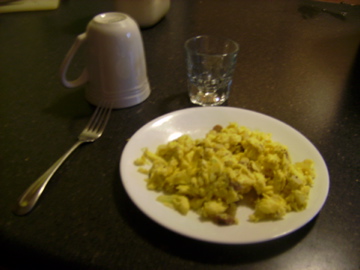
    Mark's:

    SANY0626

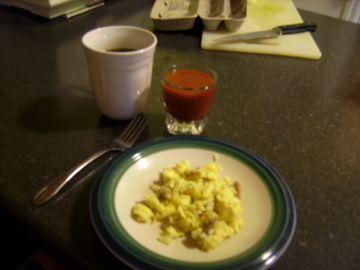
    Mine:

    SANY0625

    Four eggs scrambled in a tablespoon of coconut oil with a splash of half-and-half, a few tablespoons minced onion, one sliced sausage link, salt and pepper.

    Life's too short to eat plain scrambled eggs.

    I used the scale to divide it; I have one-quarter of the total.  (The comparison isn't perfect; my plate's diameter is smaller)

    Scrambled eggs is one of those breakfasts where I marvel at my smaller way of eating.  One boiled egg perched in an egg cup, next to a cup of coffee and a salt shaker, looks like a proper amount.  Scrambled eggs never look right except in a sprawling pile.  Mark's plate, above, still looks like the right-size breakfast for me.

    Which is why I use the scale.