bearing blog


bear – ing n 1  the manner in which one comports oneself;  2  the act, power, or time of bringing forth offspring or fruit; 3 a machine part in which another part turns [a journal ~];  pl comprehension of one’s position, environment, or situation;   5  the act of moving while supporting the weight of something [the ~ of the cross].


  • Gluttony: a definition.

    From the Catholic Encyclopedia (yeah, the old one) at New Advent.  The whole entry is worth reading for its analytical clarity and conciseness.  According to the encyclopedia, people commit the sin of gluttony when they

    • use food or drink in such a way as to injure their health
    • use food or drink in such a way as to impair the mental equipment needed to discharge their duties 
    • eat or drink for the mere pleasure of the experience and for no other reason (though the reason may be implied rather than explicit)  

    The sin is venial unless your gluttony interferes with your grave obligations to God, self, and others, in which case it becomes mortal.   

    Here's a nice quote:

    The moral deformity discernible in this vice lies in its defiance of the order postulated by reason, which prescribes necessity as the measure of indulgence in eating and drinking.  This deordination… may happen in five ways: … too soon, too expensively, too much, too eagerly, or too daintily.

    I am an instinctive list-maker, and I love the catalog of five ways to be a glutton.  It's even cooler in Latin.  

    It strikes me that a common mistake is to assume that "necessity," the measure of indulgence according to the quoted material, refers only to the nutrients required to sustain physical and mental health.  Eating serves social purposes too, and so the "necessity" that measures indulgence also should include the necessities of charity, faith, and other virtues.  

    In some cases "necessity" means less than what we need for physical health; for example, in times of scarcity "necessity" may mean going without so that someone else may have some.  And sometimes "necessity" means more than what we need for physical health:  graciously accepting  a portion of a homemade dessert, for example, is the proper and charitable response to the gift.  


  • Reasons to eat or to fast: The biochemical, the social, and the cognitive.

    I’ve been exchanging a couple of emails with Jen of Conversion Diary about intentional eating.   She mentioned to me that she wanted to explore the difference between gluttony and addiction, and I thought I’d think about it too — it sounds like a worthy distinction to make.  

    But as I prepared to think and write about gluttony and addiction, I realized that first you need to distinguish all the different reasons people eat.  They fall into three classes, I think.  Let’s start by listing the reasons people eat or fast.

    What drives us to search for food and to eat?

    (1) Hunger — that stomach-growling empty feeling, the “I could eat anything” feeling.  We feel it in our stomach, but apparently it’s not triggered merely by emptiness; insulin is involved, and the fuel available for cells.  Hunger is said to disappear, or at least to become tolerable, after a couple of days of fasting, or after a couple of days on a low-carb regimen.

    (2)  Cravings — the obsessive desire for a particular food or class of food, independently of whether one is experiencing hunger.  I experience cravings as fatigue, mental fuzziness, anxiety, or distraction coupled with an intense certainty, borne of experience, that if only I eat something I will feel instantly better.  

    (3) Social eating signals — Various social and cultural signals that one might not even notice:  for example, at a party where everyone else is eating, one might absentmindedly eat as part of being social.

    (4) “Should” — The cognitive belief that one ought to eat, independently of hunger or cravings:  for example, eating now because there might not be enough food later, or eating a serving of vegetables because you believe they promote health, or eating dessert so you don’t hurt someone’s feelings.

    What stops us from looking for food and eating?

    (1) Satiety —  not the absence of hunger, but a positive signal of fullness or “enough”-ness that creates almost a revulsion towards the idea of putting more food (or more of one particular food) in one’s mouth.

    (2) Not-eating signals — Social and cultural signals to stop eating, signals we might not notice we’re responding to:  we stop eating because the party has moved on to the after-dinner coffee and conversation.

    (3) “Shouldn’t” — The cognitive belief that one ought not to eat:  for example, one might stop eating in order to leave enough food for other people, or to avoid giving the impression that one is a glutton, or because you think eating too much will make you gain weight.

    Now let’s sort them into categories:   the biochemical, the social, and the cognitive.

    Hunger and satiety and cravings are three different drives, and I am convinced all three are biochemical.  It is possible to resist all three of them, but it’s difficult.  Scratch that, it’s not strong enough.  Resisting hunger, satiety, or cravings creates suffering; we can’t know how badly other people suffer, and I think it’s charitable to assume that many people literally cannot tolerate the suffering of resisting those drives.

    The drive to obey social and cultural signals for or against eating are, I assume, programmed into human beings and other social animals.  Exactly how those signals are conveyed is going to vary from group to group, and I am sure there are some attachment theorists or anthropologists who could write about it much better than I can, but I think I can sum it up as an unconscious drive to do what’s expected of us — including to eat in the way that we’re expected to eat — and thereby remain in the good graces of the group.  

    “Shoulds” and “Shouldn’ts” are cognitive, and I assume they are the exclusive domain of human persons:  this is where we exercise our intellect and our will to affect our behavior.  


  • Insulin and my weight loss: Did the hard work BEGIN or END the day I started to lose weight?

    One of the behaviors I cultivated to help me lose weight was the obsessive reading of diet books, looking for new potentially helpful behaviors to try.  The latest is Gary Taubes’s Good Calories, Bad Calories, and it is a doozy.

    This book digs very heavily into the research that challenges the low-fat diets and recommends low-carbohydrate (or at least restricted-carbohydrate) regimens, and it is unusually heavy on the biochemical details.  I have a scientific but not biological background, and I thought Taubes did a fantastic job explaining some complicated and subtle stuff.  

    For example, there is a chapter in which he explains that, while it is simply and  mathematically true that storage of energy = calories in – calories out, this does not mean we should assume that “overeating and/or inactivity causes weight gain.” It  could instead be true that “weight gain causes overeating and/or inactivity” or into “some other thing causes weight gain, overeating, and inactivity.”   I was skeptical when I read this — Occam’s razor seems to recommend the first hypothesis, you know?  But a presentation of the evidence convinced me, if not that the other hypotheses are certainly true, that they are not unreasonable or overcomplicated, that they are worthy of study, and that they do a better job of explaining the clinical evidence than does the simpler one.

    I’ll do my best to sum it up in the next few paragraphs.  The extremely simple version of the hypothesis is that, leaving aside social pressures unique to humans and varying across cultures, which Taubes doesn’t really cover, elevated insulin drives all three terms in the equation.

        – Insulin drives overeating: high insulin levels in the blood stimulate hunger, suppress satiety (which is its own set of signals, not the absence of hunger), and stimulate cravings for carbohydrates (which are not the same thing as hunger and are sometimes called “emotional eating.”) All of these things drive people to eat, certain foods in particular; and some individuals experience severe suffering when they cannot or will not satisfy those drives.  

       – Insulin drives inactivity:  high insulin levels in the blood induce fatigue, apathy, and sometimes depression — except after a meal when there is plenty of blood sugar around.  (Add to that humans’ ability to learn from experience and you get another feedback loop that drives eating:  I feel depressed, sluggish, and anxious, and I know if I have some carbs I’ll feel better instantly.)

        -And insulin drives fat storage:  It stimulates muscle cells to burn sugar instead of fat. it speeds up the chemical cascade that splits blood triglycerides into fatty acids that fat cells can absorb and that links them back up into triglycerides that fat cells can hold onto, while it slows the opposite cascade that splits up fat-cell triglycerides into fatty acids that can escape into the blood to be carried to cells for burning.

    (That bit about speeding up and slowing down the rates of opposing processes is an insight that helps me, as an engineer, adjust my mental model of metabolism:  There are more unit operations, and more rates to keep track of, than I realized.  We’re all used to thinking of the fat in our fat cells as a long-term store, mobilized only in the event of prolonged hunger.  But radioactive tagging studies seem to show that the fat in our gut, blood, and fat cells mixes and moves about constantly.  Our bodies burn glucose sometimes and fat other times, and it changes on a minute by minute basis, all orchestrated by insulin.)

    Recall that I’ve been thinking of myself as a recovering glutton.  As I read through the book, I felt a little bit disturbed.  Taubes is obviously interested in showing that gluttony isn’t the cause of obesity, that biochemistry drives people both to gain weight and to feel hungry, to crave and to eat.  He even presents some evidence (from rat studies) that in some cases it’s not even possible to lose fat by eating ZERO calories — obese rats with certain metabolic conditions will die of starvation, if you take away their food, before they can lose much of their fat.   Is he trying to excuse people from the idea that their behavior matters?  Does willpower play NO role at all?  Is there no hope that the opposite of gluttony — the virtues of temperance, fortitude, and self-control — can reverse the problem?

    I felt that the very last chapter, on hunger and satiety, resolved some of that question.  The resolution comes in thinking of hyperinsulinemia (background high levels of insulin) as a state of physical addiction.   It’s a bad feedback loop:  easily digested carbohydrates raise the background level of insulin and blunt the cells’ response to it, while the high insulin level creates hunger and a craving for easily digested carbohydrates, plus suffering when the craving is resisted.  

    Addictions are hard to break, and sometimes you get addicted through no fault or no conscious fault of your own.   Willpower and hard work is sometimes not enough to break an addiction; compassion and outside help go a long way.  And yet… addictions CAN be broken through hard work, through the voluntary acceptance of suffering, through decisions of the will to forgo temporary comforts.    We are human, and we are able to use our intellect and our will to decide how to respond to the signals our body sends us.  With good information and enough strength from inside or outside, we can make good choices even in the face of apparently intolerable pressures to make bad ones.

    There were two things in this book that particularly resonated with my experience.

    First was the diet prescribed by Margaret Ohlson, whose female patients achieved remarkably successful weight loss (about two pounds a week, if I remember right) with moderately restricted calories and moderately restricted carbohydrates.  Those patients were eating 1400-1500 calories a day, of which about half the calories were from fat, a quarter were from protein, and a quarter were from carbohydrates.  The reason this resonates with me is that this is pretty much what I happened to be eating during my weight loss.  The only thing I was trying to control was calories, but I measured and recorded fat/protein/carbs too.  I ate what I felt like eating, controlling only the total calories, and apparently I felt like eating  50% fat, 25% carbs, 25% protein.

    I guess that’s technically a low-carb diet.  Did I give the impression I had abandoned low-carbing?   I wasn’t trying to eat low carb, in fact I felt that I was enjoying plenty of carbs, and maybe I gave the impression that I had abandoned the low-carb thing; but understand that over the years my perception of an appropriate amount of carbs has dropped considerably, and when I “freely” consume bread or pasta or rice I still don’t tend to eat more than a few servings a day.  

    Here’s the second thing that resonated with my experience.  In the last chapter, Taubes quotes a clinician who successfully worked with obese children.   That clinician observed that in his patients the craving for sweets and easy-to-digest starches — though not the intolerable hunger — persisted for a year to eighteen months while the patients followed a diet that restricted their carbohydrates.  But at some point, the cravings ceased, apparently quite abruptly.  He said that his patients could identify the one- or two-week period when their cravings ceased.  Their background insulin level, itself stimulated by a background level of constant carb-nibbling, had slowly healed itself and dropped to normal.  

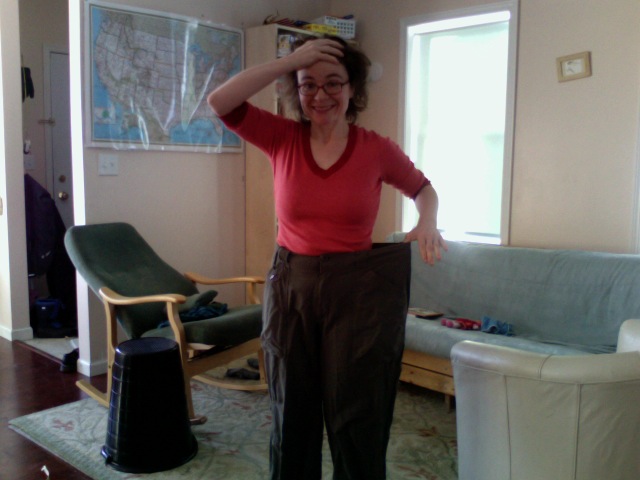
    The day I woke up and said I was ready to try being hungry was May 13, 2008.  MJ was twenty-one months old.  I had been trying, with what felt like no success at all, to stick to a truly low-carb diet since a few months after she was born. 

    So.  Maybe the reason I was successful “this time” was all that long, hard work with nothing to show for it that preceded it.  I wasn’t losing weight, but maybe — maybe — I was slowly healing inside.  Maybe May 13 was the day I was first cured.  With no addiction and no bad feedback loop, and a reasonably healthy and moderate diet, it became… not all that tough.

    I feel better about this possibility.  You’d think I’d feel better if I could congratulate myself on having finally developed the virtues of fortitude and self-control, but really, I know myself, and I know that I am not any more virtuous than I ever have been.  Still, I also know that I worked hard for a long time, and that I worked hard against something that was truly difficult.  But it feels more correct to say that the hard part of the work perhaps ENDED, not BEGAN, the day I began to lose weight.

    [Editing note.  Years and years later, I wish I’d done a better job distinguishing gluttony from other problems with food, like clinical eating disorders and other kinds of compulsiveness.  

    I want to emphasize that, whereas I identified some behaviors in myself that probably qualified as self-centered gluttony in the technical sense, I am not and never have been qualified to make that distinction for anyone else.

    I hope to add some commentary to all the posts that have this problem as I find the time to review them.  Here’s a more recent post where I acknowledge some of the problematic material I wrote and set new ground rules for myself going forward.]


  • Another kind of food goal.

    Jen at Conversion Diary has set a new food goal for herself:

    Thursday morning I was an angry, bitter troll of a person; Friday morning I felt calm and peaceful and was able to take it all in stride and count my blessings. And what I ate in the hours beforehand had a lot to do with it.

    These two examples are consistent with what I have observed over and over again in the past month. I have realized that my tendency to sin — to lash out, to indulge in self-centered behavior, the think angry or uncharitable thoughts, to turn away from God — is tremendously impacted by my diet. Eating healthy won't make me a saint, of course; but it will remove a lot of the mood fluctuations that leave me extremely susceptible to temptation to sin.


    Now that the option of weight loss has been taken off the table, I'm left to approach my relationship to food with a completely different state of mind. I'm left to pray not about how I can lose that last 10 pounds, but about how I can find the foods that will give me energy and stamina to lose some bad spiritual habits. My motivating visual now is not the image of me in a beautiful dress, but the image of me in a beautiful state of mind.


    Now that strikes me as a fantastic set of goals — goals that can be met and gratified many times each day.


  • Witness.

    The pool at the YMCA wasn't unusually crowded this morning.  Maya the lifeguard, walking the deck, waved hi when I arrived.  Her sister, a swim instructor whose name I can never remember, was there too, swimming laps.  The preschool lessons hadn't started yet.  A couple other instructors, still in street clothes, gathered around the lifeguard's chair chatting.  A heavily pregnant woman swam slowly in one lane.  Two women and three men, African-American and stylishly dressed, were seated on the benches where parents watch their children's lessons, leaning toward each other and talking earnestly and quietly.  Workers were cleaning the sauna room, adding a piney disinfectant scent to the air.    A couple of people were relaxing in the hot tub.

    Something about the women and men on the benches caught my attention as I started my swim.  Maybe it was just unusual for people in street clothes  to be sitting in that spot unless they were waiting for someone in the pool, and I couldn't really connect them to anyone else.  I shrugged it off, kept swimming, and forgot about them.

    But about thirty minutes later, when I surfaced after my interval set for three minutes' rest before doing my timed 50-yard sprint, the young woman and the young man — perhaps they were in their late teens or early twenties — had shed their street clothes.  The girl was standing waist deep in the pool and one older man was with her, his left hand on her back and his right hand upraised; he was speaking quiet and quick words that I could not hear.

    No one else was looking at them.  

    It seemed I couldn't just dive in the pool and ignore what I was about to see.  I raised my corrective goggles up off my eyes — the scene brightened and blurred, but I felt more appropriate.  The water drained from my ears and I suddenly heard singing — the older woman, in her scarf and attractive jacket, was smiling and singing to the young woman — over and over… something like "I been down in Jesus' name," or maybe it was "I bent down in Jesus' name,"  or maybe that wasn't it exactly, but that's what I thought I heard.  

    And the man in the pool grasped the girl's hand and dipped  her, like a dancer, backward, and she was baptized.

    No one else seemed to notice them.  The instructors went on chatting.  Maya went on walking the slow circuit around the pool.  The pregnant woman went on swimming.  The maintenance workers went on scrubbing the sauna and filling the air with the scent of pine.  I stood transfixed.

    She came up out of the water, and the older lady and the man clapped and hugged her and handed her a towel, and the young man walked down into the water.  Again the lady sang softly, again the man in the water raised his hand; and the young man went back down into the water and came up again.

    No one else seemed to notice them.  They took no notice of me, not that I could see, or of anyone else there.  
    Up the men came out of the water.  All five people gathered for a moment in a circle, holding hands, heads bowed.  The young people and the preacher left through the door to the locker rooms.  The woman who had been singing picked up her bag and left through the door to the lobby.  The remaining man walked a few steps toward the door, pulled a cell phone out of his pocket, dialed a number and sat down on another bench, gazing into the middle distance the way people do when they are waiting for someone to answer.

    I slipped my stopwatch ring onto my finger and dived into the pool.  The water slipped freezing cold over the back of my neck and my shoulders. I swam several strokes before I remembered I was supposed to be swimming fast, but by the time I arrived back at the shallow end I'd made up the time and shaved another second off my personal record.  

    The benches were now full of parents tugging winter jackets off bathing-suited preschoolers.  The instructors were gathering floats and water toys.  The people I'd seen before were gone.

  • Fingers.

    Since the weight loss, my wedding band keeps falling off.  I don't want to get it resized for a few months, though, because my rings are always looser in the winter and I'm afraid it'll be too tight in the summer.  

    It finally occurred to me to move the band temporarily to another finger.  It fits on my right index finger pretty well, so that's where it is for now. 

    Orthodox-Jewish style!

    …the groom steadies his trembling hands enough to slide the ring on his bride’s finger. Like the Torah that was figuratively given “from His right hand” (Deuteronomy 33:2), the groom presents the ring with his right hand. 

    A thoughtful bride will extend her right index finger to guide the overwhelmed groom. One reason a ring is placed here is because it is easier for the witnesses to see the ring when it is placed on the index finger. 

    Counting from the pinky on the left hand, the right index finger is the seventh, like the seventh day of creation. Rabbeinu Bachya adds each finger is linked to one of the five senses: pinky for hearing, ring finger for sight, middle finger for touch, index finger for smell, thumb for taste. The sense of smell is associated with sexuality, which finds its holiest expression in marriage. 


    I'll see if this helps me smell better.  Um, you know.


  • Tactical error.

    We were picking up the living room and I was humming to myself for no reason.  Oscar asked "What's that song?"

    I said, "Oh, uh, it's from a musical called Annie Get Your Gun."  I sang out loud, "Anything you can do I can do better, I can do anything better than you."

    "I like it," he said.  "Can you teach me?"

    "Well, here, let me see," I said, and with a few clicks brought up a clip.  We watched it and the children were highly amused.

    Of course you know where this leads.

    Right now all three of my children are running around having musical shrieking contests.


  • Bewildered.

    Typical of me:  when I'm not sure what to do, find some numbers and turn them magically into a piece of "new"  information.

    In the last two months of my weight loss, the loss rate had slowed to three-quarters of a pound per week.  This means that, by the end, I was running a deficit of about 375 calories per day.  So, I guess, it's that 375 calories I'm trying to fit back into my diet — not the 875 calories I feared earlier this year.  Right at the end I added 30 minutes of running to my weekly exercise plan.  That's not so much divided over the week, but it might bring the total number of daily "extra" calories up to 400.

    I am still failing to track properly, failing to make observations, and so I still feel bewildered and without a map or a plan or a new set of established habits.  Sometimes I have a bedtime snack and sometimes I don't.   Sometimes I eat a big breakfast and sometimes I don't.  Sometimes I have seconds and sometimes I don't. Sometimes I eat when I feel a little hungry and sometimes I don't.  And every time I have one of these extras I disappoint myself, because I haven't exactly proved to myself that I can "safely" do it.  Yet I am resisting doing the work that would establish what I can and can't do.

    Nor is my old mantra of "don't be a glutton" helping me out anymore.  It seems that I can either be a glutton or an anorexic.  I can't seem to feel right, or at peace, about any amount.  If I finished my meal a little hungry, I can't stop thinking about eating more food.  If I finished my meal a little overfull, the remorse lasts until I digest it.  

    Maybe I'm still a little giddy at being "allowed" to eat more or less like a normal person.    Maybe I should (while continuing to weigh, so that I can intervene with calorie control if necessary) just allow myself a little bit of a honeymoon, until the holidays are over and my food choices become more predictable, and then I can try the lengthy series of experiments and observations that will help me figure out my lifetime eating plan.  

    It's just not happening right now.

    But the weight is still  on track.   I spent two days in the "too low" range and no days in "too high" mode over the last three weeks, the rest of the time staying in my maintenance range.  The data shows I'm doing something right!  

    But I don't know what it is!   

    Weird.


  • Grades.

    Up till now (my oldest is in third grade) I haven't given "grades."  State law doesn't require them.  Rather than bothering with evaluations, for the most part, I've followed the algorithm of "don't go on unless you're sure the material is adequately mastered."  So the answer to "how's he doing?" is simply "what have we studied?"  How much of the math book have we finished?  What books we have read together?  Etc.

    This has to change at some point.  

    By the time they reach high school level, I want my kids to have something that functions as a transcript.   I don't want it to be a meaningless piece of paper that I produce simply to satisfy the bureaucrats; I want it to be a good-faith effort to evaluate my children's accomplishments, as objectively as any teacher can.

    This means that in the next five years or so, before my oldest enters 9th grade, I have to learn the habits of issuing shorthand evaluations of work, from day to day and from quarter to quarter.  

    It's tempting to think that the whole point of grades is the paper they're printed on, that the main purpose of grades is to classify children:  this one should go to college, this one shouldn't, this one is worthy of a scholarship, that one should major in English, this one should major in engineering, this one ought not be allowed to advance to the next grade.   

    But the primary purpose of grades is to serve learning.  So my most important task, in designing and using a grading system, is to teach my children the appropriate response to evaluation of their work.
      I want my child to see his grades, understand what that means to his learning, and adjust his work as necessary.  How best to do it?  

    Let's begin with the end in mind.  Forget "A-B-C-D-F."  Forget "pass-fail."  Forget percentages.  Forget "satisfactory-unsatisfactory-incomplete."  Forget plus/minus.  What do I want my child to do when he sees his "grade?"

    • If he's turned in work that's sloppy or incomplete, or if he's neglected clear instructions, I want him to re-do the work.
    • If he hasn't learned the material, I want him to return to it so he has another chance at learning it.
    • If his work is satisfactory and he has learned the material, I want him to continue working as he is, without changing his habits.
    • If he's demonstrated special insight or special diligence, I want him to know that I've noticed his extra effort.  I want him to know that he's demonstrated excellence and that he can strive to accomplish greater and greater things, if he wants to.
    If you begin with the desired responses to evaluation, it's easy to see that (unlike with standard "A+" stuff) "perfectly correct" work does not necessarily earn the so-called highest grade.  It's also easy to see that the so-called highest grade must, almost by definition, be communicated fairly rarely.

    With these in mind, I tried to distill "grades" down to five possible messages I can send my students:

    "You have correctly and carefully completed the assignment.  I am satisfied that you have learned the material."

    "You have carefully completed the assignment, and there are only a few errors.  I will be satisfied that you have learned the material when you have fixed the errors and can assure me that you understand where you went wrong."

    "You have carefully completed the assignment, but you have made many errors, or else you have made a few very fundamental errors.  I see that I have not adequately taught you the material.  I will re-teach the material and give you another assignment."

    "You have completed the assignment carelessly or sloppily, or you have not completed the assignment.  I cannot be sure that you have learned the material, and I see that you must be reminded of the importance of completing your work with care and diligence.  You must re-do the assignment and turn it in again."

    "You have correctly and carefully completed the assignment, and your performance demonstrates a deeper understanding, greater insight, or more diligence than I expected.  Not only am I satisfied that you have learned the material, I want to let you know that I noticed your achievement.  Remember that you have done this; it is my hope that you always strive to produce work of this quality."


    So each of these is, sort of, a different "grade."  I don't really think of them as being in a particular hierarchy of order; each is meant to instruct the student in a next action.  By the time they finish high school, students need to learn to self-evaluate and to adjust their study and work in response.  I hope this kind of "grade" teaches those skills.  When high school rolls around I can use a more traditional method to produce a normal-looking transcript for the bureaucrats.

    Clearly I can't write these paragraphs across the top of every assignment, nor record them in a grade book.  I need a shorthand — a single symbol or word that can be used for records or communication — for each.  I'm reluctant to use ABCDF because (1) they imply a linear hierarchy that's really not there; (2) I want to emphasize not "how you did" but "what I want you to do about your learning;" (3) I want the symbol to intuitively represent the message I want to carry, so the student doesn't have to keep consulting a key or legend to find out what I meant.

  • Redefinition of terms.

    It's common to dismiss numbers that prove somebody else's point as "lies, damned lies and statistics."  

    That kind of flip refusal to engage with data is a sure sign of someone who doesn't want to think too hard.  Or someone who is deeply suspicious of anything that looks like math.

      Numbers are numbers.  If they're properly gathered and accurately reported — that's key of course — they just don't spin, obscure, imply, connote, the way that the English language can.  Obviously people are tempted to emphasize numbers they like and downplay numbers they don't like, say, in press releases and things like that; but if you take the time to go back and look at the source data, and get to decide for yourself which numbers are important, you can get at something approaching truth.  

    So I reject the glib "statistics = lies" equation. 

    But then something comes along that makes me want to title a post "Lies, damned lies and statistics."  James Taranto reports:

    Amid all the gloomy economic news, the New York Times brings us an encouraging report on social trends:


    "The number of black children being raised by two parents appears to be edging higher than at any time in a generation, at nearly 40 percent, according to newly released census data. . . .


    "According to the bureau's estimates, the number of black children living with two parents was 59 percent in 1970, falling to 42 percent in 1980, 38 percent in 1990 and 35 percent in 2004. In 2007, the latest year for which data is available, it was 40 percent."


    What accounts for the turnaround? The Times explains:


    "Demographers said such a trend might be partly attributable to the growing proportion of immigrants in the nation's black population. It may have been driven, too, by the values of an emerging black middle class, a trend that could be jeopardized by the current economic meltdown.


    The Census Bureau attributed an indeterminate amount of the increase to revised definitions adopted in 2007, which identify as parents any man and woman living together, whether or not they are married or the child's biological parents."


    The problem of illegitimacy and broken families had seemed intractable for decades, but the Census Bureau has been able to make a significant dent in it, at virtually no cost to the taxpayer, merely by redefining the word parents.


    I have to remind myself that it's not the numbers that are lying.  What's wrong here are definitions.  Which has to do with language, with words.  

    Although it's a handy reminder that language and mathematics are perhaps inextricably combined.  For isn't classifying items into sets a basic operation of mathematics?  And how do you do that without naming them?

    In any case, shame on the NYT for reporting the "good news" uncritically in the lede, and burying deeper in the story, with almost comical understatement, the sleight-of-hand,  the redefinition of terms — a really heinous one, a damned lie if I ever saw one.
    (One hopes that the Census Bureau was still asking the right questions, so that the numbers are in fact there, somewhere, buried in the data, and that it was only in turning the numbers into the words of a press release, of a report, that the fudge occurred.  Otherwise — if all they asked was, "is there a man and a woman residing at the same address as this child?" — we'll never know, will we?)

  • Stomach-turning line in the middle of an article I expected to be good news.

    I'm not sure what was the point of including this gem from good old Arthur Caplan in part of the discussion about the so-far-successful facial transplant announced this week by spokespeople for the Cleveland Clinic.

    Because the procedure is reconstructive, and not technically life-preserving, while carrying significant risk, there is legitimate reason to raise questions of ethics.  (I come down in favor of informed patient choice here, especially as the techniques improve — no one seriously challenges the ethics of reconstruction for, say, mastectomy patients; the director of a Catholic bioethics institute is quoted, and disagrees with me.)  But really, is this the best that CNN could do?

    Bioethicist Dr. Arthur Caplan, chairman of the University of Pennsylvania's Medical Ethics Department, said Wednesday on CNN's "American Morning" that he initially had similar qualms about the facial transplant, which improves the quality rather than saving a life, but was gradually persuaded.


    People with major facial disfigurements "don't come out and basically stay at home and have a huge suicide rate," Caplan said. "They're really up against it."


    He said patients should be given an out if their bodies reject the transplanted face and are forced to live in a life of pain where they're unable to breathe or eat on their own.


    "I think you have to go in here saying to the person who tries this, 'If you get in that situation, we would be willing to either not give you treatment that would keep you going, or maybe give a lot of morphine to push you out of the picture to help you to die,' " he said.


    He added, "I know it's a radical thing to say [but] imagine living with no face."


    Caplan said he was "talking about potential suicide as an option if the surgery doesn't work. It's not something that anybody has said, that I've ever said before. But I think the misery involved and the failure here is almost unimaginable to ask someone to keep going on and on that way."


    Cheer up!  If your facial reconstructive surgery fails, you can always kill yourself!  


    Because if bioethicist Arthur Caplan thinks your life isn't worth living, then science has proven it's not.