bearing blog


bear – ing n 1  the manner in which one comports oneself;  2  the act, power, or time of bringing forth offspring or fruit; 3 a machine part in which another part turns [a journal ~];  pl comprehension of one’s position, environment, or situation;   5  the act of moving while supporting the weight of something [the ~ of the cross].


  • Lifestyle lessons.

    When I was about to come home from our family Europe trip three years ago, I listed some practices I wanted to bring back with me, so that our vacation would leave me permanently changed, if only by a little bit.

    And then there's the food. Since I have been here I have made a new vow at every meal, it seems. When I get home I am going to find a supplier of tiny sour French pickles and I will never again eat a ham sandwich without them. I will buy the beer at Surdyk's which is attached to the city's best cheese shop and I will find out if they sell Abondance and Tomme de Savoie, and I will make salads with fine ribbons of white, soft-rinded cheeses and twists of proscuitto. I will throw out all the bottled salad dressings and make only pungent mustard vinaigrettes and luscious cream dressings with herbs. I will buy a crêpe pan and an electric fondue pot, or at least a correctly-sized enameled cast iron saucepan that will hold the heat. I will buy the expensive butter, maybe not for the whole sticks that are melted to go into waffles, but at least to spread on my sandwiches. I will make pan sauces again with cream and wine.

    I know better than to think, even for a minute, that I have time to do much of the fancy sort of French cooking. But surely I have time to make my quick meals more civilized? With the good kind of canned tuna that is packed in olive oil? With better cheeses on my salad? With tiny, ice-cold glasses of fresh-squeezed grapefruit juice?

    I did take up some of those practices, and a few others, like starting family meals with "first course" when I can manage it.

    Will I take up any new ones this time around?

    I have some thoughts.

    + + +

    Food is always the first thing I think about, because you encounter it three times a day. I wish I could get greengages or Charentais melons, but they are a rarity. Anything more feasible?

    Well, I was reminded how much I like sparkling water with meals, and a couple of the kids learned they like it for the first time. I'm not sure if it's realistic to think we'll grace our table with fizzy water; it would be a pain to lug one more liquid home from the store. But it's something maybe to have more often. One of my cousins swears by a Sodastream, just for making her water bubbly. I'm a little worried that this would lead our family down a direction I don't want to go. On the other hand, you can make tonic water with one, too. I suppose I could just buy bottles for a while and see what happened.

    I have a new interest in Ligurian red wine: tart, a bit frizzante, pale so that it nearly looks like rosé. I guess I will look for some.

    I learned to make proper fondue savoyarde, and I think I would like to try it again at home; that is, if I can find the right cheeses and wine. The wine might be tricky, since I don't think much of it is exported; but perhaps I can find something close to the right balance.

    Another thing I learned: to make tuna sandwiches by mixing good tuna only with good mayonnaise, and spreading it on soft, not-at-all-crusty bread, with lettuce and tomato (maybe capers), and slicing the egg instead of mixing it in. The results are a bit more swanky and luxurious than my prior default tuna sandwich method, which involved diced onion and celery, lots of dill pickle relish, and sometimes a baguette.

    (I will go on making tuna melts the old way, I think, though, with English muffins and sharp cheddar cheese. Those are pretty hard to beat.)

    On the English side of sandwiches, I have decided to find a nice spicy chutney or two and squirrel them away in the fridge to have on buttered bread with more sharp cheddar cheese. And for drink: I was reminded of the superiority of Samuel Smith's beers. Some of these, I am sure I can find at home in Minneapolis: Taddy Porter, oatmeal stout, a bottled bitter. Maybe (I hope) the chocolate stout. "They're what, seven dollars a bottle?!" protested Mark, but I wouldn't drink them every day. Just some of the days, and I would share. Who knows, if I look high and low I might even find the apricot beer.

    Furthermore, I have seen the light: puff pastry has great utility as a carbohydrate delivery method, and I am resolved to learn how to make sausage rolls and meat pies.

    Also cheese-and-onion spread.

    Maybe mushy peas.

    + + +

    I don't know if I have any non-food sorts of things to take up. But I find myself wishing that we went away more often, maybe just for a weekend, to do things that are interesting or relaxing not so far away from home. I don't know how realistic that is. It seems easier to do one big trip than to find the time for multiple small ones; and many weekends are taken up by Scout trips, school planning, and necessary household tasks. But I would like to make it work, if it could work.

    Who knows what you are capable of as a family if you don't try?


  • Homeward bound.

    Friday morning the alarm went off at six. I made coffee and curled up on the sofa to write a blog post.
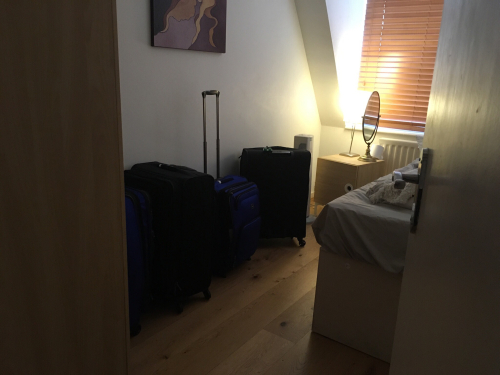
    Then it was time to finish packing. We cleared out a bedroom of loose items to make a staging area for “complete” suitcases. Beginning with the three rollers that we hadn’t touched since France: climbing gear, winter hats, and the like. They had only a little room left in them for odds and ends.

    We put the kids to work setting the apartment back to rights. Obviously we don’t have to clean it thoroughly or anything, but there is a certain amount of tidying up that (a) seems to be common courtesy and (b) is required if you want to find all your belongings in the corners.

    At the end we had time for a little relaxation, or at least to keep the smaller ones occupied while the rest of us finished up. Mark needed to repair a curtain rod that the 3yo had pulled down a couple of days prior.

    I shot a selfie in my traveling clothes.

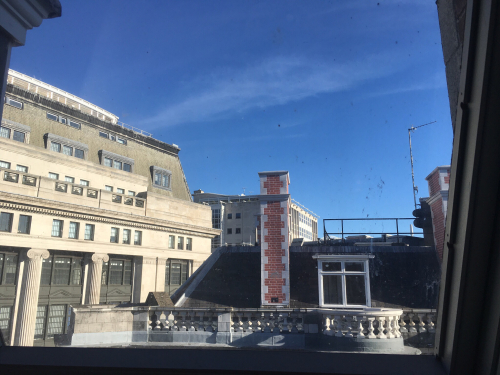
    And a couple more of the apartment: the view from the kitchen window of the lovely blue sky:

    And stepped out on the balcony into the perfect autumn day, and looked down at Bloomsbury Square:

    A van was coming to transfer us and our luggage to Heathrow. On our way back from the pub the other night, Mark and I had walked around the block that contained our apartment’s little pedestrian street, looking for a good place to wait for it. We found a sign that marked a spot as Loading Zone Only, just around the corner and across one street, and that didn’t specify who was allowed to load. So the teen boys worked to transfer the seven big suitcases and the backpacks and the car seats into a pile on the curb, one watching over the pile while the other went back and forth fetching bags.

    I gathered up the three smaller children, with the carrier and my tote crammed full of things I needed to take with me on the plane. I dropped my apartment keys on the little side table, the one with the selfie mirror, and went out the door and let it shut and lock behind me.

    + + +

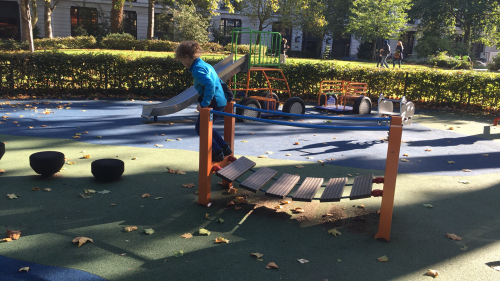
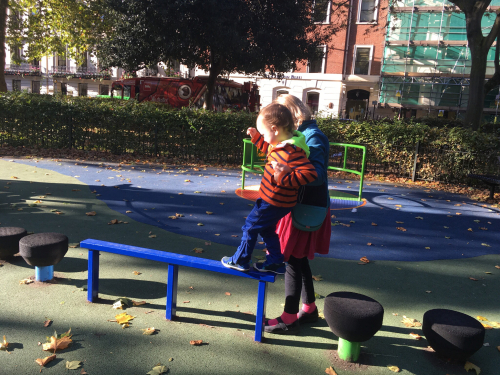
    The four of spent the waiting-for-the-van time in the tot lot at Bloomsbury Square Gardens.


    Then I got the text from Mark:


    We got in the van, and after a ten-minute standstill because of construction traffic around Bloomsbury Square, were off. I watched the neighborhoods slip away: Soho, Marylebone, Hyde Park, Acton, Ealing.

    Heathrow.

    We grabbed lunch in the airport at Leon, a Mediterranean-ish chain restaurant. My last English meal was thus a fish finger wrap.

    And a bottle of sparkling water. I am going to miss Sparkling Water Available Wherever Still Water Is Sold.

    And to the plane.

    + + +

    The three-hour hop to Reykjavik on IcelandAir was uneventful, except for a slight mixup in ticket-reading that had us rushing off the plane to make an impossibly short connection that turned out to actually be more than an hour.

    At takeoff for our six-hour flight to Minneapolis, despite the lollipops and sips of water I had at the ready, the 3yo appeared to be having Ear Problems. He shrieked, squeezed his eyes shut and shook his head “no,” and cried that he had a headache. And then, quite suddenly, he stopped crying, panted a bit with his eyes half closed, and fell asleep.

    It was maybe five or six p.m. in the time zone we’d come from, which is not a crazy time for him to be having a nap, so I let him. He slept for a few hours, then woke up cranky and refusing to eat the bag of crackers in his complementary IcelandAir kids’ meal.

    We went to and from the bathroom a couple of times. And then, with two hours left in the flight, he threw up all over himself and his carseat.

    I was relatively prepared! I had two changes of clothes for him and a lot of baby wipes. Mark switched seats with the 11yo to sit next to me and get help from the flight attendants, and we got him cleaned up, the seat cleaned up, a plastic bag for him to sit on so the damp seat wouldn’t be uncomfortable, and all the soiled clothes packed away in waterproof bags, and a pile of paper towels at the ready in case he got sick again.

    Then he threw up again, mostly but not entirely on the pile of paper towels that I thrust under his chin. More help from the flight attendants. I was glad for Mark talking to them, accepting towels and plastic bags, so I could attend entirely to my sad, sick, and uncomfortable little boy.

    How much easier a sudden crisis can be when another person frees you up to deal with the crisis by talking to the people who are trying to help, so you don’t have to waste any energy turning back and forth, adopting alternate positions of Crisis Management and Oh Gosh Thank You.

    + + +

    The third vomit was nothing left but bile, but I caught it in a plastic garbage bag that was ready on his lap for the rest of the trip. The 3yo said he felt better, and volunteered to walk on his own carrying his backpack. Through the customs line, until they took pity on us and invited us to the head of the line, he stumbled forward a few steps and then lay down on his backpack until we had to urge him forward again.

    Really sick and not just airsick? Hard to say. We’d been up for twenty hours and this was not all that different from his behavior in the UK customs line a couple of weeks ago, when he was entirely well.

    I texted a vomit warning to H., but she was unfazed. “We’ll risk it,” she texted back. And when the two cabs we hired made it to our street, our house was already lit and full of friends.

    I carried the sleeping 3yo straight up to bed, changed my clothes, and washed my hands really well before coming down to company.

    And food!

    Fish tacos!

    GUACAMOLE.

    Even a birthday cake.

    And milk, eggs, fruit, and English muffins for the morning.

    I ate, and the kids reconnected, and we chatted, and I settled into my chair with a glass of red wine from a box, and was happy to be home. And just as we started to flag, they packed up, said “Bye! See you Monday!” and went home, leaving us fed and ready for bed.

    The pile of held mail on the counter can wait, the suitcases can wait, the laundry can wait (even the 3yo’s backpack), for one night’s sleep to the sound of the ticking of the ceiling fan in my own bedroom.


  • Happy birthday.

    Thursday was my birthday. It was also, sadly, our packing day, with no outings planned because we expected a tube strike that in the end never materialized.

    I had planned to spend two or three hours shopping for gifts to take home, within walking distance of the flat. But Mark managed, unexpectedly, to get a slot for each of the teen boys to go driving at Mercedes World outside of London. So instead my shopping slot was moved to the afternoon, and he took the bus with the boys.

    Before he left I took myself out for a Full English Breakfast. At the last minute I switched my order to the vegetarian version:


    The little frittata is spinach and feta. It was nice, and more what I wanted than two kinds of meat wojld ve.

    I bought lunch things for the younger children and myself, and went back in time for Mark and the boys to leave. A little packing happened—and then I got a migraine! I took my medication, but had to nap for the next few hours. So it is just as well that Mark and the boys got their chance.

    + + +

    After they returned, pleased and with new Mercedes lanyards for their gym IDs or whatever, I supervised some more packing; and then around five o’clock I went out myself. I walked through Covent Garden, listening to the patter of street magicians, inhaling the aromas of food from the restaurants, looking in windows. I walked into a shop that sold Scottish wool scarves, I walked into a shop that sold kitchen gadgets, a shop that sold tea things, each time looked around, but kept on walking. I really didn’t have enough time to look and think and to find things I wanted, and Covent Garden seemed to be a bit pricey.

    I set a new course for Seven Dials. Here and there shops were closing. Some had closed at five, and nearly all the boutiques would be closed by seven. Looking in windows. Nothing drew me.

    I saw a sign for a vintage-clothing store. Well, you never know what you’ll find in one of these, and here I am in London, so I walked in. Men’s clothes on the left, women’s on the right. Dresses, mainly crepe floral. A pine-green cotton sweater dress with patch pockets, briefly considered. Then I went over to rifle through the small coat rack.

    Hmm. Real leather? Check the tag. Lining, acetate, outer, leather. Hmm.

    Sixty pounds? For a leather duster that fits me perfectly, in a color I like? Yes, please! Happy birthday to me!

    And then it was time to get dinner, and that was the end of my shopping trip. And that is why I didn’t buy any presents in London.

    + + +

    Our 17yo had gone out by himself to see the UK opening of the new Bladerunner movie, so the rest of us would be having our last-night-out dinner without him. At first I was disappointed that we would miss him, and it seemed wrong that there should be only six of us (although admittedly that would make it easier to get a table).

    Then I reflected that I was getting a glimpse of the not-too-far-off future when he would be gone for most all family dinners. I decided that today would be the first evening that I would begin learning about, and looking towards, that new dynamic that is coming, the dynamic where our second oldest is the oldest who is with us at the table. It will be a good dynamic, too, and it stands for good things. And—just like that—while I was still disappointed to miss him, it did not seem wrong anymore, but completely okay and right.

    “There are six of us,” I said to the waiter in the upstairs dining room of the Nag’s Head.

    + + +

    We had a pub dinner for our last night. Mark and I started with pints of stout and IPA. I think he will be glad, if nothing else, to get home and drink some craft beer with noticeable hops.

    The 7- and 11yo ordered lemonade that turned out to be fizzy, and two starters to split as their entree: a chicken basket (popcorn chicken, grilled barbecue wings, and fried wings) and a plate of battered onion rings.

    The 13yo ordered sparkling water, and baked meat lasagna that came in an individual casserole, with a green salad.

    Mark and the 3yo split a fish and chips platter, with mushy peas on the side.


    And I ordered a glorious meat pie on a mound of mashed potatoes, with broccoli and carrots and a lovely gravy, and a glass of red Tempranillo wine because by then my Guinness was gone.


    Austerity measures may be called for when I get home, but not on my birthday in London.

    + + +

    Still reading? Thanks for coming along with me.

    All that is left now is the trip home. And maybe a renewed blogging habit? We shall see.


  • Greenwich. And more pints.

    Wednesday was to be our last full vacation day. Much of Thursday we expect to be spent packing our suitcases and restoring the London apartment to a condition fit to relinquish the keys. Plus we expected a Tube strike Thursday. We decided to head to the cluster of attractions in Greenwich.
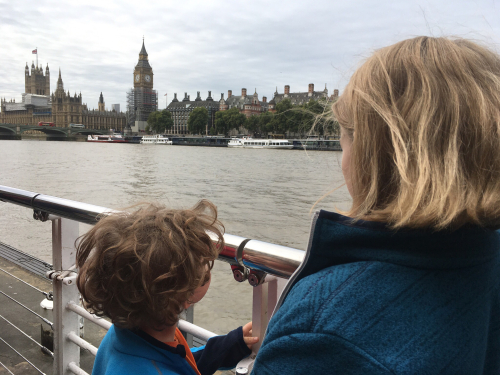
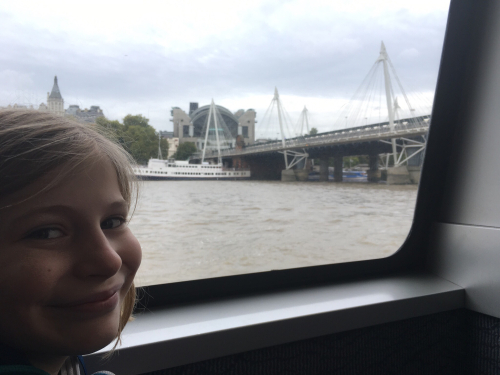
    The transit itself can be part of the attraction. We went by Thames Clipper; these ferries use the Oyster Cards just like a bus or subway. We had a twenty-minute wait on the pier, but it passed quickly as we looked at the skyline and chatted about our experiences.

    Once on the boat it was a relaxing and interesting ride for everyone. The 3yo, on my lap, was very pleased to be sitting in the front corner of the ferry, where he had an excellent view of a looped rope being tossed and tightened to secure the boat to the pier each time it stopped.


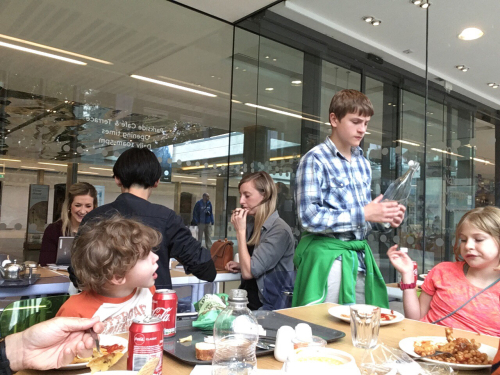
    By the time we got to Greenwich, it was well lunchtime. We looked in a couple of restaurants in the village, but decided that we were likely to pay about the same, and more efficiently, by eating at the museum café. So straight to the National Maritime Museum we went.

    The approach has a long trough of running water coming from each side and meeting at drains in the middle. It would be a good place to sail a paper boat. The children threw autumn leaves in it to amuse the 3yo.

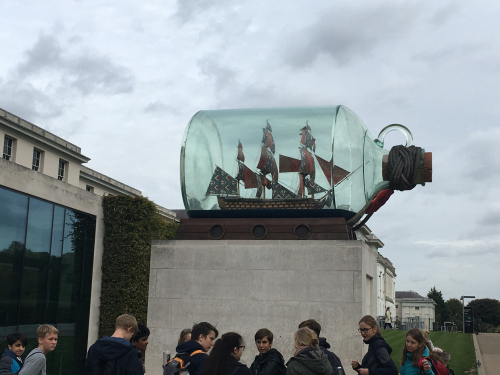
    There is also an impressive ship in an impressive bottle inside. The 7yo was fascinated by the concept. I wonder if anyone has ever built a LEGO ship in a bottle?

    Museum cafés don’t seem to cost significantly more than regular restaurants here in London, especially if you factor in a small tip. The cafeteria format makes it easy for the littlest verbal children to choose what they want. There are often tables large enough to accommodate our entire family. They are located right where we want to be. And the food has been reliably good.

    This one had cold sandwiches and salads, paninis that could be heated on request, and a small hot bar with a child’s plate, two plates of the day, and soup. Also, as at the Tower of London, you could put together a child’s box lunch out of a small sandwich, a bag of chips, a juice box, and two cold sides like gelatin dessert or grapes.

    Three kids got the £5 hot child’s plate of breaded chicken, fries, and English baked beans. Two teen boys got fat individually-baked casseroles of beautifully browned macaroni and cheese. I got a cold veggie wrap filled with greens, crunchy pickled carrots, and some kind of red-pepper-and-hummus-like spread, plus tomahto soup. And Mark got a plate of hot salt beef brisket with potatoes gratin (not the cheese kind, the buttery baked kind) and chunks of roasted carrots.

    I am going to miss the universal availability of bottled sparkling water. Everywhere there is bottled water, there is sparkling water for the same price as still.

    Satisfied, we went to see the Maritime Museum. Prince Frederick’s barge:

    A turning paddle wheel:

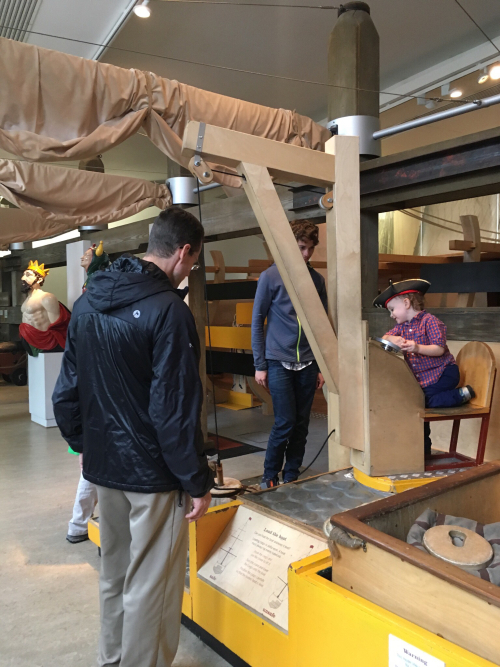
    There are two children’s areas in the museum, but unfortunately the one with a big play structure was closed. This “children’s gallery” was just about as good, though. It contained fun activities but also items exhibited here in their own right, like real cannons and cannonballs and rigging equipment. Our three younger kids were in their element, but the teens enjoyed it too.

    There’s a ballistics simulator with a cannon you can raise with a crank or turn on a turntable to shoot at a faraway island. If you are 13 and not 3 you can learn from your error and correct the trajectory until you win the game. If you are 3 you can turn a big wheel and make it go “boom.”

    Or you can find a Jolly Roger hat and use a crane to load bags of hemp and wool onto a boat.


    Extraction from the children’s area finally accomplished, we managed to see some other exhibits before moving on. The Nelson exhibit was cooler than I had expected. My favorite part was an interactive screen that showed the ship movements in the Battle of the Nile and the Battle of Trafalgar. I am fond of military history and strategy, even though I have nevr had the time to dig into it as much as I would like, and I appreciated being able to step the ship movements forward and backward in time while zooming and rotating the map. Something like that makes it so much easier to see how command decisions interact with the geography and with each other. It is really far better than reading.

    Maybe it’s actually the geography that interests me. The landforms and waterways we can still see today, and how people moved in them once upon a time. How we have changed the landscape and what the consequences will be. Geography and humans together. Battles are just a very rapid and intense kind of chapter in that same story.

    But the technology is part of it too. So battles, writ large, are a story of goals and motivations and planning and strengths versus constraints, costs and benefits. If you forget about the pain and suffering (and the simulator does; but examples of that are in the next case over) it’s an engineering problem, or a game. Which way to think about it when? Should it always be both? One or the other? Or neither?

    + + +

    Through some windows in the Maritime Museum you can see a wide swath of green grass, now littered with leaves from the trees that dot it, criscrossed with walking paths, and sweeping up a high hill. Speaking of battle geography, and having just come from the castle-studded Aosta Valley not long ago it would be entirely unsurprising to my untrained eyes if the top of the hill were crowned by a fortress to watch over the flow of the Thames. But of course the sight of the base of that grassy hill thrills me not because of its military value, but because it is the site of the Observatory.

    It is a rather long climb up the hill. Once you are up there it is obvious why the observatory is there. It is the tallest thing around.

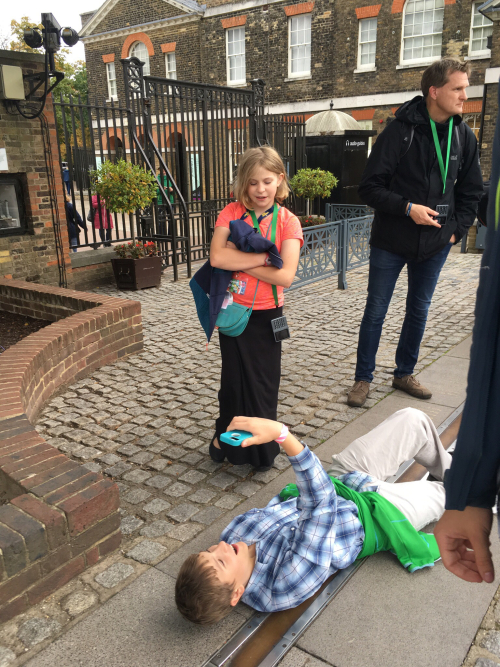
    The children all had to take selfies at the Prime Meridian.

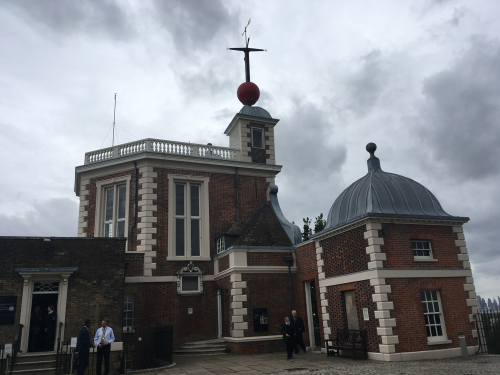
    Then we explored the Observatory itself. Many of the instruments are still in place, including the one that was used to fix the meridian.

    We had a moment of sympathy for poor Halley, who had one of the loveliest monuments in Westminster (placed on the occasion of one of the comet transits) but whose meridian, marked at Greenwich by a strip of metal on a wall, didn’t win the day. But perhaps we should have more sympathy for the pavement-layers, because the marked meridian is inaccurate too, thanks to imperfections in the plumb-line method given variations in gravity. The GPS-measured prime meridian is about 100 meters away, and as of this writing, still unmarked.


    There’s a working equatorial telescope (the kind that you can set to compensate for the rotation of the earth so you can take a good photograph of stars). In the winter it’s possible to come and look through it on special astronomy nights.

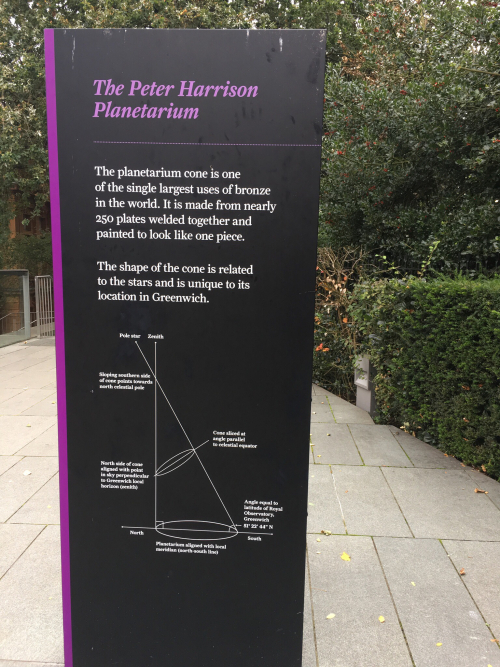
    And there’s a big planetarium.


    We could have stayed for the next show, perhaps, but Mark had other plans. The Cutty Sark! The tea clipper has been lovingly restored, and its interior is a museum unto itself. With some of the best-designed museum displays, for pure ability to transmit information, that I have seen yet.

    London museums have been top-notch in this regard, by the way. Just in the skill with which they display both quantitative and qualitative information. It’s all very smartly done.

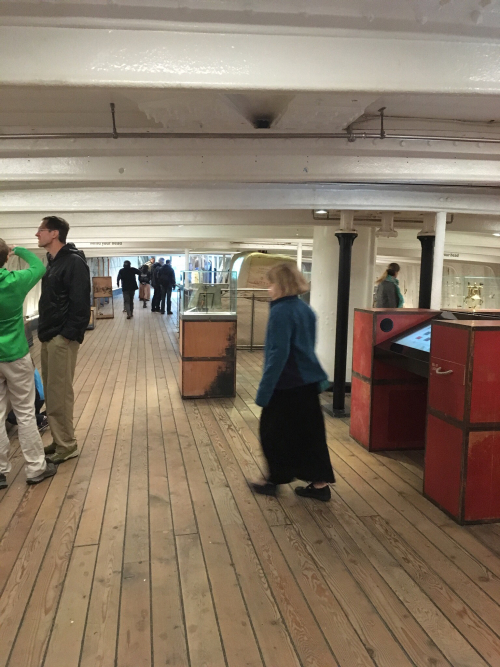
    The Cutty Sark is absolutely worth a go. I liked it far more than I expected I would. Partly because of the ship itself, partly because of the excellent displays. Also because they had very, very good displays and activities for young children in every part of the ship, not just in a dedicated children’s gallery. Both my little boys were engaged the whole time. A motorized bench you could sit on to feel the “rocking of the ship;” a game of stacking little weighted cubes, boxes of tea, in the hold without tipping the toy ship mounted on a bearing.

    There was another excellent simulator here, of steering a ship from Sydney to London while taking advantage of the trade winds. What I liked about this one was that your display consisted of a world tradewinds map, a closeup of your
    ship with arrows showing the trade winds in the immediate vicinity, and a compass. No big picture, no GPS dot on the map showing where you are. You have to pay attention and keep track.

    Top deck. Part of it was roped off; jumpsuited men and women with badges labeled “Professional Rigger” were working behind the curtain.

    Officer’s saloon. Note the drink holders that swing freely from the ceiling on either side of the light fixture

    Pantry

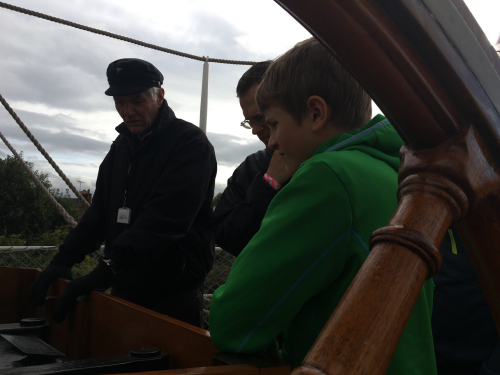
    Mark spent a lot of time admiring the mechanism that converted rotation of the wheel into rotations of the rudder. I was chasing the 3yo at the time and missed most of the explanation from the docent in the cap.

    But that was okay, because it gave us something more to talk about over pints of Extra Stout and Double Four Lager and Organic Apricot Fruit Beer after dinner, and a walk along the Strand.


  • Tyburn, Westminster Abbey, Matilda.

    We are down to the last few days, and on the last day there’s a Tube strike planned, so we must focus.

    I made the three big kids get up at nine and leave at ten, because the sisters at Tyburn Convent offer a tour of their shrine daily at 10:30.

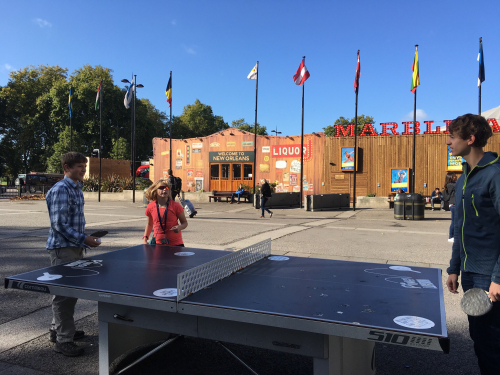
    Outside Marble Arch tube station we discovered something cool: outdoor ping pong tables! The last players had left the ball on the surface, tented under two paddles so it wouldn’t roll away: two more paddles were in slots under the table.

    Sadly, we had to move on so as not to be late.

    Tyburn Convent and Shrine occupies two adjacent door-fronts of a row of buildings opposite Hyde Park. We crossed a couple of streets and easily found it; it stands out with its red brick and its large outdoor crucifix, and a switchbackihg accessibility ramp. First we went in the convent’s front door, into a tiny lobby with a door and also a grilled window, and stairs behind a tall metal gate going down, and many notices posted on the walls, and rang the bell. And waited. Then we wondered if we should have gone up the ramp; perhaps that was the entrance to the shrine?
    I sent the 13yo ahead and then walked there myself. The ramp led to a button-operated sliding glass door which admitted us directly to an adoration chapel, with a few people inside: an elderly white couple, a Hispanic mother with a stroller and a toddler. The Host was exposed behind the grille in front.
    If I stumble accidentally into an adoration chapel, it seems rather pointedly wrong to say “Excuse me, I was looking for something else,” and stumble out again, so I signaled “A few minutes” to my oldest and we knelt down briefly, paused there.
    + + +
    The Tyburn Nuns is a well-beloved shorthand for the Benedictine Adorers of the Sacred Heart of Jesus of Montmartre. This is their motherhouse, and they have monasteries in several other countries. The canonization cause for their foundress, Marie-Adèle Garnier, founded the congregation in France in 1898 (at Montmartre, hence the name) but fled to England because of the laws in France against religious orders, and settled there at Tyburn, a bit more than a stone’s throw from the site where the English Catholic martyrs of the Reformation were hanged along with centuries’ worth of common people accused of crimes.
    After our brief adoration we genuflected and went back to the front lobby, where a sister was just opening the door to see who had rung the bell. “I will get someone to open the grille,” she said, in a strong West African accent, and closed it again. And then behind us we heard a hearty, “Hello!”
    Coming up the stairs one foot at a time was a plump, cheerful, bespectacled nun, like me not quite five feet tall. “I’m so sorry I didn’t hear the bell,” she said, “I was just putting the mop and bucket away, and then I thought to myself, I hear footsteps upstairs. Are you here to come down to the crypt?”
    “Yes, we’re here for the tour of the shrine,” I said, “are we in the right place?”
    She laughed as if that was a silly question, because of course it was. “You’re very welcome here!”
    I introduced myself and the children, and explained that my husband had stayed back with the two youngest, and she said that next time I should bring them along as she unlocked the gate and welcomed us down to the basement crypt. “I’m Sister Thomasina,” she said.

    “Now I want you to know that as you’re looking around down here, please feel free to take pictures. As many as you want! I know some feel they aren’t supposed to, in a holy place. But our work is for everyone, and the more people know about it, the better.”

    So I did take pictures.

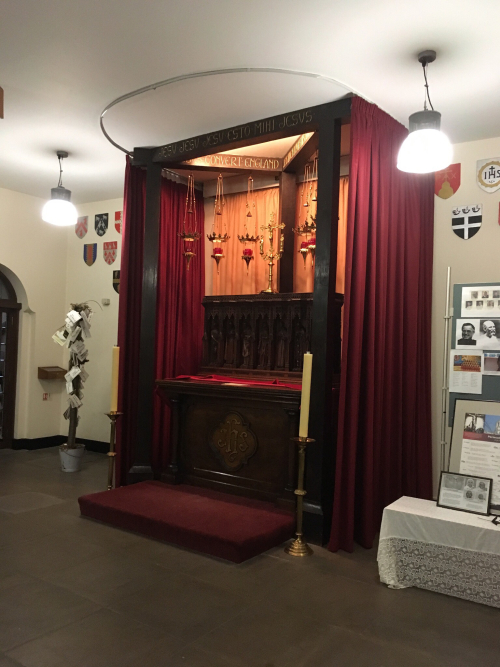
    This is their altar, topped by small replica of the Triple Tree:

    Sister Thomasina had a way of telling that started down a path, went down a trail, backed up to the main narrative, then started again down another trail. She began by explaining the long history of hangings at Tyburn. “East was the sea,” she said, “so when people approached London from the countryside they came from the west, and there was a little river here, the Tyburn. And you know, they wanted the criminals to be hanging there when visitors came from the west, so that is why the executions were here. And—listen—” She held up a finger and we heard a low rumble grow, tremble the floor, and die off. “That’s the train, from the Underground. Well, we’re downstream of the Triple Tree, and you know, the river once flowed under here, it forked. So we say that the blood of the martyrs flowed under our feet.”

    She described hanging and drawing and quartering in detail, and she had a very different demeanor from the Yeoman Warder who gave our Tower tour; he played it for laughs. She was not somber, though; there was a certain cheerfulness in her telling of the story. She explained the size of the gallows, big enough to drive two carts side by side under each crossbeam, big enough to hang eight people on each, twenty-four in all.

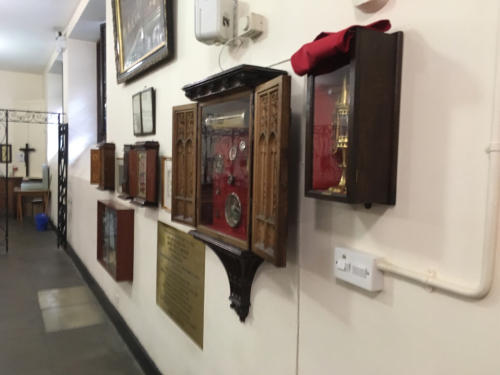
    “These reliquaries on the walls,” she said. “On this side”—she gestured—”these relics were spirited away to France during the persecution, and they’ve been brought back here. And these on this side went to Spain, and they’re back thanks to the Spanish Embassy.”


    “And here, come here.” She beckoned us up to the gallows-altar, and flung back the red cloth covering it to reveal the altar-stone. “The relics in this stone are those of Edmund Campion.” I put my hand to my face, and she invited me, “You can come and venerate it, if you like,” and so I did, walking up and laying my fingers on the cool stone surface.
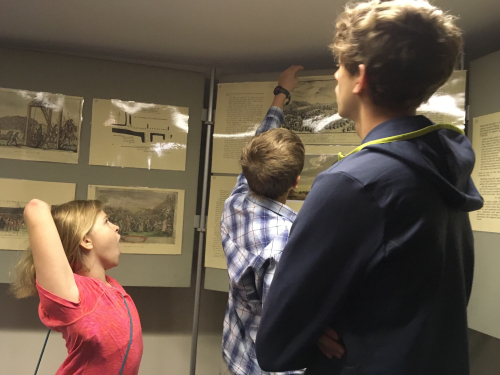
    “There’s some historic items over there if you’ll just let me fetch my keys,” she said, already on her way across the floor. The kids and I went into the other room, which was posted with a chapter from a book explaining the evidence for the location of the Tyburn gallows, and engravings that pictured the hangings and the grandstands, and a map of the path taken from Newgate Prison to Tyburn, with the stops along the way. One stop had been at Ely Place, where the 17yo and I had attended Sunday mass.
    There was another bulletin board with pictures of more recent martyrs. Seven priests. Three nuns. Twenty-one men. Children. “Yes, it’s never stopped,” said Sister Thomasina. “And people from all over the world ask us to pray for them. This place is a center.”
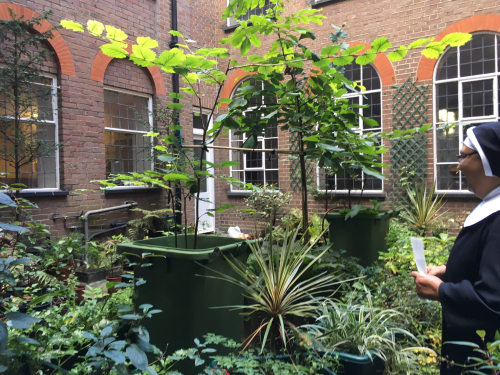
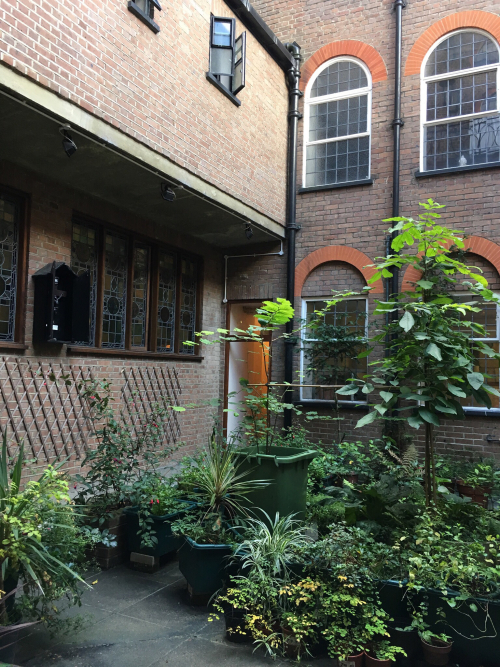
    Sister Thomasina invited us through the gate into the kitchen garden, in a tiny courtyard. “Here is where we grow our herbs, and the salad things,” she said. “We have room to try some new things now and then. Here, we are trying to grow an avocado tree. Don’t know if it will bear fruit but it is worth a try.”

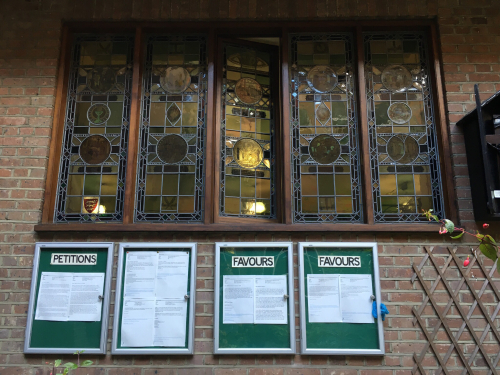
    In one corner of the garden was a raised stone sepulchre. “That’s our foundress,” said Sister. There was a little kneeler in front of the tomb, and above it a mural of the resurrected Christ. Right next to the kneeler was a large glassed-in bulletin board in which were posted printed emails. I leaned over; they were clearly petitions submitted to the Sisters via a website combox of some sort. All were crisp with relatively recent dates. I suspect that if you send them an email and ask for a prayer, your prayer will be posted here, next to the little kneeler.

    She gathered us around and handed us a little card with a prayer printed on it. “A prayer for the canonization of our foundress,” she said. “Why don’t you come around here and let’s all say it together right now.”

    So we did, and then headed back through the door, passing more posted petitions.
    The crucifix on the wall we passed bears a tag that reads: Pray for those who died around this crucifix at Ypres in the 1914-1918 war and for their chaplain. R. I. P.


    Before we left, Sister said to us, still unflappably cheerful: “If you have anything that is worrying you or burdening you, leave it here at Tyburn. Our prayers are for everyone here. Prayer is our work. Leave it here at Tyburn. And,” she added with a wider grin, “if your burden isn’t lifted, you may take that to mean that we can use some help! And pray for us, then.”

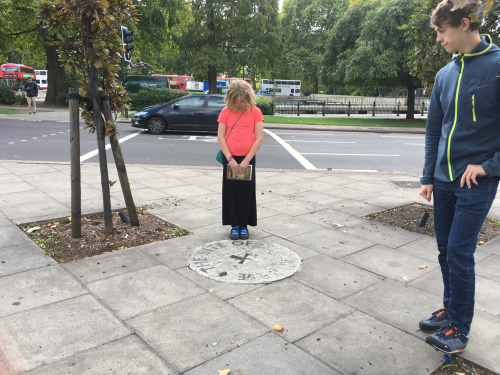
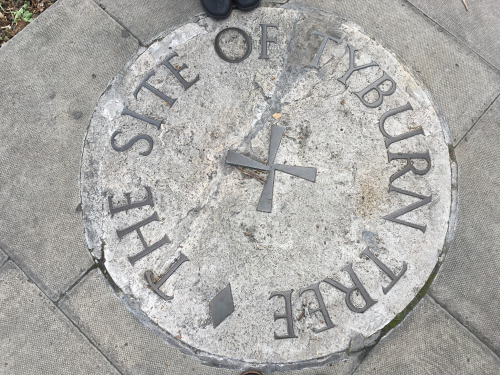
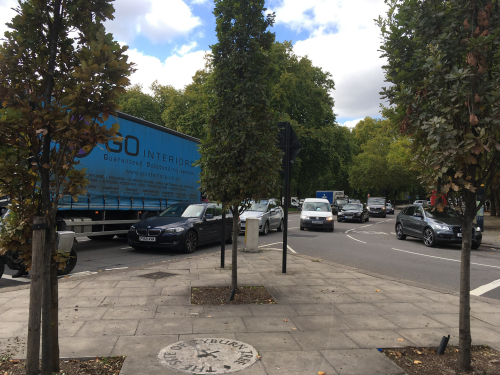
    On our way past Marble Arch we found the stone marking Tyburn where she had said it would be, flanked by three little oaks that had been recently planted to make a new Triple Tree.


    + + +

    We walked down to the Bond Street station, past Selfridge’s (which would be a better shopping destination than Harrods).

    I had promised my daughter some sushi. We found a chain called Wasabi in the mall. Very nice: you can pick individually wrapped pieces of nigiri, maki, onigiri, and other things to make a bento box, or grab a preassembled combo to go. Also there are hot noodles and rice bowls. Once again, London fast food wins the category.

    Then we took the tube to Westminster Abbey. Which had once been Benedictine, like Tyburn. But of course is quite different now.
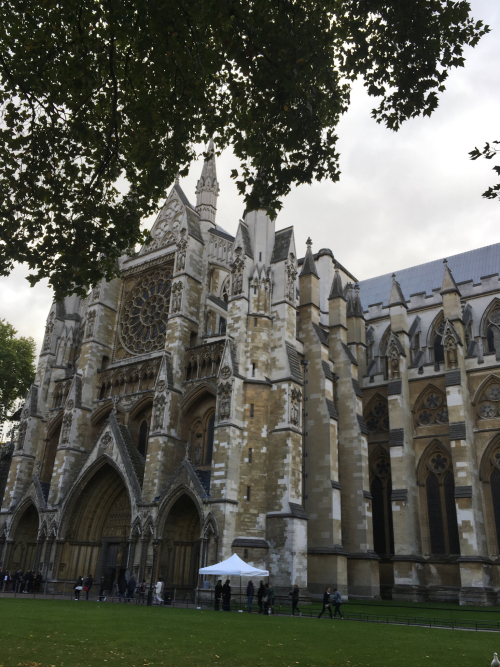
     
    I won’t go into too many details, since Westminster Abbey is well known and easy to read about. I was surprised that the high and narrow nave did not really impress me all that much; on television it looks as if it would be sweeping and dramatically high, but it seemed smaller in real life. But I did enjoy very much the great age of it, the haphazard clutter of memorials and tombs placed any which way, the weight of the years measured in tombs of kings. The ceiling of the Lady Chapel is intricate as lace, and its survival of the Reformation a thing to be grateful for. My daughter loved Poet’s Corner, and was pleased as punch to find a tidy little memorial to Wordsworth, her own favorite poet. What I think I liked best was the Chapterhouse, with its single central column rising up and branching into a many-splintered ceiling, and its perfect proportions; and the simple fact of all the monarchs’ coronations, all on the same spot, since 1066.
    I am not into the monarchy as celebrity, not all that interested in the queen’s houses and the changing of the guard; but I am impressed by any human institution that preserves its relics and rituals for so long. I find myself, late at night, looking up place-names that I happened upon that day (High Holborn; Watling Street) to find out how long it’s been there, how long it’s had the name. I like the idea of things and practices enduring. And of the physical evidences of it: the golden spoon among the Crown Jewels, the ancient chair kept under glass in the Abbey.
    + + +
    A couple of views from the walk back:

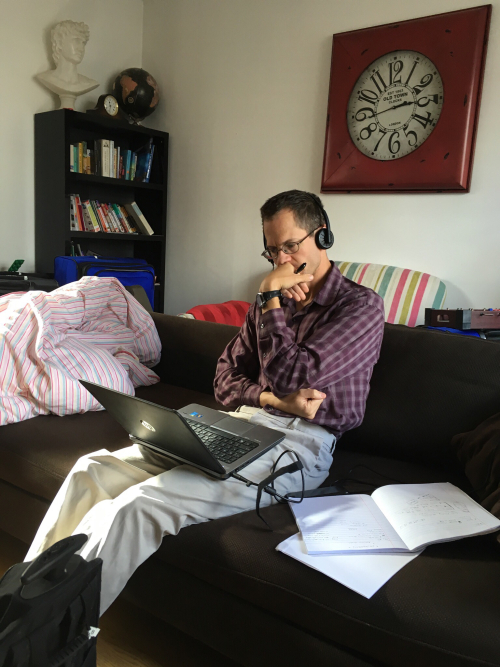
    I came back to find Mark working:

    “What did you do while you were home with Daddy?” I asked the 3yo. “We went to the playground,” he said, “and we went for a walk in the town.” They had walked to the grocery store. He was very pleased about it. I later found out that “Let’s go for a walk in the town” had been the refrain all afternoon until Mark had agreed to run an errand.
    Mark and I went out for a pint:


    And picked up dinner (more sushi from a different chain):


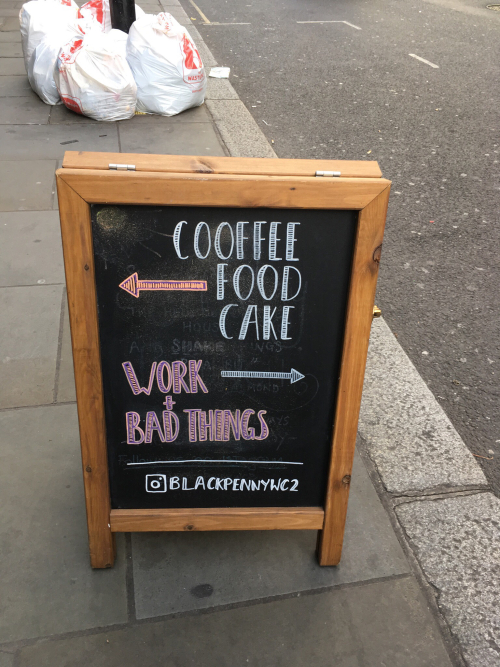
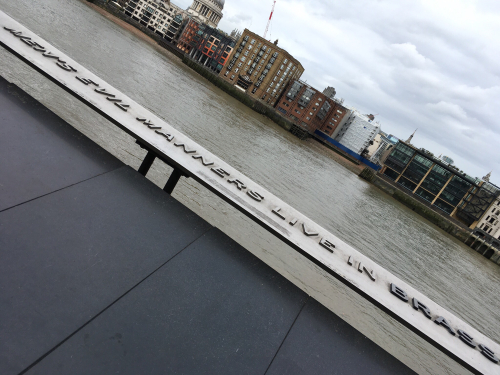
    I snapped a photo of a sign I had passed many times over the past few weeks, and been pleased by:

    After a quick gobble of dinner, I set out with four children to the Cambridge Theatre in Seven Dials. We had tickets to Matilda: The Musical.
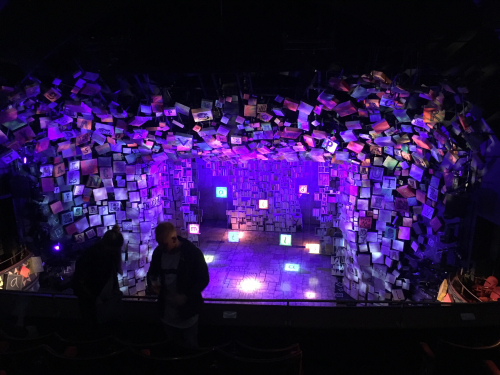
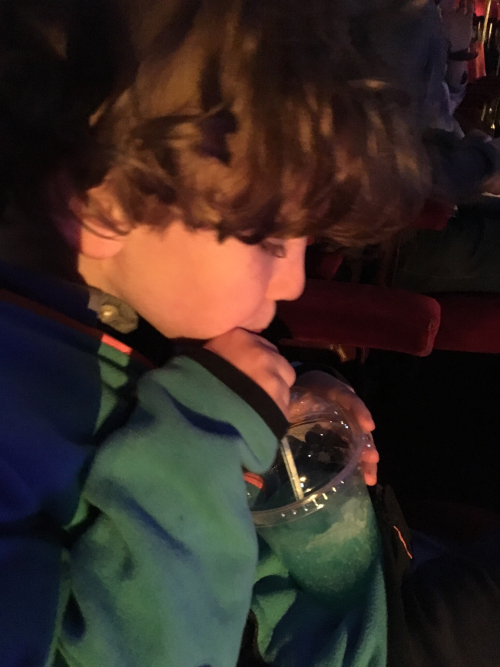
     

    I haven’t time for a proper review, so I’ll just say that we all loved it, with the possible exception of the 7yo for whom it was a bit too intense and dark. I think he was okay in the end, though. Although I love Roald Dahl (even, or especially, his stories not written for children), I never have read the book Matilda nor seen the movie from a few years ago. I only had a vague idea of the plot. So it was unspoiled for me, and I enjoyed it greatly. There seem to be a few places in the story that are paced irregularly, the mark of an imperfect adaptation. But the music is wonderful, and there was the extra delight of a passel of very talented children. Matilda herself was played wonderfully dryly by Savannah Read, a tiny girl with long red hair and expressive body language. The set design and lighting is brilliant. A lovely evening out with the kids.



  • V&A, Diana Memorial Playground, and my first London show.

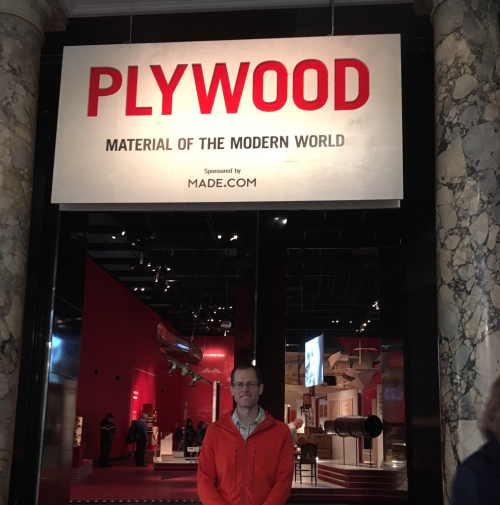
    The Victoria & Albert Museum, which seems to be officially christened the V&A these days, had an exhibit going that made Mark want to go with me.
    It wasn’t a very large exhibit, just one room of objects and materials, but put together very well. In the museums I have been to here, the explanatory materials (signage, accompanying videos, interactives) have been top-notch for anything remotely technological.

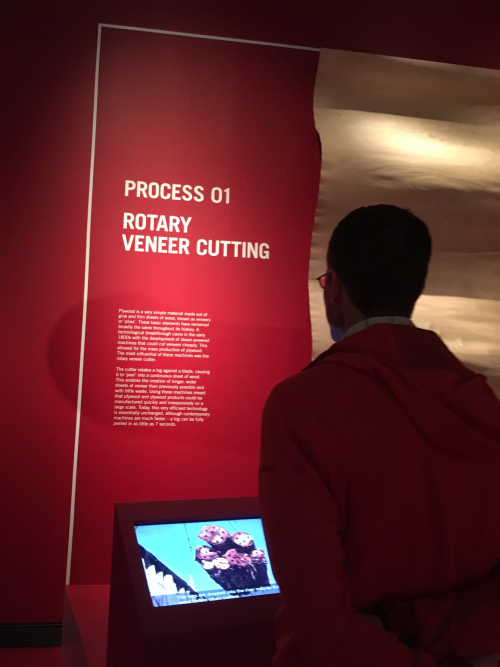
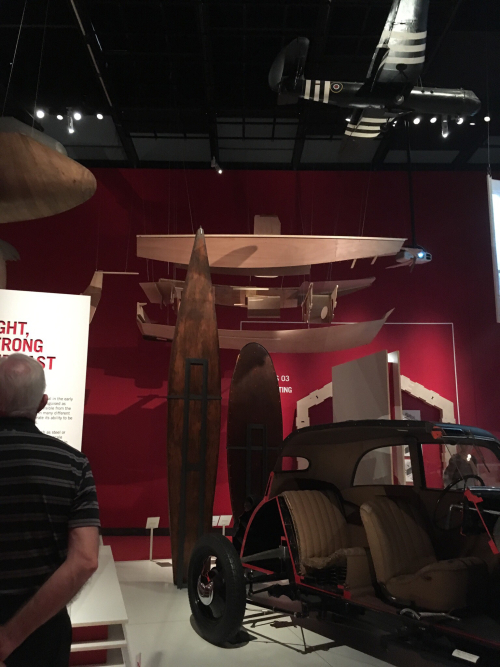
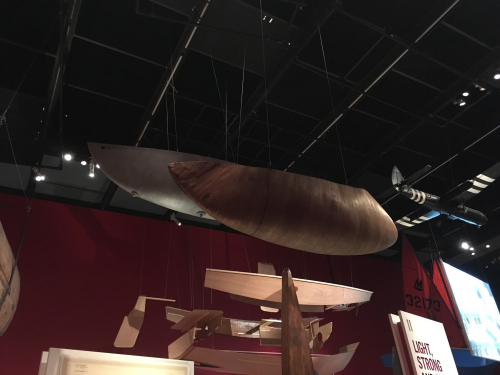
    This one had plenty of interesting objects as well as technical demonstrations (how is plywood made? why can it be formed into so many shapes? why does it make such good chairs?). With the right glues, it can be waterproof; it’s light, formable, and strong; we saw boats, car parts, suitcases, a bookbinding (the Shackleton exhibition brought a printing press to Antarctica and printed books using their plywood packing crates as hardbacks). Disposable lightweight airplane gas tanks:


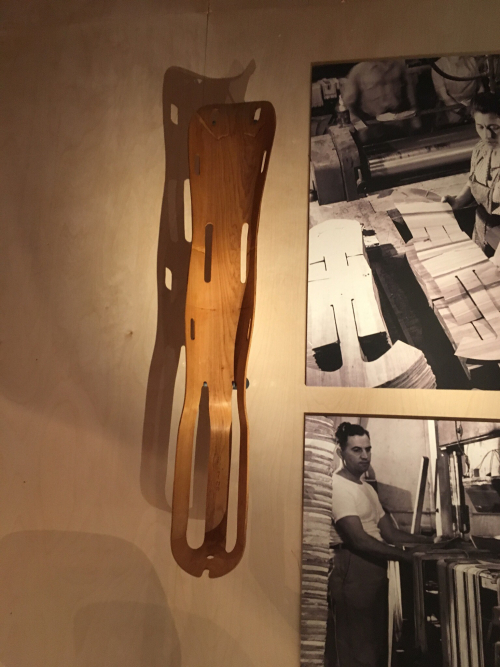
    Eames (yes, he of the sleekly curved and modern molded plywood chair) apparently did his war work making sleekly curved and modern molded plywood leg splints:

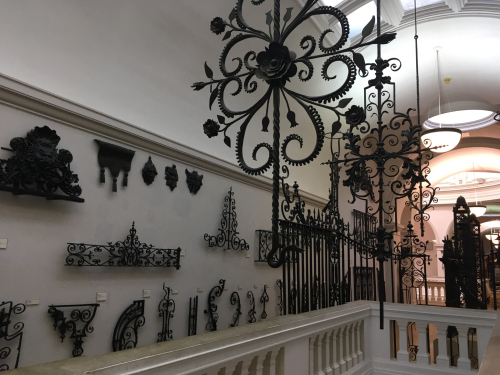
    Having finished that, we picked galleries that both of us were interested in (so I probably saw something quite different than I would have had I gone alone. We stuck to the rooms labeled “Techniques and Materials,” and started with the enormous collection of cast iron and wrought iron.

    Rooms and rooms and rooms of it. Railings, pothooks, keys, altarpieces, fire baskets, gates.
    We also saw silver and gold work, the jewelry room, alabaster and ivory carvings (the latter, mostly small pieces, displayed under glass in drawers you could pull out, so you could examine them closely). A display of sculpted clay pieces arranged them to show the different steps in the process: rare surviving works in unfired clay, then terra cotta, then glazed works.
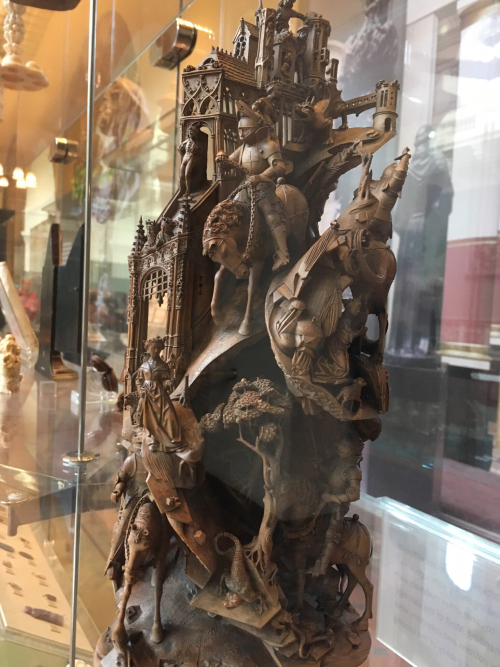
    Wood carving masterworks struck Mark’s fancy. This was his favorite. Its detail and composition reminded me of large pieces in the MIA at home, carved in China from jade:
     

    I appreciated the building itself very much. It lacked the maze of cubical white rooms that’s so common, and is made instead of courts and wide, high halls, many of them visible from above by means of galleries on the upper floors. They display many large pieces that way. The smaller galleries that run alongside often contain explanatory material or smaller pieces that are related to the massive works in the middle. It is very grand and lovely.

    We spent two hours there. Sadly, the temporary exhibit of Pink Floyd artifacts was sold out when we tried to buy tickets.

    + + +

    The day itself was relatively pretty, and I suggested for the afternoon we take the three smaller children to the Diana, Princess of Wales Memorial Playground in Kensington Gardens. We would have lunch there from the food stand, and then stay and play. The promise of food brought the teen boys too, but once we got to the gardens they decided they’d rather explore. So I gave them money and off they went.

    The two little boys, on seeing the playground, refused to eat until they had been allowed in to play.


    I fed the 11yo first (chicken nuggets for her; caprese panini for me) while Mark went in with them, then came in and gave him a chance to go eat (stone-baked Parma ham and rocket pizza). My daughter volunteered to run around playing with the 3yo, and my 7yo was already making friends, so I felt free to walk around and explore the place myself.

    The playground is entirely fenced in, with one entrance by the food stand (it has one counter inside and one counter outside, and there are picnic tables on either side of the gate). To get in, you push a panel and, if you are an adult accompanying children under 12, a guardian buzzes you in. You must also be buzzed in to leave. So, while technically parents are supposed to supervise their children, once inside the playground children can run freely through numerous outdoor “rooms.”

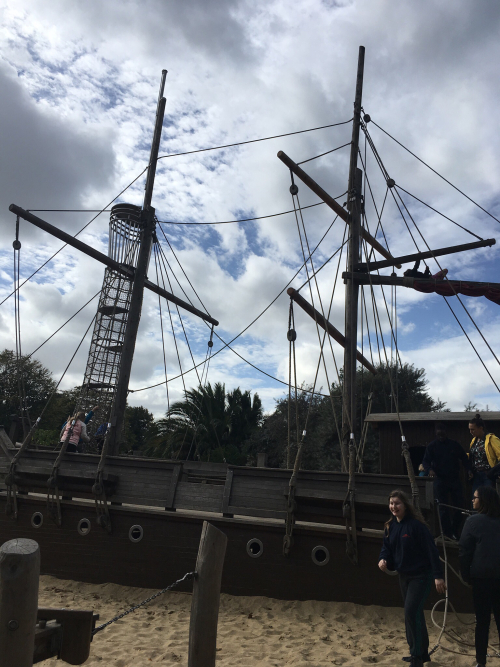
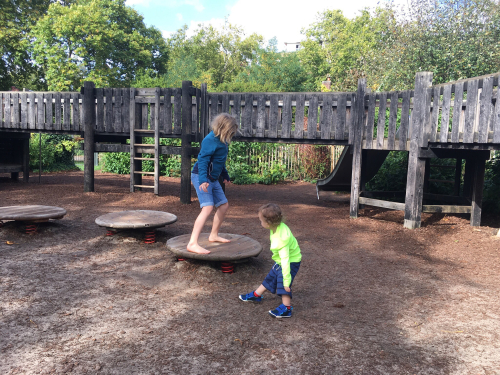
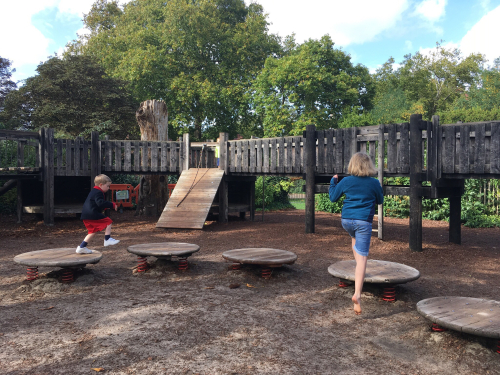
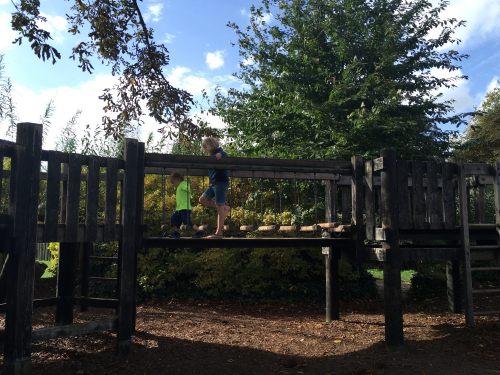
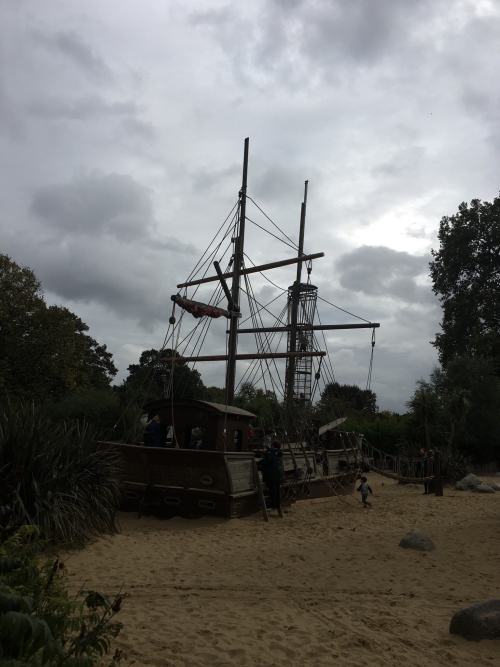
    The playground has a Peter Pan theme. The pirate ship is glorious, with smaller rowboats on the side, some stable, some mounted on springs so they can be made to rock hard left and right. The Lost Boys’ house is a clearing encircled by a wooden fort, with slides and log bridges:


    The lagoon looks like it might be a fountain in the summer, and even now there are fountains that send water in when children work them. Tantalizing shapes and objects are embedded in the concrete to look like prints in the sand: the mark of a rope, planks washed ashore, rocks arranged in the form of a crocodile. Plus shells and other small treasures.

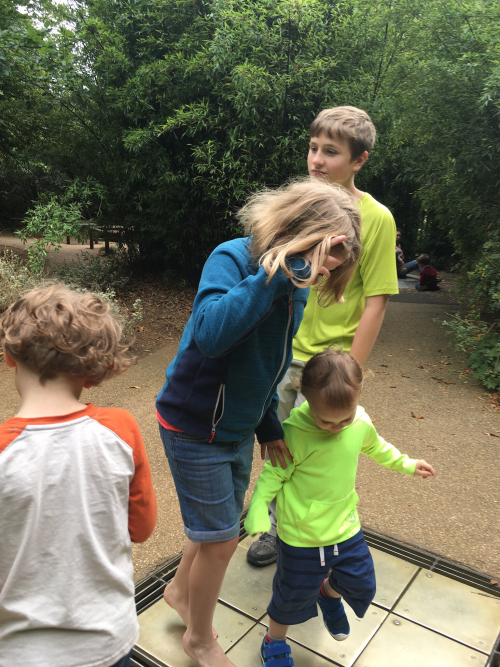
    There is a pathway that leads to an ring of trees, with a standing column of black rock in the center, that darkens and filters the sunlight to a creepy gloom. And there is a section of outdoor musical instruments, like a polished piece of granite deeply cut so that a smack will set it ringing with a bell tone, and percussion instruments, and this panel of metal spring-mounted squares that each sound a different note when you jump on them.

    Read the final paragraph on the explanatory board: “It is now recognized that risk taking is an important element of play and physical development.

    Bravo! I guess the Queen is just not all that worried about being sued if a child breaks her arm. Take another look at that pirate ship:

    While we were there, a girl of about seven climbed the ropes to the topmost horizontal crossbar and worked her way out to the end. She clearly knew what she was doing. It was a joy to watch.

    After a while, the teen boys came back, having explored the vast grounds of Kensington Gardens and then gone to Tesco for the £3 lunch special.

    My 13yo son was SO pained that he was technically too much grown to play in this playground. I could see his eyes sparkling when they lit on the pirate ship.

    We let him go in as “accompaniment” to the 3yo, with a careful admonition not to get in the way of younger children. And bought more food (the 3yo polished off nearly all of a New York Style Hot Dog with mustard, and ice cream novelties were had). And stayed still longer.

    I think maybe we were there about two and a half hours? And it was one of the more fun playground afternoons I have had.

    I don’t know why American playgrounds have not adopted the very, very sensible European practice of putting a fence around playgrounds and having only one exit. Even if you don’t have a guardian buzzing kids in and out, this makes it so much easier to safely supervise multiple kids: park yourself where you can see the exit, and you can watch in peace. Unless you have the sort of child who will climb the fence against strict instructions (and I know some of us do, true, but for most a fence can be a hard boundary), a one-exit fence is the kind of safety precaution that allows for more freedom and independent risk-taking for the children inside it.

    + + +

    Mark and the 17yo walked to get carryout from Nando’s for dinner: piles of wings and fries, and some salad and corn on the cob.

    “One of the things that’s great about British food,” says my 17yo, “is that you never have to worry, when you look at a menu, about whether you should get medium spicy, hot, or extra hot. Wings, vindaloo, whatever. Just order the hottest level always. You never have to worry that it will be too hot. Hottest is generally just right here.”

    So far, this has turned out to be correct.

    + + +

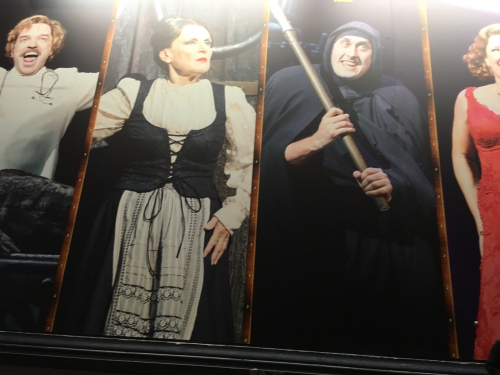
    After dinner, Mark and I headed out with our tickets for Young Frankenstein at the Garrick Theatre, a building which was financed by W. S. Gilbert.

    This show is a retooling of Mel Brooks’ original Broadway production, clearly an attempt to do something similar to what he managed with The Producers. It got mixed reviews in NY and has been tightened up from three hours to two. The monster is played here by the same actor who played him on Broadway.

    Poster outside the theatre:

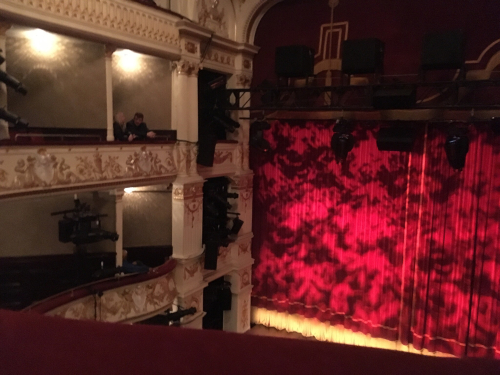
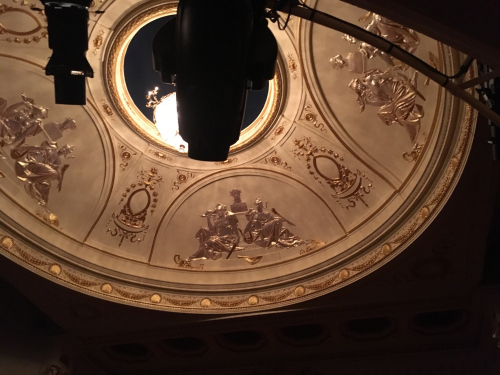
    Interior of the theater. It’s very cozy! We had front row balcony seats. I like balconies because of the wide point of view, and here it was definitely a good economic choice, as we were still quite close to the action.

    Theatre selfie:

    About the show itself: The audience around us appeared to eat it up, but I have to wonder what proportion of Brits are the sort of people who have seen the Mel Brooks movie often enough to quote it from start to finish. Because when you’re steeped in the movie, like we are, it is a standard that no adaptation can live up to. Every departure from it, however necessary for the stage, is a step down.

    It’s also a good deal bawdier than the film. “What knockers!”/”Thank you, doctor” is positively understated compared to the new Brooks-authored musical numbers. You know how people say that Brooks could never make Blazing Saddles today? He couldn’t put these musical numbers on the big screen, I think. They’re not obscene, and they’re not unfunny, but they’re also not inoffensive and may cross lines that
    would make too many people uncomfortable. One song plays physical domestic abuse for laughs, for example. And some of it just works a little too hard, expecting bawdiness to stand in for actual humor. There were a couple moments where I cringed a little for the actors.

    Still: The six cast members were all talented, with good strong voices. Igor’s physical comedy was very effective. Inga’s role called for an impressive display of both gymnastics and yodeling. The actors in the roles of Frau Blucher, Hermit/Kemp, and Monster inhabited the demeanor of the movie characters pretty well. The fiancé wasn’t really anything like Madeline Kahn (more rich bimbo) but her demeanor was funny in its own way. And the sheer impossibility of filling the shoes of Gene Wilder had me rooting for the American-accented star, who was game for the challenge and, I think, did a fine job.

    The ensemble sounded good. The dancing could have been a little more tightly executed, but I have high standards and maybe they were going for a rougher look. There were a few new one-liners tossed in that worked very well. All in all, I did have fun. But I am glad I didn’t spend money on a ticket—though they were not unreasonably priced, both together cost us less than £100—for either teenage boy.

    And if I was looking for an ordinary London experience, I thought, as we exited the theater onto Charing Cross still alive with light from the windows of pubs, and walked past the line of black cabs there to be hailed from the curb, I had certainly had one.

    We stopped at a pub on the way home for one quick pint (Fuller’s HSB for me, Red Fox for Mark), long enough to agree that the Sam Smith’s are much superior, and walked back through Covent Garden, the bricks gleaming in the streetlight, the streets still relatively crowded at 10:30 p.m. on a Monday.


  • Mass, Harrods, Science Museum again, and a lot of drinks at the pub.

    I got up in the morning for 9am Mass at St. Etheldreda’s, the oldest building currently in use as a Catholic Church in London, and either the oldest or second oldest in England. It was built between 1250 and 1290 as the chapel for the London residence of the Bishop of Ely, was taken over by the Church of England, and was purchased by a congregation of Catholic fathers in the 19th century. They restored it, with beautiful windows that are worthy of their medieval setting, and statues of the English martyrs between the tall windows on the sides. The windows receive considerable light due to the lack of tall buildings around.
    It is a little jewel of a chapel; you can see the interior at this link.
    Entering between the light stone pillars, you walk back alongside the chapel, where you can see a glimpse through a door to the undercroft, set with tables and chairs like any parish hall; up stone stairs and you go in at the back.
    There is no electric lighting. The light for Mass came from the windows and from a few candles.
    + + +
    Mass itself was a bit odd. It was the shortest Sunday Mass I had ever attended at 24 minutes. The priest skipped the second reading, the entire homily, and the prayers of the faithful. And by skipped, I mean completely omitted. I have been to Masses where the homily was two sentences long, but existed. There was no homily at all, and the second reading was just gone, the way it is gone at a daily Mass. I didn’t know you could do that.
    There was another American family behind us, and they were whispering to their children in confused tones.
    But the Liturgy of the Eucharist went down as expected, so…
    At any rate, odd as it was, it could not detract from the serenity of the setting.
    + + +
    After Mass I split up from the 17yo (he would go on to have a day-long adventure, involving finding the highest building he could go up in for free, enjoying the view, buying an amazing lunch for only £3 at Tesco, letting his phone die, getting lost, figuring it out, finding a way to charge his phone on the fly—he remembered me saying there was an Apple Store in Covent Garden—and finally being able to call Mark to let him into the apartment, since he hadn’t had a key).
    I went out for breakfast at a corner café.

    Spicy tomato juice, eggs Benedict—perfect except poached a bit hard—and two cups of coffee.

    Then I came back, picked up two kids, and took them to see Harrods.

    The 13yo split off from us to walk around on his own and buy lunch.

    Me? I suddenly realized I was about to have a migraine and hurried desperately through the gilded and granite entry, holding the 11yo tightly by the hand to keep from losing her in the crowd, in search of water to take my sumatriptan tablet.

    The directory said there was a coffee shop in the basement, so I hoped to buy a bottle of water, but when I got there it turned out, like everything else, to be Exquisite, and was “wait to be seated” only. I stood there for a moment, and then plunged into the shop, accosted a waitress, and essentially begged for a glass of water to take my medication. I may have been pale and trembling by then. She kindly gave me one, and let me sit in the booth for a moment. Hurray.

    + + +

    That over, I knew I wouldn’t feel well for a while, so we walked slowly and looked and looked. Fortunately, you can feast more sumptuously with the eyes than with the stomach.

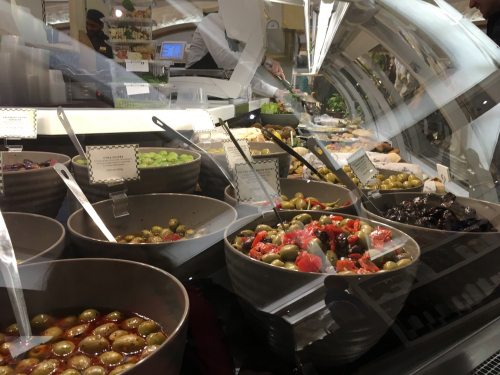
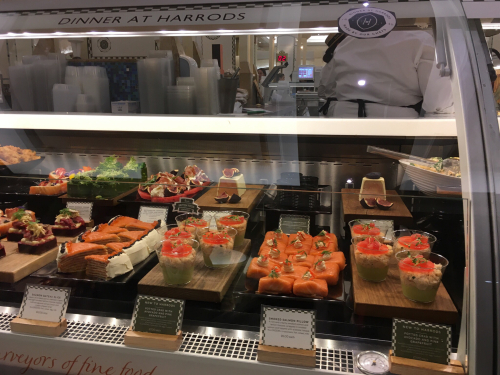
    Oh my. The Harrods food hall:


    From there we went up to the Toy Kingdom:

    The LEGO Harrods:

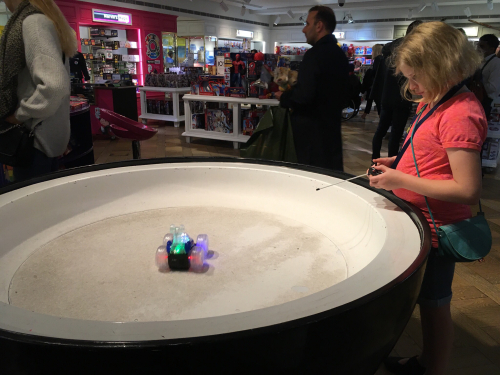
    There were some things out for demonstration. My daughter loved this RC car.

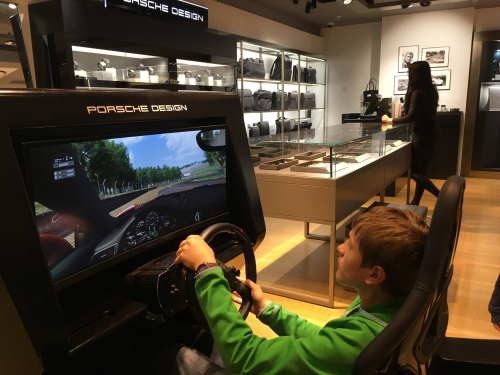
    W
    e found the 13yo in the Porsche Design accessories department, where they sell sunglasses and watches, playing this driving simulator that was set up there:

    Then we walked to the Science Museum for a go. Google Maps took us through a neighborhood with something-Mews as its street name, and indeed, the houses were made of former stables:

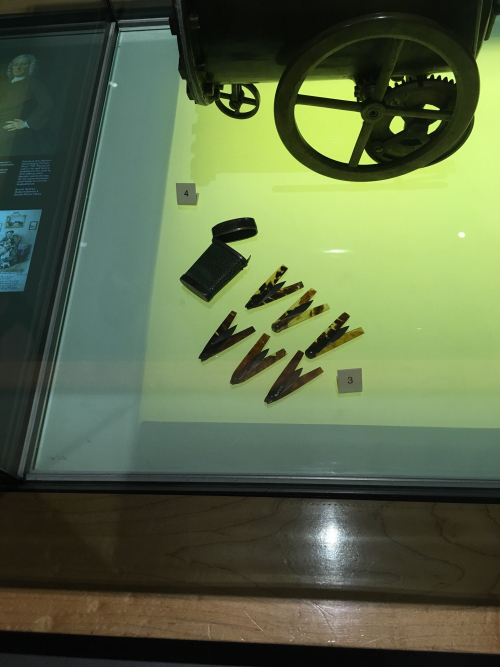
    I passed through the Making the Modern World exhibit again with them, and caught items I had missed the first time. Look! Dr. Jenner’s own lancets!
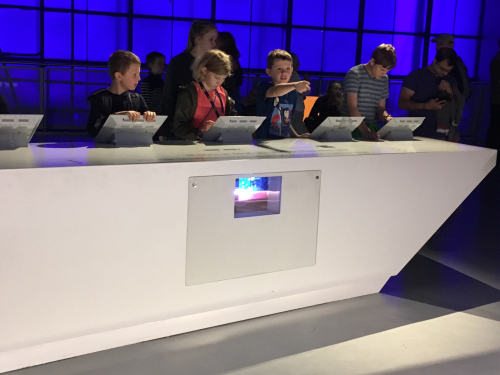
    An engineering exhibit allowed kids to build computer models of various systems and then run simulations. Both kids (with some others) played for a while at a game of building a model Mars Rover, with different numbers of differently sized and located wheels, then running it over a simulated Mars surface to see how it performs.
    The 13yo got tired and wanted to rest on a comfy cushioned bench in this dark room, so the 11yo and I went exploring in the Mathematics gallery.

    Touchable model of a control unit for a 1968 Honeywell computer:

    And this room-sized marvel, the Hartree Differential Analyzer, which solved differential equations by integrating with an analogue machine:

    A “logic demonstrator:”


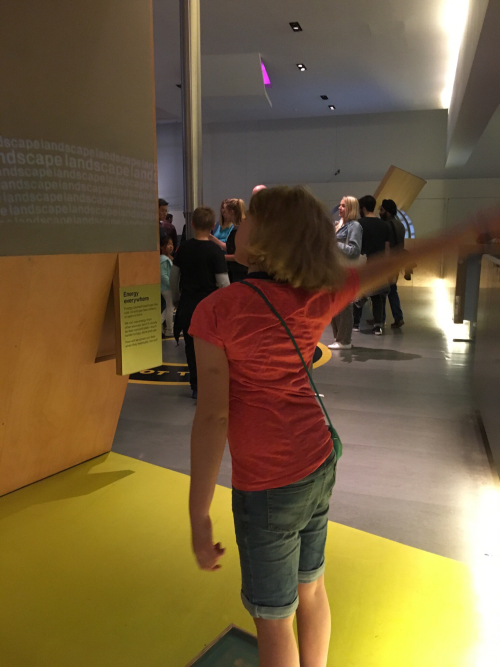
    An energy game in which windmilling your arms did, I don’t know, a thing:

    We collected the 13yo in the main gallery and headed home, rather tired.

    They’ve gotten quite good at standing on the right.

    Mark and I went to the grocery store and picked up ready-to-eat odds and ends (salad with crunchy carrots and sweet corn; cold roast-beef-and-Stilton sandwich) and a few things to go in the oven: pizza, prawn toast, egg rolls, gyoza. We all ate our fill, and then Mark and I headed out into the night, aiming for another pub.

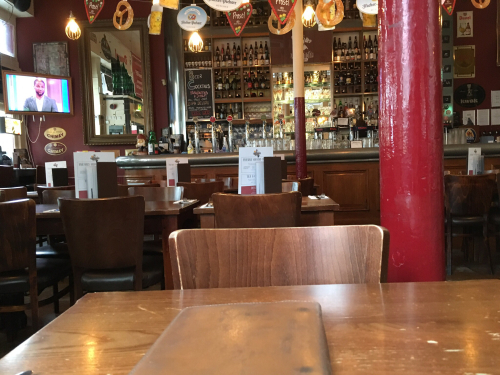
    This time, The Cock.

    + + +

    I want to say right now that Mark and I owe the heartiest thanks to reader and commenter Kathgreenwood for suggesting that we follow the map of Samuel Smith’s pubs when looking for a place to spend the evening.

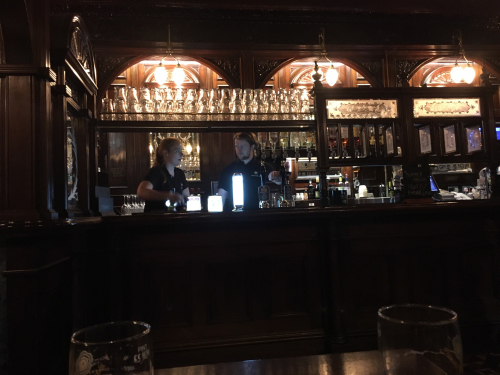
    They are top-notch. No music or television, just a place where people gather, drink, and talk. Beautifully upkept—we watched the barkeep carefully polishing the already-gleaming brass with gloved hands:

    And the beer? The best.

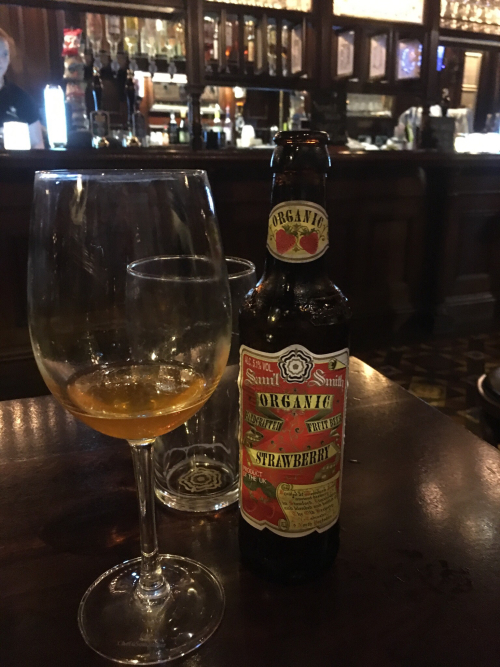
    Old Brewery Bitter has been the best of the cask-conditioned ales I’ve had while here. Today we branched out. I started with a pint of Extra Stout and Mark a pint of IPA. Then we switched to the fruit beer. I stuck with apricot, and Mark tried strawberry:

    Before tasting he stuck the glass under my nose. “Sniff,” he ordered.

    I inhaled deeply, closed my eyes. After a moment, I said: “Jam.”

    It smelled exactly like a freshly opened jar of home-canned strawberry jam. Not the vegetal notes of a fresh raw strawberry, but the scent of simmered, sugared fruit. Then I tasted.

    Readers, if you taste this, you may never call a mere red wine “jammy” again.

    It is sweeter and more fruit-forward than the apricot, the beer taste not blending so much as fading into the background. It isn’t as balanced; while I could see drinking the apricot with certain spicy meals, as you might drink plum wine or Gewurztraminer, this was dessert. Delicious, strawberry dessert.


    + + +

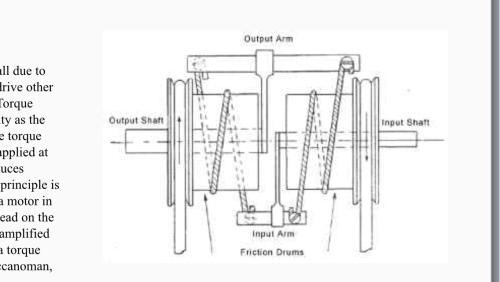
    Partway through the fruit beer we started reading about the abovementioned differential analyzer, which was famously built for the first time using an off-the-shelf children’s erector set (Meccano) with a few specially made parts, namely a polished glass disc and a steel knife-edged integrator wheel. We tried to work out how it worked, with the help of an article about it I found from a New Zealand enthusiasts’ club.

    While digital computers are the descendants of finger-counting and abacuses and arithmetical algorithms, the article explained, analog computers like the integrator are the descendants of graphical solutions and surveying equipment.
    They are called “analog” because they rely on proportions and ratios: a physical quantity is input into the machine, and transformed by proportion into a quantity inside the machine that is mechanically manipulated and may be output via another proportional transformation.

    We figured out how the disc and wheel work pretty quickly. Rotation of a polished glass disc through a certain number of radians is one step along the x axis in a finite-difference algorithm. Resting on the disc, and rolling as the disc turns, measuring arc distance, is a steel integrator wheel. The wheel’s radial distance from the center of the disc, as the disc turns through x radians, is controllable: by moving it towards the center or rim as the disc turns, you are inputting the function y(x) to be integrated. The arc length it rolls out over a differential turn of the disc is y dx. Count how many rotations the wheel makes as the disc turns, and you are finding the area under the curve.

    It took much pointing and literal handwaving, and another pint of beer, for us to make sense of the other important part, the torque amplifier:

    p

    The torque amplifier is necessary because there’s very little friction between wheel and disc, and yet the output shaft has to drive a bunch of other parts downstream in order for you to produce something you can read, like a plot.

    I will leave it as an exercise for the reader. Or you can just move on to my review of:

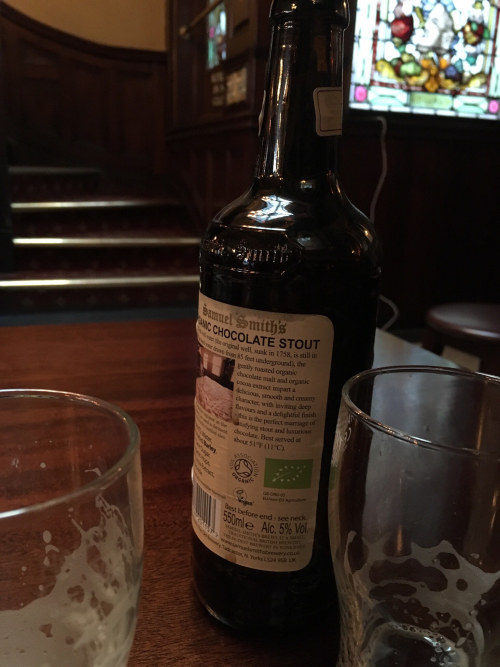
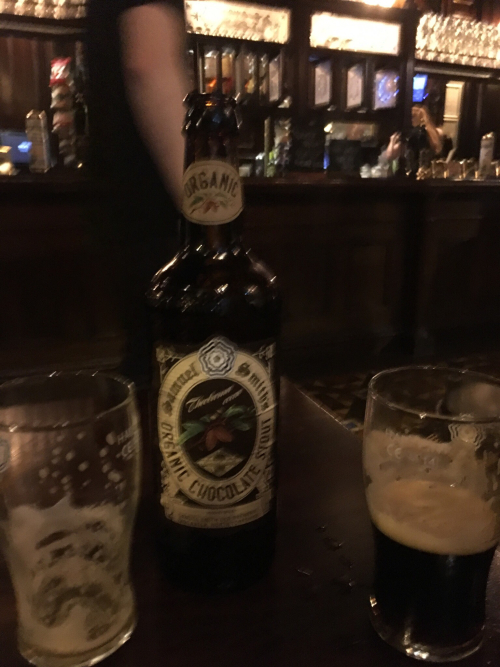
    Sam Smith’s Organic Chocolate Stout.

    You thought the fruit beers were dessert? This tastes like frothy cocoa, in a beer.

    Only because it is full of cocoa, and sugar.

    Purists might object to putting cocoa and sugar in a beer. These purists would be wrong.

    I may be ruined for life, and spend all my beer shopping time seeking out rare Sam Smith’s beers in Minneapolis.

    + + +

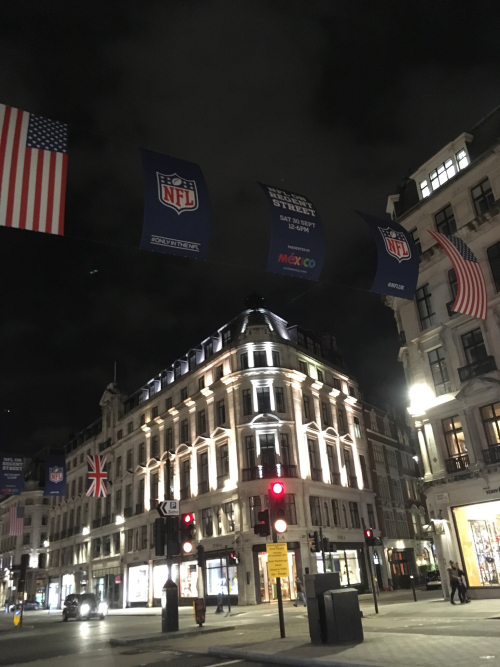
    Odd display along Regent Street on the way home. Apparently there are American football teams playing in the U. K., sponsored by Mexico. Go figure.

    This was by far the most fun evening that I have had here. Two and a quarter pints of beer might be the reason, or it was the company, or the force diagrams. Perhaps the lovely pub atmosphere, the stamped-tin ceiling and the brass. The barkeeps who were happy to explain why there were little glass louvers mounted at eye level above the bar (historical class separation: open to order your drink, close to maintain the illusion that the workingmen behind the bar would not hear the gentlefolk’s conversation). The quartet of tattooed folks at the next table, who were there when we arrived and still there when we left just at closing time.

    I thought it was oversold, but there is really nothing at all like “the pub” at home. Everything that is sort of like it, isn’t even close: the coffee shop, the brewpub, the bar and grill, the neighborhood bar, the neighborhood café, the country club, the bed and breakfast, even the occasional “British Pub Themed Restaurant,” none of them have all the pieces. Such a beautiful thing—I sincerely hope that Londoners appreciate this thing that they have on practically every corner.

    I have been to Paris, Rome, Seville, Madrid, Toronto, Lisbon, Marrakech, Lyon, Florence, Nice, and a handful of small towns (not to mention a number of large U.S. cities). In all seriousness, London sweeps them all aside. Heart, stolen.


  • Borough Market; Split up in Southwark.

    What do you do on Saturday in London? All the guidebooks describe everything as “crowded weekends, so go on a weekday.”
    Well, Borough Market is only Thursday through Saturday, so this was our last chance.
    We took the tube to Bank, hoping to change to the Northern Line to cross the river.
    But after descending many stairs encountered a gate. The Northern Line was closed.
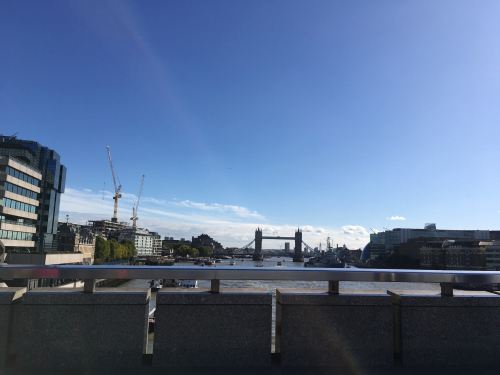
    The easiest thing to do was also fairly pleasant: a walk across London Bridge. “I hope it’s not falling down!” I said to the 7yo, who (as I predicted) thought that was terribly witty. You can see Tower Bridge in the distance.
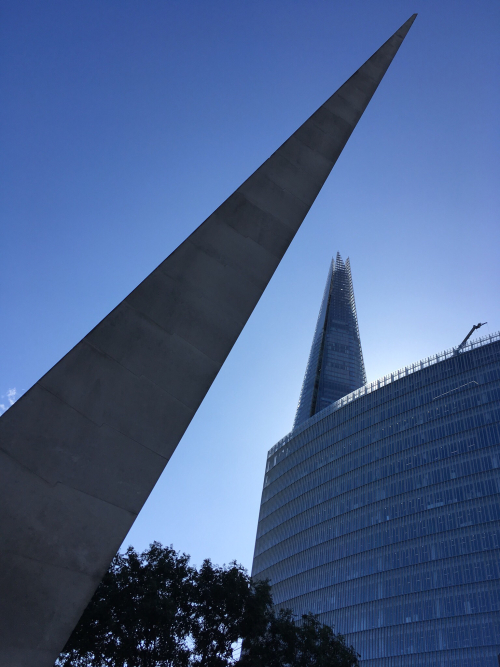
    At the south end of London Bridge is the spike that our Yeoman Warder said was kept handy just in case they ever have to put somebody’s head on it in the future. Mark thinks this will never happen.
    Knowing, though, that World War I and World War II spies were executed specifically in the Tower specifically for its symbolic value, as late as 1940, and believing firmly that a society’s civil behavior is only a surface that can be easily swept away with the right motivations, I am not so sure.
    Though maybe this spike will prove to be impractically tall and the point too brittle.
    I believe that things will go south again someday for the people of this island, as I believe they will for people everywhere eventually. I have a sort of romantic notion, because it is so very old, predating all the proper records, that the City of London will still exist as an entity when the dust settles.
    And a cynical notion (or is this still the romantic one?) that it will manage its survival in part by putting heads on pikes again.

    Metaphorically?

    Maybe.

    + + +

    Off to Borough Market, which at around eleven was not quite a complete crush of people. We had to pass through a crushing bottleneck at one end, where we were squeezed between a wall and a bar with outdoor seating (I glimpsed a tray full of brimming pitchers of Pimm’s Cup but was not able to stop and neglect my family long enough to run up to the bar and ask for one).

    But when we popped out the other side it was no longer crushing, only crowded; there were many people milling around, looking and deciding perhaps, but once you made up your mind to buy something you only had to wait behind one or two other people.

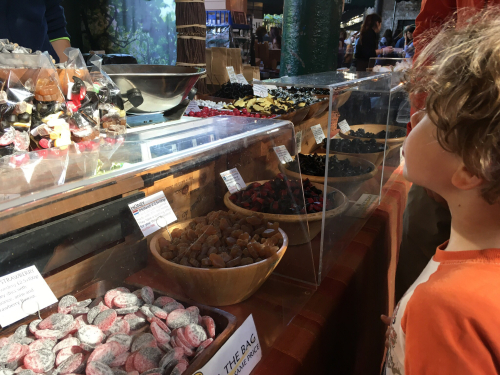
    The man at the liquorice stand got plenty of business from us.

    I also bought, for our dinner tonight: spiced-pear chutney, two cheeses of sorts recommended to me by the chutney-seller (a creamy blue and a soft runny cheese, but both carefully selected to be mild so that the children might like them; I needn’t have bothered), and two proper-looking Bavarian soft pretzels. The 17-yo asked for some clementine-like citrus fruits that he had sampled and declared amazing, and Mark chose three saucissons from a seller.

    Then we had lunch! At first we thought we might find a table in one of the restaurants around the edges, then we thought we might leave to find a restaurant, and finally Mark decided he would stake out a spot near a bench and keep the 3yo while the rest of us fanned out to find food. “Just buy me lunch,” he instructed, “well, lunch for you and for me and for the two little boys,” so I took the 7yo and headed towards where we had seen an array of sellers of hot food.

    A thing about the 7yo is that he does not like sandwiches of any kind, so we took a while in finding a not-sandwich. He agreed to a meat pie that promised to be filled with beef chili, beans, and cheddar. Relieved to have found something for the 7yo, I bought Mark a meat pie filled with beef and smoky bacon, plus mash on the side, no gravy; and a couple of sausage rolls for the 3yo, hoping that he would like them.

    I delivered the child and the food to Mark, who had found a place to sit, and went off to find something for myself.

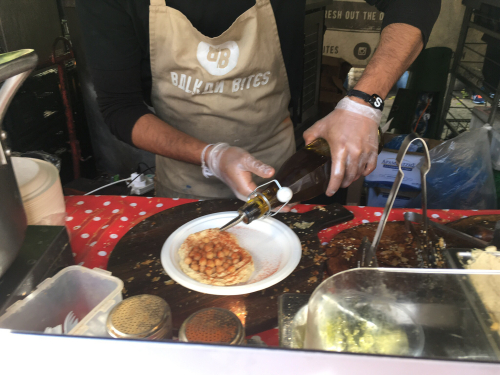
    Börek!

    Mine was filled with seasoned spinach and soft tangy cheese, and served with a pile of spicy chickpeas in a nest of hummus, with green chili relish.

    SO GOOD.

    I let the 17yo (who was contentedly deep in a meat pie) have a bite, and he thought mine was better than his.

    And the 3yo adored the sausage roll! The pastry shattered into little bits all over his pants, but he was very happy. I may have to try making these at home. At least I know what to feed him (other than square bread and orange cheese sandwiches) for the next week.

    Sadly, the 7yo did not approve of the chili pie, so he had to settle for eating a bunch of candy for lunch. Poor kid.

    As for Mark, well, in my rush to get him something with bacon in it I had forgotten that pie is not really his thing. He ate it and it was fine, and he was perfectly nice about it, and of course he had told me I should just get him any kind of food, but I felt bad anyway, just from my own spousal misfire. I had failed to blow his mind as I had hoped with amazing meatiness and bacon and gravy sealed in a flaky crust, because pie is not the sort of thing that blows his mind.

    I always forget this. B
    ecause what kind of person doesn’t think pie is super awesome.

    Sigh. I’ll do better next time. Why don’t they sell meat crumble?

    + + +

    The 2 pm show at the Old Operating Theatre was billed as unsuitable for kids under 7. I volunteered to skip it and take a turn with the 3yo. On my back, he could ride along with me to the Tate Modern. Maybe we could meet up afterwards and go to the Globe if the kids weren’t tired, or we could just call it a day.

    Mark was on the “just call it a day” team. I thought we could leave it open, perhaps. #foreshadowing #MarkWasRight

    + + +

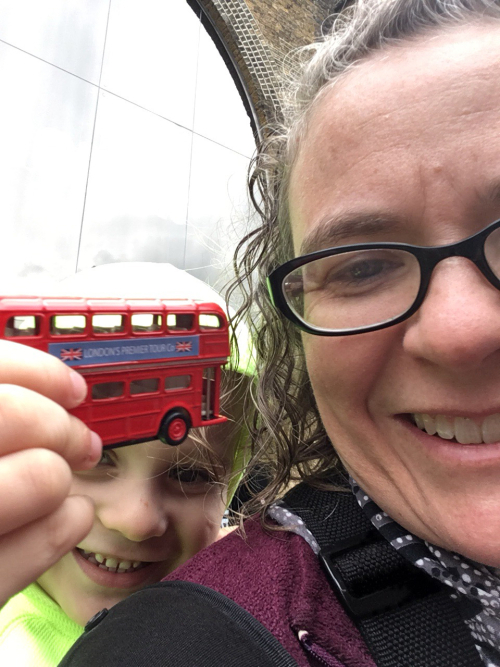
    I love just walking through cities and seeing the sights and people, and so for me, the South Bank of the Thames, between London Bridge and the Millennium Bridge, was pure delight. I was so glad to be there on that I went into the first souvenir shop and bought the 3yo a toy red bus for £3.99.

    This random purchase turned out to be a good value, as he chatted to himself about it for nearly the whole walk that followed, and only dropped it a couple of times. He was also happy to get a penny in change.

    “…their virtues we write in water.”

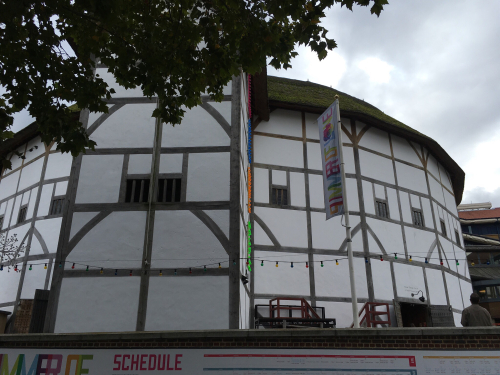
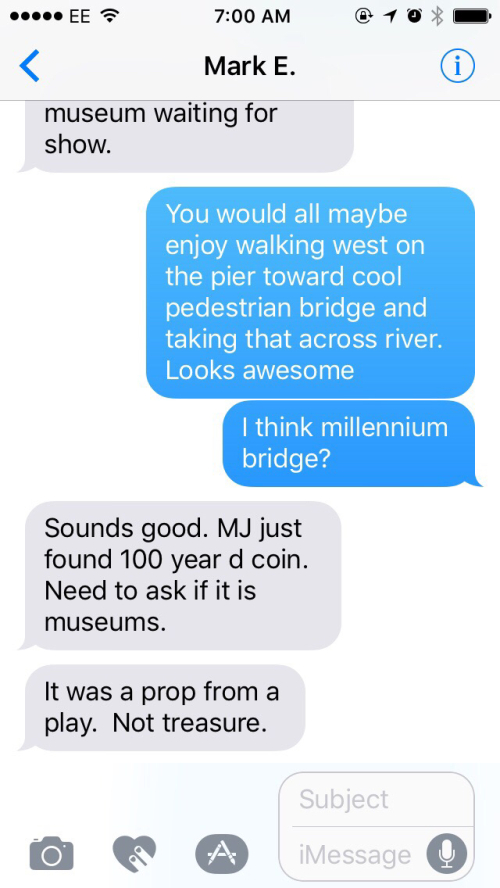
    The line outside the Globe was super long. I texted this information to Mark. He was in the Old Operating Theatre museum with the kids waiting for the show. We had this exchange:
     
     
    On to the Tate:

    With an impatient 3yo on my back, I couldn’t stay long. Enough to get a sense of the building, its space and its contents. It is sprawly, with large rooms, in two towers connected at floors 1 and 4 by bridges.

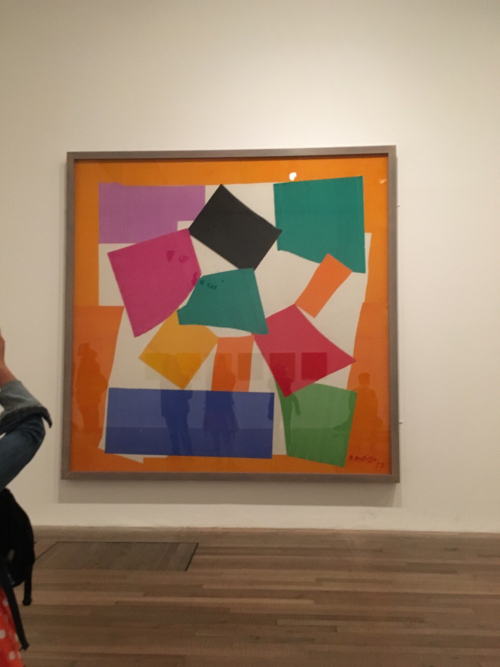
    I saw a Matisse:

    Also a Kandinsky and a Picasso and a Calder.

    There was a delightful installation of a plate-glass disc, suspended vertically on the ceiling in a small cube of a room and steadily rotating. A spotlight was trained on it from the side; the disc had been treated somehow to reflect blue light and to transmit yellow, so as the disc rotated it cast a blue reflection that revolved around the room, growing and eclipsing with the angle of reflection; and it cast a stationary yellow reflection that also grew and eclipsed. The moving blue spot collided with the stationary yellow spot every time it came around, of course, at the same moment that each shrank to a line’s width, and the 3yo cried, “Bang!”

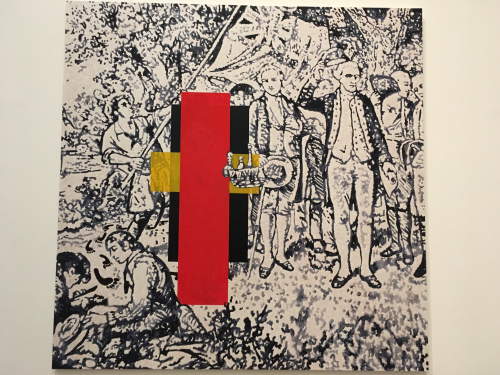
    I liked this, Gordon Bennett’s Possession Island (Abstraction), acrylics, 1991:

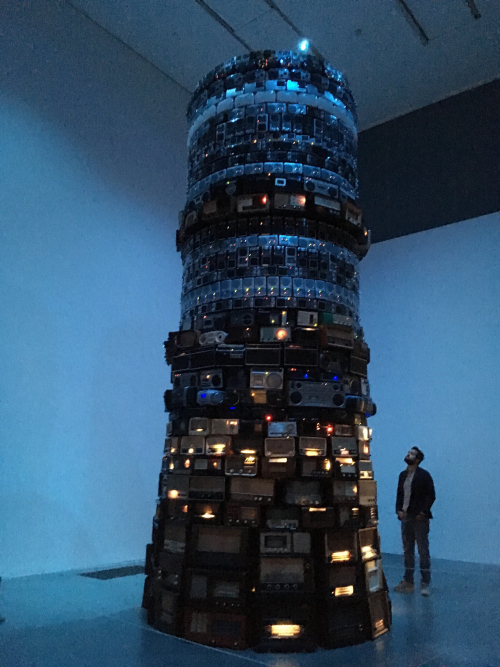
    And this, a sort of Tower of Babel made of old radios, all tuned to different stations:

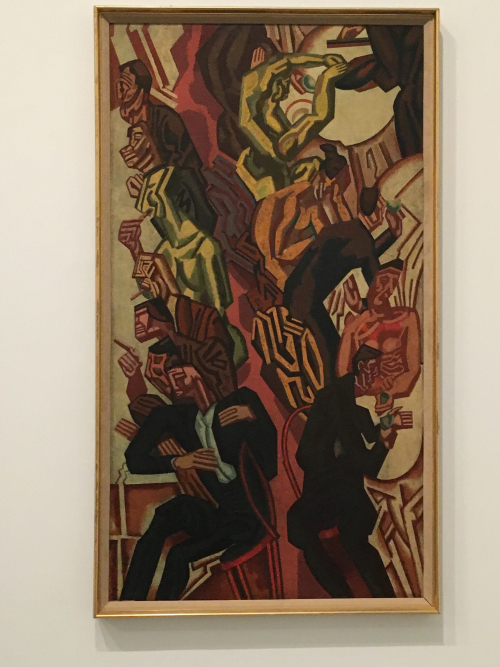
    And this, William Roberts’ The Diners, oil, 1919:

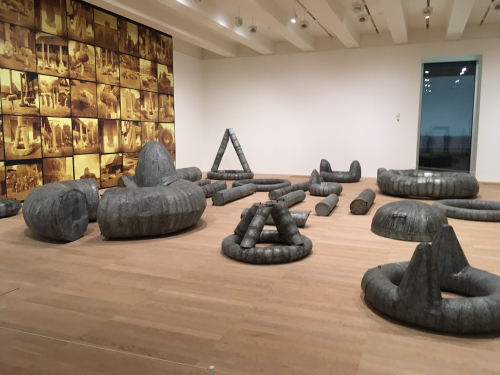
    And this installation (it’s a long story; the artist started, performatively, by engaging a village to make wheaten wreaths for her annually; she had to stop; she tried different means to preserve the art somehow; she settled on sealing the wreaths in metal “tins” in which they are presumably decaying.)

    The 3yo had had enough, so we started on a walk back to the flat, via the Millennium Bridge.

     
    It affords lovely views. I enjoyed the walk and so did my little partner.
     

    I got a new view of St. Paul’s in a reflective ball on the other side. Unfortunately, it’s dented right where you would get a full straight angle at the dome.

    Around past the side of St. Paul’s. Take that, Mary Poppins:

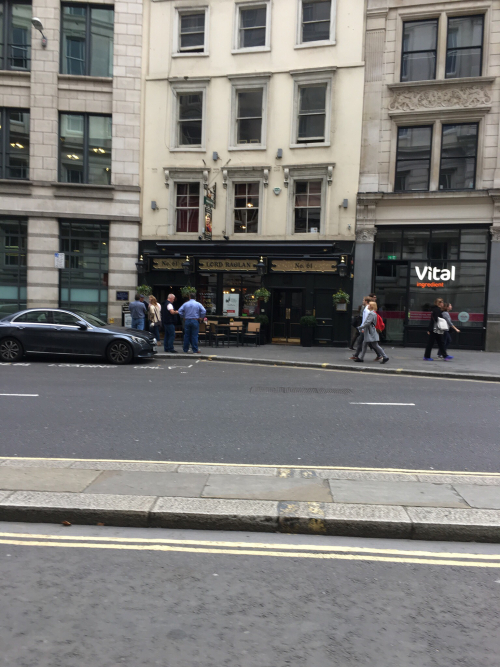
    Many photos of ordinary London street scenes, like this:

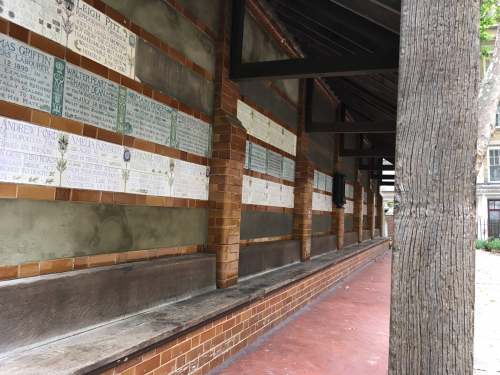
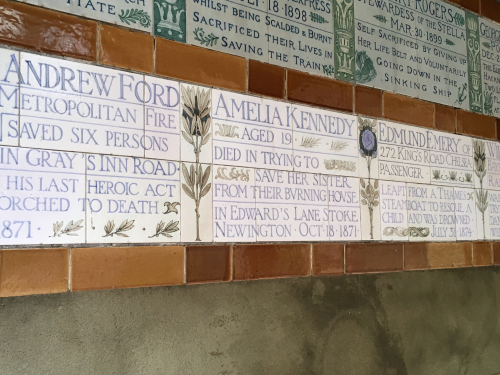
    Postman’s Park, a little green jewel of a space, contained this intriguing sheltered wall of glazed-tile texts:

    It is a work of private art for the public, a memorial to everyday heroes.


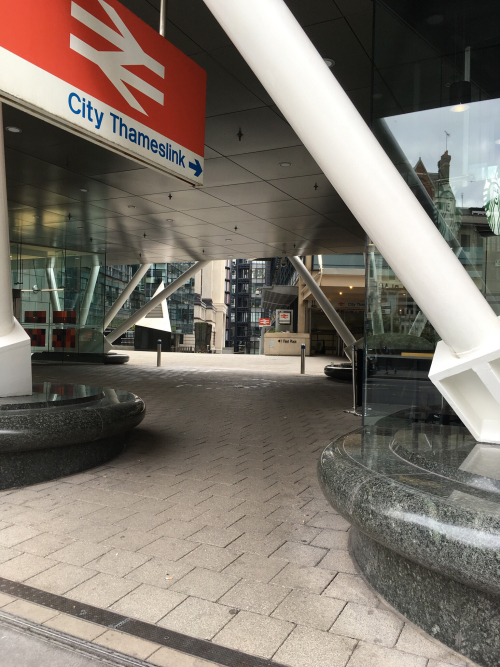
    I enjoyed the many-layered angles of this view through a building to who-knows-where (besides the City Thameslink, that is):

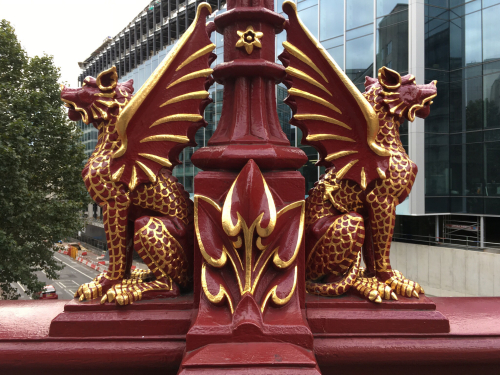
    I crossed the Holborn Viaduct, its rails brightly painted, studded with these dragons that remind us we are within the jurisdiction of the ancient City of London. A worker on the opposite side of the bridge had a big fluffy duster on a pole, and was carefully dusting the metal lions at the other end.

    A glimpse through a gate.

    Fleet Street.

    I passed the Temple Bar memorial, and turned to get a photo of its dragon in the center of the street.

    I stopped at the grocery store before finally coming back to the flat. Mark and the other kids had arrived only minutes before me. He left again to take some of the kids to Mass (I planned to go Sunday morning early, along with the 17yo), and, after resting a while watching “Horrible Histories” DVDs, I set up a dinner.

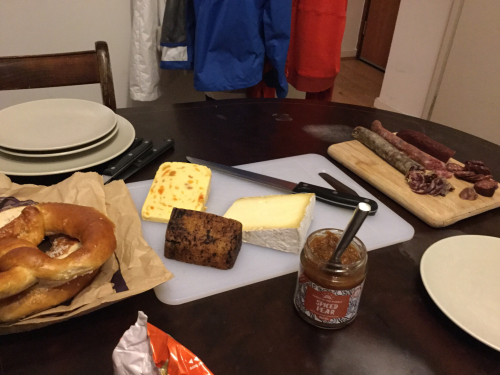
    Pretzels, cheeses and chutneys from Borough market, apricot Wensleydale, saucissons. And hummus and veg and cut mango and blueberries and crackers and Irish soda bread and leftover chicken soup. And a bottle of red wine, Montepulciano from a store somewhere around here.

    We were tired, and I planned to get up early; so off to bed for me.


  • Tower and St. Paul’s.

    I have to be brief today!
    Friday we decided to go to the Tower, the one place Mark has insisted we must go, despite (because?) having seen it before on a business trip.
    We went by bus. The bus that came was a lowly one-level, which saddened some of the children. The rain might have kept us from seeing much anyway.

    But I did catch a tantalizing glimpse of St. Paul’s as we swung past.

    The Tower, of course, figures heavily in history and also in some of my favorite books. I have seen a map of it many times, with historical overlays and such, and wondered if it would feel “right-sized” when I got there. Not so much its height but its layout. It is, after all, nearly a tiny walled village. Would it feel as broad and wide, as compact and enclosed, as it did in my mind’s eye? Its walls as thick, its towers as stout?

    Remarkably… it did! The books I read must have done a good job of evoking it, because I almost felt as if I knew my way around.

    We took the Yeoman Warder’s tour. These fellows are showmen (and, presumably, show-women), with many prepared one-liners for the crowd.

    “Any Australians here? There’s always some! Well, you all must feel right at home, here in an English prison!”

    “Americans? Yes? Well, if you had been quicker about paying your taxes, all this history could be yours! How’s democracy working out for you these days?”

    “Speaking of democracy, for this next part of the tour I’ll be taking a vote. Shall we hear about prisoners, death, and executions? Or shall we hear about unicorns and kittens?….. I’m always glad when the prisoners, death, and executions wins, because I only have one unicorn story. It’s about a unicorn trampling a kitten to death.”

    The 7- and 11yo’s were quickly cured of their despair at having been roped into a guided tour. When it was over the 7yo was astonished to learn that it had lasted a whole hour.

    Here is Traitor’s Gate, the trip through which was described in detail by our Yeoman:

    And here the central fortress, stout and looming and impenetrable-looking at the time, meant to cow the City of London into submission:

    I had to leave in the middle of the tour to take the 3yo to the toilets, and when I returned the family was seated in the middle of the chapel listening to the end of the tour. (I had to convince the Yeoman Warder keeping non-tour tourists out of the chapel to let me past the chain.) I decided not to try to take him back in and hung about just outside, looking at the private living quarters, some of them in literal (Tudor) row houses. I suppose this window is over somebody’s kitchen sink.

    Afterwards we walked along the top of the north battlements, which takes you through a few towers that have been set up with exhibits of one kind or another (e.g. The Princes In The Tower, with a rather frightening short animated film being shown, in a style that reminded me of Fiver’s dream in the Watership Down movie). And we went through the Crown Jewels exhibit, which was relatively uncrowded (we walked right up to the moving sidewalk) and which I liked better than I expected.

    I mean, you just have to be impressed when you find yourself in front of a beautifully crafted, gleaming golden spoon, looking brand new, and then you find that it’s well over eight hundred years old.

    + + +

    The Tower, for me, is a good example of the sort of compromise you must make when you travel with smaller children. I could spend the whole day there. I would want to walk over the whole thing, with a good map (can you believe the maps they give you when you come in don’t even have the names of all the towers labeled on them? Only the famous ones) and really understand the distances, take it home in my head as something I have gotten to know a little bit. But you simply cannot do that with kids under 12, unless they happen to fall in love with the place right then and there.

    We ate in the cafe so we wouldn’t be hungry, and then we left.

    + + +

    It was a twenty-four-minute walk to St. Paul’s, and not much faster on the tube or bus, so to avoid the complications of transit we walked there. We did get a feel for the distances, and admired the big buildings in the City of London.

    I don’t have many pictures of St. Paul’s. I was busy herding children on the exterior, and inside photography is not allowed, as far as I can tell.
    All I really wanted to see, in St. Paul’s, was the building itself. We split up, since I had the 3yo on my back, so that Mark could take all the others up to the Whispering Gallery right away. I wandered around, relishing the sense of space, walked right to the center of t
    he dome and looked up, admiring. It really is, in terms of pure aesthetics, one of the finest domes I have ever beheld: not the tallest or widest (I have been to the Pantheon, I have been to St. Peter’s, I have been to the cathedral in Florence) but possibly the loveliest.
    My family hadn’t returned yet, so I went down to the Crypt and wandered around, stepping on the tombstones that make up much of the floor. Found Wren’s memorial, and William Blake’s right by, and John Rennie’s great polished-granite block.

    + + +

    I found Mark sitting in a chair in the middle, and passed the 3yo to him so I could climb the steps to the Whispering Gallery. The 13yo and 7yo went with me to show me.

    This week, the path up to the gallery is by a different staircase from usual, for some reason (perhaps workis being done on the regular stairs?). The “Secret Stairs” were frighteningly narrow and steep, not to mention numerous, and I was very glad that I hadn’t attempted them with a child on my back. The muscles in my thighs trembled by the time I was up.

    These stairs take you to a passage where you can see between the two roofs. I didn’t see any no-photos sign here, and we weren’t in the worship space, so I tried to snap one. Too dark for the photo. You could see the gray humps of vaulting through the gloom.


    The Whispering Gallery is fun. It really works! A couple of rows of benches encircle the dome. I sat with the 7yo directly across from the 13yo. A handful of other people paced or sat. We waved at each other. At first I thought I couldn’t hear anything, just a strange, pinging echo, a general murmur, like being underwater: sound comes from far away, strange directions, distorted. Then I heard the 13yo’s voice, clear but still far away, and I thought at first he had shouted, or spoken sharply, to me across that wide space. And then I realized he hadn’t been shouting at all.

    I tried it. “Hello?” My own voice came back to me an instant later, distorted and sharp, again like an underwater reflection. You couldn’t say where it was coming from, it was just there, as if inside your head.

    Before leaving I walked swiftly all the way around, my eyes trained on the floor far below, on the upper-floor corners (full of church things like stacks of folding chairs and cardbord boxes) under the evangelists, watching them turn below me, and felt I was flying.

    + + +

    To the store with the 11yo for groceries for dinner.

    St. Paul’s may be a marvel of engineering. I am less impressed by the self-checkouts at Sainsbury’s. I cannot please them.

    The assistants who have to bail me out five or six times per transaction are probably similarly unimpressed with me. It always climaxes with the trouble caused by a chip-and-signature card.

    I made macaroni and cheese for dinner. I forgot both the garlic and the mustard, but the shredded English cheddar was so beautifully sharp that no one missed it.

    I added broken-off bits of a slice of Red Leicester to the sauce so it would be ever so slightly orange for the sake of the youngest children’s expectations. I served it with steamed green beans, a can of Heinz baked beans, and fresh blackberries.

    Mark and I went out, to a Puglian wine bar called Li Veli. My dinner was better than his. We split a grilled vegetable appetizer (eggplant, zucchini, asparagus, tomato, long slivered onions); he had the sea bass, with potatoes and bitter greens; I had an orecchiette-like pasta with turnip tips, anchovies, cherry tomatoes, and bread crumbs.


  • Engines and Parliament.

    With Mark back from his business trip to Sweden, I realized that there was something I wanted to do with just him, not distracted by the younger children. But he had a Skype meeting at two and planned to work after that until dinner.
    So in the morning we woke up the teen boys and told them they had to babysit. And we headed off together…
    …to the Science Museum.
    + + +
    I know, I know. The Science Museum in London is probably one of the best places in the city to take children. And I do plan to take them. It’s free, after all, and relatively easy to get to.
    But I wanted to take Mark to Energy Hall to see the steam engines.
    + + +
    Which did not disappoint! There is a huge central room on the ground floor full of enormous machines, from the black and stained to the gleaming and polished. It is dominated by one in the center with a brightly painted wheel, several meters in diameter, grooved deeply on the outside, which once supplied the power for 1700 looms in a factory.
    There is a progression of historical steam engines, from the earliest meant to draw water from mines, through Watt’s and on to more advanced ones. For example, the oldest surviving “atmospheric engine” is here, used for pumping water up from mines; it gets its name because atmospheric pressure supplies the force for the return stroke, as cold water is injected into the steam chamber to condense the steam rapidly and create a vacuum.
    Each engine is accompanied by a well-design touch screen which includes a careful animation of the operation of the engine, so you can see exactly how each part of the cycle worked, while standing in front of the engine itself and able to see all its parts. It’s one of the best-designed galleries I have ever seen.
    I was so busy enjoying it that I forgot to take pictures. Mark and I moved from engine to engine, sometimes studying them, sometimes just enjoying them.
    We laughed at an apologetic description: “These machines may look crude, but in fact they were among the most advanced technologies of their day.” Crude? How could they look crude? They are beautiful. And they are amazing, when you pause for just a moment and think about the constraints upon them when they were made. I see nothing crude about them. They had to drill smooth, straight bores through narrow cylinders that were meters long, for the pistons. They had to make pressure vessels out of metal that was not steel. They had to invent the machines that made the machines.
    I was very taken by a description of how the designers of one very popular sort of engine for factories supplied to their customers only the blueprints, so to speak, and a professional engine erector to oversee the work; it was up to the owner of the new engine to obtain local laborers and even to source parts. I had no idea that the economy of engine-installation had been so decentralized. But the expertise must have been in such high demand then, with comparably few designers and so many new machines needed. How could it have been any other way?
    + + +
    “Clockmaker’s museum,” read Mark off the museum directory, but I said, “No, no, we have to go through ‘Making the Modern World,’ that is why I brought you here. Besides the steam engines, I mean.”
    And… in a series of displays that were lit from beneath, good for drama, not for photography…
    A Cooke and Wheatstone Telegraph!
    Davy’s safety lantern with its wire mantle! (On the right.) Lister’s compound microscope—that is, Lister the surgeon’s dad’s microscope. And that spindly thing second from left? Faraday’s magnet and coil. Faraday’s!
    Look! A Jacquard punchcard loom! I ran around it and halfway up a staircase so I could get a good look at the cards.

    The original pilot Bessemer converter! Not a copy. Not one in a later factory from Bessemer’s design. Bessemer’s own kettle from which the very first cast of mass-produced steel was poured:

    “This is where it came from,” Mark said in real awe. And then, in a case next to (oddly enough; but it was at about the same time) Elias Howe’s sewing machine:

    James Joule’s calorimeter!

    I may have teared up slightly.
    + + +
    There were many other artifacts, too many to photograph. Roentgen’s X-ray apparatus is
    there, for example. And here is Bragg’s X-ray spectrometer:
    Having spent time in the company of modern ones, I was charmed by the wooden supports and nearly struck dumb by the necessity of obtaining parts for it from a machine shop.

    Here is Watson and Crick’s DNA model, reconstructed from some replica and some original parts (particularly the metal plates that represent cyclics) as they had built it to show physically the three-dimensional structure of the double helix:

    “It’s made of ring stands,” I pointed out to Mark.
    Along the sides of the gallery are a collection of technological artifacts from everyday life: porcelains and plastics, wood and textile and metal, the materials and tools and machines that surrounded ordinary people in what must have seemed ordinary times. I took a picture of a breast pump, with a tulip-shaped glass bell that fitted to a brass piston:
     

    We finished out the gallery, hung with airplanes (“I am always amazed those old metal prop planes could fly,” said Mark, “the early ones are light like gliders and the later ones had jet engines and better metal, but these middle ones I cannot believe could get off the ground”) and cars; penicillin, thalidomide, modern dentist’s drills, anesthetics, an early MRI machine, a Cray-1 supercomputer.

    There was so much in that one gallery alone, I could come back and spend the same amount of time again, and still not see all I wanted.

    That’s good, because I really should, you know, bring the kids here.

    + + +

    Upstairs we went to the Clockmakers’ Museum. Much of what they have here is similar to the smaller, concise gallery in the British Museum, but there was one historical piece I made a beeline for: Harrison’s “H5” marine clock.

    We marveled at the tiny, beautiful watches. I honestly had had no idea they could make watches that small that early.

    Everything was really beautiful. The worksmanship, top notch. But there was a bit of the interpretation displayed that issued a sort of caveat. The English clockmakers had refused to accept that their customers wanted more affordable goods, with less-than-top-quality (but still functional) construction, and foreign-made affordable goods put many of them out of business.

    One of my FB friends, on seeing the photo of the old cash register from the British Museum that I shared a couple of days ago, commented “I wish they made ordinary things this beautiful today.”

    Beauty can be made at any price, I believe; but the nature of economics is such that if you will not sell people the thing they want at the price they can pay, someone else will.

    + + +

    We had to go, so that we would have time for lunch before Mark’s Skype meeting. On the way out I took some pictures in the first gallery, Energy Hall.


    + + +

    When we got back, I queried the children and settled upon walking in for a tour of Parliament. My daughter frowned and said, “I don’t like tours. Tours aren’t fun.” I have limited patience for making eleven-year-olds do things they don’t want to do, especially when I am on vacation, and don’t have help from a spouse (remember, Mark had telecommuting work to do), so I took the teen boys.

    You aren’t allowed to take photos except in a few places in Parliament. I took one in Westminster Hall.

    This medieval hall was really the thing I came to see, the only surviving part of the earliest Parliament building, but I enjoyed the whole tour. The audio tour was really quite well done, and I enjoyed the artwork, the statuary and paintings of kings and prime ministers, the spot on the great wooden door that is splintered from being ceremonially bashed by the Queen’s representative to be let in. We wondered at the system of vote-counting where the members physically sort themselves into “yes” and “no” lobbies (or, in the House of Lords, “content” and “not content” lobbies) and file past the clerk in person.

    Standing in the House of Commons, walking up the steps to the top rank of green benches not so far from the ones on the other side, you sense how claustrophobically small it is, how the opposing parties face one another, and how very different in character it is from the U. S. system. My boys found it fascinating.

    + + +

    We emerged from Parliament just a few minutes too late to enter Westminster Abbey as tourists, so we continued north, past the Treasury, to the Churchill War Rooms, and took the tour there. It was even more claustrophobic, but very interesting, especially the map room, and filled with small artifacts like job acceptance letters, memos to staff, and a do
    or hung with dozens of keys and their handwritten tags. There is a Churchill Museum that is part of it, with interactive displays on the life of the prime minister, but we skipped that for lack of time and explored the underground government bunker only, with the aid of the audio tour. I was pleased by the heavy sculptured telephones, some of which could be switched from “Normal” to “Scrambled,” and by the voice interviews coming through on the audio tour with women who had worked as typists and switchboard operators, never talking to their families about exactly what it is they did at their jobs in “an office” until after the war.

    We reunited the family at dinner time and headed off to an Indian restaurant for a feast of papadum (“This minted chutney tastes like key lime yogurt.” It did), and onion bhaji and tiny samosas and chicken pakora, and lamb vindaloo and tandoori chicken and dal and sag paneer. The little children had fish fingers and fries. Our waiter chatted with us for a long time about different things to see in London, asking about where we came from, and when Mark asked where he liked to eat, admitted that his favorite food was made in his own kitchen.
    Back at the apartment, we dropped off the kids and headed to another pub. Just one pint for me, thanks; I was nearly exhausted. We sat for quite a while, looking around at the interior, on a leather (or leather-like) banquette seat that ran around the back of the pub next to the fireplace.
    “No restaurant at home is such a welcoming place to imagine meeting a friend for a beer,” said Mark.
    “It’s the materials,” I said, “they’re so much warmer than any restaurant or bar.” The paneling was a dark polished wood, the floor was Oriental-carpeted, the fireplace set around with colorful tile, the round, wooden tables were crowded closely together in this back room, a little randomly as if they’d been left behind by a large group of friends who had moved them closer and pulled up their chairs, squeezing into the space. The walls were a mass of framed photographs (the sort signed by actors, but the effect was of a wall of family portraits) and theater posters. A staircase with a carpet runner and a wide polished bannister went up and around a corner. A television was on, and music played, but not so loud as to squelch a conversation.

    I was too tired for another pint, but not too tired for a meandering walk through Seven Dials and Chinatown. I’m amazed at how dense the small boutiques are, there’s no such thing it seems as an alley that goes behind things; everything is full of storefronts. The energy of people and crowds are everywhere. You can just walk and walk and take it all in for hours.

    Back to the apartment, and a collapse.


  • Buses, coaches, and everything else.

    On my way out to get some cash from the machine in the morning, I happened upon a strike march, complete with loud upbeat music and vuvuzelas.
    Just an odd note. But if I were going to give this photo a title, it would be “Wait/Look Right.”
    + + +
    I came back and gave the cash to the teenagers for lunch. They had offered to stay home with the 3yo so I could take the 7- and 11yos somewhere without him. “Should we go on the tube to St. Paul’s and climb up in the Whispering Gallery?” I asked. “Should we take a bus to the Royal Mews and see the Queen’s horses? Where do you want to go?”
    “I want to stay here and sleep,” groaned the 11yo.
    “I want to go on the top of a bus,” said the 7yo, “really anywhere.”
    So I went out with just him.
    I thought the Mews would be a good place for him, anyway, because he is interested in horses. So we waited for the number 38 bus, touched in my card, and climbed the steps to the upper level, swaying a little and clutching at the handrail as the bus accelerated away from the curb.
    I am glad I only had one child to manage for my first bus trip. It turns out that the London buses are not hard to manage or to figure out, but I am wary from having lived and traveled in cities where they can be more confusing.
    It was a twenty-minute ride or so, fairly scenic, with lovely views of Green Park toward the end, and the bus let us off just across from where we were going.
    As we walked in the first door, a staffer with long straigh gray hair and a kind face pointed out horses exercising in an indoor yard just visible over the sill of a half-door. I lifted him up to see. “Those are the Windsor Grays,” she said, “though they look rather white. They’re the queen’s horses, and in a procession she’s always pulled by those. You’ll learn more about that on the audio tour.”
    “No thank you,” he said, “I don’t really like tours.”
    “You really ought to take the player with you,” she said, “it’s very fun and tells you a story. If you don’t want to listen to it, you can always take it off.”
    He decided to give it a try.
    The children’s audio tour was nicely designed, with a little video on the player; a couple of horses (and a corgi) take you from stop to stop, and you can skip the details or click more to hear and see more of them, like interviews with staff.
    We looked for quite a while at the various coaches. The newest one, only a few years old, is fitted with many shock absorbers for a gentler ride. I liked the older ones myself.


    It’s very interesting how they have put rooms of a working stable behind glass for visitors to see. I am sure there is much more going on behind the scenes. We saw the Harness Room, and I pointed out the leather-polishing equipment on the table, and the perfection of the finish of the leather on the hanging harnesses.

    Under the table: a child’s toy pedal-cart. The 7yo tried to convince me it could possibly have belonged to Prince George.

    Children do live here, in apartments around the central courtyard, with their parents who work here. This idea fascinated him, and he surveyed the balconies and thought aloud about what it would be like to live among the Queen’s horses.

    In a grand stable hall built for George IV they no longer have horses, but they have a carriage replica you can sit in, mounted on springs, that rocks from side to side if you lean.


    And a dress-up closet with miniature uniforms.
    And a wooden pony with a harness you can take off and put on again. The harness was already on the pony when we arrived, with the reins pulled back and draped casually over the hanging hooks, and the 7yo set himself to trying to take it off. He ignored the numbered step-by-step instructions written on the sign behind the horse and went for the nearest buckle.
    An older British couple was coming through taking pictures. The woman said to him, “Oh dear, you’ll never get it off like that. First the reins, and then this bit over here, and then this comes off after that.” She placed her hands on the leather, and I could see she knew what she was talking about.
    “Thank you,” he said, “but I want to figure it out by myself.”
    They went away, and while he struggled I walked around, looking at the smaller carriages displayed here: everyday carriages, and a miniature one that royal children used to use, pulled by a pony. Words from books, like “brougham,” known only in a vague fog before as a wheeled thing pulled by horses, condensed into a solid object.
    After a long time in that room, the 7yo gave up on the harness and instead spent time standing behind the wooden pony with the reins in both hands, shouting “Giddyup!” I got him to buckle up what he had undone and put the reins back, and we went on to the tour’s finale, which is the Gold Coach.

    Commissioned in 1760 for George III and still in use, albeit rarely (I think it was last in a procession in 2012), it only goes at a walking pace and yet requires 27 meters’ braking distance. The wheels are not spoked in a plane, and so they are tilted outward to make the spokes meet the ground at 90 degrees.


    We put our audio players in the slot and headed back outside. Google Maps told me to walk to Green Park station to get either the bus or the tube, so we started off toward Buckingham Palace.

    Just as we got there, there was a blare of a marching band, and the crowd there started moving from the outside in, with people dancing about on the fringes trying to get a good view on their phones. I could see horses.

    I looked at my watch. Eleven-thirty. We had stumbled upon something I hadn’t planned to see at all, because it isn’t really my thing: the changing of the guard.

    All that we saw was a brief little parade from the front of the palace, out the gates and across the street into another gated yard (Wellington Barracks). But it impressed the 7yo anyway. He made me follow the crowd, climb through a handrail separating sidewalk from street (lots of other people were doing it) and cross over so we could get a good look. The music was all over quite soon.

    I had gotten turned around with our rush to figure out what the music was, so we walked the wrong way at first, and then when I figured it out the 7yo nearly collapsed in despair for his lunch. I promised to feed him before we got on the bus, and worked out that there would be food available near Green Park station.

    We took a quick selfie in front of Buckingham Palace, to celebrate accidentally seeing a quintessential London tourist thingie we hadn’t meant to.

    Then walked north through Green Park while the 7yo fretted about how long it would be until he could eat lunch, as this was obviously an enormous park that would take forever to get out of.
    We made it out, however, and after searching for a place to cross the street, found ourselves at a Pret-a-Manger. “I don’t like sandwiches,” protested the 7yo, but I enticed him in with the promise of a Tuna Melt Toastie.
    He always forgets that he likes tuna melts.
    For me, a Posh Cheddar And Pickle Baguette, with kale chips and a petite bottle of carrot juice.
    I had a clueless culture moment when, the place nearly full, I set the child on the last empty stool in a long bank against the window, figuring I had room to stand at the end myself. A few minutes after I had done the work to set him up, opened his drink, extracted onions from his sandwich, etc., the woman seated at the stool next one over turned and looked at him pointedly a couple of times, with a look that I associate at home entirely with “I was dining here peacefully and then you had to g
    o and put a child near me where I might hear it.” I ignored the look, because that is what you do (where I come from) when people glare silently at your children who are behaving perfectly fine.
    (It’s different if they are misbehaving or having other difficulties like spilling or being audibly sad. Of course I acknowledge that. But I generally don’t apologize for children’s merely taking up space in places they have every right to be. And yes, you do encounter people who think otherwise. And I generally respond by behaving exactly as if nothing is wrong.)
    A few minutes later a man came by with the tray and the two of them gathered up their things exceedingly rapidly, too fast for me even to realize what had happened, and left, presumably in search of another pair of seats together, without ever saying anything to us, let alone “Oh, do you mind, I am saving this seat.”
    Ahhhhhhh. I see what you mean now about the silent seething.
    That was embarrassing. In my defense, I come from a land where the apology would have been expected to come from the person taking up two seats in a crowded restaurant.
    But, you know, when in Rome. I’ll try to be more alert next time.

    The top of the bus, home. Front row this time, which really does afford a nice view.

    + + +

    Back at the apartment, the teen boys were slurping down the last of the noodles from their second Wagamama order in eighteen hours. “What shall we do now?” I asked, and ticked off some choices.

    We went for the London Transport Museum, which is less than fifteen minutes’ walk away, in a structure that was once the Covent Garden flower market. I carried the 3yo until we got there, and then put him down because it’s the sort of museum where little children run around frantically pushing buttons and having their paper passport punched at different stations.


    The building itself is really cool.

     
    And there are plenty of interactive exhibits, especially for kids who like sitting behind Driving Wheels.


    Spent quite a bit of time in the play structure designed to look like a Tube station. Was amused that they included the detail of a busker’s open violin case on the floor, with some percussion instruments to play.


    I was able to enjoy the exhibits myself, too. I loved a diorama showing how the Underground was built, by digging a trench, laying tracks, and roofing it over; miniature people standing in miniature back gardens with a gaping hole behind, planks laid over the edge to give them a way to walk to the shops. I played with the subway-driving simulation (key to success: begin braking long before getting to the station) and took pictures of the kids seated in various restored vehicles, from horse-drawn omnibus to twentieth-century double deckers.

    On the way back we stopped to get ice cream from a shop we’d seen on the way in, just before arriving at Covent Garden. Our 3yo can be messy like any 3yo, but he has inherited his dad’s ability to consume an entire ice cream cone without wasting any, faster than the ice cream can melt. So (after myself removing just a bit of the excess, to be sure) I had no compunction about ordering him one and letting him eat while walking in London, holding my hand. He was barely sticky when it was gone.


    I was completely exhausted when we returned. I sent the teen boys and the little boys back to the apartment, and went with the 11yo to the store, where I bought things I could cook. The easiest scratch meal I could think of: chicken soup. I bought a small whole chicken, and onions and celery and carrots, and salt and a package of fresh tagliatelle, the only egg noodles I could find.
    Then back to the apartment where I discovered there was no soup pot big enough to hold the chicken.
    I opened a cider and drank it (rapidly), and then made do by spatchcocking it and squashing it into a deep saucepan with the whole aromatics and as much cold water as I could fit. Not enough for a proper quantity of broth, so after it was cooked I retrieved the aromatics and bones and stuffed them into a smaller saucepan with more water to make a second batch of broth. Into the first batch went the diced aromatics.

    And when that was done, in went half a kilo of noodles, which soaked up all the liquid. In the end we had to assemble our bowls from one pot of broth, one bowl of shredded chicken, and one pan of noodles and veg.

    + + +

    I fell asleep before Mark got back and failed to answer his texts asking to be let in, but fortunately our teen son was awake. And that was one day.


  • British museum and a short solo outing with a purpose.

    My teen boys are using their vacation, in part, to—get this—relax.

    Plenty of this going on with the little ones, too.

    Tuesday Mark had to take off for a business trip. One of the ways we managed to pull together such a long trip is by having him do some work while we’re gone: a few days of telecommuting and some European business that he would have had to travel for anyway.

    With him not here to help, I planned something fairly easy:

    Yes, it’s enormous, but it’s also a five-minute walk from our apartment and free, so we can just go in, spend time, and leave again, and come back later easily if we want.

    My plan: all five kids and I would go together at the ten o’clock opening, see what we could manage before lunch, have lunch there, then split up. The teen boys could go off on their own together, and I would take the younger ones back to the apartment to rest.

    There is a little line outside just to get through security. They look in all your bags and purses and don’t allow large ones. They did not have a problem with the child carrier, but they do not like it if you absent-mindedly take a picture while you are in the security tent (ask me how I know).

    We made a beeline for the Egypt collection.

    The Egyptian artifacts are so numerous as to be overwhelming. We had young ones, remember, so we could not give each item a very close scrutiny, but I left with a strong impression of the painted and carved funerary objects as items crafted by real people with individual styles and hands. The picture-words aren’t printed or stamped, each bird and stream of water isn’t the same as each other; there is a fleeting imperfection to each one, as in pop art paintings where the artist has reproduced some scrap of text in the Courier font by hand-drawing and inking each enlarged letter-form.

    My 3yo, on the 17yo’s back, greeted the canopic jars: “It’s a bird pot, and a dog pot, and a monkey pot, and a person pot.”

    I marveled at the painted linens and funerary portraits from the Roman period. The realism, the twinkle in the eyes:

    It isn’t hard to find the Rosetta Stone; just follow the crowds. We squeezed through and got a good long look at it, up close and personal; the best unobstructed view was from the side of the case, which still got you a nice good view of the inscribed texts on the face of the stone. I took a moment to point out to the 7yo the everyday, easier-to-write Egyptian script in the middle. What a treasure, this otherwise plain black rock, unlocking all the gloriously painted ceremonial writings on all the funerary objects in the other rooms.

    Here’s what I wish, though: That, however lengthy and tedious and repetitive it might be, that the museum would post by the hieroglyphic objects the translation of the texts that are written on them. I don’t just want to look. I would like to know what everything said.

    I suppose it might slow down the crowds. And maybe I would spend more time reading cards than admiring craft. There is a cost to everything.

    + + +

    A staircase was hung with Roman floor mosaics:

    We spent a long, long time admiring the stone palace reliefs from Assyria, depicting the Lion Hunt of Ashurbanipal:

    These were really, really amazing, and I am not surprised to read that they are among the most popular antiquities in the museum. There are a lot of lions, some of them dead and dying, many of them wounded (one has an arrow through the eye sockets; some are vomiting streams of liquid as they pace, arrows sticking out of them), some are fleeing, some attacking. It is practically a study of all the ways you can depict a lion.
    Many panels are packed with action. I am very fond of art, especially very old art, that appears to have stumbled upon the conventions of twentieth- and twenty-first-century superhero action comic and graphic novels; I think because it is evidence of something universal in human communication. I mean, it’s obviously possible that the Lion Hunt formed part of the chain of influence that led to Spider-Man, since it preceded it and was famous, but I think it more likely that this sort of communication of motion and sequence developed largely separately.
    Anyway, I am thinking of a single particular panel that I approached from left to right: a wounded lion, pierced by arrows, fleeing away to the left; some empty space; a single arrow in sharp relief, at the height of its flight; empty space; and at the far end, the hunters, much flatter and more stylized
    than the lions, aiming to shoot again. Taken as a whole, you can see the arc of the arrows’ flight, and it functions as a three-panel snippet of a story, the intentional blank spaces providing a sense of separation. You can follow one arrow from right to left in time (he shoots—the arrow flies—hits its mark) or you can see the arrows in succession from left to right (the first already piercing the lion—the second in the air—the third already on the bow).
    The hunters’ beards and the lions’ manes are beautifully curled, the armor detailed. Stylized vegetation and waves indicates forested hills or sea. In one panel, horses swim a river, seen in whole as in profile, surrounded by large fish. A city wall is detailed by myriad individually carved fish-scale-like stones. A siege machine batters away at a wall with a menacing levered boom, and cubical bricks tumble down from a growing hole, its edges jagged in right angles, the negative space where square bricks came away. And there are meters and meters of the carved stone.
    + + +

    The 7yo was seriously waning by now, so we promised him something modern. Upstairs were two little galleries I wanted to see: Clocks and Watches, and Money.

    We walked into the clock gallery just a moment or two before eleven o’clock, and were rewarded with the unexpected music of many chimes: I had not expected this, but many (not all) of the clocks were running.

    This one has metal rods mounted on the bottom of the pendulum which expand upward as the pendulum expands downward, compensating for the effect of temperature change by keeping the center of mass closer to where it is supposed to be than it would be otherwise.

    We had a physics problem about this a few months ago, so I made my 17yo come look at it.

    In turn, he pointed out to me a springed, chain-driven clock, the chain wound about an axle whose diameter changed as the spring ran down. “The axle profile is a graph of the changing force expected from the spring,” he said. Indeed.

    (This clock was also notable for the little silver-colored ball, seen at the left side near the support, that rolled down a zigzag channel, taking a minute to do so; when it reached the edge, the table tipped the other way and the ball rolled back.)

    + + +

    The Money gallery included collections of coins and notes and other monetary objects, like cowrie shells and gold wire. There were seals, too, each displayed face up, next to a little wad of putty or clay bearing their impression. The detail on some of the coins was amazing; I have seen many ancient coins in pictures and in museum displays that were very degraded, but I have never seen so many pristine ones.

    There were pieces of eight, I think the first ones I have ever seen up close, and a whole case of counterfeit British pounds. There were dies and tools for minting coins. There were examples of some of the world’s oldest paper money, Ming dynasty I think, a note about the size of a piece of A4 paper with a picture of a string of stacked hole-punched coins that was some sort of official measure, displayed next to a physical reconstruction of the same string of coins.

    There were items for storing money, such as this 18th-century poor-box, which had a double lock so that it required at least two different keys to open it.

    There was this beautiful cash register, which I photographed because it was made (according to the card, in London) by the National Cash Register company, a business which was headquartered in my home city of Dayton, Ohio.


    I loved this quick coin-counting board, with slots for the right number of coins to fall into until the excess slides right off. A useful engineering trick you’ll see in other places besides money-counting.

    + + +
    We had lunch in the café on the ground floor of the Great Court.
    People like massive domes around here, and dramatic entrances.
    Not much to report about lunch: cold smoked salmon from the case for me, hot panini for the 17yo, pasta salads for the 11- and 13yo, grapes and popcorn and potato chips for the smaller children. Then I handed some money over to the teen boys and they disappeared.

    I decided to build a little endurance into the others by inviting them to pick a gallery to see before leaving. The 7yo refused, but the 11yo wanted to take a closer look at Greek and Roman things. She wasn’t interested in the Elgin marbles (the 7yo was a bit interested in the model of the Parthenon displayed in the entryway, but only for a moment), but in the statuary.

    What she seemed especially interested in was delivering a lecture on the relevant myths to the 7yo. To his credit, he listened attentively. So she told him all about Aphrodite:

    And about Dionysus, and the panther associated with him:


    And also about Apollo and Diana and the bragging of Niobe, mother of fourteen, and the twin deities’ subsequent slaughter of her children (thanks to a large medallion-shaped depicting that particular event).

    + + +

    But that was about all the small boys could take, so we left and headed through Bloomsbury Square to stop in the tot lot for a little while.


    It couldn’t last long, because people had to go to the bathroom. Fortunately our apartment is only a block away. We went there, and turned on the TV, and rested a while.

    I hung up the still-damp laundry, still hot and moist from the “dryer.” There was a little sun, and I thought perhaps it might evaporate some more of the moisture outside.

    I sat down to make a list of the things I wanted to do and a list of the dates that are available to do them in. I stared at the two lists in some dismay. One is long and the other is short. Here I have been in London since Saturday evening, it was Tuesday already, and I have not laid eyes on St. Paul’s or on Parliament or even on the Gherkin. How will I find the time?

    Well, if I am going to spend lots of time in one neighborhood, at least I am in a good one, with lots of things to see, eat, and drink.

    + + +

    The teen boys returned around three o’clock, and I headed out on my own with a mission.

    After having learned from the discount ticket office that everything I was interested in seeing wasn’t likely to be discounted much at all unless I got lucky in the rush line a few minutes before the show, I decided the simplest way to get tickets for things in the next couple of weeks was just to stroll right into the box office and buy them in person. We are quite close to many theaters so this was

    This show opens tomorrow. I haven’t even read the previews yet. I bought tickets for myself and for Mark:

    These are in the front row of the upper balcony (I like the wide scope of balcony views, which is handy for money-saving) and cost me in total £99, in case you are curious, at full price.
    My other goal was to find tickets to a musical I could take three or four of the kids to. I hesitated. To the Strand, to see if there were any tickets for Les Miz? I have seen it before but would see it any number of times, the kids haven’t, and I am in London. Or to Seven Dials….
    for Matilda?
    (Seven Dials is cool. Look at all the pointy flatiron buildings around the roundabout.)
    I made the mistake of jaywalking to the center column-pedestal thingy instead of taking the sidewalks around, and was trapped for a few minutes while the traffic in the circle passed by. Then I went into the Cambridge Theater box office and bought five tickets. These are also upper-balcony, but not in the front, and you see the price there. So, not what I would call cheap, but also not like buying Hamilton tickets in the secondary market or anything.

    Then I headed back to the apartment, but not in a big rush. I went a roundabout way.

    Tried on a couple of wool coats in a vintage store, but had no luck. I am not very attuned to fashion trends, but I have noticed the usefulness of a feminine look that appears common in this part of London in this cool weather: A well-made felt or wool coat, expensive but not ostentatious, either of the slightly battered and beloved variety or shapely and new with a b
    eautifully turned collar; sometimes a thick solid color like pigeon-gray or camel, sometimes a retro sort of bright tweed; worn open, the belt loose, over Literally Anything You Just Threw On To Run To The Store.

    Maybe if you have a pretty enough coat, you don’t ever have to buy anything pretty to go under it.

    + + +

    Some neighborhood scenes:

    A fish-and-chip shop with outdoor seating at tables large enough for our family:
    + + +
    I stopped at Sainsbury’s to buy groceries. I had told the kids to text me if they thought of something they wanted from the store. My phone had been pinging for blocks.
     
    I bought the snacks and sweets they wanted, and also square white bread and milk and crumpets (yum) and little dessert pots and coffee and ginger beer and tuna and pre-cut mango. From the hot bar, Spiced Potato Wedges and Southern Fried British Chicken Thighs.
    (The 7yo is still bitter about yesterday’s chicken strips that turned out to have been roasted.)
    I struggle with the Sainsbury’s self-checkout. If you take too long trying to find the bar code, it alerts the shop assistant that you need help. If you get the handles of your bags tangled when you are trying to bag an item, it alerts the shop assistant that you need help. If you try to rearrange items in your bag so the soft things don’t get crushed, it alerts the shop assistant that you need help. And every time, the light on top changes from green to red and the touch screen shuts down with a “Please wait for the attendant to assist you” and there’s no button to push that says “Sorry, thank you, I’ll manage quite fine by myself.”
    And then at the end I need them again because my card is chip-and-signature. I apologize a lot.
    Eventually I got everything into my two roomy mesh drawstring shoulder-handled shopping bags (tip for European travel: bring your good reusable bags from home), came home, fed the younger ones, and then gave the teens cash and told them to go get takeaway from Wagamama and order what they wanted.
    House ramen for the 17yo.
    A massive pile of gyoza, two different kinds, for the 13yo.
    For me, duck-leg donburi with a petite cup of kimchee. And a gin and tonic I’d had in the fridge from M&S.

    Canned, cold, and well-earned.