bearing blog


bear – ing n 1  the manner in which one comports oneself;  2  the act, power, or time of bringing forth offspring or fruit; 3 a machine part in which another part turns [a journal ~];  pl comprehension of one’s position, environment, or situation;   5  the act of moving while supporting the weight of something [the ~ of the cross].


  • Dodging the bullet (journals).


    It is Sunday, and I am resolutely resting.  My iPad is propped up on my lap, and I am about to indulge in some blogging.

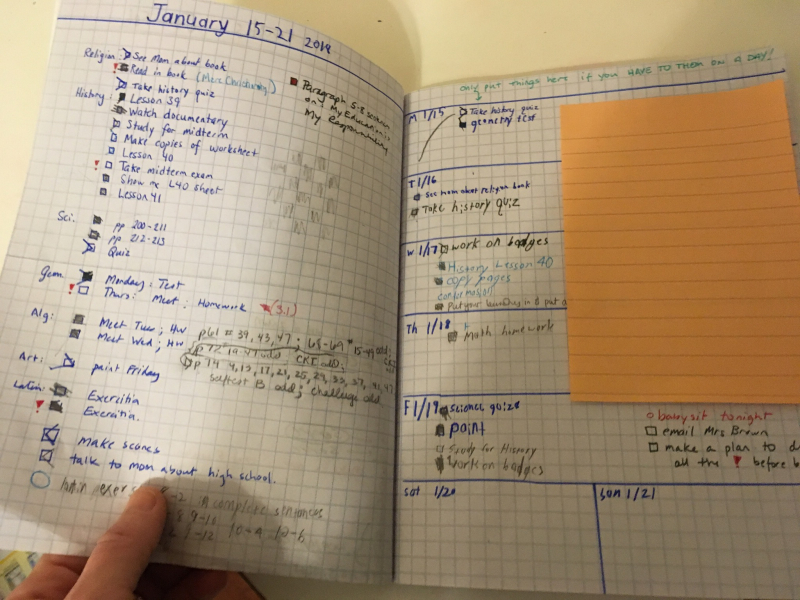
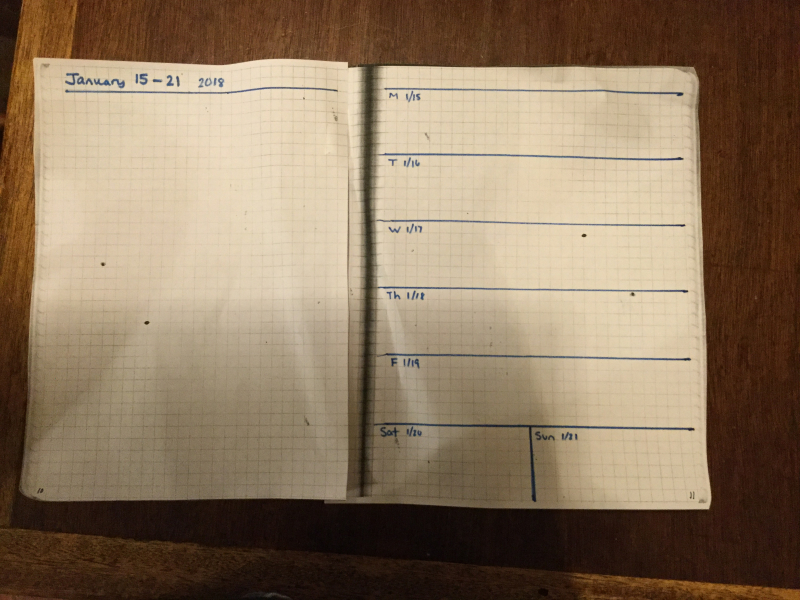
    Advent is when I like to start my new year, partly because it is the start of the liturgical year and I like being countercultural, partly because it gives me an excuse to procrastinate all the Christmas things.  So over the past couple of weeks, I spent time setting up a new notebook.

    Are you familiar with the “bullet journal” productivity fad?  If you have so far escaped knowledge of this, and you are prone to declaring that there exist no individuals who have time for such activities, I have a suggestion: Take a look at the original concept by the man who coined the term and then this minimalist self-proclaimed ugly version by a woman working in tech before you do any such fool thing as google “bullet journal ideas.”  

    Especially without the -pinterest tag.

    + + + 

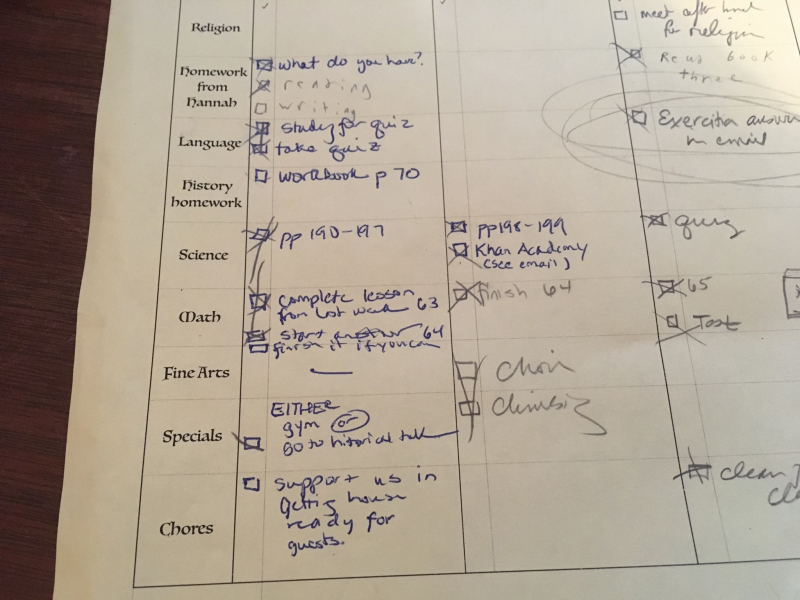
    Paper notes and lists have always pleased me more than digital ones.  I have a near-religious devotion to the utility of taking class notes on paper.  I write out daily to-do lists for my K-8 homeschoolers.  I still make my grocery lists on paper forms, and I go through post-it notes and index cards terrifyingly fast.

    Some transitions I have made.  I was one of the last people I know to move from a paper calendar on the wall to a Google calendar, but it has been years now and I am completely comfortable with it.  I have stopped making paper flash cards for the students I tutor and have encouraged them to get onto Quizlet.  I store some lists (notably, meal plans) on Wunderlist so I can access them from anywhere.  I use my email inbox to capture miscellaneous thoughts I have now, and email ideas to my future self via followupthen.com.  Every Saturday I shoot out a series of emails to all the homeschoolers I supervise with their assignments for the week.

    But I can't see myself going full digital quite yet.  I still love thinking on paper, and I am used to finding information I've written down by flipping through a book.  So I carry a paper notebook around in my bag, next to my iPad. 

    + + +

    What I do NOT do:  

    • color-coding
    • calligraphy
    • write out a year-at-a-glance page or month-at-a-glance pages
    • have an expensive boutique-quality paper notebook 
    • elaborate layouts
    • numbered pages and a table of contents
    • daily to-do lists

    What I DO use it for:

    • periodically writing out master lists (“brain dump”) of tasks, projects, and “someday/maybes”
    • making notes of things as I go through my inbox each day or two
    • thinking through things by writing about them
    • planning how to spend time
    • blocking out project timelines in the form of a mini-calendar
    • taking (or rewriting) notes to organize information
    • taking notes I’ll never look at again just to help me listen and pay attention
    • as handy paper to write the odd grocery list

    As a system it is semi-intentional.  I observed how I do and don’t use it, and constructed a standardized (not idealized!) algorithm.

      80431513-58FD-4684-AFB9-D56292723A32

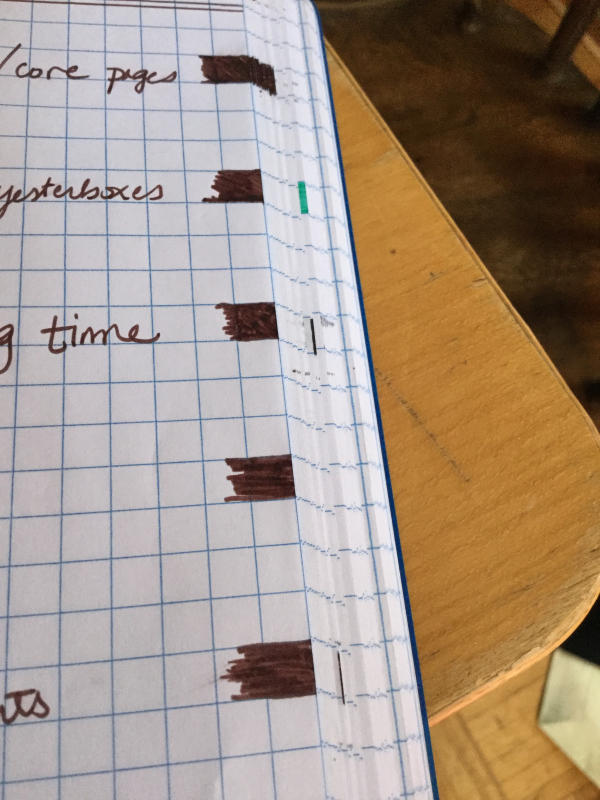
    As I was transferring information into my new notebook this year, I decided to add a tabbed index, but not a table of contents.  In a journal where notes are added chronologically, tables of contents get too jumbled up for me to find them useful. Instead,  I created just a handful of broad categories and used a blacked-in square at the edge of the page to tag pages.

    F600438B-5622-4045-B50B-2C82E48C69EE

    The categories are:

    • Pages copied from last year’s journal and core pages
    • Task lists and brain dumps and notes from going through inboxes
    • Planning out projects and time
    • Thinking on paper
    • Insights I want to remember

    There’s a last category, but instead of giving it a tab I write it from the back toward the front by turning the notebook upside down and backwards:

    • Notes just for listening

    This lets me treat the back of the book as a simple chronological notebook of things I was trying to pay attention to.  It keeps the organized matter at the front from being interrupted by scrawls of low importance.

    CORE PAGES

    So in the very front of my notebook, which is just a quadrille-ruled composition book with a plastic cover, I have made:

    • a page with my contact information
    • the tabbed index with the list of categories
    • a page of long-term goals (roughly ten years out)
    • a page labeled “Backlog” of tasks that aren’t urgent but I want to get around to
    • a couple of pages of memory-joggers for when I am making task lists.

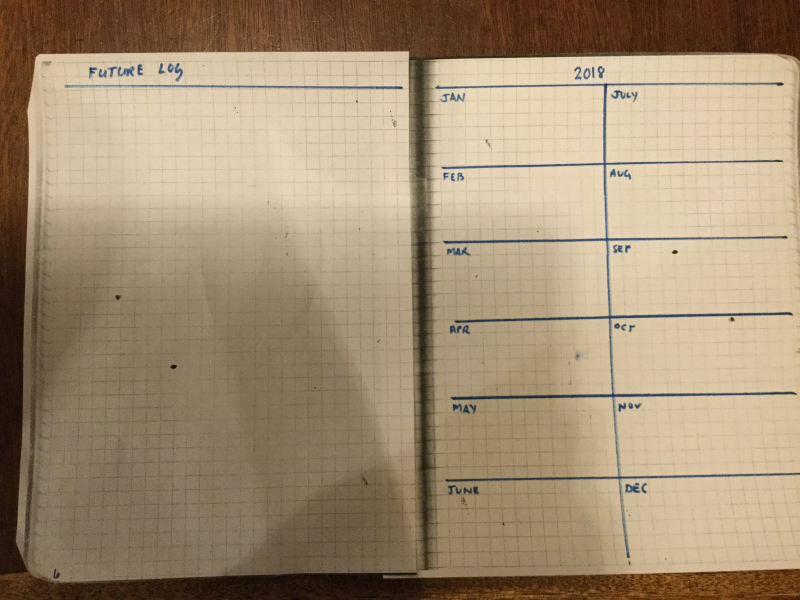
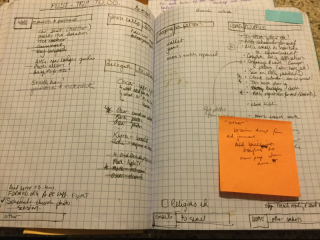
    There is also a set of pages of reference information that I copied forward from last year’s notebook.  For example, the long-term school planning chart (picture above) that tells me what grade everyone will be in each school year for the next ten years.


    BRAIN DUMPS

    My system starts off with a master task list, a.k.a. a “brain dump.”  This corresponds roughly to a monthly review and task migration in the minimalist bullet journal system, or to a weekly review in GTD, but I don't do it at set intervals.  I dump my brain whenever I feel that it is starting to fill up with loose ends of things that I need to remember, or whenever the existing lists start to feel out of date.  It is a mini fresh start, best done on a Saturday morning after one and a half cups of coffee.

     I usually make a brain dump onto a two-page spread, and often put items into categories, depending on how I am feeling.  Sometimes I categorize by people:  a list for self, for Mark, for each of the children (or sometimes just a KIDS list), extended family and friends, community.  I often do that if I am trying to jog my memory and write down all my current responsibilities toward other people.

     Other times I categorize tasks by context.

    457FA602-4E1B-4D66-8A81-A1F6E29C6F3A

    Context means the environment where I can perform the task.  The idea is that when I find myself in a particular context, I should work from the part of the list that contains the tasks I can do most easily there.  

    Sometimes context is a physical space and sometimes it is more of a state of mind, or both.  My contexts include

    • Web (researching, purchasing, reading, other)
    • Phone calls (for which I need quiet)
    • At home, with quiet access to my school materials, archives, and files
    • Emailing
    • Household tasks (for which quiet is not necessary)
    • Brick-and-mortar errands and shopping
    • Coffeeshop work
    • Tasks to delegate to someone else
    • Complicated multistep projects (not really a context, but important to put on the same page as the brain dump)


    YESTERBOX

    This is what I call the intermediate step between the brain dump/master task list and today’s to-do list.  It is kind of like a daily review.  I don’t do it every single day, although I probably should.  

    The concept of the yesterbox comes from Tony Hsieh, who wrote about it concisely here.  It works brilliantly with the technique of using your email box as a way of collecting tasks and thoughts.  I already email myself reminders pretty often, so I have found it useful.  The basic idea: Yesterday’s inbox is today’s to-do list.   Every day you must deal with the emails that came in the previous day, and then you may call yourself done (with email, anyway).  There’s some fine print at the link for how to adapt it as needed, but that is the basic idea.  

    I have employed synecdoche, calling the whole daily review a “yesterbox,” to remind me of this focus.  I open the notebook to a new page, date it, and then start going through my email from yesterday (including any email reminders I sent myself).   Here I write down new tasks that the emails suggest to me.  I also add events and scheduled tasks to my digital calendar at this time—these do not go into my notebook, since I will get an electronic reminder about those.  And I note things coming up on the calendar.  Anything else that comes to mind, too.  I also look at notes I made for myself yesterday (i.e., yesterday’s yesterbox) and carry things forward as seems appropriate, or delete them if they have become irrelevant, or cross them off if I actually accomplished them.  In any case, I can stop when I get through all the emails and reminders that came in yesterday.  Or, if I wish I can look at older emails and at new ones that came in today.

    I do not use the yesterbox as today’s task list.  It’s too long.  So the next thing I do is:


    THE INDEX CARD

    I make my daily to-do list on one side of an index card.  This prevents me from making a to-do list that is too long.

    I write down things I know I must do today first. Then I select tasks from the yesterbox list and copy them onto the index card.  If I know I am not going to get to a yesterbox task today, I might copy it back onto the master task list if it is not already there.   That would be the best and most organized thing to do, but I often don’t have the self-discipline to admit to myself that I am not going to get to it today.  So sometimes just leave it there for now where I will be able to see it tomorrow and carry it forward onto the next yesterbox.

    If my card is not full, I go back to the brain dump (working master task list) and pull tasks from there to put on my index card.  

     The index card goes in my pocket or purse and follows me around.  I sometimes write information on the back, like a phone number I need to call.  At the end of the day, whether I have finished everything on it or not, I put it up on the prayer shelf above my desk and forget about it.    

    Most of the tasks are duplicated in the notebook, so I won’t lose any vital information.  Shelving the cards, finished or not, up on the little shrine of sorts where I keep a crucifix and some devotional images, is a way of letting go of the day’s obligations and making peace with my imperfections.   A stack of to-do cards grows there, like a little pile of offerings.  Every so often I throw them away.


    BACKLOG

    This is a relatively new addition to the notebook, but I have high hopes for it.  It comes into play when it is time to make a new brain dump.  My plan to try for this year is to migrate every non-obviated task from the old brain dump:  either forward onto the new brain dump, if it is still relatively fresh; or, if it has fallen to “if I get around to it” status, backward onto the backlog.  Anything that I just don’t need to think about anymore (I missed my chance, or somebody else did it, or it became irrelevant) can get crossed out, but things I still hope to do will be captured either on the new brain dump, or saved in the backlog for possible future consideration.  The old brain dump is no longer active or useful.

    + + +

    Well, that is a decent overview of my hybrid digital-paper system, such as it is.  No glitter, washi tape, stamps, or fountain pens allowed.  And I break my own rules all the time.  Does it still count as a system?  Well, I am on maybe my fourth notebook in as many years, so I think it does.  I still probably use it to procrastinate more than anything else, but it makes me feel organized, and sometimes that is enough of a boost to get some things done.


  • Prepare ye.

      A couple of weeks ago, a friend emailed me to check on me, because I hadn’t blogged.  And here it is, even later than that.   What happened?

    I am not sure, but I guessed it had something to do with Christmas.  The holiday season descended upon me, as it does this time of year, and fell with a quiet, suffocating thump.   I cannot seem to help it, but I always wilt under a sense of obligation, this time of year.  I think the stress is mainly associated with presents, and I joke (okay, it isn’t actually a joke) that I have a Gifting Disorder.  So I have tried to reduce that, through asking relatives if we can’t just skip it.  I also have reduced the number of people I spend time at the holidays down to people I actually want to spend time with.  And yet this generalized holiday-season dread remains.

     It is usually all right once I actually arrive at the party, or exchange presents.  It turns out fine, mostly.  But there is a nasty dread in the anticipation.   It’s just a sense of not being able to dredge up the correct feelings and motivations.  “Giftmas” makes me feel like a bad person.  I am grateful to be aware that Christmas depression is not uncommon and to recognize the pattern in myself, because I know it is temporary.  The soft slumping weight will all melt away in January.

    + + +

    It has helped for me to remember that Advent is a season of preparation.  Some of my FB friends and I were grousing good-naturedly (I hope) about pastors who preach from the pulpit to keep Advent peaceful and watchful  and not do things like put up the Christmas lights until Christmas.  We were observing that perhaps Father doesn’t realize that if you want to have a “nice” Christmas, it takes about a month to get ready.  I suggested that waiting patiently with joyful anticipation during Advent is appropriate if one is in a stage of life, such as being four years old, when Christmas is something that just comes along; but when one is in charge of making Christmas, the only way to keep Advent meaningful is to think of it as a season of preparation.  Which it is.  

    I was thinking about the parable of the ten virgins, which was one of the daily readings sometime in the last couple of weeks, I forget when.  Everything eschatological applies to Advent and vice versa, I think, so it seemed appropriate.  As Advent gets closer and Christmas draws near, we must get ready; we must fill our lamps with oil.  It is a huge effort for me to do this.  I want to crawl into bed, forget the lamps, and hide from it.  Part of what I am hiding from are people who appear to be one-upping each other with gaudy, complicated, blinding lamps that take a lot of work.   

    I do not know whether those other people’s lamps are full or not, but the thing I have to keep in mind is that all that is required is that the lamp be full of oil on the inside.  I mustn’t let the outward appearance of others get me down so much that I don’t fill my own.  Preparation for Christmas is not optional.  It is necessary.  Some work is necessary.  Even some of the work that intimidates me!  But not all of the bustle and business is part of what’s needful.  Wake up, fill my lamp, trim my lamp, don’t worry about the standards set by other people and their fancy glittering lamps.  Eyes on my own work.  It is real effort, this quieter, appropriate preparation.  And that part is worth doing, even if it is hard not to just crawl into bed.  

    + + +

     Related (probably):  I have been ill for weeks, off and on.  There were cold symptoms at some point, and Mark had them too, and some of the kids.  I thought I was better, then got tired and achy again.  I have missed a lot of workouts, but not all of them, since just before Thanksgiving.  Maybe I have managed one per week.  This past week I haven’t managed any; I have slept a lot.   I began to wonder if I had some kind of mononucleosis-type viral infection, either milder than mono or maybe it was mono and I was one of the lucky people who was only mildly impaired by it.   Then this Monday a blister like a cold sore erupted on my hard palate (so, exactly like a cold sore, the rarer intraoral type), and then on both Tuesday and on Friday I took 4-hour naps in the middle of the day.  And also the nodes on the left side of my neck are tender to the touch, off and on.  I keep thinking I am better and then crashing again.

    I don’t get cold sores very often.  Years and years go by between them.  I know that flare-ups of HSV (the cold sore virus) are often associated with stress.  I must have had a primary infection at some point before this, but the  first time I remember getting them was the week my mother died.  

    + + +

    Christmas is not as bad as all that, of course, but it is undeniably a source of stress, even though objectively speaking there is no real reason* for me to be stressed.  A lot of the things that I used to point to as stressful are not really there anymore.  Many dreadful gift-giving situations have gone away; we deliberately see fewer people than we used to, and all the ones we do see are people I am genuinely excited and happy to see; I guess it is just residual association?  But I am willing to believe it is a strong one.

    ———

    *After writing this, I remembered that in a short number of days I have to drive 12 hours with all the kids (and without Mark).  Also, before that, there is the usual checklist of things like packing and cleaning up the house, with some added responsibilities such as present-wrapping.  This possibly counts as a “real” reason to feel somewhat burdened.


  • A little translation for you.

    Something different for Sunday.  A while back, I wrote some posts about the books I bought while I was in France, and I promised to read Marielle Blanchier's Et Ils Eurent Beaucoup d'Enfants first and get back to you.

    This, you'll remember, is the memoir of a woman, trained as a chemist, who has twelve children.

    Well, I haven't finished the book yet, but I'm a few chapters in, and for a fun evening project I thought I would translate a bit of chapter 3.

    Chapter 1 is sort of the story of how she and her husband met and married and how her rather surprising lifestyle unfolded.  Chapter 2 is called "Mother's Day Treasures" and is a humorous account of how she deals with all the handmade gifts her children bring her home from school.

    Chapter 3 is called Neuf Années de Grossesse:   "Nine Years of Pregnancy."  This is the first part of it.

    + + +

    In the last twenty years, I have lived through nine years of pregnancy. 

    And, no, it's not so much that I like to be pregnant. 

    Yes, and no.  My feelings are very ambivalent.  Honestly, it's not a pleasure in and of itself.  Carrying life is a great joy, in my view the most marvelous that one can experience; but it's also a handing-over of the self, and a time of anxiety:  will I have a miscarriage for the umpteenth time?  And what if by the fifth month I'm already completely drained?  Will my cervix dilate to soon and bring on a pre-term birth?  There is also the apprehension of having to accompany a new human being for a whole lifetime.  And my body, changing.  I feel weakened, diminished.

    Digging out the foundations of a house in the middle of winter, under the rain, would that be a pleasure in and of itself?  Not really… but we likes the result.  To give life to one m0re person.  Carry that life within oneself, feel the baby move in one's belly, discover him on the screen of the ultrasound.  A new marvel every single time… However, as the pregnancy draws toward the end, there are so many challenges to take up.  Putting up with the constraints of fatigue.  Keeping charge of the house despite having no energy.  Finding time to rest enough to allow the baby to grow.  Enduring the ordeal of the transformation of my body, the burden of these 25 to 40 extra pounds.

    At the beginning, the baby bump is cute.  Then, naturally, I grow… and grow.  I eventually get to the point of asking myself if I'm not going to end by losing all femininity.  To become, once and for all, "the fat old bag who had twelve children."  The kind about which people think:  "The poor thing, she is already on her twelfth…"  That prematurely aged woman who people mistake for Grandma.   

    Even though what I really want is for people to keep asking me if the child in my stroller is my first.  Happily, that still happens to me sometimes when I am out by myself with Charles [the youngest]. 

    I answer "No," obviously. 

    Then they question me:  "Oh, he has a little brother or sister?" And sometimes they go on to give me a few child-rearing tips. 

    I let them speak, then I savor the effect when I reply,  "Oh. this is my twelfth child."  

    "What?!?  How many?"  My interlocutors never recover from this. 

    Some can't believe it at all, and toss "Ha, that's a good one!" over their shoulder as they walk away.  But most often, they shout to their husband, their wife, their children, or passing strangers, "Did you hear that?  This lady, she had twelve children!"  Then they add:  "Well, you don't look like it—you look good!"  

    Naturally, I like to hear this, because it means that I haven't been permanently scarred by the pounds, the fatigue, the tension.  Because it demystifies the caricatured mother of a large family:  I have made an unusual choice, but I'm not some kind of alien.  And also because their reaction testifies that I accord this baby the same attention as if he was an only child.  I comport myself as if he were the first.  Quite a lovely compliment!

    I have noticed that sporting a bulging belly has a lot in common with walking a dog or fixing a car in the middle of the street:  everyone wants to talk to you about it.  It is a way for people to make a connection—and I have noticed that people often have a need to talk.  They seize upon this pretext, and it pleases me that they are willing to speak to me so easily, even if it means moving on to other subjects afterward. 

    Even so, on thorough reflection, there are one or two things that irritate me.  When anyone tries to touch my belly, for example—but people rarely attempt this, they must sense that I am ready to bite!  Or when they tell me for an hour about the family life of some second cousin who had just as many children.  Or when they prognosticate, "A pointy belly means it's a boy, a round belly means it's a girl."  And it's not just the grannies who play Madame Fortune-teller.  I never know what to answer to avoid offending them.  They really seem to believe what they say.

    — From Marielle Blanchier and Pascale Krémer, Et Ils Eurent Beaucoup d'Enfants (Éditions des Arènes, Paris, 2013)


  • Entering year 10 of maintenance (V): Long-term thinking.

    Let me tell you what I had to eat yesterday (still following along in my French book of meal plans):

    Breakfast called for coffee or tea, 50 g of bread, and 20 g of cheese.   

    ………I had: coffee, a packaged English-style crumpet (49 g) and 20 g of four-pepper goat cheese spread on it.  140 calories.

    Lunch called for 100 g of chicken "escalope grillée;" 120 g of pasta, rice, or quinoa; vegetables; 1 teaspoon of oil to dress the vegetables; and 1 unsweetened dairy product.

    ……..I made salsa chicken rice bowls to feed the co-schooling horde for lunch.  I had:  shredded chicken breast cooked in the crockpot with salsa; 120 g of mixed brown rice and red beans; a pile of braised green peppers and onions; 1/4 avocado in lieu of the oil ; and 20 g of shredded cheddar cheese.   500 calories.

    Dinner called for 200 g of a velouté of winter vegetables with a teaspoon of crème fraîche stirred in; 2 soft-boiled eggs; 40 g of whole grain bread; and 2 clementines.

    ……..I had:  200 g of some leftover curried squash soup that contained coconut milk; 2 soft-boiled eggs; 40 g of homemade whole wheat waffles; and the prescribed two clementines.  I also indulged in some syrup for my waffles, but skipped the sausage patties that everyone else had.  400 calories.

    Also:  I chose to have half a doughnut at snack time—it was a birthday, with candles in the birthday teen's doughnut—165 calories—and enjoyed a gin and tonic at the theater (215).  The latter probably had something to do with my decision to eat a cold waffle out of hand when I got home, and also some saltine crackers (let's call that an additional 175 calories). 

    I'd say the doughnut and the gin and tonic were celebratory pleasures that I freely chose to enjoy, and fit nicely into my overall-moderate day; but consuming the cold waffle and crackers was an impulse that represented the kind of behavior I want to minimize in long term. 

    As maintenance has stretched into years, distinguishing between freely-chosen pleasures and not-so-pleasurable impulses has gotten easier and easier.

    Remembering to put down the cold waffle, in the moment?  Not really any easier, especially under the influence of G&T-induced munchies.

     Still, the distinguishing is the first step.

    + + +

    A couple of weeks ago, I decided to take another look at my long-term goals regarding weight, eating, and fitness.  The point of this exercise:  to inject some sanity and, well, serenity.  Too often I swing wildly between two poles:  either panicked feelings of lost control, or rigid, unhealthy obsession.

    Fact:

    If a time traveler from the future

    came back and told me that I would weigh the same at age 55 as I do now

    —even at my highest recent weight, which is ten to fifteen pounds more than I wish I weighed—

    I'd be thrilled.


    Because most of my anxiety surrounding weight gain has to do with slowly creeping back up to my old weight in the long term.  Where I am is a fine weight to grow older in. 

    Sure, I'd be a little more thrilled to learn that future-me would weigh ten pounds less.

    Or, better, to find out that I would weigh the same but would have more muscle mass because I will have made the time to lift weights consistently.

    The point is that the difference is not so big as to call "I weigh the same at age 55" a failure.  If it comes to pass, I will count it a measure of success.

    + + +

    The number "55" is not an arbitrary number, but it's a generous estimate.   

    That's because at age 43, the most sensible long-term timeframe is "the other side of menopause."  No matter what, that'll be a time to take a new look at things.  So there's not much point in looking far beyond that.

    I'm healthy now.  So one way to look at the long term is:  

    What conditions do I want to persist until after menopause?

    + + +

    (Before reading on, please recall that I'm under five feet tall.  People who forget this tend to gasp in horror)

    + + +

    As long as I'm not engaged in systematic weight training, I would be happy to see my weight remain between 117 and 125.   The latter number represents a BMI that is just barely into the "overweight" category, but especially as I age, I'm fairly certain that it would still be a fine weight for me. 

    (I am extremely skeptical of the boundaries of the "normal" BMI range for people as short as me.  Really?  I could go down to 92 pounds and be healthier than I am at 125 pounds?  This beggars belief.  When I briefly weighed 108 pounds, people said I looked unwell, and I was freezing cold all the time.)

    In my last post in this series, I laid out my theory that numbers aren't goals, they're metrics.  

    But I do have a goal related to those numbers.  The goal is:

     Stop myself from freaking out at weights between 117 and 125.

    I know what many of you are thinking.

     Erin, do you really freak out at the scale when it measures between 117 and 125?

    The answer is:  Yes.  Yes, I do freak out at these numbers, which are 40-45 pounds lower than the weight of the average American woman (who's only four inches taller than me, by the way).

    And this is not a sign of good mental health.

    Anxious feelings are not always under our control.  I'm aware of that.  But one way we can dispel anxious feelings is to look critically at the picture of reality that they are painting for us.  We do that by holding on to pieces of objective reality to which we can compare them.  And this is such an anchor.  When I feel anxious about numbers that are between 117 and 125, I must talk myself down from it:    

    Your feelings do not reflect your rational thinking about this number. 

    This is a good number. 

    This is a number that you have already decided is a fine place to be, not just now, but far into the future.

    Mind you, I'm not giving myself permission to indulge in anxiety when my weight is out-of-range.   Anxiety at those times, however, is a different problem, and not a problem I have right now.

    Dealing with my present problem requires me to banish the periodic delusion that the good place I happen to be in will never be good enough.  

    And while "I don't freak out" is more of a metric than a goal, because anxious feelings aren't entirely under my control:  I can set a goal to react to them by consciously changing my thought patterns.

    + + + 

    I have now-until-55 goals for exercise too.

    Because I'm engaged in many activities that put pressure on my time and that I wish to prioritize alongside fitness, my long-term fitness goals are modest.  

    I very much want to maintain the level of fitness that I have.  I can run three to four miles without stopping, I can climb stairs, I can sprint to catch a bus or a fleeing child, I can climb at a climbing gym, I can ski any intermediate downhill terrain, and I can hike all day carrying a weighted pack.

    I can do that, I believe, with three workouts per week.  Where a workout is defined as any of the following:

    • A run at any pace around any of the local lakes
    • 30 minutes of running in a gym or on a treadmill
    • At least 20 minutes of steady lap swimming
    • 1 hour spent at the climbing gym
    • 60 minutes of continuous walking
    • 30 minutes of walking with a weighted pack

    A secondary goal is to record performance data.  That's to give me more than one number, so the scale gets less important by comparison.

    How many workouts per week?  That's the simplest thing to record.  But I'm also tracking, now, my average running and swimming pace.  I hope, no, expect, to speed up and eventually plateau, at a point where I would have to change my priorities to go faster; and then, if I don't want to change my priorities, I suppose I will have to be satisfied with maintaining those paces.

    If I decide to take up weight training between now and then, I'll re-evaluate my goals.

    + + +

    These are my long-term thoughts.  I do have short-term and medium-term ones.  I touched on those at the beginning of this post and in my latest maintenance story, where I explained my post-vacation austerity measures working with the French book of meal plans.  In the next post I will try to tie the short-, medium-, and long-term thinking together.  This might require me to repeat myself, but I think it'll be a little more organized presentation of the information.  Stay tuned.


  • On the logistics of serving family meals in courses.

    A side note on logistics.

    I've been dabbling in serving "first course" before "mains" at family meals ever since our first European trip three years ago, and it's a habit that has persisted remarkably well.  I wrote about it for the first time here:

    [O]ne thing I noticed that I liked is the serving of meals in courses.  Yes, I know that is a totally normal thing to do "over here," but it's nothing we ever do; we tend to put all the serving dishes in the middle of the table and help ourselves to everything at once.  

    There's nothing wrong with that per se, but I wonder if I could slow us down just a wee bit, and have a first course.  

    Not make anything extra.  I typically have two or more vegetable side dishes at each meal anyway.  Just take that salad, or that soup, and put it out ahead of time so we can warm up to the table and to each other before we start snarfing down our meat and carbs.

    In the next post after that, I listed some examples of potential first courses.  But I don't think I have written much about it since then, until yesterday when I wrote about searching for meal-planning guidance in French bookstores.

    There appeared in the comments a question from ChristyP:

    I was thinking yesterday about the logistics of separate courses and quickly became overwhelmed by the number of dishes and potentially serving pieces to wash.

    You certainly have more helpers, but are you actually running the dishwasher after the first course so that it can be emptied and refilled with the rest of the dishes from dinner?

    Or do people keep the same plates and have other items served upon them (possibly with wiping up any extra salad dressing with a paper towel between courses)?

    I can answer this one! 

    There are several reasons why I have been able to execute this without getting overwhelmed. 

    + + +

    Simplifying factor #1.  I make a maximum of 3 "family-style" meals per week.

    How is this so?

    • Mondays we take turns preparing meals with another family whose kids and grownups are going to the same Monday night meetings.
    • Wednesdays are self-serve Leftover Buffet Nights.  
    • Saturdays, one of the kids makes dinner.  They take turns.  I don't micromanage the planning, cooking, or serving.
    • Sunday dinner is a cheese-and-meat board with bread, crackers, and crudités.

    Not doing it every day is surely one of the reasons it is not overwhelming.

    + + +

    Simplifying factor #2.  Though I might have three "courses," it's only two sets of dishes, not three.

    Except for parties, I basically never make a sweet baked dessert or anything else that couldn't go on the same plate with the mains.  The sugariest thing I might cook to go with a regular dinner is a baked apple.

    For the most part, until this year, I only ever tried to manage two courses:  a first course (usually a salad or other vegetable), and a main. 

    Lately, inspired by careful attention to French magazine articles and serving suggestions on French prepared-food packages, I have been putting out a "dessert course" which amounts to a platter of either cut fruit or wedges of cheese, at the same time as the main and sides.   

    I have been enjoying taking my portion of the fruit or cheese after I have finished the main course, but of course anyone can serve it to themselves as a side.   It goes on the same plate as the other food, or on the bread-and-butter plate if the main happens to be soup or something else that requires a bowl.

    So if you're imagining three sets of plates, banish that.  Think two, max.

    + + +

    Simplifying factor #3:   Smaller plates.

    This really helps with the dishwasher.

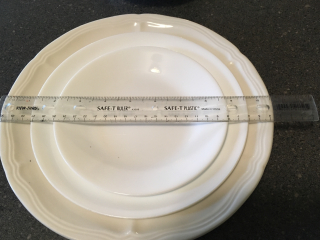
    Shown below, stacked from bottom to top:  (1) a "standard" 10-3/4-inch dinner plate, (2) our dinner plates, (3) the plates we typically use for first course (or for a bread plate if we're having soup):

    IMG_4403


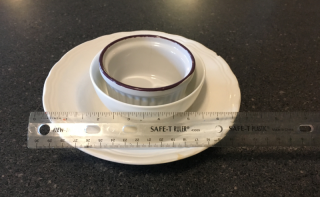
    Shown below, stacked from bottom to top:  (1) a bowl for first-course soups for Mark and teenagers, (2) a bowl for first-course soups for me and middle-size children, (3) a ramekin for first-course soups for smaller children:

    IMG_4405


    I generally get away with two dishes per person.  And unless I have to break into our "standard" plates for some reason, every plate and bowl can fit on either the bottom or the top rack of the dishwasher.  So it's not terribly difficult to get them all in.   

    That is, it wouldn't be difficult if we started with an empty dishwasher.   In truth, with six people here all day long, the dishwasher is almost never empty, and there's usually a backlog waiting in the sink; so maybe the real reason it seems easy is that seven extra dishes from first course don't make a noticeable contribution to the pile.  

    + + +

    Simplification #4:  It's routine.

    In practice, when I am in charge of a multicourse dinner, I plan it this way:

    • I plate the first course and put it on the table while the table is being set. 
    • We wait for everyone to come to the table and say grace before we let anyone dig in (or complain).
    • As we start eating, the main course items (including the stealth fruit-or-cheese-course) are in resting on the counter, chilling in the fridge, or staying hot in the oven, depending.   
    • When most of us are done with the first course (except for the 3yo, who can't be reasoned with yet), I get up, take away those plates and drop them into the sink or stack them by the dishwasher. 
    • I then bring the dinner dishes in a stack and hand them to a teenager to distribute. 
    • While he is doing that, I fetch the serving dishes to the table. 
    • I'm not above just putting the soup pot or the crockpot insert on the table, by the way.  I draw the line at serving from the rice cooker because I am not tall enough to see over it when seated.
    • We pass the rest of the dishes family style.

    If I really needed to conserve plates, I think I would not be above using our divided plates and serving the first course in one of the sections of the divided plates, and letting people keep those plates between first and main courses.  Alternatively, I could allow people to opt-in to the multi-plate dinner, keeping their first plate unless it really bothered them that there were traces of salad dressing or whatever on it; in that case they could get their own clean plate if necessary.

    I personally find the rhythm of changing the plates to be pleasanter. 

    + + +

    Simplification #5:  I have three offspring who can load and unload the dishwasher and hand-wash dishes without help, plus one apprentice.

    I almost never wash dishes in my own house.

    As ChristyP noted, this surely is part of what makes it all seem feasible.


  • Entering year 10 of maintenance (IV): The trap of Only One Number.

    Before starting, a few things à propos my last post

    On the subject of publicly available advice from the French on "what should I serve my family?":  

    • Read French?  Here is a website (put out by the French national health program Manger Bouger) that will generate random menus for your week, with links to recipes for everything.  To stave off despair, don't forget to check the "Express" box which will give you meals that are supposedly quick to prepare and include convenience foods.  You know, like individual pots of prepared tiramisu, which I'm sure you can find at the supermarket.
    • Are readers interested in my doing a little more live-blogging of my experimental menu-planning with the help of my weird little French eating-plan book?  It may have to wait till I finish my maintenance series.   But it would be something along the lines of:  hey, breakfast on the plan today is yogurt, 30 g of cereal, and 10 g of nuts; I'm having a mix of Cheerios and puffed kamut, with pecans, on my yogurt.
    • Forgot to link yesterday, but the weird little book is available on Amazon.fr here.  There is also a second volume which I will probably acquire.

    + + +

    On to the Only One Number trap.

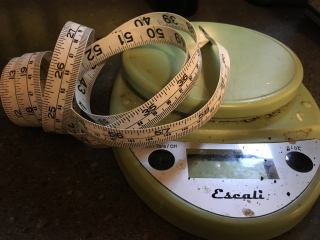
    IMG_4402

    I've written before about The Numbers:  as I put it, "the weight on the scale, the dress size, and even the calorie count."

    "[T]he numbers" are not under your direct control. Behavior and habit development are under your direct control; the numbers aren't. If weight/size control for health is your desire. the numbers are useful — not as goals or targets, because you cannot really aim at them — but as diagnostics to evaluate existing habits and behaviors….

    [I]f you're going to freak out and feel like a failure, don't do it because the numbers are bad. Focus all concern about failure, all motivation to succeed, on the behavior. Not on the numbers. The behavior is what you can control. The numbers are an indirect effect.

    Let me restate the point of that post as follows: 

    Nothing that is a number is useful as a goal nor a resolution.

    Self-deception is required to "resolve" to lose ten pounds or some such thing.   We can only resolve to act upon things that are under our direct control.  To do or do not.  And none of the numbers are things we can control.  

    (Really?  Miles per month?  Can't I control that?  Sort of— you can decide to do it, but the resolution comes down to things like "I will set my alarm to go off every Tuesday and Thursday at 5 am" and "When my alarm goes off tomorrow, I'll get up and go running").  You don't just…. run 15 miles this month by force of will.  Real, deception-free resolutions are, basically, yes-no questions and not quantitative ones.)

    A better way to think of each number (the scale, the dress size, the lipid levels, calories per day, cigarettes per week, miles run per month) is this:

    Numbers are metrics that measure our response to our resolutions.

    They are measures of our body's response to the things we can control.

    They are, mostly*, objective tests of whether our resolutions have been useful.


    + + +

    Successfully reframing numbers as metrics rather than as resolutions takes away the power of the number as a number to cripple us with shame or despair.   

    The anguished question of "Why can't I make this number change?" fades away, because the plain truth is that no one can make this number change.    

    Instead, when the number fails to do what we hope, there's really only one question** to ask:

    What resolution can I make that would be more useful for this number?

    If we have kept a resolution faithfully and given it plenty of time but the number has not responded the way we want:  That resolution is not useful, at least not for changing this number.

    If the problem seems to be that we have made a useful resolution but have failed to keep it:  The only useful resolutions are the ones that we keep.  If we find that we have not kept a resolution, it needs to be tweaked until we do keep it.

    So:  

    Nothing, here, about Why can't I keep my resolutions?!? either. 

    No Why can't I??? at all.  

    + + +

     All that is ground I've covered before.  Here's the new bit:

    Multiple metrics help you identify useful resolutions.


    If the only metric I use is the scale, then I might give up too soon on resolutions that, behind the scenes, have been helping me in other ways.

    Maybe I've changed my diet and my weight hasn't budged—but perhaps I haven't noticed that my blood pressure has gone down.  Maybe I've been getting to the gym a couple of times a week for months and my pants size hasn't changed—but perhaps I haven't noticed that I can now climb a whole flight of stairs without getting out of breath.  

    I risk giving up, never having noticed that the effort I made was paying off in better health.  And if I give up on enough resolutions, I may give up making new ones at all.

    + + +

    One of my newer maintenance resolutions, therefore, is to actively track more numbers.

    The number on the scale is not one that makes me happy on a regular basis, even though the news it delivers me is not objectively bad.  I would like to decrease this metric's significance, its hold on my imagination. 

    could do that by stepping, permanently, off that scale.   

    I'm not ready to take that step.

    But… I am ready to make it just one of several numbers.

    + + +

    Here's what I'm doing.

    First:  I'm adding physical performance metrics.

    I'm  trying out the free version of an app called Runkeeper to store exercise data.  So far I'm tracking:

    • my average running pace in 5K workouts (currently 12:30 minutes/mile)
    • my average lap-swim pace, without regard to length of workout (currently 48:15 minutes/mile)


    Second:  I'm adding behavioral metrics.  Right now, I'm tracking

    • number of workouts per week (Runkeeper stores this data too)
    • (temporarily) daily caloric intake, for which I am using the premium version of the app Lifesum

    Besides these, I'm looking for a good data-recording method to track

    • fraction of days on which I did, or didn't, have feelings that my habits were "out of control" 


    The third category is "body" metrics:

    • the number on the scale
    • upper arm measurement
    • hip measurement


    + + +

    I'm wary of tracking too many things, too often.  I hope these aren't too onerous:

    • Calorie entries are the most time-consuming and have to be entered every time I eat.  I don't intend to do it every day for the rest of my life.
    • Exercise metrics need to be entered into my app at the end of every workout.  That's usually pretty fun and easy because I always feel satisfied to have finished the workout and eager to see progress.
    • I'm trying to step on the scale only every few days rather than every single day.   Once a week is plenty.
    • There's no point in measuring with a measuring tape more often than every month or so (although getting average readings from several days in a row isn't a bad idea, because measuring tapes aren't so precise).
    • I'm least likely to remember to do the "how did I feel about my eating today?" but in many ways it is the most important metric because it is probably the poorest metric related to my diet.

    + + +

    What numbers could be useful for you to measure?


    ___________________________

    *Remain humble and allow for the possibility that the numbers changed because of circumstances that are out of our control, not necessarily because of our smarts, strength, or lack thereof.  It does happen.

    ** Supposing, of course, that the desired change would be a real good for us that is worth real effort.


  • Entering year 10 of maintenance (III): The latest maintenance story.

    If there is a pattern in my years of maintaining most of the 2008 weight loss, it is a succession of stories:  In Which I Try Something New For A While To See How It Works.

    "Works" is pretty mild here.   I haven't done the slow creep of weight gain (I'm heavier now than before my last pregnancy because I didn't drop back down quite as far, but am stable).  So none of these things seem to have mattered in terms of keeping the weight off.  It's staying off, it seems. 

    What I'm looking for is, I guess:   Does this new thing (intermittent fasting, rule-based eating, No-S, whatever) make it feel easy?   Does it make prudent-yet-pleasurable dining second nature and reinforce good habits?  Does it get me out of an unhealthy headspace of obsession?  Does it keep me from being terrified of re-gaining weight?  

    Here's the story of my Something New for right now.

    + + + 

    One of my goals, going into the couple of weeks my family spent in France this past September, was to spend several hours in bookstores.  Because there's no substitute to being able to browse through stacks of physical books, and I don't get to do that very often in my second language(s).

    I had literary items on my to-do list, both fiction and nonfiction.  But I also had a couple of, shall we say, lifestyle-related items to tick off.  What I really hoped to find would be a practical book about feeding families, by French and for French families:  about keeping the traditions of the family meal, the leisurely, conversational, multi-course family meal, while under the pressures of dual-income families (or single-parent families), busy school and sports schedules, and all the distractions that tug at individuals and pull them apart. 

    I especially hoped to find realistic and practical meal plans:  daily menus that reflected the courses that French families put before their children on the dinner table.  

    I know that there is a tradition of entrée, plat, dessert–where "dessert" is often fruit, cheese, or both—and where the entrée is likely to be a vegetable first-course.  

    I know that you can take an American square meal and, theoretically, untangle it so that (for example) the vegetable side dish comes out first, the fruit or a dairy product is pushed back to last, and what's left (meat and complex carbohydrates) becomes the plat, or main course.  

    But I wondered how this looks in real life.  And I wondered if any enterprising French author had taken it on herself to explain to bewildered French millennials exactly how to perform this fundamental familial magic, à la Adulting.  I wanted to see meal plans for a whole week that would tell me, for example:

        WEDNESDAY DINNER

    • Entrée:  Grated carrots in lemon and olive oil dressing
    • Plat:  Grilled chicken with herbed rice and sautéed mushrooms
    • Dessert:  Wedge of Camembert
    • White Burgundy, or Belgian bière blanche

    …. and so forth, all set up to make it easy to use up leftovers.  All set up to give many examples to show how to feed both children and adults with a balanced and pleasant meal, made of excellent ingredients, simply prepared and served in tidy little courses.

    Sadly, I could not find such a thing in the shelves of childrearing, education, or cookbooks.  It seems that the French, even millennials, are not yet so disconnected from their roots that they need people to tell them how to eat dinner.

    But I did find something very like it, somewhere else, by accident.

    + + +

    I was browsing through a spinning rack of French self-help mini-books, because I am fascinated by the existence and format of self-help books and was curious about whether French ones were different from American ones. 

    Stop being a workaholic!

    Learn to meditate!

    Get organized! 

    As you might expect, a number of these were faddish exercise or diet books:  yoga, juicing, etc.   When I came upon a generic, non-faddish-looking one (Mon cahier minceur, or "My slimness workbook"–the French don't mince words and call their goal "health" or "weight loss"), I picked it up and opened it to a page.

    And!  It was full of meal plans, very like the ones I was wishing for (only, for the benefit of those pursuing the elusive minceur of the title, the plans suggested quantities in grams).

    So I bought it, of course. 

    • It was a cheap little paperback, and the meal plans looked like normal, non-faddish, non-fat-free, whole-foods stuff, on the principle of Reasonable Or Reduced Quantities of Good Things.
    • Furthermore, they were simple and modular—very unlike your average "Drop 7 pounds in our 7 days of meal plans" American magazine article, which pretends that you will put together a vegetable frittata for Tuesday morning breakfast and whole-grain waffles on Wednesday.  (Fun for a few days, but hard to sustain in the long term.) 
    • The suggested gram-quantities are different for different people (I took the little quiz and wound up in the second-lowest-quantity bracket).   This is a weigh-some-of-your-food plan but not a count-your-calories plan.
    • There are three weeks of "regime" menus, to be repeated as long as necessary, followed by two weeks of "stabilization" menus, to be repeated for as many weeks as one was on the "regime."  The "stabilization" menus have larger quantities, meant to ease the person into maintenance.
    • Finally, they have a slight but unmistakable French accent.  Breakfast is present but unimportant, almost a careless throwaway half-meal; there's cheese and yogurt and crème fraîche everywhere, and also bread with butter (though a scantier smear of butter than I would like); dinner comes apart nicely into courses; and there are strict warnings against the dangers of eating between meals.  

    I decided to follow it as much as I could, for as long as it was enjoyable, as my post-vacation Austerity Measures.

    + + +

    Today's Tuesday, so here's a sample Tuesday menu.  The gram-quantities for you might be different than those for me, by the way. 

    Breakfast:

    • Tea or coffee
    • 50 g of seven-grain bread (pain aux céréales)
    • 20 g of cheese

    Lunch (imagine this as a large salad with the yogurt for dessert):

    • Crudités (example:  carrots, celery, grated cabbage).  Unlimited.
    • 1 teaspoon of oil to make the vinaigrette [understood:  mix with as much vinegar, salt, pepper, mustard, etc., as you like]
    • 2 slices of cooked ham 
    • 150 g of cooked green peas, flageolets, or lentils
    • 1 plain yogurt [this means 125 g, and it's not nonfat, but French "demi-écremé," which is executed better than our low-fat yogurt.  I just eat whole-milk yogurt and enjoy it.]

    Dinner:

    • Green salad seasoned without oil; e.g., make a vinaigrette with 1/2 tsp mustard + pepper + 2 tsp. vinegar + 2 tsp milk + lemon juice
    • 100 g of roast beef
    • Gratin dauphinois made with 175 g potatoes sliced and layered with 15 g grated emmenthal and 30 g crème fraîche mixed with 50 ml milk, baked 1 hour at 350° F
    • 1 fruit

    + + +

    This is pretty representative.   

    • Plain vegetables are always unlimited. 
    • Fruits aren't weighed, but the number is set: half a grapefruit, one apple, two kiwis.   
    • Added fats, such as butter, oil, mayonnaise, and cream, are present at most meals in restrained amounts. 
    • Breakfasts are always complex carb (bread, sometimes buttered, or cereal) plus dairy (cheese, milk, or yogurt).   
    • Lunches and dinners are quite square:  a serving of meat or fish, a serving of complex carbs, usually both vegetables and fruit, and nearly always a serving of dairy.
    • There is one very simple recipe given as part of one meal each day, such as the gratin dauphinois that accompanies Tuesday's dinner.   

    And let's take a look at that dinner, shall we?  Here's how I would render it into a family meal:

    • First course:  Big green salad (full of things the children like, including red bell peppers and cucumber, with cold roast beef strips on top, and croutons for the rest of the family, and their favorite bottled dressing for the children; but for me, an oil-free dressing with lots of strong dijon mustard)
    • Second course: That lovely potato gratin, which finished baking while you had your salad.  And if your family would prefer it with cheddar cheese, do it that way.  You could add extra cheese to people's servings, too.  
    • Cut fruit — I would put it on the table at the same time as the second course, and people could decide whether to have it together or separately.

    Obviously, you could serve a plainer salad first and then put a beef roast next to the gratin; but I don't really like roasting beef, so I'd put deli meat in the salad.  YMMV.

    + + +

    I've been surprised how much I don't miss my Egg For Breakfast (eggs have been moved to lunch, where they are just as pleasant).    It helps that I have replaced it, often, with buttered toast, which is one of my very favorite things.

    One of the best parts of all this:  lunches that end with 20 g of good cheese.  I had forgotten how good a creamy blue cheese can be as a course to end a meal.  I would absolutely eat Stilton for dessert, any day of the week.

    + + +

    To my surprise, the whole plan seems to work very well for me.  At least by the measures of suppressing panic and obsession, enjoying my food, and supporting good habits. I'm a little sheepish that I'm having such a good experience with what is basically an unusually-well-put-together "magazine plan."

    That's not to say that everything I've eaten in the past few weeks is by the book.  I've demolished a few piles of chips and guacamole here and there while getting together with friends—but one of the things I want out of daily moderation and simplicity is that it leaves room for feasting.

    Next post:  escaping from the Only One Number trap.


  • Entering year 10 of maintenance (II): A look back at twice-annual posts.

    Let’s look back at my November and May weight maintenance posts over the years.

    But first, a disclaimer.

    [Editing note.  Years and years later, I wish I’d done a better job distinguishing gluttony from other problems with food, like clinical eating disorders and other kinds of compulsiveness.  

    I want to emphasize that, whereas I identified some behaviors in myself that probably qualified as self-centered gluttony in the technical sense, I am not and never have been qualified to make that distinction for anyone else.

    I hope to add some commentary to all the posts that have this problem as I find the time to review them.  Here’s a more recent post where I acknowledge some of the problematic material I wrote and set new ground rules for myself going forward.]

    + + +

    November 2008:  I reach my goal weight, according to the five-day rolling average that I decided would be the criterion


    The stomach/intestinal bug hit us around 3 AM, the morning after Thanksgiving.

    By seven or so, I lay in bed sipping weakly from a glass of diluted Gatorade that Mark had just brought me.

    “You’re probably dehydrated.  You should weigh yourself!” he said cheerfully (considering the circumstances) as he went out the door to tend to the boys.  Sickness makes them noisy squabblers, and Grandma was laid low too behind the bedroom door a few feet where they were playing.

    I grunted and rolled over, but a few minutes later staggered into the bathroom to step on the scale.

    106.4, huh.  Well, that makes my 5-day average.  With room to spare.

    The next time Mark came up to see how I was feeling, I told him the number.  He grinned.  “Congratulations, hon.”  We both twirled our index fingers in the air and muttered, “whoo.”

    Party today.  In my in-law’s bathroom, next to the toilet bowl.  Today, I am so totally going to eat all the saltine crackers that I want.


    + + +

    In May 2009 (six months post weight loss) I do a series about habits.

    • Part 1:  My failure-free, real-life habit constellation
    • Part 2:  Why I call it failure-free
    • Part 3:  Why unplanned eating isn’t failure anymore
    • Part 4:  Seven well-established features
    • Part 5:  Habits for getting back on track

    + + +

    In November 2009 I was heavily pregnant, so I didn’t write about weight loss. 

    But in May 2010 I was writing about maintenance again.     

    You have to understand, if you are where I was, and if you are hoping that someday the impulses will just disappear, or that you can kill them… that they may never disappear, and yet even though they persist, it is possible to learn to ignore them.  You see, I still have them.  I still think about secret cheeseburgers.  I still remember the prolonged pleasure of six slices of pizza.  I still pause to study the contents of vending machines.  I still get an urge to pile on the seconds after my plate is empty, every time.  The impulses are not gone, they are not less frequent.  If they seem weaker now (even though occasionally I do give in — I am not perfect, after all), I believe it is only because I am stronger now, after close to two years of resistance training.  In the beginning they were just as strong as ever.

    I didn’t gain willpower overnight.  But I did, it seems, gain a will.  And the will to live differently was enough to drive me to find a way around the obstacles, the impulses.  It was suddenly so obvious to me that to follow these urges would still feel good, but would be the opposite of what I desired — those paths would not just take me the opposite direction from what I desired, they would BE the opposite of what I desired.  I wanted to feel the steeper trail beneath my feet, not just the smooth downward grade.  I wanted more than the view from the top.  Though the effort would hurt, I wanted to climb. 

    That desire is something that seems to have come out of nowhere, a pure gift; the closest thing I have ever come to understanding what grace is.  I believe there is more yet I can learn from it.  I believe I know what I am to do with it next. 

    Will I?

    (Lots more related posts in May 2010, so if you want more, read the whole month. It’s a few pages long so you’ll have to click through.)

    + + +

    Mid-October 2010:  I am still weighing daily and get seven “high” readings in a row.

    This morning I’m going back into “weight loss mode” for, I think, the first time since I got back down to my postpartum goal weight.  I’ve been within bounds for close to three months — not a bad run, considering I’m dealing with the ups and downs of breastfeeding.

    (A note on that — When I was heavy, I didn’t even notice that breastfeeding made me need more food.  I figure I was already eating so much and throwing off the excess in heat, that my body just threw off less heat and fed the baby from that.  Now it’s very, very obvious that feeding the baby means I have to eat more, though the exact quantity is difficult to hit.)

    I weigh daily.  One way I make this work for me — one rule — is that I return to stricter habits when I have seven readings in a row that are above my target weight of 112.  It goes very nicely with daily weighings (seven days = one week) and it’s not hard to remember.   Seven is enough data points that a trend can be visible among the random ups-and-downs.  

    I still have a hard time understanding why people say “Oh, I can’t weigh daily.”  Data from the National Weight Control Registry has me convinced that daily weighing is not harmful (even though you will frequently see that advice on dieting sites and in books as if there was evidence that daily weighing stalls weight loss all by itself).  

    I guess I can understand it depending on the personality.  I have to hold myself back from restricting my habits too soon — like, oh no, I had a bad food day and the next day the scale reads 2 lbs higher, I better act NOW.   Well, I hadn’t thought of this possibility, but it can act the other way too — a friend of mine told me she doesn’t weigh daily because, when she happens to have a lower reading, it’s easy to convince herself she “has room” to go off habits that day.  

    (Which is a normal part of maintenance — but is an act of pure self-sabotage in attempts to reduce weight.  “The data shows that what I’ve been doing is working!  I should do the opposite today!”)

    Anyway.  Seven “high” days in a row, and it’s time to check my habits.  I consider myself back in maintenance after I bring my five-day running average under the target.  That can take a few weeks.  

    Habit number one:  tomato juice and boiled egg for breakfast…


    Ten days later I feel like I’ve re-established habits.

    About ten days ago I mentioned that I was having to go into “weight loss mode” for the first time since returning to my postpartum goal weight.   You know what?  It’s still not easy, getting back into gear.  Yesterday was the first of those ten days that I really hit most of the habits I was shooting for.  

    Ever since the baby was born (he’s almost 9 months old), I’ve been struggling a little bit with how much I need to eat while breastfeeding.  As I wrote in the linked post, this baby’s newbornhood was the first time I’ve noticed that nursing gives me a bigger appetite — since I wasn’t used to eating too much all the time, I noticed needing more food.  And I had to ditch some of my trustworthy habits, like “never eat a bedtime snack.”  

    All of that kind of worried me.  Here I had spent two-some years carefully cultivating all these habits that were going to keep me from gaining the weight back, and now I was having to eat whenever I needed food? I’m going to have to start eating in response to hunger signals? Disaster.  This hasn’t worked for me before, you understand.  And yet, my postpartum weight did come off pretty steadily and I got to maintain for about three months.

    Lo and behold, the baby started eating solids and bing!  my weight jumped up a couple of pounds.

    But this post isn’t about weight gain; it’s about habit mentality.  Ten days is how long it took for me to go from “okay, my weight is out of bounds” to “today I behaved in a way consistent with weight reduction.”  Now that the baby is eating solids (though still nursing heavily) I will have to find a new balance of habits for maintenance; but as always, I will look for that maintenance by first practicing habits strict enough that my weight starts to decrease.  

    Ten days!  This is why it’s so important to focus on habits instead of scale numbers (even though I weigh daily as a measure of whether the habits are working).  In ten days I could see a blip on the scale that might convince me the problem isn’t that big of a deal and I could “afford” to indulge in a destructive habit.  But in that same ten days, it is keeping the habits before my mind that gets the rusty gears grinding again and reminds me how to live in this slightly more austere mode.  There are so many little things I learned to do to serve the less-eating habits that I haven’t had to do for a long time.  Wash the spoon so I don’t lick it.   Deliberately make not-quite-enough rice.  Brew coffee for after dinner.  It’s not second nature anymore and it takes me a good ten days to get there.  


    Habits like these:

    Okay, so in this post long ago I explained some me-specific context, a few habits I have all the time that set me apart from the average person.  I don’t drink a lot of caloric beverages, I eat a lot of vegetables, I use small plates at home, I’m habitually wary of sugar and white flour, I don’t buy much snack food (lately this has slipped — I can at least say, “not for me”), I keep almonds in my car, and I chart my weight daily.  

    That’s pretty much the extent of my self-control as long as my weight stays within range.  I would like to say I don’t eat kids’ PB&J crusts, or that I don’t take seconds unless I’m actually still hungry, but it’s not true.  I don’t eat like I used to, but that’s largely because I’m used to a different level of eating, not because it requires a lot of self-denial.  The small plates are a big help.

    So, if I get seven measurements in a row above my target weight, that’s what triggers my “oops, I need to lose weight.”  And then I don’t get to go back to maintenance until I bring the five-day average down at or below the target.

    So while I’m in that “oops” mode I am mainly working on reining in the sloppiness that may have developed since the last time, a surprising amount of which consists of “eating things I don’t even want to eat.” Often, getting rid of that is all it takes, and I’m back to my usual weight in a week or two.

    January 2011 (still in resolution season):  I come up with the metaphor of the Akron U-Turn:

    If you have ever tried to lose weight on purpose, think back.  After dropping a couple of pounds, and still wanting to lose more, did you ever find yourself thinking, “I’m down a couple of pounds.  I can afford to splurge at this meal/have this extra snack/eat the whole thing.”   I am sure it is really common; I have done this myself, lots of times.  

    Step back and look at how loony it is from a loss standpoint.  “I’m down a couple of pounds; I can eat more” is correct if your goal is to remain the same.  Because eating more will fix the problem of having lost weight.   This is what your body has tricked you into thinking with that supposedly smart brain of yours!

     It is as if you have started driving from New York to L. A.,  and after a while you realize you’ve gotten all the way to Akron, so you decide you can afford to turn around and go east for a while, which feels better because now the sun isn’t in your eyes so much, and then after a while you’re like:  What the hell?  Why am I seeing these signs for Scranton?  This isn’t working!   

    No, the proper response is:   I want to go past Akron.  I got to Akron by traveling west.  Therefore, I can keep going west and that will get me past Akron.  

    …It isn’t terribly important to me to drop one pound right now, so I haven’t resisted the corrections my body keeps applying every time I start.  But having made a few attempts and watching what happens, I think I understand those corrections a little bit more. 

    + + +  

    May 2011:  Maintenance Blues and Acceptance.

     
    + + +
     
    November 2011:  I still feel fat in my jeans even though I’m not:

    When I was 45 pounds heavier it used to make me feel bad to spend a lot of time in the car, because after an hour or two my jeans started to pull at my hips and thigh and butt uncomfortably.  Making creases in the flesh:  not painful or anything, just tight here and pinched there.  I would shift my body, push my feet against the floor and straighten up, in the guise of stretching my back, and it would stop feeling tight in one place but it would start feeling tight another.  All those hours of driving, and it was a constant and niggling reminder that I was a fat person.  After a while I would start to wonder:  Does this feel worse than last time?  Maybe I’m gaining weight, even.  

    I suppose I could have stopped wearing jeans and switched to flowy loose skirts or something.  I didn’t want to.  Part of me believed that the constant pinching, pulling, tight-across-the-thigh feeling was something that kept me from getting even fatter, because it kept me miserably reminded of how fat I was already.

    + + +

    And then I lost weight and I discovered something:

    Jeans don’t pull and pinch slightly and make creases in the flesh and get uncomfortable on long car trips because you’re fat.  

    Jeans pull and pinch slightly and get uncomfortable on long car trips because they are jeans.

     
    December 2011:  Is this habit a puppy, or is it a turkey roaster? (much longer than this excerpt)
    A habit is not like a toggle switch; it is more like a houseplant or a tropical fish or a puppy. It requires care. Yes-no choices do go into it, though. Choose often enough to feed it and it thrives; choose often enough to neglect it and it withers. Useful habits are habits to live with: not necessarily permanently, but for long periods. They can be tried for a while to see if they are pleasant to live with and if they have desirable effects, but this is not the same as toggling them on and off; it is more like a temporary adoption, to see if an attachment will deepen.

    Compensatory deprivations are less like a companion pet and more like a spare folding table or a turkey roaster: an unwieldy, occasionally used piece of furniture or appliance that you get out of the basement from time to time when necessary. (e.g., at the holidays.)

    We all know some person (a lot of us seem to be married to one) who decides he needs to take off a few pounds, gives up ice cream for a couple weeks and bam, problem solved,the lucky bastard. That is the idea we are going for. A useful compensatory deprivation is something that’s at least a little painful, but is temporary and effective. If it works but hurts, the working should be enough motivation to keep going just until it isn’t needed anymore. If it works and doesn’t hurt (or you find you get used to it eventually), maybe it should be nurtured as a long-term habit after all. If it hurts and doesn’t help, then there’s no point, now, is there?
     
    Followed by a list of habits to try for the 2012 new year:  (click through to see the list)
     
     It is resolution season, folks, and this is post two in a series…

    Yesterday I wrote a post about distinguishing desirable habits from interventions, that is, from temporary deprivations. Habits are like puppies: if you like them and can live with them, you adopt them for the long haul. “Compensatory deprivations” are like spare furniture you get out only when necessary. They can be useful temporary fixes, but they are not something you want to live with permanently.

    I think a lot of people slip up by resolving to deprive themselves permanently or indefinitely of something they really enjoy that is ordinarily harmless, or at least it is harmless in moderation. It would be better to identify habits that are really desirable, and try to set yourself up to fall into them, so to speak.

    As for me, my biggest problem right now is that I have slipped into an indulge-gain-deprive-lose cycle, and I really need to get out of it and into a more balanced pattern. That calls for a look at habits I would like to re-establish for the new year: permanent changes that I really want to have.

    So I made a long list of potential behaviors, and then I carefully considered each one. If I found it appealing, I put it on my list of “habits to try.” If I didn’t, I put it on the list of “compensatory deprivations” — and I don’t intend to touch those except on rare occasions, such as the morning after a day full of bad food, or as a needed kick start.

     
    + + +
     
     
    As I have been struggling with weight maintenance more than usual this month, I have found myself contemplating the two dominant narratives about weight loss and weight gain, and why neither of them ultimately satisfies.

    Here they are, in brief:

    “A calorie is a calorie.” Weight gain is caused by eating more calories than you burn, and storing the extra as fat; to lose weight, burn all the calories that you eat, plus extra that come out of your fat stores. In this narrative, the amount of calories is far more important than the type of food the calories come from. People who cannot lose weight are people who have a gluttony problem.

    “Insulin resistance and glycemic load.” Gluttony does not cause people to gain weight. Excess adiposity — fatness — is a symptom of metabolic syndrome, an endocrine disease. The disease comes from a diet that has more sugar and refined carbohydrate than the body can handle, because of an environment that constantly pushes such foods. The only cure for the endocrine system is to cut back on carbohydrate load, and some people have to cut back drastically for a long time to see results. People who cannot lose weight are people who have not tried the right cure, who have not tried a drastic enough cure, or who have not yet given it enough time to work.

    I think the insulin-resistance theory has the chemistry right, but it gets gluttony wrong. It is enormously comforting for a heavy person to hear that gluttony is not the cause of his fatness, and it is even more comforting to hear that it is unnecessary to beat gluttony in order to get better. The message from the insulin-resistance crowd is “You are not bad or weak; you are just sick. Take the cure and you will get better.”

    The calorie-is-a-calorie theory has the chemistry wrong, but it doesn’t have the gluttony part entirely right either. It persists, by the way, because it is so comforting to the not-fat people. The people who can control their weight get to go on, like Job’s friends, believing in the essential justice of the universe: that person can’t get thinner because she is weak-willed and lazy. The laws of thermodynamics make it so. Perversely, there is some comfort for heavy people: I am this way because I deserve it and because the universe is just; but there is hope for me, because if only I can become a better person, I will surely lose the weight and become beautiful and accepted. Someday I will.

    (I wrote more subsequent posts about that.)
    + + +


    Back when my oldest was three and my second was a baby, we had a family membership at the YMCA.  I was sporadically lifting weights and using an exercise bike, Mark was running, and we were putting the three-year-old in swimming lessons for the first time.  As I brought him to the pool and picked him up afterward, I would watch swimmers swimming laps, literally something I had never done for fun or exercise.  

    Swimming seemed to me a magical, mythical exercise.  It seems so difficult to arrange, all that changing and showering.  And there is the mysterious lap etiquette by which three or more swimmers can share a lane without hating each other, despite not being able to rely on eye contact because of their otherworldly goggles.  And I heard that it requires inhuman acts, like getting up early in the morning (isn’t that what swimmers do?  swim early in the morning?) and possibly going outside with your hair wet in January.  Also, I didn’t know any swimmers.  I just saw them in the locker room, peeling off their caps and heading for the shower as if it was the most normal thing in the world.

    I found myself, though, saying to people over and over again:  “Oh, I lifted weights during my pregnancies… as long as I could… but I kind of wish I could swim better, so I could try swimming during my next one.  I can’t really swim though.”  I said it to H. often enough that one day she said to me, “Well, why don’t you just take lessons then?”

    And after a while I thought:  Indeed — why not?  

     Part II of that post: 

    I have played around with hand paddles, with lap counters. I have been through at least half a dozen swimsuits. These days I follow a minimalist, 1650-yard workout that requires little thought and takes a bit more than 45 minutes:

    • 300 yard warmup: 2 laps pulling, 2 laps kicking, 2 laps backstroke
    • 400 yards freestyle, 100 yards breaststroke
    • 300 yards freestyle, 50 yards breaststroke
    • 200 yards freestyle, 50 yards breaststroke
    • 100 yards freestyle
    • 150 yard cooldown: 1 lap backstroke, 1 lap kicking, 1 lap pulling

    I am too busy right now to think about improving, so this is my holding pattern. I only have one goal, which is to get it reliably below 45 minutes — an average of 1 minute 22 seconds per lap. The warmup and breaststroke are much slower than that, so I need to speed my freestyle up considerably to break that.

    One of my greatest pleasures comes weekly when I bring my now-six-year-old daughter to her swim lesson. Her lesson is 40 minutes, so I can almost get my whole workout in while she swims. When she is done, she patters over to the end of the lane where I am finishing up, sits down and dangles her feet in the water, and taps me on the hand when I arrive at the wall. “Can I swim with you?” she asks, and if the pool is not too crowded and no one is sharing the lane, I say “Yes” and she hops in with me. I tow her to the midline and back, nodding approvingly at her paddling form, grinning and clapping when she shows me how she has learned to dive to the bottom or to float on her back.

    She cannot remember a time when I wasn’t a swimmer, every week stuffing my hair under a cap and jumping right into the cold pool without hesitation or shudder. Every one of her lessons have been, for her, learning to do something she sees me do all the time.

     
    But in December I wrote the “Semiannual Gluttony Retrospective:”
     

    Let’s talk first about whether maintenance is getting “easier” as time goes on.

    The challenges change, that’s for sure.  My mental health has improved.  When I first changed my way of eating (WOE as they call it on the various boards — not my favorite acronym the Internet has produced), I had done little but exchange one kind of disordered eating and disordered movement for another:  I’d gone from slothful gluttony to hyper-control-freaky rigidity.

     I’m not saying I regret that, because the second set of disorders got me where I wanted to be.  But they took a while to fade.  

    The improvement is here:  When my weight is within limits, well under control, I can just… live.  No counting, no stressing.  Eat when I am hungry, etcetera.  I do normal things like occasionally nibble on the kids’ leftovers, but I don’t feel compelled to clean their plates for them.  I sometimes have seconds of something tasty, without guilt, but I don’t eat six helpings.  I might eat that extra slice of pizza now and then.  Sometimes, when I’m busy, I skip going to the gym and I don’t worry that it means I will never go again.

    Nowadays, I only get that panicky must-count-all-my-calories, guilt-over-the-sensation-of-fullness, must-get-to-the-gym-before-all-else, lie-awake-fretting-about-whether-I-can-still-control-myself-sufficiently feeling when my weight goes up to 115 or if I wear a pair of pants that feels tight as I go about my day.

    I am unsure as to whether I should consider its persistence a feature or a bug.


    So I haven’t been doing that “weight control chart” for a long time now. I still weigh myself most mornings, and every few days I write it down because I want to keep a long-term record (and if nothing else, there’s a height and weight check-in on the NFP charts, so I will at least have one data point per month). I stopped doing that thing where I would start following more rules when I had so many data points (weight readings) that were in such-and-such a range, etc. It was worth a try, but it was really too involved to keep up with.

    I have been thinking more and more about the most useful attitude to have toward the numbers: the weight on the scale, the dress size, and even the calorie count (or WW points or carb grams—whatever countable food metric you might be considering).

    Coming into the start of my fifth year of weight control, I am even more strongly convinced of a particular way of thinking about these numbers. I have pointed out before that “the numbers” are not under your direct control. Behavior and habit development are under your direct control; the numbers aren’t. If weight/size control for health is your desire. the numbers are useful — not as goals or targets, because you cannot really aim at them — but as diagnostics to evaluate existing habits and behaviors.


    I think it’s common to use “hey, I’m doing pretty well!” as an excuse to undermine ourselves by going back to undesirable behaviors.

    Some good habits have persisted in the face of my okayness, and some have drifted away.   What’s the difference?  I think a lot of it has to do with having created “bright lines” around some behaviors:  some rule I’ve stated to myself, even gone public with here on the blog or in my family. Something that It’s not okay to eat a whole pizza.  A normal breakfast can contain one egg, but not two.  The right dessert size for me is about as big as two Oreos.  I don’t go through a drive-through to get a snack.    I go to the gym at least twice a week.   

    You have to strike the right balance when it comes to these:

    • they have to be something that you really want to adopt permanently, with few exceptions.  
    • They have to be something where it doesn’t matter if you’re doing “okay” — for the rest of your life you want to live with these bright-line boundaries, no matter what your dress size.   
    • And you have to know when to define your bright line around a “never” (in my case, “never eat a whole pizza”) and when to define it around a “normal” that can be excepted on special occasions (like the two-egg thing; if I’m starving, I’ll order a big fat omelette at a restaurant, but I think of it as a splurge, a deviation).

    The hard part is creating the bright line in the first place.  I may think I want to stop doing a certain behavior, but often I find that I don’t really want to.  I’ve tried to establish “I never nibble off the kids’ plates after lunch” and it hasn’t worked very well.  On the other hand I might well be able to establish “I make the kids scrape their own plates into the trash after lunch,” now that I think about it.   So maybe part of it is carefully choosing which behavior to enclose in those bright lines.

    Right now the “okayness” I struggle with is in the physical activity.


    One thing that is definitely getting better is the long-term view. I keep coming back to that. Because this is a rest-of-my-life thing, it is okay if the trends are really, really slow and slight. I don’t really care about getting quickly back to my target. I only care about not getting farther away and making course corrections that nudge me back to where I am going.
     
    + + +


    Sometimes I start worrying, “What if I gain weight and I need to lose it again?  Will I ever be able to do what I did then?  Maybe I’ll never recapture it, if I ever need it.”

    And I say to myself, “I know how I can make myself feel better.  I’ll prove I can still do it.  I’ll lose 1 pound, starting right now.  Even though I don’t objectively need to lose any pounds, I’ll just lose 1.  If I still have what it takes, it won’t take long, just a couple of weeks, a month at most once I get back in the groove again.  I’ll crack down really hard on myself and I’ll lose 1 pound, and I’ll prove to myself that I could still lose weight again any time I want to.”

    And then I can’t “crack down on myself” as hard as I think I should, and the little line I still plot on a chart most days goes down a little and up a little and down a little just like it always does, and I fret some more.  Maybe I’ll never get that groove back, even if I need it.  If I can’t make it happen whenever I want to, whether I need it or not, will I be able to make it happen someday if I do need it?

    And then I imagine a future where everyone makes fun of me because I blogged about overcoming gluttony but then I got fat again.  Seriously?  This is what I worry about?  Becoming a data point on the nobody can lose weight and keep it off side?  Or is it being proven wrong?  Am I a thin-person impostor?  Are the size 2’s only a disguise?

    This is not a healthy mental space to be in.

     
    + + +
     
    In November 2013 I was heavily pregnant again.  And in November 2014 I was sick and only wrote a few posts.  I pulled it together by…


    I am really, really frustrated by the non-budging of my postpartum bathroom scale.

    Is it just the difference of being four years older in this last pregnancy than I was in the pregnancy before that? Or is it from being four years farther removed from the felt experience of constant, successful self-denial in my 2008 weight loss, so that I forgot how to work hard? Or is it from having 25% more children vying for my limited attention than the last time around? Whatever: After my last pregnancy, the weight came off with very little effort, and fairly quickly. This time — it appears to be happening, but verrrrrrrry sloooooowly.

    Seventeen months postpartum, I am still 7-10 pounds above my prepregnancy weight, which (on my 4’11” frame) means I am still one full clothing size larger, which means that I have a bunch of clothes that I would really like to wear that I can’t. The conflict: I am still, unnecessarily it would seem, living in the yoga pants that I bought at the beginning of pregnancy to bridge the gap until maternity clothes. Should I accept life in my current size, buy more clothes that fit me, and get rid of the ones that don’t? Or should I keep on working at it, in the hope that little by little, enough flesh will slip away to allow me to wear my “real clothes” again?

    I don’t look bad. I don’t feel bad. But I don’t want to buy a whole new wardrobe either. It feels like giving up.

     
    + + +


    My brain is a traitor.  It has completely gone over to the side of the body in this one.  How to explain it?  My brain doesn’t try to get me to break my resolutions, to foil my plans, anymore.  It’s learned that this does not work.  

    I don’t do the emotional-eating thing.  I don’t get tempted to break my resolutions.  If I am conscious of a plan I have made (say “Don’t eat dessert tonight”) you can wave a chocolate cake in front of me all evening and I will not take that first fatal bite.   My brain has given up trying to tempt me away from my plans.

    Instead my brain has learned a better way:  it causes me to forget I had a plan in the first place.  “Ha ha!” the brain says.  “If I refuse to do my job of remembering important things, there’s nothing that the rest of you can do about it!” And when dinnertime comes it’s all like “Plan?  What plan?  Pass the potatoes.”

    I realize that this sounds absolutely insane.

    I can’t think of a better way to describe it.

    I make plans.  I literally forget them, or at least forget that they matter, when I sit down at the table.  And then immediately after we are all done eating, I seem to remember them again.  Shit.  And then the remorse.

    This is not a good mental situation.  I really have to do something about it, because it is the kind of mental situation that eating disorders are made of:  a cycle of self-recrimination that begins immediately after a meal.  It’s bad.

    Followed that up with a post on the depressing reality of eating while short:
     

    In sum, a not-quite-five-foot-tall woman like me — fairly physically active — gets to eat approximately half of the average restaurant meal, without fries, unless she doesn’t mind sticking with a simple bowl of soup.

    And that is without saving any room for a dessert — or rather, for a couple of bites of someone else’s dessert.

    This gets old really fast — unless you can really internalize the notion that restaurants portion for big, hungry males, and small women are second-class citizens.

    …Oh, wait, it still gets old really fast.

     + + +

    May 2016:  What makes me different from the people who regain?

    I really, really hate the “hopeless” narrative of obesity reversal: the idea that there is nothing we can do to get rid of excess fat and keep it off. Very hard work and obsessive attention can make it happen under some circumstances. We know this because a few people succeed, and none call it easy.

    But I also really hate its opposite, the “slacker” narrative of obesity reversal: the idea that, because weight loss is possible, those who stay obese must be greedy, lazy, or stupid.

    I prefer a “heroic” narrative of obesity reversal. Every piece of evidence points to the conclusion that it is massively difficult to reverse obesity long-term. Failing to lose a great deal of weight is no more proof of a person’s sloth and greed and self-indulgence, than his failing to run the Ironman would be….’

    Sometimes, to be honest, I think my body creates the feeling on purpose to reverse any weight loss I may have managed. But it is very difficult to resist — there’s this general feeling that I can’t think, and I will be able to think if I just have a sandwich. Maybe that is what I get instead of the constant hunger thing, now that I have learned that a growly stomach won’t kill me and I can wait a couple of hours to silence it. A new tactic, and a more effective one, since I hate the “can’t think” feeling.

    And then there are still cravings: the desire to eat when not hungry, or to have seconds and thirds after an already-satisfying plate. It’s moderately hard to resist these; I can do it, usually without a great deal of effort, but not effortlessly. And all those little efforts add up to fatigue.

    This is the part about working on weight maintenance that has been so frustrating, if not entirely unexpected. It costs. I feel permanently, or at least periodically, diminished. Fuzzy in the head, fatigued from saying “no thank you” to every impulse, chilly enough to put on a sweater, wanting a nap, irritable. I drink more coffee and snap at children. I have to spend some of the time and motivation that could have gone to create, or write, or analyze, or plan — instead on getting from meal to meal. I feel that weight maintenance has made me slightly stupider.

    So, I don’t know. Is it worth it?

    + + +

    And… in fall 2016 I was too depressed about politics to even think about it.   And in May I was too busy.

    Which brings us to this fall.  

    And I’ll write this fall’s maintenance posts next.


  • Entering the tenth year of maintenance: a small series.

    I don't know if you can believe it or not, but next month it will be the ninth anniversary of my six-month push to a 40-pound weight loss which took me down to a weight 52 pounds lower than my highest nonpregnant weight.

    Since then I've had two babies and — mostly — maintained it.  I say "mostly" because 

    • after a few months at that weight, I decided that too many people were asking me if I'd been ill, and deliberately re-gained about 6 pounds, at which point the concerned questions stopped.
    • after my most recent pregnancy, not quite all of that came back off, and I stabilized at a weight that was, let's see, ten pounds heavier than that.  

    And that's more or less where I've been for the last two years or so, with some seasonal and vacation-related fluctuations.  I did manage to get within three pounds of my pre-pregnancy weight at one point, but it proved difficult to maintain and I went up to the ten-pounds-higher one.

    Still in the "normal" range, though!    And  that's why I feel like I can keep saying I maintained the weight loss.  I maintained most of it and am pretty stable.  As in, for the last two years I have not been working particularly hard, and my weight has not changed much at all, apart from some seasonal-type fluctuations.

    + + +

    Let's just label as "seasonal-type" the few extra pounds I took back with me from my five weeks in the French Alps, the Italian Riviera, and London. 

    I knew it was coming.  I had spent the last few weeks drinking a lot of pints of bitter and glasses of good red wine, and eating a good deal of cheese, pasta, and meat pies.  Somewhere in there I made a deal with myself that I would stop worrying about it, enjoy myself thoroughly, and implement Austerity Measures as soon as I returned.

    + + +

    Austerity Measures seemed like a better name to me than a lot of the other trendy ones burbling around these days, like Clean Eating (with which I have a word association problem) or Whole 30 (why exactly thirty?)  or, uh, I don't know… Dump Dinners?  Can we get rid of the phrase Dump Dinners?   Just for the hell of it?

    Anyway, having come so recently from France, I decided on some decidedly French Austerity Measures before I got home. 

    British Austerity Measures are not nearly as pleasant.  Trust me, when you are in London, you want abandon, not austerity.  You want three pints a day and plenty of meat pies.  The same goes for Italy.   You want pizza and pesto and gelato (and more gelato) and lots of wine.  

    But actually, French-style Austerity Measures aren't too bad.  I will elaborate in upcoming posts.

    + + + 

    I also want to write a little bit about:

    • the trap of Only One Number, and my recent goal to generate other interesting numbers to distract me from it;
    • long-term (first medium, and then very long-term) thinking;
    • my ever-present concern (since about 2010) that in writing about weight control at all, I'm contributing to a culture of body shaming, making an idol out of Looking Not Fat, and putting myself in a not-so-good headspace;
    • and the surprising situation I'm in, of thinking about my physical self in a future that, likely will have no more babies in it.

    Be patient with me, it'll probably take me a month to get all four or five or so of these posts out there.  But:  that's November, my goal-weight anniversary month, and I can't help but be thinking about it a lot.  So I guess I might as well take you along.


  • Reading matériel (III).

     Continuing from the last post and the one before that.

    + + +

    Assassins d'avant by Élisa Vix

    IMG_4321

    This one is another roman policier.

    One of the nice things about reading to improve one's language is that you don't really have to read things that are very literary.  Popular works, for the sake of their popularity, can be instructive all by themselves.  Not that this isn't going to be literary; I don't know whether it is or not.  But I don't need it to be.  I just need it to be interesting enough to keep the pages turning.

    The back-of-the-book summary:

    Manuel Ferreira is a cop.  When a young woman asks to interview him about the ranks of the police, he's charmed at first.  But when she pulls out a photograph taken twenty-five years ago, the worst of memories rise up to the surface.

    Adèle Lemeur is no journalist, but a medical researcher.   Her mother was Marie Moineau, the fifth-grade teacher killed in front of her classroom of students, including Manuel himself—who never forgot that terrible scene, and maybe became a cop to exorcise it.  

    She wants to know why her mother died, and Manuel is the only one who can help her find his former classmates, the witnesses to the crime.  He says yes:  because he wants to see her again, because of his unhappiness, because of his love for the one woman he has no right to love.

    In a novel as incisive as it is mysterious, Elisa Vix drives her heroine on the trail of a truth that lies in wait to snare her.  Twenty-five years are not enough to repair the wounds and the lies.  And what if Adèle has been sheltered from these things for her own good?  And what if there is no such thing as a family without something to hide?  Adèle will go farther than she ever imagined.

     So, there you go, pretty standard French detective novel.  Maybe a little psychological thriller throw in for good measure.


     + + + 

    Le Chemin de Mère Adèle Garnier by Gianmario Pica

    IMG_4316

    First things first:  I did not buy this book.  It was handed to me for free by Sister Thomasina of the Tyburn Nuns when we visited the shrine.

     But it wound up in my hands (in England), and I will probably crack it open at some point, so I may as well mention it.  

    Mother Adèle was, of course, the foundress of the congregation, and her cause for canonization has recently been opened; she has formally received the title "Servant of God" as of, oh, about a year ago.  This book came out in 2013.  Some Googling reveals a few details which the Catholic press found interesting, namely that the foundress is said to have witnessed multiple Eucharistic miracles.  But Sister Thomasina hadn't mentioned that to me, stressing instead Mother Adèle's personal holiness and the great gift that is the Martyrs' Shrine.

     Here's the brief biography of Mother Adèle on the Tyburn website.  I am interested to know more about this woman and her work.


    + + +

    L'Équation du Nenuphar:  Les Plaisirs de la Science, by Albert Jacquard

    IMG_4314

    Waterlilies again!  

    I stood in the bookstore for a long time with several books by this author in my hand.  I was looking for nonfiction essays, and I couldn't decide which of his books to buy. 

    My eye had lit upon his name as I scanned the "essais" section, because I noticed right away that he appeared to have published books essays on at least two distinct topics:  general science and philosophy.  The philosophy book was entitled, Petite philosophie à l'usage des non-philosophes, that is, "Little philosophy for non-philosophers."  That interested me, because I am not a trained or certified philosopher, but I do my share of philosophizing. 

    The science book purported to be the sort of thing to demonstrate the beauty and pleasure of science to people who (unlike me) are not trained scientists.  So in one sense, the other book was for me, and this book was not for me.  But on the other hand, there is the potential to enounter the pleasure of science in French.  That would be new.  And I like the idea of reading philosophy by scientists, and of studying and performing science with the eye and mind of philosophy — which is what's necessary to know science's place in the scheme of things. 

    So I immediately knew I wanted to get one of this guy's books and see what he had to say.  It was just a matter of whether to get one, both, or neither.  In the end I put down the philosophy book and promised myself I could order it later if the science book made me think I wanted more.

    Jacquard, who died in 2013, seems to have been quite the polymath:  double baccalaureates in math and philosophy, master's degree in factory engineering from the École Polytechnique, civil servant, additional studies in population genetics and an appointment at the WHO as well as at several universities.  He has written numerous works of professional and popular science as well as works of politics and philosophy.  I'm interested to meet this author:  it may well be that we will have points of difference in our politics, but in any case I should enjoy some of the work I'll have to do to hear him out.


    + + +

    A Stack of Magazines

    IMG_4322

    Not much to explain here!  Most of these are cooking magazines, and one is sort of a French equivalent of Scientific American.  I set reminders on my calendar to dole them out to myself at the rate of one every two months. 

    I do have a couple of other things, namely a couple of cookbooks, but I'll bring those up if and when I ever make some food with them.  As I got some interest from these, I will probably attack Et ils eurent beaucoup d'enfants first.  I hope to report back with at least a few pages read.


  • Reading matériel (II).

    Continuing from the last post.

    I was thinking this morning, it's too bad that I didn't buy anything in Italian.  I have exactly one book in Italian (not counting the first one that I set aside after discovering that it famously includes lots of Sicilian which is impenetrable by all my Italian dictionaries), which I was using to slowly improve my Italian before leaving.  I'd like to continue studying Italian—and also to maintain my French—and to reprise my haphazard study of Somali out of local interest—argh, so many languages, so little time.

    Oh well, I do have French covered for the next couple years of reading, anyway.  That's pretty optimistic, actually.  I doubt I will get through these all in two years.

    + + +


    Cuisine Facile pour Parents Pressés, from the "Mon Cahier" series

    IMG_4313


    All the bookstores I entered in France had a spinning metal rack stocked with these little self-help paperbacks, all labeled with some variation on "Mon Cahier" (My Notebook).   Recipe books, diet advice of all kinds, home organization, budgeting, meditation, juicing, controlling your temper, positive thinking.  All the ones I picked up begin with a Cosmo-style quiz to find out what sort of cook/housekeeper/thinker you are and purport to design their approach to your type. 

    I am fascinated with cross-cultural self-help advice and I was sorely tempted to buy several.   I restricted myself to one that might actually be useful to me.  This one, in case you can't tell, is "Easy Cooking for Busy Parents."   (I wish, now, that I had also bought "Cooking for Less Than 3 Euros.")  

    Do you want to know what French "Easy Cooking for Busy Parents" has for main dishes?

    Open-faced sandwiches with meat, cheese, and pickled cucumbers and onions; risotto-style shell pasta with mushrooms, Mimolette cheese aged six months, and ham; "authentic Cantonese rice" which is essentially fried basmati rice with egg, chives, peas, ham, and five-spice powder; croque-monsieur type sandwiches stuffed with duck breast and tomato marmalade (or maybe it's dried tomatoes in oil); potato galette with smoked salmon.

    I think I will enjoy playing with some of these.  But I don't know that it will be any easier than what I've been doing.  On the other hand, it will give me an excuse to find out if any of the cheese shops around here carry Mimolette, which Googling taught me just now is "A gratable, melting cheese ike parmesan, but brilliant orange."  Orange cheese!  And French!


    + + + 

    Aurélie Valognes, En Voiture, Simone!

      IMG_4317

     I picked this up from a bestseller table, knowing nothing whatsoever about the novelist or the book.  The title appears to mean Get in the car, Simone!; the previous title advertised on the book sleeve apparently means Grandma in the Nettles.

    I picked it up because the setup didn't sound amusing but it claims to be a comedy novel; I was curious because of its apparent popularity.  It's exactly the sort of book I would never pick up in English.   I'll just translate the back of the book for you:

    Recipe for an irresistible family comedy:  one despotic and selfish father (Jacques), plus one mother (Martine), rebelling after forty years of marriage.  Also their sons:  Matthieu the eternal adolescent although father to three children; Nicolas, chef by day and authoritarian [I think?  the word is literally "castrating"] all the time; Alexandre, the dreamer and  slacker.  And… three deliciously insufferable daughters-in-law!  Stéphanie, the anxious mother hen; Laura, the anxious vegetarian; Jeanne, the newest addition, feminist and bewildered, whose arrival is about to throw the family out of balance.  Put everyone in a big house in Brittany.  Add to this mixture Antoinette, a grandmother with wisdom to rival the Dalai Lama; and one tagalong dog.  Stir well, let simmer… and enjoy!

    Like I said, this is the sort of book I would never pick up if it were in English and set in the U. S.  I generally don't like insufferable characters and am hoping that the dog is the protagonist, or possibly the grandma.  But we shall see.  It got a lot of one-star reviews on Amazon, but many of these seem to be by people who were disappointed because it was the same as a book sold previously under a different title that they'd already read.  So I will keep an open mind.


    + + +

    Jochen Gerner, Repères:  2000 Dessins pour Comprendre le Monde

    IMG_4319


     Benchmarks, 2000 Cartoons For Understanding the The World.

    The author/artist is the cartoonist for a weekly independent, ad-free newsmagazine called le 1, Un Journal pour Comprendre le Monde (The 1:  A Paper for Understanding the World).  That's its logo in the lower right corner of the cover.

    The paper is called "The 1" because each week's issue concerns one sole topic, about which it says it includes articles from different points of view.  It's also a really short newsmagazine, only 16 pages.  (Nine euros per month for a digital subscription, in case you're wondering, or about $2.60 an issue.)

    The cartoons are mini-lessons in history, culture, and current affairs.   A number of them concern topics internal to French policy and government, which I thought I would find interesting and educational; also a great way to learn some vocabulary I don't have.


    IMG_4320

    More of my purchases in another post.


  • Reading matériel (I).

    I took advantage of a sojourn in France to get to a bookstore and browse titles, looking for things that might be fun to read. 

    Obviously, it's easier than it ever has been to obtain media published in other countries; I've ordered from Amazon.fr and Amazon.co.uk numerous times, when there was something specific I was looking for.  But when I'm looking for something new and interesting to read, there is no substitute for walking into a library or bookstore, full of physical books, and browsing:  reading the backs of the covers, the tables of contents; seeing how books are jumbled together on tables; opening to a page in the middle and deciding if I like that sort of style.

    Limited, of course, by luggage space, I couldn't buy everything I thought I might like.  But I tried to get a sampler of things that might keep me in French, whenever I felt like attacking some, for a few years.  

    Note:  I still have not read any of these.  The books are on my bedside shelf, waiting for a moment when I don't drop to sleep the moment I hit the pillow (yes, still jetlagged).  The magazines are stowed in a holder and I've set an email reminder to order myself to "deliver" one to me every two months for the next year.  

    Here are a couple of the books I bought.  In the interest of getting a post out today, I'll save others for another post. 

    Michel Bussi, N'Oublier Jamais  

    IMG_4315
     This is a novel by the same author as Nymphéas Noirs (now in English translation as Black Water Lilies), the detective novel that I read all summer to get myself back into a French-speaking mindset.   

    Nymphéas was a real page-turner, perfect for driving me forward through the difficulties of reading in French (my best second language, but still so much slower than reading in English).   

    I had also bought a republished form of the author's first novel, originally Omaha Crimes, now called Gravé dans le Sable, which began with a sort of apology for it because he wrote it when he was relatively inexperienced at researching the details of the settings of his novels.  Let's just say:  the setting was the U. S., and the apology was warranted.

    But I enjoyed the author's style very much, and I have more hope for this one, supposedly a standard roman policier.  At any case, I've definitely learned that mysteries are an effective way to keep the pages turning even when it takes effort and a dictionary app at hand.


    Marielle Blanchier (with Pascale Krémer), Et Ils Eurent Beaucoup d'Enfants…

    IMG_4318The title of this memoir, I think, is meant to evoke a fairytale phrase of sorts:  "and they had many children."

    I'll just translate the back for you.

    Marielle has twelve children.  When she got married, this trained chemist never imagined she would find herself at the head of such a household.  But life and love played a pretty trick on her.

    In this book, she relates the great joys and the little troubles of her daily life:  back-to-school season, Mother's Day, birthdays, chores… But also the baguettes (36 per week), the milk (100 liters every month), and the ultra-fast recipes.  At the same time, she shares some principles of childrearing and her scheme of organization, down to the millimeter, that allows her to devote some time to everyone.  A fascinating and extraordinary adventure that confirms the adage: a big family makes a happy family!

    I think this will be interesting precisely because large families, even "medium" ones like mine, are so very, very rare in France at this time.  It's not that I need her tips, tricks, and principles (although I'm always up for those); it's more that I am curious how this author presented herself and her family.  And if her background is in chemistry, well, she and I will have that in common as well.  Looking forward to it.

     I'll share more books later….