bearing blog


bear – ing n 1  the manner in which one comports oneself;  2  the act, power, or time of bringing forth offspring or fruit; 3 a machine part in which another part turns [a journal ~];  pl comprehension of one’s position, environment, or situation;   5  the act of moving while supporting the weight of something [the ~ of the cross].


  • Composition on the fly.

    One teaching activity that I find mildly entertaining is coming up with sentences, on the spot, for my nearly-six-year-old to practice reading.  

    By now I've taught him almost all the sounds in English, and he recognizes one or two spellings for each sound.  (For example, he knows that "ai" can spell the so-called "long a" sound.  He knows that either "s" or "z" can spell the sound /z/.)  A few years ago, I was teaching the same concepts to my first son, and waaaay back then I compiled word lists for each sound.  ("Y spells /y/:  yam, yap, yell, yen, yep, yes, yet, yin, yip, yon, yum.  OR spells /or/:  Borax, border, borer, boring, Boris, born, boron, bullhorn…")  That makes the job easier.

    Anyway, at this stage my reading teaching tools are very portable and fit in a pouch or a slim binder.  They consist of a dry erase board, a couple of markers, a rag to wipe the board, and my word lists.  I sit down with Milo, scan the lists for good words, and construct sentences in my head, which I write on the board for him to read.  It's kind of fun trying to come up with interesting sentences.

    Today's were:

      Look at that fast-running river!
    Help!  Rescue that boy!
    I stuck a card in the book for a bookmark.
    The ash borer is a bug that can kill a stout tree.
    A planet must orbit its sun.  (He really tried hard to turn "must" into "Mars.")
    I got a new outfit for Lori's wedding.   (He couldn't really read his aunt's name without some help, and it's not his fault.  That "i spells /ee/" is a ways off.)
    Beef at a nickel a pound is a good value.
    This long stick is a pool cue.

    It should be pretty obvious that we're working on "oo," "ou," "or," and "ue."  I meant to practice "ch" too but I forgot to include any words.  Oops.

    We have to take some time off next week, so I'm going to wait before introducing anything new, but as soon as we start up again I'm going to add the "long vowel" pronunciations of A, E, I, O, U (that  would be "oo" not "yoo").  Once he's got those, he will be able to read — or make good guesses at — quite a lot of common written words.   

  • So far, so good — or, some so good, some not so good.

    Self-check, two and a half weeks of the school year down.

    Things I appear to still have a handle on.

    (1) Planning a reasonable amount of schoolwork to accomplish in a given day.  It's all getting done, or close enough.    

    SURPRISE FACTOR:  High — I expected I'd plan too much and have to scale back, as in all previous years.  

    (2)  Planning and preparing meals.   We're all eating pretty well.  No unplanned restaurant trips or pizza deliveries yet.  

    SURPRISE FACTOR:  Low — I have a high standard for myself in this area.

    (3)  Minimum housework standards.  Granted, I'm not trying to do very much.  I am in true "minimum" mode.  But the minimum is being met.

    SURPRISE FACTOR:  Medium.  I usually have a hard time with this one.  On the other hand, my minimum is really rock bottom, and doesn't entail much more than stopping the house from spiraling out of control.   On the other other hand, hey, that's worth something.

    (4)  Tuesdays and Thursdays co-schooling with my friends' kids — a total of six children on Tuesdays and ten children on Thursdays — has not descended into chaos.  We are accomplishing what we set out to do, mostly, and having fun doing it.

    SURPRISE FACTOR:  Low for well-established Tuesdays, medium for still-figuring-it-out Thursdays.  

    Things I clearly am not quite on top of:

    (1)  Keeping "screen time" low for my three-year-old and my kindergartener.  I am relying on videos or computer games at least once each day so I can have a chance to work one-on-one with my oldest.   I need more ideas for keeping the three-year-old, who does not nap, busy and happy and not interrupting my close work with the oldest.   Better-quality videos are part of the answer, but I still want to get the total screen time under an hour a day if I can.  

    (2)  Getting enough rest for my pregnant self.  I think I would function better if I could get a catnap somewhere in the middle of the day.  Fortunately, Mark is doing most of the evening clean-up, which has reduced my on-my-feet time.

    (3)  Getting everybody outside in what's left of the nice weather.  

  • First science experiment of the year.

    Oscar's working on this question:  What is the difference between a cake baked without oil and a cake baked with oil?

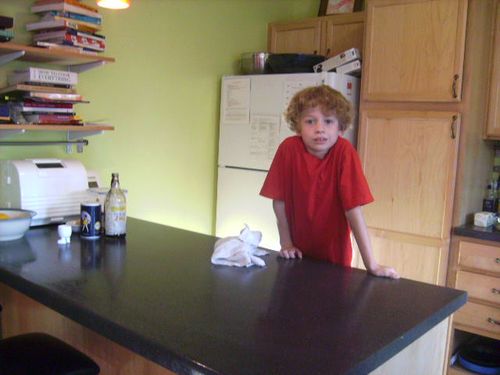
    The young investigator in the "lab."

    SANY1079

    Not to be confused with what's behind him, i.e., the "kitchen."  Note French toast in progress.

    SANY1089

    Nor with the opposite side of the counter, i.e., the "Pokémon bench."

    SANY1083

    Weighing an egg in grams on my kitchen scale.

    SANY1084

    The worksheet we developed for making sure that each small cake contains the same amount of egg.  (This was really, really fun for me to lead him through on Monday when we prepared for the lab).  Complete with hands-on lesson in Why We Must Align Digits Neatly In Our Lab Notebook Lest We Make Simple Addition Mistakes.  Woo-hoo!  

    SANY1085

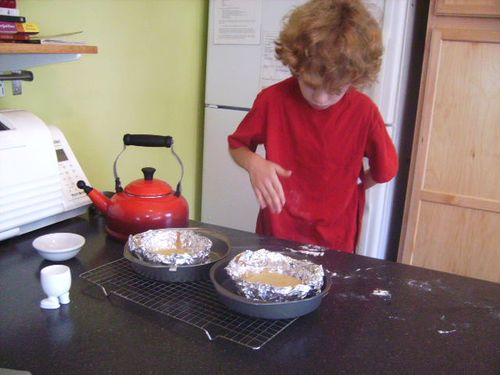
    Control cake batter on the right.  Test cake batter (sans cooking oil) on the left.

    SANY1087

    One does not "make mistakes" in the lab so much as one Deviates From The Experimental Procedure.  This is not necessarily Ruining The Experiment, as long as you document what you did.

    SANY1088

    Visual observations of the freshly baked cake.  Note to anyone who might be concerned about following standard laboratory kitchen procedure:  They were done at about the same time, so we managed both to bake them for the same amount of time AND to bake them to the same doneness.   All controversy related to which of these is more appropriate is thus, for the moment, moot.

    SANY1090

    Finally:  the focus group test.  (It's not double-blind.  It's not even single-blind.  I wasn't looking when it started).

    SANY1091

  • Why I homeschool (not the same as why you should, or shouldn’t.)

    An old friend contacted me recently and in the catching up process wondered about my reasons for homeschooling.  I hadn't contemplated the question in a while.  Obviously I could write a long laundry list about the benefits, objective ones and subjective ones.  There are many out there for the googling.  I enjoy many of those benefits

    But they aren't all my reasons, the ones I really own.  

    Let's just take this one for example.  "Homeschooling is a way to provide excellent academic preparation, and I believe I am likely to do a better job of teaching my particular child than other schools I might choose, public or private."

    Am I confident this is true?  In my current situation, yes.

    Am I confident it's always going to be true at all times and everywhere?  Actually, no.  Academically excellent schools exist, and children's academic needs evolve.   I know of a couple private schools around here where I think Oscar, kid that he is, would likely get an excellent education.  Maybe at some point I'd become convinced that one of them might be able to match my abilities to teach Oscar specifically.  

    By itself, would that be enough to make me switch?  I don't think so (although it would play into the decision, of course).  Because academic excellence, though I'm glad to have it, isn't the primary reason I homeschool.  

    How about this one?  "Homeschooling my kids is rewarding.  I enjoy it."

    True?  Yes.  Absolutely.  Even when it's frustrating, I am grateful for the experience.  It is shaping me in a way that I truly value.

    Will it always be true?  Maybe not.  I could definitely imagine a time when I wasn't enjoying it, or when there were things I would enjoy more, or value more, that I would be sacrificing for homeschooling.   I might, for instance, warm up to the idea of returning to some semblance of a career, or begin to desire to go back to school.  Or as the children age out of the primary school years I might discover that homeschooling older kids isn't as rewarding as I expect it to be.  Or I might just get tired of it.  Who knows?

    Still, I don't think I would conclude I ought to stop.  It's not the primary reason I do it.

    There are lots of possible reasons.  It costs me less than private school would (more than public school would, of course).  It frees our whole family from planning around the school's clock and the school's calendar.  It allows my kids to be outside more than they might if they were in school (although I'm not sure we actually ARE outside as much as we should be).   Any of those or a host of other reasons might be some family's primary reason to homeschool.  We're all different.  

    But this is mine:  Homeschooling allows my children to spend most of their time in an environment rich in real relationships.

    At this age, this mainly means:  Each child is together with siblings all the time.   My children are each other's most significant playmates, and they have close and loving relationships that have never been disturbed by long periods of time in enforced age segregation.

    This is the most important reason I homeschool.  It didn't develop until I noticed it happening, but the rewards are unspeakably huge.  

    I have noticed something about that, when I mention it to other people.  It rings true to almost everyone.  You know — skeptical family members, random other moms at the playground ("You homeschool?  Wow, more power to you.  I could NEVER do that"), and other homeschoolers too, of course.  (I've never tried it on a professional K-12 educator before and one of these days I mean to because I'm really curious about the response I would get.)  

    It doesn't even matter if the person you're talking to is really committed to the necessity of early "socialization" to large numbers of one's age cohort, which is basically the thing that steps in and displaces the sibling relationship I'm speaking of.  The reaction to this simple statement:

    "What I really love about homeschooling is that my children spend so much time together, they are each other's best friends and playmates, and they have really close, loving relationships"

    is always, always, always, a positive one.    Sometimes the expression you will see on your interlocutor's face will break your heart.  Try it and see.

    But what I'm getting at is that I really mean this, I really believe it.  I have learned to leave it at that (unless I am pressed with more questions, which I am happy to answer).  I am confident that this is reason enough.  I don't go on and on about academic excellence or individual attention or personal satisfaction or any other sort of thing.   I enjoy all that stuff, but they aren't my REASON.   So I probably wouldn't be all that convincing, frankly.  

    As the children age, the world expands to include more relationships.  We already see several relationships with people outside our family that are nearly as important as the sibling ones.   Maybe some of the children's sibling relationships will, in time, decrease in importance.  I think, however, that homeschooling saturates the student in relationships that have a chance to be more than superficial, because  with homeschooling we have a chance to arrange our lives to focus on what's important for the growth and development of each individual child, or at least to balance it pretty well among the needs and desires of all the members of our family.  It's much like the way we can make sure that the one who shows an aptitude for music gets to spend extra time and money on music lessons, that the one who's obsessed with birds gets to do a lot of nature study, that the one who loves to read has a well-stocked library of the kinds of stories she likes best.

    Fewer connections may be made, true.  I think we can hope that fewer may be broken, too.

    Anyway.  If I thought that homeschooling were preventing a particular child from forming or preserving strong and important relationships, that might be, for me, my reason to stop, if the other benefits don't seem to outweigh it at the time.  I'll make no claims about whether that's likely or not.  I can't predict the future.

  • Slipping.

     Halfway through third grade, Oscar's cursive handwriting was reasonably tidy, well-formed, and compact.  I put away the handwriting workbooks and told him he was done with handwriting as a separate subject; all he needed to do from now on was try to write legibly and smoothly whenever he had a writing assignment, and his handwriting would get better and better without special handwriting practice.

    But he resisted writing in cursive, and unless I explicitly ordered him to he would tend to print.  So when we began the school year and he started displaying comparatively atrocious handwriting, I made a mental note to pick up some fourth-grade handwriting practice books.  Clearly he needed to re-learn some skills.

    Today, though, prompted by a fairly stressful day in which Hannah's Ben and my Oscar reacted off one another in ever-increasing mood swings, and after a post-schooling cup of tea venting and self-analyzing session in which Hannah and I wondered aloud to each other if we'd done the right thing by each other's children, we both took a closer look at some of the writing Oscar had produced over the last few weeks.

    We noticed a pattern.

    Some pieces:  fairly neat writing with well-formed letters, (usually printing but sometimes cursive), correct spelling or reasonable guesses, thoughtful composition.

    Other pieces:  scrawly writing, unreasonable guesses at spelling, careless sentences ("Yep, I think so" as the third of an assigned three-sentence summary).

    Good writing, good spelling, and good composition went together.  Bad writing, bad spelling, and bad composition also went together.

    Diagnosis:  Not a handwriting problem.  A sometimes-I-go-too-fast problem.  Developing under my radar.

    Clearly it's ME who needed to re-learn some skills, namely (a) setting clear standards and (b) following up by checking and correcting.

    I brought the subject up in the car on the way home, stressing that I wasn't angry but that I thought the two of us had fallen into some bad habits.  We talked about it and he agreed that he had been trying to get his work done and over with quickly.  The "Yep I think so" sentence?  "I wrote that in bed," he admitted.  "I just wanted to go to sleep."  I promised I would tell him exactly how I wanted a piece finished:  in cursive or printing, with careful spelling attempts or with checked and corrected spelling, and ask detailed questions, and explain the purpose of each assignment.   He promised he would be more careful and try to meet the standards I set, and also asked if I would get him a handwriting practice book so he could get faster at writing in cursive, a request I agreed to fulfill.

    It was one of those days where somebody learned a lot.  It seems to have been me, mostly.

  • Iowa vs. Minnesota.

    Minnesota wins.

    Although I don't think I'm interested in any kind of corn dog.

  • If it’s Tuesday, it must be muffins. Definitely not cookies.

    This morning:  chocolate chip coconut pecan.  "Again?  We had those last week!" I asked Mark, a little bit incredulously, after I had requested his input (incidentally, it took me several years of marriage to learn that asking my spouse's input about the menu leads to a certain expectation that said input ought to, you know, have some effect on what I decide to make.  I keep forgetting this important insight, and I still slip up and ask for input from time to time).

    "Hon, you are the only one around here with the 'we can't eat the same food twice in a row' complex.  They were good muffins.  Let's have them again."

    Really I was thinking "I made those for the kids' tea.  What kind of degenerate person eats chocolate chips for breakfast?" but decided not to verbalize that.  Until now.

    Last week I told the kids they were "chocolate chip cookie muffins."   It's what came into my head naturally; a while ago I dubbed another kind of muffin "oatmeal cookie muffins" in an attempt to make them sound more attractive, and also because they contain oats, raisins, cinnamon and cloves, and molasses.  Anyway, there were exactly six "chocolate chip cookie muffins" left over after breakfast, so I thought:  Perfect, I have to feed a snack to six children this afternoon at Hannah's.

    When it was four o'clock or so and time for tea snack, I announced that I had chocolate chip cookie muffins, plus apples or whatever else I had (don't really remember), which brought several children running.  I handed out the muffins and busied myself preparing something else in the kitchen; a moment later I heard a loud altercation behind me.

    Perplexed, I turned around and saw that the altercation was coming from Hannah's four-and-a-half-year-old daughter, who was screaming at me in utter, red-faced rage.  I honestly could not make out what she was saying.  "Hazel!  Calm down — what's wrong?"  Hannah wryly translated:  having been promised something called chocolate-chip-cookie-something-or-other and being handed a muffin was, um, unacceptable.  Or the last straw or something.  To say the least.

    Now let me preface this by writing that after nearly 9 years of bringing our families together one or two days a week, Hannah and I have established a comfortable pattern of responding to each other's children.  So in that kind of a situation, I get to decide how to respond — we mostly suppress our impulses to jump in and whisk the child away and insist that she apologize.  

    Hazel is a sweet little girl, and it had been a long day, and frankly I was surprised (and admittedly kind of amused) by the unforeseen result of my muffin-naming.   (I mean — you give a kid a chocolate chip cookie muffin, you don't expect apoplexia.  At least I don't.  Maybe I should.  I don't know.)  So I sat down beside her and said "What a mix-up!" and explained why I named the muffins "chocolate chip cookie muffins."  She sniffled and hiccuped and tried the muffin. I don't remember, she may even have apologized to me.  I don't think she liked the muffin very much.  But everything did turn out okay in the end.

    Where am I going with this?  I don't know, but the chocolate chip cookie muffins are done now and I can take them out of the oven.  Today I'm leaving the muffins at home and bringing applesauce.  I didn't make it myself, so I know it's safe.


  • Suppressed evil impulse of the day.

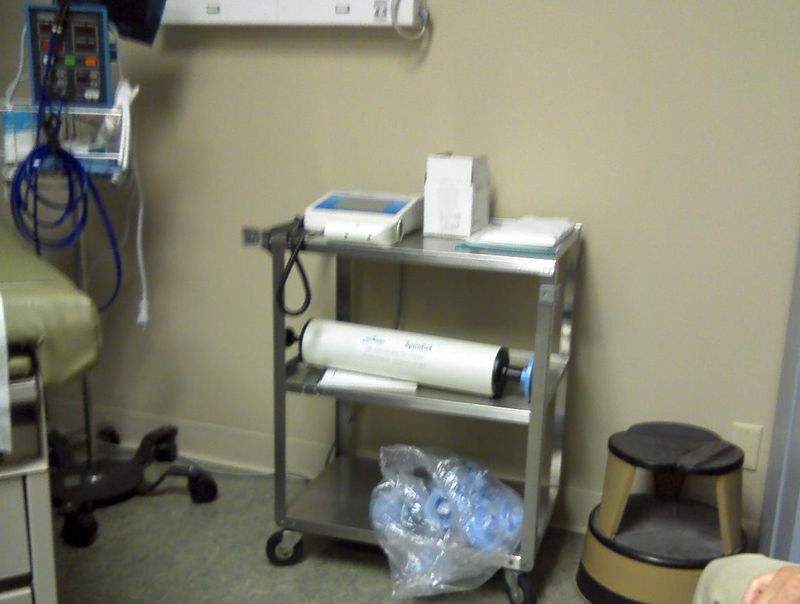
    On seeing the "3.00 Liter Calibration Syringe" on the middle shelf of the cart in the pediatrician's office: 

     "There you go kids.  That's the shot you're going to get at the end of the appointment."

    0831091409-00

    Like I said:  suppressed.  But just barely.

  • Pasta all’amatriciana.

    I think I spelled that right.

    I've made variations on this bacon-tomato-onion pasta sauce before, but I think the version I tried yesterday evening was the absolute best, the permanent one in my repertoire from now on.  I think it's the provolone, an unusual substitution for pecorino romano, that makes the difference.  It's from a Williams-Sonoma cookbook called simply Pasta Sauces.  Here's how I did it.

    • 5 large ripe Roma tomatoes, or a mix of Roma and conventional tomatoes, diced
    • 1  small onion, chopped fine
    • 6 ounces bacon, snipped into thin strips 
    • 2 Tbsp or so olive oil, plus extra 
    • 8 oz or so rotini or farfalle (whole wheat works fine) 
    • 3 oz finely grated provolone cheese   
    • Pinch cayenne pepper, more if you like 
    • Salt to taste 

    Sauté the bacon in the olive oil until crisp and rendered; use a slotted spoon to remove it to a small bowl.  Add the onion to the skillet and sauté until translucent and soft.  Add the tomatoes, salt, and cayenne and cook, stirring occasionally, until the tomatoes break down and the sauce becomes creamy and thick.

    Meanwhile, cook the pasta until al dente.  Drain and toss with a little olive oil.  When everything's ready, toss the pasta with the hot sauce.  Add the bacon and provolone and toss again.

    I served this with fruit salad and steamed Brussels sprouts (and also a bowl of pasta with just butter and Parmesan for my little sauce-rejecters.  Who am I to complain?  MORE BACON FOR ME).

  • After quickening.

    I hadn't felt the baby move yet until yesterday. But in the morning, I was lying in bed and absentmindedly pressing my fingers into my abdomen, feeling the contours of my uterus — and there it was, someone pressing back into my fingers.  Four times, equally spaced.  Just a little slow push back.

    I lay there for a while, pleased.  Mark woke up not too long later, and I told him, and put his hand on the spot and showed him how firmly to press, and we lay quietly and waited — not long, maybe a minute.  

    "There — did you feel that?"

    "I did!"  Surprise!  That's a first.  I'm used to weeks and weeks going by, after I first feel movement, before the baby moves when I want it to.  Let alone when I'm trying to get him/her to perform for somebody.

  • Customer service.

    Dooce fights Maytag, and everybody wins.  

    Seriously, read to the end…  I think she used her power for good, in the end.  Don't you?

  • Six.

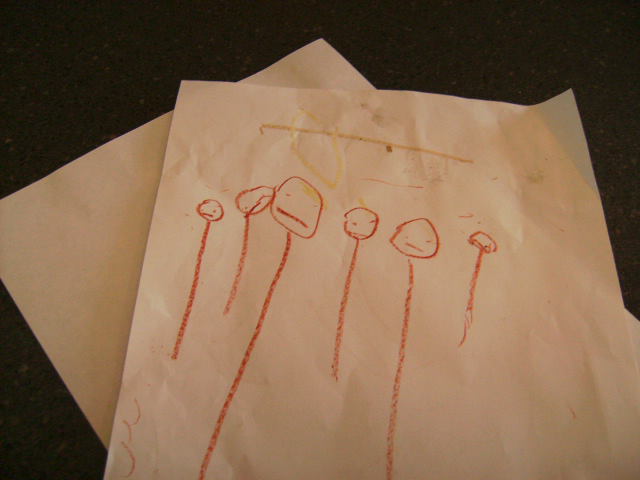
    Hannah suggested that 3yo Mary Jane draw a garden of flowers.  She said she couldn't.  "Then draw just one flower," suggested Hannah.  

    "I can't," insisted Mary Jane.

    "Well, what can you draw?"

    "I can draw myself," she told Hannah.

    "Then draw yourself," Hannah told her.  But she said:  

    "No!  I will draw my WHOLE FAMILY."

    First family portrait - 6 by mary jane

    From right to left, she reports:  "The new baby in Mommy's body… Daddy… Sister (me)… Mommy… brothers."