bearing blog


bear – ing n 1  the manner in which one comports oneself;  2  the act, power, or time of bringing forth offspring or fruit; 3 a machine part in which another part turns [a journal ~];  pl comprehension of one’s position, environment, or situation;   5  the act of moving while supporting the weight of something [the ~ of the cross].


  • Safety analysis.

    So I asked Mark what he thought about what I mentioned in my last post, the analysis of that 2007 chemical plant explosion in Florida (summary here; full report including awe-inspiring post-explosion photos is  here).  Bottom line, the owners of that plant — T2 Laboratories of Jacksonville, Florida — were seriously, severely, fatally negligent (one, the engineer, paid for it with his life, plus the lives of three employees).  

    But we concluded that the board recommendations for increased "reactive hazard awareness education" in the undergraduate chemical engineering curriculum miss the point entirely.  Even had the chemist-owner and the chemical-engineer-owner had specific undergraduate training in runaway reactions or in failed cooling systems, I doubt it would have made a difference.

    Why do I think so?  Because they didn't follow the recommendations of their own hired consultants, and they didn't make reasonable modifications after experience taught them that their desired reaction had the potential to run out of control.  Clearly the root cause wasn't a knowledge problem, but an attitude problem and a company culture problem.  In fact, the reason they didn't know about the runaway reaction was BECAUSE they ignored a consultant's recommendation.

    Consider the following facts gleaned from the report:

    • "One of T2's design consultants identified the need to perform a hazard and operability study [HAZOP]… CSB found no evidence that T2 ever performed the HAZOP."
    • "The runaway reaction on December 19, 2007 was not the first unexpected exothermic reaction that T2 experienced; three of the first 10… batches resulted in unexpected exotherms [that is, they got hotter than they were supposed to]…. T2 did not repeat batch recipes to isolate the problem."  
    • "As demand grew, T2 increased batch size and frequency with no additional documented hazard analysis"… and indeed with no other changes to the process.  Scale-up IS something that is included in the standard engineering curriculum and the engineer-owner knew better.
    • T2 submitted the reports required by the Emergency Planning and Community Right-to-Know Act, but they left off required information about the chemical they were manufacturing.
    • "T2 hired a consultant to analyze regulatory programs that might apply… The consultant informed T2 that it must develop a hazard communication program, which should include employee training, chemical labeling, and provision of MSDSs… The consultant listed other OSHA [Occupational Safety and Health Administration] requirements … the consultant recommended that T2 hire an additional consultant with OSHA expertise… There is no documentation that T2 further addressed potential OSHA requirements."

    Because of this evidence, I conclude that it's bulls#!t that the root cause is, as identified by the board, that T2 did not recognize the runaway reaction hazard.  Equally bulls#!t, the idea that adding reaction hazard analysis to undergraduate education would have fixed the problem.  The root cause here was, in my opinion, a corner-cutting culture in which T2 didn't follow the advice of the experts it hired to tell it how to build a safe process — especially, omitting the HAZOP analysis.  The owners weren't ignorant because their professors omitted to teach them about runaway reactions; the owners were ignorant because they were to cheap to pay for HAZOP analysis they knew they were supposed to have.

    * * *

    The problem isn't that all undergraduates should receive formal reactive hazard analysis training.  The problem is that all engineers should follow the recommendations of  the experts who HAVE received formal hazard analysis training — hazard analysis of all kinds, from the hazards of specific chemical reactions to ordinary workplace hazards.  If we need more undergraduate training — and quite possibly we do — it should be as general as possible, an attempt to inculcate an expectation of a culture of safety and general hazard awareness in every newly minted engineer, so that we're all always looking for ways to make the workplace safer for everyone.

    UPDATE.  Mark pointed out something I didn't catch:  their cooling system was guaranteed to foul and occlude, because it constantly boiled municipal water and vented steam, thereby concentrating minerals inside the system.  According to the report, the owners never did any preventative maintenance, and it was indeed a failure in the cooling system that precipitated (no pun intended) the accident.  

     Now I know that fouling of heat transfer equipment is something that was covered in my undergraduate chemical engineering education!  Could it be that more undergraduate technical education is not the answer?

  • Explosion.

    The rare engineering post makes an appearance on my blog.  

    Derek Lowe points to an summary in Chemical and Engineering News (a trade magazine of the American Institute of Chemical Engineers) of a tragic but interesting 2007 chemical plant explosion.  I clicked over to the full report to fill in some of the details for myself.

    I was amused to read some of the responses on Derek's blog (he seems to think that part of the problem was that the operators "only" had undergraduate degrees — sorry, but it's a rare PhD or Master's program that covers process controls in the kind of practical detail needed to prevent this kind of explosion) but also interested to read (in the full report, not the summary) that the Chemical Safety & Hazard Investigation Board recommended that undergraduate chemical engineering education be modified to add "reactivity hazard awareness" to the curriculum.

    That got me thinking — what aspects of reactivity hazard awareness belong in an undergraduate curriculum? There's the operator's end of the hazard awareness, in which the decision tree ought to be something like, "The temperature's going up — what should I do to stop it — and at what point should I start running?"  And then there's the design end, in which perhaps the most important thing to teach is how to know when you ought to outsource process design to somebody more experienced.

    I'd like to get Mark's opinion on this, but I have to go to bed now.


  • Inspiration porridge.

    Leila wrote about putting leftover steel-cut oat porridge in her bread — and I thought, Hey!  I have leftover steel-cut oat porridge in my fridge right now!

    So I put it in my bread machine for the next loaf.

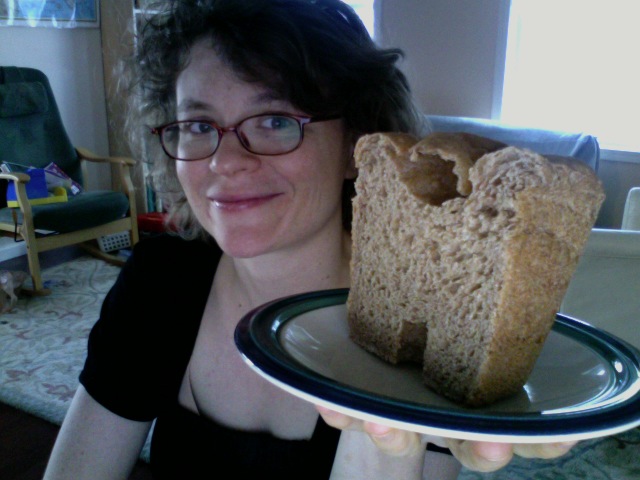
    Photo 91
    I call this my "Lusty Bread Wench" pose.  You get it because I couldn't find the camera, so I resorted to Photo Booth.

    This loaf of bread marks a sort of turning point for me.  I think I'm getting good enough at bread making — in the bread machine anyway — that I no longer have to follow a recipe exactly.  I can mess with it a little bit, and it still comes out nice.  Sometimes it comes out EXCELLENT.  And that is what happened with this bread.

    Here is what I did.  I had a serving or so of cooked plain steel cut oats in the fridge left over from the previous day's breakfast.  They had been on the moist side — not nearly as "grainy" looking as the oats in Leila's post, more soupy/porridgy.     I didn't even measure them — I tossed the porridge, which had congealed to a disk the shape of the bowl, into the bottom of my bread machine pan.  

    I figured it represented about three tablespoons of raw oats and about six ounces of water, some of which had been absorbed by the oats of course, and of course sometimes I add cooked grains to my bread without changing the water at all; so I used 8 ounces of water instead of 9.  I thought about leaving the egg out but decided against it; in it went.  Honey seemed like it would taste nice as a sweetener, so 2 Tbsp of that.  I used a bit less coconut oil than usual because there was some in the porridge.  3 cups whole wheat flour, a bit less than 2 Tbsp dry milk, a teaspoon and a half of salt, and a teaspoon and a half of bread machine yeast, and there it goes.

    I checked it during the knead cycle, and MAN was it wet!  You could stick your finger right in it, like, well, like porridge.  I added 4 tablespoons of all-purpose flour.  I didn't know how much to add, I just tried to add flour until it looked right.  I guess I must be getting better at this…

    It came out gorgeous.  Look at that crumb!  And moist.  There is just something about cooked oats that moistens baked goods of all kinds.  Fantastic.

    So, now I have something to do with those leftover steel-cut oats that appear in my kitchen once or twice a week.  But more importantly, I am apparently figuring out how to change bread recipes on the fly.  And THAT is extraordinarily useful.

  • “Behold the s and p orbitals.”

    From Derek Lowe:  "Generations of students have learned these as abstractions, diagrams on a page. I never thought I'd see them, and I never thought I'd see the day when when it was even possible. As always, I react to these things with interest, excitement, and a tiny bit of terror at seeing something that I assumed would always be hidden."

    Carbon orbitals

  • Bread machine bagels (honey wheat edition).

    I've had the bread machine for over a year now, and I only recently discovered that it renders bagel-making simple enough for weekday morning breakfasts. 

    (At least, in my house.  Because I prefer to eat hot breakfasts, and I like to feed myself what I prefer, I'm used to scheduling my mornings around breakfast.  We are not a household that relies on cold cereal or granola bars to get out of the house on time.)

    The sorts of things I have not yet been able to figure out for weekday mornings are breads that require a complicated shaping and then a long second rise before baking.  Cinnamon rolls are a perfect example of something I would like to make for breakfast (they're my favorite pastry) but don't, because there's that bit about rolling it out, adding the filling, cutting it into rolls with a length of dental floss, and then letting the darn things rise "until doubled in bulk" for an hour before baking.*  By this time, even with the head-start from the bread machine, I will have had to have been awake for an hour and a half at least before even putting them in the oven, and plus there's the mess of rolling out the dough, dribbles of filling everywhere, etc. 

    Bagels, however, are surprisingly quick and low-mess (once the dough is made).   I set the bread machine and my alarm clock for the same time; I work for 25 minutes shaping, boiling, and topping the bagels; they bake for 35 minutes while I shower and get dressed; I come downstairs and take hot, crispy bagels out of the oven.   The hard part is waiting for them to cool enough so I don't burn my mouth.

    Notice especially how few items are dirtied in the morning, and the quick hand-shaping that doesn't mess up a rolling pin or the counter.  Obviously, you can adapt this recipe to make the dough in a mixer, but then you probably won't want to make them for Wednesday morning breakfasts.  Unless you let the dough have its first rise in a cool place overnight, something I can never seem to get to work right.

    Honey Wheat Bagels (for the 1 or 1-1/2-pound bread machine)

    3 cups whole wheat flour
    2 Tbsp wheat gluten
    2 tsp bread machine yeast
    1 and 1/2 tsp salt 
    1 cup water
    3 Tbsp honey

    Ahead of time:  Add the water, honey, flour, gluten, and salt to the bread machine pan and level the dry ingredients carefully on top of the water.  Make a well in the center of the dry ingredients and add the yeast.  Set the machine on the "dough" cycle to finish the dough 1 hour before the bagels are to be done.

    When the dough cycle is complete:  Preheat the oven to 350 degrees F.  Put a large pot of water on to boil.  Spray a cooking sheet with cooking spray.  Turn the dough onto a lightly floured surface (I flour a cutting board for easy cleanup) and cut it with a sharp knife into 8-12 pieces.  Shape each piece with your hands into a rope, then overlap the ends and work them together to seal.  Let the bagels rest a few minutes on the floured surface until the water comes to a boil.  Boil the bagels 4 at a time for 1 minute, turning them halfway through.  Remove them with the slotted spoon to the cookie sheet.

    (Optional topping step:  Beat 1 egg white with 1 Tbsp water.  Brush this glaze on the bagel tops and sprinkle the bagels with toppings of your choice, such as sesame seeds, poppy seeds, coarse salt, onion flakes, cinnamon sugar, etc.)

    Bake the bagels 25-30 minutes until golden brown.  Cool on a rack.
    ______________________________
    *I tried shaping the cinnamon rolls and letting them rise in the fridge overnight a couple of times, but they didn't rise enough.  I have also made pseudo-cinnamon rolls with a refrigerator dough, and they were okay, but not great.

  • Storytelling.

    "Once Daddy took me to Nashville," said Mary Jane to me earnestly, "and you didn't go."  This began a long, detailed account of the day Daddy took her to Nashville, the sights they saw, the fun they had, and how sorry she was that I missed all of it.

    The story was a work of fiction, and very interesting to listen to.  Milo was upset.  "Mom!" he hissed.  "She's lying."

    "She's telling a story," I corrected.  "Isn't it a good one?"

    All three of my children have come through this period of storytelling, in which they recount long tales, some more plausible than others, about something that purportedly happened to them.  And I remember other children telling these stories too — my younger brother, I remember, was prone to tell stories about "when I was a grownup," for example.

      It's really interesting to hear what they come up with.  I wonder why?  I don't think they are lying exactly.  Nor do I think that they don't understand the difference between a true story and a made-up one — they have all gone through this at an age around three years old, when they are wont to accuse a sibling of lying about something, and accurately too.  I do think that they have trouble expressing the difference between a true story and a made-up story.

    And I think back to the way we model storytelling.  We read them stories:  Frances and Little Bear and Peter Rabbit. Fanciful ones, and realistic ones.  And we tell them stories, stories about ourselves, stories that they have no way of verifying.  And we use the same word for it:  we read a bedtime story, and we say "Let me tell you a story about when I was a little girl."   How do they know what we're doing when we tell a story of what happened to us when we were children?  How could they tell that we are not making the stories up simply to entertain them?

    I think when they launch into these tales they are not lying, they are not seeking attention, they are trying to participate in "storytelling" — as best as they can puzzle that out from the styles and genres of "stories" that grownups and older children tell them and tell each other.  They may not be sure what storytelling is, but they clearly know a good story when they hear one, and by now have some idea about what elements in a story will interest other people, and they stud their own stories with details to create them.  We don't verify our stories to them, so why should they feel a need to stress truth or falsehood?  We don't make much of a distinction between a true story and a made-up story, so why should they? 


  • Swimming on vacation.

    May I just say that the YMCA in downtown Nashville is the cushiest YMCA I have ever been in?  Nice pool with wide lap lanes, five (!) of which are available for lap swimming at any time.   Outdoor pool to keep the rabble out of the indoor pool.  Enormous two-level fitness center with 1/12-mile indoor track, studded along its length with fitness objets like stretch cages and spinning machines for easy cross training.  Café inside that will take to-go orders when you come in and have them ready for you to pick up at the end of your workout.  A lifeguard who politely reminded me she couldn't talk because she was required to keep her eyes on the water (wow!  functional safety consciousness!)  A positively cavernous women's locker room with sauna, broad marble vanity countertops, shower stalls with curtained private vestibules, and not so much lockers as cabinetry.  Fantastic.

    Mark and the kids and I had walked to a Panera around the corner from our hotel for breakfast.  I  wore my running shoes to make room for my netbook in the gym bag I carried, and then they went back to the hotel while I walked to the downtown Y.  As we left the Panera I said to Mark, "Wow — I am actually craving a swim."   (I'd skipped my Thursday workout while I was taking it easy after that bout of preterm contractions two nights before).

    "Well, then," said Mark, "it's not 'exercise' so much as it's just 'swimming,' right?" 

    I suppose so.  I went on to the Y and had a fantastic swim.  I really feel so much better now.  When I talked to my midwife yesterday afternoon to update her on how I was feeling — I'd had a little bit of back pain and wanted to check in — she had been the one to suggest that I try to get into the pool for my regular workout.  I'm glad she did, because it would have been easy to talk myself out of it — maybe I ought to keep "taking it easy?" But with the strength of her encouragement behind me I made it a priority, and I'm so glad I did.  I felt strong and, well, my normal self once I got into the pool again.  A nice place to be.


  • Classic (not classical) economics, and the value of an anecdote.

    A Facebook friend* linked to this 1945 paper I'd never read before:  The Economic Organisation of a POW Camp, by R. A. Radford.  I saved it to read to Mark during our 5-hour drive from Cincinnati to Nashville, because I knew he'd really be interested in it. 

    We reached a transit camp in Italy about a fortnight after capture and received 1/4 of a Red Cross food parcel each a week later. At once exchanges, already established, multiplied in volume. Starting with simple direct barter, such as a non-smoker giving a smoker friend his cigarette issue in exchange for a chocolate ration, more complex exchanges soon became an accepted custom. Stories circulated of a padre who started off round the camp with a tin of cheese and five cigarettes and returned to his bed with a complete parcel in addition to his original cheese and cigarettes; the market was not yet perfect. Within a week or two, as the volume of trade grew, rough scales of exchange values came into existence. Sikhs, who had at first exchanged tinned beef for practically any other foodstuff, began to insist on jam and margarine. It was realized that a tin of jam was worth 1/2 lb. of margarine plus something else; that a cigarette issue was worth several chocolates issues, and a tin of diced carrots was worth practically nothing.

    Radford goes on to describe the development of a trading and barter economy complete with currency, price fixing, a futures market, middlemen, entrepreneurs, a service industry, and a robust internal debate about economic policy.  It's really worth a read even if you think you're not very interested in economics.

    I guess it's a "classic" paper, and I'm not surprised.  The writing is crisp and detailed, well-organized and a good balance between the personal experience and the interested (though probably not objective) observer; it was easy to imagine Radford the economist-turned-prisoner-of-war, or maybe he was a POW-turned-amateur economist, watching the little economy rise and fall (and sharing in its fortunes) and thinking, "I'm going to get a paper published about this when I get out of here."

    Radford's paper struck me as an excellent example of engaging science writing, even if the observations are anecdotes and the science a social rather than a hard science.  I think there is a place for narrative-style, rather than data-driven, reports about observed phenomena.   As long as you are careful not to draw stronger conclusions from the described experience than its narrow scope permits, and as long as you remain open to considering narratives from other observers that may offer counter-evidence to your own conclusions, this kind of anecdotal and personal report has great value.  If nothing else such reports suggest avenues for further exploration, and they stimulate interest in the subject for lay and technical readers alike.

    ———————————–

    *I am new to Facebook**, and I'm not sure yet of the etiquette of hat-tipping people for Facebook links when they blog under a pseudonym.  Somebody fill me in when they get a chance.

    ** Unless we're close in real life or have corresponded for quite some time, if you try to friend me I probably won't confirm it, at least not yet.  I'm still not sure how I want to use FB.  Don't take it personally.


  • Rough night.

    I started feeling a little "off" the day before yesterday.  Mostly fine, though, until partway through dinner last night, when I began to wonder if the pain in my lower abdomen was an incipient UTI.  I went to bed as soon as we got back, leaving Mark to wrangle a hopped up MJ, and by midnight I was in serious pain.  Cramps, low back pain that I kept thinking "ah, it's getting better!  ..no, wait, it's getting worse… no, better… wait, there it is again…"

    I finally had to admit to myself I was dealing with a possible problem when I found myself pacing in the bathroom practicing slow breathing and leaning over the sink.   I waited until I was sure Mark had MJ well settled and then I went downstairs to google "preterm labor."

    A few minutes later I woke Mark up to let him know I was about to call our midwife for advice.  This got his attention pretty quickly as I am not the sort to call in the middle of the night unless I'm really worried.   He disentangled himself from Mary Jane, who had only JUST settled into deep sleep, and waited while I called.  I hoped this wasn't going to lead to an emergency room visit in the middle of the night.  An awful prospect, but not as awful as being worried I was going into labor at 20 weeks.

    She answered, I described the problem, she listened.  Was I bleeding?  No?  Then yes, I could go to the ER if I wanted to; they'd probably do an ultrasound to see if my baby was okay, maybe a cervix examination, but there was not much more they could do at 20 weeks, she thought.  26 or maybe 24, possibly; twenty, no.   So probably there was no real reason not to wait till morning, we worked out together.  "You're traveling," she said, "you are eating different food, maybe dehydrated, maybe your bowels are more active, it's all linked together.  Drink a lot of water and try to rest."  She advised me to watch for spotting or bleeding and to go to the ER right away if I found any, or if the pain got excruciating, but mainly to try to get some sleep and to drink a lot of water.  And call her in the morning.

    Well.   I hadn't thought I was thirsty, but I managed to put away four big glasses of water over the next half hour or so.  And more every half hour after that.  The pain got worse before it got better — I lay there in the dark wide awake for a long time, curled up with a hot compress at my back.  But at some point I fell asleep in between contractions, and though the pain kept waking me, it seemed to be less frequent.  I got up, went to the bathroom, drank a full glass of water several times.  And eventually it was morning.  And there weren't any more contractions.  A steady, dull muscle soreness all up and down my sides; a low and burning ligament ache; a famishing desire for breakfast; but no more contractions.

    Not much fun.  I called the midwife back when it seemed late enough and together we decided I'd stay home all day, make sure to get plenty of rest and keep drinking water, and take it easy for a couple of days.  So Mark and I scaled back our travel plans, cancelled getting together with friends tonight, cancelled a planned trail hike tomorrow.  I stayed in bed most of the day, emerging for meals and glasses of water and trips to the bathroom (and now to plug myself into the non-wireless internet temporarily). 

    I still don't feel quite myself, but I'm not sure if the exhaustion is physical or emotional.  I've never been through anything quite like that before — at least not prior to 36 weeks.  It felt exactly like early labor does, the kind that eventually peters out and stops after many hours of being sure "this is it."  Only, when one is full term, one is supposed to go with the contractions and visualize them opening you up and doing good work to get the baby out.  It was peculiarly exhausting to find myself fighting them instead, arguing with them in my head and visualizing my body staying closed up and tight and keeping the little one in where he or she belongs.


  • Police blotter item.

    Actually from Apple Valley.  According to the Star Tribune, on August 10th:

    Theft. A man called police to report his wallet was stolen by a cab driver who drove him home from a bar. As the taxi pulled up to his house he told the driver he would have to go inside to get the money to pay him. The taxi driver reportedly told him the only way he would allow that would be if he left his wallet with him and he would get the wallet back when he returned with the money. He said he then went into his house, used the bathroom, and got hungry and decided to make himself something to eat. After eating he went back outside and the taxi was gone.

    Yes, I searched the police blotter to see if any cab drivers had reported being bilked of a fare they took home from a bar.  No luck; I guess my career as an investigator will have to wait.


  • And verily it was so.

    This week I fulfilled an ancient prophecy, of sorts. 

    I remember once telling a friend of mine — I forget whom, or when, but it was long before I had children and long before I got married — "If I ever put on a two-piece swimsuit, it'll be when I'm huge and pregnant."

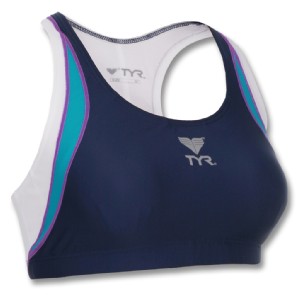
    (At the time I was thinking of beachwear, not a Tyr triathlon suit.  That's the way it is with ancient prophecies.  They are rarely fulfilled in the way you might expect.)

    Here's the deal:  I am short, with a short torso.  THERE ARE NO MATERNITY SUITS THAT FIT ME WELL ENOUGH TO ACTUALLY SWIM IN.  The straps fall off my shoulders and the next thing you know — or would know if I was foolish enough to try to wear one in the lap pool and you were foolish enough to watch me — um, coverage is compromised. 

    So.  The belly is hanging out.

    Tri-t Tri-b

    (You didn't think you were going to get a bikini pic, did you?)  

    I feel weirdly exposed, swimming in a two-piece, no matter how many times I remind myself that we've all seen plenty of bellies as big as mine hanging out over a pair of swim trunks. I've never worn one before. It is taking some getting used to, too, to feel the water on my bare belly, and the absence of support. Rather obviously, the belly fabric on a one-piece provides some support to the abs when you're swimming. Not so with the two-piece.

    I'm getting used to it, though.  The top is really comfortable and supportive, and it is not going anywhere during my laps.  I am kind of tempted to try to find some kind of top, though, maybe the top of a slightly-too-large maternity tankini, to wear over the two-piece before my belly gets TOO grotesque.  I think I can deal with some extra fabric flopping around, as long as I know I've got a real suit underneath that's going to stay on.

    (Photo is of the Tyr Splice Maxback top and bottom, sold separately, which I heartily recommend for pregnant lap swimmers.  Mine is pink, not blue.)


  • Probably true about both sides of the health insurance reform debate.

    Megan McArdle:

    "People don't know what's in various bills, because bills are very complicated, so they just project whatever they think would be neat onto the ones authored by politicians they like."

    I've noticed this too.  Come to think of it, I haven't read the various proposed bills myself, relying on an assortment of summaries.  For all the buzz, how many folks do you think have read the assorted proposals?  (And kudos in advance to any of my readers who've done it).  I try not to project my wishes too much onto politicians I like, but I mostly accomplish this by assuming that all the politicians have mostly bad ideas until proven otherwise.

    A couple of examples at the link about the kinds of subtleties that people might be missing.  I can see how people might not appreciate the difference between their health care payroll deduction and their health care benefit.