bearing blog


bear – ing n 1  the manner in which one comports oneself;  2  the act, power, or time of bringing forth offspring or fruit; 3 a machine part in which another part turns [a journal ~];  pl comprehension of one’s position, environment, or situation;   5  the act of moving while supporting the weight of something [the ~ of the cross].


  • Sourdough Not-fail!

    Hurray!  My very first real, traditional sourdough (read:  no yeast-from-a-jar) has been baked and is successful!

    So here is what I did:

    1) Refreshed my starter:  The half-cup of starter from last time gets taken out of the fridge and mixed with 1 and 1/2 cups whole wheat flour and 1 and 1/2 cups water. 

    2)  Let the mixture sit for "a while," 6 to 8 hours. Crucially for fitting this into my lifestyle:  Timing is not actually all that important.

    3)  Set aside 1/2 cup of starter for next time, in a clean jar in the fridge.  I have to feed it in a week.  This leaves me close to 2 cups of fresh starter to use in recipes.  Crucially for fitting this into my lifestyle:  The exact amount is not actually all that important.

    4)  One cup of fresh starter went into an ordinary sandwich-bread recipe, right away, in my bread machine.  That is just a side note.   

    5) I then modified a multigrain-loaf recipe to accept the sourdough starter.  I calculated the proper amount of flour and water as instructed by the pamphlet that came in the mail with my starter:  for each cup of starter, reduce the flour and the water by 3/4 cup each.  And I didn't add any baker's yeast.

    6)  So right after sending half a cup to my fridge and one cup to my bread machine, I mixed the remaining cup of fresh starter with 

    • 1 and 1/4 cup whole wheat flour
    • 7 Tbsp water

    and then I let that sit around for a few hours again.  

    7) About two hours before bed, I put the flour-water-sourdough mixture in my bread machine with

    • 1/2 cup rolled oats
    • 1/4 cup oat bran
    • 2 Tbsp wheat gluten
    • 2 scant tsp salt
    • 3 Tbsp molasses
    • 1 Tbsp coconut oil
    • 1/4 cup chopped pecans
    • 2 Tbsp flax meal

    and let the machine run on the DOUGH cycle.  When the dough was done, I turned it out onto a floured board, kneaded it a few times, shaped it into a boule, and put it on an oiled baking sheet, covered with plastic wrap.  Then I went to bed.

    8) In the morning I stuck it in the oven at 350 degrees and baked it for, I don't know, 45 minutes or so.

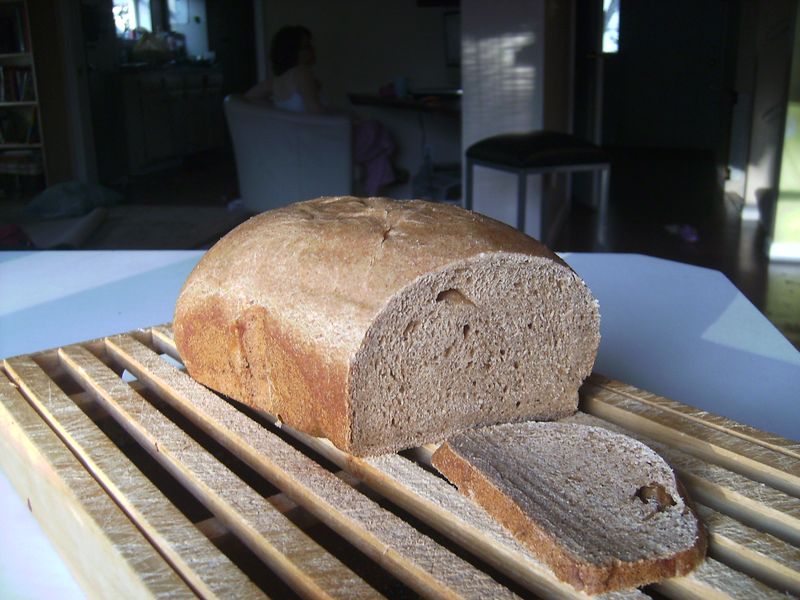
    Result:

    1001091314-00

    Seriously good.  It rose perfectly, with the long cool rise (it's probably 68 degrees in my house at night), domed beautifully, and has a fantastic tart-molasses flavor.

    I can't wait to try this with a white bread.


  • What to do with a rye sourdough baguette that’s too dense and didn’t rise.

    Remember my sourdough FAIL from a few days ago?  The 100-percent rye baguette that didn't work?  How I thought I might slice it up into Melba toast?

    This is today's public service announcement:  If you ever make a batch of sourdough, rye in particular, that doesn't want to rise and is suspiciously dense after a couple of days, definitely do this:

    1.  shape it into a very long baguette — 3 inches in diameter or so

    2.  bake it

    3.  if the resulting baguette is indeed really dense and unrisen, slice it thinly (1/4-inch) and toast it dry in a 225-degree (F) oven, turning the slices after a while, until it's good and crisp.

    Seriously.  Awesome.  Melba toast.  

    (This does nothing for the problem of can't-stop-eating-it, by the way, but at least it feels like you are eating something you made on purpose rather than destroying the evidence of an accident.)

    The toasts would probably make a fantastic accompaniment to tomato soup, but I don't think they are going to make it to lunch.


  • Should be thought-provoking no matter how you feel about population/environment.

    Two quotes from an article I saw linked on FB recently:

    "It’s no coincidence that most of those who are obsessed with population growth are post-reproductive wealthy white men: it’s about the only environmental issue for which they can’t be blamed."

    "It’s time we had the guts to name the problem. It’s not sex; it’s money. It’s not the poor; it’s the rich."

    As a side note, I'm always kind of surprised at how little attention is paid to reducing the amount of fuel we burn with non-essential air travel. This table from the Bureau of Transportation Services appears to show that (in 2005 at least) we burned about ten times as many gallons of gas/diesel in highway driving as we burned gallons of aviation fuel (domestically — international travel is not included). I don't know how the two compare in terms of emissions per mile of human travel, or emissions per mile per ton of cargo carried; but surely airplanes burn a not-insignificant fraction of the total.   And what percentage of that goes for inessentials or luxuries, compared to the percentage of fuel burned by cars and trucks (including shipping)?  You just don't hear about it much…


  • The perils of being a grammar geek, or pedant, or whatever.

    A funny story (I thought so anyway) from Neal at Literal-Minded.  

     As far as I was concerned, Chad’s use of "myself" was not only a mistake, but a mistake that needed to be corrected, by me, then and there.

    “With me,” I interrupted.

    “What?” Chad asked.

    “Michelle will be riding with me.”

    “No-o-o,” Chad said, looking puzzled as he reviewed the drivers and riders in his head. “Michelle will be riding with me.”

    “He’s correcting your grammar,” Michelle told him. “You said ‘with myself.’” But even the clarification from Michelle—who had dated Chad the previous year, by the way—couldn’t completely erase the pathetic impression of a jealous loser, stepping up to challenge Chad for the privilege of driving Michelle to the dance. I still cringe when I think about it. Luckily, I have much more embarrassing memories to draw on to make this one not so bad.

    Preceded, of course, by a thorough linguistic explanation of reflexive pronouns.


  • Anticipation and imagination.

    So I'll admit to being a little (just a little) bit disappointed about the "it's a boy" news.  Not because of an inherent preference of girls over boys, I don't think;  I am pretty sure I was kind of rooting for my daughter to get a sister, which she doesn't have yet, that's all.  It will go away eventually, probably long before the birth, certainly by VERY shortly after.   

    Hannah said that it's different when you find out the gender at the birth — there almost isn't a possibility of real disappointment, because at the same moment as you discover the sex of your baby, well, there's a BABY!  A real live one right there in your arms!  (Or maybe you don't know until even a few minutes after that.)  And there he is! (Or she.)  And beautiful!  And perfect!  A whole little person, and how could you want anyone else?

    The photographs, and even the wriggling live image on the tech's screen, are beautiful too, but there is an element of unreality about them.  I can't look at those pictures as pictures of a person I really know, not yet; it's like a photograph that arrives in the mail.  You open the envelope and think, "There he is;" but no, there he isn't, it's just a picture, it's not illuminated from within with a memory and a knowledge (connaitre) of a person, with the reality of someone making themselves known — a voice that shoves the air around like he means it, limbs that kick and elbow and make room for himself, winks and smiles and snarls, picking things up and putting them down where he wants them to be.   The squirming creature in my belly (who really is the baby, though unseen) is already doing that, shoving my insides about and kicking me in the cervix.  It's hard for me to connect him with the photographs in any deeply felt way.

    Not much strikes us as unusually callous about, "Gosh, I was hoping for a different sort of picture to arrive in the mail."  But it would feel wrong, maybe even impossible, to hope for a different real person when the real person is really right in your arms.  When he is there he is himself, and himself is the sweet baby, you know?

    It led me on to contemplate the nature of prenatal testing in general.  We had news that "everything looks fine," lucky us so far.  Some don't get that.  What a difference it must be for those who get Bad News after, or right at, birth, compared to finding out while the baby seems little more than images on the screen.   It's not quite the difference between hearing sad news about a stranger, and sad news about a close friend; but maybe a little like that?   

    I hear people say that it is helpful to know Bad News ahead of time because it gives time to prepare.  Maybe that is so.  I can see it giving time to prepare for living with Bad News.  I don't think, though, it can prepare for knowing and loving the little person, the person who lives (for however long) with the reality that the Bad News represents imperfectly.  

    There's a  terminology called "person-first language" for speaking about people who live with disabilities and conditions of one kind or another — it's occasionally derided as politically-correct, and not all people want it used about themselves, but as a matter of respecting human dignity I use it as my first choice at least when it is not linguistically awkward.  It's the difference between "a cancer patient" and "a person with cancer," between "a Down's kid" and "a kid who has Down's."  Instead of putting the disease or disability first, it reminds us that people are first and foremost people.  It is a slight difference, but I think a difference that makes a difference.  

    Prenatal diagnosis of disorders of one kind or another has utility.  I see that.  I do.  I think though that it can't help but put the disorder, disease, disability, dis-whatever before the person, because you can't help but know it outside the context of knowing the person; the person is still secret, hidden, inside.  It's a trade-off.  That's all.  There may be consequences.  Almost no new good thing is without them.

    This is not my story, and there is a twist of irony about my writing it; here I am writing about people who receive Bad News, and imagine its effect on their lives, before they can the whole story, the whole person, the wholeness of the effect on their lives; and of course in writing it I am imagining how I would feel if it were me, even more imagination.  I can hardly fault imaginary people for imagining things.  Silly blogger.

    The whole thing should teach us all to avoid, or sharply curtail, imagining how things must be in the lives of other people we can't really know.  It's not true that we can't make judgments about ought-to and should; but we really cannot judge how things must be and how experiences are lived.  Including how people live in circumstances we think we would find intolerable.  Many real people are imaginary to us, and when we move their little avatars around in our minds it's good to remember that the avatars are just that, imaginary; the real people are somewhere else, making their own moves on a distinctly real field.

    But all that is beside the point today.  I have a new little boy to get to know.  This is not he, not exactly, but it is a picture of him:

    Photo 93

    He is squirming and real, and I can't show him to you just quite yet.


  • The secret will be out.

    I'm having my very first ever ultrasound, in this my fourth pregnancy, early this afternoon.

    I don't do routine ultrasounds, being the crunchy home birthing type, but had a variety of reasons for choosing to do one this pregnancy.  Everyone who knows me, knows I don't like having "routine" unnecessary testing in pregnancy, and could go on at length about it.  Which is why it may seem kind of weird, but… now that I've made the decision to go on and get the u/s, I'm actually excited about it.

    Anyway.  More later…

    Side note.  I was at a family wedding a couple of weeks ago, and everyone — people I knew, and perfect strangers — kept asking me "So do you know what it is yet?" and I would say truthfully, "No, but we'll know in a couple of weeks," and the small talk would continue to "I never had an ultrasound with any of my others so this is a first time" and invariably they would say:  "Oh, my gosh — how come you're doing one this time?  Is there anything wrong?"

    This kind of shocked Mark, who asked me later:  "Isn't that kind of a strange thing to say to someone as part of small talk?  I mean, what if you had some terrible condition that you didn't want to explain?"

    I had to remind him:  This is the way it is with women and pregnancies.  Pregnancy and childbirth stories, breastfeeding and in some contexts fertility stories, even horror stories, are the stuff of small talk among strangers.  It is very strange, and I don't understand it, but discussion of  one's (female) reproductive system is not reserved for among intimates.

    Anyway, I skirted the question fairly gracefully, if untruthfully, by laughing and saying, "Oh, no, it's because I'm getting so old," a comment that was accepted with knowing laughter by all the mothers present.   I mean, I AM thirty-five next week, and if I was seeing an OB he'd expect me to, oh, I don't know, expire any day now…

    Anyway… as I said… more later…

    UPDATE:  It's a boy:-)


  • “Filtered reality.”

    David Post at the Volokh Conspiracy makes a novel baseball/politics analogy that I think is right on.

    I then said something like – “but it does seem like the overall level of defense is improving all over – I see so many great plays these days . . .” before I recognized how stupid a comment that was.  Of course I was seeing more great defensive plays than I had 10 or 20 years before – because 10 or 20 years before there had been no Sportscenter (or equivalent).  In 1992 (or whenever exactly this was), I could turn on the TV and catch 20 or 30 minutes of great highlights every night, including 5 or 6 truly spectacular defensive plays; in 1980, or 1960, to see 5 or 6 truly spectacular defensive plays, you had to watch 20 or 25 hours of baseball, minimum.

    I call it the ESPN Effect – mistaking filtered reality for reality.  We do it a lot.  All I hear from my left-leaning friends these days is how crazy people on the right are becoming, and all all I hear from my right-leaning friends is how crazy people on the left are becoming, and everyone, on both sides, seems very eager to provide evidence of the utter lunacy of those on the other side.  “Look how crazy they’re becoming over there, on the other side!” is becoming something of a dominant trope, on left and right.  It is true that we’re seeing more crazy people doing crazy things on the other side (whichever side that may be, for you) coming across our eyeballs these days.   But that’s all filtered reality; it bears no more relationship to reality than the Sportscenter highlights bear to the game of baseball.  My very, very strong suspicion is that there has never been a time when there weren’t truly crazy people on all sides of the political spectrum doing their truly crazy things.

    That sounds about right…


  • Sourdough FAIL

    So I attempted to substitute sourdough into my oatmeal bread and the result was like a bread pan full of porridge when the machine finished.  Weird.  I transferred it to the oven and baked it longer and it was still very goopy.   We fed it to the kids for bedtime snack with honey on it and then we threw the rest out; I probably should have tried to make French toast out of it.  Oops.

    And then I believed the instructions that came with my sourdough starter, the ones that said "any flour" could be used, and tried to make a hand-shaped bread out of 100 percent rye flour.  Well.   I let the batter sit all day and it barely rose.  I hand kneaded the dough for ten minutes and it was stiff, sticky, and not at all elastic, kind of like cookie dough.  I let the ball of dough sit overnight and it was not a whole lot bigger in the morning.  I shaped it into a dough turd baguette and let it sit on a greased baking pan all day and it still didn't get any bigger or show any sign of elasticity.  "Well, I might as well bake it," I thought, and baked it, and removed from the oven a hard, dense, chewy monster.  You can barely slice it.  I tried some anyway.

    Here's the thing though.  I can't stop eating it, slathered with local Hope Creamery butter.  The bread is awful.  And yet I have eaten, um, many slices.

    Possible causes.

     – I am 22 weeks pregnant and pregnant women will eat anything

     – That's damn good butter

     – I just can't bear to let it go to waste

     – Sourdough that has developed for 2 days is tasty no matter what the texture

    Anyway, next time I put some wheat in, I swear.


  • Just sourdough.

    The first time I put sourdough starter in my bread machine, I just substituted it into my regular bread machine recipe for some of the flour and water — I didn't reduce the commercial yeast at all.  The result was a loaf that looked like a regular loaf of bread, tasted like a regular loaf of bread, but had a wonderfully improved texture. 

    In the second loaf, I decided I'd find out what happens if I don't add any commercial yeast.  (Added:  Recipe exactly the same as the first loaf in the link above except with no added yeast).

    Traditional sourdoughs typically require a longer rise than commercially-leavened yeast breads, and bread machines are designed for the latter; so usually, it's not recommended to bake sourdough in a bread machine.  Indeed, the loaf that came out was very short and dense:

    SANY1281

    But it was nicely domed and browned, with a quite sour flavor.  You can tell that the only thing wrong with it is it didn't rise long enough.

    Off the top of my head, there are a couple of things I could try.

     - Use more starter-plus-sugar and less dry flour and water.  I don't know if that would work or not.

     - Try an in-between amount of added yeast, see if I can get away with less of it, and get the nice sour flavor plus the rising boost of the commercial yeast.

    – Crazy thought here, I know — but this bread is still pretty sour.  What if I put some baking soda in it?

     - Try (but in the bread machine) the recipe in the instructions that came with my sourdough starter, which involves a double-refreshing of the yeast:  once to feed it and produce fresh starter, then again to produce the right amount of dough for a batch.  I will get around to this eventually.

    – Hand shape the dough and let it rise a long time (probably the best suited to produce good sourdough).  I haven't done this very much to produce everyday bread, because it just doesn't fit into my lifestyle neatly enough compared to letting the bread machine do the baking.  I can, however, exploit the bread machine to mix the dough and finish it at a pre-set time.

    – Incorporate it into one of the no-knead Dutch oven breads, like this one that Christy sent me some time ago — not a bread machine bread, but with some planning ahead produces a special loaf with little effort.

    – Try a dark rye bread, or another German-style bread like an adaptation of this wheat bread or this white rye or (ooh look a recipe for Scandinavian rye crisp bread), sorry, where was I?, oh yes.  The point here would not be to make it rise higher, but to find a recipe that would make a pleasant dense loaf — one that would make it seem a feature, not a bug.   

    Meanwhile, I have this 1 and 1/2 pound loaf of dense sourdough, and I am the only one who wants to eat it.  This is kind of a problem.    Hannah reports to me that the really dense sourdough she used to make with the same culture made excellent cheese toast, but I'm not sure the kids, or Mark, will eat it.  I am thinking I might slice that loaf very thin, toast it slowly in a low oven, and call it Melba toast…

    Added:  My next loaf this afternoon will be another honey oatmeal "household staple" loaf, you know, for my family to make PB&J with.  After that I'll do another experimental sourdough.  Looking forward to using the sourdough in some raisin bran muffins on Tuesday.


  • Wow.

    Hat tip to the Agitator for linking to this clip from the Ukraine.

    The audience members are transfixed.  The Agitator says, "She's portraying the German invasion of the Ukraine in WWII."


  • I don’t think I’m quite ready to try this at home.

    How some guy got his electric oven to get up to 850 degrees Fahrenheit so he could make Neapolitan pizza at home.

     The cabinet of most ovens is obviously designed for serious heat because the cleaning  cycle will top out at over 975 which is the max reading on my Raytec digital infrared thermometer. The outside of the cabinet doesn't even get up to 85F when the oven is at 800 inside.  So I clipped off the lock using garden shears so I could run it on the cleaning cycle. I pushed a piece of aluminum foil into the door latch (the door light switch) so that electronics don't think I've broken some rule by opening the door when it thinks it's locked.   Brick ovens are domed shaped.  Heat rises. There is more heat on top than on the bottom.  A brick oven with a floor of 800F might have a ceiling of 1200F or more, just a foot above.  This is essential.  The top of the pizza is wet and not in direct contact with the stone, so it will cook slower. Therefore, to cook evenly, the top of the oven should be hotter than the stone.  To achieve this, I cover the pizza stone top and bottom with loose fitting foil.  This keeps it cool as the rest of the oven heats up.  When I  take a digital read of the stone, I point it at the foil and it actually reads the heat reflected from the top of the oven. When it hits 850, I take the foil off the top with tongs and then read the stone. It's about 700-725.  Now I make my pizza.  As I prep, the oven will get up to 800Floor, 900+ Top.  Perfect for pizza.

    Recipes, photographs, and advice on how to keep your glass oven door window from shattering if you drip sauce on it, also included.  FOR AMUSEMENT ONLY.  DO NOT SUE ME FOR REPOSTING THIS IF YOU BURN DOWN YOUR KITCHEN.


  • Tummy trouble.

    Ugh.  What's the best thing to eat for lunch when you had way too big and heavy a breakfast and by 1 p.m. the breakfast still feels like it wants to escape your esophagus?  Should I eat something light because I shouldn't skip a meal, or should I just wait till I'm hungry again?  Bleargh.