bearing blog


bear – ing n 1  the manner in which one comports oneself;  2  the act, power, or time of bringing forth offspring or fruit; 3 a machine part in which another part turns [a journal ~];  pl comprehension of one’s position, environment, or situation;   5  the act of moving while supporting the weight of something [the ~ of the cross].


  • Bra fitting.

    I had to hit REI today for a couple of new sports bras for my expanding self, and so was amused to read this piece by Emily Piacenza appearing at DoubleX. 

    Inside the store, I was seated briefly in a tight corner, surrounded by lingerie and hosiery, and there I filled out a questionnaire about my goals. I was interested in comfortable, everyday bras, not "special occasion" lingerie. Yes, I often found that my straps slid down and that underwire left marks. I did not have a problem with bras being too tight. I wasn't sure if they were too loose. No, I did not need a lot of padding. Yes, my breasts were two subtly different sizes. In the space marked "other concerns," I wrote, "I am a schoolteacher and cannot have my nipples visible at any time. Thank you." A small bespectacled woman eventually approached me through the screens of silk and lace, collected my paper, and glanced over it quickly. "OK, Emily, please follow me into the dressing room," she said, not really smiling, and back we went.

    In a small, curtained cubicle she asked me to take off my top and bra, and I stood uncomfortably aware of my boobs as she looked at them quickly and quizzically and then left. Alone, I gazed at myself in the full-length mirror, but before I could do a thorough analysis, she was back, armed with twenty bras. She chose a plain black one with lacy straps, held it up in front of me, and then with one swift movement hooked it around me. I couldn't remember the last time anyone had actually helped me put on my underwear, and so distracted was I with that thought that I didn't even really notice that she was tugging at the bra and adjusting the straps, the band, and my breasts. She stepped away to give me a glance into the mirror. I stared.

    I had a very similar experience (only with a consultation rather than a questionnaire) when I bit the bullet and went to the Expensive Department Store to get properly fitted a few years ago, and was transformed in the space of a few minutes from ill-fitting 40C to correctly-fitting 36DDD.  Had to get re-fitted again last year after dropping 50 pounds; who knows where I'll be post-baby?

    Needless to say, REI does not employ bra fitting specialists that I know of, but by now I have a decent idea of how they are supposed to fit.  It's sort of amazing that I went for so many years doing it all wrong, though.


  • Goals.

    I'm still swimming, and I'm still doing something I call "running," a few times a week.  It'll all get harder after the baby's born, I know — mostly because of scheduling.  As much as we like the people who staff the child care in our YMCA, the new baby will be many months old before we even try to find out whether he likes being left there for 20-30 minutes.

    It's not exactly dismaying to see my performance declining in pregnancy, because (a) I expected it and (b) I never managed to maintain the habit of exercising through any of my other pregnancies.  There is a certain amount of "Gosh I hope it doesn't take me forever to get back where I was" and a dash of "Is it even possible to get back where I was?"  Obviously one goal will be to return to where I was before my pregnancy started.  But I think I might like to set my sights higher than that, and set a "next" goal as well — bearing in mind that it could be a while before I get there.  So here are two.

    1.  My next performance goal as a swimmer is to raise my workout distance to one mile.  When I first started, I got noticeably faster every time I got in the pool, and so my workout distances lengthened steadily.  By the time I got pregnant, the improvement had slowed, and I'd been swimming 1400 yards (28 laps) each 40-minute workout.   1750 yards — 35 laps — is just about one mile, and I think I'd like to be able to say that I swam "a mile" at the end of my workout.  It's a modest improvement, 25 percent; but I need to get a bit faster for it to work, because I don't have much time to spare.  I'd like to be able to swim the whole workout in 45 or 50 minutes.

    2.  My next performance goal as a runner is to complete a 5K — walking or running — in the spring, and to run a 5K (without stopping to walk) by late summer or fall.  It pains me a little bit to have such modest goals, but I'm a good bit nervous about returning to running, having perused the "post-pregnancy" forum at Runners' World.  Apparently injuries are pretty common if you overdo it too quickly, what with all the ligament -softening hormones.

  • Embarrassment.

    At Gravity and Levity, before he gets into the meat of the post, there is a short memoir of his embarrassing first day as a graduate student.  He concludes:

    The following month proceeded something like this: I would go to his office in the morning and he would give me a problem to work on.   I would spend the afternoon and evening reading through my old textbooks and lecture notes and trying to piece together a reasonable solution, usually using the direct and formal mechanisms I had learned as an undergraduate.  The next morning I would bring my big solution to his office and present my result (the usual evaluation: you’re kind of right, but not completely right).  Then he would show me how to solve the problem with one diagram and three lines of algebra, give me another problem to work on, and the cycle would repeat.

    If I have any “intuition” in physics, it was only developed through a painful and somewhat embarrassing process like this one.  Sometimes I think that to be a scientist is to live in constant fear of embarrassing yourself.

    I totally related to this post and wish I'd read some of it before I started grad school so long ago.  I had many days in graduate school that felt very much like that.  Fortunately, I didn't have the embarrassing moment of first encountering my adviser in the men's room.  If I had, that would have been even MORE embarrassing.


  • Grammar.

    Eugene Volokh is blogging about grammar again and getting lots of comments.  It's the old "what is standard?" argument again…

    So, commenters, is it that all these writers (whose work ranges from the late 1500s to the 1900s) and many more were wrong, and you’re right, when you say that “their” can’t be used in these contexts? Is it that you have the Logic of the Language on your side — the same logic that tolerates the singular “you are,” “aren’t I?,” “ice cream,” and much more, but that as a matter of the laws of logic balks at a singular “they”? Or is it just that you’re discussing what you find aesthetically pleasing (or even pedagogically optimal, for instance with an eye towards teaching students usage that will satisfy self-described “purists” and will thus serve them well socially)? If it’s the latter, I’ll happily end the debate. But my sense is that many people who denounce the singular “they” (including where the singular relates to nouns with a collective meaning, such as “everyone”) and similar matters are making an assertion about correctness, and not just about their own tastes or about the most useful teaching approaches.

    As a writer — of blog posts, personal correspondence, scientific papers, and the like — my style priorities come in this order.

    1. Clarity
    2. Elegance (a context-dependent subjective judgment)
    3. Logical construction
    4. Adherence to standard grammatical rules

    Most of the time, these four goals align.  Occasionally they don't.  And when they do, a writer has to make a choice.  Everybody must take his or her own bag adheres to rules, and is logical.  It is, I think, just as clear as Everybody must take their own bag.  In most contexts it's not as elegant.

    As a teacher, though, I'm a big believer in instructing kids and other emergent writers "slavish adherence to standard grammatical rules," followed by "logical construction of sentences."  

    First, I want them to learn the rules; occasionally context demands slavish adherence to standard rules, and in most contexts nonstandard writing creates unintended distraction rather than intended style and elegance.

    Second, it's easier to teach younger children objective, clear rules.  It's much harder to explain concepts like "elegance" and "clarity," at least until they're older.

    Third, subjective evaluation of writing is made easier over time as learners gain confidence and comfort with the language they're writing in, and as they gain exposure to many contexts and to examples of really excellent writing that may play looser with standard syntax.

    Fourth, you get more leeway with nonstandard writing when you're good at it, and especially, good at judging when it works and when it doesn't.  

    That's pedagogy for you — and not everyone with an opinion on the subject has bothered to distinguish pedagogical from stylistic issues.


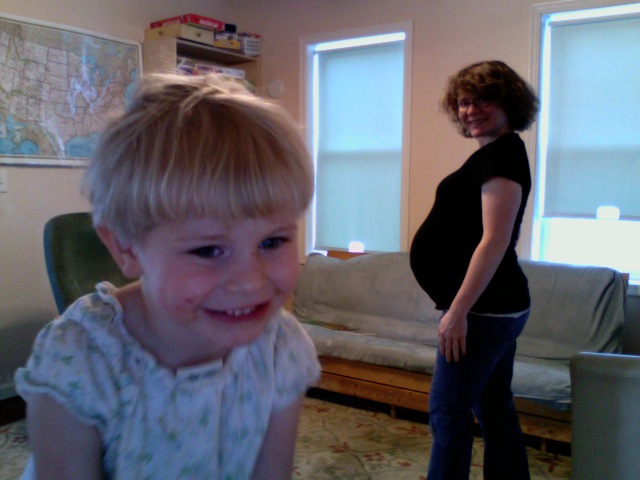
  • More gratuitous belly pics.

    Thirty weeks tomorrow.  MJ operated Photo Booth for me so I could mug.Photo 109

    Photo 105


  • Charming advice.

    The midwife told me it's time for me to start telling the baby that he should turn head down.

    I admit to being skeptical that a life of perfect obedience will begin in utero.


  • Art lesson.

    Milo and Silas have been working together on art prints, Charlotte-Mason-style, for several months now.  Yesterday I took the  two of them to the Minneapolis Institute of Arts for a brief visit, and a chance to see some "real" artworks up close.

    I took them straight to the "Art of the American West" collection, because I thought they'd find it exciting.

    1117091328-00 Milo picked Edgar Payne's "Canyon Portal" as his favorite piece in the room; here's Silas examining it.  

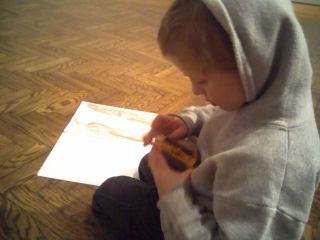
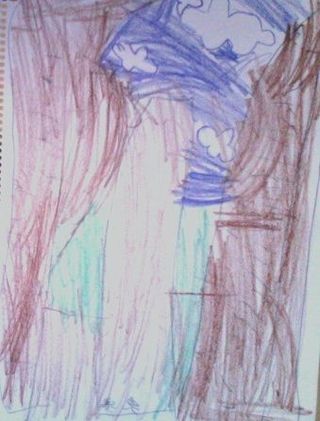
    1117091339-00Meanwhile, Milo sat on the floor with a sketchbook to produce his own version.  Here it is: 

    Milo - Sketch Canyon Portal1 See the two little men on horseback at the bottom?

    Silas chose a Bierstadt as his favorite painting, but while we waited for Milo to finish his sketch copy of the Payne, Si was drawn to this bronze by Harry Jackson, "Stampede:"

    1117091331-00

    He talked about it at length, pointing out the three cowboys among the rushing mass of cattle, and was especially interested in two details:  one cowboy who'd fallen off his horse, dragged by his ankle in the stirrup, and one steer's missing horn-tip.  I suggested that perhaps it was the artist's intent to show that some of the cattle were hurt in the stampede, their horns broken off, but Silas was sure that some mishap had occurred to the artwork.  "It is really old," he told me.

    We moved on to the next room of American Art, where the boys studied two beautifully crafted flintlock rifles.  "Why is a gun in an art museum?"  I asked them.  "Can a gun be art?" and got some interesting answers, mostly revolving around the idea "Because they're old."   

    The room after that was a bit of a mixed bag, with furniture, textiles, still lifes, and things.  I thought the boys would go for the ENORMOUS still life on one wall, or the striking painting of a tornado over St. Paul on the other — but no; Silas grabbed the sketchbook and crayons, and made a beeline for a jewel-like little still life on the opposite wall, next to a marble bust.

    1117091350-00

    It turned out to be a Peale — Raphaelle Peale's "Still Life with Fruit, Cakes, and Wine."  Silas has an eye for the well-regarded, I think.

    I don't have a picture of Silas's sketch, but it was charming — sort of a linear left-to-right catalog of all the items in the still life.  A line across the bottom made the surface the elements rested on, and from left to right he drew a cup of wine, an apple, a leafy twig, a medium orange, another leafy twig, two "cupcakes," and a stick-straight vine with five grapes like beads on a string.

    Meanwhile, Milo was entranced by a giant silver Tiffany urn.

    1117091344-01 

    I let the boys choose the last room.  They led me downstairs and decided on the Chinese pottery.  Each picked some items to draw, and then I had them both draw the same item to finish up:  a little Sung Dynasty dish that had attracted Silas.  "It's so little, I can make it little like it is," he said happily.  Milo shrugged –'s'OK – and dutifully they passed the red-orange and green crayons back and forth until they had finished.

    1117091408-00

    On the way home they were immersed in a book of picture puzzles Milo keeps in the car ("can you find the twelve differences between the two photos?") and wouldn't talk to me.  But they were happy to be singled out together for a "special" lesson today, while all their siblings stayed at our house and did "the usual" lessons with Hannah.  And they both agreed that it is more interesting to see the "real thing" than to study a print of a painting.   


  • History and today.

    I've started thinking already about next year's literature-based American History study.  Last year we did "prehistorical North America through the War of 1812."  This year we're doing "19th century" — really, "war of 1812 through U.S. entry into WWI," with half the year spent on Civil War and related topics.  Next year we'll wrap it up with "Twentieth-Century America" — which is really going to be "World War I through 9/11/01," I think.

    When I prepared the book lists for the first two-thirds, I started by picking up a couple of good high-school history textbooks and reading through them to get an idea of which topics to cover.  I think this time around, though, I am not going to do that.  That approach forces you to start in the past and look forward.  It's also an approach in which everything is important — in which it's hard to make priority choices, given the limited time we have to spend.  But I need a way to decide which topics we must cover and which must be set aside.   So I think maybe the best approach is to start in the present and look back.  I want to ask myself, "Where are we now?  And how did we get here?"

    It's not that I want to focus heavily on current events with the kids I'm teaching, who will be two fifth-grade boys and one seventh-grade girl next year (plus whichever younger kids "tag along" with the subject from day to day).   I don't think they are old enough to really dig into the complexities of modern-day politics, domestic and global.  

    But I do want to supply them with the basic historical background they will need to understand today's United States and its place in the world.  I want to steep them at least a bit in the past, so that when it comes time to understand a complicated present, they'll have some idea that it didn't come out of nowhere.  And so when I select topics, I want to do it with an eye toward setting the stage for today.  That, I think, will be my primary organizing principle, since I can't cover everything.  Does this topic help us understand where we are today?  Here in the U. S.?

    I think it has a way of focusing how to teach about things.  It's so easy to think of the twentieth century as a string of "eras:"  the World War I era, the Depression era, the WWII era, the Cold War era, the era of the Civil Rights Movement, and so on.  I was tempted to break it up like that myself.  But there are other ways to think about all these pieces, less as discrete time blocks than… phenomena maybe?   The end of American isolationism and the beginnings of intensive global involvement, for better or worse.  The great migrations from rural areas to cities, and from south to north.   U.S. involvement in the Mideast.

    Let's talk presidents.  I'd rather cover a few in depth than all of them superficially.  In the 19th century I planned to cover biographies of only three presidents, the most interesting ones:  Jackson, Lincoln, T. Roosevelt.  In the twentieth century, whose full biographies to cover?  It strikes me that two are no-brainers:  FDR and Reagan.  They make interesting counterpoints, if nothing else.  When I was talking it over with Hannah I also ticked off "and Kennedy," but when I mentioned that to Mark he said "No way.  Kennedy's only interesting because he was assassinated.  You want an interesting character study, you want to do Lyndon Johnson."   

    "Nixon maybe?"

    "Well, sure, he's a character too, but a lot of interesting things happened under Johnson.  Think about it."  And I am thinking about it — he has a point.

    Anyway, I am a long way from committing anything to paper, but I will definitely have food for thought over the next few weeks.


  • What is it about Sunday afternoons that just knocks me out?

    I don't get it.  It's not like I am out late partying every Saturday night.  Yes, I went to a potluck last night.  I was still home and in bed by 11:30 p.m.

    It's a Sunday afternoon thing.  I feel like I've been run over by a truck.  This happens most Sunday afternoons, it seems.  I decide I need to go lie down.  I do.  Ten minutes later I think I never want to get up again. 

    The body knows, maybe, that there's this one little chance, between coming home from church and starting Sunday dinner, to catch up on all the rest missed out in the whole previous week, to get ready for Monday and the start of a new to-do list.  I probably should put the little netbook away and close my eyes and let it become a real nap, in time for that nap to be a whole hour long. 

    The kids, worn out from riding bicycles and playing at the park, are playing computer games; Mark is putting the snow tires on the van; nobody needs anything from me for a little while.  I should make the most of it. 


  • Details, details.

    Having less time to spare has forced me to learn to be more flexible.  Last year, for instance, I had planned out every book we were going to read for our literature-based American History study down to which chapters we'd read which weeks, all in advance, for the entire school year.  I felt sure I'd fall behind or miss something if I didn't.

    This year (19th century, with half the time spent on the Civil War) I managed to make a list of books I wanted to use, and to divide them roughly up into topical chunks lasting two to six weeks long, but I didn't get around to figuring out exactly which ones, and which pages of which ones, I would have time to cover in two hours' reading and discussion per week.

    To my surprise, the world has not stopped turning, and the children seem to be getting some decent history education.  

    This is what I am doing now:  A couple of weeks in advance I request the dozen or so books I need for the next several-week chunk.  Then, the morning that we're doing American History — Tuesdays with Hannah — I frantically flip through the books and find some decent excerpts that add up to the number of pages I can reasonably cover in the allotted time.  Then, I read them to the kids and we talk about them.

    There's a lot of stuff we never get to.  Especially, there are many books that I would love to read in their entirety, but can only afford the time to read half, or a couple of chapters.  

    For instance, a few weeks ago, I read about half of a wonderful old book by Fletcher Pratt called The Monitor and the Merrimac.  Fantastic.  Yeah, it covered the Battle of Hampton Roads.  But it also contained biographical information about Ericsson, the engineer who developed so many original innovations that became part of the Monitor; a lot of really interesting (to me anyway) technical information about the process of working out the kinks in the boat; detailed explanation of the North's strategy of naval blockade against the Confederacy, including discussions of the implications for international relations, blockade running, and the like; and it gave us the opportunity to discuss the concept of an "arms race" with the fourth graders.  But the whole book is 180 pages long; I got as far as the end of the actual battle between the Monitor and the Merrimac itself, and really didn't have time to go on to the second half which went into the rest of the naval campaigns of the war.

    Still, it was a great choice.  The boys loved it.  So did I!

    Today was another example.  I cobbled together a lesson from:

    • 1 picture book, the text of which was the Gettysburg Address, to use with the younger children as their history lesson
    • One section of a children's book about the Battle of Gettysburg, for the background leading up to the battle
    • A few pages of 1 book for young people called "The Military History Of Civil War Land Battles" written by a military historian, for covering the actual battle, and using its maps to discuss troop movements
    • Parts of two chapters from a book about women in the Civil War, for covering hospital work and bread riots
    • Part of Daugherty's biography of Abraham Lincoln to cover NYC draft riots, Lincoln's many pardons of army deserters, the famous letter to Mrs. Bixby, and the Gettysburg Address again in more detail.

    The whole lesson wound up being surprisingly cohesive, since the chapters about women and the civil war (A Separate Battle by Chang) centered around the time period near Gettysburg.  

    Next week we begin the wrap-up; all I know is that we'll read one book about Sherman's march to the sea and we'll read part of a book about Lee's surrender to Grant at Appomattox — a book that is itself 180 pages long.  The next week we'll read more of that book and also a book about Lincoln's assassination.  Then we cover Reconstruction.

    Anyway, my point is that I am learning to wing it.  "You call that winging it?!?" says Hannah incredulously, knowing that I have already put a lot of work into selecting the list of books to read from — even if the list is too long and I still have to pick and choose and excerpt the morning before a lesson.  Believe me though, this amount of flexibility is new to me.  It's giving me so much more confidence that things will go all right, the children will still learn, even when I don't have a super-detailed plan.

    Medium-detailed, though, I'm clinging to as long as I can.


  • Not as good as Smales’ on Xenia Avenue, Dayton, Ohio. But a heck of a lot better than Auntie Anne’s in your local mall.

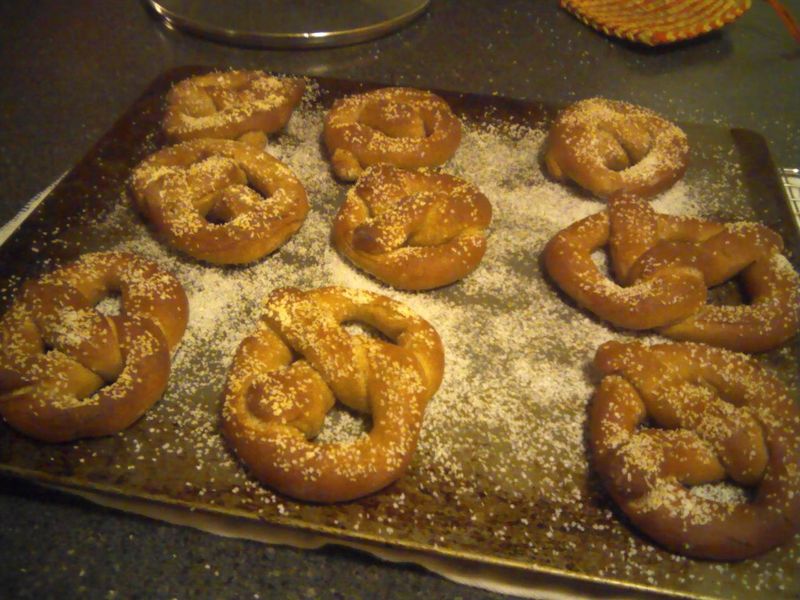
    Pretzels

    I figured that soft pretzel dough had to be pretty similar to bagel dough, right?  So I decided to try Bavarian-style soft pretzels, risen with sourdough.

    Not bad!  The outside wasn't quite as glossy and chewy as I would like a soft pretzel to be, but the interior was the right texture and the flavor was lovely.  Could be the difference between a lye bath and a baking soda bath, or maybe because my starter was whole wheat instead of high-protein white flour as a pretzel ought to be.

    Recipe for my bread machine:

    • 1 cup fresh sourdough starter
    • 2 cups bread flour
    • 3 Tbsp brown sugar
    • 1 tsp salt
    • 3 Tbsp water (added by the tablespoon during the knead cycle to produce a smooth, unsticky dough)

    I ran this through one dough cycle, cut it into 9 pieces, and rolled the pieces into long thin ropes (1/2 to 3/4 of an inch in diameter) before twisting into the classic pretzel shape.  I put them on a sprayed baking sheet and let them rest about 10 hours at a warm room temperature — from midmorning until bedtime snack time.

    Then I boiled a solution of 2 cups baking soda in 4 quarts water, and boiled the pretzels for 20 seconds or so on each side, letting them drain on a wire rack set over a towel.  I placed them on a sprayed baking sheet well sprinkled with kosher salt, and sprinkled their tops with more salt.  Then I baked them at 475 degrees F for about 10 minutes.

    They smelled like Oktoberfest when I took them out of the oven.  Seriously.  The aroma was right on.

    They are slightly sweet, with a slightly crackly crust, a little softer than I wanted, but with a nicely balanced flavor.   


  • Concentrating on the youngest.

    Hannah and I recently picked a couple of pre-writing exercise books from Rainbow Resource Center, because Hannah wants her pre-K daughter Hazel to concentrate on stroke development before she starts in on proper letter formation, and we thought my three-year-old could tag along with that work.   We were delighted to discover Let's Write:  Prewriting Beginner's Level.  It's a slim workbook of sheets for practicing tracing a variety of dotted-line strokes; what we liked about it is that each sheet has a nursery rhyme theme (see the sample sheet), like "Rain, rain, go away" or "Rub-a-dub-dub, three men in a tub."  We immediately saw that we could use the sheets both for pre-writing stroke development and for memory work, kind of a proto-poetry memorization.  So on a given afternoon we've been memorizing a nursery-rhyme verse with the girls, and then "doing the sheet."  Also, each day we have practiced the ones they've already learned. 

    We've had to resort to some Googling to find the words for some of these nursery rhymes.  I had never heard the one that starts, "Cock-a-doodle-doo/My dame has lost her shoe."  Hannah thought she remembered it going on, "Give her another/to match the other/and then she'll walk on two."  We Googled it and discovered that its most common form appears to be a riff on erectile dysfunction

    Cock-a-doodle doo,

    My dame has lost her shoe.

    My master's lost his fiddling-stick,

    And don't know what to do.

    There's more, in which the dame goes to bed and scratches her head, but for the girls we went with what Hannah remembered. 

    Mary Jane and Hazel have sort of been running feral while we concentrated on the four school-aged boys. But the co-schooling has been going so smoothly that we decided to add in a little more discipline — self-discipline that is — to work with these two younger ones.

    In some subjects, we think Hazel will eventually converge to be a work partner with my 6yo Milo, but Milo is busy working hard on learning to read, at the same level as Hannah's 7yo Silas. There's not much they can do besides that.

    What Mary Jane does, exactly, doesn't matter all that much.  She's three years old, for pete's sake.  But she wants to be doing something she can call "schoolwork," and she needs one-on-one time with the adults.  So it seems pretty natural to let her tag along with Hazel, the next youngest, and let Hannah set the pace at the proper pre-K level for Hazel.  Hazel does other things on other days of the week, of course, so we had room to start "easy and simple."  

    First we added a dedicated reading/narration time just for the two little girls, first thing in the morning after everyone has a chance to settle in.  That only has to be about fifteen minutes, the length of one or two good picture books, with time to ask the girls questions about what they are seeing and reading.  No planning necessary — one of us just pulls a promising storybook out of the library basket or off the shelf, cuddles up with the girls on the sofa, and we're off.  

    In the afternoon we can do the aforementioned nursery rhyme work and prewriting practice.  If we have time, we have the girls draw illustrations for brief stories from a children's Bible.  So far the favorite story seems to be "The Story of the Real Princess Who Saved The Baby And Is Possibly Also A Ballerina," a story which you may know better as "Moses in the Bulrushes."  We have also given them their own five-minute session to look at and talk about an art print, much like we're doing (in greater detail) with the middle boys.

    It's only a total of about 30 minutes out of the day, but already we are seeing a little extra peace in the day just from taking these two brief times to concentrate just on these youngest two children.  Later we can work on "serious" things like phonics or math, and we've already bought some materials to use with them when they're ready; but for now, just starting small and simple.