bearing blog


bear – ing n 1  the manner in which one comports oneself;  2  the act, power, or time of bringing forth offspring or fruit; 3 a machine part in which another part turns [a journal ~];  pl comprehension of one’s position, environment, or situation;   5  the act of moving while supporting the weight of something [the ~ of the cross].


  • Gratuitous geek post.

    No reason, just a post (coincidentally, from a year ago today) that I came across while surfing aimlessly, on Wolfram's blog, about the powerful convenience of being able to embed images directly into lines of Mathematica code.  Nifty pics at the link, of interest to photo-manipulators, image processors, and the like.

    I kind of miss playing with Mathematica.  Wonder if they'll ever come out with a homeschooler's math course based on it, because that would be awesome.  And we thought the TI-81 was cool back in 1990.

    UPDATE:  It looks like there used to be a Mathematica Homeschool Kit, but all the info I can find is from 2003.


  • Fox affiliate in Chicago likes more pie with its pie.

    Funny post at the Volokh Conspiracy, about a particularly boneheaded graphic that appeared on a local Fox station in Chicago (summed up well by VC's title, "This Pie Goes To 193%"). 

    I should note that it is mostly funny because of the one commenter who feels compelled to defend the graphic, and, I suppose, Fox News by proxy.  


  • New year’s resolutions.

    The first Monday of Advent is at least as good a day for New Year's resolutions as is 1/1. 

    We're feeling like making some this year, maybe because we can build on a recent family history of success.  With Mark's help, 2008 was the first year I ever kept one — to get to the gym twice a week.  A couple of years ago, Mark resolved to commute by bike or foot 50% of the time, and he didn't manage it at all that year, but since then he's gotten the percentage up to 80% or more.  Those habits seem to have stuck pretty well, too.  (We'll see after we have the baby in late January…)

    The craziness of modern Christmas present exchanges (rant omitted for brevity) is on our mind in a new way this year because for the first time we are not traveling back to Ohio, what with the baby due in January.   On the one hand:  we will miss our relatives and friends that we usually see at Christmas and New Year's.  On the other:  The chance for a quiet Christmas at home and to celebrate Advent all the way through in our own parish is really appealing.  On the third hand:  Hey!  I have to "do Christmas" this year!  At heart, I am a holiday slacker.  Yeah, there's a Christmas tree somewhere in the attic.  And a lot of ornaments we haven't used since we got them as wedding presents (that happens when you get married in December) .

    Family at Thanksgiving gave us presents to take up to Minnesota for the kids to open under our tree, and we'll wrap some for the kids too; Mark and I don't usually give each other Christmas presents, but maybe we ought to?  There are things each of us want and/or need; suppose we bought the same sorts of things we might buy anyway this fall and wrap them up and enjoy them as presents?  After all, that's rather the way things would go for many families:  instead of buying what you wanted as soon as you decided you wanted it, and maybe as soon as you could afford it, you might wait till Christmas so it could be opened as a present. 

    We were thinking maybe a good resolution for us this year would be to save up a lot of our buying of wish-list items (both for children and for ourselves/each other) for "feast" occasions.  Christmas, for instance, and Easter, and maybe one more in the summer or fall, like Assumption or Nativity of Mary or something.   It would have the added benefit of maybe getting us more in touch with the year cycle, too, another resolution I am perpetually nearly making.


  • Giving up hope may be good for you?

    That's the attention-grabbing headline, but I would phrase it differently.

    Holding on to hope may not
    make patients happier as they deal with chronic illness or diseases, according
    to a new study by University of Michigan Health System researchers.

    "Hope is an important part of happiness," said Peter A. Ubel, M.D., director
    of the U-M Center for Behavioral and Decision Sciences in Medicine and one of
    the authors of the happily hopeless study, "but there's a dark side of hope.
    Sometimes, if hope makes people put off getting on with their life, it can get
    in the way of happiness."

    The results showed that people do not adapt well to situations if they are
    believed to be short-term. Ubel and his co-authors — both from U-M and
    Carnegie Mellon University — studied patients who had new colostomies: their
    colons were removed and they had to have bowel movements in a pouch that lies
    outside their body.

    At the time they received their colostomy, some patients were told that the
    colostomy was reversible — that they would undergo a second operation to
    reconnect their bowels after several months.  Others were told that the
    colostomy was permanent and that they would never have normal bowel function
    again. The second group — the one without hope — reported being happier over
    the next six months than those with reversible colostomies.

    "We think they were happier because they got on with their lives. They
    realized the cards they were dealt, and recognized that they had no choice but
    to play with those cards," says Ubel, who is also a professor in the
    Department of Internal Medicine.

    "The other group was waiting for their colostomy to be reversed," he added.
    "They contrasted their current life with the life they hoped to lead, and
    didn't make the best of their current situation."

    I wonder if it has more to do with being free to craft your own hope — hope that you can survive and thrive in a difficult circumstance — rather than being circumscribed by the hope ful story others manufacture for you.


  • Consensus.

    I continue to follow the so-called Climategate stories with great interest.  This morning the most interesting comment thread appears to be at the NYT dotearth blog, with many comments from a variety of people including the apparently technically trained and from both "sides" of the AGW debate, if it can be said to have clean sides.

    Let's talk a little bit about the "consensus," the one that supposedly includes
    thousands and thousands of the well-informed.  Here is a little Venn diagram for you:

    PEOPLE WHO HAVE AN OPINION ABOUT AGW (anthropogenic global warming)
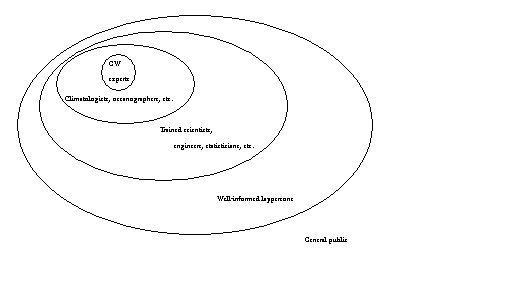
    GW_venn Here we have some nested groups.  General public is on the outside.  Within that, laypeople with enough technical education — they paid attention in high school or college science classes, they may have an amateur interest in science, etc. — to understand the arguments about it that appear in newspapers, magazines, or the popular literature. 

    Within that, technically trained scientists, engineers, statisticians, and the like.  I am a member of this group.   We know how research is supposed to work and maybe we know a bit about how it really works.  We might at some point have attended a seminar or taken a class on climate change, for instance, and at any case we know quite a bit of physics, mathematics, statistics and the like, and are used to reading and evaluating papers.  The key feature of this group:  We are all pretty sure that if we wanted to take the time to read the climate-change literature, take a look at the code, we could make an educated and independent judgment about it. 

    A bit farther in, climatologists and oceanographers and geologists, perhaps a few biologists who specialize in species affected by climate change, earth scientists in general:  the sort of people who are expected to be familiar with the literature on AGW.  They know the research intimately.

    And then in the middle, a much much smaller group: those climatologists, oceanographers, geologists who actually produce the research, write the papers, design the models, manage and manipulate the data.

    I have no doubt whatsoever that, as you move inward from circle to circle, you see that a greater and greater fraction of the people are convinced that (a) the globe is warming, (b) it's caused by human activity, (c) there's something we could do about it.  That's what you call a "consensus."

    What's not clear to me as a member of the third group from the center:  How much of that conviction rests heavily on the integrity and good judgment of the people farther in, and on the soundness and objectivity of the peer-review process?  This is especially important when you consider the interface between the two centermost circles — because those second-ring people know enough and are familiar enough with the literature to critique the research of the inner-ring people, and then have the authority to add their voices to the "consensus" that is supposed to carry so much weight.

    I rather suspect it's a lot.  I'll raise my hand right now and tell you that I am a trained scientist who has generally assumed the peer review process regarding AGW to work the way it's supposed to, and has assumed good faith and rigorous adherence to professional values on the part of the global-warming researchers (I don't assume they are unbiased — who is?).  We're seeing a crack in that facade.  It's clear that the values are compromised at major research facilities.  That there's been an attempt to compromise the peer review process — whether it has been compromised isn't clear, we haven't heard from the journals as far as I know.   My assumption wasn't valid.  Is my part in the "consensus" (such as my part was) back to square one?  Maybe so.

    UPDATE much later: What we’re talking about, of course, is a general problem with the peer review process, which is kind of broken everywhere. It’s not something that’s especially wrong with the climate literature. This is just to say, this isn’t a reason to throw out climate science, unless you’re throwing out all the other science too—and I’m not prepared to have nothing rather than something when it comes to learning new things, publishing results, and building on what’s gone before.

  • Bad-cop story of the day.

    I would  so sue if this was my kid.

    The 13-year-old son of John and Tara Farrell and a 12-year-old friend were walking in Brooklyn Park one August night when a Cadillac Escalade sped up and the driver ordered them inside.

    The man drove to his nearby house, sat the frightened boys on a curb and slapped handcuffs on them. Only then did they learn that they had been placed under citizen's arrest by off-duty Minneapolis police officer Tony Adams, whose doorbell had been rung earlier by someone who fled and who had heard from neighbors that teens might be breaking into vehicles in the area.

    The Farrells, who had called 911 about their missing son and had been frantically searching for him, didn't learn the identity of the man they believed had abducted the boys for at least 10 minutes.

    Adams'  lawyer says he was only doing "what any cop would have done."  On behalf of everyone in Minneapolis:  Let's hope not. 

    Several people witnessed the "arrest," and called 911 to report what looked every bit like a kidnapping to them.


  • Hotelling.

    Mark had a business trip to Somewhere in Illinois today, and rather than have him fly out and back before we could drive through on our way to visit family for Thanksgiving, I opted to drive him there from Minneapolis myself. 

    Bonus:  Free money from his employer, who will compensate us for 700 miles of wear and tear on the minivan that would have been incurred anyway.

    Downside:  I had to get up at 3 AM and drive it all myself, so Mark could get adequate rest and also engage in conference calls.  Which were at least mildly technically interesting to me, so not too bad of a way to spend the day.

    Bonus:  Am now enjoying free wireless at the hotel, also on the company tab, while the kids veg with cups of root beer in front of PBS Kids and we wait for Mark to finish up at the site and rejoin us for dinner. Mark claims there is a YMCA in town, so if we're not too tired, I may even get to finish up the day with a swim.


  • Professional values.

    Interesting discussion at Althouse about the human interchanges revealed in the so-called “climate-gate” email leak.  Actually, interesting discussion in a lot of places, but I’ll just pick Althouse to start.

    I write this at a time before the emails are confirmed to be completely genuine, and I write as a global-warming agnostic.  [Editing note:  that is, in 2009.  Speaking from 2025 when I write this note, agnosticism is long gone.  OK, now back to 2009]  It is reasonable to take prudent steps to alleviate the problem as long as there is a significant consensus among climatologists that there’s a problem and there’s something we can do about it, as seems plausible; it is also reasonable to continue to take data, to publicize raw data, and to keep objectively re-evaluating the data we have in preparation for revising those steps if necessary.   Really, that’s the sort of thing I would say about any kind of research that seems to demand Action Be Taken — look at the health recommendations of heart-disease researchers, for example.

    But there’s nothing terribly shocking to me about how the climatologists are apparently behaving in these e-mails.  And I am not saying this because I believe climatologists to be peculiarly biased or peculiarly political-minded.

    Having got out of the academic research business immediately after receiving my doctorate, my experience with the writing and submission of scientific papers is limited. I have served as peer reviewer exactly once. My name appears on a couple of papers that I didn’t write (and didn’t ask to have my name attached to). I chose not to put in the work to finish or to submit the papers that were based on my thesis research.

    That’s a long caveat for this observation: Scientists and engineers are subject to human nature just like everybody else.

    Because “objectivity” and “adherence to the data” are explicit values of our profession, I think the human tendency to let our feelings about people influence our beliefs about their competence, or to ignore data we don’t like, or to nudge our conclusions in the direction of our own ideologies, are probably mitigated relative to many other professions. (Which is why “Show me the data” is a demand that will always have teeth.)

    But those tendencies don’t go away, and they never quite let go their sway over people.

    Every once in a while you hear someone sniff, “We’re scientists, we make recommendations based on objective observations” — as if the mere fact of “being a scientist” is a guarantee that he or she will behave like scientists are supposed to.  (What would you think of a sitting congressman who stated, “I’m an elected official, therefore you can be sure that I always act in the interest of my constituents and the good of the country?”) It would be better for scientists and engineers to acknowledge that they must have biases, being human, and that those biases always exert a pull on their work, and then do their best to overrule them with the rational mind, to root them out in the service of the values of the profession.

    One way to root them out is to show your data to someone who disagrees with you, of course, and let him or her have their say.  That’s one of the things which peer review is supposed to accomplish, but it’s also the sort of thing that one could do in private, as a preliminary exercise or test of one’s own conclusions.  How solid are they, really?  Can you really say “incontrovertible?”  That’s almost like saying your theories are “untestable.”  Which is treading close to saying that they are not scientific statements at all.

    Anyway, my point is just that there’s nothing special about climatology, or about other lines of research with policy implications, that make the scientists and engineers who are involved in it peculiarly subject to the whims of human nature.  You see it everywhere you look hard enough.  Maybe that’s just another way of saying that everything is fraught with politics, and it doesn’t matter how petty the politics is — we could merely be talking about intradepartmental politics, or hunger for power within one single research group in one department in one corner of one university in the middle of nowhere — it still gets deep into people and makes them forget the higher values of their profession.


  • In your own interest.

    In the last six months or so, in political conversations and articles and blog posts that range from light to intense, I've repeatedly heard or read a certain phrase.   The context is mostly the health-care bill these days, but of course I heard it a lot back during the presidential campaign cycle too.  Maybe you have as well.  The implications of the phrase seem oddly illogical to me.  Help me out here.

    It's this:  The person says (or writes) about some bloc of voters, with a note of incredulity in his/her voice (or style):  "They just won't vote in their own interest."  Or:  "I don't understand why they don't vote in their own interest."  Or "If only we could get them to vote in their own interest."  Or something along those lines.

    What I don't understand is the incredulity here.

    I mean, there's nothing WRONG with voting in "one's own interest," which I take to mean a purely practical calculation:  I will personally be better off if this policy gets enacted, or if that politician takes office, rather than the alternatives.  I expect that a largish fraction of voters follow this line of reasoning on a largish fraction of issues.       

    What I don't get, though, is why anyone with a reasonable grasp of the diversity of human philosophies would be confused by the tendency of significant numbers of people NOT to follow that reasoning.

    First of all, have the people who use this phrase never heard of "the common good?"   What's so odd about someone saying "I know I will never benefit from such-and-such a policy, but many other people will, and I cast my vote on the side of those other people?"   

    Even if you truly believe that rank individualistic pragmatism is the way to go, and I can see the logic in thinking that if the majority of voters cast their votes in "their own interest" then "the common good" would necessarily be served, it just doesn't seem all that crazy to me that large numbers of people would prefer to cast their vote — or think of casting their vote — in the direction that they believe serves the wider society best rather than the one that serves "ME" best.  In fact, I'll bet a lot of people who really DO vote only "in their own interest" like to tell themselves they are voting for "the common good."

    Second, the phrase assumes unquestioningly — despite the evidence to the contrary that is implicit in the aforementioned incomprehensible voting behavior — that the speaker knows what those people's "own interest" is.   Can such a speaker comprehend that other people's idea of "their own interest" may be different from his?  This possibility is so obvious that I am almost embarrassed to point it out.    And no one who uses the phrase ever seems to acknowledge the fact of this assumption with any qualifiers.   I can't think of any commentary I've read that goes, "I just can't understand why those folks don't vote according to what I think is their own interest."   

    The obvious rejoinder is "You don't understand it because you haven't asked, 'Why do you perceive this policy, and not its alternative, to be in your own interest?"  Or else, I suppose:  "You have asked, and you reject the answer and believe that you know better than someone else what his own interest is."

    In sum, it just strikes me that to wonder aloud (or in writing) why a group won't "vote in their own interest" is to openly admit one of these three things:

    •  a philosophy of total cynicism, in which it is irrational to act for the common good; 
    • open contempt for the agency, intelligence, and motives of other people
    • at best, a complete failure of imagination

    A better question is …. "Why is making such an admission in the speaker's interest?"  


  • Bra fitting.

    I had to hit REI today for a couple of new sports bras for my expanding self, and so was amused to read this piece by Emily Piacenza appearing at DoubleX. 

    Inside the store, I was seated briefly in a tight corner, surrounded by lingerie and hosiery, and there I filled out a questionnaire about my goals. I was interested in comfortable, everyday bras, not "special occasion" lingerie. Yes, I often found that my straps slid down and that underwire left marks. I did not have a problem with bras being too tight. I wasn't sure if they were too loose. No, I did not need a lot of padding. Yes, my breasts were two subtly different sizes. In the space marked "other concerns," I wrote, "I am a schoolteacher and cannot have my nipples visible at any time. Thank you." A small bespectacled woman eventually approached me through the screens of silk and lace, collected my paper, and glanced over it quickly. "OK, Emily, please follow me into the dressing room," she said, not really smiling, and back we went.

    In a small, curtained cubicle she asked me to take off my top and bra, and I stood uncomfortably aware of my boobs as she looked at them quickly and quizzically and then left. Alone, I gazed at myself in the full-length mirror, but before I could do a thorough analysis, she was back, armed with twenty bras. She chose a plain black one with lacy straps, held it up in front of me, and then with one swift movement hooked it around me. I couldn't remember the last time anyone had actually helped me put on my underwear, and so distracted was I with that thought that I didn't even really notice that she was tugging at the bra and adjusting the straps, the band, and my breasts. She stepped away to give me a glance into the mirror. I stared.

    I had a very similar experience (only with a consultation rather than a questionnaire) when I bit the bullet and went to the Expensive Department Store to get properly fitted a few years ago, and was transformed in the space of a few minutes from ill-fitting 40C to correctly-fitting 36DDD.  Had to get re-fitted again last year after dropping 50 pounds; who knows where I'll be post-baby?

    Needless to say, REI does not employ bra fitting specialists that I know of, but by now I have a decent idea of how they are supposed to fit.  It's sort of amazing that I went for so many years doing it all wrong, though.


  • Goals.

    I'm still swimming, and I'm still doing something I call "running," a few times a week.  It'll all get harder after the baby's born, I know — mostly because of scheduling.  As much as we like the people who staff the child care in our YMCA, the new baby will be many months old before we even try to find out whether he likes being left there for 20-30 minutes.

    It's not exactly dismaying to see my performance declining in pregnancy, because (a) I expected it and (b) I never managed to maintain the habit of exercising through any of my other pregnancies.  There is a certain amount of "Gosh I hope it doesn't take me forever to get back where I was" and a dash of "Is it even possible to get back where I was?"  Obviously one goal will be to return to where I was before my pregnancy started.  But I think I might like to set my sights higher than that, and set a "next" goal as well — bearing in mind that it could be a while before I get there.  So here are two.

    1.  My next performance goal as a swimmer is to raise my workout distance to one mile.  When I first started, I got noticeably faster every time I got in the pool, and so my workout distances lengthened steadily.  By the time I got pregnant, the improvement had slowed, and I'd been swimming 1400 yards (28 laps) each 40-minute workout.   1750 yards — 35 laps — is just about one mile, and I think I'd like to be able to say that I swam "a mile" at the end of my workout.  It's a modest improvement, 25 percent; but I need to get a bit faster for it to work, because I don't have much time to spare.  I'd like to be able to swim the whole workout in 45 or 50 minutes.

    2.  My next performance goal as a runner is to complete a 5K — walking or running — in the spring, and to run a 5K (without stopping to walk) by late summer or fall.  It pains me a little bit to have such modest goals, but I'm a good bit nervous about returning to running, having perused the "post-pregnancy" forum at Runners' World.  Apparently injuries are pretty common if you overdo it too quickly, what with all the ligament -softening hormones.