bearing blog


bear – ing n 1  the manner in which one comports oneself;  2  the act, power, or time of bringing forth offspring or fruit; 3 a machine part in which another part turns [a journal ~];  pl comprehension of one’s position, environment, or situation;   5  the act of moving while supporting the weight of something [the ~ of the cross].


  • Tripping.

    I am sitting at my kitchen counter, waiting for the pizza that will feed my three kids and their grandma and grandpa, my husband’s parents, for dinner.  Not long after the pizza man knocks, the bell will toll for me, and it will be a taxi taking me and a suitcase to the airport.  

    Grandma and Grandpa are here all week, spending Thanksgiving with the kids at our house, and me?  Well, I am going to be… elsewhere!  And (except from 8 to 5) with Mark!

    I will have plenty of time during the day while he is at work, assisting with tweaking the controls on the startup of a snack-food line.   Keeping my fingers crossed that when Friday rolls around he will not be needed anymore and we can dash off for a weekend before both of us return home together next week.

    At this point I should pause and note that we have spent exactly one night away from the children since our oldest was born at the turn of the century, and we have never gone anywhere just the two of us on a plane since our honeymoon.

    The time went by…. really fast?  And we enjoyed going places with our kids, and occasionally alone while the other stayed back?  What I am saying is, no regrets.

    But just in time for our twentieth anniversary is a good time to go have a little fun.  (Thanks to those lovely grandparents.)

    Perhaps I will report back later?


  • Specialization and generalization.

    Yesterday was a very busy and raucous co-schooling day at my house, but it was fun, for a couple of reasons.

    The first is a welcome new development for this year:  H and I now have our friend M joining us again after a few years of working through different options, with the one child that she's homeschooling this year.  It's so lovely to have her back with us twice a week; we've really missed her and her kids.  I made taco salad for lunch (general recipe at the end of the post), and M brought apple crisp and cheese for afternoon snack, and we kept the coffee flowing.  Faster now that teen boys drink it.

    The second thing is that I have fun things to teach this year, practically all high-school level.  I had to skip geometry today because of an unintentional late start, but I still got to teach one of the enjoyable parts of civics, and a challenging-to-communicate topic in chemistry, and all about relative clauses in Latin.  By the end of the day I was, truly, happy about how I'd done (at least from my end; can't know how well the kids absorbed it all).  I enjoyed interacting with the kids each time, and as I looked back on the day, I was left feeling:  "Hey!  I'm pretty smart.  I did a good job."  Which always feels nice.

    + + +

    Mark, too, has been having some successes at work that leave him feeling good.  We were talking about our days last night over dinner out (new "soul-inspired, chef-created" place went in a few blocks from our house; grits and biscuits and collard greens and country ham feature prominently, as well as brioche buns and good craft beer); we talked about them some more over coffee this morning.  A lot of Mark's research and development work winds up being proprietary to his employer, but he occasionally gets to publish with his colleagues:  there are eight patents, for example.  He doesn't have to be secretive about the fact that he's done significant work on prominent and popular brands.  And soon he'll be an author on a new open-access  item that's the culmination of a lengthy collaboration he's really proud of.

    "It's very weird to work on the same project for years," he told me this morning.

    "I know what you mean," I said.  "I am not sorry that I had the opportunity to become an expert in one very narrow subject area.  It was a valuable experience, to learn how to focus that tightly for so long.  But I am glad that I did not spend my life's work on it."

    "I'm not sure if I'm a specialist or a generalist," he said thoughtfully.   "On the one hand, I'm definitely one of the go-to guys in my specific area of work–" [this sentence heavily paraphrased to remove technical details –ed.] "–on the other, I enjoy being the person who generally knows how to solve whatever problem happens to come up anywhere in the process."

    "Perhaps you're not all that different in scope from an academic.  I mean, they may be the worldwide expert on one very narrow thing; they do active research on a set of narrowly related different topics; they have to have a working understanding of everything closely related to the field so that they can spot new directions of inquiry and support or criticize their colleagues' work; and they have to stay well-enough grounded in the basics of the field that they can deal with it if they have to teach some random undergraduate class."

    I didn't get to hear his thoughts analyzing that one, because he looked at his watch and had to jump up and give me a kiss and run out the door because he had a 7:00 a.m. call to Europe and a meeting across town right after that. 

    Me, I poured myself another cup of coffee and wrapped my bathrobe more tightly around myself and settled back on the couch, thinking about writing a blog post in the time before the children wake.

    + + +

    Chemistry yesterday was the most challenging to teach, not because I don't grasp the material well, but because the material is not very easy to explain to newbies.  The language that's used by convention seems poorly designed; maybe it's the best we could do, but sometimes you'd like to go back in time and straighten people out before they named things.  ("Ben.  Trust me.  You want to label the resinous electricity as 'positive.'  Not the vitreous electricity.") 

    Anyway, I was laying the foundation for understanding electron configurations:  the four principal quantum numbers, how they give a unique "address" for each electron in the multielectron atom.  At one point the teen boys were laughing:  "Wait, the numbers are called n, l, m… and SPIN?"  and:  "Wait, l is also s, p, d, and f?"

    ["No… is allowed to have the values zero through n-1.  It's just that when it's zero, we call it s, and when it's 1, we call it p, and so on.  It's like a code.  I don't think the reason why we haven't changed to using numbers is anything other than that it's less confusing to label, say, 3p instead of calling them 3-1 orbitals."  I've since looked it up and been reminded what I had forgotten, that s, p, d, f stand for sharp, principal, diffuse, and fundamental, and refer to groups of spectral lines.  I'll be sure to tell them next time we meet.] 

    The whiteboard was a mess, but it made sense.  I loved it.

    Then in Latin we read through a long passage of a story from the textbook which was designed to teach them about relative pronouns (qui quae quod, "which/that" as in "the fruit that rotted was an orange") and the use of the same words as interrogative adjectives ("which/what" as in "what fruit rotted?") and demonstrative adjectives (ille illa illud, "that" as in "that fruit was really disgusting") and demonstrative pronouns ("that" as in "that made me sick) and third person pronouns (is ea id, "he/she/it" as in "it totally had to be trashed.")  In all five cases ("the fruit that made me sick"/"the person whose lunch this is will be disappointed"/"to whom can I complain about the fridge?"/"the odor that I smelled is tremendous"/"the bin in which I will throw this is over there").  It's relatively elementary stuff but there was a giant chart on my whiteboard and also some passages in which I had to keep switching marker colors so I could show them how the relative clauses and the prepositional phrases can be set apart from the main thrust of the sentence for easier translating.  And it was all very fun.

    And finally there was Civics, where I am going through parts that are not so suffused with gloom and disappointment, but the workmanlike stuff of, having discussed the history first, outlining the Constitution (Preamble.  Articles, I-III in the first group, IV-VII in another.  Amendments:  1-10 in the first group, 11-27 in another,)  giving them the big picture as they get ready to read it straight through for the first time.  All laid out once again on the same whiteboard.

    + + +

    I have to think about all of these things, and how to communicate them, and I like that it's languages and politics and chemistry.  I never get sick of it.  I'm not saying I would necessarily have been sick of it if I was concentrating on only chemistry, or only languages, but I do like having to think hard about all three.

    Am I a generalist or a specialist?  I specialize in a small group of kids, and I specialize in putting things into terms they can understand.  That's kind of a special skill.  But it requires me to know a fair amount about quite a lot of different things.  Not very prestigious; no publications yet (since I quit academia); but day to day, pretty fun, and I count it valuable to our family.  I suppose that's more important than how it is categorized, and that goes for what Mark does too.

    ______

    *Taco salad:  a lot of ingredients but a relatively simple and low-mess way to feed a crowd with varying tastes.  My crowd had three 4yo, two elementary schoolkids, two junior high age kids, two high school boys, and three adult women.  I do this:

    • Put a cup (dry) of brown rice on in my rice cooker in the morning
    • brown three pounds of 80% lean ground beef, season it generously with a mild spice mix (packets or your own), and put it in the crockpot with some water to stay hot; when the rice is done, mix that in (the rice absorbs the fat and flavor, and extends the meat some, and also rice served separately gets all over the place).  That will keep till lunch.
    • shred half a small red cabbage, chop 1 green bell pepper, and tear up two hearts of romaine; mix
    • put out the salad mix and the crockpots with bowls of: spicy pinto beans, plain black beans, sliced black olives, chopped avocado, sour cream, cheddar cheese, mild salsa, hot sauce, and tortilla chips.  Let kids decide what goes in their salad, unless they are four, in which case parents make the best guess.

  • Humorless.

    "What happens at Georgetown Prep stays at Georgetown Prep.  That's been a good thing for all of us, I think."

    –Brett Kavanaugh, of his all-male high school, in a 2015 speech to the Columbus School of Law, to laughter from the audience

    + + +

    As I get older and gain experience in the world, and in particular become a middle-aged woman on my way to becoming an older one, I have had occasion to muse about the stereotype of older women as humorless.

    MNY4355

    Here's what I have discovered:

    The more time I have had to encounter the jokes of men, the more time I have had to realize just how effing often certain classes of jokes are employed as a tool to deflect, deny, disguise, and defend abusive and selfish and objective acts towards women and girls.

    And, of course, toward other marginalized persons.

    The older we are, the more likely we are to have experienced a particular class of joke as a threat instead of as an amusement.

    After a while that class of joke simply ceases to be funny and is only ominous.

    This is true even when it comes from a person who only intends to be amusing. 

    It is still ominous, though for a different reason, when it comes from a good person who, because they generally have good intentions, can sometimes find it very difficult to believe in the badness of other people's intentions.   What's ominous about that is: to preserve their own innocence by refusing to believe in certain kinds of guilt, certain kinds of human vileness, they implicitly refuse to believe the testimony of those who have suffered from witnessing that violence.

    Ominous can't be funny.  It can maybe be deployed as pointed, dark satire.  But not ha-ha funny.

    + + +

    I believe I understand the "humorless" stereotype now.

    When you've had a few more years to watch it happen, it becomes obvious, and then you see it everywhere: how very, very often the accusation of humorless (often tied to an accusation of being no longer young) is weaponized to control the discourse.

    And then it’s not funny even from people who really do only want to amuse. Because it has associations with some other guy who we saw use it as a tool to cover up his awful treatment of someone or his terrible beliefs.

    + + + 

    There are other jokes we could point to (those that involve slurs, for instance) but let's take a look at the timely one I quoted above.

    The joke about “what happens in X stays in X” (popularized by an ad campaign for Las Vegas attractions) is a joke about lying to your spouse after deliberately doing something that you know would hurt them or damage their trust in you.   

    Funny, right?

    This is a classic example of imposing an expectation that the in-group will treat transgressions as a joke, precisely in order to escape consequences for the transgressions.

    + + +

    So one time (not that long ago, I was 41) I had the experience of being called an unacceptably righteous prude who couldn't take a joke, among other things, because I called someone out (privately! with I-statements and everything!) for making jokes in front of my kids with slurs for gay people. 

    Having this experience was a bit of an awakening for me because I found that for just about the first time I did not have one single fuck to give about how this person thought of me, or how they might describe me to other people. 

    I attribute this to a certain long-awaited wisdom of middle age.

    I realized in that moment that I honestly don’t give a shit about being perceived as humorless when it comes to jokes that are at base dehumanizing.

    I might leave, I might try to undermine the jokes subversively, or I might call them out on the spot, depending in the circumstances; but I won’t laugh anymore and I don’t care what men think of me for it.

    The power of older women is not giving a flying fuck what men think.  And I'm grateful for it.


  • Prologue.

    I am sitting on H.’s back porch in the waning days of summer, watching my oldest son swing a badminton racket. 

    He has been playing all morning against the younger kids, both mine and hers, in various combinations.  It is humid out, and the kids are all sweating as they shriek and swing and dive.  The oldest does not particularly like hot weather, but he is grinning.  He comes in, declares it to be terribly hot, gets a drink of cold water, heads back out again.  Plays against the sixteen-year-old boy, against a doubles team of his eleven-year-old sister and her friend, against the eight- and fifteen-year-olds.

    Comes back in for iced coffee made by H.’s oldest.  “How hot is it?  At least eighty.”

    H. opens a weather app:  “Eighty-one.  Feels like eighty-six.”

    “More like, feels like ninety-six.”  He goes out again. 

    + + +

    This is the last day we will spend over here before we take him off to college in a few days.   He has spent two days a week with this family since he was born.   H., who used to let him help her bake bread when he was a toddler and I was working on my dissertation, marveled to me, last Thursday, that it’s hard even for her to believe that she will see so little of him from here on out.

    + + +

    And what about me?  Is it hard?

    Right now the dominant feeling is wishing I could rip the bandage off more quickly.   Preparing the first young person for college (including lots of homeschool-specific tasks, like writing the transcript) has occupied a huge part of my attention for the past year, and I almost can’t bear to think about it for even two more days.   I would like to go now and get it over with.  

    I am not, not at all, worried:  he is a sensible young man, and I’ve internalized that he is his own responsibility now. 

    I am not sad:  this has always been the plan, it has finished exactly how I hoped it might.  

    I am a little surprised at how quickly it went by, and also at this logical amusement:  at the same time, it seems that it take a very, very long time for the youngest (not quite five) to get past the stage where he must be supervised at nearly every moment.  

    + + +

    Like all diarists and memoirists, I am an unreliable narrator.  I have been telling my story for years; maybe he was six or so when I started?  Kindergarten, or first grade?  In any case, I still felt fresh out of school myself.  (He was three and a half when I walked across the stage with his younger brother in a a baby wrap.) 

    But the thing is, wherever I have written about my son, that first oldest boy, I have not really been writing the story that belongs to me.  My perspective is limited, by necessity and design,

    If I myself had been a character written by a master, then the perceptive reader would have been able to see the true story between the lines, the story that managed to elude me even as I spooled it out in my own words.  But I am not so well-crafted as that.  

    He has a story, and I am not the truthful narrator, and when I have tried to be one, I have fallen short.  I cannot even see where to bring the seams together, let alone stitch it up neatly for show.  And you cannot look through the seams.

    + + + 

    There is a lot to do, to keep busy, these last few days.  Clothes and supplies to buy, paperwork to sign, accounts to open.  I am staying out of his way and watching, watching the birdie fly across the lawn, back and forth.

    “Score!” Arms raised in mock triumph.

    + + +

    Let me go back to my own story:

    The first day of the rest of my life went unrecorded, but it must have been quite soon after I moved in to my freshman year at college, maybe as soon as the first Saturday morning; in my memory the marching band was audible already (because what college story isn’t better with the marching band in the background); one of the guys from down the hall stuck his head in at the door and offered to us freshmen girls in the quad room, as I usually tell the story, tequila. 

    But now I doubt myself; from all that I know about the guy now (and that’s a lot), I suspect it was far more likely to have been bourbon.  Did I insert the tequila myself because it connotes more mischief?  Maybe it was tequila, and if so, maybe it was his roommate (the best man) who was there and who offered, actually.  But he did stick his head in at the door, and I did say no, that time.   I am sure of that.

    This is what I think of about that first move.  Whatever algorithm put me on that floor of that dorm in that year, and that culminated in (among other gifts) the gift of this tall young man wiping the sweat away and laughing and playing lawn games with his sister and brothers,  whatever made it happen was completely out of my control.  And for that I am thankful.  How could I have planned this?  I couldn’t.  I couldn’t have come up with it in a million years.

    And off he goes.  I won’t say to write his own story.  Discover it, maybe.  

    D3F27663-D9A9-4206-AF3C-787BFE9BE7DA


  • When freedom isn’t free, and someone else pays.

    A recent Twitter thread by @KGuilane got me thinking.  (Here it is in situ, and here in unrolled form.)

    We [need] to stop framing racism as offense and start to frame it as abuse.  This [is] really not about hurt feelings.  This is about health, psychological and economic abuse.  We need to move away from the feelings discourse.

    The hurt feelings discourse is what allows…fools to run the right to offend argument.  You may have a right to offend but sure have no right to abuse.

    …Abuse has long [term] consequences.  Offence is short lived.  Offence is about sensibilities.  Racism is not, it is about our right to health & mental [health].  It is about our right to safety and dignity.  It is about our right to freedom from psychological violence.

    ….when racism is framed as offence.  You need to recognize it and reframe shit as appropriate… Trust me being offended is the least of POC [people of color]’s concern.  No one gives a shit about being offended.  POC are being harmed.  Harmed not offended.  Reframe shit…

    [O]ffence does not cause depression/low mood.  Offence does not make you despise yourself.  And the world.  Offence does not make [you] lose hope.  Offense does not make you lose the will to live… Abuse does.


    To forestall an anticipated counter-argument:  The author doesn’t spend characters distinguishishing between moral right and legal right in this Twitter thread.  I do distinguish them; but remember, I think that moral rights are real and respecting them is at least as important to the protection of human flourishing as is respecting legal rights.  So.  

    I think she’s right.  The question is, what to do about it?

    + + +

    What she wrote made me notice something I hadn’t noticed before.  Free speech advocates, including myself, assert that “nobody has the right not to be offended,” and we generally mean that “right” in both the legal and moral sense:  the law doesn’t protect anyone from being offended, and we don’t have a moral right either:  if we are offended, we can’t say we have been wronged either intentionally or unintentially.

    But that’s only true if we’re careful about the meaning of the word “offended.”  

     + + +

    Feeling “upset, annoyed, or resentful; displeased” is something that can happen when we encounter opinions we disagree with or uncomfortable facts.   Particular annoyance at a particular perceived insult or snub is natural and common.  One of the reasons free speech advocates insist that there is no right not to be offended is because these feelings of annoyance and resentment and displeasure are so subjective.  Sometimes they come from encountering wrongness and bad-faith arguments and irritating people; but other times, they come from being wrong and encountering the truth.  

    Sometimes muscle aches are a symptom of having done/encountered something wrong, but other times they are a symptom of being stretched and exercised.  Being “offended” by discourse is like that.  It’s uncomfortable to be right and to encounter arguments that are really wrong; it’s also uncomfortable to be wrong and to encounter arguments that are really right.  

    Insisting that no one has the right not to be offended—made uncomfortable—therefore supposedly protects normal, healthy discourse from being quashed.  Remember “comfort the afflicted and afflict the comfortable?”  The second part only works at all if there’s no moral right not to be afflicted, no?

     + + +

    So.  I’ll be talking about moral rights and not legal ones in what follows (what I write will sometimes apply to legal rights too, but mainly I am talking about moral rights).

    The temptation, I think, for free speech advocates, including myself, is to try to protect the moral right to speak freely by including—without speaking it, perhaps without interrogating it— far too much under the umbrella of “being offended” in the statement “no one has the right not to be offended.”

    That’s a consequence of thinking only from the point of view of speech producers and failing to think from the point of view of speech targets.

    No one has the right not to be offended.  But everyone has the right not to be abused.  And so when we say “no one has the right not to be offended” we cannot make the error of including things that count as abuse (whether by neglect or by malice) under the umbrella of offense (normal discomfort at encountering opposing opinions, discourse that’s heated in a way that’s not to our taste, or unpleasant facts).

    + + +

    Let me reiterate that I am in the U. S. and just about an absolutist when it comes to freedom from government interference with speech and actions-as-speech protected by the First Amendment.  That’s a legal, political, pragmatic position.

    I’m also a personalist.  Speech affects human persons.   Speech carries responsibility to treat those persons with the dignity appropriate to their status as humans.  That’s a moral position.

    The consequence of holding those two positions?  We have to reckon with the real harm that “mere” speech can cause to real, individual human persons.

    If speech can do harm, then “more speech” is not always a sufficient remedy. 

     Can speech (leaving aside fraud and other unprotected categories) do real harm?  Of course it can.  Begin with the obvious case and then move away step by step through the ambiguous.  I won’t pretend to know where the line should be drawn, but the line is there somewhere, because at the extreme, some rather common speech objectively, measurably harms people.  Consider, for example, a child verbally abused by his or her parents, or a bullied teenager.  Consider vulnerable adults, and adults made vulnerable by careful grooming and deliberate verbal abuse.   

    Verval abuse from people who are supposed to protect you, or who share a space and protection by your own protectors, harms you.  It deprives you of a measure of the security that human persons require to thrive.

    + + +

    Consider, too, the accumulation of many “little” abuses even from strangers, even at a distance.  Those add up, no?  Those add also to more personal, close-up abuses.

    If a thousand strangers each hurl a single abuse at you, perhaps it harms you the way you would be harmed if one person with the opportunity abused you a thousand times.

    Are we thinking too much from the point of view of one of those thousand strangers, each committing one sin, something they might repent of and be forgiven for?  Or are we ever thinking from the point of view of the person who bore a thousand insults?  This is the difference between focusing on “intent” and focusing on “impact.”

    (It’s one reason why I am unsatisfied by the current term “microaggression” to describe this phenomenon.  I understand that the goal is to call something out as more harmful than it has been acknowledged to be, but I fear that it misses the mark:  it focuses on intent rather than impact and literally minimizes it (“micro”).  It allows the people who commit small hurtful acts to excuse themselves by interrogating their own perception and intent rather than the perception of the target: I cannot have committed a microaggression because I did not feel aggressive.  I’m not sure exactly what term would be better, but I would like to see something that acknowledges the total impact and wearing-down, the bleeding from many wounds, the oblivious just as dangerous and exhausting as the malicious.)

    + + +

    When bad speech damages the public discourse, I believe that more speech and better speech is the correct remedy.

    The remedy for the discourse, that is.

    The better and more convincing ideas may win the day, may shed a cleansing light on harmful nonsense and drive it out.

    But it likely leaves behind harmed human beings who still need a remedy for the damage that they sustained.  More speech may improve the discourse, but on its own it will not make them whole.

    + + +

    I do not have a good answer for this.

    Non-governmental consequences for “bad speech” that rises to the level of abuse are surely one corrective.  Employers do not have to keep on a verbally abusive employee.  Forum owners do not have to harbor abuse.  Shunning and shaming for abuse, setting boundaries that clearly communicate it won’t be tolerated, enforcing those boundaries, are all fair game.

    Government regulation of bad speech that rises to the level of abuse?  Something to be wary of.  Bad actors, confronted with deft arguments against their positions or evidence of their misdeeds, whine about being attacked and abused, and may succeed in getting the arguments and evidence suppressed.    Who is in charge of drawing that line?

    Private, non-governmental punishment for speech that’s wrong or unwise but isn’t abusive?  Allowed, if we’re not talking about tortious interference, or abuse in return; because it’s also speech.  But maybe unwise too, like the speech it counters.

     I am not wise enough or good enough to write the “rules” defining abuse on my own.

    But let’s start reckoning with remedies, for harmed persons, that go beyond “more speech.”  Can we shield, at least, children and vulnerable adults from abuse by strangers or not?  Can we reverse or mitigate the damage done?  Can we help the abused recover?  To even a small degree?  If not, what obstacles stand in our way?

    It’s a first step.

    And what about when we think we need to say, “okay, but sometimes, the truth hurts?”

    Let’s pause, and be very careful, and listen first, and consider our own fitness and authority to speak, when we think we might be holding that truth.   Am I distributing bread, or am I casting a stone?

    + + +

    Freedom is not free.   It turns out that often one person, without consenting, pays the cost for another person’s freedom.  The rest of us who enjoy liberty and value strong protections for it need to share and bear some of those costs, by getting behind efforts to help people who get hurt by bad actors who use their liberty maliciously, or even cluelessly.

    True freedom is the freedom to act with justice.  The right reason, the correct end, of declining to suppress bad speech—including much speech that causes real harm—is to allow sufficient freedom for good speech to flourish without fear of repression.   This is the end of all human freedoms: legal protections for  free markets, free association, freedom of religion or of no religion; and speaking of religion, I believe it’s the purpose of the free will that we were created to possess and exercise.  

    It’s my hope that people of good will can value and protect the freedom because of its intended end (the flourishing of good uses of freedom), without mistaking the entirely foreseeable abuses of that freedom as something valuable in itself.  That we can value and protect it while at the same time confronting and remedying and trying to prevent the real harms caused by the malicious or negligent use of that same freedom.

    It might require experiencing discomfort in the face of heated discourse, challenging opinions, and uncomfortable facts.

    Good thing we don’t have the right to avoid those feelings.


  • Some pragmatic motivation: Thinking beyond the single vote.

     I last posted that, as I prepare to teach civics to a few homeschooled kids next year, I find myself enmeshed in a cynicism that makes it hard to get excited about passing it on.  My old motivations feel too o ptimistic, and until things turn up, I fear I need a different set.

    So I am going to try to take a more pragmatic approach to the question:  why are we learning this anyway?  And I will take that approach by starting from a rather cynical-sounding assertion, inspired by Ilya Somin’s work of a few years ago, the book Democracy and Political Ignorance.

     (I have not spent enough time with Somin’s arguments to decide if I am fully convinced by them, but they are interesting and worthy of consideration.  He outlined them in a series of posts,beginning here, on the Balkinization blog some years ago; and in an article for Cato Unbound.)

     Somin argues that, given the complexity of our political system, it takes significant time and effort to acquire sufficient political knowledge to make wise choices about the various options in any given election.    People know this.  They also know that one vote does very little.  That is why they reasonably do not choose to be informed.

    In short, here are the assertions:

    Most political ignorance is rationally chosen.  

    and

    An individual voter has virtually no chance of influencing the outcome of an election.

    I want to begin by assuming arguendo that these assertions are true, and yet, to articulate a motivation for expending costly effort to learn the content of the high school civics course that I plan to facilitate.

     In other words, either

    the information content of the high school civics course is more valuable than most political information;

    or else

    there are other uses for political information, besides influencing an election with a vote, which make its acquisition more valuable in circumstances where those uses can be exercised.

    So let’s take a look at both.

    + + +

    I.  The political information content of the high school civics course is extra valuable.

    A.  It contains locally tailored information.

    First let’s concede that the insignificance of one vote is relative.  As elections become smaller and more local, the power of an individual vote increases.  Your vote is worth many times more in smaller states than in larger states, in municipal and district elections than in state elections, in primaries than in the general election, on obscure and boring referenda than on interesting and controversial referenda.   So, although the chance of swaying any of these may be quite low, it might be rational for a purely utilitarian voter to expend the effort to learn about small and local elections but not about large and statewide ones.  Therefore, one of our principles might be:  Local political information is worth more.

     And indeed, my high school civics course includes local political information.  Since we all live in the same general area, and the class is small, I can tailor my course to the individual students’ districts.  Each of the teens will learn who represents them in the state house and in Congress.  They will develop lists of the most pressing issues in their own community; they will find out when the next municipal elections will be held; they will learn about the local flavor of the national political parties; and they will project which issues will likely be on the table in the first local election of their eligibility to vote (2020 and 2021).  

     But the local information is only a small fraction of the course; and again, even in small local elections, the individual vote has low absolute value.  It’s just that it has more value than in large elections.  So I will have to look for another source.

    B.  Rather than information on specific issues, it contains structural information that is useful across many issues and from year to year.


    We will spend a little bit of time talking about political issues and current events, because there will be times when particular examples will illustrate a greater point.  

    But most of a basic civics course is about the structure of the government and how power and responsibility is distributed (and how it might possibly be redistributed  through ordinary channels).  This makes the information more valuable because it applies all the time.  

    So, for example, rather than spending a great deal of time on background information that would help students decide how they should vote on a particular issue, in this course students will learn how to determine who can, and cannot, take action on what sorts of issues.

    • Which officials are responsible for each issue?
    • When are social conditions directly impacted by policies and when are they largely out of the immediate control of politicians?  
    • Which branch of government has power over the aspect that you would like to improve?
    • Which level of government–local, state, federal–is in charge of this particular problem?
    • Whom do you approach when you have a complaint?  Do you contact your congressional representative, your city council member, the mayor, the chief of police, the school board, a judge?  Or someone not in the government at all:  a party official, the local newspaper, your neighbor?
    • What's the process for changing the law and the Constitution?  

    There are also some conceptual basics, some of which are matters of fact and some of which are matters of philosophy:

    • How do checks and balances work?  Is your "obstruction" my "safeguard?"
    • A good deal of history:  how did we wind up with a population-based House and a not-population-based Senate?  why are there nine justices on the Supreme Court and not five or twenty-one?   why do we have exactly two major parties?
    • Where do rights come from?  Can a right exist if a government has not agreed to protect it?  
    • When is it important to make a law uniform across the country, and when does it make more sense to have the law be different in different places?  
    • What is the value of compromise? 
    • What is the value of tolerance?
    • What is the value of a freedom to say and do things that are wrong?
    • Is it possible and good to live peacefully with people who are very different from us?  Or should we always be struggling for dominance so that "our" idea of how to live a right life will come out on top?
    • What happened, at each step, in the lives of people who had the least political power?

    The point of all this is to acquire the habit of thinking a step more deeply and being aware of the tensions that are inherent in the structure of U. S. government.  There is a lot of balancing two goods that cannot perfectly co-exist, or trying to eliminate one evil without also eliminating something good with which it is entangled.  There is a great deal of historical justification of why certain classes of people ought not to be able to access the benefits and protections and rights that are secured by "regular Americans," the definition of which is constantly shifting.

    Sometimes the habit of thinking historically helps:   if you know a little about how the sausage was made in the past, then you know to be skeptical about proposed future encased meat products.   The structure and processes of American government were not handed down to us on high, but were put together by human beings–exceptional human beings, no doubt, or such a structure might never have been formed; but unrepresentative in their exceptionalness, and deeply flawed; everyone is flawed, but these folks (being exceptional) were flawed in some systematic and exceptional ways.  They left us a way to change their work, and that is a power for both good and ill.

    There are no perfect analogies, and every historical situation is different; still, we can see through some of the rhetoric of the past with hindsight, and developing that habit, maybe we can see through some of the rhetoric of the present.   

    I don't have to get too embroiled (or angry) laying out the details of What's Going On right now.   Mind you, it's extremely important to avoid falling into the error that all the bad things happened in the past and now we've gotten over them, so it's not a matter of "back then bad things happened"; it's more a matter of pointing out the continuity of themes of history.   The First Amendment and the Fourth Amendment, the Equal Protection Clause, the opening and shutting of the Prohibition era, the meaning of citizenship, the role of commercial operations in public life, the role of ideas about powers that are higher than government itself, asymmetrical power and asymmetrical freedoms and asymmetrical protections: all these are still in play.

     II.  There are other uses for political information besides the (relatively worthless) casting of a single informed vote. 

     In Democracy and Political Ignorance, Ilya Somin asserts

    Only those who value political knowledge for reasons other than voting have an incentive to learn significant amounts of it.  Acquiring extensive political knowledge for the purpose of becoming a more informed voter is, in most situations, simply irrational.  This point applies even in cases when political information is available for free… As long as learning the information and analyzing its significance requires time and effort, the process is still costly for citizens.

     This is true even for highly altruistic and civic-minded citizens, he argues:

    the rational altruist would … seek to serve others in ways where a marginal individual contribution has a real chance of making a difference to their welfare, such as donating time or money to charitable organizations.  By spending time and effort on becoming an educated voter, the altruist might actually diminish others' welfare by depriving them of the services he might have conferred on them through alternative uses of the same resources.

    So if we accept all this, and we seek an incentive to learn significant amounts of political information, we must work out whether we have some reason other than voting to motivate us.  I think we do have these reasons.  Let's take a look.

    A.  (Trivial use): A course of some kind in U. S. Government is a state graduation requirement.

    I include this only for completion of the argument, but it is worth noting because it is important to me.   While homeschooled students do not strictly have to meet the state graduation requirements, it is one of the goals I set for my home school.  The diploma I issued personally to my first high school graduate stated that he had fulfilled all the same requirements that institutionally-schooled students must, and I meant it.  I intend the same for my other offspring.  

    B.  Contributing, in a very small way, to the public good of the "informed electorate."

    Somin mentions this.  An informed electorate is a public good.  We all consume its benefits.  If the teens expend time and money to become informed, if I expend time and money to teach them, then they and I are contributing to the production of this public good.  The value is offset perhaps by the opportunity cost mentioned above:  we might have expended the same time and money to serve the public in a direct way that is much more valuable.  But these resources would only ever have been used on some homeschool course, after all, and likely another social studies course.   I don't think it's crazy to think that working hard on a civics course might be the most beneficial use that we were likely to make of this aliquot of resources.  

    C.  Preparing these teens in case one becomes an influencer.

    There are some individuals who can and do use political information to influence society far more than by a single vote:

    • journalists
    • widely-read opinion writers
    • policy makers
    • lawyers and judges
    • politicians and high-level administrators
    • teachers at the secondary and university levels
    • wealthy-enough donors to campaigns and to nonprofits

    I don't know what these kids are going to do with their lives, but any of them could wind up in a position to have a nontrivial effect on communities through influencing elections and their aftermath.  If they go in a direction that makes that possible, then the public will be better off if they have been well prepared and are informed.  We don't know which young persons will become influencers; but we want all our influencers to be well informed; one way to make that more likely is to give everybody a good, thorough grounding in the basics.

    D.  If the subject sparks particular interest, it can be its own reward.

    It can be difficult to escape political information; there's a bit of consolation for those of us who are self-described "political junkies," who like discussing politics with like-minded or differently-minded people of good will, and who are intellectually stimulated by keeping up on legal and political news (and perhaps engaging in activism here and there:  citizen journalism, contacting officials, going to town meetings, showing up at demonstrations).   Someone who enjoys political knowledge for its own sake, and for the sake of positive interactions with other people, will reap the rewards of an interesting and accurate treatment in the teen years.   

    Furthermore, if I am careful about the attitude that I bring to class and foster among the teens, I can set a good example for how to talk and argue about politics with charity, fairness, inclusivity, and truth-seeking.  That is a worthy goal.

    E.  In order to truthfully and convincingly persuade others.

    Persuading other people can reach farther than your own ballot, and can even reach into places where you cannot vote, such as in local elections in other states.  It's very easy these days to put your thoughts out there and inflict them on the unsuspecting populace.  Much better for those thoughts to be informed and not ignorant.

    As a side note, it may be necessary for these young people to persuade others — not so much of political information — but of their own worthiness as an employee, a student, a writer, a thinker, a colleague.  It would be a worthy goal to contribute to their intellectual development and knowledge acquisition as it applies to political information. 

    In other words, "so they don't look foolish."

    F.  So you can decide where to send your money or spend your time.

    Political contributions, like persuasion, can reach outside your own district.  We can support candidates anywhere in the country where we think the dollars will do the most good.  But to decide where the money should go requires rather a lot of political information.  

    Knowledge of the structure of the nation, state, and city also helps you decide where to send charitable contributions and perhaps how to spend your volunteer time.  Often charitable donations are a way to respond to the aftermath of bad law and bad policy:  we can mitigate the effects of harmful legislation by directly helping the people who have been harmed by it.  And we can also support nonprofit organizations which are committed to changing law and policy.   

    For example, we can respond to cuts in services for the poor by stepping up our individual almsgiving and support of civic groups that work to help them. 

    We can support organizations that provide lawyers to vulnerable people, or organizations that argue cases before the Supreme Court on behalf of individuals, businesses, and nonprofits, or "think tanks" that work to shape policy.  But to envision these uses of our money requires considerable political information.

    G.  So you can "vote with your feet." 

    This is one of the points that Somin stresses the most, since it supports his overall thesis that decentralized federalism is the best system to promote citizen welfare and government accountability:  "foot voting" has a direct and immediate impact.  I have found it to be a fruitful point for motivating my teaching.

    [O]ne of the main causes of political ignorance is the fact that it is "rational."  Because even an extremely well-informed voter has virtually no chance of actually influencing electoral outcomes, he or she has little incentive to become informed…if the only purpose… is to cast a "correct" vote.  By contrast, people "voting with their feet" by choosing the state or locality in which to live are in a wholly different situation from the ballot box voter.  If a foot voter can acquire information about superior economic conditions, public policies, or other advantages in another jurisdiction, he or she can move there and take advantage of them even if all other citizens do nothing.  This creates a much stronger incentive for foot voters to acquire relevant information about conditions in different jurisdictions than for ballot box voters to acquire information about public policy.

    …It is an option that can be made available to most, if not all, of the population, and individuals' choices are causally effective in a way that ballot box votes are not.  Moving costs and other constraints limit the extent to which participation in foot voting is ompletely equal.  But… these constraints are not nearly as severe as conventionally thought.  And, obviously, individual influence over government policy in ballot box voting systems is also far from fully equal.

    Political information can be applied in the students' individual lives to answer many questions which will directly impact their quality of life and their interactions with government:

    • Where will you live?
    • Where will you buy property?
    • Where will you go to school and how will you pay for it?
    • Where will you raise children and how will you educate them?
    • Where will you do business? 
    • Where will you select health care?
    • What industry will you engage in?
    • In what communities will you perform services?
    • Which jurisdictions will receive your sales, property, and income taxes?

    The more they can foresee interacting with government at the local, state, and federal level, the more important it will be for them to understand the ramifications of choosing the jurisdiction to live in. 

    I could add that the altruistic foot voter can also employ political information in order to decide — not so much where the economic and political conditions will help them prosper the most — but where they can do the most good for others.  Particularly for people who are considering going into a career of serving others — health care, teaching, law, clergy — acquiring political information may pay dividends not just for themselves but for society at large.

    + + +

    I feel like I need to write down a list of these "reasons to do a good job with this" and paste it on the inside cover of my teacher's edition.  I think if I can keep all these at top of mind, I might be able to keep the cynicism at bay.  And maybe it will give me some material for my first, introductory class:  the one where I explain to them all why they are here, and why they should listen to me.


  • Not so civics minded.

    In the fall, I am slated to guide two or three teens through high school civics.  This is the second time through; the last time was two years ago, 2016-2017.  

    That was a difficult year to teach U. S. Government.  I felt that I had lost something, because in any previous year I would have greatly enjoyed it.

     I like politics, I like constitutional law, I like liberty and the American experiment, I enjoy thinking about the various tensions that we have to keep in balance in this country and how best to draw the careful lines that must sometimes be drawn even between good and reasonable claims made by opposing groups.  That our ideals, expressed in our laws, have the potential to create room for justice and liberty and security for everyone, at least as well as any government can.  I like talking with people of good will with different opinions about things.  I like practicing good will when I form them.

    Especially, when it comes to introducing children to the world, I like encouraging them to think about opposing views.  I like to introduce the notion of different ideas of “fair” — this idea that most people believe, or manage to convince themselves, that their own position is the “fairest;” people believe in fairness, they often have a different idea of what is fair.   There are not that many true Bad Guys in mainstream American politics, I would have said a few years ago.  Most of us are trying to promote what we believe to be good.  And an important part of understanding political discourse is to brush away the strawmen and listen to the real arguments made by the thoughtful people on each side of an issue, not a caricature, not the extremes.

      Also to listen to people’s stories (not restricted to the most thoughtful people, but only to honest people) about how they are affected by policies.  Not necessarily because these stories and their human faces and voices will change our theories about what is right and good; but because they remind us that policies have consequences.  Maybe with more care we can design them to mitigate the troubles they cause people.  Maybe with more attention we can reach more finely tuned compromises.  Maybe if nothing can be helped, at least the winners can bear in their hearts a little of the weight that falls in a more tangible way on the losers, and remember it for next time.

    But I can’t muster it right now.

    + + +

    What I feel I have lost, I can’t decide if it was a false thing, like scales falling from my eyes, or if it was some of my own hope and charity.   I used to be confident that truly malicious motives were rare, and that the great majority of people convinced themselves that they were seeking a thing which we all can agree is good:  safety, or fairness, or freedom, or justice, or protection of the vulnerable, or enjoyment of the good things in life.  Maybe too much of one here and not enough of another there, but seeking something good.  

    And now, everywhere I look, I see spreading fibers of sociopathy, twisted and tangled through everything that seeks the good, roots and stems and branches of the poison tree, something that cannot be pruned or grafted to yield good fruit and must simply be torn up and thrown into the flames. 

      + + +

    I always fancied myself as playing a sort of character when I helped kids through history or civics:  Professor Socrates Neutrale, perhaps.

    I feel now like a new character:  Armband Krabappel.    Perhaps Armband Krabappel can be a good civics teacher, but I am not super confident that she will have inner peace while doing it.

    + + +

    I know I have to get my motivational act together. Cynicism, possibly rational, possibly not, stands in the way of my usual motivation.  I need a new one or I cannot move forward.  

    Partisan activism is not the answer, I believe, because that is what created the current situation.  Also, I am not only teaching my own children; one or two other families will be entrusting their high schoolers to me; I owe them an approach that isn’t narrowly focused on my own values and politics.  We do, of course, share many values that I can take for granted, but part of my responsibility is to run a more “classroom-like” experience, where they can practice encounters with values none of us share.  They need to know that otherwise good people can hold views that are noxious and that noxious views, enacted, harm people.  And that correct views, enacted hamhandedly, also can hurt people.

     I think I am going to have to take an extremely pragmatic approach, and keep before my mind some entirely utilitarian reasons why these young people should want to to put effort into understanding the mechanics and structure and consequences of government.  Mostly because it will help me keep putting one foot in front of the other from the beginning to the end.


  • Title goes here.

    And now for something completely different.

    A bit more than a week ago, the curated collection of interesting women scientists among the users in my Twitter feed lit up with a new hashtag:  #ImmodestWomen.  A few clicks and I came to the origin, a UK historian named Dr. Fern Riddell.  

    She — along with a number of other academics — had tweeted a criticism of the Canadian Globe and Mail’s new style guideline (link goes to the Twitter thread she was referring to):  in the paper’s articles, health care professionals were to be referred to as “Dr So-and-so” on second reference (including some medical professionals for whom, in the UK, bachelor’s level training is sufficient).  Other doctorate holders were to be referred to as Mr./Miss/Ms./Mrs. Such-and-such on second reference, even when being interviewed on the topic of their specific scholarly expertise.   

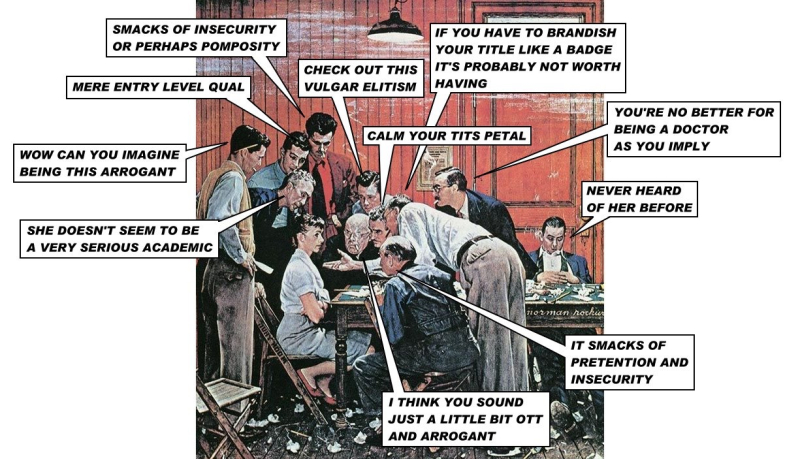
    To make a long story short, although rather a lot of academics weighed in on the topic, Dr. Riddell found herself the target of a storm of Twitter invective. Some of it abusive, much of it gendered.  I think you would have to analyze the data to be certain.  I do get the distinct impression that, while lots of people might hold the opinion that an academic title is unnecessary or even mildly offensive, more of them are willing to get on with their lives when the “Dr.” has replaced a “Mr.” than when it apparently replaces “Miss/Ms./Mrs.”  

    Twitterer @RalphHarrington made an illustration of some of the replies that Dr. Riddell got:

      401A1C4E-41E2-49BF-A3BA-45A9EA44F1D2

    Anyway, one of the tweetstormers accused Dr. Riddell of “immodesty,” she made the hashtag, and it took off; a lot of women decided to come along for the ride.  Temporarily or permanently, they changed their Twitter names to include their earned doctoral titles (along with some who added other professonal titles,  “Rev.” or “Rabbi,” and one scholar I remember who changed hers to include everything she qualified for:  I think the full string included “Dr.” and “Mrs.” and “Rev.” and “OBE.”)  There were also quite a lot of cheers and supportive tweets from women and men who use different titles or no titles at all, a number of people subscribing quite simply to the “call people what they wish to be called” ethic and also of the “titles are not really necessary but if you are going to use them you should use one that is accurate,” ethic, too; a handful of men, many with stories of nontraditional paths to the academy; and (being international but primarily a UK thing) it was all rather jolly.  I found a good deal more women scientists (and other interesting people) to add to my timeline.  And there was some good discussion, too, about the odd complexity and (unnecessary?) fraught-ness of the whole thing.  

    I joined in on the discussion, because, well, it is something I think about and on which my mind has not yet settled.  Here is an incomplete list of thoughts, tossed out quickly rather than organized:  

    • I am clear with myself that I disagree with the Globe and Mail:  just because one meaning of “doctor” in English usage is a synonym for “physician,” does not mean that its other, older (and original and still current) meanings must be discarded.  And I don’t agree that the medical field is some sort of extra-special field of study that deserves to be put on a special pedestal above others.  If doctorate titles are to be discarded, fine; but why should physicians in particular  get a pass?
    • I’m also aware that the systemic dis-crediting of women scholars, whether conscious or unconscious, is real; “let me introduce our panelists, Dr. Smith, Dr. Jones, and Katie” is a thing that happens, and arrangement of speakers on a dais is a thing that happens, and subtle pressure to discard outward signs of rank and expertise is a thing that happens. 
    • There’s a serious discussion that can be had about the relevancy of scholarship and expertise, of ordination or military rank, or indeed of marital status, to ordinary interactions: formal and informal introductions, business cards, handwritten envelopes, adults mentoring young people who are not supposed to use the mentors’ first names.  Is it relevant, and does it matter if it’s not? 
    • And there’s a serious discussion about trying to move toward egalitarianism by discarding titles:  does it help if only some people do it?   Or, if all the people in an environment discard the formal acknowledgement of their expertise (or specialization or rank), does that help or hurt the people who, not resembling the accepted model of a person with authority, relied on a formal acknowledgement of expertise as one of the tools they could wield to assert the authority they require to go about their business?   
    • And what about self-perception, a sense of identity?  If I don’t feel like “Mrs.” is a name that means “me,” even after nearly twenty years of marriage, maybe I don’t have to keep trying to get used to it?  Can I not ask to be called something else from among the options available to me by ordinary English-speaking etiquette?  Whose name is it?

    Some hours went by.  I kept coming back and checking the thread.  Medievalists, biologists, primary school teachers.   I had a couple of encouraging conversations.  Finally  I decided, at least temporarily, to throw in with the rest of them.  I would add the “Dr.”

    On making that decision, I marveled at the internal resistance, almost dread, that rose up.  (Other people in the #ImmodestWomen hashtag commented on it.  I am not alone there.)  

    Should I heed the reluctance?  Is it a kind of guilt?  Is it a kind of embarrassment?  Is it a fear?  Should I, instead of letting it tell me what to do, push through it?  It certainly doesn’t appear to be coming from reason.  

    I could think of reasons, but the reluctance wasn’t from any of them.  Was it trustworthy or an error?

    Unfortunately, there is no rule of thumb for gauging the wisdom of following a feeling based on its strength alone.  

    The change is not irreversible; the likely consequences are small; I had been watching people add their titles to their Twitter names for a day and if I thought about these other people doing it, and not myself,  I never thought them to be unreasonable or reckless or puffed up.   It clearly is not an act that carries significant moral weight in ordinary discourse.   Also, I have enough self-awareness to know that I am prone to overthinking sometimes.  

    The only thing to do for it, I decided, to recover reason, was to do an experiment:  give it a try and find out what happens—if nothing else, then perhaps I would come to understand that internal resistance a  little better.

    So I did (on Twitter) and pinned the tweet,  heeding a sheepish compulsion to make clear the cause for the alteration.  As if I was saying:  Here’s why it’s okay.

    More to unpack.

    + + +

    Mind you:  This doesn’t change my Twitter handle:  I am @erinarlinghaus and will remain so.  The boldfaced name next to the avatar is much easier to change and change again.

    I will give it some time, and report back on the outcome.   I’ve already had some fruitful discussions.  And I think I am starting to coalesce my rather diffuse thoughts about the whole thing — from the general to the personal — around a few dusty points.  Will come back to this, and in the meantime, comments are welcome.


  • Speechless.

    Sometimes I don't write at length about something because it upsets me to even think about it.

    I can tweet, and I can post links to Facebook, but when I sit down and try to organize a set of original thoughts into a persuasive or at least coherent whole, my heart goes into my mouth and I sit dumbly at the keyboard.

    I place my hands in the home position.  I put them back in my lap.

    I lapse out of prose.

    + + +

    So, if I detach myself long enough to think in a way that feels, to me, like clarity

    (and I should acknowledge that it is a mark of high privilege that today's politics can be for me a thought experiment instead of a trauma)

    I can observe that the principle of double effect is always at work,

    and that it damns those who would do harm to children and families

    in order to seek a particular end

    (an end of any kind; even an indubitably desirable one)

    by means of doing that harm and thereby instilling the fear of that harm;

    likewise does it damn those who would, somehow, reason that

    doing harm to children and families

    is a mere side effect

    of an act meant to achieve a good that is in no way proportional to the harm done.

    + + +


    Are we consequentialists?  The law can be consequentialist; it is not a religious teacher, after all.

    But when the lawyers wish to use religion and metaphysical morality to justify the law, 

    the law had better have learned its catechism.

    + + +

    The next thing that I observe comes from a detractor:

    "If it's wrong as you say to separate families

    [unnecessarily; that's what I say; and it usually is unnecessary]

    at the border

    because it harms children,

    then it would also be wrong

    to incarcerate a great deal of other people

    for doing —

    you know

    — crimes!"

    Well. 

    You have said so.


  • Why the NFL kneeling ban is especially bad: five things that aren’t reasons, and one thing that is.

    The NFL's decision to fine teams when a player kneels during the national anthem is a particularly bad policy, one that the American public  should strongly oppose.

    Let's be clear on the reason for its particular badness, and why it particularly deserves our scorn.


    640px-San_Francisco_49ers_National_Anthem_Kneeling_(37721041581)

    Photo: Keith Allison

    I give you:  five things that are not reasons, and one thing that is.


    (1) Has the policy earned our particular scorn because it requires certain players to violate their own consciences, by making them express a certain message even if they do not agree with the message?

    No. 

    This cannot be the reason, because it's not quite accurate.  Under the new rule, players are permitted to remain in the locker room during the national anthem.  The NFL says they will not punish its employees merely for declining to participate in the NFL's preferred expressive act.  The punishment is exacted only if the employees engage in a particular different expressive act.   The employees are not required to express the NFL's message; they are, rather, forbidden to express a different one.  

    Is there a categorical difference?  Coming from my philosophical background, I say yes.  The duty to speak the truth, like any positive duty, does not compel us at every moment; for proportionate reasons, we sometimes rightly refrain from speaking and acting in truth.  This is different from our duty not to tell lies, which is always in force.  The players are not, technically, compelled to violate their consciences, because they are not compelled to engage in the NFL's preferred expression.  It would be a different matter if the rules did not permit players to abstain; but they do.

    That permission to abstain outright from appearing during the anthem also probably sufficiently (under employment law) accommodates players who might have a religious objection to honoring the flag.

    We shall have to look for another reason.


    (2 )Has it earned particular scorn because it violates the players' First Amendment rights?  

    No. It does not violate them.

    The First Amendment protects us from government-compelled speech (including acts that signify meaning, like "stand and show respect.")  The NFL is not the government, and so the First Amendment doesn't constrain it, but rather protects it as it protects all our businesses and employers.  Private entities, such as the NFL, cannot violate the First Amendment by requiring a certain kind of speech as a condition of employment, nor by prohibiting a certain kind of speech.  So even if the rules did compel the players to be on the field standing during the anthem, it would not be a violation of the First Amendment.


    (3) Even if the NFL has benefited from taxation structures and public funds?

    No.  It does suggest a means by which the scorning public can react by withdrawing government support or by making that support conditional on different behavior; but government support doesn't turn them into the government.  And so the special indignation that Americans should properly have towards First Amendment violators is still not in play.

    This isn't the reason.


    (4) Has it earned particular scorn because the policy is an example of bad faith on the part of management in a labor dispute?  

    No. 

    It's still unclear whether any aspects of the NFL's policy violates the collective bargaining agreement.   The players are unionized, and the union can make use of an established process to challenge perceived violations.   In this sense, it's no different from any other rules that an employer may try to push through only to find later that the collective bargaining agreement will not permit it; and perhaps, even if challenged, the policy will be upheld.  Furthermore, if it is upheld, the players have another recourse: can bring the issue to the table the next time collective bargaining begins.   So:  this isn't the reason why we should be particularly scornful of this rule.


    (5) Has it earned our scorn because it represents a kind of retribution for unpopular or offensive speech?   

    No.  The mere fact that it is retribution for speech is not enough to earn most people's scorn.

    It would seem that m0st of us do not scorn people who exact retribution from speakers on account of disliking the speech, provided that the retribution is itself legal.  Recall this xkcd cartoon, which by all accounts was shared by people across the political spectrum:

    Free_speech

    This cartoon clearly asserts, and even honors, a right of private actors to exact retribution for speech that the private actors view as wrong.

    The value expressed by the cartoon, like so many clearly stated values, cuts multiple ways.  Just as I don't have to listen to or host speech that I think is bullshit—just as I have a moral right and a First Amendment right to react honestly with my own speech and meaningful acts — the NFL has that, too.  The NFL doesn't have to listen to what protesting players say; it doesn't have to host them while they say it.  They are not shielded from criticism of their protests, nor from financial consequences; they may be yelled at, boycotted, fired; if the NFL thinks they are being assholes, the NFL gets to show them the door.  

    No, in fact, the NFL, like any other business, is itself protected by the First Amendment.  They get to send the message they want to send.  That's their right of expression.

    The NFL's policy is an expressive act.  The primary effect of its permitting players only a single visible response to the United States flag and national anthem is not, actually, to silence the players.   I mean, they're trying to, but not very effectively. 

    No, the primary effect of this policy is the promulgation of a specific message that the NFL itself wants to express.

    And that's where we come to the reason why the NFL policy deserves our particular scorn:


    The reason the NFL policy deserves our particular scorn is because of the content of the NFL's own message.

    By enacting this policy, the NFL says:

    • There is only one way to love, to will good for, to be grateful for, this country. 
    • There is only one way to respond to a symbol that represents the country's values.
    • Only uncritical love for the republic counts as respect, or as patriotic, or as honorable.
    • To peacefully demonstrate a desire for justice for all fails to respect the republic for which it stands.

    And there's something especially bad about this message.

    It is not just a political message.

    It is an anti-American message.  

    It is uniquely anathema to fundamental American values.

    + + +

    Indeed, employers have the right to send all sorts of messages.   They can and do send messages that are false, dangerous, harmful, or downright evil.  It happens all the time.   Of course, the thing about merely bad speech is that honest people can honestly disagree about what constitutes bad speech.  Some businesses say things that I think are good and other reasonable people, who come at life from a direction different from mine, think are wrong.  Other businesses say things that I think are wrong and other reasonable people think are good.   I can object, using my own speech.  They can object, using theirs.  This is, generally, okay, and consistent with the fundamental values on which the nation was founded.  It is one of the ways that we give and take and push and pull against one another's ideas, a way we come to some equilibria where we can live next to one another in relative peace and freedom to go our own ways.

    But—and I get to say this, because it's my thought—

    This message? It is not okay, and it is fundamentally un-American, precisely because it attempts to claim monopoly over American-ness.

    The NFL is trying to speak for the whole country, and trying to say what love of the country means, and how it must be expressed.

    It's trying to control the narrative about how to love, and how not to love, the United States.

    And it's using the symbol of the entire United States to do it.

    They are trying to enact a lie in my name, and in the name of everyone in the country.

    I say we should not leave the NFL's message unchallenged. 

    I say we should start showing them the door.


    (Photo of San Francisco 49ers kneeling by Keith Allison under a Creative Commons license.)


  • The year of three languages.

    Mark and the three older kids are gone camping this weekend, and Saturday was cold and drizzly, and the house was already clean because Friday I had paid a person to come clean it, so I gave the two little boys leave to play quietly and watch videos while I dove deeply into hours and hours of brain work. 

    About half of it I spent on Latin—plans for teaching it—and about half I spent on Somali—at a tedious but necessary stage of learning it.

    And somewhere on my mental to-do list, Swedish is lingering around, and I'm going to have to turn to this eventually, in June or so.

    + + +

    Somali first.  (My most recent post on learning Somali is here, containing links to earlier posts.)

    I've been cruising through the textbook at seven pages per week, aiming to hit the reading goal by the time my little study group meets again in a month.  Mainly I advance through the book all at once in a few hours on a Saturday, making flash cards as I go out of the exercises, and I review the flashcards daily thereafter.

    I didn't quite make my goal last week because when I ran up against declining nouns with the definite article appended, I couldn't hold all the different rules for spelling changes in my head at once.  

    Summary of what I'm trying to learn. 

    • Noun cases are subject, genitive, vocative, and absolutive (think none-of-the-above).  To change the case or the number, you change the ending, mostly, and also the stress-tone pattern.
    • But when you append the definite article suffix, you have to use a fifth form, called the premodifier, that is unmarked for case.  It may have a different ending, too.
    • The case marker appears instead in the choice of article:  -ta, or -tíi, or -ka, or kíi, for absolutive, and -tu, or -tii, or -ku, or -kii, for subject. 
    • (-t- is for feminine nouns and -k- is for masculine nouns). 
    • But for sound-production reasons, depending on the ending of the noun's premodifier form, a -t- may change to a -d- and the -k- may change to a -g- or a -h- or be deleted.  Also sometimes before -k- the last vowel of the noun changes to match the vowel of the article.
    • In most of the declensions, pluralizing the noun changes its ending and its gender.

    So far, given a noun, I learn the singular absolutive; the plural absolutive; then I learn how to change both to the premodifier form; then I have to decide "is it masculine or feminine?"; then I have to work out whether the ending is one that requires changing the -t- or -k- to something else; finally, if it's a -k-, whether I need to change a vowel too. 

    (I'll get into the difference between, say, -ku and -kii, some other time.  I haven't entirely learned it.  The latter is kind of like a demonstrative, but with some additional layers.)

    So, I didn't do very well on my first set of exercises, and I decided yesterday that what I really needed was to write out a whole lot of nouns from all seven declensions, one case and number at a time, so I could see the patterns.  Then I could sort the nouns in each declension into groups according to what happened to their endings.

    Behold!  Ecce!  Waa kan!   I have about ten pages of this, organized by declension and number.

    IMG_5288

      IMG_5289

    The issue here is that the book teaches the organization of nouns in a way that isn't the way I've had success in other languages.  I need to mentally hang each new noun on a "hook" that's, essentially, "nouns that decline just like this one."  There are more hooks in Somali than there are in Latin or French, but otherwise the process is essentially the same.  

    So my next step is a Big Sort, and then I can start thinking about nouns, "Well, this one declines like saaxibad" and I'll be able to start hanging them up one at a time.

    + + +

    Okay, moving on to Latin.  I'm going to save most of this for another series of posts, but I spent a lot of yesterday working out how to put all the different pieces of next year's Latin goals together.  I really, really love Lingua Latina, the curriculum I've now switched to, and the kids are enjoying it a lot; but it's super freeform compared to the Mother of Divine Grace lesson plans for Henle Latin , which I used with the kids who are now graduating.   

    Last time, I needed the structure of MODG/Henle when I was learning along with the kids.  MODG's spiral-bound syllabus literally laid out exactly what the student was to do every single day, five days a week (which vocabulary to drill, which charts to recite, which grammar concepts to read about, which exercises to do) and had a complete set of quizzes and tests.  It's also set up for self-teaching.  

    But the approach of Lingua Latina is much more fun for the next batch of kids (ages 11-15 now).  And I've got enough Latin under my belt that I can actually guide them through it.  (A motivated, language-loving, puzzle-solving sort of person could probably self-teach with it, but for all others it's better to have a guide.)  Incidentally, LL is fairly popular as a two-semester college course, which means that for me it will function as a two-year high school course and so I can get through about half of it next year.  I have a five-chapter head start so I'll do half of what's left, i.e., chapters VI through XX.

    Anyway, besides working through the text, I need to do assessments, form drills, grammar reviews, some English grammar teaching, and additional cultural/historical stuff.  And figure out the best way to fit it into each week of two 90-minute classes (each class in two sessions with a break between) and two homework assignments.  So yesterday was Massive Spreadsheet Time, but everything I put in was a placeholder; later I have to go in and work out what pages to read for each assignment, etc.

    Screen Shot 2018-05-20 at 8.00.23 AM

    I've generally worked out that I'll do each chapter in four class periods:  introduction, text, text, followup; introduction, text, text, followup.  We'll see if I can fit all the bits for each class into one 90-minute period plus one homework assignment.  

    Don't @ me for putting in my spreadsheet, e.g., "Show me exercitia" instead of "Show me exercitiam."  I can't code-switch that quickly when I'm trying to organize.

    + + +

    OK now, Swedish.

    Not much advancement in that area, just a little tickle in the brain, but I'm pulling together the resources to pull one of my kids out of Latin and enroll him in adult language classes at the American Swedish Institute, which is a 30 minutes' walk from my house. 

    American_Swedish_Institute

    The American Swedish Institute.

    This is a classic case of Adapting the Homeschool to a Child's Specific Needs.  He is having a rough time of it in Latin with the other three kids, and he's not enjoying it at all.  Having dabbled with him in other languages here and there, I'm convinced that the problem isn't just that he Hates Latin; he is going to have to work disproportionately hard on any language, certainly harder than he wants to.

    But… foreign language is not entirely optional.  Two years are required for freshman admissions at most four-year-colleges he might apply to.  Although there are of course numerous other options out there besides freshman admission into a four-year, he wants to have a shot at this path, and so we need to find a way to hit that minimum.  

    So, this has been a mini-epiphany for me, the kind of person who always felt ashamed to be anything other than The Best or at least Near The Top.

    Sometimes… the most important thing is hitting the minimum, and doing so with the least damage to other parts of the whole person.

    And when you shift your focus from "what is the absolute optimal learning experience we can have, with the most joy and excitement and fascination and love of learning?" to "what is the best way for us to hit the minimum requirements?" — you often wind up going in an entirely different direction.

    I'll save some of that for another post, probably after we've gone to the ASI and had our introductory Swedish class.  Anyway, the point now is that I am trying to plan so that he can earn his two credits at half-pace, over four years.  I only have a vague idea at this point of how it's going to work, and to some extent we are at the mercy of the class schedule, which hasn't come out yet. 

    So the extent of my preparation is a lot of muttering of  Please please please don't let his only choice be Monday evenings.  

    This is going to be a very linguistic year.


  • Language teaching milestone, and musings on teaching what you aren’t qualified for.

    A Milestone, upon which I will give my two cents:

    On Friday, I wrote and hit "Send" on the very last assignment for the fourth year of high school Latin, at least for this particular cohort.

    I've been teaching Latin to a small group that included my oldest and H's oldest since they were about nine years old.  (I started with my oldest when he was seven; here's the proof.)  I can barely believe that after this week I won't be sending them any more assignments.

    I didn't take Latin in high school or college. I majored in engineering, not classics. I was an absolute beginner when we started, just like them—with the advantage that I had plenty of experience learning one language, namely French. 

    But I got a couple of kids all the way from beginner stuff through high school Latin IV, by dint of staying a few steps ahead ahead of them in homeschool curricula, and searching for things I didn't know whenever I realized I needed more information. 

    And, of course, by buying books.

    Behold, most of the books I used (or at least bought) over the years to teach myself and the kids (that's an aluminum meter stick in the picture for scale):

    IMG_5261

    (Not shown:  books that fell apart, books I couldn't find this morning, books still in my teenager's school bag, online resources that didn't cost me anything, and a few months' subscription to https://aeneid.co/ .)

    Now the money question:  Did I do an adequate job?

    Did I satisfy the relevant goals and purposes of learning a foreign language in high school?  (See here for a discussion.)

    Did they learn it well, compared to how they might have done in an institutional school?

    Well, I wasn't able to talk either of them into taking the AP® Latin exam, but they did sit for the National Latin Exam every year and always scored pretty close to the national "par"; a couple of times one or the other earned a certificate or a medal by scoring above average.  If either of them ever sits for a placement test for college, I'll let you know.

    Their grammar work definitely interlaced with their work in English grammar and rhetoric, and their studies of literature, culture, and history interlaced with the heavily-classical program of literature study that H. designed for them.  (Ninth-grade English literature was practically all ancient authors, plus Shakespeare's Julius Caesar.).

    At the advanced levels, they translated and read a lot of Caesar, read a big chunk of Vergil, and dabbled in the translation and reading of an assortment of other writers:  off the top of my head:  Horace, Catullus, Ovid, Pliny, Eutropius, probably a dozen more.  They liked some more than others.  

    Both are thinking seriously about college-level language study now:

    • My son has already corresponded with freshman advisors and decided that if he has to take any language in college, he'll start with a 200-level Latin class that provides a comprehensive grammar review followed by studying Ovid's Metamorphoses, which we've only dabbled in at home.  
    • H's son is studying modern Italian on his own and hopes to continue.   Motivation?  A beloved uncle has married an Italian citizen and moved to Sardinia to start a family.  He's already remarked on the head start that Latin gave him for this.

    Finally—I can't be sure of this, because they are kind young men who don't complain to me much—but I think they enjoyed themselves.

    I definitely enjoyed myself.

    + + +

    Anyway, all this is to say: There's this idea that you have to know a subject to teach a subject. Sometimes that's true; but another way is for a lead-learner to set the pace and learn alongside the other students. 

    (Psst:  Eventually, the boys got better at parts of it than I did.  They spent much more time doing homework problems; I could cheat with the answer key.)

    Let me be clear:  I had a lot of advantages that not everyone would have here:

    • It helps to be interested in the subject.
    • It helps to have experience with self-teaching.  (I do.)
    • It helps to be motivated to help the kids succeed.
    • It helps to be rich in resources, time, and connections, all of which I have the privilege of enjoying.  (How much do you think those books cost me, in money and time?  How many of my friends who have studied Latin or classics do you think I reached out to for a question now and again?)

    I would never call it an easy way to do things.

    But I'd also never call it impossible, at least not with sufficient support.  And don't forget, you always get to ask for help.

    If you get a takeaway from this, here's what I suggest: Don't talk, ever, as if it's necessary to hold an external qualification in x, y, or z to help your kid learn it at home.

    Don't say it about yourself, and don't say it about other people.

    Seriously:  I never want to hear you say "Oh, I'm not qualified" or "Do you really think you're qualified?"

    There may be obstacles, but there's no reason to add to them by giving voice, unnecessarily, to a certainty of failure that isn't certain at all.

    (Behold the closeups you're going to ask me for.  Left to right:)

    IMG_5262


    IMG_5263


    IMG_5264


    IMG_5265