bearing blog

bear – ing n 1 the manner in which one comports oneself; 2 the act, power, or time of bringing forth offspring or fruit; 3 a machine part in which another part turns [a journal ~]; 4 pl comprehension of one’s position, environment, or situation; 5 the act of moving while supporting the weight of something [the ~ of the cross].
-
-
Guest posts, coming up: Topic bleg.
I was in Colorado all last week. Did you miss me?
In the car on the way back, I had a conversation with my husband in which I think I might have convinced him to make a small series of guest posts here on humble bearing blog.
Ostensibly they will be on the topic "Weight Loss: How to Be (Or Pretend To Be) The Supportive Spouse," with perhaps a small detour into "Who Not To Hire As Your Ice Climbing Guide."
Just in case any of my readers were thinking of taking up a new hobby.
Is there something you'd like to read from Spouse of Bearing? Comment on this post with questions, suggestions for topics, etc. I cannot make promises about what will be covered (or when, really) but I'll pass them on.
-
Struck by lightning.
Probably my least favorite piece of Ohio religious art was destroyed by a lightning strike while I was on vacation. I heard about it on " Wait Don't Tell Me" and I thought, I wonder if it's THAT Jesus statue? And then I thought, it must have been, or it wouldn't have made "Wait Wait Don't Tell Me."
I am sorry for the congregation of the mega-church who lost their giant Jesus statue, and I hope for their sake it was insured, but oh my, lightning?
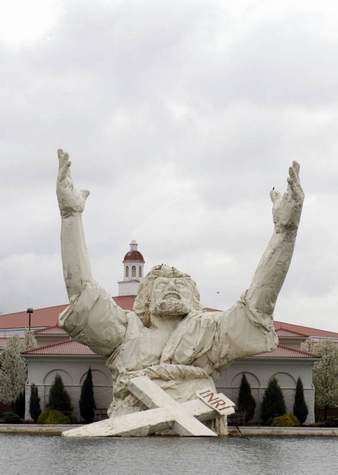
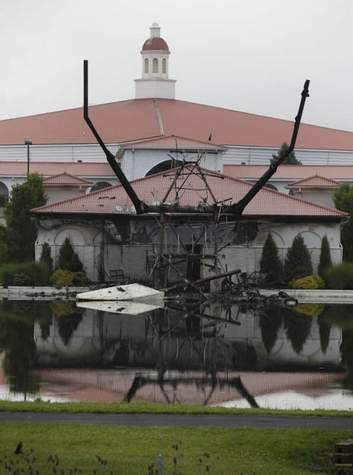
I always thought the iconography was all wrong. I assume it's supposed to be a post-resurrection image, what with the wrong-sized toppled-over cross, but the pose reminded one of Moses. Or possibly of a football referee.
Better to stick with the traditional forms. And the non-flammable materials.
(photos from cincinnati.com by way of Amy Welborn)
-
Hearts of flesh.
I wrote this some time ago and didn't polish it, and haven't time to do so today, but I thought I'd put it up for its timeliness, as today is the Feast of the Immaculate Heart of Mary.
* * *
I will take your heart of stone and put a new heart of flesh within you. (Ezekiel 36:26)
And Mary kept all these things, reflecting on them in her heart. (Luke 2:19)
And a sword shall pierce through your own heart. (Luke 2:35)
– – –
I am fond of Ezekiel 36:26 and use its language in petition whenever I need to tap into reserves of compassion I don't naturally possess. I think we all intuitively grasp the meaning of the term "heart" in that passage — it's not a literal reference to a blood-pumping organ, obviously, and we English speakers are surely familiar with the word "heart" to symbolize emotions, or love, or vitality, or the embedded core of something real or abstract. And yet… Are the English associations the ones meant by references to "heart" in Scripture and Tradition? Why does Mary ponder in her "heart" and not in her mind? Why does Simeon prophesy "And your own heart" [sometimes "soul" but often "heart"] "a sword shall pierce"? . Why is there a pious devotion to the Sacred Heart of Jesus, to the Immaculate Heart of Mary? What is this "heart?"
Set aside what we moderns know about anatomy and physiology. The ancients knew this much: the heart is a bodily organ, necessary for bodily life, an organ in constant motion as long as the body lives. Even if the "heart" has a symbolic meaning, representing capacity to love, or an inner core of the self in some way — there is something fleshly about it.
If so, it's quite different from the mind and from the will. We believe that even dis-embodied persons — angels, the souls of the dead, God the Father — have a mind and a will, and therefore are capable of knowing and of loving. So if it's the mind that knows — how can Mary ponder the mystery of her son
in her heart? If love is an act of the will and not a feeling — why do we represent the Sacred Heart burning with love?I think when we speak of a "heart" that can ponder, a "heart" that can love, we are speaking of something natural, embodied, enfleshed. Often we speak of the flesh as being opposed to things of the spirit. The flesh, our bodies, tempt us to turn away from spiritual goods and crave selfish things. But
haven't you noticed that our bodies tempt us to love as well? We have natural inclinations (for example) to care for our offspring, hormones that surge to reward us for nursing our babies, that overflow into strength and aggression to help us defend them from harm. Could that be the heart that
loves — the biochemical, physical mechanisms that urge us to lay down our lives for the ones we are attached to, that urge us to attach to each other in the first place?A body that tempts us to love: could this be the "heart" we mean?
If so… this is a kind of love unknown to the angels — a kind of love unknown to the universe before the advent of the human race. God MADE this kind of love, the love of the human heart; He did not possess it according to God's eternal nature. Father, Son, Holy Spirit had no heart, no body with which to love as bodies love.
At least not until the Incarnation.
It is interesting to think that upon the Incarnation the Son of God received for the first time a nature through which He could be tempted by Satan in the desert. Through that nature He could also, for the first time, be tempted by the flesh to love. God's love is perfect and always was perfect; and yet in
creating human beings He created a kind of love that He did not possess, and that He only made his own upon His conception. Think of the baby relaxing into his mother's arms; of the frightened toddler fleeing to the safety of his father's side; the grown man in justified anger, driving corruption from his Father's house; oxytocin, cortisol, testosterone; the heart, the body tempted to act in love.Odd, but true: that even though the Son of God, being eternal, pre-dates the Mother of God, in a sense is His mother's own creator; but Mary's heart pre-dates the Sacred Heart. All that it is truly came from her. And so to take a pious formula — to "flee to the shelter of the Immaculate Heart of Mary" is to say, Shelter me where you sheltered the Lord; form my heart in the womb where the Sacred Heart learned to beat.
Heart: the body that tempts us to love.
-
Creativity exercise.
MJ, weeping: The boys say I need a name for our game but I can't think of one!
Me: Can I help you think of a name?
MJ (sniffles): Okay, but it has to rhyme with "black."
Me: Um, Jack?
MJ: NO! It has to have black IN it!
Me: Black-patch the Pirate Princess?
MJ (exasperated): NO! It has to be a FOOD!
Me: Blackberries?
MJ: No, because Milo is already blackberries.
Me: Black Pudding?
MJ: Pudding is NOT black.
Me: Umm… Blackened Redfish?
MJ (makes face)
Me: …
MJ (brightens) I know! Black Coffee!
(runs off)
(returns)
MJ: Oscar says Black Coffee is not a food.
Me: Tell him I say it is.
MJ (gasps excitedly): I will be Black Coffee Ice Cream!
(runs off, doesn't return)
-
Monk’s meal.
This morning I rolled out of bed at 5:45 to get my last chance for a swim this week. I had to get back in time for Mark to leave for work. I can't really exercise on an empty stomach, but I was rushed, so I sawed off a slice of homemade bread, buttered it, found a cheese stick in the fridge, and ate them up. Not my favorite breakfast — I like having an egg — but it would have to do.
As I chewed my bread, I thought about a post I read yesterday by Willa at Quotidian: "Bread and Pittances," about the daily diet of Cistercian monks. The monks (except the sick) get bread and vegetables on ordinary days, and small amounts of eggs and fish on feast days. Willa did a nutritional calculation on the monks' meals; the results may surprise you.
If nothing else, it should be a corrective for that twice-annual fast day panic: "OMG it's Ash Wednesday, I only get to have one normal-size meal, I better make sure it's BALANCED AND HEALTHY."
Reality check number one with this: Fasting is not about eating healthy. It is supposed to be a mortification. Check out the root of that word.
Reality check number two, a corollary to the first: Clearly if we think our TWO fast days per year should be balanced and healthy, we must secretly be thinking that "eating balanced and healthy" is a penance, rather than everyday life. Balanced and healthy is Ordinary Time, folks.
Reality check number three: Check out that monk's meal. Bread and vegetables. And? Balanced and healthy. In particular, it's got plenty of protein. These guys are living simply, but they are not starving. They live every day on something that we would be worried we wouldn't make it through ONE day on. Clearly we are messed up.
For people who are inclined to be concerned about "balanced" meals, it is really easy to fall into the trap of thinking that you need animal protein at every meal to be "balanced." I am no vegan, believe me. I am pretty sure humans need at least a little bit of animal fat and animal protein for optimal health. (And the Cistercians that Willa mentions do get this, just not every day). But the longer I have spent living and eating my new life, the more I am shedding my Fear of Bread and the more often I find myself making meatless meals.
-
Sequelae.
I live far, far away from the Gulf of Mexico. I have never walked its beaches and have not seen its waters (unless you want to count a single airplane flight into New Orleans for an American Chemical Society conference some years ago).
The kind of natural getaway that's within a day's drive of my family is the north woods of Minnesota. Also beautiful and fun for the family, but not much like a beach.
So I appreciated this: a brief, wistful description of the immediate effects from the BP oil disaster, on a family with kids, much like mine.
Noticed this at the bottom and thought it was worth repeating:
We plan on still supporting our beach towns by returning here throughout the year. Although we may not have been able to prevent the ecological destruction caused by BP, we can prevent the economical fallout and keep our beach towns alive. If you live nearby, I encourage you to do the same.
-
Civil War in four minutes.
We'll be watching this today!
h/t American Catholic and Never Enough Homework.
UPDATE. Got more than four minutes? Instead of maps and figures (as exciting as they can be) take a look at a primary source, found in this post from Ta-Nehisi Coates. "Laura Spicer was sold away from her husband while they both were slaves. After the war and emancipation, the two considered reconciling, but the husband had remarried. Here is a letter to Laura from her first husband…"
Read the discussion, too. TNC's blog posts on slavery and the Civil War have, I hope, deeply affected how I homeschool about it.
-
Good, sturdy back carry.
Christy P showed me (via technology, not in person) a new way to tie a back carry, just in time for some serious hiking with my not-yet-sitting-up four month old. Check it out — photos at the link and a link there to some Youtubitude.
I wore Leo for a few hours the other day, very comfortably. Mark hiked with Leo on his back for a family hike today. Worked great. Much of the weight seems to be distributed onto my abdomen and ribcage.
Recent Comments
Recent Posts
- “Unprofitable servant”… of God.
- Mardi Gras recipe hack: Bread Machine king cake.
- Minnesota furious.
- Contemplation of the work.
- Boundaries and whom to set them with.
Categories
…more to come later
 bearing blog