bearing blog


bear – ing n 1  the manner in which one comports oneself;  2  the act, power, or time of bringing forth offspring or fruit; 3 a machine part in which another part turns [a journal ~];  pl comprehension of one’s position, environment, or situation;   5  the act of moving while supporting the weight of something [the ~ of the cross].


  • Brain scans.

    Yesterday Hannah brought me over a newspaper clipping that she had removed from the copy of the Wall Street Journal that was delivered to her house.  Here's the link to the article, "Eating to Live or Living to Eat?"

    Scholars have understood the different motives for eating as far back as Socrates, who counseled, "Thou shouldst eat to live, not live to eat." But nowadays, scientists are using sophisticated brain-imaging technology to understand how the lure of delicious food can overwhelm the body's built-in mechanism to regulate hunger and fullness, what's called "hedonic" versus "homeostatic" eating.

    One thing is clear: Obese people react much more hedonistically to sweet, fat-laden food in the pleasure and reward circuits of the brain than healthy-weight people do. Simply seeing pictures of tempting food can light up the pleasure-seeking areas of obese peoples' brains.

    In a study presented this week at the International Conference on Obesity in Stockholm, researchers from Columbia University in New York showed pictures of cake, pies, french fries and other high-calorie foods to 10 obese women and 10 non-obese women and monitored their brain reactions on fMRI scans. In the obese women, the images triggered a strong response in the ventral tegmental area (VTA), a tiny spot in the midbrain where dopamine, the "desire chemical," is released. The images also activated the ventral pallidum, a part of the brain involved in planning to do something rewarding.

    Definitely interesting and worth reading the entire article.  

    This is the point I'd like to highlight:  

    Some of the most intriguing imaging studies have peered into the brains of people who have lost significant weight and kept it off through diet and exercise alone—although researchers say they're hard to find.

    "They are very controlled individuals, and they are very rare. We had to fly some in from Alaska," says Angelo Del Parigi, a neuroimaging scientists who finally located 11 "post-obese" subjects who had dieted down to the lean range. In his studies for the National Institutes of Health's diabetes research center in Phoenix, Dr. Del Parigi found that food still elicited strong responses in the middle insula and the hippocampus, brain areas involving addiction, reward, learning and memory, just like the 23 obese subjects did.

    This suggests that the temptation to see food as pleasure doesn't go away. "Post-obese people are extremely prone to regain weight," says Dr. Del Parigi. "The only way they have to counteract these strong predispositions is by having a very controlled lifestyle, with restrained food intake and exercise."

    It doesn't surprise me at all, as a post-obese person.  I have written about how the impulse to eat too much hasn't gone away.  But I want to point this out because it supports two things I strongly believe about the chronically obese:

    (1) It is really, really, really hard to overcome obesity because of factors that are beyond your immediate control (even if they are the result of free choices made long ago).  Be kind, for everyone is fighting a terrible battle.

    (2)  It's not hopeless.  It's not impossible.  It requires a lot of hard work.  It can be overcome.

    When we talk about individuals who are battling obesity, we have to acknowledge the difficulty, and honor the success, at the same time.


  • Introduction to the Devout Life: Structure of 1-5 through 1-24.

    Yeah, I skipped blogging 1-4.  It’s about having a spiritual director.  I don’t have one and I don’t anticipate getting one anytime soon, so I didn’t pay a lot of attention to it.

    I have, however, read quickly through the rest of Part 1.  I want to take a moment to step back from the details and look at the general overview, because it struck me that it makes one cohesive chunk, telling you how to start your program of learning devotion.  Here’s an outline of these sections:

    Introductory Remarks

    • 1-5.  “The Purification of the Soul.”  It takes time to learn devotion, we have to purify our soul to do it, and we don’t get to stop purifying our soul as long as we live.
    • 1-6.   “Purification from Mortal Sin.” Continuing the introductory remarks:  “Purification from mortal sin is the first step, and the sacrament of penance is the means of effecting it.”  St. Francis explains that he’s going to send you to confession, preferably a general confession, and explains why he advises it.
    • 1-7.  “Purification from Attachment to Mortal Sin.”  Francis explains that the purification referred to in the previous paragraph, confession and absolution, isn’t enough:  “If you desire to embrace the devout life…you must not only give up sin but also free your heart from all attachment to it, for such attachment not only places you in danger of relapsing but is a constant source of weakness and discouragement, preventing you from doing good readily, diligently, and frequently, which is the essence of devotion.”

    A Three-Step Program For Getting Rid of Mortal Sin and Attachment To It

    Step one:  How to obtain perfect contrition so you can make your good general confession and to help root out attachment to mortal sin.

    • 1-8.  “The Means to the Purification.”  “The first step towards this purification is a clear and vivid realization of the terrible effects of sin, leading to sincere and vehement contrition… To obtain such perfect contrition you must carefully make the following meditations…”
    • 1-9 through 1-18 are the ten meditations, which are designed to progressively instill contrition.  I will write more on them later; they would make a great “examination of conscience” novena, I think.

    Step two:  How to make your general confession.

    • 1-19.  “General confession.”  This is really no more than brief encouragement to make a good one.

    Step three:  Make a firm resolve not to sin again… hmm, this sounds familiar.

    • 1-20.  “Solemn resolution.”  Francis provides a model of the kind of prayer he means.
    • 1-21.  “Conclusion.”  “We can never really uproot our attachments to sin as long as we live; we can, however, mortify them, so I will give you some further advice which, if practised, will preserve you from yielding to them…”

    Other things that will Obstruct You From the Devout Life:

    • 1-22  “Purification from attachment to venial sins.”  “Now to be attached and inclined to venial sin is a very different thing from actual venial sins themselves, for it is not in our power to avoid venial sins altogether for any length of time but it is within our power to avoid being attached to them.”(Hold on there —  I said I was not going to get into details but I can’t help myself here.  Is that not precisely the opposite of what we might intuit?  Don’t we usually say, “You can’t help your inclinations, but you can choose not to act on them?”  Here Francis is saying that we can’t actually avoid sinning — not completely anyway — but that we can do something about the underlying inclinations that lead us to sin.  Which is right?  Are they both right? )

      Anyway, here Francis is explaining why attachment to venial sin will get in the way of the devout life.  And there are two other things that will also get in your way:

    • 1-23.  “Purification from attachment to useless and dangerous things.”
    • 1-24.  “Purification from evil inclinations” — by which he really means “imperfections” that “give rise to various faults and failings which are in no way sinful.”  “Just as there is no natural temperament so good that it may not be perverted with bad habits, so there is no natural temperament so difficult that it may not be overcome with care and perseverence and the grace of God.”

    Conclusion of the Mortal Sin Part, and Transition to Part II.

    • The very end of 1-24:  “I will now advise you on the various means by which you may purify your soul from
      • attachment to venial sin
      • and to dangerous things,
      • and from your imperfections,

      so that your conscience may be fortified more strongly than ever against mortal sin.”

    So there you have it:  St. Francis de Sales’s self-help program, outlined.  At least the first part of it.

    I’ll write more about the ten meditations next time, but before I close, I just want to add that I think as I read this I feel a missing piece falling into place.  You see, I know about getting rid of an attachment to venial sin, dangerous things, and imperfection, because I have done it once in one area of my life.  Will this book help me take what I’ve learned from that and make the necessary analogies to apply it in other areas of my life?  Because it’s not like gluttony was my only vice…
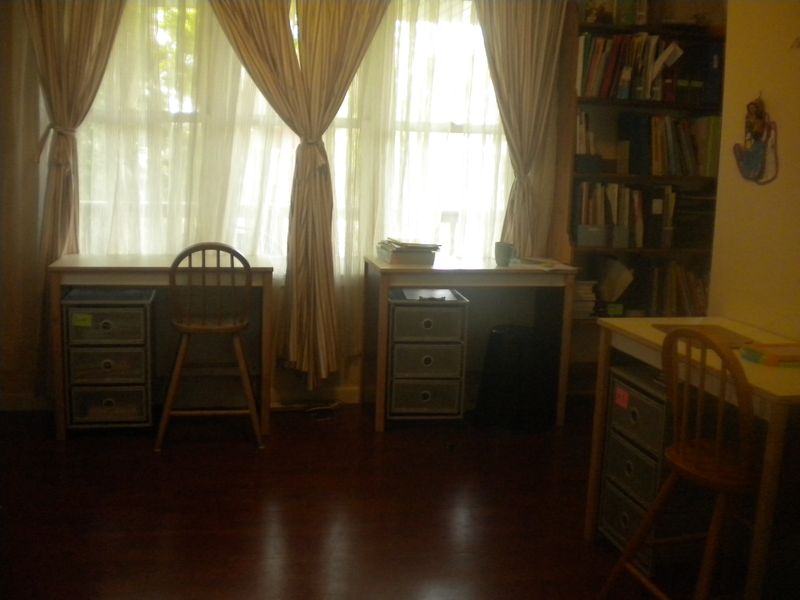

  • I’m in love.

    With my new schoolroom desks.  

    Or maybe just with the guy who made them for me. 

    Check 'em out:

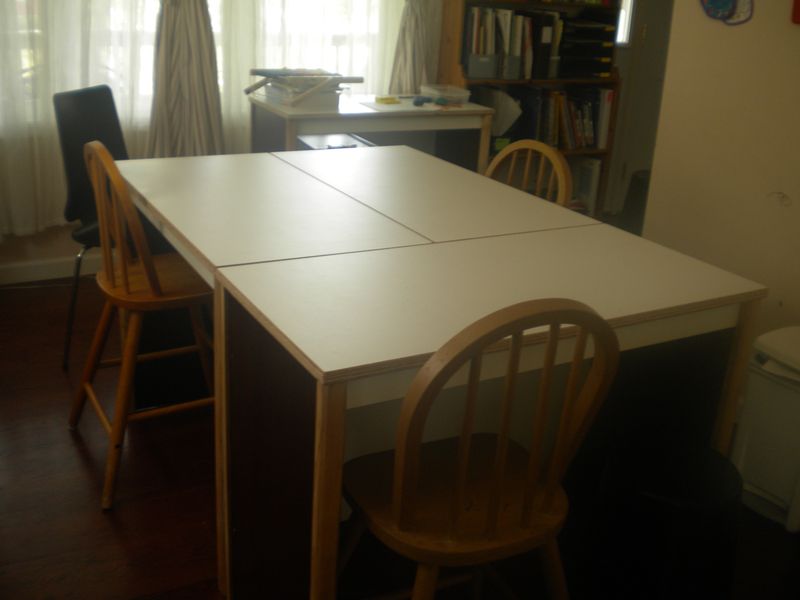
    DSCN0628

    DSCN0629

    Aren't they lovely?  The metal drawer-units on casters are from IKEA, but the desks themselves were designed by my husband and me.  The sides are mahogany-stained plywood, the trim is maple, and the top is a plywood with a white polymer veneer.  That white-veneered stuff is all over our house — Mark used it to make the boys' beds, the (new) dining table, the shelves in the laundry room and the mudroom and a closet, and a bunk bed for our friends that maybe someday we'll get back.  

    I've "done school" on an old dining room table from the beginning.  At first, it wasn't the old dining room table, it was… the dining room table.  Then we moved to a house with a dedicated schoolroom (made out of a dining room) and we got a new table for eating and put the old one in the schoolroom.  And there it stayed until yesterday.

    So the desks (four of them) are for my children to have individual space to work.  Ah, but Erin, you're thinking, what about coschooling?  What will you do when you have ten children in your house?

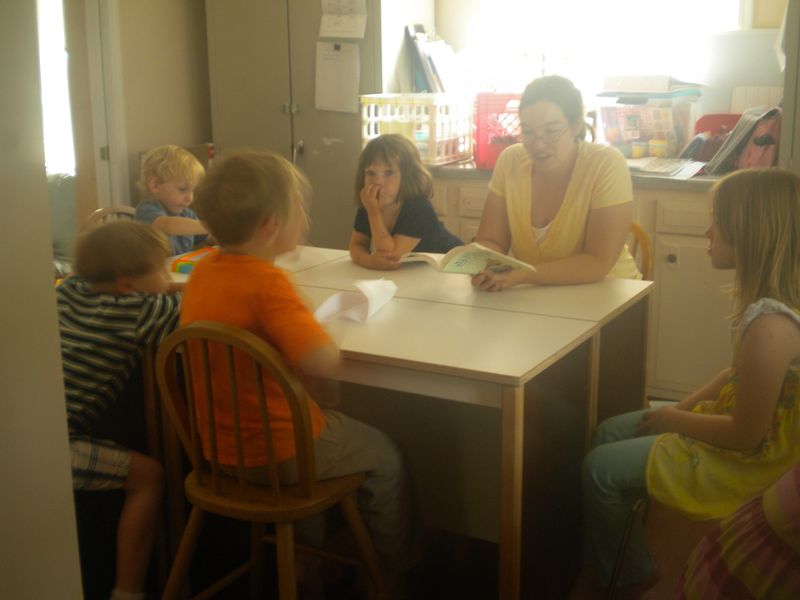
    Well… you roll the drawer units against the wall and push the desks together to make a table, of course!

    DSCN0619
     

    (Shown with three of the four 18"x36" desks put together to make a 36"x 54" table.)

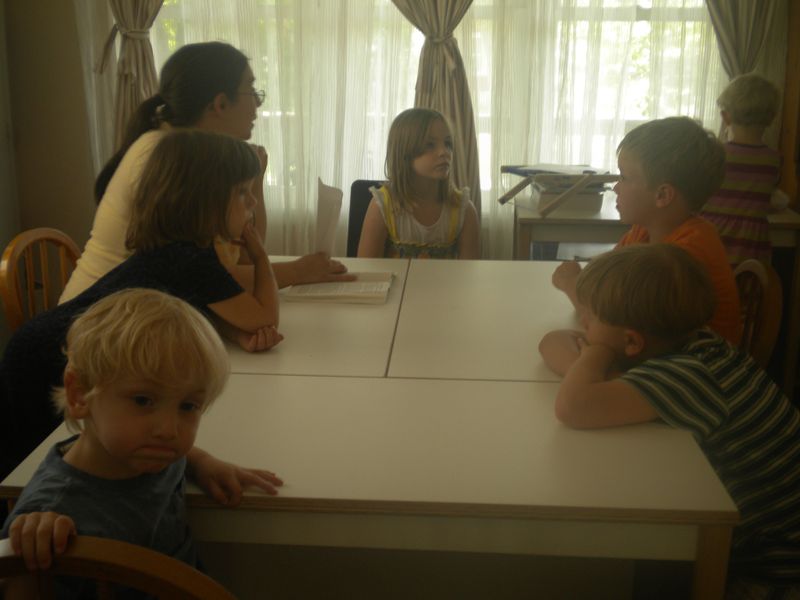
    Does it work?  Check out today's nature lesson:

    DSCN0627 

    Even the "spare" desk got used:

    DSCN0624


    And did I mention that the desks are the exact same height as my dining table (which is made of the same white-covered stuff), so I can use them as table extensions on the dining table too! 

    Thanks to Mark for making almost all the tables in my life.  Not just the spreadsheet kind.


  • Sustainable, healthy, and cheap menu plans.

    Check out the Cook for Good website.  It's not the most attractive-to-navigate website around, but the author has obviously put a lot of thought into some well-designed menus. 

    There are instructional videos, a month of menus (breakfast, lunch, and dinner) for spring — and I should add, there is plenty of repetition among the breakfasts and lunches, which makes the menu plan realistic if you ask me — a little monotony is a good thing) — and a bunch of good, basic recipes for vegetarian/thrifty living.  Oh, and an e-book.

    If you've been looking for some ideas (especially ideas to eat less meat and spend less money) you may like this one.

    via Lifehacker


  • Introduction to the Devout Life, 1-3.

    This chapter is called "Devotion is suitable to every Vocation and Profession:"

    WHEN God created the world He commanded each tree to bear fruit after its kind; [8] and even so He bids Christians,–the living trees of His Church,–to bring forth fruits of devotion, each one according to his kind and vocation. A different exercise of devotion is required of each–the noble, the artisan, the servant, the prince, the maiden and the wife; and furthermore such practice must be modified according to the strength, the calling, and the duties of each individual. I ask you, my child, would it be fitting 

    • that a Bishop should seek to lead  the solitary life of a Carthusian?
    •  And if the father of a family were as regardless in making provision for the future as a Capucin, 
    • if the artisan spent the day in church like a Religious,
    •  if the Religious involved himself in all manner of business on his neighbour's behalf as  a Bishop is called upon to do, 

    would not such a devotion be ridiculous,  ill-regulated, and intolerable? 

    Nevertheless such a mistake is often  made, and the world, which cannot or will not discriminate between real devotion and the indiscretion of those who fancy themselves devout,  grumbles and finds fault with devotion, which is really nowise  concerned in these errors.  

    I think we've all heard this argument before, though perhaps not so bluntly stated.  Devotion requires discretion; "those who fancy themselves devout" commonly commit the indiscretion of attempting methods of devotion that are not suitable for their station in life.   

    I find this to be tougher to work out than it sounds.  From time to time, for example, I've tried to steadily pray the Liturgy of the Hours — usually just one or two offices — as a personal devotion.  Now, let me stress that the LOTH appeals to me personally a great deal. love coming to know the psalms.  I love knowing that I'm praying the "prayer of the whole church" right along with the whole church.  I love having a big fat worn dog-eared book with slips of paper and Post-it notes stuck in it, and praying intensely while flipping the pages back and forth from this section to that, like an engineering student taking an open-book thermodynamics exam.  It suits me.

    It takes concentration, I find, to really "do."  And concentration is something of which I don't have enough on the regular basis that LOTH demands as a steady devotion.   I tried, because it seemed that I should be able to make room for this prayer that I like so much.  But it rarely works out.  Either it's early in the morning or late at night and I'm too tired, or the children interrupt me.  It seems I can only use this as an occasional treat, not my daily bread.

    (Demand your daily prayer!  Every mom needs it!  Train the children not to interrupt you!  Sure, that works if all the children are over the age of four.  I am not there yet.  And remember what I've been writing, about suspecting that I need to be more interrupt-ible, not less?  I am beginning to suspect that refusing to allow children to interrupt me during time I owe to them, even for prayer, would be one of those false devotions that St. Francis is writing about.  I'm thinking I need to work with what works, not with what's not working.)

    So how to figure out what does work?  It seems that St. Francis, too, thinks that if a method grates against the duties of one's vocation, then it's not the right method, and to keep trying to practice it would be a false devotion:

    No indeed, my child, the devotion which is true hinders nothing, but on the contrary it perfects everything; and that which runs counter to the rightful vocation of any one is, you may  be sure, a spurious devotion. …[T]rue devotion…not only hinders no manner of vocation or duty, but, contrariwise, it adorns and  beautifies all. 

     ….[E]verybody fulfils his special calling better when subject to the influence of devotion:–family duties are lighter, married love truer, service to our King more faithful, every kind of occupation more acceptable and better performed where that is the guide.

       It is an error, nay more, a very heresy, to seek to banish the devout life from the soldier's guardroom, the mechanic's workshop, the prince's court, or the domestic hearth. Of course a purely contemplative devotion, such as is specially proper to the religious and monastic life, cannot be practised in these outer vocations, but there are various other kinds of devotion well-suited to lead those whose calling is secular, along the paths of perfection. 

    The Old Testament furnishes us examples in Abraham, Isaac and Jacob, David, Job, Tobias, Sarah, Rebecca and Judith; and in the New Testament we read of St. Joseph, Lydia and Crispus, who led a perfectly devout life in their trades:–we have S. Anne, Martha, S. Monica, Aquila and Priscilla, as examples of household devotion, Cornelius, S. Sebastian, and S. Maurice among soldiers;–Constantine, S. Helena, S. Louis, the Blessed Amadaeus, [9] and S. Edward on the throne. 

    Did you notice that Martha is an example of household devotion?  

    And as for the excuse that "I can't get enough time alone to practice my devotion, poor me, I give up:"

    And we even find instances of some who fell away in solitude,–usually so helpful to perfection,–some who had led a higher life in the world, which seems  so antagonistic to it. S. Gregory dwells on how Lot, who had kept  himself pure in the city, fell in his mountain solitude. Be sure that  wheresoever our lot is cast we may and must aim at the perfect life.

    Trying and trying to stick with a devotion that doesn't mesh well with our life is a recipe for failure:  an excuse to fail at prayer (when life activities suit us more) or to fail at our duties (when prayer suits us more).  We have to do both.


  • Good resource for movie/book/TV reviews.

    I just stumbled across a website that was new to me that seemed worthy of sharing:  http://www.commonsensemedia.org .  It consolidates thousands of reviews of movies, books, TV shows, games, websites, and music, with notes about age-appropriateness and descriptions that ought to enable parents to make some judgments about whether the material is appropriate for their own children.  

    Even better, there are many lists of recommended titles.  For example, here are the lists of recommended movies, (without regard to age-appropriateness), including such lists as "Best Offbeat Animated Movies" (Chicken Run, James and the Giant Peach) , "Best Anime Movies for Kids and Preteens" (Miyazaki holds the top five spots), and "Don't Mess With These Movie Moms" (The Incredibles, Spy Kids).  There are book lists too, which will help me as I am out of touch with any children's book published after about 1989.

     As usual, you can't let the judgment of the editors of any website substitute for your own judgment.  But it seems to me this site will be helpful in sifting through the huge volume of media aimed at kids.


  • All-day ratatouille.

    The original summer stew, which I made from a hybrid of about three different recipes plus my own little twist.  We were going to be gone most of the middle of the day, so I decided to slow-cook it for 7 hours in a low oven, in my French-oven stew pot (you know, the heavy enameled cast-iron kind with two handles and a heavy lid — mine's from Tramontina, not the pricier Le Creuset).  Worked like a charm!  

    All-day Ratatouille

    • 1 big eggplant
    • 3 medium-to-large zucchini
    • 2 big red bell peppers, seeds and ribs removed
    • 2 yellow onions
    • 3 ripe tomatoes
    • 10 cloves garlic, peeled and halved
    • Fresh thyme sprigs and chopped basil leaves
    • Lots of olive oil
    • Kosher salt and fresh-ground pepper

    Peel and trim the eggplant and slice 3/8-inch thick; cut rounds into quarters.  Toss eggplant slices in a colander with a tablespoon or so of kosher salt and allow to drain for 30 to 60 minutes.  Before proceeding, squeeze out all the excess liquid, rinse, and pat dry with paper towels.

    Trim the zucchini and slice diagonally 1/4-inch thick.  Slice the peppers 1/2-inch thick.  Slice the onions thinly.  Trim the tomatoes and slice 1/4 inch thick.

    Heat a fairly thick layer of olive oil in heavy pot or skillet over medium-high heat.  (I used the same heavy-lidded enameled pot I would bake it in, but you could use a skillet for this step if you intend to bake the ratatouille in something not stovetop-safe.) Fry the zucchini slices in batches in a single layer, turning once, until lightly brown on both sides.  Remove the slices to drain on paper-towel-lined plate.  Repeat with the eggplant, adding more oil if necessary, and removing to a different paper-towel-lined plate.

    Into the hot, oiled pan, add the onions, stir and toss for a few minutes, and then add the peppers, garlic, and a few sprigs of thyme and some of the basil.  Sauté until tender, adding salt to taste.  Lay the tomato slices on top of the mixture and let cook down for a bit, then stir and toss some more until everything is soft and well blended.  Transfer to a dish.  (At this point I wiped out the pot)

    Film the bottom of a heavy lidded pot with olive oil.  Layer a third of the tomato-pepper-onion mixture, half the eggplant, half the zucchini, the second third of the tomato-pepper-onion mixture, the rest of the eggplant, the rest of the zucchini, and the final third of the tomato-pepper-onion mixture.  Sprinkle with salt and drizzle with a little more olive oil.  Cover and bake for several hours at a low heat.  I baked mine at 275 degrees F for 2 and 1/2 hours, then turned the oven down to 250 and left it the rest of the day; all day at 250 would probably work too.  I checked it a couple of times to make sure there was still plenty of liquid.  There was.

    I served it with a sprinkling of more fresh basil and a drizzle of olive oil, on a bed of polenta with lots of Parmesan.  (French-Italian fusion cuisine!)  Mark said that it was the first time he thought he'd ever enjoyed eggplant.  With it we had some strawberries in balsamic vinegar.

    This was a great dish for a Sunday, because I did all the prep work in the morning before 11 AM Mass, and then I didn't have to do anything else before dinner except grate cheese and cut strawberries and drink Cabernet.


  • Introduction to the Devout Life, 1-2.

    I started blogging on this spiritual classic in this post.  Here is another installment from St. Francis de Sales, in chapter II.  As usual, I add paragraph breaks to improve blogginess, a quality unknown in the first years of the seventeenth century.

    ...a devout life is very sweet, very happy and very loveable. 

     The world, looking on, sees that devout persons 

    • fast, 
    • watch and pray, 
    • endure injury patiently, 
    • minister to the sick and poor, 
    • restrain their temper, 
    • check and subdue their passions, 
    • deny themselves in all sensual indulgence, 
    • and do many other things which in themselves are hard and difficult. 

    But the world sees nothing of that inward, heartfelt devotion which makes all these actions pleasant and easy. …   the martyrs have counted fire, sword, and rack but as perfumed flowers by reason of their devotion. And if devotion can sweeten such cruel torments, and even death itself, how much more will it give a charm to ordinary good deeds? We sweeten unripe fruit with sugar, and it is useful in correcting the crudity even of that which is good. So devotion is the real spiritual sweetness which 

    • takes away all bitterness from mortifications; 
    • and prevents consolations from disagreeing with the soul: 
    • it cures the poor of sadness, and the rich of presumption; 
    • it keeps the oppressed from feeling desolate, and the prosperous from insolence; 
    • it averts sadness from the lonely, and dissipation from social life; 
    • it is as warmth in winter and refreshing dew in summer; 
    • it knows how to abound and how to suffer want; 
    • how to profit alike by honour and contempt; 
    • it accepts gladness and sadness with an even mind, 
    • and fills men’s hearts with a wondrous sweetness.

    First point.  I continue to be struck by Francis’s emphasis on the virtues of detachment and even-tempered-ness.  He tells us that the devout will reap rewards equally whether things are going on pleasantly as planned-for and hoped-for, or…. not.  

    This is one of those truths that we all know, right?  It’s a matter of being able to remember it in the moment, when the good and happy life is interrupted and changed.  As for me, I have a terrible time switching gears.   I hate changes of plans — even happy changes disturb me.  And this sluggishness, this undue attachment to my own expectations, this desire to own my own time, has corollaries.  I dislike being interrupted at any task.  And yet being a mother means I need to be flexible, need to be cheerfully interrupt-able, because whatever immediate need my children have, has to take precedence over whatever I merely wish to do.  

    Second point.  I highlighted a phrase that caught my eye:  Devotion “prevents consolations from disagreeing with the soul.”  This made me hoot with knowing laughter.  I can’t think when I’ve ever read any spiritual adviser who acknowledged that spiritual consolations might “disagree with” the soul.  Most of the time, “consolations” are portrayed as nothing less than a font of joy and peace and general wonderful-ness.  

    We are cautioned not to expect a steady supply of consolations — received assurances of truths in which we can take comfort, or gifts of emotional response that make prayer and charity easier.  We are told that even the greatest saints experienced long periods of “dryness,” i.e., the absence of consolations.  And here is St. Francis de Sales letting us know that even “consolations” don’t seem all they’re cracked up to be sometimes!  Having been on the receiving end of at least a few consolations that left me muttering, “Gee, thanks a lot,” and knowing well that I could do better on the devotion end,  I just loved this.

    More later, I hope.  I’ve actually read quite a bit farther than I’ve blogged, and probably won’t blog on every chapter.


  • Co-schooling: Latin.

    In one sense, I am no more qualified to teach Latin to my children and to two other families' children than any of the other parents in our circle. 

    You might think my husband is the most qualified:  he took three years of Latin in high school, which is three years more than any of the others.  But since he remembers very little (odd bits surface from time to time, like the first two lines of the Lord's Prayer or witticisms like semper ubi sub ubi), 'twere foolhardy to put him in charge.

    Or you might think Hannah is the most qualified, since (I think) she's the only one of us who studied two different foreign languages.

    But in the end, it was me, and it was Latin. 

    Why am I teaching Latin, and not French, in which I'm fairly fluent?  Because I already know French and I want to learn Latin.  When my kids learn a modern language, I hope it's Spanish (for utility in our neighborhood, city, and country) or Arabic (for cross-cultural and international utility), not the comparatively useless French, even though I love French and even though I owe my high school French teacher a major shout-out for teaching me how to learn a language down to the bones.  AND the nice thing about the classical languages is that curricula are available which assume the teacher has no prior knowledge of the subject.  Self-teaching curricula, you might say.  (Greek, Hebrew I think, and American Sign Language are others.)

    A better question is why my friends are allowing me to teach Latin to their children.  Weeeeeelll, maybe they will pop in and comment in their own words, but I think it has a lot to do with the facts that (a) I was willing and (b) that's one less subject that they have to teach and (c) it's an elective at this stage anyway so even if I screwed it up completely, no matter.  I'm flattered that they trusted my abilities to do it. 

    So I already had been teaching my then-8-y-o for a while from Memoria Press's Prima Latina and Latina Christiana I before the other kids joined, so he spent something like ten weeks on a side project of learning the Pater Noster and Ave Maria while Melissa's then-10yo daughter and Hannah's then-9yo son caught up to him in Latina Christiana.  That slight gap has been a little bit of a distraction since my son is eager to show off what he knows; eventually the other two got to the point where they were nearly as comfortable with the material as he, and then we could get down to business.  I started working with them regularly twice a week in a "group lesson."  The other two would do drill on some of the other days of the week at the discretion of their mothers. 

    After the other two children caught up and I started teaching all three together, it became clear that we'd have to change the order in which we worked on the material.  The three-kid combination I was teaching needed to absorb the material in bigger, more uniform chunks:  so instead of learning, for example, a couple of first-declension nouns and a couple of second-declension nouns and a handful of verbs, and one grammar concept in one lesson, we would spend time on a group of first-declension nouns drawn from several lessons until they were all learned, and then some time on the second-declension nouns, and then the verbs, and so on.  After the vocabulary was mastered, I'd start introducing grammatical concepts and use the vocabulary to make sentences that illustrated them.  We slowed down considerably and I took the children completely off "Scheduled lessons," choosing instead to work on a set of vocabulary or a grammatical concept until mastery.  (Readers who use Latina Christiana will understand if I say that we worked on things at the level of the "Review Lesson" — I would teach all the material in one review lesson at a time, in the order that made the most sense to me.)

    As we went on I started inventing my own drill games on the fly.  We played charades a lot, and use the flash cards heavily.  I also discovered that the kids LOVE translating, probably more than any other activity.  This meant I had to come up with sentences using the vocabulary they have learned from their book.  What a fun challenge that has been.  I give them worksheets with five or six sentences to translate from English to Latin, and five or six to go the other way.  Sometimes I write silly sentences, sometimes serious ones.  Sometimes I try to ask questions and give them a chance to compose sentences of their own.  It takes a little time but it's one of my favorite school-prep tasks to do. 

    Early on I stopped teaching the "Famous Men of Rome" history material (though I bought the books for our library) and I also haven't used the material on English words derived from Latin.  I can't figure out a natural, timesaving way to include material with such advanced vocabulary. We have limited time and we are doing different history stuff (although I think it could probably work really well, and save time, to use this curriculum for classical history too.)  I'm going to use a different word-roots program this year instead as a supplement.

    Teaching Latin has freed me from feeling enslaved by the recommended teaching schedule of a curriculum.  This is the first time I have really taken a well-designed, purchased curriculum and completely changed it around to suit the needs of the children I was teaching.  I have bought Memoria Press's First Form Latin, and when we finish the material in Latina Christiana I we're going to switch over to that.  I think its approach, which is more rigorous-grammar based, will suit us all better.  But in between, I'm going to help the kids build their own Latin binder in which they keep lists and tables and grammar rules, which they can use for reference and continue building on as long as they continue studying Latin.


  • I feel boring today.

    Everything I think of to write about seems uninteresting to others.  So I'm going to take requests.

    This is all I have thought about writing in the last couple of days:

    – the travails of planning my next school year

    – summer dinners (see, I told you, boring)

    – light co-schooling in the summer

    – ideas for eating less, but nonzero, meat

    – what it was like to fill out my first questionnaire after enrolling in the National Weight Control Registry as a research subject

    – more, probably boring, thoughts on _Introduction to the Devout Life_ (St. Francis de Sales)

    – what's in the family camping kitchen box

    – on trying to practice detachment this week by allowing myself cheerfully to be interrupted by the children

    Pick one, or ask me a question.  Otherwise, I'm pretty writer's blocky.  Will check back in after tea time.


  • Hagiography.

    Searching for biographies of U. S. presidents in the juvenile literature section can be very annoying.  It's not bad, per se, that there are 272 copies of 22 different juvenile biographies of the current president in the library system (although since all of them will be outdated shortly, I question the financial wisdom of such a large purchase).    It seems that all the other presidents have been crowded off the shelf, at least at my local branch.  But the others are there, it's just that many are in the stacks at the central library.  There are almost as many copies about FDR (29 titles, 220 or so copies).    Whom I went searching for yesterday.

    I took home three titles.  And was immediately annoyed.  According to all three of them, FDR was basically flawless.  As were pretty much all  the policies mentioned in the books.  No reasonable opposition to, say, the Social Security program is described in any detail whatsoever, unless it was to say the law didn't go far enough — not even in books written well into the era when the flaws in funding Social Security are obvious to everyone.   And then there's the scanty coverage of bad moves like Roosevelt's attempt to pack the Supreme Court.  The author of a book for teens writes about this one as if some mysterious illness had taken over the normally perfect Roosevelt's brain.  

    Roosevelt's remarkable political gifts… deserted him during the court-packing battle.  The decision to "pack" the Supreme Court was made differently from almost every other important decision of his presidency… Then, as the battle raged, Roosevelt never showed his characteristic flexibility…

    Roosevelt was perfect, so it's a mystery why he supported such a crazy idea!

    I don't think it's a matter of partisanship (although I will let you know when I go looking for Reagan biographies shortly).  I suspect it's more this idea that we can't let kids think that the big stars of American history are anything other than visionaries, the policies that passed being the ones that were predestined from the beginning by history's inevitable march.   A generation from now, some future homeschooler will probably be annoyed about the library books portraying the saintliness of President George W. Bush. 

    Well, I have other sources — the TIME magazine archive, for instance, and the American Presidency Project's Audio/Video Archive. Some opposition commentary will surely turn up.  It's really important, I think, to point out that the presidential administrations of the past ran up against serious opposition as well as support, usually for good reasons on both sides.  Otherwise, you get this idea that partisan rancor is worse now than it has ever been, and that's simply not supported by the evidence.