bearing blog


bear – ing n 1  the manner in which one comports oneself;  2  the act, power, or time of bringing forth offspring or fruit; 3 a machine part in which another part turns [a journal ~];  pl comprehension of one’s position, environment, or situation;   5  the act of moving while supporting the weight of something [the ~ of the cross].


  • Seasonality.

    It’s Lent.  For the first couple of weeks of Lent I was still meeting friends, driving kids to activities, and having breakfast in restaurants.  I started out just making jokes about how I was “giving up touching my face for Lent.”  And then the changes came hard and fast; one week I was grocery shopping with gloves on, trying to get the slippery ends of the produce bags to open with the knitted woolen fingertips; then I was skipping trips to the gym; and now I have given up going anywhere at all, except a daily walk in the sunshine, apologetically skirting a six-foot radius around all the other humans in my path.  We have given up close contact for Lent.  It is a Great Lent, one that makes us wonder what Easter will come.

    But the global spread might have struck us at any season of the year.  Would we find meaning equally well in each?  Does that give the lie to our sense of pattern?

    Had it been during Advent, surely we would be talking of the darkness of winter, in sin and error pining, and longing for the light.  Had it struck in the Christmas season, what then?  I imagine we would be drawing a contrast instead; despite the sadness of having to cancel all our holiday parties and Christmas dinners and midnight masses, we’d probably be consoling each other with talk of the true meaning of Christmas, and making Grinch jokes.  Maybe after a few drinks we’d work a little too hard on our analogies and wax poetic:   giving up our freedom to stay secluded in our houses, for the health of the world, is a little like the God of the universe giving up a measure of dignity and freedom to become enclosed in flesh, in helplessness.   How about another drink?

    Had it struck in the Easter season, what then?  I guess we would be grateful to have made it through Holy Week and the Triduum, before having to step away.  The newly baptized, the ones just received into the church—those of us who have been there know the peculiar post-Easter letdown even in a normal year.  All those months of preparation, the climax of the vigil, the sacraments—and then waking the next morning and just simply getting on with the Christian life, well, it can be anticlimactic.  Imagine, had this struck in the Easter season, being a new Christian, and suddenly no church to go to:  no persecution, just the doors closed.  What then?  And the rest of us would feel it too, the great nothingness, in the season that ought to be the fullest.  I think we would console ourselves by thinking of the invisible Church, the rest of it, the triumphant, the suffering, going on about their business of rejoicing and praising with nothing more to fear.  Taking over where we left off.

    And Ordinary Time?  Maybe we would have thought nothing particularly appropriate, had it struck us at the start of the long ordinary season.  Perhaps we would think about how we don’t know the day or the hour; we are promised wars, and reports of wars, and signs, the sorts of things like earthquakes and pestilences, every single ordinary day; none of them will help us identify the end, because they will keep on coming, and we will keep on getting through them, however portentous they seem, generation after generation.  This is the ordinary thing about ordinary humans:  we like to imagine patterns and messages where there is only the stochastic march of random events.  Had it struck us in ordinary time, perhaps we would be reminded only that suffering is ordinary, and maybe this is a portent and maybe it isn’t;  but it doesn’t much matter, because our job is the same either way.  Go on loving God, and go on looking out for our neighbors just as we would look out for our own selves, and not give up on that.  Keep getting up every morning and doing it all over again.

    I am sure we would have come up with a way to fit the pestilence, the lockdown, the isolation, the loss of our sacramental life, into our year.  Whichever season it happened to land in.

    But darn it.  Doesn’t it feel that it belongs when it is?  Don’t we who keep Lent feel, just a little bit, oriented to it?

    We’re told it will likely last through Easter and beyond.  When that happens, if we are still shut in, will we feel any change?  Will we sense the season?


  • A tentative distance co-schooling plan.

    I texted H yesterday “Let’s talk later,” and then spent some time with a pad and pencil.  It’s difficult right now for me to concentrate; I kept looking up, reaching for my phone, putting it down again.  I was trying to think:  what, after all, is the point of going on with this school year?

    But I have been writing, in various Twitter threads and Facebook discussions, comments to parents who find themselves suddenly supervising their children’s education at home.  And in part because the act soothes me, I have been writing things like “It’s okay if you can’t keep up.  Keeping up is a low priority.  The distance learning tools the school sends you are resources to help you.  Use them to help your kids have structure and a sense that the adults are taking care of them.  Use them to help your kids stay connected with their classmates.  Use them to reassure your kids that they are still doing what they are supposed to be doing.   But when ‘keeping up’ becomes a source of stress, step back.  You get to choose what works for your family.”

    I don’t think we can “keep up” either, and I don’t think it actually matters in the end if, e.g., we finish the whole Latin book.  (After all, every other kid in the country has been similarly disrupted.)  What we need to do, I think, is just connect the dots from here till when This Whole Thing Is Over.  We can pick up the pieces then, adjust; but these kids need time to get used to this new normal, time to grieve the experiences they have lost, time to make up for the extra stress that we are all living through.   And if they aren’t feeling it, they may pick it up from us, and if they don’t pick it up from us, then we probably need that extra time too.

    I just want them to feel that something normal is happening, and to relax into it and do the work we give them, to learn and have the satisfaction of learning.  The dosage might have to be different.  We all need more time.

    + + +

    Giving ourselves enough time, I wrote at the top of the page, and What do we need?  The first thing to make room for, I decided, was a nice big block of time to connect with friends.  A dedicated time when they could use the computer or phone to play Minecraft or text other kids.  I would ask H if we could coordinate the same time for that.

    Everybody needs some exercise and fresh air.  I would like to take a daily walk, as long as it is allowed.  Backyard time for the younger two, maybe encourage the teens to run or to climb in the basement on the climbing wall.

    The 16yo needs driving practice, if that is allowed.  If we have a shelter in place order, it might not be.  We will see.

    The 13yo wants to bake cakes and cookies and make candy.  I can make room for that, if we ever have a steady supply of groceries again.

    I need time to write and connect with people.  Early morning is fine.

    In between all those things, what of the school can get done?


    + + +

    I queried the teenagers and they both said they would prefer to meet me in the afternoon and be left to do independent work in the morning.  Fine; I can concentrate on the younger boys in the morning.  Perhaps the online connection time could be from eleven or so until two or so, with a hasty but simple lunch in the middle.

    After I called H, and we discussed how it could work teaching each other’s kids over the phone, I went away again and made a plan.

    Gone is our block schedule with all day Monday and all day Thursday working together, the other days working apart.  Now we have set aside the hour from 2:30 to 3:30 each day, Monday to Friday, as remote checkin time.  Some of the days it is H discussing English, first the teen boys (who are tenth graders) and then the teen girls (eighth and ninth grade).  One of the days it is me checking in on the Latin students and then trying to do an abbreviated geometry lecture.   One of the days it is split between us: some tenth grade English, some geometry.  (And there is a single check-in she will do one morning with my fourth-grader.)

    That decided, I returned to my schedule.  While I teach the youngers, the teens have the morning to do independent work; the computer time starting in late morning can be a carrot, perhaps, to encourage them to complete a modest goal set at breakfast.  The ten-year-old is adept at independent math, so that can be his post-lunch work.  After the remote meeting block, I can check in with each of my teens in turn for their other subjects.

    I am positive we will not be moving as fast as we were.  I was having the teen boys complete two history assignments each week.  I am only going to do one to start.  I was doing geography twice a week with the 10yo.  I believe that will drop to once as well.  I think math can continue at about the same pace, but I won’t push too hard.  And I honestly have no idea yet what I am going to dowith Latin, for which I relied heavily on our two ninety-minute sessions of intensive group work each week.  I still have to figure out how to transition to a much more self-directed form of learning, becoming less teacher than tutor.   But I have a plan for this coming week, not a very exciting one, but intended to give me time to come up with something better adapted to our current situation.

    Maybe the whole thing will not work at all and we will have to try something else entirely.  Who knows?  But we owe it to them to do something, and owe it to ourselves, too, because too much nothing is not great for anyone.


  • Fourteen-day contact diary, backwards into memory.

    Unnamed

    3/18

    I took a walk.  I passed within six feet of somebody coming out of his house.  When I was twenty feet away I heard him cough.  I will try not to think about this for the next fourteen days.  I also saw some good dogs.  From a distance.  People are visibly crossing the street to avoid passing other people on the sidewalk.  That includes me (although, to be honest, it's not such a deviation from my usual behavior, because I like talking to myself).

    Mark called in an order to that same neighborhood bar-and-grill and picked it up from their parking lot.  He didn't have to get out of the car or sign the receipt.  We ate it from paper containers at our table.  The kids had bottled root beers delivered, and I drank a beer I found in the fridge.  The nachos, one box with jalapeños and one without, were cold, but comforting.  


    3/17

    Mark went for a run.   Nobody else left the house.  We finished watching Avatar:  The Last Airbender.


    3/16

    I took a walk.  I didn't pass anyone closely.  People were not crossing the street, just stepping off the sidewalk and smiling sheepishly to let each other pass with a wide berth.  Nobody else left the house.  We still had episodes of Avatar left.


    3/15

    Sunday morning.  Mark convinced me to take a trip to the local natural-foods store, which is considerably smaller and more expensive than the regular grocery store, and also very close to the house.  I went around 9 AM.  It was busy on a level that's normal for 4:30 p.m. on a weekday.  I wore gloves and didn't spend any time close to any shoppers, but I did prematurely flee the bulk coffee dispensers when a man next to me started coughing.  I guess I might have spent an hour there.  Of course, I "came in contact" with the cashier.  Bagged my own groceries in bags I brought from home.  Normally I forget to bring them.  I bought five gallons of milk.


    3/14

    Woke up in a Hampton Inn in Mitchell, South Dakota.  Ate breakfast in the breakfast room:  we made the smaller kids sit down and fetched their food for them, so they wouldn't run all over.  Left a double tip for the housekeeper, repacked our van, and drove back to Minneapolis.  Stopped for a bathroom break, maybe fuel  too, at a Kum-and-Go in Adrian, MN, and got lunch from a McDonald's drive-thru in Worthington, MN.  There may have been other fuel stops and bathroom stops.  I don't remember.  We ate the McDonald's food in the car in the parking lot and got back on I-90 to get home.  Arrived at our house, parked the van in the front, turned the water back on.  Fortunately, I'd forgotten to throw out the milk in the fridge.  I made some chili.  We settled in.


    3/13

    Mark worked from home till early afternoon.  I had a dentist appointment at my regular dentist at 8:20 a.m.  I definitely came into extremely close contact with the hygienist and the dentist.    My 16yo walked to the natural foods store, I think, in the afternoon,  too.  We cleaned up, threw out the food from the fridge that wouldn't last, turned off the water in the house, turned on some lights, put the small car in the garage, and headed out West for our weeklong ski vacation. 

    We chose a Perkins for dinner, I think the one in North Mankato, because we felt a sit-down chain restaurant would be complying with hygiene orders from corporate; also, it was Friday and they have pancakes.  We weren't wrong; the manager explained about how the jelly caddies and bowls of creamer had been taken off the table, and we were handed menus still glossy from having been wiped down.  The waitress kept her distance.  I tipped her very well.  Then (there must have been a fuel stop; maybe it was at the same off-ramp as the Perkins?)  past Sioux Falls to Mitchell, SD, where we got a room big enough for all six of us in a Hampton Inn.  After Mark checked in—I suppose he must have come in contact with the desk clerk he gave me one of the key cards and I went in with a tote bag full of cleaning supplies.   After I finished pre-cleaning my own hotel room and disinfecting all the high touch surfaces, I opened a window and propped open a door to let the fumes out and texted the family to wait eight minutes and then come in.  They did.  We slept soon.


    3/12

    Mark's last day in the office.  We had about a half-day of co-schooling at H's.  Her mother was there, saying hi to us as she headed out and we headed in.  H. had pizza delivered from Domino's.  Then we went home.  Mark picked up our 16yo's prescription toothpaste at the uptown grocery store.  We had Chinese food delivered from a local place for our last dinner at home.


    3/11

    We learned that the 10yo's playdate friends had mild sniffles, so we canceled the planned playdate and everyone stayed home.  The teenagers took the city bus to the climbing gym for team practice.  I drove the 10yo to his weekly religious education class, where they were having Confession Night.  Then to the grocery store, where I bought mostly nonperishable items to stock the kitchen in our vacation rental, but also some extra cleaning supplies.  I finished quickly enough that I had time to pick up the 10yo after his class; Mark picked up the teens, probably waiting in the car in the parking lot for them.


    3/10

    Dentist appointment for the 16yo; Mark drove him and probably sat in the waiting room.  I picked up a few things from the natural foods store, just enough for dinner that evening.   In the evening I met Mark in the Y parking lot and handed off the 6yo for swimming lessons and the 16yo, who wanted to lift weights.  My class had been canceled.  I didn't go in to run or swim, either.  I hadn't, either, encouraged the other two children to go and get some exercise.  It seemed imprudent.  So I just went home.


    3/9

    At H's all day.  Ran an errand to the post office to send something Priority Mail; used the self-serve payment kiosk (wore gloves) and handed the envelope directly to a postal worker who happened to be emptying the catch bins under the slots.  There was no meeting for our daughter's scouting-type group that evening, so I took three children home early while Mark drove the 16yo to a scout meeting.


    3/8

    11 AM mass.  We made the small kids keep their knitted gloves on in church.  Doughnuts and coffee afterward.  But we stayed at our own table.    I made a trip to the somewhat fancy grocery store to pick up charcuterie items for dinner, and also to Walgreens to stock up on hand soap, disinfectant, cleaning supplies, and the like.  I laid out the table and we ate; H. and her teens showed up and scarfed down some of it; then she and I and all four of the teens piled into my van to go see Twelfth Night at the Guthrie.  We arrived with just enough time to buy drinks in the express cafe to carry into the theater; of course, I spent time in line, and with the two staffers behind the counter.  As for the play:  It was a wonderful production.  A packed house.  Great acoustics, too:  from our balcony seats (row N) I heard every cough.


    3/7

    Breakfast at my favorite Saturday breakfast spot. I had a table to myself, though of course a server came around and refilled my coffee, and I paid at the counter, and waited in line with a couple of other people.  I sat there from 7:30 to nearly 10:30, reading; and then decided to go for a walk around Bde Maka Ska.  It wasn't too crowded, even though the ice had almost melted off the paths.   Meanwhile:   The 16yo went to his last Swedish class at the Institute, and Mark took the 10yo to the Y for swimming lessons.  He picked up milk on the way home.  The 16yo, newly accepted onto the intermediate climbing team, and visibly excited, went to his very first Sunday evening practice for it.  I don't remember if he took the bus.


    3/6

    I went to the Y to swim in the afternoon, by myself.  Usually I take the kids, since there's open swim and a child care, but I didn't this time.  It was lovely.  The pool and locker room were uncrowded.   I spent time in both women's and girls' locker rooms, because the hot water was out in the women's.


    3/5

    H. at our house for co-schooling.  In the evening, we went to the Children's Theatre to see Spamtown, USA — a really well-done production, seriously — in the smaller Cargill theatre, packed on padded benches.  Before they let us into the theatre the smaller children ran around in the lobby, tracing the spiral-patterned tiles on the floor, with numerous other waiting children, as the space was designed to allow; and they used communal art supplies that had been set out for us; and the teens bought candy from the concession stand with their own money.  After the show we went to our usual bar and grill, the one where they know us and we know them; ordered root beers for the kids and drinks for Mark and me, and dinner for all:  but first, two big platters of steaming hot nachos, one with jalapeños and one without, the cheese coming away in long melty strings.


  • The Confusing Mysteries.

    Today is a fast day in our Archdiocese, declared by the archbishop, a response to the pandemic.  It’s the same rules as Good Friday or Ash Wednesday.  I had coffee for breakfast, and some instant miso in the middle of the day with a few spoonfuls of leftover cooked brown rice and peas stirred in.   We still plan to order takeout for dinner from some local restaurant; it isn’t hard to find one that will sell us a pesto melt or fish tacos.


    + + +


    Thoughts and prayers.  Thoughts of food, and prayers.  I took a walk today while the kids ate their cheese pizzas:  I walked south until I finished the rosary, and then on my way back a Divine Mercy chaplet.


    It’s Wednesday, and that’s the Glorious Mysteries, but every single time (n=1,…5) that I started a decade, I said “The n-th Sorrowful Mystery” by mistake and had to correct myself.  And what stood out to me wasn’t the glory at all, but the moments of sheer confusion.


    They have taken my lord away, and we don’t know where they have put him.


    they were looking intently at the sky… “Why are you standing there looking at the sky?”


    They were all astounded and bewildered and said to each other, “What does this mean?”


    I couldn’t feel anything at all except the confusion.  I went with it, though.  I know that there is a resolution, an explanation, in all three of the stories, but I sat, or rather walked, with the confusion.


    + + +


    I am going easy on myself this afternoon, just as I usually have to on the ordinary fast days.  I did housework all morning while Mark worked on his laptop in the attic:  laundry, then I set up the bread machine, hoping the yeast was still good (it was).  Then I got some hot soapy water and washed all our light switches and doorknobs.  We have been quite isolated since we abandoned our trip, but it seemed like a good idea to start.  Sooner or later someone will need to venture out to a grocery store or something, and they will touch knobs and such when they come back, and maybe by then I’ll want to follow the path from the door to the handwashing station, disinfecting.


    After that I read and commented on blogs, and answered emails from friends, and checked in on some specially created FB groups.  Before, I called that “wasting time” but now it is on my official to-do list, because it feels good for us all.  And then the walk, and now I am resting, and writing on my tablet propped on a pillow on my knees.  I don’t really have much energy left, though after breaking fast tonight I will probably have energy for something or other.


    + + +


    St. Francis de Sales’s Introduction has a multistep method of mental prayer where you begin by choosing one of four ways to place yourself in the presence of God.  If you are seasoned, the ways will all sound pretty elementary.  The fourth way is to imagine Jesus in his humanity in the room with you, as you might imagine a friend (“I imagine I see such-and-such a person, doing this and that,” says St. Francis), and then you move on to the next steps.  Usually I straightforwardly picture the presence of an adult Jesus sitting just behind my shoulder where I can’t see, but today on a whim I thought instead of myself sitting by the manger instead.  What should I do now? I wondered, and the thought came, Pick up the baby, and I desired to and of course I can’t.   And there was a flash of real grief, here and then gone… but strong, and I did not know what to do with it.

    So that was a sudden felt longing.  And an impression that pick up the baby is a sort of guiding principle that I can lean on in the coming weeks, even though what exactly it might mean for me leaves me, well… confused.


  • Science communication in the age of… oh gosh I’m so tired of “in the age of”

    I've been thinking a lot about the power of science communication this week. 

    Even though I've fallen off on blogging, I think a lot about sci-comm in general… or, now that I think about it, my thinking about sci-comm in general is part of why I've fallen off in blogging. 

    When I first completed my PhD and transitioned to full-time attention to raising and educating my own family, I was highly confident that I would never be an academic or a researcher again (and not too sorry about it, although I would miss many corollary benefits).  I had an idea that sometime in the future (but with no urgency, and no plan) I might move into the broad field of sci-comm.  Journalism?   Textbook publishing?   Something to do with education?   It was then, and always has been, a vague idea.  I enjoy explaining technical things to non-technical people:  converting technical language into everyday language, and I think I have a bit of a natural talent for it; I'm untrained, if I ever decided to really make the career change I'd probably seek out some technical communications courses first to brush up on my skills, but it's always floated around in the back of my mind as "the thing I would do if I decided to re-enter the paid labor market."

    (Understand, by the way, that I have zero formed plans or intentions to re-enter said market.  It's just a topic that's been on my mind a lot, especially since I decided to follow a bunch of sci-comm professionals on Twitter, who are always tweeting about how valuable it is and generally bumping it up in my consciousness a lot more.  So don't read any of this as hints that I am purposefully researching a career change.)

    So why am I not blogging, then.  I guess, the more that professional writing and communication is on my mind the more clogged up I become as an amateur writer.  Sometimes I think about banging out a quick critique of  a news article on a technical topic, or an opinion piece about something or other, or even a close reading of some research article that's making the rounds in the form of bad journalism.    For a long time I was perfectly happy to blather on at length, applying mathematics or chemistry that I learned in one context to situations that are entirely different, evaluating writers in fields far outside the areas where I legitimately have some expertise.  Because I like to have broad technical competence, not narrow and specialized knowledge (I learned that when I spent seven years specializing).  I like to drill down deep here and there, all over the place, according to my interests, and as I learn, bringing other people along with me.  It's simply… fun.

    But I've always been aware of the dangers of thinking that because you're an expert in one field, you get to be treated as an expert in other fields.  Even if you count expertise that isn't credentialed — I believe it is possible, even common, for motivated and intelligent people with a good sense of what they do and don't know to develop genuine expertise outside the gates — you run the risk of overstepping your knowledge and not realizing it, and that's downright embarrassing when you get called out by the specialists.  The generally nerdy nerd has to be a humble listener, and listen to the specialists.  There is a general technical toolbox that we all share, but the specializers are the ones who generate the majority of the information that we generalists relish, chew on, and digest.

    I feel like I can come up with new ways to say things, new ways to organize information.  Occasionally I have anecdotal experiences that are worth sharing, for the purpose of raising questions about how they connect to the wider world of investigation.  I'm not doing original research.  I know this.  But that doesn't mean I shouldn't be able to write about other people's expertise.

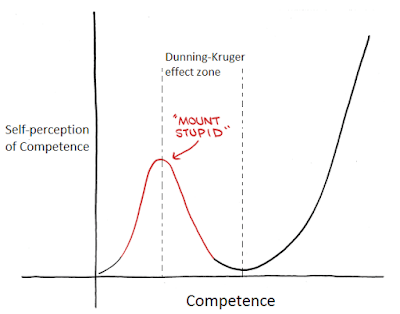
    Still, I am a little bit choked these days by the fear that I will either overstep my bounds, or appear to be pulling rank inappropriately:   "I have a PhD in something so you should listen to me about this other thing."   The more I appreciate the importance of general science communication, the more I respect it as a profession, the meeker I feel about engaging in it as an amateur.   It isn't imposter syndrome, exactly; there's no particular place that I belong, but feel a secret un-belonging.  It's more the backside of the popular concept of Dunning-Kruger:  I've gone over the edge of Mount Stupid and the valley on the other side is long and flat.

    The other reason I think I've been hesitating is because I feel more mixed these days about having a blog that is about a million different things.  There is no way I could separate them and have one blog for recipes and homeschooling and another blog for technical writing and a third blog for theology and canon law and a fourth blog for constitutional law and… The whole reason this won't work (unless I ever do make that career change) is my penchant for general nerdiness.  I am nerdy about recipes, and homeschooling, and numerous technical topics, and canon law, and constitutional law, and language learning, and basically everything I ever think about at any time.  It's unclear to me where the dividing line is between "Personal Musings" and "Technical Communication."  

    ….aaaaahhhh, there is no such line for me.  I just gotta start climbing the other side of that valley.

    + + +

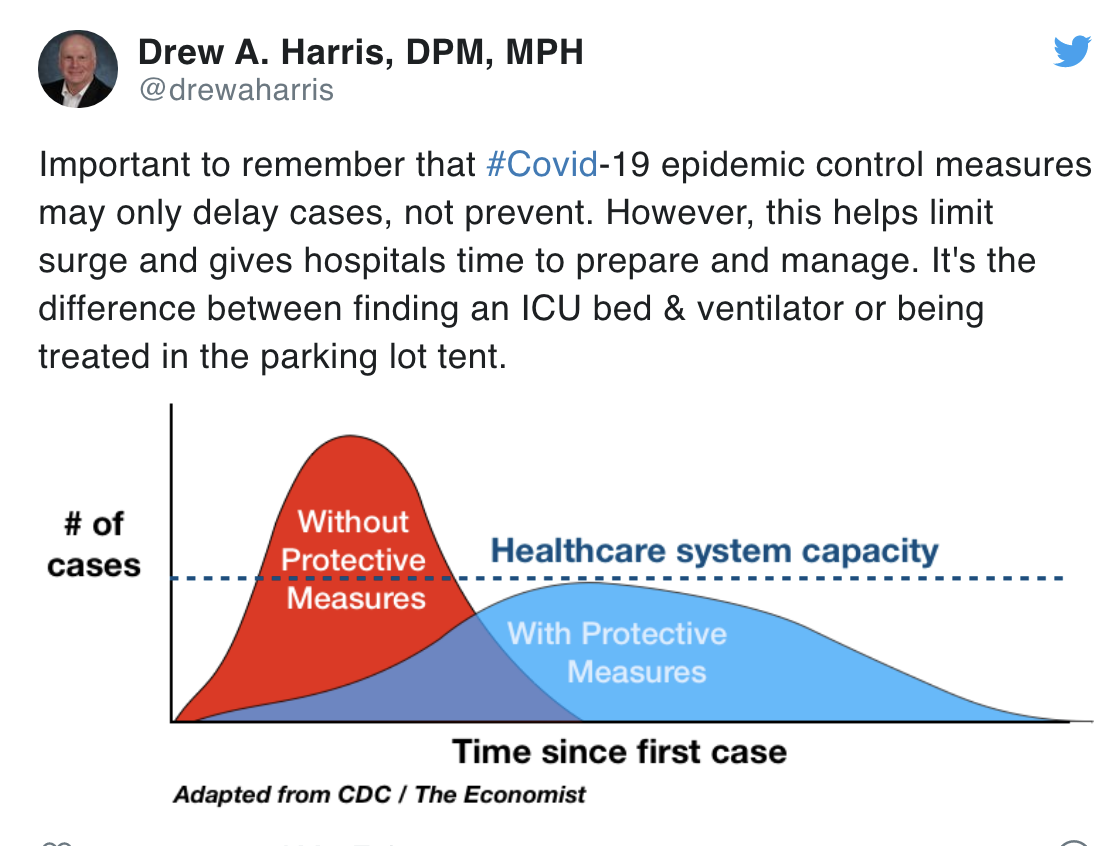
    I'll just close here by noting something that I hope the rest of you have noticed, too:  The people who made the various popular versions of the "Flatten the Curve" graph have, personally, probably saved an uncountable number of lives. 

    I'll highlight Drew Harris's version below for its unfussy and concise elegance.  This is not the work of an amateur; it's the work of an expert.  But his version nailed the clear communication of the relevant information.

    Screen Shot 2020-03-17 at 10.32.12 AM

    The concept predates Dr. Harris, and other artists made later versions which arguably were accessible to more laypeople and included information showing how ordinary people could "flatten the curve."  Personally, I think his version marks the turning point of the dissemination of this idea.  This article traces the evolution of the idea's presentation from a 2007 CDC publication, through Dr. Harris's chart, to the memes that people are sharing today.

    Now go wash your hands.


  • Inside.

    taps microphone

    Hello?

    Anyone there?

    + + +

    I'm trying to imagine an alternate universe right now, one where we decided to have a Spring Break staycation for no particular reason; didn't feel like skiing or camping, just decided to hang out at home and chill all together.  I can't quite make myself imagine it vividly enough to enjoy myself.

    Yesterday I made my last trip to a grocery store, not a big one, a small neighborhood natural-foods store, so I could stock up on the last few items for my freezer.  I didn't empty any shelves, but took one thing here and one thing there; the exception was milk, which I'd just that morning remembered you could freeze; that memory was why I decided on the "one last trip."

      I came home and was beset by anxiety for a few hours about having done it.  Even if I don't set foot outside my house for the next fourteen days, I think I'll still have little waves of anxiety about it.

    Tomorrow it will be fourteen days since I worked the polls on Super Tuesday.  Thursday it will be fourteen days since the family went to the Children's Theatre.  Saturday it will be fourteen days since I last had breakfast out.  Sunday it will be fourteen days since H and I took four teens to see Twelfth Night at the Guthrie.  Ticking them off one by one.

    + + +

    Whenever I actually spend time working on something that theoretically will Help Us Get Through This, I feel better while I'm doing it.  Early this morning I did laundry, extra focus on the towels and on the gloves we've worn in public places, and the scarf I used to grab all the door handles.  Later I went downstairs and took inventory of the freezer.  Then I made lunch for us to eat together as a family, Mark coming down the stairs with his coffee cup to sit with us, almost as if it were dinnertime. 

    I thought that would be a comfort to me, having us all together; but it seemed only to remind me today how very disturbed we are:  we never sit down together for lunch on a weekday, I don't even sit down with the kids; I don't eat what they eat; the teenagers usually make frozen pizza or quesadillas and I usually eat leftovers or a salad.  And here we were all six of us, Mark and me and the four kids still living at home, eating waffles and sausage and a sort of peach topping I made out of an ancient bag of homemade peach pie filling that I excavated from the freezer.  

    FIFO, y'all.

    + + +

    I hope that after a few days it will start to feel like a new normal, and I'll cease being startled by it.  We'll start doing school again on Monday, a week away, somehow or another; we won't go to H's,  but we'll do something; I'll enlist the teenagers, hers and mine, to work out some kind of remote voice chat thing.  

    + + +

    I feel kind of lame about my attempt to sit down and write a blog post.  I hoped I would write something different:  either something a little more inspiring, or else something that might actually help someone, information and recommendations; or a meditation on this long unchosen Lent we face, that will stretch on beyond Easter; or, I don't know, almost anything else besides what I'm actually writing about, which looks like a rather dry accounting of being home for one whole day with my family (most of it) but it's really not about that at all; in fact it's about a wrenching sorrow that I'm tamping down and trying to keep below the surface, a sorrow for missed chances, for lost data of all things, for future lives everywhere that spool out like threads, the frayed end tucked under the few turns that are left, not enough length to hold the seam.


  • Back to basics, in a brand-new way.

    Here we are, in Lent again.  Days have come when the Bridegroom has been lifted from us — or when we feel, acutely, the absence of the Bridegroom — or try to notice it — and so, we fast.

    + + +

    I went back to St. Francis de Sales earlier this winter and reviewed the extremely basic advice on prayer in Introduction to the Devout Life.   There's some stuff in there where he writes that certain people aren't gifted in the art of mental prayer,  they only know how to practice vocal prayer, and so in order to help that sort of person, he gives some detailed advice (it's in part II) about how to do it.   

    I confess that the first time I read ITTDL I did not really take to heart the possibility of being defective in the art of mental prayer. 

    After all (I thought), I am not living in the year 1600; reading is not an uncommon pastime; I, unlike the good saint's clients, have also seen lots of movies; I can easily picture the things I think about.  I am a thoughtful person and I think a lot, and I do not have to move my lips when I am thinking about things, or reading things.  I do not need to be reciting a formula and thinking about the formula, although of course that is a good discipline to take up. Because, you see, I can think about anything I want whenever I want, like any modern who does not suffer from a particularly diminished attention span.

    But it occurred to me recently that "thinking" is maybe not the same thing as "mental prayer" or even "meditation."  And then I considered something I noticed a long time ago:  a great deal of my attempts at mental prayer and even vocal prayer give way, rather quickly, to thinking.  I can't tell you how many times I've started a brief morning offering, child's play, and twenty minutes later realized I was actually making a grocery list in my head.   

    So… maybe it's time to start over, with a little more humility?

    + + +

    It isn't quite true to say that I reviewed the Introduction, it's more that I went back and really read and worked through the parts about "how to do mental prayer even if you are totally convinced that you will never be able to do it."  You know, as if I was totally convinced I didn't know how to do it, instead of reading it as if I already knew that I knew how to do it, NBD.

    I don't use the term "convicted" very much but, er, from II.5:

    After using your imagination you begin to use your understanding, and this is what we call meditation; in other words, making use of considerations to raise your heart to God and to the things of God.  This is where meditation differs from study and from considerations which are made to become learned, or to write or to engage in discussion.

    (Après l'action de l'imagination, s'ensuit l'action de l'entendement, que nous appelons méditation, qui n'est autre chose qu'une ou plusieurs considérations faites afin d'émouvoir nos affections en Dieu et aux choses divines:  en quoi la méditation est différente de l'étude et des autres pensées et considérations, lesquelles ne se font pas pour acquérir la vertu ou l'amour de Dieu, mais pour quelques autres fins et intentions, comme pour deviner savant, pour en ecrire, ou disputer.)

    + + +

    Anybody out there read French, or astute enough at examining texts to notice that my English translation (Fr. Michael Day's) is missing a clause?

    Here's my own somewhat dynamic translation, in case you would like help.

    After using your imagination, you'll move on to using your understanding.  This is what we call meditation, which is nothing more or less than to mull over one or a few things, but done in order to stir up our affections toward God and toward the things of God.  It's in this that meditation differs from study, and from other kinds of thinking on things; those kinds we don't do in order to get better at virtue or at loving God, but for other intents and purposes, such as to become learned, or to write about them, or to argue about them.

    + + +

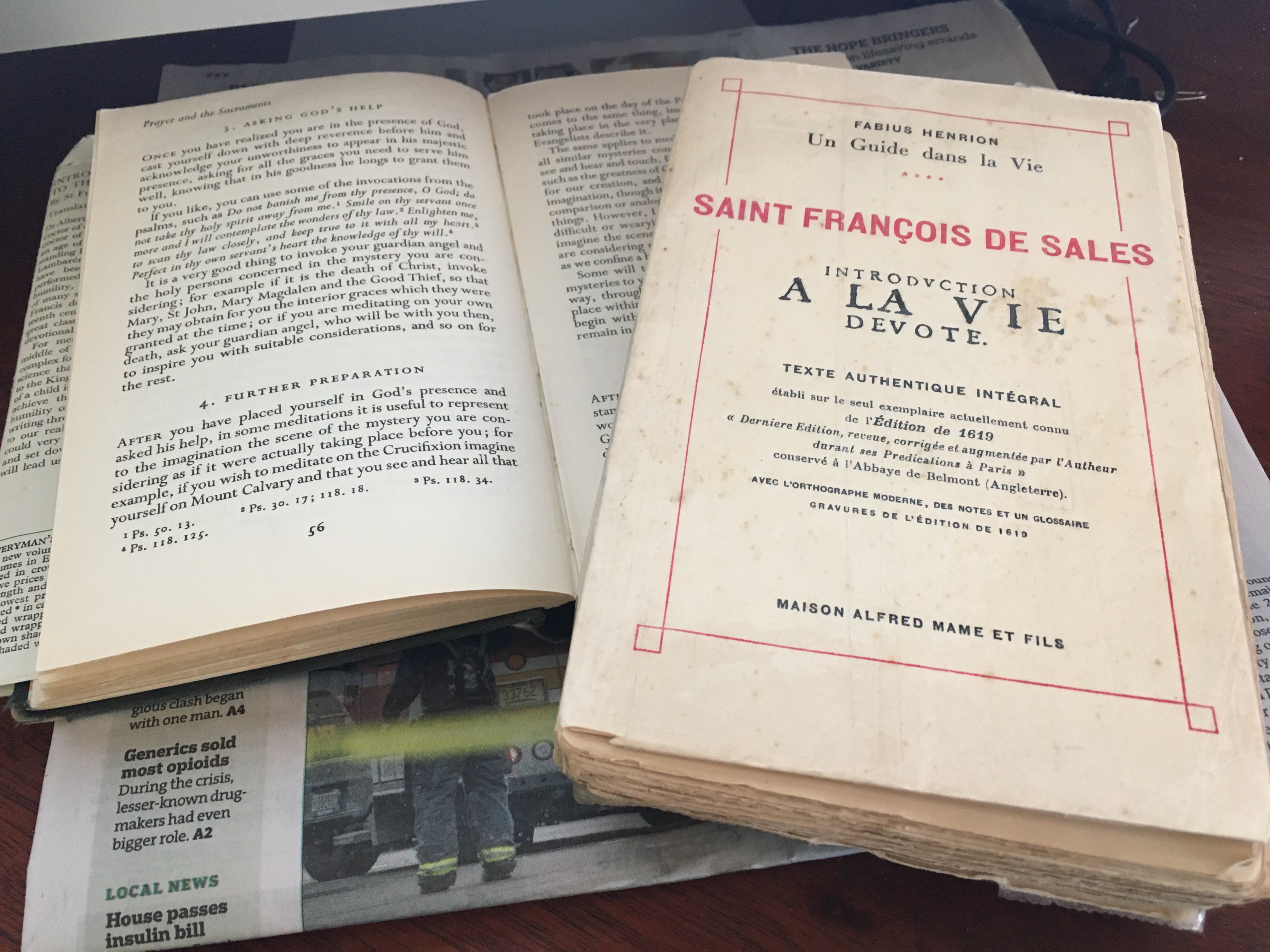
    So, yes, this time through I picked up a copy in French, Texte Authentique Intégral but avec l'orthographe moderne, des notes et un glossaire.

    IMG_8405

    It may seem a little surprising that I haven't dug into the Introduction à la Vie Dévote before, since I do read French, and I enjoy linguistic comparisons, and this is basically my favorite devotional work ever and I've already written about it quite a lot here on the blog.  

    It's really only in the past couple of years (thanks to determinedly plowing through several detective novels ALOUD) that my French has been fluent enough that I can pick up a complex work and, you know, read it.  So the words go into your head?  You know, without having to work very hard?  I mean, I still have to keep the dictionary app close at hand because I run into new words all the time, it's not a function of vocabulary, it's more an ability for the sentences to make sense immediately in the order that the words arrive.

    So anyway, that passage above hit me right between the eyes, the bit I'd not read before about the difference between thinking and meditating.   Because I pretty much always approached mental prayer as if there was something I had to figure out.  And yes, quite often, in order to come up with something to write about (hello, blog) or a good argument (hello, Facebook and Twitter).  

    I mean, it worked?  The inside of my own mind is a fountain of things to write about and argue about.  Some of the arguments and the writings are pretty good!  If I do say so myself.

    (Luke 18:11.  Depending on your translation, you may get The Pharisee stood by himself and prayed thus …. or you might get The Pharisee, standing, prayed thus to himself…  yep, or Le pharisien, debout, priait ainsi en lui-même…)

    + + +

    What's been missing is that notion, that intent, to émouvoir nos affections en Dieu.  The English raise your heart to God just didn't quite make me notice it; I'm afraid that as an Anglophone, I think of "my heart" more as connoting "my innermost being, my core," for better or worse, and the thing about me is that I am centered very much in the mind and distrustful of feelings, the movements of the adrenal gland, the motives in emotion.  So I passed serenely over it and never really noticed the contrast intended between the intent to "raise your heart to God" and "to study… to become learned, or to write or to engage in discussion."  (Not that the saint thinks these things are bad, it's clear that he just doesn't name them "mental prayer."

    It was the missing bit, with its implication:  All that is well and good, but it isn't going to help you grow in virtue or love God any better.

    Let's just say it got my attention.

    + + +

    So I've carefully read and re-read that second part, in French, for the past few weeks, as a sort of preparation for Lent, and I've found another interesting thing, too, which is that I can't go from reading French prayer advice in French and then put the book down and immediately start talking (to myself or to God) in English.   No, I generally find myself going straight into French in my mind too, which is utterly weird because I'm only kinda fluent?  Although there's no one there to correct my grammar so that helps.  And I don't have immediate access to fine shades of meaning?  And I'm extra on alert not to accidentally switch into "practicing language learning" mode, so I'm not picking up my dictionary, but I'm forced to give voice to my prayer and meditation in much more concrete and simple terms —childlike terms — than I normally do?

    And I kind of understand, now, a little bit better, a tiny piece of the special magic of having a liturgical language?  The code-switching, the turning on of a circuit inside you that puts you in a different state of mind — for me, here, a fresher state of mind, a younger and more halting one?

    If nothing else, I feel that I hear St. Francis's real voice a little bit better.  I really do.  And I am looking at this book in a whole new way (and wondering what other details Fr. Michael Day might have left out — I still think his translation is great for its conversational and intimate tone, but now I'm side-eyeing him a little bit.  Maybe the publisher made him cut out bits that sounded repetitive and didn't admit it on the dust jacket).

    I know that I can't necessarily recommend this particular reading to everyone, although I will go ahead and say:  if you do read another language with reasonable fluidity, maybe give some of the classic spiritual works in that language a try, particularly if you've already read them in translation.  It's quite a different experience.

    And if you don't think your fluency is quite up to speed yet, maybe try the detective novels as a first step.  Couldn't hurt!


  • Sleep timing and other potentially poor choices. (With an important 2025 update at the end)

    I have sleep on the brain this week.

    I am a big believer in the importance of getting enough sleep, probably because I’ve never (not even when I was much younger) been able to function well after missing it.  I’m highly assertive about myself going to bed on time, taking naps, and resting extra on weekends.  Also, I’m a morning person.  But for the past six months or so I’ve been having a sleep problem:  not insomnia exactly… more that I start getting tired in the afternoon, and by the time 7:30 or 8 pm rolls around I’m absolutely ready for bed.  And then I do go to bed, leaving the teenagers to clean the kitchen (no problem there) and Mark to send the youngest two to bed all by himself (he’s rather good at this, but I don’t blame him if he would like me to do my part sometimes), because, well, see above:  highly assertive.

    And then I pop awake at two or three in the morning… if I manage to get back to sleep again, I’ll pop awake at 5… and my alarm really goes off at 6.

    + + +

    Long story short, I bought one of those light therapy devices, the wearable kind, which makes you look slightly like a cosplayer fan of Geordi LaForge* and shines bright LED light down at your face for 20-40 minutes.  Most people who buy this are putting it on first thing in the morning, when they wake up, because most people who buy this thing either have difficulty getting up early in the morning, or they live somewhere that’s too dark for happiness and they need to trick their brain into thinking they get to sit outside and enjoy a beautiful sunrise.  But if you fall asleep too early and get up too early, you might be eligible for a diagnosis of Advanced Sleep Phase Disorder, which sounds like “Long-Untreated, It’s Gotten Extra Bad Sleep Phase Disorder” but really means “The Opposite of Delayed Sleep Phase Disorder.”   And that sort of person is supposed to wear the thing shining down upon them in the evening.  So that’s what I’ve been doing for the past few days.  No improvements seen yet, but I’m hoping that at least the placebo effect will start kicking in soon.

    Download-1

    Geordi LaForge. Not Data.

    (No, I haven’t gotten a diagnosis.  Yes, I have sought the help of Doctor Google, M. D.  Why?  Because as far as I can tell there aren’t any unpleasant side effects, and buying the thing and trying it out is significantly cheaper than seeking a diagnosis first.  If it works, I’ll come out way ahead; if it doesn’t work, I’m set back by way less than the cost of a specialist visit.

    + + +

    The homeschooled teenagers who live with me also have inconvenient (to me) sleep schedules, but it goes the other way.  They stay up late (ok, that helps with getting the kitchen cleaned up; I drowsily noticed plate-clattering noises from downstairs when I turned over in bed at 11:45 pm last night).  If left to their own devices, they sleep in well into the morning and sometimes even the afternoon.

    The 16yo boy has, after a couple of years of trial-and-error, adapted his schoolwork routine remarkably well; he rarely, now, misses turning in his homework assignments on time.   This morning, as I often do, I came down for my coffee to find on the counter the algebra book and a sprawl of mostly-finished homework; he’ll have time to complete it before it’s due early afternoon.   I saw a similar pattern in his older brother, who’s now doing fine in college as far as I can tell:   given the freedom to set his own schedule, he adapted early to a routine that’s not all that unusual among college students.

    NOTE:  I mean, I didn’t do that when I was a college student.  I preferred 9 a.m. classes; I badly needed to go to sleep by 11 p.m.; and I successfully avoided all-nighters for my entire undergraduate education except for twice (thank you, enforced group projects with assigned partners who did not share my self-care priorities).  But I can see how it can work.

    The 13yo girl has only just been given control over her schedule this year, and is still in the trial-and-error phase.  Occasionally I need to firmly suggest that what she is exercising is procrastination rather than Scheduling Work To Happen At A Time More Convenient Than Right Now, Namely Later, When I Will Really Be Motivated.   But I am also seeing some creative problem solving; lately she’s initiated a daily trek to the public library branch, where she has the opportunity** to do her homework in an environment of enforced quiet.

    + + +

    I mentioned that I really believe in sleep.  I especially believe in sleep for teenagers:  quite literally, one of the benefits of homeschooling that I always tick off when asked to explain myself is that we are free to find a sleep schedule that suits our bodily needs, instead of conforming to whatever schedule the school district imposed upon us in order to marshal its transport resources.  So I’m inclined to (mostly) let them sleep when they want to sleep.  Occasionally the outcome of this plan, confidently prescribed by Erin-the-believer-in-getting-enough-sleep, is a little shocking to Erin-the-natural-morning-person.

    I didn’t really expect, the other day, after a late scout meeting, that when I said “Tomorrow, since we had to stay up late, you can sleep in,” that one of the teenagers would actually not come downstairs until 2 p.m.   Who would voluntarily miss the whole morning?!?   What is this sorcery?

    + + +

    So, here’s a question that I think is open:   Is it a problem if a teenager, able to set their own schedule, chooses to sleep as late as 2 pm on a regular basis?

    Note that it’s not just homeschoolers.  Around here, high school juniors and seniors can be dual-enrolled in college courses that might not start until late morning or afternoon; and of course there are some young people who are in vocational programs, or not in school for whatever reason and working jobs for now.   Is it a problem?

    I think I’m a little privileged, as a natural morning person.   The class of American morning people seem to have been able to take a position of power in which they have set expectations for early starts to all kinds of businesses, including many that really don’t have to have early starts.  So I think there’s a prejudice against sleeping late and going to bed late, a prejudice that implies moral laxity or sinful sloth, when it’s really just a matter of timing.

    Some people have trouble getting up in the morning.  I’m not much good by dinnertime and am almost incapable of staying up late.  It’s not that hard for me to imagine an alternate world where school starts at 3 pm, where bosses expected all employees to do productive work late into the night and didn’t let you start until after lunch.  This would be a world that would fail me and call me lazy.  So I’m sympathetic, and I try not to assume that sleeping past an arbitrary clock time = dangerous malingering.

    And nobody denies that sleep deprivation is bad for your health.

    On the other hand…. we live in a scheduled time, and one day the sleepy teenager may be a sleepy adult who is required to be at a desk, or on a line, or at a post, by 8 in the morning.  In the winter.  Is it better to train them to be able to ignore their body’s needs, so they can meet their economic needs?  Will the teenager who is allowed to sleep regularly from 3 in the morning to noon, develop a sense of entitlement?  (The same entitlement, because aligned with the world, that I feel to keep my schedule of sleeping 11-to-6?)

    Is it a good idea to practice the flexibility needed to keep a variable schedule (“OK, on Tuesday and Friday mornings you can sleep as late as you want, but Saturday there’s a 9:30 class and on Wednesday I need you to be up in the morning because I’ve got something to do in the afternoon”)?  Or is it better to be consistent, getting up at the same time every day aligned with the earliest regular appointment, preferring regularity to getting, on average, enough?

    + + +

    The whole point I am trying to make here is that I think it’s obvious that this is an open question.  The answer here is “It Depends.”  Different families, with different schedules and different needs, are going to approach the question in different ways and come to different conclusions.  They may change their policies from one teen to the next, as well.

    It’s also obvious (to me) that a large number of people will have strong opinions that only one answer is correct.  I say those people are wrong.

    Third obvious thing:  Even the parents who make the decision that is the best choice at the time, with all the available information, and carefully and selflessly choosing for the good of their individual children… well, some of them are going to find out later that maybe a different choice would have led to a better outcome.    It turns out that they were missing information that would have helped them make a choice with a better outcome.

    (Missing information, because they can’t see into the future.  But I digress.)

    Like, maybe they pick the get-up-early-every-day option, because they truly are convinced that sleep schedules can be shifted.  Maybe with the help of dark shades on the windows, special sunrise alarm clocks, melatonin pills, and light-therapy devices like the one I just bought.  They expect that the child is going to need to learn to get up by 8 AM eventually, so they do their very best to enforce it.  And then maybe their child turns out to have some kind of sleep disorder that they couldn’t predict, one that’s very resistant to all the light therapy, and maybe losing sleep turns out to have awful consequences later, like exacerbating a tendency toward depression or anxiety.  Maybe in the end, after years of bad grades and employment struggles, the now-grown-offspring finds their niche working in an industry with late nights and late starts, or works remotely for people in a different time zone.  Maybe it becomes obvious in retrospect that, if everyone had only respected the teen’s needs early on, they would have thrived under those expectations all along.

    But at the time, it didn’t make sense.

    Or, well, you can write the alternative.  I’m living it now.  I’m letting the kids take naps if they say they’re tired, and rarely wake them up before ten-thirty, and occasionally sleep as long as they want even if that’s through lunch.  It seems best to me, because I think sleep is important for health, near the bottom of the hierarchy of needs.   And I do wonder if someday they’re going to come back to us and say, “Mom, Dad, I really wish you had forced me to get up in the morning and drink some coffee or Mountain Dew or something and start staring at my books and papers by 8:30, like all the other kids, because now I have to get to work on time and I still haven’t learned to accept it and sometimes I sleep through my alarm and people get angry at me.”

    (You can write the alternative, because I just tried to write that one, and I’m fully aware I can’t do it in a convincingly parallel fashion.)

    + + +

    What’s my point here?  SO MUCH of parenting is like this.  SO MUCH is doing the best we can, with the information we have at the time.  And SO MUCH of the answer to the question “is this good?  are we doing things that are good for our kid?”  is not going to become clear until YEARS after it’s too late to change our trajectories.  Should we train this teen to work WITH their body or DESPITE their body?  We… don’t… know!  It could go either way!

    Download

    From “Indiana Jones and the Last Crusade,” of course.

    We might choose poorly, and not know it till later!

    I’m talking about sleep.  That’s important, but… there are even more serious parts of parenting.  Homeschool, private school, or public school?   What sort of food should we make freely available, and what sort should we restrict, and how much?  How should we help a young person who, we discover, is engaging in risky and perhaps illegal or addictive behavior:  leap into assertive action and require immediate treatment and behavioral change before it’s too late, or move carefully and prioritize a message of acceptance and unconditional love?    Should we give our children lots of freedom and plenty of responsibility for their own safety, or should we take steps to protect them from foreseeable hazards; and which hazards, and for how long?

    + + +

    If serious outcomes do befall our young people,  experience (see:  media) suggests that someone, somewhere, will confidently say it’s all our fault***, as if we had that crystal ball.  When easily it could have gone wrong the other way, and then there would be just as many someones, somewhere, who would confidently say that that would be all our fault.

    Much better not to listen to those someones.

    You know what’s even better than that?  Not to make decisions coming from a place of fear of those someones.   I confess that I have a hard time with that one.


    + + +

    I picked that .gif up there, “He chose… poorly”  for a reason.   In the movie referenced, the villain had a bad outcome because he chose poorly.  It wasn’t the other way around, the way the someones often reason:   the bad outcome didn’t make his choice poor.

    And what did “choosing poorly” mean, in the Spielbergian spirit?

    Not the choosing from a place of fear; not the choosing from a place of reduced choices; not choosing from a place of inevitability of bad outcomes; not choosing from a place of ignorance, even.

    No, what was wrong here was that the villain chose from a place of extremely misplaced priorities.  The villain chose from a position of moral poverty.

    That—unlike the other ones—is the kind of poverty that we, we parents, are bound to avoid, and all of us competent to avoid if we wish.


    FOOTNOTES

    _________________________________

    *I had to seek the help, once more, of Doctor Google (D. F. A.?) to get this character name correct; my first guess was “Data”

    **I’m no fool.  There, she also has the opportunity to play computer games we don’t have at home and read books for fun, and also to sit in comfy deep armchairs.  I will judge this tree based on its fruits.  But I’m not going to say NO, either.

    ***Let’s be real.  It’ll be the mother‘s fault.


    AN UPDATE in 2025

    __________________________________

    The teenager who was sleeping till 2 pm?  Not quite three years later was diagnosed with a sleep disorder.  Sometimes you have to dig even deeper than you thought.


  • Liminal spaces.

    Once, when I was in elementary school, I was sent to the counselor's office.  Her door was shut when I arrived, a minute or two early, and no one was watching me, so I wandered out into the peaceful wideness of the hallway, to look at the sixth-graders' art on the walls.  A tall male teacher passed, looked at me twice:  "Where are you supposed to be?"

    "Nowhere at the moment," I said truthfully, and was shortly dragged (well, that's how I remember it anyway) back to my classroom where I had to stand there while he told my classroom teacher that I'd talked back.  I don't remember if I got to see the counselor, but I won't soon forget the sense of being yanked out of a quiet, empty, long hallway and back to the noisy, bright classroom, along with my face, hot, the center of attention.

    + + +

    Last summer I saw a tweet that spoke to me:

    Screen Shot 2020-01-17 at 1.29.09 PM

    "I love airports as liminal spaces. I'd say more but I've been awake since 4 and I'm beginning to shut down." — @diannaeanderson

    It spoke to me because I'd literally just been in an airport, all by myself, a handful of days before.  My 13yo daughter had been flying back from Colorado unaccompanied, and it fell to me to pick her up.  The other children were watched by the oldest, there was no school to do and no place to go, and what did I do but show up a good hour earlier than I needed to?   For no other reason than that… I also love airports?

    Obviously I had plausible deniability.  Had I said to myself, "I must be sure to get there early, for the security lines might be long, and it's vital I arrive at the gate before her flight lands," well, nothing odd about that, right?  But truly, I wanted to get there early for the sheer pleasure of strolling through the airport, unrushed, sipping from a paper cup of steaming coffee, and walking from the end of one concourse to the end of another and back, a brisk indoor walk.  And I did enjoy it, wandering in and out of the shops and other spaces, sniffing the trial samples of lotions for sale, perusing the covers of paperbacks; finally arriving at my daughter's gate a good forty-five minutes after coming in.  Watching all the people rushing here and there, families picnicking on the floor among their suitcases, be-suited travelers looking expectantly up at the arrivals screens with their phones plastered on their ears.  Normally if I'm in the airport, I'm among the rushed ones.  Not this day:  I was entirely separate and apart from all the travelers, at least until my daughter came off the plane and I signed for her, like a parcel.

    This was not even the first time.  I have also been known to enjoy long layovers and, on a weekend trip meeting a driving friend in Chicago, to positively jump at the chance to be dropped off at the airport several hours before my flight home was to leave.

    + + +

    Until I saw Ms. Anderson's tweet a few mornings later, I had never been able to articulate exactly what it is I love about airports-not-in-a-hurry.   But I felt an instant "click" with the identification of airport-as-liminal-space.  That's exactly the quality I love about it, its between-ness.  Neither a destination nor a point of origin; not a place to live, but a place to be suspended from normal, everyday life; a place through which you carry a few things you need, to pass you through a time and space of limited access to your belongings and resources.  Most of the people around–with the notable exception of the people who labor there–are coming from somewhere and going somewhere else, crisscrossing in the space, mysteries to each other.  And it's a place where you can buy food, and coffee, and a drink, and something to read, or something to wear, or toys or puzzles.  It's a place where you can sit, sit for a very long time; or walk, walk for a very long time; and no one will bother you. 

    The reason to be there is to move on, but not yet; and for that reason, everyone who is in an airport (at least, everyone past the security checkpoint)… is presumed to belong.

    + + +

    Another liminal space is the public area of a hospital.  I found myself sitting in just such a space on Wednesday morning, after my diagnostic ultrasound, which came after the diagnostic mammogram, which came after I got the phone call about my screening mammogram three days prior. 

    After the radiologist herself came in to finish up the ultrasound and pronounced the dense spot benign, pronounced me free to go and to return to the usual annual screening schedule.   I was free to go and yet I didn't quite want to leave.  The atrium, where the different wings of the hospital come together, is several stories tall and at that moment was full of music:  there is a piano on the second floor, by the railing, and someone was playing the piano up there. 

    I walked out of the wing where they keep the Breast Health Center, briefly considered stopping by the cafeteria for something to eat (hospital cafeterias are liminal spaces), and instead passed the elevators, heading for the curve I could glimpse of a handrail to stairs going up. 

    I'd taken the elevators as I came in.  Each time I stepped out of the elevator and looked about me for a directory, immediately a person walking briskly past stopped and asked:  "Can I help you find somewhere?"  I was grateful at that moment to be told where to go:  from the parking garage elevator to the central elevators (passing the silent and lonely second-floor piano on the way) and from the central elevators to the correct hallway around the corner.    

    That was then, and I wanted the stairs; but before I got to the stairs I passed a row of inviting upholstered benches and chairs, and I chose one and sat on it and looked about me, listening to the melody rolling down out of the atrium, brought forth by the hands of a passerby.  I could see just the top of his head, his soft cap, over the railing above, moving gently along with the notes.  A passerby, someone like me, perhaps, except that he knew how to play the piano and so he'd chosen to take his momentary seat up there.

    + + +

    It was while I was sitting there between the wall and the stairs that I remembered the liminal space.  That's where I was now, in the liminal space between the (extraordinarily common) experience of waiting for that second mammogram after the first (extraordinarily common–something like ten or eleven percent) abnormal one; and going back home and resuming my normal life, the one where I wake up and I don't have any reason to be concerned that my immediate plans are all about to be upended.  I had already passed through the difficult bit, the part where it isn't clear yet (even though it's likely) that I can return.  I liked the liminal space, I was relieved, there was music, there was a comfortable chair, I needed to go home but no one was expecting me quite yet, and so I sat for a moment and just listened.

    + + +

    I might have thought of the liminal space when I was ushered into the changing room.  The changing room looked like a slightly cushy locker room, such as you might find at the YMCA in the tonier neighborhoods:  not metal lockers but easily-cleaned cabinetry, doors with keys and hooks behind; and quilted robes that snap up the front instead of hospital gowns with ties.  A separate room with dim lights and comfortable chairs for waiting, and one other woman, staring at the wall and fidgeting with her hands. 

    I might have thought of it, because locker rooms are another kind of liminal space; a reason I like swimming for exercise isn't despite the extra time it takes in the changing room, the showers before and after, the extra work with hair and clothes, but because of the extra time, the time between; time for stepping out of the day and into the water, out of the water and through the steam and terrycloth and hot blowing air, and so back to the day again.

    + + +

    But I didn't think of it then, and instead (after the second, more detailed mammogram, after the tech came in and said, "Well, they would like to go ahead and do the ultrasound, too") I thought about the Gulag Archipelago.   I'm going to apologize right now for the ridiculous comparison, there's just one little aspect that I remembered.  I was sitting in a consultation room, alone with several comfortable chairs and boxes of tissues and books displayed on the shelves, books with little pink ribbon designs on them, with titles about being inspired and courageous and communicative, and I was thinking how very much I did not want to be living in the world where I might seek assistance from the pink-ribbon books.  I kind of glared at the closed door I'd just come through, and thought about how I'd just walked through that door and sat down to wait, warm in my quilted robe, and how now I was finding myself in one of the anterooms of the secret world of the sick.

    And that made me think of the Gulag Archipelago, which I haven't read.  Just some of it.  But I was really, really struck by a description from early on in the book, a sort of introductory description; the sort of thing that made me put the book down to think hard about it (and then I guess I didn't pick it up again): 

    We have been happily borne — or perhaps have unhappily dragged our weary way — down the long
    and crooked streets of our lives, past all kinds of walls and fences made of rotting wood, rammed
    earth, brick, concrete, iron railings. We have never given a thought to what lies behind them. We
    have never tried to penetrate them with our vision or our understanding. But there is where the Gulag
    country begins, right next to us, two yards away from us. In addition, we have failed to notice an
    enormous number of closely fitted, well-disguised doors and gates in these fences. All those gates
    were prepared for us, every last one! And all of a sudden the fateful gate swings quickly open, and
    four white male hands, unaccustomed to physical labor but nonetheless strong and tenacious, grab us
    by the leg, arm, collar, cap, ear, and drag us in like a sack, and the gate behind us, the gate to our past
    life, is slammed shut once and for all. 

    Reading that, I was struck in the imagination:   the G. A. as a disconnected, other world, another dimension almost, where the disappeared lived; and the many, many doors, just through which one could be thrust immediately from the real world to the parallel world of the G. A., doors through which people disappeared into the other world, doors everywhere and anywhere.

    It's not the Gulag Archipelago, but I suddenly thought of the door to my consultation room as being a similar door.  Doors everywhere, some in hospitals, some in clinics, some the doors to ordinary cars and buildings, I suppose; and on the other side, maybe, a different world; the archipelago of the sick.  I sat in the consultation room, knowing I'd soon be ushered out of it and into another room for the ultrasound, and I hoped that the ultrasound room door would be one of the doors leading back out.

    + + +

    It was, you know; it was a door back out, out to my regular life.  I sat in the atrium and realized:  the thing that's peculiarly frightening about Solzhenitsyn's gates–I mean, besides the fact that they were real, and to be disappeared through them meant real, awful horrors–I mean the thing that chilled me and has come back to me over and over about them–is that they are gates without liminal zones. 

    There's something peculiarly horrible about the other world, the otherworldly, the place where the rules don't follow– being so close, just on the other side of a door, with no sense of passing through; just there one moment, and somewhere else the next.  The theme appears again and again in our deliberately thrilling cinema:  I was terrified by Poltergeist on HBO as a child (that cloacal closet door); a more childlike, similar thrill recurs again and again in Harry Potter, on Platform 9-and-three-quarters and in Diagon Alley; just a couple of years ago, Stranger Things hinted at the same terror with the Upside Down.

    Even on my way out of skirting the edges of wondering–just a couple of days, days in which I could and did reassure myself that most likely everything would be fine and in fact there are a very large number of cases that get called back and turn out to be nothing significant at all–even on my way out, even with the children waiting at home and with many things left I was very glad to be able to return to doing today–I preferred to sit for a moment in the hospital hallway, with nowhere I needed to be at the moment.  

    I like to be the one who decides that I am ready to come out of the in-between space, and move on.

    IMG_8251


  • An expected relief.

    The 19yo is home from college for another few days; he has a plane ticket to another city, where he will meet a friend, see the sights, and then drive back to school.   

    Most of his break between semesters was filled up with our usual long car trip back to Ohio to stay with Mark's parents.   I imagine there's more than a little culture shock involved when you go straight from your five-guys apartment with your own bedroom, to folding your long legs into the minivan with six other people for an eight-hour trip.  I think we had a good Christmas, though, all together; the little boys are thrilled to have him home, and the teenagers are pleased to have another companion.  Sunday he suggested we all go skiing at the local hill, and he spent most of the time partnered with the 9yo, practicing whirlybirds on the easy slopes.

    + + +

    I was 39 in my last pregnancy, the one with the boy who is now 6, and remember well the sense of dread that pops up now and again as the unknown day of labor approaches.  It's not that it was a particularly difficult pregnancy; none of mine were all that bad, none particularly scary, all low-risk.  It's that you just don't know how it's going to go.  No one ever does!  And I am the sort of person who really, really does not like being in the situation where I don't know how things are going to turn out.

    (Yes, yes.  We are all, always, in that situation, all the time.  We do not know how anything will turn out, and our world can change in an instant.  But the great majority of the time it is possible to pretend otherwise.  Pregnancy, not so much.)

    That last pregnancy had a particularly harsh final week, during which I struggled almost minute by minute with many immediate fears.  In the end it did all turn out fine. I had a quick and peaceful birth of a healthy and strong baby, and suffered no adverse complications to myself either.   

    For a long, long time afterward, though, I would startle myself—a rush of warm relief would come out of nowhere.  It's over—I got through it—no bad thing that I feared happened—it all turned out okay—the waiting and worrying, about THAT anyway, is over.

    Kelly commented on one of my posts after the 9yo was born, "That moment when the afterbirth is out and I hobble to the bed and lay down. That feeling of being not pregnant. As not pregnant as you can ever get. It's the greatest feeling in the world."   It's almost exactly that same feeling, the one that would come to me for months afterward, in a rush of surprise:  The hard thing is over, and it turned out okay (and I don't have to go through it again).

    + + +

    Where am I going with this?  Some time ago I stumbled across a crumpled sheet of notebook paper, something that the 19yo had clearly discarded while he was home:  an errant draft of a homework assignment for one of his college classes.  It was a sheet of mathematical calculations; I was in a hurry at the moment, so I didn't pause to examine it to decide if it was a sheet from a calculus class, or statistics, or financial mathematics.  I dropped it in the recycling bin and went on.

    Something about seeing the rows and rows of double and triple integrals in my 19yo's familiar handwriting tickled the back of my mind, though, and gave me little bursts of that same sort of relief all day.   

    Even if everything is going very well, there's a lot of how is this going to turn out rumbling around under the surface of raising children, all the time!  And of course, since we went ahead and decided to manage all their schooling ourselves, there's some extra how is this going to turn out related to that as well.  

    Look, we're all going to screw up along the way.  I did.  I stumbled through a lot of this.  Mark will be the first to tell you that he stumbled too.  We didn't know how it would turn out.  And of course it's not done "turning out" — there are many more steps along the road, even for this young man, who's doing his own thing now and is mainly responsible for himself, and is getting to take math classes that I didn't get to take.

    It's still not done turning out.  I can't see inside the 19yo's head, nor would I want to.  I know that when I was that age I still had many things going on unformed inside my heart and mind, many things that needed to be dealt with, troubles that would surface later, so much left to learn.

    But… some of the hard thing, the part that was my job, is over for me.  I have handed it on to someone competent to take over from me.  And it turned out… better than okay:  whole, and complicated, and deeper than I can see and know even if I were to read every book on the shelf.    

    I expected it would probably turn out okay, but knowing that it did is enormously better than that.


  • Purposeful procrastination.

    Normally I score pretty high on executive function, but I have one counterproductive (or maybe it's contraproductive?) quirk:  the more ideas I have for new, fun, fulfilling projects I could embark on , the less likely I am to do any of them.   And the more attractive it feels just to move forward on ordinary daily things, like making dinner or doing another round of school planning.  

    Yes, that's right:  the more exciting, challenging, and fun things I could be doing, the less likely I am to get around to any of them.  I become too paralyzed by choices even to procrastinate appropriately.

    + + +

    I think this year I am going to try to procrastinate something every day.  I'm doing it right now:  I have a history exam to write, and also the whole week's upcoming school to plan, and instead I am forcing myself to use one of my Pomodoros (let me google that for you) on this blog post.  Because, naturally, one of the fun and exciting and challenging projects is returning to blogging.

    More challenging than exciting right now, I think, but it's there.   

    + + +

    What are all the projects that float around my head making demands on me, that I keep not getting around to because I feel bad about the ones left unchosen? 

    Well, there are all the languages I am sort-of-trying to learn:  Swedish and Greek to support two of my children who are learning them; Latin for the students I'm actually facilitating; the Somali I started to learn and haven't touched for a few months but that I see on signage all around me reminding me that it's just a flashcard pack away; Italian and Spanish because maybe I will get to use one or both on an upcoming trip; and always, always, the French that I want to keep nudging asymptotically closer to fluency and correctness.   Not to mention the ones I've never started learning but am secretly intrigued by (I'm looking at you, Basque).   I'm not sure what will happen next, but I made myself a little language tracker for the time being, one block to be filled in each day I spend time working on improving the language:

    IMG_8225

    Then there are all the books I want to read.  I still have a giant pile of unread books on my nightstand, sorted into fiction and nonfiction.  Last year I swore I'd read (or give away) the books I already had before buying any more (physical) books, and unfortunately this did nothing more than to instill in me a sense of obligation that I resisted, so that last year I wound up completing FEWER books than probably in any other year of my life since I was two years old.   I now think that perhaps I need something akin to the Dave Ramsey Debt Snowball, but for catching up on my unread books.  It would go something like this:

    1. stack my unread fiction books from shortest to longest regardless of interest rate sense of importance, "goodness," or how long I've had it on the shelf
    2. pay minimum attention to all the books except the smallest
    3. put all my available reading time towards the smallest book until I finish it OR give it away
    4. repeat until each book is read OR given away

    I've also got a few pending projects regarding my mental health and relationships—nothing urgent, just me working through some philosophies and priorities, and doing the necessary self-examination to make good decisions.  Mostly I do this by carrying around half-finished legal pads, hauling one out when I feel like working on it and have a few minutes.  I probably don't have to do anything more to keep these in mind.  The paper pads are enough. 

    I have other creative projects in mind that I don't want to get into here on the blog today, but suffice it to say that they are vague enough that I haven't invested deeply in them.  I think that these will rise to the top naturally as they become more important to me—if they become more important to me.   So I am going to try not to let them bother me anymore.  I think I will ritually inscribe them on a page in my bullet-journal-type-thing as "Something that I have decided not to act upon yet"—perhaps knowing that they are there, whenever I am ready to think about them some more, will free me from the tethers they have kept on my attention.

    + + +

    But for all, any of this, to work—I literally have to procrastinate more.  It will not happen unless I decide, day in and day out, to spend twenty minutes on something fun instead of twenty minutes on a have to.  And, crucially, I have to pick one at a time, and not let any feelings of guilt about not picking the others derail me. 

    Nor the sense of having "more important" things to do. 

    Because I am never, ever, ever going to run out of important things I should be doing.  I will leave some undone.   I won't do everything I should do.

    And, having established the kind of woman I think I am, there's nothing left but to haggle over the cost.


  • All those weight loss posts: Bathwater or baby? (Updated Oct. 2025)

    Anyone who has been reading this blog for more than a few years knows that starting in 2008, I wrote a long series chronicling a number of lifestyle changes:  learning to run and swim, ending some destructive food behaviors, and dealing with the mental and physical fallout of the significant weight loss that followed.  
     
    And anyone who has been reading this blog for the past few years knows that I have not been adding to the series very much recently.  Let’s talk a little bit about why.
     
    + + + 
     
    I have a bit of a compulsive personality, and it’s hard for me to live in the wide, slippery gray area between two extremes:   habitual, mindless grazing, self-soothing with food; and anxious, obsessive dieting, self-soothing with control.  All that writing helped me detach from the emotional content, put it into something that was more cerebral and philosophical, and less fear- and shame-based.  As a Catholic I tried to grapple with the connotations of loaded words like “gluttony,” paring away dehumanizing associations and finding useful definitions that honored the body and its theology.  And I tried to be honest about how my mental health fared (hint: not always well) as I went along.
     
    All the writing helped me.  It did.  But as the years went on I have begun to feel less confident about its being good for readers in general.
     
    Oh, taken all together, I know it is a good thing.  It is my true story, for one thing, as much as I felt comfortable sharing.  And as a whole, I think it is balanced.  I try out ideas, some of them don’t stick, others do.  My general approach was to perform experiments on myself, keep good records, and report back.  I still think this is a good approach to all kinds of life changes.  What worries me is the taking out of context:  that one post all by itself might encourage extreme behavior, or fat-shaming, or trigger someone who has struggled with serious eating disorders.  I can’t say with confidence (unless I embark on a long project of combing through all the posts, considering them as individual posts, and annotating them) that I haven’t written something problematic. 
     
    And I have thought to myself:  Maybe I shouldn’t create any new blog posts about my weight maintenance until I have done that comb-through, and come up with some principles of harm reduction, and perhaps put in content warnings or updates to how my thinking has changed.  This thought has given me pause lately, whenever I have thought about writing anything related to food.
     
    + + +
     
    A second obstacle, probably related to the first, has been the nature of the work I have been doing on myself in the past few years.  To put it bluntly, I have been trying to get off the diet train completely, in hopes I might ditch the constant, low-level anxiety and shame that I still carry around.   I still have this idea that if I get rid of the anxiety and shame, I will gain weight again (so far, evidence bears this out), and so I am in a somewhat ridiculously fraught state of mind about it, in which I am not entirely convinced that the anxiety and shame is wholly unhelpful.  So it’s been very difficult to write honestly about, because I can’t quite commit to being ready to let go of all that anxiety, and I am not yet sure that I can’t harness it somehow instead, and channel it into a healthier kind of motivation.   It seems sort of irresponsible to be honest about all this, lest anyone take it as an endorsement of, well, anxiety.
     
    At the same time, I have clearly (well, to myself) made some progress on the shame and self-hatred front.  And who knows, it could maybe be good to write more openly about dealing with a very real decision to find the place I want to live, the unsteady compromise where I am choosing behaviors I can feel confident are good for me, and that don’t activate a cycle of destructive thought patterns.  
     
    It seems that the destructive thought patterns have been doing much of the maintenance lifting for me, so I have that to work through.  On the other hand, there are some other things that have changed over the same time period; for example, I’m now no longer breastfeeding, a situation that is entirely new to me as a post-lifestyle-changed person.   Surely I’m also adapting to that as well, and other changes that come with the journey through middle age.
     
    + + +
     
    So, what brings on today’s post?  Well, just before the holiday season really started to take off I received an incredibly kind email.  I’ll not quote it directly here because I haven’t the author’s permission, but she described a yearlong journey of significant transformation informed by much of my writing—not just an improvement in health and fitness, she said, but also in self-image.  It made me feel a little bit better about what I’ve wrought, at least about the work as a whole.
     
    I still suspect that I could improve some of the language in individual posts, and reduce the chances that the material could encourage fat-shaming and general body negativity.  I’d like to do that work now, sooner rather than later.   Maybe I won’t toss the baby out with the bathwater after all.

    UPDATE (October 2025): After having moved the blog from Typepad to WordPress, I began in earnest to do the work I mentioned above. The first step has been to go through posts having certain keywords and add a disclaimer to them. For example, most posts that mention “gluttony” are getting a disclaimer that looks something like this:

    [Editing note.  Years and years later, I wish I’d done a better job distinguishing gluttony from other problems with food, like clinical eating disorders and other kinds of compulsiveness.  

    I want to emphasize that, whereas I identified some behaviors in myself that probably qualified as self-centered gluttony in the technical sense, I am not and never have been qualified to make that distinction for anyone else.

    I hope to add some commentary to all the posts that have this problem as I find the time to review them.  Here’s a more recent post where I acknowledge some of the problematic material I wrote and set new ground rules for myself going forward.]

    It’s the best I can do quickly to start setting things right. I have something like 3,000 posts altogether to go through. I don’t stand by everything I ever wrote in the last 20 years (who does?) and of course I wish I could go back and fix all the mistakes I ever made, put things in context, say things like “I’ve changed my mind since then.” But a project like that takes time. Deleting or hiding posts would be quicker, but it seems more honest to me to leave things up, and add caveats where necessary. So. Do let me know if you notice anything that needs attention.