
A couple of days ago BBC News published an article about a recent survey (in the UK, so) that determined that "middle age" begins at age 55:
Never mind the ridiculous language about "research suggests" and "pinpointing," here is the lede:
Middle age starts much later than previously thought – at the age of 55, research suggests.
And Britons do not see themselves as elderly until they are nudging 70, the survey of 1,000 UK adults aged 50-plus for the Love to Learn online learning website says.
Previous studies have pinpointed the start of middle age as early as 36.
The research suggests that as the population ages, new cut-off points are being drawn.
Whatever. Let's not take this too seriously, but use it as a jumping-off point.
This isn't the first time I've mocked the inflation of "MIDDLE-AGED." I have been known, for instance, to go around casually calling myself "middle-aged" in order to upset old people. Basically, as I do for much of the degeneracy in society, I blame the Boomers, who are using their numbers to abuse the language so they don't have to call themselves "old" yet. What, do you think you are going to live to be 110?
I know, unfair. These are Brits. Being a "Boomer" probably means something entirely different to them. What about Americans? When does middle age begin for us? I went googling around and found an interview with Patricia Cohen, the American author of In Our Prime: The Invention of Middle Age, who was asked: When does middle age begin?
That’s the first question that everyone asks.
Forty has long been the traditional turning point in adulthood in the West. The New American dictionary defines middle age as “the period between youth and adulthood, generally 40 to 60,” while the U.S. Census Bureau define middle age as 45 to 64.
Extensive surveys reveal that the definition frequently depends on a respondent’s age, sex, class and ethnicity. Those with more schooling tend to mark its onset later, as do those who are older; men think it begins earlier than women. Men between 25 and 34 say middle age commences at 40 and ends at 56, for example, while women between 65 and 74 say it starts at 48 and lasts until 62.
As life expectancy has increased (by more than three decades in the 20th century), people have stretched the ribbon of middle age like a rubber band, extending it into their seventies. In 2009, a survey asked people between 50 and 64 when midlife ended. Most chose age 71.
Middle age is like a Never Never Land — a place that you never want to enter and never want to leave.
I think we are a little safer in the United States against all that inflation because of the persistence of the "black balloons on your 40th birthday" meme. The greeting card industry will also help us here.
I tease about the "living till 110" thing, but "middle age" obviously doesn't go by life-expectancy number-crunching alone. The life expectancy for American men is (as of 2006) 75, for women 81, so let's call it 78.
- We could suggest that middle age begins halfway through the life expectancy, I suppose — that gets you to age 39 — which might be about right — but it doesn't tell you much about the end.
- Or we could suggest that "middle age" is the "middle third" of the lifespan — but that makes it 26 to 52… nope. You're not middle-aged at 27 unless you are an exceptionally crotchety person.
- Mark suggested it may describe the middle third of adulthood. Okay then… subtract off the first 18 years and divide the remaining 60 by three, and you get 38 to 58. This is definitely more promising, but something about the upper end is unsatisfying to me.
"[N]early one in five" of the Brits thought middle age didn't begin until after age 60 (!) but about the same number thought middle age was a "state of mind." This terminology — it's all in your head! — I also find unsatisfying. Partly because I suspect — can't prove it, but suspect — that this is the doing of the "You're only as old as you feel!" people, whose fault is all this "when I'm an old lady I shall wear purple and wear a red hat" business.
One reason I think this is silly, is, well,
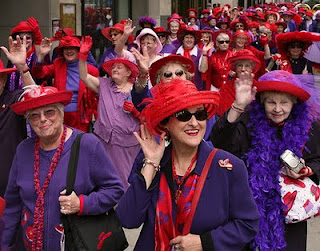
(photo from here)
But another reason I think this is silly is the obvious implication that it's important to think like a young person your whole life, and do your damnedest to feel like a young person (in your heart, dear) as long as you possibly can, and, well… You know what? There's only so much plastic surgery you can get, and how much pretense you can put on.
The fact is, you're going to die sooner or later, you might as well accept it. Being old is, in part, getting ready for death, and there is nothing whatsoever wrong with that. You don't have to go gently into that good night, but you do have to go, and it's possible to do it gracefully instead of, um, the opposite of gracefully.
+ + +
A better definition of middle age, I think, comes from rites of passage and stages of life. The only thing inherent in its name is its "middle-ness" — it is between something — by implication "youth" and "old age," but I think it's something else.
As a mother I'm inclined to think that middle age begins somewhere associated with the child-raising years — some would say, "When the kids are out of the house!" but I'm reluctant to say so, because with people having kids later that can be quite late indeed. Unless you want to put your foot down and say that middle age begins at menopause (and that's not an unreasonable place to put it, for women) you could be having babies in middle age, and have them not out of the house until you are old.
That's not really fair to the people who don't have children, though — to mark middle age entirely by child-raising. I would like to give it a more generally applicable spin.
Right now, at 38, in what I think is my early middle age (unless you buy the menopause thing, in which case I'm not there yet) I think the start of it has something to do with confidence. They are the years when you realize that this is the life you are leading, and (hopefully) by now you are comfortable in it and have developed some skill in it.
When people fight against believing they are in middle age, I think they are fighting against the idea that the "anything is possible" time is over. I think it's kind of nice to get past the "anything is possible" time, myself, because the vast array of possibilities are so paralyzing. I am happy that I have roots now. I feel that I am hitting my stride as the matriarch of a family.
I want to believe that this is the start of middle age, in part because — if it is — I am off to a seriously great start.


 bearing blog