
Some time ago I attended a talk at our local Catholic homeschooling co-op, a lecture entitled "The One-Room Schoolhouse."  My friend The Road Scholar has put together an entertaining and informative presentation about how the teachers in American one-room schoolhouses in the late 1800s and early 1900s taught their subjects, managed their time, and maintained discipline in classrooms with dozens of children and young people who might be aged 3 through 20.  She  drew from her own family history and from primary sources like teachers' record books and employment contracts, and included lots of photographs as well as a sample daily schedule and a formidable sample eighth-grade graduation examination. (If you're currently looking for a speaker, I believe she's available for presentations to homeschooling conferences…)

It turned out to be very inspiring, not in the spiritually uplifting sense, but in the kick-in-the-pants sense.  As in, If a twenty-year-old high-school graduate could provide quality instruction to twenty kids from kindergarten through eighth grade in the same room, then I can sit my five-year-old daughter and my eight-year-old son next to each other and teach them, too.

There had been so much sniping and bothering each other, and also of each one disappearing from the schoolroom the instant I turn my back to attend to the other, that I had allowed my school day to become like this:

MORNING:  Teach the eight-year-old, ignore the five-year-old

NOON:  Hashslinging, decompressing

AFTERNOON:  Teach the five-year-old, repeatedly shout at the eight-year-old to get back here and finish your independent work

(Meanwhile, my eleven-year-old chugged through his to-do list without any input from me.  That kid spoils me.  But I should point out that he probably deserved more attention from me than he's been getting.)

I sat down and thought about the differences between my schoolroom and the stereotypical One Room Schoolhouse.  

(This is my schoolroom looking its absolute best:)

6a00d8341c50d953ef0133f251090e970b-800wi

There are a lot of them.  I don't have a big chalkboard, because I use lap-sized dry erase boards or printouts.  I have a thermostat instead of a woodstove.  I can send people around the corner to watch videos if that seems like a good idea.

But probably the biggest difference is that my schoolroom has no place for me.

In the one-room schoolhouse, the children sit and work facing the teacher, and the teacher works standing at the board or seated at a desk facing the students.  She can see all of  them at once, and this is true even if she is working one-on-one with a student at the front.

My schoolroom has no "front of the room."  There is a countertop on which I prepare my lessons, but no place at the front for me to stand or sit.  Typically when I work with a child one-on-one, I pull up a chair next to him at his desk.  This works great for the child to whom I am attending, but then my back is to the others.  Distraction ensues.

It isn't that I want to create "school-at-home."  I don't.  But right now I need to borrow a technique for helping two squirrely children stay on task while I work with them in turns.  

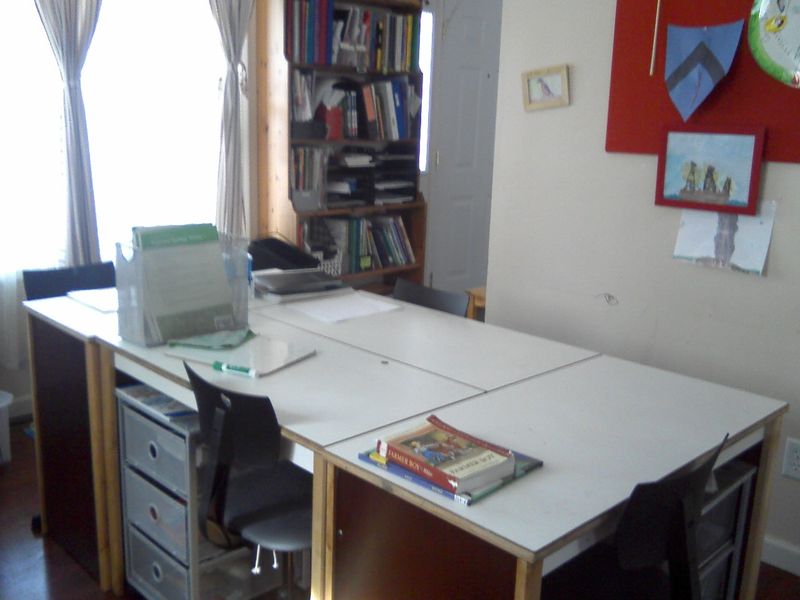
Fortunately, the desks move (and are the same height and a carefully chosen aspect ratio):
0306121335-00

It's not great, but it is the best I could do in a pinch.

See the desk with the dry erase board and marker on it?   I can stand or sit there.  Now my five-year-old can sit directly across from me, and my eight-year-old can sit at the desk on the right.   The eleven-year-old still has access to his desk on the left, although he has proven himself focused enough to be allowed to work anywhere in the house that suits him.

I've been making my five- and eight-year-old plow through their work at their own desks, and insisting that they get permission before getting up to use the bathroom or get a glass of water.  (Trust me, they have plenty of opportunity; it is just that there has been a disturbing trend of conversations like this:

ME:  Hey, 8-year-old, would you mind—

8YO: I have to go to the bathroom!!!!

[running feet]

[faraway slam]

[silence for the next 20 minutes])

And I have a big basket of already-sharpened pencils on the counter behind me, so that excuse is gone.

With the two of them right in front of me, it is much easier to work with them in turns.  When my daughter finishes a task, I can see it, and I can turn around and grab another assignment or at least a book for her to read.  When my son casually leans back to try and peek around the corner to see what his toddler brother is doing, I can catch him out.  For the most part, I can keep them on task, at least better than before.

There is a lot of moping, and a lot of "Can't you make her be quiet?!?" but I am determined to allow them to learn how to work in the same room with each other, respecting each other's space and cultivating patience for the inevitable distractions.   Fortunately the bottoms of the desks are built like enclosed boxes, so they literally cannot kick each other under the table.  

It's not that long.  Only about an hour in the morning and less than two hours in the afternoon.  With plenty of bathroom and glass-of-water breaks — between subjects.

Speaking of subjects, I've aligned their subjects together now — which is to say that the 8yo works on his catechism during the same block of time that the 5yo listens to or reads Bible stories, that the 8yo has math lesson while the 5yo does math worksheets and vice versa, the 8yo writes in his journal while the 5yo prints in her copybook, and they both do independent reading at the same time.  

This works shockingly more efficiently than my previous model, which was to teach one while the other (theoretically) worked quietly and independently.  The problem is that neither one of them seems to be developmentally ready to sit and work independently without help — not help with the math problems or sounding out words, but help staying on task.  Does it sound unrealistic to have a five- and eight-year-old sitting in chairs being directly taught for a two-hour stretch?  Trust me, it is more unrealistic to expect this five- and eight-year-old to decide where and how to sit and what order to do their work in, and yet complete their daily tasks.

Still many bugs to be worked out, but I've got something that's going pretty well for these middle two right now.

(And in case you are wondering what I am doing with the toddler, the answer is that I am coping as best I can.  He has a little table around the corner.  Today it has Play-Doh on it.  Tomorrow it may be something else.  I'm not above a video or two if it comes to that.  Sometimes I am lucky and he goes down for a nap just in time for afternoon school.)


Comments

11 responses to “Moving the furniture.”

  1. Cathie Avatar
    Cathie

    Whoo-hoo! That is awesome!

    Like

  2. Cathie Avatar
    Cathie

    And thanks for the plug!

    Like

  3. Rebekka Avatar
    Rebekka

    Just out of curiosity and not because I’m actually going to use the info for anything (if I were going to homeschool it would be because civilization has collapsed), do you ever have the oldest help one of the younger ones, for example with a math lesson? It sounds like it would both be a help to you but also a good way to do review of basic skills plus develop pedagogical skills, patience, and a host of other virtues.

    Like

  4. Rebekka: Yes, I do. Last year, when I was teaching math to my #2 (then seven), my oldest’s “assignment” was to do some activity with my #3 (then four). Sometimes he read to her, sometimes he played games, sometimes they did a small craft of something. And I often have #2 or #3, who both read well, read stories to the two-year-old.
    If I am in the middle of teaching and #2 or #3 comes to me with a quick question, such as “what is this hard word” or “what does this problem mean,” I often send them to the oldest. So, yeah, we do a bit of that.

    Like

  5. I don’t know what it is with school rooms, but it seems like they work and work and then all of a sudden they just don’t work at all anymore. We have gotten to the point where we are taking most of the school work to the dining room table and only using the school room for art projects, shelving/storage, and the play kitchen that also resides there. I need to do something about it, but I can’t figure out what needs to be done. Part of it is that I just don’t want to be in there with all four kids (it feels too compact and overwhelming) and also that the table just isn’t big enough anymore. (especially with the way that my eldest monopolizes it!). I can’t decide if I should move her to her own desk, make the table bigger (it has a leaf, but then the room will feel more cramped), keep going back and forth (which actually works pretty well, it just seems kind of silly and causes a lot of walking!) or what. My husband will be gone for a few days later this month and I will probably rearrange then. For some reason I always rearrange furniture when he’s gone…

    Like

  6. And I would love to have heard that presentation about one room schoolhouses!!

    Like

  7. Tabitha Avatar
    Tabitha

    I’m going to be reading this post more thoroughly when I have a bit more time, but I have a thought and a question.
    I am homeschooling an 8th, 6th, 4th, 1st, and preschooler. Next year I’ll add in the now 3yo as a preschooler. I’ll still have a barely 1yo at that time, too.
    I consider this a one room schoolhouse, for sure.
    We’re trying to make decisions for next year for high school for my oldest. The thought that keeps running through my head is that “There is a reason one room schoolhouses ended in 8th grade.” I want to be able to make it work, and many families do. I’m just not sure I’m capable of adding high school into this mix. Any of your amazing readers have any thoughts?

    Like

  8. Well, my plan for high school has been to try to get my kids as independent as possible before they get there! I figured that we would be spending a pretty big chunk of eighth grade working together — the eighth-grader and I and my husband that is — to decide what needs to be in the curriculum, which textbooks and other materials to use, and how we’re going to put together his portfolio or whatever it takes for applying to whatever postsecondary institution he winds up being headed for.
    I haven’t ruled out enrolling any of the kids in a traditional or nontraditional high school, if that is what it takes, to be honest. We are fortunate to live in an area where there are many schooling options, even à la carte coursework at a small independent Catholic academy centered around our parish. But we are also enjoying the benefits of co-schooling with other families, which has really opened up a depth of learning that I didn’t think was possible to organize on my own, because we (the parents) have been able to specialize in areas of personal interest to us. But we’re still maintaining the cozy familiarity of being among people who care about our kids and really know them.

    Like

  9. I guess what I’m getting at, with all that, is that the high school student ought to be taking on a lot of the responsibility for his own learning. He’s got to. He needs to have the kind of self-discipline that most people don’t have to show until they are a freshman in college, when Mama isn’t around to make him do his homework anymore. I may be around, but I’m busy with younger kids, you know?

    Like

  10. Tabitha Avatar
    Tabitha

    I read it more thoroughly. Definitely some areas I can improve with my 5, 7, and 9 year olds. Thanks for the thoughts.
    My oldest 2 are already very independent. I thought my high school plan was going to work. 8th grade has shown me all the deficits, though, and I don’t know if I can overcome them. She needs some one on one time and it’s hard to make that consistently happen. I’m starting to see school through 8th grade as more general and high school as more specialized. I don’t feel like I can do both justice. I’ve long envied your co-schooling set up. You are very blessed!

    Like

  11. “I’m starting to see school through 8th grade as more general and high school as more specialized.”
    My theory: yes and no. You have to be somewhat specialized by that time, because there simply isn’t time in the day to do everything, and so your student is going to choose to study some things and not others (or be constrained to do so in order to meet requirements she may meet later).
    But you can still be aiming for a strong liberal arts education, which is by definition well rounded and broad, with deeper “dips” here and there into areas of special interest to give a sort of taste of specialization. There is time for specialization in college or on the job. The proper place of high school is to develop the child’s mind into the adult one, and to fine-tune the skills of self-teaching, the “lost tools of learning” that Dorothy Sayers wrote about in her famous essay. The subjects are just the material on which the mind cuts its teeth.
    Every school (home or institutional) has inherent deficits, and you could look at the ones in your own home school as teaching tools for learning how to learn — because identifying and remedying deficits in the resources available to you is a basic tool for self-teaching. I would say, bring the 8th graders into the discussion of what seems to be missing from their environment, and work together on the challenge of restoring it.

    Like

Leave a comment