
My family and I spent the last week up north at YMCA family camp.
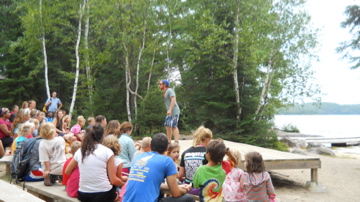 Campfire songs, skits, picnics, counselors, and all that, next to beautiful Burntside Lake just a few miles from the Canadian border, and right on the edge of the Boundary Waters Canoe Area.
The staff — a few full-timers and a number of young summer counselors, mostly college students who apparently love nothing more than their summer jobs up here, got the crowd fired up every day for some serious relaxing and family fun.
The young man leading the crowd in song from the stage there — the stage looks out over the lake and the swimming beach — is a counselor named Brian. This is the third year that we've encountered him at camp. The first year he was there as a high-schooler in a leadership program. Now he's on staff. My kids love him. He was my seven-year-old's age-group counselor.
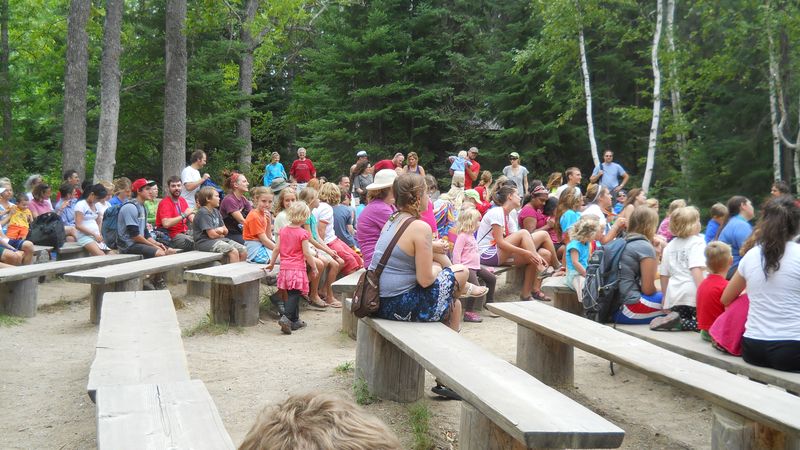
There are about two hundred people, maybe, at camp at any one time, all for a full week stretching from Saturday evening to the following Saturday morning. All of them families, plus the staff and the teens in the leadership program. Parents, if you'd like to pay for the privilege of knowing your teen is cheerfully cleaning outhouses ("biffies") for a couple of weeks, this is the place.
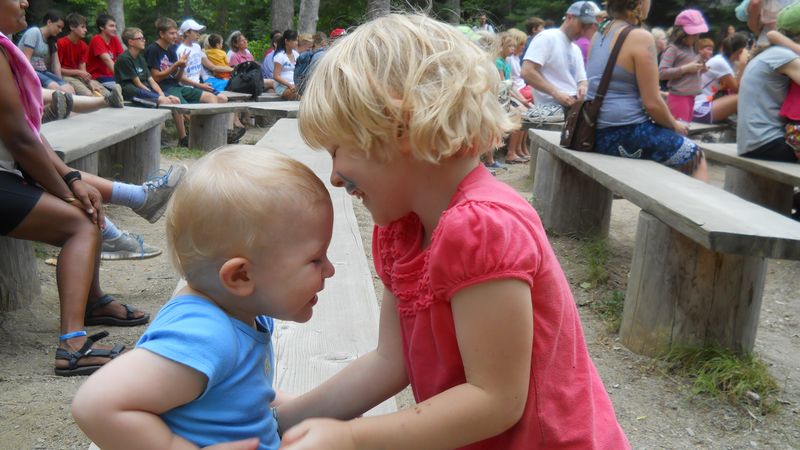
Over the course of the week it's possible to get to know some of the people fairly well. I watched my daughter solemnly declare several counselors and leadership teens as her new best friends. Actually, I watched in amazement as she reached out to what seemed dozens of people. "I have to go say hi to Sara," she would say at lunch, and dash off. "I have to go say hi to Joe." I had no idea she was capable of being so outgoing, or so memorable to others. It seemed by the end of the week that everyone we passed on the trails knew her name.
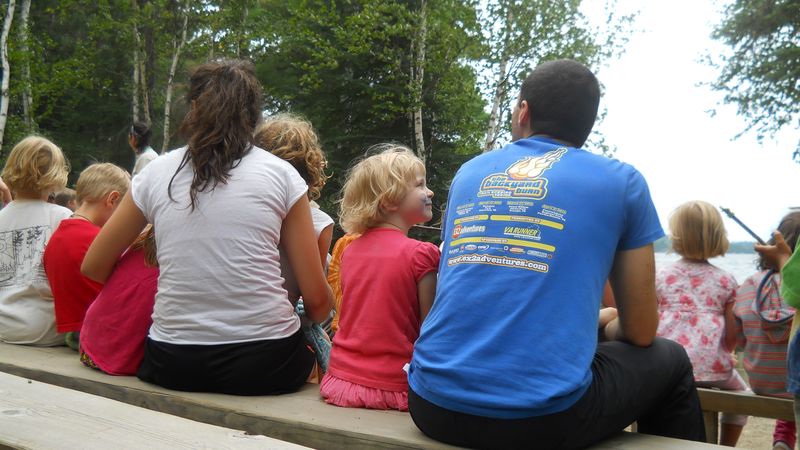
That's Joe, one of her age-group counselors.
The children spend 2 1/2 hours in the morning divided up by age, and the rest of the time can mix freely or spend time with their families. "Age groups" allows the parents some time to reconnect with each other, or a couple of hours of quiet solitude, or a chance to try something too difficult for the children; Mark and I practiced canoeing and kayaking, and went on a few hikes together.
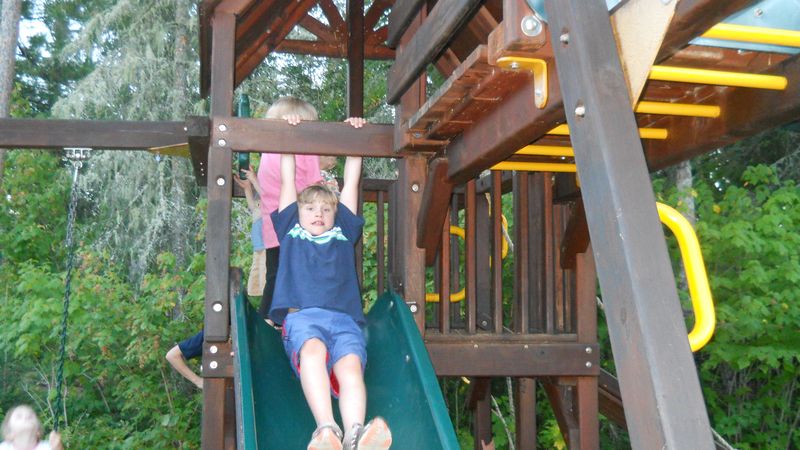
One of the things that's most precious to me about this week, for my city kids, is the chance to let them roam a little more freely than they can in our neighborhood at home. The oldest can buy a drink in the coffee shop or play tetherball and volleyball or just wander around, with hardly any worry. Even the smaller kids can be sent here and there, say, out to the playground while the rest of us linger in the mess hall over coffee.
I enjoyed being (mostly) unplugged, too. The cell phone service is pretty spotty, and there's no Internet connection at all. The staff actively discourages the use of electronic devices where other people can see you, with the exception of e-readers. I had my iPad, but it was pretty much demoted to a Kindle emulator, and I was too ashamed to bring it outside the cabin. Mostly used it to read while I was spending a couple of hours in the cabin each afternoon supervising a napping baby and a "resting" five-year-old.
I do confess to using Mark's iPhone to access this Wikipedia article. Let's just say there was a pressing need.
As the days wore on, I reflected that spending a week at summer camp — especially when it's late in the summer, and here and there you can't help but glimpse a reddening maple among the green forest foliage — really drives home the ephemerality of so much that gives us pleasure. Perhaps that's a trite observation, but it's true. The kids form devoted friendships — and we adults form pleasant camaraderies — and perhaps we exchange addresses (my kids left with two pen-pal addresses in their pockets), but for the most part we may never see these folks again after the end of the week, and we know it. It feels odd to enjoy people's company so much under those circumstances. Yet it's not all that different from many of our longer-lasting friendships. It's hard to tell in the midst of them which of those will die back if and when our circumstances change.
And of course, the beauty of the woods is all around — the clear, cold, deep lake, its lush border of trees, the tiny cabins that dot its edge — Mark thinks they spoil the view, but I'm a city girl, and I love to see the work of human hands (in small doses) even in the middle of the forest — the three whitetails I saw at 6:30 in the morning on the last day as I walked alone to the shower house — the variety of colors of pebbles on the lake bottom, the blue sky, the nighttime wail of the loon.
And of course, we soak it in while we can, but we know all along that it's only for a short time, and we have to go back to our "real" lives.
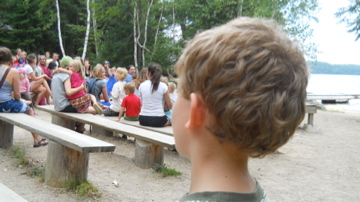 My eleven-year-old felt it most strongly. From the very beginning of the week he was alternately exuberantly happy to be in the woods, and crushed with misery that the experience could only last a week. He was desperate to spend every possible moment having fun. He hasn't yet learned that "fun" isn't something that can really be grasped at. That you have to find it almost accidentally, while you're busy doing something else, or even nothing at all. You have to let it sneak up on you.
Kind of like the realization that "fun" isn't something to be grasped at.
I like going to camp for the very last week of summer, right before starting school (and indeed, in about 20 minutes the kids' alarms will go off, and I will feed them breakfast, and we will dive back into math and reading and science). I like that there is a drive of several hours between our sad departure and our arrival home — because by the end of the drive we're very glad to get back to our own little house in the city.
And keeping safe, perhaps, a few of the more permanent kind of souvenirs.


 bearing blog