
I decided to stop Experiment #1 early, and baked the bread after about 4 hours of soaking. Here's why:
- The question I wanted to answer was: Will the yeast stay dry? After 4 hours there wasn't any sign that the dry flour the yeast was sitting in had gotten even the slightest bit moistened. I decided it was safe to stop the counter-top experiment and try a timed-in-the-bread-machine experiment instead; I no longer worried that the yeast would get wet and explode the dough all over the inside of my bread machine.
- I was concerned that the dough was drying out too much. So I thought, "If I bake the bread now, I can check it during the knead cycle and add back enough water to rehydrate it. Then I'll know about how much water to add to my recipe next time."
(Mark, later: "Why didn't you just weigh it to find out if it lost an appreciable amount of water?" Well. Duh. Even though I have two degrees in chemical engineering, I have been cooking for far longer than I have been using laboratory equipment, and I tend to forget to replace my (imaginary) chef's toque with my (imaginary) lab goggles when I need to do any sort of analytical cooking, or cooking analysis. See here for another example.)
- I mixed soured milk, all but 2 Tbsp of the whole wheat flour, and coconut oil in the bread machine as "quick bread," the only setting that begins the MIX cycle immediately. Then I turned off the machine before it could start the BAKE cycle.
- I mixed sugar, salt, 2 Tbsp white flour, and gluten powder in a small bowl. This was about 1/3 cup dry ingredients.
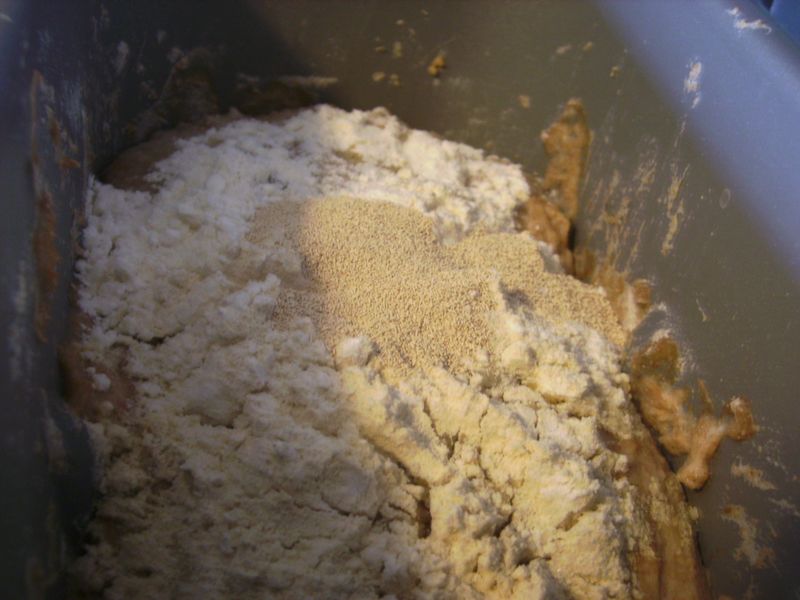
- I covered the wet mixture with the dry ingredients, leaving an extra heap on the very top.
- I dug a little well in the dry ingredients and added the yeast to that.
- I set the machine's timer to complete the bread 12 hours later (allowing for 8 hours soaking).
See, it occurred to me that the gluten, sugar, and salt don't need to be soaked (in fact it's probably better if they're not mixed in there, and if kept dry, they could add to the total volume of dry ingredients and provide a thicker blanket with which to cover the wet flour mixture.


 bearing blog