bearing blog


bear – ing n 1  the manner in which one comports oneself;  2  the act, power, or time of bringing forth offspring or fruit; 3 a machine part in which another part turns [a journal ~];  pl comprehension of one’s position, environment, or situation;   5  the act of moving while supporting the weight of something [the ~ of the cross].


  • Shaking it up a little, involuntarily.

      Like his brothers and sister before him, Child No. 4 entered what we call the "Feng Shui" phase of toddlerhood at about fourteen and a half months.  He walks around attempting to lift small pieces of furniture or portable items such as wastebaskets; when he finds that he is able to move one, he carries it somewhere else and leaves it there.  So we keep finding potties in the hall and office chairs in the bathroom.  

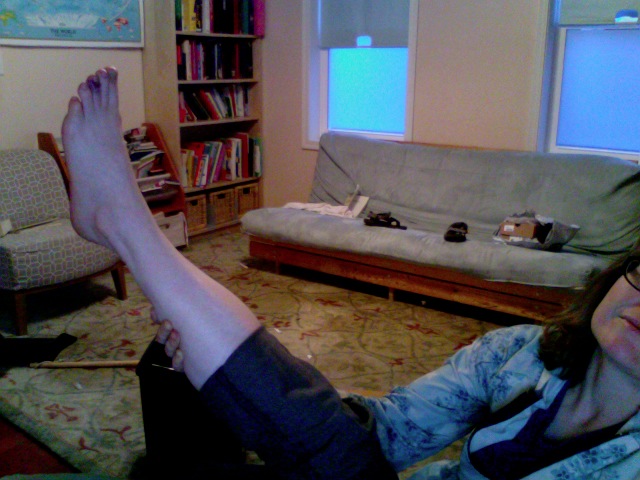
    Yesterday morning my middle toe found a step stool in the kitchen.  Right up against the wall so it didn't give a millimeter.  Here, let me pause in my R.I.C.E. therapy to show a little leg, courtesy of Photo Booth:

    Photo on 2011-04-25 at 19.58 #2

    I decided to do my part to keep health care costs down by not getting it checked out just yet, especially since (a) the website we checked said things like, "An x-ray may be required, but only to appease the patient" and (b) I've been through this before.  Yes, yes, I promise to go to urgent care if it starts to necrotize or something.

    It hurt a lot after Easter Mass (should have stayed sitting down; should have worn the Dr. Martens instead of the Fluevogs with my pretty Easter dress), and I frowned a lot.  But this morning, once it was buddy-taped to the next toe over and laced into the Docs, it wasn't too bad, and I started to hope that maybe it was only sprained instead of really broken.  We'll know soon enough; if sprained, it'll feel better in a few days, if broken, not for a few weeks.

    Mondays, my 4yo has a 30-minute swim lesson.  Usually I swim laps while she's busy with that, but it didn't sound fun.  Neither did running, obviously (still cringing at the thought of a footfall driving the foot forward into the toe box of my running shoes).  I brought  my gym bag and changed into running clothes anyway.

    Once in the fitness center I decided to make friends with the rowing machine, something I never use.  There's no impact; the foot strap goes over  the top of the foot well above the toe; and while the foot does flex, I didn't feel much discomfort there.  

    By the time I figured out what I was doing (push with the legs then  pull with the arms; reverse the steps to recover) I only had 17 minutes to do the workout.  So I tried to make it count by getting the power readout about up to what the treadmill tells me I burn in Cal/hour.

    I hope my foot feels up to a run or at least a stairclimber soon, but I guess I could have fun on the rowing machine for the time being.  Maybe I'll brush up on technique first.

    Mark thinks I should try lifting for a while, but I never see the point of taking up lifting as a temporary diversion.  When I start lifting, it'll be either for a specific purpose, or because I intend to keep doing it for the rest of my life.


  • Holy Thursday rerun.

    Here's a rerun of a post from 2009 with a Holy Thursday theme.

    * * *

    I've never had trouble with the concept that Jesus felt physical pain, that He physically suffered.  Seems obvious to me:  If you have a body, it hurts sometimes.  And that doesn't feel good, even if you know the pain is necessary and a sign of something good.  Anybody who's given birth knows this.  Pain is more bearable if you understand where it's coming from, but it is still pain and it would be nicer if there were less of it.  Right?


    But the fear?  How does that work?  How on earth can the omnipotent and omniscient and eternal "fear" his own willed temporal suffering?  Fear comes from a lot of places – not knowing, for example.  (But God knows all.)  And being out of control.  (But God is in control, even in the person of Jesus who submitted to others.)  And the threat of annihilation.  (But God is eternal.)  Isn't fear something that is fixed by knowing, by control, by the promise of continued existence?  Well?


    I wasn't thinking about that when I began the sorrowful mysteries of the rosary yesterday, when I arrived at the story of Gethsemane.  I was thinking about Amy Welborn's meditation on the resurrection of the body and her quote of a post by Fr. Longenecker , about the resurrected body being "the soul in every cell," that she said helped her feel relieved:  "I could not begin to parse it philosophically or theologically, and nor did I have any desire to. Something within got it, and I was able to trust." 
     Of course, I took that to prayer thinking I would try to parse it philosophically or theologically.  A lot of what Amy writes about difficult-to-grasp assertions of our faith resonates me. I have a very cerebral, historical approach to the Catholic faith, and aspects that can really only be approached so far with the intellect, further progress having to be made obliquely or with intuition, leave me with a permanent sense of unease.  So that's what I was trying to understand.


    What came to me was something that happened to me years ago.  Have you ever had a genuine panic attack?  I have.  I had a string of maybe five panic attacks over a period of about six months when I was in college.  I never knew why they appeared, and I never knew why they went away again — I've never had any since.    I remember it vividly though, one of the most surreal things ever to happen to me.


    It was surreal because at every moment I knew exactly what was happening to me.  I recognized the sensation as a panic attack.  I knew I was, in fact, safe.  I knew there was no thing that could have triggered a legitimate fear response.  And yet my body was behaving as if I was in terrible danger.  My heart was pounding, my skin was sweating, the prickly hairs were standing up on my neck and arms, my blood was dumping adrenaline into my muscles, my breath came swift and panting, the lights brightened as my pupils dilated.  


    I suffered.  Not because I knew fear but because I felt it in my body.  My physical response created an unbearable restlessness — my very cells shrieked, Run! Fight!  And in a way that made it even worse, because I knew there was, in fact, no point in running and nothing to fight.  And yet my body urged me to do something — I kept having this urge to leave the house I was in, to run away into the night.  But since I knew I was safe, I had to bring all the strength of my will to bear against the irrational urges of my body to flee.   I told myself "This is a panic attack, it will pass," but the one thing I did not know was how long it would last.   In the end I sought help, called a friend (to my embarrassment, waking up his parents in the middle of the night) and begged him to keep me company on the phone until the terrible sensations passed.  I didn't feel wholly better until after I had fallen asleep (completely physically exhausted) and awoken hours later.


    So I remembered that, and then it made a little bit more sense to me how Jesus could know all and yet suffer from His fear, as we believe He did in Gethsemane.  I'm not saying that I know how it works, I just say that I see now a way that it could work.  Because He could certainly have willed His body to yield the fear response, just as He could (and we know, did) will His body to experience pain, to send distress signals to His brain.   If a panic attack can feel physically even worse to one who knows there's nothing to fear, because of the constant effort for the wiser mind to suppress and overrule the wild urges from the body, the urges of muscle and bone — then I don't doubt that the fear response generates real suffering even to the omniscient.


    * * *


    That permanent sense of unease, about things that can be grasped only so closely by the intellect — it is not a bad thing.  For me, "to trust God" means above all else to accept "I can not understand this except when You decide to gift me with insight."  The habit grows easier with time, but the unease remains, part of that restlessness that belongs to this life.  St. Augustine wrote:  Our hearts are restless until they rest in you.  It doesn't make sense — that's a kind of restlessness, an urge to do something, to find out something, to write and write to try to figure it out, to read and read, to argue and understand.  And restlessness isn't always made easier by knowing that there's really nothing more that can be gained by action.
    * * *
    No posts tomorrow.  A blessed Good Friday to all.


  • Why we don’t do soccer.

    Jamie needs an auxiliary brain:

    A few years ago I remember thinking, "If I have three kids in Scouts and three in soccer my head is going to pop off." 

    …My plan was to catch the last few minutes of Marty's game and warm him up with a cup of tea at the nearby Panera. Then I'd drop Joe off for his 11:30 game and let my husband take over, picking up Joe and getting Pete to his 2:00 game.

    Except it didn't work out the way I planned. The 11yo's game was cut short on account of rain and humiliation (for the other team — Marty's crew won 8-0). Instead of seeing the last few minutes of play I found Marty alone, soaked and tearful. (FAIL FAIL FAIL. I reminded him that he could ask another parent to call me if something like that happened again, but still: FAIL.) He perked right up with that cup of tea, though, and I was feeling like things were back on track when Joe said, "How's Pete going to get to his game?"

    …I'd brought the wrong boy. The 11:30 game was Pete; the 2:00 game was Joe.

    It's been a while since I stirred up the waters of controversy, but I want to throw something out there and see what bites.  It has to do with my theory about soccer.

    See, soccer is a great sport for a kid.  The equipment is cheap; kids all over the world live and breathe the sport; you can play a pickup game on almost any flat surface of any size with a number of players ranging from four to 40.  Also, a kid who plays soccer runs.  A lot.  There's a good amount of physical activity in every soccer game for just about every player.

    But based on everything I hear from parents of soccer players, however good soccer may be for a particular kid, I am convinced that soccer in its usual suburban-American form is a Very. Bad. Choice. for larger families.  If you have four kids in soccer, then every kid is on a different team (unless you have a set of quadruplets all the same gender).  That means every kid is on a different schedule.  Frequently it means different fields at different places in town.  I'm sorry, but that sounds like a logistical nightmare to me.  I do not want to spend my life in the car.

    So far I have been plunking my kids in physical activities where two or three kids are doing the same thing at the same time in the same place.  Swimming lessons at the Y, for instance.  There's also a swim team at the Y where all ages practice and compete at the same times in the same place; I tried to get the kids interested in that but they didn't bite, but maybe the younger ones will go for it.  Martial arts:  the Aikido studio up the street has "youth classes" where all ages and belt levels under 17 practice at the same time in the same place.   

    I know several larger families in which every child takes piano lessons.  This strikes me as the epitome of an activity that is well adapted for large homeschooling families, at least the ones who have a piano.  Especially if you can get the piano teacher to come to your house (which is, I hear, easier to do if your family is paying for a block of four or five lessons in a row).  Efficient.    Soccer strikes me as the polar opposite of this.

    Am I right, or very, very wrong?  Set me straight if you will…

    UPDATE – Jamie dusts off the brain and responds.  


  • Still Alice: A review.

    We spent last weekend in IA visiting commenter Kim-in-IA and Husband-of-Kim-in-IA and their three boys, one of whom is my godson.   While we were there, spring arrived.   I had optimistically tossed a pair of sandals in my duffel bag, and you bet I wore them.  Our four children and their three children ran around in their big back yard (big enough to toss a Frisbee without losing it to the neighbor's roof, a novelty for my kids).  And Kim performed one of the coolest hostess acts ever when she tossed me a novel I hadn't read and said, "Here, this doesn't belong to me so I can't lend it to you, but why don't you just go ahead and read it straight through while you're here this weekend.  It's a quick read."

    The novel was Still Alice by Lisa Genova, and it was indeed a quick read:  a page-turner, fascinating, not really what I would call deep, but with enough subtext and a little bit of mystery to keep me thinking about it for several days afterward.  Highly recommended, if only because the payoff is high compared to the amount of time it will take.  Absorbed very easily, like beach reading or interesting nonfiction, and yet it sticks around.  I finished it in less than a day, at times curled up on the couch, at other times reading it one-handed while I pushed the baby in Kim's tree swing.

    (Now that I am a busy mother, I appreciate book reviews that tell me exactly how much undivided attention I have to give a certain book in order to enjoy it or at least follow it.  So now when I review books, I always stick that bit up front.  My apologies if you're wondering why I didn't begin with a hook that had anything to do with the plot.)

    OK, so, Still Alice is the story of a 50-year-old woman, a Harvard psychology professor married to a Harvard biology professor, who is diagnosed with early-onset Alzheimer's disease.   The story is told in third-person limited subjective narrative mode (yes, I had to look that up), which is significant because although Alice does not tell her own story in the book, the narrator tells us her thoughts and feelings.  Such a narration restricts the reader to what Alice herself can see, feel, and understand; and the scope of  Alice's understanding narrows more and more toward the end of the book as her memory and cognition fail.    The reader follows Alice from her first suspicions that her neurological symptoms are serious, through her diagnosis and its confirmation, and then follows her through a rapid decline.  

    It's a good thing the narrative style is so ambitious and well-pulled off.  I think Alice is not a very finely drawn character, even at the beginning of the book; she's a  bit of a caricature of "successful, brilliant, driven career woman."  That does not seem to me to detract from the book very much, because much of the backstory is left to the imagination, and because the disease (and the story) progresses so fast that the reader barely gets a chance to get to know Alice before she becomes altered.  I don't know whether this "sketchiness" was intentional on the part of Genova, a first-time novelist, but it works.  Alice's husband and grown children are the only other significant characters in the book, and the reader has to guess a lot about their motivations and feelings.  We only see and hear them through Alice's clouded glass.   

    Besides being a pretty gripping story, there's a lot to learn in it about Alzheimer's disease; the author's got a doctorate in neuroscience, which she says opened a lot of doors to her as she researched the book.  

    I came away from Still Alice with changed perspective.   First, of course, there was the fact that for the next few days I noticed EVERY SINGLE TIME I couldn't remember the word I was looking for, or opened the wrong cabinet looking for a measuring cup.  (This is maybe not a good book for hypochondriacs.)  But it's also a peek inside the mind of degenerative mental illness, one that I think will be enormously helpful for people who work with, care for, or love patients who suffer from dementia.  Since we can see what Alice is perceiving and processing, we understand  the reasoning behind each seemingly senseless, "crazy" act, and we know that the husband and children will never understand because she will never be able to explain herself to them:  but we the readers know why she painted the mirrors white, we know why she struggled violently to throw a heavy rug out the front door, we know why she burst into tears at this or that moment for no apparent reason.  Her frustration is palpable.  

    It's also a profoundly life-affirming book.  This seems an odd thing to say about a book in which the main character devises early on a plan to commit suicide in the future, and in which this decision is put in a considerably sympathetic light.  I think the sympathy with which Genova treats it is entirely appropriate, though; Alice deserves our sympathy as she contemplates a future so horrible that she cannot imagine wanting to live it.  

    And this makes it even more surprising that Alice goes on to live past the decision point of that future, and as we are shown her adult daughters defending her existence:  "She's not a burden.  She's our mother."  We see a woman who cannot recognize her own daughter, but who thrills to the sight of watching her perform in a play; a woman who relishes the taste of real ice cream; a woman who continues to enjoy music; who feels excitement in the presence of dear ones; who is recognized and loved by a baby grandchild.  

    The title of the book gives a clue to what is, I think, the main thrust of the book.  "She's not herself anymore," people will say about someone with dementia or traumatic brain injury or something like that.  The book is an argument against that kind of language, which is — I am convinced — deeply wrong, and bound up in an idea of mind-body-spirit separation that I cannot support.  Alice is Alice all along.  Her brain deteriorates but remains "Alice's" brain, not some other person's brain or no brain at all;  the mind with which it is entwined, therefore, remains "Alice's" mind; Alice is still Alice, a whole person.  There is a poignant scene where Alice herself struggles to express what she is lost, and can only get out a few words:  "I miss myself," she tells her husband.  It's ambiguous (and I think it's telling that some publishers of translations — notably the Dutch — chose to title the book I Miss Myself instead).

     I resolve the ambiguity in favor of continuity, despite the paradox.  She cannot say "I miss myself" unless she is herself.  She has lost some of the things that made her "herself," but she has not lost all of them — there is something "pristine" that she can feel still remains, and it's from within that pristine part that she's able to say, "I miss myself."  

    The novel ends while Alice still has communication skills and physical capabilities.  I conjecture that she will never lose all the things that make Alice Alice.  But that conjecture is in the place where the reader has room to make private interpretations of what's going on; whether accidentally, or wisely, Genova leaves many such places in her novel.  It's a good read.


  • Here is my first stab at an Xtranormal movie. I call it “Homeschooling Geography.”

    I got the idea from a conversation I had with Hannah last week.  See if you can guess which parts are inspired by actual learning experiences that transpired in my house.

    http://www.xtranormal.com/site_media/players/jw_player_v54/player.swf

    What do you think?


  • Challenge and compassion.

    Boy, I haven't written in a while.  This has been a weird Lent.

     It seems I usually have weird Lents.  Last year I had a brand new baby, and after a while I pretty much gave up on any kind of penitential sorrowful feeling.  Totally un-fakeable, even, with a brand new baby to sniff.

    This year I decided to cut back on blog reading and blog writing, with an eye towards avoiding irritation and recapturing some serenity.  All I really did was sequester a bunch of blogs, mostly political and social commentary, in a "Temporary Embargo" folder in Google Reader, and then promise myself I wouldn't open the folder.  I continued reading many blogs, though.   You might think that my intent would be to read only spiritual blogs or something like that, but in fact I kept a good number of political or econ or law blogs in my daily diet.  The ones I put away for Lent are the unsettling ones:  the ones that tended to draw me into combox debates, or the ones that from time to time would leave me feeling vaguely irritated all day as I imagined possible rebuttals.  I kept the ones that I often learn from, that are funny or interesting or creative, without occasionally annoying me.

    The result is that I have much less to read, and apparently, much less to say.  I think I'm enjoying the Internet more, but less frequently.  It hardly feels like a sacrifice, though I can see the difference in myself and in my internet experience.   Which makes me wonder whether I should ever go back to reading the unsettling blogs at all.

    And yet there's something very, very unsettling about the notion of avoiding them on purpose.  Because many of these blogs I read on purpose because they are intellectually and philosophically challenging and stimulating to me.  I guess you could say that I believe there is value in getting unsettled.  In reading opinions that differ from mine.  In hearing the voices of people who start from different assumptions.  

    Is an "open mind" my value?  I am no relativist; I'm the first person to agree with G. K. Chesterton's assertion:  "The object of an open mind, as of an open mouth, is to shut it again on something solid."  But no matter how confirmed I am in my own beliefs about what's right, there's still a lot to learn from people who think otherwise.  

    The best arguments against your own position are the ideal ones on which to test and hone your own arguments, for one thing.  

    For another, I detest a straw man:  I want to contend with a real, flesh-and-blood opposition, not an easy dummy I've invented in my head.  The first hint that you've created such a thing is when you really begin to believe that your opponents are stupid, evil, and/or irrational.  Of course, many people are one of these things (including some who agree with you), but certainly many smart, truly-well-intentioned, and reasonable people out there believe differently from you — they start from different first principles, or they follow a different line of reasoning, or they have different priorities, and that's why they wind up in a different place.   But it's always tempting to resort to "they're evil/stupid/irrational" rather than taking the time to distinguish the different starting points, or to locate the point in the chain of reasoning where you and he diverge, or to justify your own ranking of priorities against his.  And you'll never be able to do it if you never listen to the other person explain himself.

    And maybe most important:  Those other people are human beings, and their arguments may be wrong or dangerous, but their feelings and experiences aren't.  We need compassion for them.  It feels uncomfortable to find ourselves with compassion, the desire to help and advise, and yet with the knowledge that our kind of help and advice won't be accepted; or worse, knowing that we don't have any good answers at all.  But it's still good to feel the compassion even if it comes with discomfort.  

    So I believe all those things, that challenge stretches the mind and awakens compassion, and yet I can't deny that I live a more comfortable and calmer life when I deliberately avoid challenging myself, intellectually speaking.  What's the right answer when Lent is over?

    Am I living the kind of life where I am called to guard my serenity even if it means robbing my mind of some of its favorite things to think about?  Maybe as the mother of several small children, who has difficulty tapping reserves of love anyway, I ought just to delete those blogs from my reader.  Maybe I need to live in the echo chamber for now after all, whether I like it or not, because I have challenge enough within it.  Maybe I need to drop "discussing things with people who disagree me" like a hobby I just don't have time for.

     That feels wrong.  I could *be* wrong about that.

    Is the answer to find some kind of balance?  If I spend too much of my heart and energy on arguments, it's not good for me or my home life.  But I want to insist that it's good to leave my comfort zone, regularly even.    So maybe the answer is to go back to my old ways, but not to excess, and avoid unnecessary discord on days when serenity is at a premium.  Know when to quit.

    Or maybe the bush just needs pruning.  Maybe all the challenging voices need to be put to the test:  is this helpful to me living my real life, exterior and interior?  Or can I contribute something real to the conversation?   Maybe I need to set aside some of it and keep others (as I did at the start of Lent, only with an eye towards permanence).  

    Or maybe the answer has more to do with attitude, with a lightness of heart that can remain even while the mind thinks hard on tough questions.  

    I'm not sure, but I'll tell you that this question has me unsettled all on its own.


  • Homeschooling history.

    I taught a fun 20th-century U.S. History session to the 10-, 11-, and 12-year-olds today:  the legal history of homeschooling.

    We just finished a unit on civil rights movements of the 20th century, a unit that encompassed the school segregation cases, the larger civil rights movements, women's suffrage, and the disability rights movement.  A lot of our emphasis had been on the particular legal means by which various forms of institutional discrimination were ended or mitigated. So, for example, we watched  the TV miniseries Separate but Equal, which is like a courtroom drama centered on Brown v. Board of Education.  We talked about the passage of the constitutional amendment that enshrined women's right to vote.  We talked about how the Americans with Disabilities Act — a piece of congressional legislation — was fought for and passed, and how its interpretation continues to be refined by the courts.  

    Having spent a fair amount of time on constitutional law, I was looking for a sort of a "capstone" lesson that would talk about one issue that's concrete to them as kids.  I found that a number of children's and teens' books about government and civics cover the "students' rights" cases, presumably because adolescents in public schools are interested in their own free speech and privacy rights with respect to the government entity that's most closely intertwined with their lives — the government school itself.

    But since our kids aren't in a government school, or an institutional school of any kind, I didn't think that would be quite so interesting to them.  So instead I decided to teach them about the legal status of homeschooling, and how that right was won in the twentieth century.  It took me a couple of hours of Internet research, and skimming through one or two books, to find the information I needed to lead the discussion.  I hardly counted the cost, because it was interesting to me personally anyway.

    I began by writing on a white board a series of dates that the kids have memorized, keyed to particular events we've studied:

    • 1492
    • 1776
    • 1860
    • 1865
    • 1900
    • 1918
    • 1929
    • 1941
    • 1945
    • 1989 (fall of the Berlin Wall, in case you're wondering) 
    • 2001

     I asked them to tell me about where on the timeline the first public school in America was founded.  They correctly guessed, "Between 1492 and 1776" (for the record, it was Boston Latin School, and it was founded in 1635).  Then I asked, "About when did it become common for most kids in the U. S. to attend some kind of an 'away school?'"  (I accepted "around the turn of the century.")  We talked about when compulsory education laws became commonplace (a little bit later than that) and then when enforcement became stricter (still later, possibly not till the forties, and not uniform across states).  And then I asked, "So when were parents educating their own children at home?"  Correct answer:  all along, although for a period of time — between maybe 1900 and 1980 — they would be breaking the law in some set of states. 

    (In retrospect I should have stuck to Minnesota for the timeline of compulsory education laws, because I did a lot of hand-waving and talking about "most states" and "many states" and the like.  Every state has its own timeline here and the overlap is not neat and tidy.  If you adapt this lesson, I think it's probably a good idea to stick to your own state.)

     So then I gave a short explanation of three landmark U. S. Supreme Court cases that set important precedents:

    Meyer v. Nebraska (1923), which established that there are limits on the state's power to regulate how children are educated.  (Specifically, it struck down a xenophobic — mainly German-phobic — Nebraska law banning foreign language education.)

    Pierce v. Society of Sisters (1925), which established that a state cannot require that all children attend government-run schools; the right of private schools to operate, and of parents to fulfill compulsory-education obligations by sending children to private schools, was established.

    Wisconsin v. Yoder (1972), the most significant "Amish school case," which established that certain applications of a state's power to compel attendance at schools may impermissibly violate parents' right to direct the religious upbringing of their children.  (After I finished reading The Yoder Case by Peters – to myself, not to the kids –  I decided that Yoder is actually pretty complicated to grasp.  I tried to keep it simple for the kids, and get the point across that there's a tension between compulsory education laws and religious freedom, and in this case the Court came down on the side of religious freedom.)

    The children enjoyed discussing the legal principles of the cases, so we spent some time just talking about the details.  For example, they were utterly amazed that a state would decide it was dangerous to teach children a foreign language.  (Direct quote from the Nebraska decision that upheld Meyer's conviction before it went to the U. S. Supreme Court:  "Other citizens, in their selection of studies, except perhaps in rare instances, have never deemed it of importance to teach their children foreign languages before such children have reached the eighth grade.")   As for Yoder, I would have really loved to delve into the personal stories of the people behind the case; I wish there was a children's book about the Yoder case.  It would make a really great picture book.  Seriously.

    I wanted to make it clear that homeschooling still comes under legal attack from time to time, so I shared with them two 2008 articles from Time magazine's archives: "Criminalizing Homeschoolers" and  "A Homeschooling Win in California."  

     Then I explained how the Minnesota compulsory education law used to go.  This is from Esbeck, Journal of Law and Religion, Vol. 4, No. 1 (1986), pp. 211-240:

    The Minnesota compulsory education statute required students not attending public schools to be taught by "teachers whose qualifications are essentially equivalent to the minimum standards for public school teachers of the same grades or subjects."

    I read that quote to the children and explained, "If the parent didn't have the right qualifications, the superintendent could tell them they had to send their kids to a school or at least to a teacher who did.  If the parent refused, they could be charged with a crime."  I let that sink in and then asked, "Okay, so how could a parent become qualified to teach her children at home?"

    They made me read it again and then guessed… "They have to be a teacher."  "They have to have gone to college."  "If they're teaching, say, the second grade, then they have to at least have done second grade."  

    "It isn't obvious, is it?"  And then I went on to explain about Minnesota v. Newstrom, the 1985 case that struck down the existing compulsory education law as "impermissibly vague" and overturned homeschooler Jeanne Newstrom's criminal conviction.  After that, the Minnesota legislature crafted clear guidelines outlining how an ordinary person could fulfill Minnesota's compulsory education law through home education.  (Those guidelines survive today with minimal changes in MN Statute 120A.22.)

     Then they wanted to know how we qualified to be teachers, so we gave them a quick summary of the rules, including the list of subjects we have to teach and our reporting requirements.  After that I asked them some questions:  

    • Do you think the government should require us to teach you a certain number of days per year?  
    • How about a minimum number of hours per day?
    • Should they tell parents exactly which subjects they have to teach?
    • Should homeschooled students be allowed to get a job for money during the hours when most kids are in school?
    • Should homeschooled students be allowed to join the public school band or football team?

    Interestingly enough, the kids all seemed to be supportive of heavy regulation!  I think this is because at the ages of 10-12, kids are far more concerned with fairness than they are with freedom, and they think it is only fair that our homeschools should be held to the same standards as kids in institutional schools.  

    Also, they've never really had to deal with paperwork.  It's easy to support heavy regulation when you don't have a grasp of the cost of enforcement.

    When they were discussing how "qualified" a teacher should be to teach a subject, I asked these kids, whom I also instruct in Latin:  "So how much Latin do you think I learned in school?"  That trap didn't work, since they already knew that the answer was "zero."  But I pressed them:  "I don't have any qualifications in Latin. But I'm not doing a bad job, right?  How is it that I'm able to teach you adequately without any qualifications?"

    My 10-year-old:  "Duh!  You have a teacher's manual."

    I like to think that it takes more than that, but it made both Hannah and me smile.


  • Scriptwriter’s block.

    If I were to attempt to write one of those trendy Xtranormal animated dialogue movies, the ones that have two animated characters speaking in a dreary monotone, what should I write about?

    Of course it has to follow the formula described in this NPR article:  a dialogue between  "a wise guy who is the voice of reason, and a tone-deaf, argumentative adversary."

    Give me some ideas.


  • A multi-age, whole-family science curriculum.

    This week I wasn't able to get together with Hannah for co-schooling, so I gave the kids Tuesday and Thursday off and dedicated a day and a half for school planning:  mainly, to throw together a week-by-week curriculum for next year's science.

    This coming year I want to try out something new:   teaching the same subject to my three school-age children as a group.  I figured we'll read some picture books and have some discussions and activities together, and then my sixth-grader can be sent off for some extra independent work.  I thought I'd try it with the subject block we call "science."  I typically hate -hate-hate prepackaged elementary school science programs anyway, so as long as I'm going to be winging it I might as well save time and teach the same subject to all three kids.

    (Why do I hate prepackaged science curricula?  Let's be blunt:  I have had enough training in physical science that I tend to get morally outraged by all holes, errors, oversimplifications, and gaps.  This causes me intense irritation that I don't experience when trying to teach other subjects, such as art appreciation or history.   I recognize that every curriculum contains holes, errors, oversimplifications, and gaps, but even when they are obvious to me, they don't bother me as much as they do in science curricula.  I would be interested to find out if other homeschooling parents get exceptionally irritated  about the shortcomings in curricula covered by their particular fields of expertise).

    Since it's the first time I'll have tried teaching science to three levels at once, I want to pick a topic that would be easily accessible to all of them.  That is, I want to choose a field with the potential for hands-on demonstrations and experiences that can involve the kindergartener and second-grader; at the same time, I want the sixth-grader to keep a laboratory notebook,  make precise measurements, run calculations, and self-evaluate.  

    I briefly considered botany, but decided to save it for another year on the grounds that I would have to do a lot of preparatory review myself (I've only had one year of high school biology, from a ridiculously incompetent teacher).  Earth science would be good, except my sixth-grader already had that as a second-grader; I'll repeat that curriculum (which I designed, natch) for the younger kids some year when he's doing something else.   The sixth-grader has also already done electric circuits, anatomy, and a chemistry-in-your-kitchen sequence.  Hannah has been teaching ornithology to the younger kids for months now; come to think of it, she has done such a great job at it that I ought to ask her to write a guest post about it!

    In the end I settled on human nutrition:

    • There are a seemingly endless supply of relevant picture books in the library system.
    • The subject is obviously and practically related to daily life, which fits my philosophy for primary-grade nature study.
    • The "labs" are mostly cooking, but the sixth-grader will be able to find some test-tube-and-beaker work.
    • I can use the subject to teach some useful practical-life skills, like snack-making and food budgeting.
    • The topic is interdisciplinary in an interesting way.  By that I mean I can use some good children's literature about food (food preservation unit study = Blueberries for Sal!) and I can let it creep into social studies at the edges (what children around the world eat for breakfast; economics) as well as getting into several different branches of science and technology (chemistry, anatomy, ecology, agriculture) and, as a bonus, some rhetoric (why do we have a "food pyramid" and not some other shape?).

    Once I got that figured out, I picked a sixth-grade nutrition textbook with decent scope and some ideas for experiments — yes, it's full of holes, errors, oversimplifications, and gaps — and used that as a sort of skeleton to hang my own ideas on.   

    Just when I had made up my mind to teach human nutrition, along came Jamie's suggestion via email that I should review Ellyn Satter's Secrets of Feeding a Healthy Family (I'm giving it a mixed review:  I criticize some aspects here and here, and I begin to point out some good stuff here).  One of the appendices is entitled "Nutrition Education in the Schools," and it gave me some good ideas for organizing my approach toward the differently-aged children.  Because of its influence, I think I will save all the "nutrient" discussions for the sixth-grader, and spend my time with the younger children exploring the world of human food: classifying, growing, harvesting, buying, cooking, preserving, displaying, tasting, and digesting.  

     So far I've assigned a topic to each of the thirty-six weeks of the school year, based on the kind of work I think my sixth-grader ought to be doing.  Now I'm going down through the topics and searching through the library catalog for good picture books that match up with each topic.  (I am doing subject searches like:  "Vegetables — Juvenile fiction" and "Refrigeration and refrigeration machinery — Juvenile literature.")  This is the fun part.   It'll give me an excuse to check out a whole lot of kids' cookbooks, if nothing else.  

    Once I get all the topics in order with a list of good picture books appended to each one, it'll just be a matter of requesting  the books a week or two in advance so I can plan some activities.  I'm pretty used to doing this by now with history, so I have a lot of confidence that I can "wing it" on a week-to-week basis as long as I have a topic plan in place.  If I have time before the year starts, though, I can plan more details in advance and so cut down on the winging it.


  • Secrets of Feeding a Healthy Family review part 3: Some good stuff.

    In the last two posts (#1 and #2) about Secrets of Feeding a Healthy Family by Ellyn Satter, I pointed out problems and inconsistencies I perceived in the book.  Now I want to write more about things I found helpful or that I  particularly liked.

    The book has an odd structure.   From the title, you might guess that it's mainly about how to feed children.  But that's only what the middle section of the book is about.  The subtitle is a little more descriptive:  How to Eat, How to Raise Good Eaters, How to Cook.   

    I suspect with this title, the book is trying to set a trap.  Parents will pick the book up hoping that it will help them get their picky eaters to eat, or maybe hoping that they can curtail a junk-food habit.  And then, perhaps, they will discover that part of the problem is that they (the grownups) have unresolved food issues — maybe even eating disorders — themselves, and that before they can teach good food-acceptance and food-choosing skills to their children, they will have to work on their own issues.

     + + +

    That first part — "How to Eat" — is aimed at people who really don't know how to feed themselves, or who have such awful emotional issues around eating that they do not possess the skills to eat normally, or who suffer from eating disorders.   It's not a comprehensively long section, but I think it contains some good stuff. 

    As I wrote before, Satter comes from the "accept your body at the weight it is" school of weight-writers, and one of her chapter titles is "Eat as much as you want."    I do not share the fatalistic "you can't lose weight and you shouldn't try" attitude, and I think "Eat as much as you want" is correct only as long as your "want" is in conformity with the requirements of your body, duties, and state in life.  But we have to have our priorities right, and changing one thing at a time is often best; and if you lack the most basic skills of feeding yourself, or suffer from a clinical eating disorder, or experience terrible emotional reactions to food and eating — as, apparently, do many of the people that Satter works with — then probably you need to put healing first, and shelve concerns about weight or even the advanced topic of gluttony until you've mastered simply feeding yourself.  

    Indeed, I suspect that Satter's focus comes from being used to working with people whose weight problem is not their biggest problem, and for whom over- or under-eating is a symptom of an underlying disorder.    Just to give you some perspective:   Her anecdotes include

    • a woman who required weeks of therapy to muster the courage to taste a strawberry
    • a man who felt guilty about consuming a single bite of anything that wasn't bland,  
    • and a woman who thought it was obscene that her seven-month-old liked eating.    

    For these folks, worrying about weight or gluttony would be counterproductive.

    Still, for those of us who aren't quite so far gone, and who understand that "acknowledging a moral fault" isn't the same thing as "descending into a spiral of negative emotions and self-hatred," speaking of "gluttony" can be helpful.   In myself I found that gluttony, as a moral fault, was inextricably bound up with physical and psychological problems.  Physically, I had to reconnect with my sensations of hunger and satiety, as Satter recommends; once I'd done so I was less enslaved by gluttony, but even to take that first step required resisting gluttonous impulses — that first step, in other words, was a moral victory.    And preceding that was a desire to be freed from the impulse-pleasure cycle, a desire that can only have been put in my heart by God.   Psychologically, I continue to struggle with the impulses of bulimia; I have the most success when I acknowledge a spiritual and moral component to that struggle.  We should never be surprised that the mind, the body, and the will are entangled, and that all three need to be taken together as a united whole.

    To that end, Satter's book contains tools and ideas that can help someone who's trying to release herself from the hold of gluttony.  Here are some that I find especially powerful:

    •  The idea that "eating competence" can be broken down into a set of discrete skills which can be individually learned.
    • The idea that food needs fall into a hierarchy, and that more-fundamental needs should take priority over less-fundamental ones.  
    •  A good description of "normal eating."
    • Tips for being satisfied at meals.
    •  The idea that "food acceptance" (the opposite of pickiness) can be broken down into a set of discrete skills which can be individually learned.
    • A technique for learning to recognize the signals of hunger and satiety.
    • Tips for learning to eat at meals (instead of grazing) and for organizing successful family meals.
    • A philosophy for dividing responsibility for children's nutrition between the parent and the child at various ages. 

    All of these are good, and I'll write more about them in subsequent posts.


  • Review part 2 of Secrets of Feeding a Healthy Family: Virtue and restraint.

    (Part 1 here)

    So there's a couple of turns of phrase in Ellyn Satter's Secrets of Feeding a Healthy Family that sets off red lights and sirens for the likes of me.

    The first one is "Shun Virtue."  Yes, you heard that right:  shun virtue.  It even appears in the index:  "Virtue, shunning, 20."

    The second one is "Restraint is profoundly unrealistic."  "The research is clear that restrained eating profoundly disrupts eating attitudes and behaviors" (okay, that's circular) "as well as destabilizes body weight."

    Let me first give you an idea of the grain of salt you need to tuck into your cheek here.  Note that she does not say that the research is clear that restrained eating causes, or even is associated with bad outcomes — only that it's associated with weight instability, which in turn is associated with bad outcomes.  And although the heading "Restrained Eating" in the appendix (pp. 240-241) is followed by a column and a half of text with citations, only a couple of these are actually about so-called "restrained eaters."  Just one of those looks well-supported to me, and I'll write more about that one further down.

    But more to the point, how can we take anyone seriously who says "shun virtue" and "restraint is unrealistic?"  I'm automatically suspicious of the "restraint is unrealistic" line, because in my experience it's often the backbone of an entire philosophy of existence, life, and education — a philosophy which I utterly reject.   It comes too often with advice to "do what feels good", justified by the assertion that self-control is inherently damaging, and that our pent-up frustration will find an outlet in psychological problems or some kind of binge.  We Catholics are certainly familiar with analogous philosophies in sexual matters, no?
     
    I'm not saying that Satter espouses a "do what feels good" philosophy, or even that she's incorrect in suggesting that "restrained eaters" really do tend to binge as a reaction to their restraint (more on that later — I think the evidence is that some of them do).  I'm just saying that the twin phrases "shun virtue" and "restraint is unrealistic" make me instantly skeptical.

    But maybe the problem is one of defining one's terms.  Obviously Satter's not setting out to write a book about virtue and vice.  She's not, then, using the term "virtue" and "restraint" in the same way that we are — they aren't theological jargon, but some jargon of her own.  So what does she mean?

    A quote:

    When I helped Wesley learn to feed himself in a more positive and nurturing way, I encouraged him to have regular meals.  This brought us right up against his well-developed pattern of freaking himself out with the food rules, and together we apprehended him again and again when he went chasing off after the food rules and neglected to provide himself with foods he enjoyed.  When his eating became chaotic, we traced it to his out-of-control virtue.  You understand the dilemma of the overdeveloped conscience if you order broiled fish when you really want it fried, and then give in to cheesecake when the dessert tray comes around.  If you truly enjoy broiled fish, you will have to come up with some other example of out-of-control virtue, but the point stands:  If you can't give yourself permission to eat the foods you enjoy, you will have to rely on impulse to get them.

    She's using the word "virtue" to mean something it never means in ordinary usage:  something bad.  Can real virtue get "out of control" and become bad?  I think not, although we can misunderstand what behaviors are required for the practice of virtue (and become prudish when we intended to be modest, for example).  So — this is an error on her part, and it sounds to me like she's unfamiliar with the language of virtue — or else she would choose a different word.   (Note too the reference to an "overdeveloped conscience."  No such thing.  You can have a perverted conscience, though, which is what she really means:  a conscience that tells you good things are bad.)

    What Satter means for the reader to shun is food scrupulosity:  excessive rule-following coupled to self-judging with respect to the rules.  She calls this "virtue." I hope it does not reflect upon her opinions about people who really do try to be virtuous in the correct sense!

    That takes care of "virtue."  Now, how about "restraint?"  What does she mean by a "restrained eater" or an "unrestrained eater?"

    Helpfully, she includes a side box with a definition of "restrained eating."

    As originally defined, restrained eating is trying to get yourself to eat less food or less-desirable food than you really want in pursuit of thinness [or health]."

    • Imposing absolute limits:  so many calories, so many helpings.  Going by portion sizes or a food pattern. 
    • Making yourself hurdle:  "I have to eat this before I can eat that."
    • Avoiding certain foods…
    • Limiting your menus to drab, uninspiring foods
    • Trying to fill up on low-fat, low-calorie, "healthy" food
    • Trying to eat only low-carb…
    • Substituting low-calorie butter, margarine, or salad dressing for the real thing in order to save calories.
    • Asking yourself "Do I really need that?"

    This is what she means whenever she talks about "restraint."  She clearly doesn't mean all kinds of self-control, because (while she recommends "self-trusting" eating) she does make recommendations that require self-control or self-discipline, and even an imposed outside structure.  For example:

    •  She advocates eating as part of regular meals and snacks — not grazing.
    • She offers techniques for learning to like new foods through controlled exposure.  (Some of us find it hard to believe you might need self-discipline to get yourself to eat more of something, but indeed you do.)
    • She advocates "tuning in" and "staying in touch with your feelings of hunger and eagerness to eat" while eating — mindful eating.  She even advises, "That takes effort."  In other words, she advocates slowing down and paying attention.  
    • She even gives an excruciatingly detailed technique for learning to notice hunger and satiety signals, right down to how long to chew a mouthful of food.  If that isn't controlled, I don't know what is!

     
    It's pretty clear that she thinks *her* messages are all about trust and not control or restraint, but I'm not buying that the distinction is all that clear.  (Similarly, she writes lots of stuff about how children need to be free to take as much or as little of a food as they want — but when you get right down to it, even she says that children should only be given one helping of bread lest they fill up on it!  And she even advocates making "rules" — her word, not mine — about Halloween candy.  Gasp!  Rules!)

    So.  What does her "unrestrained eating" have to do with gluttony?  When she says "get rid of restraint," is she inviting us to be gluttons?

    What's usually cited as Aquinas's "definition" of gluttony is really more of a classification of gluttonies (too much, too soon, too eagerly, too pickily, too expensively).  I made a stab at defining gluttony here:  gluttony abhors the restraints on food that are necessary according to our state in life.  Restraints are placed on us by a number of different requirements:  charity, obedience, resources, physical health, religious or ethical duties, and manners, among other things.  If you can't stand to make your food intake conform to these requirements, you might be a glutton.

    It's really clear from reading Satter that with her term "restrained eating" she doesn't mean to condemn any of the restraints I mention above — except those we perceive we need for physical health and especially thinness.  For example, she strongly emphasizes table manners, and demonstrates sensitivity to food budgets or cultural differences in food traditions.  

    As far as I can tell, though, she completely ignores a distinction between our real physical constraints and our perceived ones, and condemns as dangerous "restrained eating" any self-control in pursuit of help.  

    Can she really mean this?  I assume, for instance, that she wouldn't advocate ignoring the restraints placed upon people by allergies, autoimmune diseases, or endocrine diseases like diabetes — even though these involve eating "less" or "less-desirable" food "than you really want" in the pursuit of "health."   A diabetic simply cannot eat as much as he or she wants of whatever he or she wants.  And conditions like diabetes really do exist on a spectrum from healthy to pre-metabolic syndrome to metabolic syndrome to pre-diabetes to full-blown diabetes, itself on a continuum of severity.  So somewhere along the line, a person has to be aware that food choices affect health, and a little bit of "restraint" won't kill you.  But by ignoring the constraints placed on people by real physical disorders, she loses the opportunity to clarify when restraint is appropriate.

    So I mentioned above that there was one thing about the dangers of restraint that made sense to me.  Here's the one thing she writes that looks plausible to me based on the citations, and that I'm willing to believe on her authority, given that she works with people who suffer from eating disorders:

    Rather than overeating per se in response to stressors, restrained eaters suspend restraint:  They stop undereating.  Then, because restraint has been violated, rather than simply eating enough to satisfy hunger, they go on to overeat.

    That sounds really familiar.  The term she uses for this pattern is "restraint and disinhibition."  And I think what it comes down to is this:  Following rules won't cure gluttony all by itself.  The tendency is still there.

    And she may be right about this.  On the other hand, the problem may also be that the rules are poorly designed.  I tend to think that she doesn't really think all rules are bad; she just won't call the good rules "rules."  More on this another time.


  • This.

    xkcd this morning.

    Beauty

    I think it explains why I love my husband.  

    Not that he reminds me of a slime mold or anything.