bearing blog


bear – ing n 1  the manner in which one comports oneself;  2  the act, power, or time of bringing forth offspring or fruit; 3 a machine part in which another part turns [a journal ~];  pl comprehension of one’s position, environment, or situation;   5  the act of moving while supporting the weight of something [the ~ of the cross].


  • Rerun week, post #8: Convenience and variety.

    I'm posting reruns this week.  Today's post is from August 2007.

    And before we get into it – Don't forget about the homeschooling space Flickr pool contest.   Coming up soon!

    ————

    DarwinCatholic has a post pointing to a report of an intriguing study.  Convenience foods don't help you get dinner on the table faster — they help you get more elaborate dinners on the table.

    Interesting!  But I want to know what is meant by "prepackaged convenience food."  The article says that convenience foods "tend to be high in preservatives, unhealthy fats and sodium. tend to be high in preservatives, unhealthy fats and sodium."  But then, at the end of the article, a short list of examples from a "convenience" dinner includes "prebagged salad" and "bagged dinner rolls," while a "from scratch" dinner includes "bread."   (The "convenience" dinner also included "macaroni and cheese."  I guess I'm to infer that it came from a box; perhaps the reporter, like one of my mother's amazed co-workers on seeing Mom's lunchtime leftovers, doesn't know there's any other kind?)

    I got a copy of the text of the article, which is Beck ME, "Dinner preparation in the modern United States," British Food Journal v.109 n.7 pp.531-547 (2007).  Here Beck defines her terms:

    Commercial foods, as the term is used here, are either purchased as ready-to-eat or prepared by the home cook entirely according to package directions.  "Commercial foods" are similar to "convenience foods", formally defined elsewhere as "fully or partially prepared foods in which significant preparation time, culinary skills, or energy inputs have been transferred from the home kitchen to the food processor and distributor" (Capps et al., 1985).   Time saving is not considered in this definition of commercial foods, because time can be measured independently.  Emphasized instead is the lack of independent handling and preparation… Such foods are often highly processed, because increased processing tends to remove the possibility of independent decisions in dish completion.

    I was wondering if canned single ingredients, like tomatoes or tuna, counted as convenience/commercial food.   It turns out that they are:

    The following items were not considered to be commercial ingredients for the purposes of this analysis:  spices, seasonings, or marinades; dairy products…; dried pasta; ready-made tortillas…; and frozen edamame (soybeans) in their pods.  Commercial items include prepared meats such as hot dogs and pepperoni as well as vegetarian versions… They also include purchased tomato or alfredo sauces, rice in flavored rice mixes and pre-measured boil-in bags (but not non-instant rice purchased loose in larger quantities), and frozen or canned vegetables (which are processed to the extent that they may be simply heated and served, without washing, trimming, or adding other ingredients).

    What's with the amnesty for the frozen edamame?  Is it because they have pods?  Every restaurant that I know of serves it up in the pods as a finger food, kind of like shell-your-own-peanuts.   And what about the tortillas?  Sliced sandwich bread doesn't count as non-commercial [I presume — you would think they would mention it], but tortillas are OK? 

    Here's a fascinating paragraph from the journal article:

    Families in our study often served extra dishes to please individual family members who did not like the rest of the meal.  In their study of Italian-American families, Goode et al. (1984, p. 199) noted, "The way of handling the strong likes and dislikes of non-influential family members is to make them supplementary dishes or serve them leftovers" and argue that it is "a distinctly modern American pattern."  Other researchers have found that such accommodations to individual tastes are an accepted part of meal preparation in Italy, although they are often considered frustrating or annoying in the USA (Ochs et al., 1996).   Some parents in this study approached such requests with flat refusal or open resentment while acquiescing.

    I was amused by the Goode et al. quote — "non-influential family members?"  Is that just code for "little kids?"  If so, how non-influential could they be if they got the cook to make something special just for them?  Anyway, since one of the points of the study is that people who don't use prepared food make simpler dinners with less dishes, a corollary here seems to be that if you make food from scratch you're less likely to make sure that picky Junior gets peanut butter AGAIN while the rest of the family eats moussaka.


  • Rerun week, post #7: How to stop navel-gazing.

    I'm posting reruns this week.   Today's post is from October 2007.

    ——-

    Every once in a while I have to step outside myself and take a critical look at how I'm feeling about this stay-at-home-mom thing.   It's a checkup, an "Are you still okay with this?  Haven't snapped yet?"   So far the answer is "Fine, thanks, no regrets, can't think of anything else I'd rather be doing."  I keep checking because intellectually I still find it a bit hard to believe that I can really be content in this life — two dozen years of jobs = exciting, motherhood = stifling conditioning dies hard.   When I first found myself at home, which happened before my PhD diploma even arrived in the mail, I must have asked myself every day or two.  The need to peek is getting less and less frequent as the months and now years (a bit more than 3) go by.  Maybe every two or three months now.  I guess I'm very slowly getting over myself.

    One part of this examination is the question — Why am I content?  This is an interesting question because the answer keeps changing.  It seemed at first to be because I was getting a badly needed break from working so damn hard, like I was on vacation with my kids.  After a few months of that, the answer seemed to change; now I was content because I recognized that my chosen field didn't suit me, nor I it; it was good to be at home, where I could get my head together and figure out what I was really going to do with my life.   A few more years in and it is finally sinking in that this is what I am doing with my life.  Whether it's what I should be doing is kind of irrelevant; every morning I wake up and I do a certain set of things, and what they make me is a parent at home, a homemaker, a homeschooler.

    Not someone on vacation (though many days still feel that way) and not someone taking time off from real life.  This is my real life.  Sometimes I like to imagine that I can go back in time and find myself when I was a senior in high school and tell her what lies in store.  I have some bad news and some good news.  Well, actually, most of it is really good news, but it's not going to sound good from where you're sitting, Little Miss Excellent SAT Scores.  Heh.

    So I guess the question why am I content is even more interesting than before, to me anyway, because the answer used to be because this bizarre situation I find myself in is not really my real life, and since then I've realized that I was wrong, it's a permanent condition.  I don't have to answer it, it's wonderful enough that I am content, but I still keep holding this curiosity that is Erin-at-home-at-peace up to the light and squinting at it, looking for the flaw. 

    I don't do it for very long, though, and each time less.  Eventually some perspective intrudes.  I should be embarrassed to be so self-absorbed.  The world is full of people who have dull, or difficult, or physically exhausting, or hateful, or painful, or treacherous jobs because they have to.  My "job" (whatever some may think) is not any of those things, at least no more than life must be once in a while.  All I need to remember:  How it would be to want to stay home with my kids and be unable to.   It's a swift kick in the butt that makes me especially thankful I'm where I am.


  • Rerun week, post #6: If you can take a trick, take it.

    Rerunning old posts this week so I can get ready for school.  Today's post is from July 2007.

    ————

    I played euchre in college.  Euchre is a four-person partnered card game, I started to write, trying to briefly summarize the rules, but now I'm giving up – here is the Wikipedia article if you need to know more.   It's one of those games that comes in endless variations.   Did I play Ace-no-face?  No thank you.  Screw-the-dealer?  Absolutely.   Nell-O?  Only in Kentucky.

    In euchre, as in many card games, there's a certain etiquette, passed down in lore from player to player.  In central Ohio, for example, one emits a moo when one achieves nine points.  Message: I'm in the barn!  The most serious breach of etiquette — not including rule violations such as reneging — is summed up in the maxim Never trump your partner's ace.   Another piece of advice is Count on your partner to take one trick.

    The bit of advice I remember most is If you can take a trick, take it.  (Wikipedia, helpfully, has anarticle about tricks.)  It's an important piece of advice for a beginner who might otherwise try to hold on to the "good" cards or who might be intimidated into leaning on the partner a bit too much.  The idea is simple:  When play comes around to you, and you see that you can play a high enough card — here, in this hand, this trick, right now — play it.  You might want to consider your move carefully — Don't, because you're holding up the game.  You might hope you'll look smart and strategic if you hold onto your good card and "throw off" now (play a low card that won't take this trick), saving the good card until the perfect time.  Don't — that time might not come, and you're not going to look so smart when everyone finds out that you could have taken a trick and didn't.  You might think that your partner will enjoy playing his high card here.   Don't yield to him yet (unless you're thinking of trumping his ace, of course) — remember, your partner is counting on you to take at least one.

    I find that If you can take a trick, take it is a pretty good rule of thumb for housekeeping, and indeed for life in general.   It's not so overwhelming as a plan to win the whole game, or even a hand of the game (five tricks in a hand, three to ten hands in a game).   A trick is a tiny little victory.  Tricks add up to hands,  and hands add up to a win, so these tiny little victories matter.  On each one — and you rarely know while you're in it — the whole game might turn.   At the same time, though, when you see you can't take one, you let it go.    Just let it go.  Maybe your partner can play the card that'll take it, but if not — it's only one trick.

    So if I'm passing through the kitchen on my way to the stairs and there's my husband's shoes on the floor and I could take two steps out of my way to grab 'em and take 'em up to the closet with me — or I might not – if I can take a trick, take it.  My partner can count on me for this one.  Up they go. 

    Or if there's a mess on the floor under the baby's high chair, and I have a few minutes, but I'm thinkingLater on I'll be scrubbing the whole floor so why bother cleaning that up now? – I remember that I don't really know if I'm going to have that time, I don't know if I will win the whole hand, but I can take this trick. 

    Or if I happen to be in the bathroom and it occurs to me that while I'm in here I could get a wipe from under the sink and quickly get the worst of the spots off the floor — that realization, plus the brief seconds of extra time I could use for it, is the "high enough card" to take that trick.  No point saving it for later; when the trump cards come out it'll be worthless.  If I can take a trick, take it.  Twenty seconds later I leave the bathroom a little bit cleaner than it was.

    Or if I happen to be in a friend's bathroom, for that matter, if she has company, and I notice that her kids have left a little present smeared on the side of the toilet.  No, she would not expect me to clean it up.  I could go out and tell her quietly, "Hey, your toilet needs attention before your guests see it."  But the container of antibacterial wipes is just sitting there where I can see it.  So is some soap to wash my hands with.   You've heard the answer to But who is my neighbor?  Well, who is my partner in this game, hm?  Anybody who can count on me to take a trick, right?  Twenty seconds later I leave her bathroom a little bit cleaner than it was.

    I find myself applying it to housecleaning because those particular opportunities for tiny victories are the ones I'm both likely to encounter and likely to let slip by.  But everyone's jobs, everyone's relationships, everyone's game has these little decisions.  Sooner or later play comes around to you, and you have a certain set of cards, and you have to decide whether to throw off.  If you think too hard you're holding up the game — that's why we have the rules of thumb.  If you can take a trick, take it.

    What kind of tricks can you take today?


  • Rerun week, post 5: String theory, an optimization problem.

    This week I'm rerunning old posts.  (The first day of school looms.)  Today's  post is from July 2007.

    ————


    This morning I placed a polyethylene bag full of fresh string beans on the kitchen counter in front of me.   I set a metal colander at my right hand.  I tore open the bag of beans.  With my left hand I picked up one bean and examined it briefly, turning it in my two hands until my left (dominant) hand grasped the stem end.  I pinched the bean just below the stem, between my index fingernail and the pad of my thumb; my left hand then held an amputated green-bean stem and my right hand held the long end of the bean.  I dropped the stem onto the counter and grasped the bean again, holding both ends, then broke it in half.  I passed the half held in my left hand to my right hand and with my right hand dropped both beans into the colander.  I picked up another bean.  The piles of stems to the left and beans to the right grew slowly.

    There were about two and a half pounds of green beans to trim.  It's not a bad job; the mind can wander.  Today I thought about the way I was doing it.  Could I be more efficient?  I tried speeding up and dropped a bean.  No good.  I went over each step in my mind:

    1. pick up random bean in left hand
    2. grasp bean with right hand
    3. rotate bean into position
    4. pinch stem off bean
    5. throw stem to the left
    6. grasp end of bean with left hand
    7. break bean with both hands
    8. pass bean halves to right hand
    9. put bean halves in colander to the right

    Could I go faster if I pinched the stem off with my right hand?  I tried it for a couple of beans and concluded that my first unconscious choice, left-handed stem-pinching, had been the most reproducibly successful one; right-handed, I take off more stem than I usually want.  (Of course, I mused as I turned a bean between my fingers, it's not appropriate to think of the stem-removal operation as "left-handed" or "right-handed."  One hand steadies the bean, the other hand pinches the stem, and the person that manages the hands distributes the tasks as best as she can.)

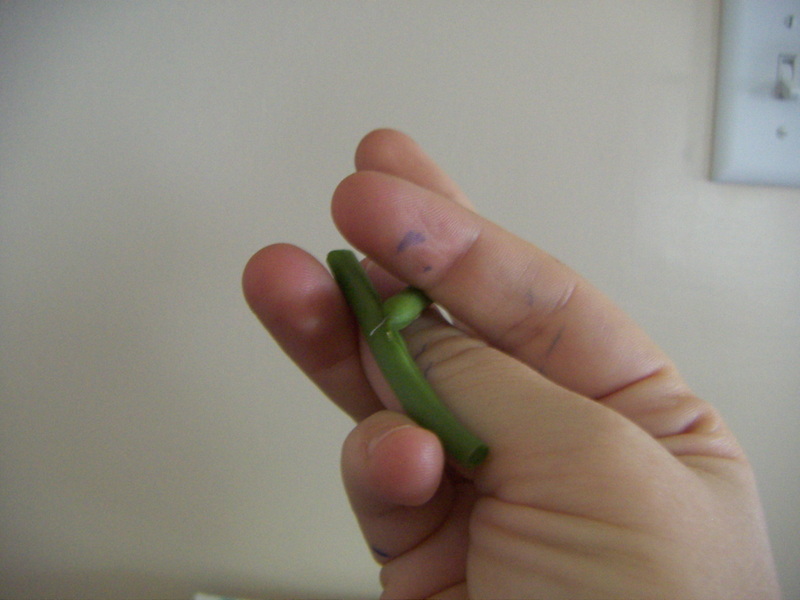
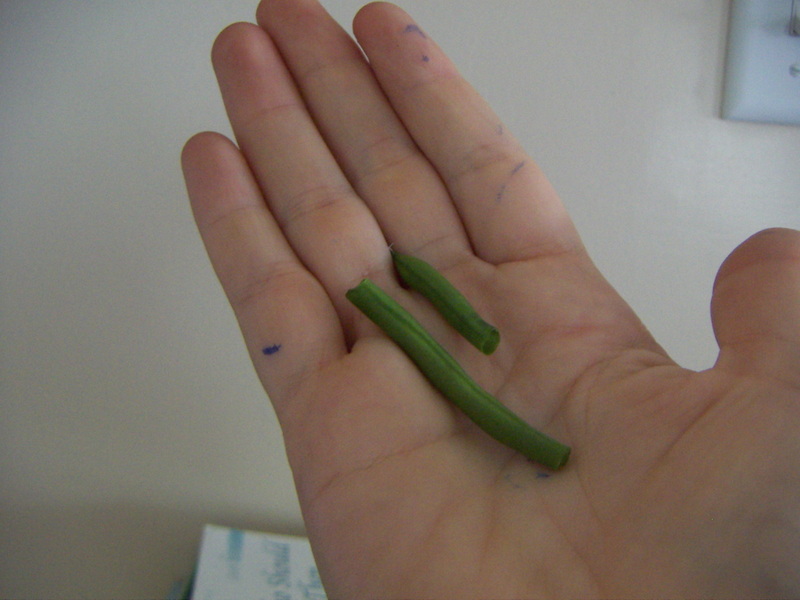
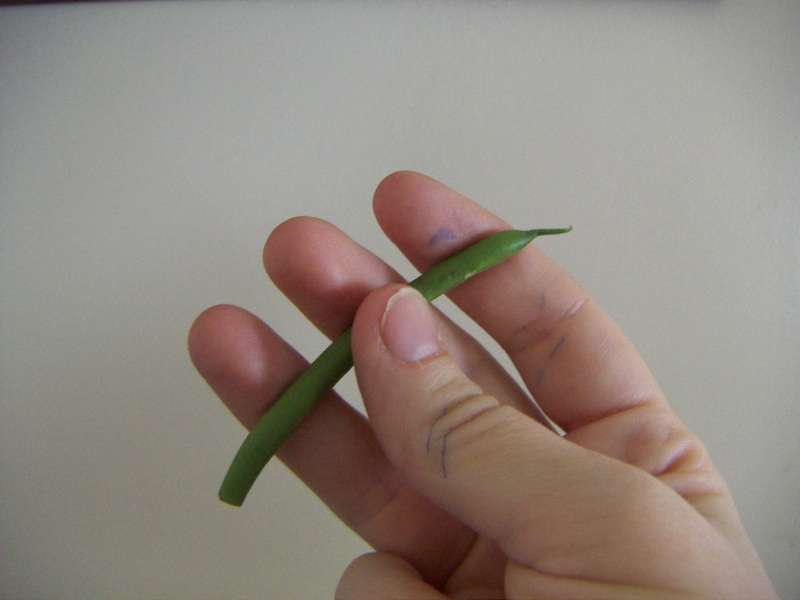
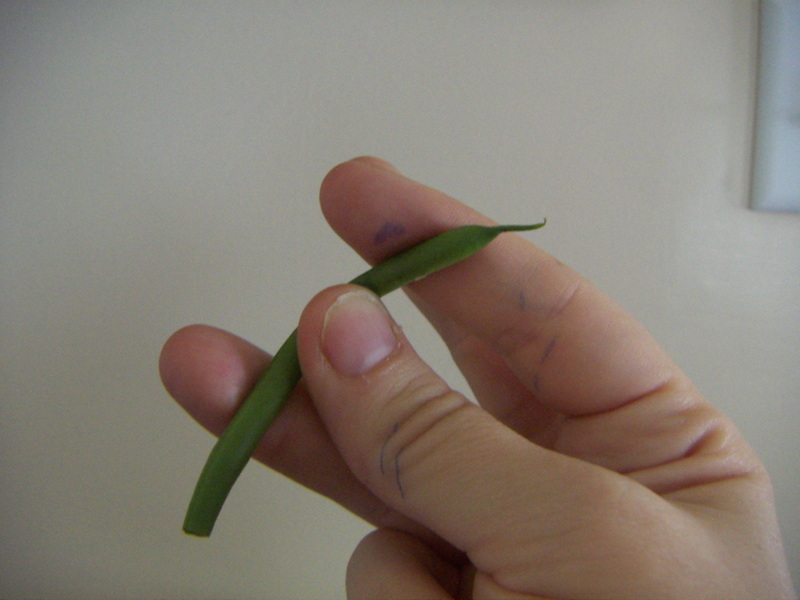
    Then I turned my attention to breaking the bean in half.  I realized that if I could alter step 7 by somehow breaking each bean in half with one hand — my right hand — I could eliminate steps 6 and 8.   After a little experimentation and practice, I was able to develop a one-handed, non-dominant-hand bean-snap.   

    Various_052_2 Various_053_2  Various_054 Various_055

    Pleased, I went on with the beans.  I did seem to be going faster.   But the question dogged me… was I going optimally fast?

    As I worked, I realized with irritation that I was needlessly over-handling the beans.  I had learned in my earlier stem-pinching experiments that I could not eliminate step 2 without undesirable results.  One-handed stem-removal was a path that I had already tried and found wanting.  But why, I thought, did I have to rotate the bean between picking up the bean and pinching off the stem?  I have some control over the bean-choosing, bean-picking process, don't I?  Why not just pick up the bean more carefully, so that it's already in position in my left hand by the time my right hand arrives to grasp it? 

    I happen to have a pretty good machine vision system, at least when I remember to put on my glasses, so it was trivial to develop a new bean-choosing algorithm.  It only took a little bit more attention, and less time, to watch my left hand as it dipped into the bag of beans (which I was beginning to see as an ensemble of rigid rods having a certain distribution of lengths, diameters, orientations, etc.), and to pick up each bean between index fingernail and thumb, positioned at the point where I wished to sever the stem, and with my wrist oriented in such a way that when I brought hand and wrist back to a neutral position, they would naturally rotate the bean so that at the very moment my right hand grasped it I could sever the stem.

    Grabbing the beans in position took more attention than I realized, especially as the number of easy-to-grab bean stems dwindled, but I quickly saw the superiority of the new system.  I had reduced the number of physical steps to six:

    1. pick up bean carefully in position in left hand
    2. grasp bean in right hand
    3. pinch stem off bean
    4. throw stem to the left
    5. snap bean in right hand
    6. throw bean halves into the colander

    Only one of the steps, number one, had gotten significantly more complicated, and all of the complication was in processing.  I have plenty of memory and my processor speed is high compared to my bean-handling speed, so this was hardly a trade-off.  I suppose I don't get to let my mind wander quite as much.

    That might not be a bad thing, now that I think about it.


  • Rerun week, post 4: People who work in the food industry are interesting.

    This week I'm rerunning old posts.  Today's is from June 2006.

    —————–

    "How was work today?"

    "Today I learned that the most expensive peanut butter sold in the United States costs six hundred dollars a pound."

    Choosy moms, apparently, choose NIST SRM-2387.


  • Rerun week, post 3: Short Communication: On Toast.

    I'm posting reruns this week.  Today's post is from August 2005.

    ———–

    It is unquestionably evident that the peanut butter toast must be bisected twice along the diagonal. 

    This produces four (4) isosceles right triangles, in the case of square toast.  (Applying this method to rectangular toast produces two obtuse and two acute triangles, which does not affect the following analysis.)  Experiments indicate that the triangles are, predominantly, eaten beginning with the vertex opposite the two equal angles.  Current theory holds that the driving force for this behavior is the phenomenon of crust rejection, which is not universal among toddlers but is nevertheless common enough to warrant its consideration as a general case.  Then crust acceptors can be regarded as a special case of the generic toddler, which will be treated at the end of this report.

    By the time the crust (which I define self-consistently as that part of the peanut butter toast that is inedible to a crust rejector) is reached, and laid down on the plate, its configuration is approximately linear. 

    Since the toddler's face is a convex curve (which can be approximated as a paraboloid for the purposes of contact mechanics, viz. the theory of Hertz), it is tangent to the idealized crust at a single point.  Compression of the curve against the crust (as if to obtain the last bit of jelly) can expand this point into an ellipse, of course, but any such ellipse is finite and limited, as the force of compression increases with the 3/2 power of the contact area.  (The value of 3/2 assumes elastic contact, which is, of course, preposterous, but can be excused on the basis of the fact that my textbook on non-Hertzian contact mechanics has gone missing.)

    The competing technique that has the most support is to bisect the toast twice, parallel to the sides.  But this practice, though well-grounded in theory (chiefly because it produces four congruent quadrilaterals that may be conveniently stacked, regardless of the aspect ratio of the original toast, and thus appeals to the toddler who likes making little sandwiches), fails miserably in the laboratory setting. 

    For the toast is highly likely to be consumed along the path of least resistance, which clearly begins at the only crust-free vertex of each quadrilateral and proceeds across the toast until the crust is reached.  But the crust of such a quadrilateral extends along two adjacent sides of the quadrilateral, subtending a right angle.  Whereas the linear crust produced using the double-diagonal-bisection method is tangent to the toddler face in the absence of compression force, the crust produced in the double-parallel-bisection method conforms to the toddler face even in the case of  very small compression force, and even in the most idealized situation is guaranteed to make contact in at leasttwo separate locations.  At each of these two locations the situation is comparable to that of the single contact in the double-diagonal-bisection method.

    Therefore, the double-parallel-bisection method can be expected to result in toast-face contact over approximately twice the surface area that would result from the double-diagonal-bisection method.  Accordingly, twice the amount of peanut butter will be transferred from the toast to the face. 

    The author of this report, therefore, recommends that the double-diagonal-bisection method be employed for all crust-rejecting children.  Crust acceptors are exempt from this recommendation.


  • Rerun week post #2: “The Father through Christ is addressing us, the ones who never left home.”

    I'm posting reruns this week.  Today's post is from June 2007.

    ———

    Regarding being raised Catholic vs. being a convert – I said I was going to mention an insight I'd been chewing on, and then Amber sidetracked me into the last post, which led to some good comments (thanks commenters).   

    Just a day or two ago I came across B16's commentary, in Jesus of Nazareth, on the parable of the two brothers, aka the parable of the prodigal son (Luke 15).  I had always read the two brothers first as the story-on-its-face, and also as representing the pagan world and faithful Israel.  Indeed B16 discusses this common and traditional interpretation.  But he also goes on to describe another angle:

    …[W]hat Jesus says about the older brother is aimed not simply at Israel…but at the specific temptation of the righteous, of those who are "en regle," at rights with God… In this connection, Grelot puts emphasis on the sentence "I never disobeyed one of your commandments."  For them, more than anything else God is Law; they see themselves in a juridical relationship with God and in that relationship they are at rights with him.  But God is greater:  They need to convert from the Law-God to the greater God, the God of Love.  This will not mean giving up their obedience, but rather that this obedience will flow from deeper wellsprings and will therefore be bigger, more open, and purer, but above all more humble.

    Let us add a further aspect that has already been touched upon:  Their bitterness toward God's goodness reveals an inward bitterness regarding their own obedience, a bitterness that indicates the limitations of this obedience… There is an unspoken envy of what others have been able to get away with.  They have not gone through the pilgrimage that purified the younger brother… They actually carry their freedom as if it were slavery and they have not matured to real sonship.  They, too, are still in need of a path; they can find it if they simply admit that God is right and accept his feast as their own.  In this parable, then, the Father through Christ is addressing us, the ones who never left home, encouraging us too to convert truly and to find joy in our faith.  (pp. 210-211)

    It's kind of cliche (and almost new-agey sounding) to write that everybody needs to find their own way, but here is Benedict coming right out and saying it:  They, too, are still in need of a path.  Everybody needs to make a journey of conversion.  Without that, living the righteous life is just a bunch of rules that somebody else foisted on you because you happened to be born into one family and not into another.  And it's pretty discouraging when you find out that following the rules doesn't always get you where you think it ought to get you in this life.

    Benedict points out that the elder brother's response is not given to us.  It's left open whether he  stomped off angrily, refusing to have anything to do with such an unfair dad, or whether he accepted the father's generosity and joined in the rejoicing.  Maybe he went off to try out being prodigal himself.

    But at least it gives me a model to think of the position that the "cradle Catholics" that are my children might be in. 

    Thoughts?


  • Rerun week post #1: Can we think outside the “thinking outside the box” box here?

    I'll be running reruns this week.  This post is a rerun from May 2006.

    + + +

    Rich Leonardi on the trend of face-to-face confession:

    The decline in the popularity of Confession roughly coincides with the rise of the face-to-face confessional. (Whoops, I'm sorry; I of course mean "Reconciliation Room.") The intention of this innovation was to create a more welcoming, less intimidating environment than was offered by the supposedly cold, dark, screen-divided little room of tradition. Yet I suspect most people of parenting age have not-so-fond memories of sitting in a padded chair in a "Reconciliation Room" across from their parish or school priest and embarrassedly baring their souls. Or not baring — far better to mumble a sin or two, say an act of contrition, and clear out of there.

    It has always flummoxed me — what on earth made pastors and church architects think that people would feel MORE comfortable confessing their sins face to face with their parish priest, than anonymously?  The RCIA teachers years ago couldn't explain it to me either, back in that university parish with no confessionals at all — confession was only by appointment in the priests' private offices.

    What was the idea?  That putting a "wall" between the minister of the sacrament and the recipient damaged the character of the sacrament, somehow?  But the wall is porous — the only blocked sense is vision.  On the penitent's side of the wall hangs the crucifix — and it's Jesus who ultimately absolves.  Isn't it possible that the image of Fr. Joe or Fr. Mike might itself be a wall that obscures?  Aren't we often freer and safer behind closed doors?

    This is rather cynical, but maybe the sex-abuse scandal will help bring back the confessional.  I'm sure that many people by now , whether rightly or wrongly, don't feel very comfortable sending their nine-year-old into the priest's private office for ten minutes.  That unwelcoming "wall" between priest and penitent is probably starting to look like a better idea.

    From a 2002 article from OSV:

    Duncan Stroik, a professor of architecture at the University of Notre Dame who specializes in churches, told Our Sunday Visitor that he knows priests who were so concerned about their safety and/or their reputations that they have had windows or stained glass installed in reconciliation rooms. Some even have installed exit doors, alarms or telephones. Stroik noted that the traditional confessional with separate rooms had probably come about for good reason….

    Rolf Rohn of Rolf R. Rohn & Associates in Pittsburgh told Our Sunday Visitor that he has had requests for more observable confessionals [note:  I think he's using this term to mean "reconciliation place" in general — E.] because of the safety issue. He related a story about a disturbed woman who began screaming at the priest in the reconciliation room and blocked the door. Indeed, news reports indicate that priests have been attacked and/or robbed in confessionals. Hence, Rohn likes to design reconciliation rooms with a second door emergency exit.

    How very welcoming and conducive to spiritual peace!  Instead of that pesky wall, we've installed panic buttons and emergency exits.  Oh, and by the way, now it's not just the priest who can see you — anyone can see you through the window.   Have a Kleenex.  Feel free to open up.   

    My big beef with the OSV reporter is that she let architects be the experts about what a confessional issupposed to look like and feel like: 

    "One thing is for sure," Rohn said, "the guidelines for building a confessional are that it should be very, very open, inviting, with all kinds of imagery of reconciliation. Whether it’s the woman at the well, or the prodigal son, or the woman with the coin, there should always be a space in front that allows people to pray and meditate to some kind of theme. So it isn’t just a box anymore. It has to have an environment."

    James McCrery of Franck Lohsen McCrery Architects in Washington, D.C., and New York, emphasized that the setting for the sacrament should be inspiring.

    Are these guys even Catholics?  Have they ever experienced the sacrament themselves?  Doesn't say.  Seriously:  considering the nature of Confession, what is wrong with a small private room, a place to kneel, and a crucifix on the wall?  Isn't it weird that while the architectural trend for the church as a whole has been to remove decoration and beauty, stripping it bare and creating a "place of emptiness," suddenly the confessional (the ONE place where the attention of the worshipper is meant to be INWARD) has to have lots and lots of imagery?

    "There should always be a space in front" —outside the box? — "that allows people to pray and meditate… [I]t has to have an environment."  Duh.  We used to have those.  Very elaborate, they were, with lots of imagery.  We called it the sanctuary.

    Related: a good post from 2003 by Fr. Rob Johansen about the confession in general, and also this oneabout face-to-face confession in specific.  Incidentally, canon law requires that confessionals with grilles be made freely available, and permits either priest or penitent to insist on anonymous (behind the screen) confessions. 


  • Reminder: Homeschool room photostream drawing coming up…

    This is just a reminder that Dorian Speed and I are sponsoring a little Flickr photostream contest along the theme, "How does your schooling space fit into your home?"

    Dorian's post explaining the rules and two ways to submit a photo, here.  Photo pool with samples here, including some from me.

    For example, I included this one:

    DSCN0815

    with the caption:

    This is my schoolroom.  

    My husband made the desks; they are really just boxes.  The gray metal rolling drawer units are from IKEA, about $25 each. The junior office chairs are also from IKEA.

    The desks are lightweight and easily moved.  We sometimes put them together to make a big table.  I have four altogether (one is just barely visible around the corner).


    Originally the submission deadline was going to be Sunday, August 21, but we had some trouble getting the photostream set up (I'm a Flickr newbie) and so the deadline will probably be extended to August 31.

    Please caption your photos — we want to know what we're looking at!


  • Improvements.

    Seeing as I've been sufferig from blogger's block lately, I thought maybe I'd do a week or so of reposts of old favorites.  While I was looking for some, clicking through my old posts, I found this one from about six years ago:

    Here's an interesting mortality calculator.  Not only does it tell you how long you're slated to live, it tells you how much you could increase that by changing certain habits.

    I'm supposed to last until mid-2063, when I'm nearly 89 years old.  This is a bit less than the median (the median survival age of the general population, or of those taking the test?)  I blame my parents.

    Apparently I could live about eight months longer if I stopped driving, avoided all major stress (at least in the last year of my life), became a conditioning exerciser instead of just an "occasional" exerciser, and stopped having sex.   Six of those months come from exercising.  Apparently avoiding driving is only good for about ten days, and stress for three weeks.   Sex is costing me two whole weeks of my life!

    For some odd reason, the model also cheerfully informs me that if I don't mind cutting my life short by 0.34 years, I can increase my alcohol consumption to 2-3 drinks per day.  Is that good news?

    I wouldn't call the post a favorite, but of course I couldn't help but check, and it turned out that the mortality calculator is still there.  I took the quiz again today.  With my new lifestyle, and (I suppose) a few extra years in which to demonstrate my survivability, this time I get to live to … 2068.

    In six years, I gained five years of my life!

    And I didn't even have to stop having sex.


  • Bus.

    I took my eleven-year-old son on a small adventure over the weekend:  bus travel.

    It's not that riding around on the city bus is particularly exciting in and of itself.  Because there are four children, we don't do it much, except once in a while when the car is in the shop.  It is always a little bit of a treat for the kids ("Hurray!  We're going on the bus!") until the trip turns out to be much longer than it is in our car.  

    Saturday, though, my son and I went so that he could practice riding the bus with an eye to someday going by himself.  

    I've always thought that by the time my kids were fourteen or so, earlier even maybe, they ought to be comfortable using the city bus system to get around Minneapolis and St. Paul, completely independently.  It's all part of my "don't drive kids all over creation" plan:  at some point I want to say "Hey, kid, here's some money, go to the mall and buy some pants that fit you," and the sooner the better if you ask me.  Anyway, not too long ago I did the math and realized that if the kids are going to be using the bus system independently by fourteen, I need to get started on training.  

    My first thought was to find some single, repeatable destination, like a weekly karate class or something, an easy bus trip from the house.  Something I could ride with an older kid a few times, and then send him to do by himself after that.  I considered, for example, a karate class a mile and a half away that had a bus stop right in front of it.  

    When the karate instructor refused to quote me any prices unless I took my kids in for a "free demonstration class," (yeah right — like I'm going to give my kids a taste of a fun activity before I know how much it costs?)  I abandoned that  idea and was looking for a new one when I realized that I could go about it very differently.  

    It turns out that two of the north-south bus routes that pass near our house are "part of the high-frequency network," meaning that the buses come every ten to fifteen minutes all day long.  They're simple, straight routes along one major street.  They pass many interesting destinations.  The distance along the routes are easy to navigate because Minneapolis has numbered streets.   And it occurred to me that I could simply work, as a first skill, on riding up and down one or both of these two routes.

    So Saturday we set out for the bus stop, a half-mile walk, with the intention of going to the downtown Target store to buy school supplies.  My son carried his backpack to lug the things home.  We waited a few minutes, boarded the bus (another bonus:  only one route stops there — no getting on the wrong bus by accident), asked for transfers for the return trip, and trundled into downtown.  Once there, we had a drink in the Target snack shop while we spread the bus schedule out on the counter and practiced figuring out the time tables.  When I was satisfied that he could work out how long the trip home would be, when the bus would arrive at the nearest corner, and which buses he shouldn't take, we folded up the map and went shopping.

    Outside the store we transferred our stuff into his backpack, and a couple things into my purse, and then we walked towards the center of downtown.  I was thinking I might show him the place in the middle where all the transfers happen.  But we got tired and thirsty and decided to ride back out, past our house, and get a snack.  We used our transfers to get on the return bus.

    On the way out there was a minor altercation:  a woman was playing a radio, a second woman yelled at her to turn it off, a man yelled "Don't yell in my ear."  The second woman complained loudly about drivers who didn't enforce the rules.  We thought the trouble was over when she got off the bus in a huff at the next stop, but then the driver pulled over to the side of the road and sat there for ten minutes while people got increasingly nervous about missing their connections.  It transpired that the complaining woman had called the police, and that this required the driver to pull over until he was authorized to continue, which did not particularly enthrall our fellow riders.  (The consensus was that if she was going to call the police, she shouldn't have got off the bus and left the rest of us to deal with the consequences.)  Eventually the driver got going again.  

    A learning experience.  We stayed on the bus, things calmed down around us, and we went on our way.

    I got us off at a little strip mall with a coffee shop in it — my son loves coffee shops — and we went in and had chai while I checked my email and he read the neighborhood notice board.  Then we went back out, crossed the street, and waited for the return bus.   It was a few minutes late so we had to wait a whole fifteen minutes (another learning experience) and by that time our transfers had expired (thanks a lot, cop-calling bus lady) so we had to pay another fare (learning experience).   

    This time I sent my son in front to pay his fare and ask for transfers and a schedule by himself.   He also had to figure out where to get off.  He pulled the cord all right at the right time but sat politely in his seat until the bus had stopped, and so by the time he got to the door there were already people coming in and we had to excuse ourselves to get past.  I explained as we headed down the street that, yes, ordinarily it is good to stay in your seat in a moving vehicle, but on the city bus they expect you to be right by the door and ready to get off before the bus stops moving.

    A fun and purposeful outing for both of us.  He definitely needs a lot more practice, and the next time he needs the responsibility of reading the schedule and making all the decisions.  But sooner than I think he'll be ready to ride.