bearing blog


bear – ing n 1  the manner in which one comports oneself;  2  the act, power, or time of bringing forth offspring or fruit; 3 a machine part in which another part turns [a journal ~];  pl comprehension of one’s position, environment, or situation;   5  the act of moving while supporting the weight of something [the ~ of the cross].


  • Staying crunchy.

    I was reflecting with Hannah the other day on how, as your family grows (and you as parents learn and grow with it), perspective and experience gradually clarifies your approach to how you live out your values.  Some ways of living, you get even more and more confident and sure you need to do as time goes on.   Some preferences, though, turn out to be more situationally dependent than you realize, and when you find yourself in a different situation, you may make different choices than you imagined you would.  Other times, a tension appears between two values and you must choose between them or somehow make the best balance you can.  

    And then, of course, occasionally you turn out to have been simply wrong-headed about something.

    At age 25, I was a fairly crunchy, "continuum-concept"-minded mother-to-be.  Four children and twelve years later, which of my crunchy practices have I stayed committed to?  Which have yielded to a less-crunchy (or perhaps differently-crunchy) lifestyle?

    Still Committed, Still a Believer, Still Going Strong

    • Breastfeeding past toddlerhood
    • None of that "baby food" stuff
    • Co-sleeping nightly, well into early childhood
    • Asserting our authority as parents, and striving for modeling and firm discipline that hopefully doesn't require "punishment" (caveat here is that I have always lost my temper a lot, so we have never been a yelling-free or attention-getting-swat-free house)
    • Natural family planning (yes, I have reasons besides crunchiness, but it is pretty crunchy, and we are still with it)
    • A parent at home full time
    • Babywearing young babies
    • Avoiding strollers
    • Homeschooling

    Even More Confirmed Than I Ever Thought I Would Be

    • Actually being the parent at home full time.  (With every year that passes I am more comfortable and happy in that role, and more certain that the delegation is right for our family.)

    Theoretically Committed, But No Longer Able To Figure Out How To Do It, Ergo Constant Feelings of Inadequacy

    • "No TV or videos for kids under six"  
    • "We don't eat that much sugar or packaged food"

    Level of Commitment Has Waned, And I Don't Feel As Bad About It As I Expected Because Competing Values Have Grown Important

    • Cloth diapering.  (With each child I've relied more and more on the convenience of disposables when out and about.)
    • Babywearing older toddlers.  (My back can't take it.)
    • Rarely leaving a baby with a babysitter.   (This would have shocked the younger me with only one child, to discover that I would use babysitters more than was necessary.  It turns out that my younger kids were greatly comforted by the presence of their older siblings.  Also, I now value getting regular exercise, and my older kids need attention from us too sometimes.  I couldn't have taken my big kids skiing, for example, without relying on the hourly child care there for the baby.)

    Getting Lazy or Busy, and Aware That I'm Paying the Price

    • Elimination communication/infant potty training.  I had #2 and #3 out of diapers by eighteen months.  I was so proud of myself.  I totally dropped the ball with #4, at 19m he doesn't even know what the potty is for, and now I have traditional potty training to look forward to.  It's my own damn fault and I know it.
    • Patiently teaching very young children kitchen safety skills.  By the time #1 was 19 months old, he was well on his way to safely use various pointed and otherwise sharp or hot objects.  Not having invested that time yet with #4, it will be longer before I can be less vigilant in the kitchen.

    ——

    If I think of any more, I'll add them in updates to the post.  How about you? 

    Added:  Jamie posts a response to this post.  How could I have forgotten homebirthing?  (selfdopeslap) Yes, homebirthing FTW. 

  • Ending up in widely different places.

    I don’t know if it is an effect of the Montfortian consecration prep or not, but I seem to be drawn more strongly to the Rosary these days.

    The Rosary has never captivated me. “To each their own,” I would say, “the Rosary is nice, but it’s the Divine Office I love.” I prayed the Rosary once in a while, and when I did, I truly got something out of it, every time. I was always glad afterwards. But I would never have said that I loved it, or that it had changed my life, the way that some people do. And I never looked forward to it, or felt that it fed me.

    Lately it seems different. I don’t pick up the beads every day, but I find myself wanting to at odd moments (sometimes when there isn’t time). I got to Mass early this morning and borrowed my daughter’s clunky blue plastic rosary to use while we waited. Most of the time I can never get five decades in before Mass, even if we arrive quite early, because of squirrelly kids. Today it happened that Mark had the baby and the five- and seven-year-olds were interested in their books, and so I prayed all five decades, finishing the Salve Regina as the processional hymn started up.

    Do you find that you begin each mystery thinking about it the same way every time? I do. The Ascension, for me, begins always by meditating on the Scripture verse, “This Jesus who is taken up from heaven shall return in the same way you have seen him go.” (paraphrasing from memory). And, for another example, the mystery of finding Jesus in the temple begins with a meditation on the idea I have that Mary must have thought the twelve-year-old was with Joseph and the men, and Joseph must have thought he was with Mary and the women and children.

    Even though I always begin the same way, the meditations can take me in very different directions once I start. That is some thing that I find pretty cool about it. I keep expecting to run out of new (to me) thoughts about them, but I almost never do. I mean, not for all five mysteries each time do I think a new thought, but almost every time there is something new there.

    Today, on the Ascension, I thought that maybe the “in the same way that you have seen him go” mainly means “don’t expect him to come the way he came the first time, born again as a helpless baby.” And that this maybe is connected to the identity of Mary as mother of God, because the flesh she gave him is sufficient for eternity. But another time, I found myself wondering why this particular event was marked by angels, and not others.

    The last time I thought about the finding of Jesus in the temple, I wondered if the doctrine of her sinlessness meant that losing Jesus must have been Joseph’s fault, or if they could both have made honest mistakes. But another time I thought about how it will not be long before I have a twelve-year-old, and how that is an age when many parents fear they are “losing” their children, and what a comfort the story could be to such parents.

    Do you start each mystery the same way? What strange places have they taken you?


  • Quick-takes style, Marian consecration edition.

    1

    I'm doing this seven quick takes thing because of my weird blogger's block.  I'm not actually going to bother with Mr. Linky.   Incidentally, another reader emailed me and said that she felt oddly introspective while doing the 33-day Montfortian consecration, and so it rang true that I am having trouble writing while doing it.

    2

    But this seems kind of strange to me, because (what with school starting and all) I can only do a wussy version of the consecration prep.  There's a little bit of reading, and a couple of prayers, both grabbed whenever I have time; a different focus in my spontaneous prayer throughout the day; a general attempt to turn from "the spirit of the world;" and I'm noticing more  frequently how often I screw up and prove myself a very worldly person.  The Montfort subroutine is running in the background of my real life.  Hasn't crashed the system yet.  

    I'm aiming for Our Lady of the Holy Rosary, Oct. 7, or more likely, the next day, which is a Saturday when I can attend Mass and go to Confession.

    3

    After I read St. Louis de Montfort's True Devotion to Mary, I felt unsatisfied.  All the people who'd told me about it claimed it was this amazing, mindblowing work, but it didn't really ring with me.  Really, except for the explanation of the consecration itself, it all just seemed like a repeating string of assertions about Mary, little of which were new to me (but maybe they were new to the people he was writing to back then?) and none of which were backed up by any arguments that weren't themselves simple assertions.

    "God in these times wishes his Blessed Mother to be more known, loved, and honoured than she has ever been."  Okay — how do you know?  Why particularly in these times?  "God the Son imparted to his mother all that he gained by his life and death, namely, his infinite merits and his eminent virtues."  Where does that come from?  How do we know this?  

    I think it is meant to be inspirational writing, rather than thought-provoking writing, and I am peculiarly un-susceptible to inspirational stuff.  

    And lookie here what I found:

    "Were I speaking to the so-called intellectuals of today, I would prove at great length by quoting Latin texts taken from Scripture and the Fathers of the Church all that I am now stating so simply.  I could also instance solid proofs… But I am speaking mainly for the poor and simple who have more good will and faith than the common run of scholars.  As they believe more simply and more  meritoriously, let me merely state the truth to them quite plainly."

    Well, there's my problem.  I believe complexly and not quite so meritoriously, I guess.   Let me hope I can glorify God in my infirmity.


    4

    On the other hand, the idea of the consecration itself was thought-provoking and interesting.  So I went looking for more modern writers, less concerned about writing simply and plainly.  And I found a gem of an online book:  Mary in Our Life, by Rev. William C. Most.  It was written in the 1950s. The link goes to a table of contents that links to all the chapters, online, for free.  Much more my kind of "inspirational" writing.

    5

    This is the kind of Marian writing that makes the tops of Protestants' heads blow off.  The word "Co-Redemptrix" is bandied about, for example.  And as I read it, I found myself struggling with some of the concepts, precisely because of the Protestant, anti-Marian influence in American Christian culture.  It was very edifying, because intellectually, Father Most's arguments make a great deal of sense to me.  And yet the logical conclusion of his arguments suggests an attitude toward the Blessed Virgin that feels radical to me.  Deep down, it seems, I feel a sort of repulsion against fully embracing the idea of Mary as intercessor, which as I search my history seems can only have come from contact with American Protestantism.  I didn't even realize that I felt that internal repulsion until reading Fr. Most's arguments forced me to confront it.


    6

    At the same time, it's exciting to have read this, because it's the first time in a long while that I have had a theological concept of any kind to grapple with in a radically new way.  I think it's funny that the concept itself isn't particularly new, and is even uber-traditional.  But it's really blown my mind and I still have a lot to think about.

    (And yes, I could write more details, but I am having trouble expressing them.)


    7

    Meanwhile, all sorts of odd little messages from outside seem to be finding their way to me, encouraging me to keep on with the Consecration such as I can.  I'm aware that human beings are great at finding patterns where really there is only random noise, and that it's unsurprising that if I'm thinking Marian thoughts, I would see signs everywhere (such as, having just prayed for discernment about whether to make the consecration, being handed a business card 15 minutes later, on which was printed a call to people to make a Marian consecration!  That was a fun example).

    It's time for me to get back to work, and writing this has exhausted my creativity.  Have a great Friday!


  • Conflict.

    Typing feels like moving through wet sludge this week.  I'm going to try to get this post out, though, while the middle kids are decompressing with some cartoons, the oldest is finishing his mechanics assignment (think punctuation, not wrenches), and the baby is sleeping.  I mixed myself a rum and coke before I sat down, hoping that the combination of caffeine and relaxant will generate a little fluency.  *slurp*  Let's see.

    I don't know why, but I have had little desire to write this week.  Many ideas, little desire.  Could be the early days of school; lots to do, less time.  Could be that I have decided to embark on the consecration I mentioned a few days ago (thanks to those of you who emailed me and commented — it was very helpful).  On that, I've had a number of thoughts I've wanted to share, but had difficulty putting into words.  This probably isn't the post for it.  I will write about it.  I want to write about it.  Somehow I keep abandoning the posts after two or three sentences.

    The kids are pushing back at me as we get started with school.  Except for coschooling, which is so far fine, my days are so much less than I want them to be.  If only there were enough of me to go around.  If only I had enough energy at the end of the day to greet "Can I watch videos now?!?" with anything other than relief.   I have made sure that my day's schedule includes a block of time spent one-on-one with each school-aged child.  That's an improvement over last year.  Now if I could just get the others to stop interrupting.  

    And why so much drama?  Why so much wailing about what there is to do and how long it will take?  Why not just sit down and do the damn stuff?  

    I'd better shut up on that last point, lest I have to take my own advice.

    All right, I think I'm done venting.  I just wanted to keep the blog from going blank.  

    Yesterday I went for a swim at the end of the day, and thought furiously as I plowed back and forth across the pool.  I just need to discern what I'm supposed to be doing, I thought, figure out how best to allocate the limited resource that is me.  An answer floated back to me as I touched the side of the pool:  No, it is much simpler than that; I just have to do what I can and do it in love.  If I don't know how to do that, I have to ask for the grace to do it, and trust that it will be enough.  It makes sense, but I wonder what it would feel like; I don't think I have ever tried.


  • “Looking up.”

    Marc at Bad Catholic:

    "If you find yourself drenched in lemonade, but know that you haven't drenched yourself, what is left to conclude? That someone else has drenched you. If you find yourself drenched in worth, but know that you have no reason to feel worth, what is left to conclude? That someone has given you worth. It's a joke, see, because you're drenched in lemonade, and worth everything! Who among you would find themselves drenched in lemonade, look around and realize they could not have drenched themselves, and thus concluded that they were not, in fact, ever drenched."

    RTWT.


  • …And the winner is…

    Well, you know, it wasn't all that tough since all of FIVE of you sent in photographs, to the little contest/drawing/thingy that I sponsored with Dorian Speed of Scrutinies.  The "let me see your homeschooling space" contest.  Really it's more like a show and tell.

    But there are lots more than five photographs, because (a) Dorian and I put some in too, and (b) those of you who participated sent in at least a few photos each.  

    And what cool photos they are!  

    (Be sure to look at the slideshow with captions:  some of the ones labeled "Dorian Speed" are photos that were submitted to her by email, and the photographer's name appears in the captions.)

    Thanks to Jennifer Fitz, "Notes from a Mama,"  Ann-Marie Gorman, Cathie Baier, and the Meineke family (also known as commenter Kelly) for playing along.

    But what you really  want to know is the winner of the random drawing:  

    Kelly M!

    Also, I want a comfy rocking chair to teach in like Kelly's.

    Kelly, please email me at bearing@bearingblog.com with the email address that you wish to use for such great honors as receiving $20 Amazon gift certificates!

    And the rest of you… feel free to continue uploading photos to the homeschooling pool.  I think it's still open.  Even if the loot is already gone.


  • Three o’clock on school day #2: a snapshot.

    Um, I guess I mean four snapshots.  Because I was going to use the metaphor of a snapshot to describe, er, these snapshots.  Never mind.


    Kindergarten, still very excited about having math worksheets of her very own:

    0831111455-00


    Second grade (reading assignment for the day, an article about animals that live in caves):

    0831111455-03


    Sixth grade, discovering the joys of tuning out the world in order to concentrate on the daily journal page (summarizing the plot so far of the book he started reading yesterday):

    0831111455-02

    Perhaps the most advanced of all of us, in some sense:

    0831111456-00

    Next stop:  Doughnuts for snack!  Because you have to numb the pain of the first week just a little bit.


  • First day of school.

    That's watercolor, my friends.  It washes off.  But you should have seen his hands and feet.

    0829111442-00

    The first day went surprisingly well — as it always does, since the newness of it all makes the day at least interesting.  

    My daughter loves her new math book — hopefully not just because it was pink.  

    We finished everything in our (admittedly reduced for the first-week ramp-up) schedule by tea time.  I even got to the gym and had a nice long swim at the end of the day.


  • Consecration bleg.

    Would any of my readers like to comment on the class of devotions that are commonly known as the “Total Consecration to Jesus through Mary” or sometimes just the “Total Consecration to Mary?” I am discerning whether to make such a consecration and would be interested in hearing any experiences or insights about the nature of the devotion. I am not really sure I understand it, and though I get the impression that most folks enter into a deeper understanding of it as they go along, I am trying to take seriously the cautionary language l am seeing in some sources about the need for discernment first.

    The most well-known form of the consecration under that name is, of course, the method of St. Louis de Montfort; but I have seen a couple of websites and books claiming that this is just one possible method, and that the same consecration can be enacted under one of several other methods, some of them being other well-known Marian devotions. The examples I have seen mentioned are the Sacred Heart devotion of St. Margaret Mary Alacoque; the Brown Scapular; and the Militia of the Immaculata consecration of St. Maximilian Kolbe.

    I will maybe write more about my thoughts on this later — I have read de Montfort’s _True Devotion to Mary_ and some twentieth-century writings on the subject by Rev. William G. Most, and the experience has been thought-provoking to say the least — but I thought first I would solicit comments from readers. Anyone?


  • Summer camp.

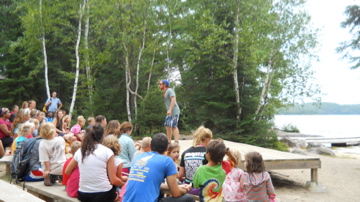
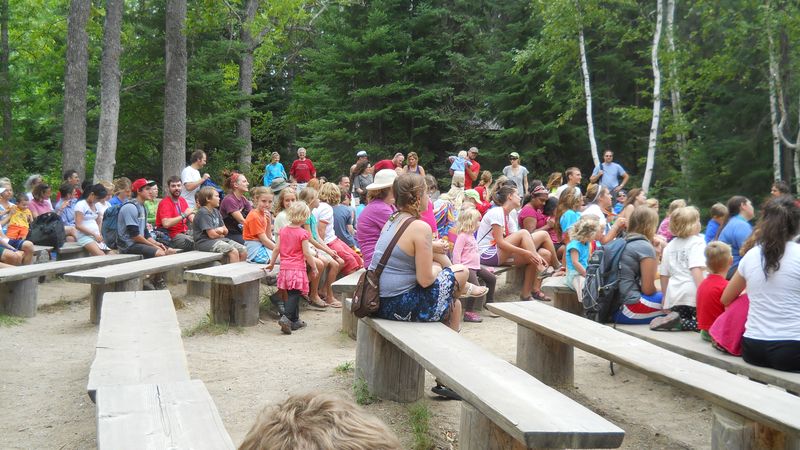
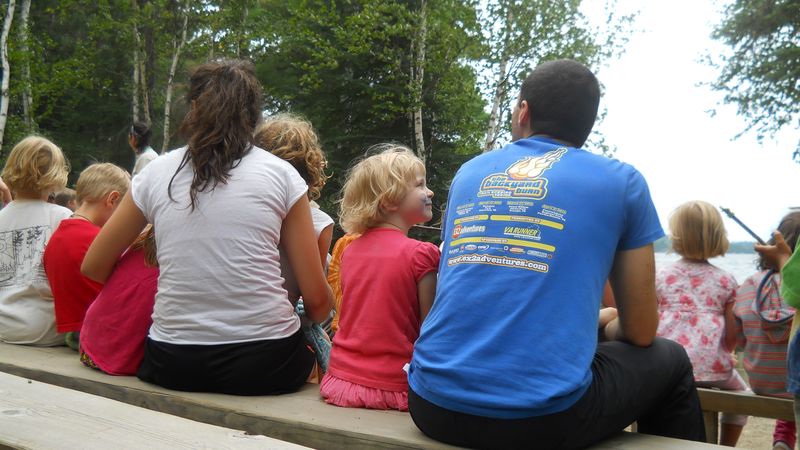
    My family and I spent the last week up north at YMCA family camp.

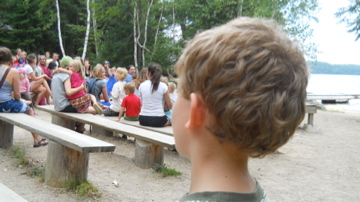
    DSCN0813Campfire songs, skits, picnics, counselors, and all that, next to beautiful Burntside Lake just a few miles from the Canadian border, and right on the edge of the Boundary Waters Canoe Area.

    The staff — a few full-timers and a number of young summer counselors, mostly college students who apparently love nothing more than their summer jobs up here, got the crowd fired up every day for some serious relaxing and family fun.  

    The young man leading the crowd in song from the stage there — the stage looks out over the lake and the swimming beach — is a counselor named Brian.  This is the third year that we've encountered him at camp.  The first year he was there as a high-schooler in a leadership program.  Now he's on staff.  My kids love him.  He was my seven-year-old's age-group counselor.  

    DSCN0814

    There are about two hundred people, maybe, at camp at any one time, all for a full week stretching from Saturday evening to the following Saturday morning.  All of them families, plus the staff and the teens in the leadership program.  Parents, if you'd like to pay for the privilege of knowing your teen is cheerfully cleaning outhouses ("biffies") for a couple of weeks, this is the place.

    Over the course of the week it's possible to get to know some of the people fairly well.  I watched my daughter solemnly declare several counselors and leadership teens as her new best friends.  Actually, I watched in amazement as she reached out to what seemed dozens of people.  "I have to go say hi to Sara," she would say at lunch, and dash off.  "I have to go say hi to Joe."  I had no idea she was capable of being so outgoing, or so memorable to others.  It seemed by the end of the week that everyone we passed on the trails knew her name.

    DSCN0811
    That's Joe, one of her age-group counselors.

    The children spend 2 1/2 hours in the morning divided up by age, and the rest of the time can mix freely or spend time with their families.  "Age groups" allows the parents some time to reconnect with each other, or a couple of hours of quiet solitude, or a chance to try something too difficult for the children; Mark and I practiced canoeing and kayaking, and went on a few hikes together.  

    DSCN0820
    One of the things that's most precious to me about this week, for my city kids, is the chance to let them roam a little more freely than they can in our neighborhood at home.  The oldest can buy a drink in the coffee shop or play tetherball and volleyball or just wander around, with hardly any worry.  Even the smaller kids can be sent here and there, say, out to the playground while the rest of us linger in the mess hall over coffee.  

    DSCN0816

    I enjoyed being (mostly) unplugged, too.  The cell phone service is pretty spotty, and there's no Internet connection at all.  The staff actively discourages the use of electronic devices where other people can see you, with the exception of e-readers.  I had my iPad, but it was pretty much demoted to a Kindle emulator, and I was too ashamed to bring it outside the cabin.  Mostly used it to read while I was spending a couple of hours in the cabin each afternoon supervising a napping baby and a "resting" five-year-old.

    I do confess to using Mark's iPhone to access this Wikipedia article.   Let's just say there was a pressing need.

    As the days wore on, I reflected that spending a week at summer camp — especially when it's late in the summer, and here and there you can't help but glimpse a reddening maple among the green forest foliage — really drives home the ephemerality of so much that gives us pleasure.  Perhaps that's a trite observation, but it's true.  The kids form devoted friendships — and we adults form pleasant camaraderies — and perhaps we exchange addresses (my kids left with two pen-pal addresses in their pockets), but for the most part we may never see these folks again after the end of the week, and we know it.  It feels odd to enjoy people's company so much under those circumstances.  Yet it's not all that different from many of our longer-lasting friendships.  It's hard to tell in the midst of them which of those will die back if and when our circumstances change.

    And of course, the beauty of the woods is all around — the clear, cold, deep lake, its lush border of trees, the tiny cabins that dot its edge — Mark thinks they spoil the view, but I'm a city girl, and I love to see the work of human hands (in small doses) even in the middle of the forest — the three whitetails I saw at 6:30 in the morning on the last day as I walked alone to the shower house — the variety of colors of pebbles on the lake bottom, the blue  sky, the nighttime wail of the loon.

    And of course, we soak it in while we can, but we know all along that it's only for a  short time, and we have to go back to our "real" lives.

    DSCN0815 My eleven-year-old felt it most strongly.  From the very beginning of the week he was alternately exuberantly happy to be in the woods, and crushed with misery that the experience could only last a week.  He was desperate to spend every possible moment having fun.  He hasn't yet learned that "fun" isn't something that can really be grasped at.  That you have to find it almost accidentally, while you're busy doing something else, or even nothing at all.  You have to let it sneak up on you.

    Kind of like the realization that "fun" isn't something to be grasped at.  

    I like going to camp for the very last week of summer, right before starting school (and indeed, in about 20 minutes the kids' alarms will go off, and I will feed them breakfast, and we will dive back into math and reading and science).  I like that there is a drive of several hours between our sad departure and our arrival home — because by the end of the drive we're very glad to get back to our own little house in the city.

    And keeping safe, perhaps, a few of the more permanent kind of souvenirs.

    DSCN0819


  • Rerun week is over!

    Regular blogging will resume later today…  maybe with a few pictures from camp.  Have a great Sunday!


  • Rerun week, post #9: Your way and my way? No, our way.

    I'm rerunning posts this week (school starts MONDAY ack ack ack).   Here's a post from early in our co-schooling days, October 2008.  

    ——————-

    I set down my second cup of coffee and leaned back in my chair, rubbing my eyes.  "Okay.  Write these two things down."  I paused while Hannah turned to a new page in her spiral notebook (past one that read If Hannah finds the broken pieces of the yo-yo on the floor B. will pay her 25 cents, signed B., Witnessed Hannah).  "First.  ONE ROOM SCHOOLHOUSE.  Second.  SINGLE LARGE HOMESCHOOLING FAMILY."


    We were at a Caribou Coffee in a little strip mall, not far away from Hannah's house, where presumably our husbands were playing chess, cleaning up chili, or turning on a DVD for our total of six children.   


    We were looking for a new paradigm.


    Hannah said at one point, "The problem is not that we don't know how to let go of the we-do-it-differently-in-different-families paradigm.  The problem is we haven't taken it past the Naptime Level."  I had to get her to explain that, and she reminded me:


    When our children were all small and we would excitedly explain to other mothers, weary, isolated at-home mothers, how we had brought more balance and fun and connection to our lives by spending one or two whole days together every single week and sharing our work, the other mothers would listen, sometimes with a longing expression on their faces, and tell us how wonderful it sounded.  "You could do it," we would tell them.  "You could find a friend and just start spending lots of time at each others' houses.  We hardly even knew each other when we started.  You just have to make it happen."


    And the other mothers would say, "It sounds great.  But it would never work for me, because my baby has to take his nap at one.  We would have to be home for his nap."  End of discussion.


    We'd always been pretty proud of ourselves that we decided we would forget this whole "gotta be home for naptime" thing.  OK, so our children have a need that we usually meet by going back home, isolating ourselves once again in our own houses?  We won't ignore the need, but we'll find a way to meet it that meets our goal of staying together, of not being isolated.   Babies learn.  Our babies did.  They nap pretty easily in each others' houses. 


    That was the naptime level.


    Fast forward five or six years and we have some school-aged kids.  


    The other mothers now ask us, "So, you co-teach?"  and we say, "Um, no, not really."  They can't imagine why we would be going to such trouble to spend all this time together without seeking the benefits of co-teaching.  


    Hannah and I don't teach the same way.  Our kids don't learn the same way (a superficial example:  my firstborn does well with a list of stuff to finish each day; hers, all last year, thrived on a schedule of so many minutes studying one subject, so many minutes working on the next, and so on).  We don't teach the same subjects.   We have assumed all along that our differences mean we cannot really integrate our schooling.  When I spent a day at Hannah's, I lugged a big bag of "our school" to her house, unpacked it all, and we did "our school" at the table next to Hannah and Hannah's kids, then packed it all up at the end and carried it back to my van.  When she came to my house, she did the same.  Small wonder that we both have come to store our kids' school stuff in sturdy tote bags hanging on hooks in the schoolroom!  


    It's exhausting, and it's kind of dumb.  We have to get past the Naptime Level.  OK, fine.  So my son "needs" to learn one way, and her son "needs" to learn another.  So Hannah likes to teach one way, and I like to teach another.  So we plan differently, pace differently, organize differently.  This is not insurmountable.  If we decide we NEED to work together, we can find a way.


    Toddlers have different nap schedules BECAUSE they are in different families.  They are not in different families because they have different nap schedules.


    And though we thought we had to do school separately because we approached it so differently — the truth is that we approach school differently on Tuesdays and Thursdays BECAUSE we have not done it together.  If we set out to work together on those days, we reasoned, we will find a way — not the way that Hannah's family works — not the way that my family works — not some compromise, halfway between — but the way that our families work when they work together.  


    We're going to tear out the page that says TWO FAMILIES HOMESCHOOLING AT THE SAME TABLE.  


    * * *


    We've made up our minds not to mess with the curriculum for this year; next year, I guess we'll be choosing curricula together.  This year, though, we can take a look at the schedule.  Can the boys do their spelling together? (They can at least administer the daily spelling tests, one to the other, even if they are spelling from different lists.)  Can the boys do math together, one with Saxon, one with Singapore?  (They can at least listen in on each other's lessons.)  Can her second boy and mine learn to read together, even though they're at different levels in the same program? (We tried it yesterday and found a pattern:  my son reads one of his workbook pages, and her son reads one of his; they pass the pencil back and forth to trace their letters on their pages, taking turns.)  


    Yes, I think we can do this:  we've done it with Naptime, we've done it with Teaching Kids To Get Along, we've done it with Housework, we now have to do it with School On Tuesdays.  It is going to knock us out of our comfort zones, but then… we've been through this before.  Making connections means resisting the culturally programmed impulse that says I have to do it my way and you have to do it your way.  But every time we've figured out an our way, that has turned out to be just as comfortable, and a lot more companionable.