bearing blog


bear – ing n 1  the manner in which one comports oneself;  2  the act, power, or time of bringing forth offspring or fruit; 3 a machine part in which another part turns [a journal ~];  pl comprehension of one’s position, environment, or situation;   5  the act of moving while supporting the weight of something [the ~ of the cross].


  • Choosing peace, or something like peace, anyway.

    ChristyP sent me a link at just the right time for me yesterday.  The post, from a blog I'd not seen before (Steady Mom:  On the Journey toward Intentional, Professional Motherhood) is short enough that I'm just going to repost it.  Here you go (permalink here):

    A few days ago I sat down in the morning, per my usual routine, to make my daily to-do list. As often happens, there were more items to do that day than there was time for the doing. 

    Anxiety and overwhelm began to threaten me, though I tried to ignore their taunts.

    Still the nagging thought kept creeping back, "How exactly am I going to get all this done?"

    Suddenly God whispered to my heart. What He said surprised me, changed my outlook, and altered the entire direction of my day–of all my days. He said,

    "Choose peace over productivity."

    Peace is the goal of our days.

    Peace is THE goal of our days.

    At the top of your to-do list, write it – Peace.

    If anything tries to threaten your goal, it gets crossed off immediately. Don't worship at the altar of busyness and allow the very heartbeat of your family to suffer.

    Let me spell it out as a reminder for us all:

    Laundry isn't more important than peace.

    Cleaning isn't more important than peace.

    Homeschooling isn't more important than peace.

    The family budget isn't more important than peace.

    We're better off getting only one thing done in an atmosphere of peace than crossing off multiple tasks weighing fretfully on our shoulders. I know, because just this morning I forgot the lesson already, and paid the price by handing over the mood of our home. It wasn't worth it.

    What will our children remember when they leave our homes–how busy Mom was or how joyful she made them feel?

    Choose peace over productivity.

    Yes, this is nothing new.  Yes, this is absolutely a message I've heard before in one form or another and attempted to assimilate.  Something about the way it's put, though, makes me want to tape it to my bathroom mirror.  Well, I'll do the next best thing and stick the blog in my RSS reader for a probationary period to see if she says anything else I like!

    She has a followup post, on What Choosing Peace Does NOT Mean:

    Here's what choosing peace does NOT mean:

    – staying in your pajamas all day

    – reading blogs when you should be playing with your kids

    – feeding your children chicken nuggets every night

    – spreading piles of laundry around the house

    – leaving dishes to pile up in the sink all day

    – ignoring your children because you just can't take the bickering anymore

    [cough, erm, yeah]

    – letting mess accumulate while you chant "I'm peaceful, I'm peaceful."

    Choosing peace does mean:

    – That people are more important than tasks

    – That you have adequate expectations of yourself, depending on what season of life you're in

    – That you try to stop what you're doing to look your children in the eye when they interrupt you

    We will not find peace at the end of our to-do list. That effort has a name: striving. It promises peace, but in the effort required it steals the very promise away.

    This is one of those things that I, personally, need to be reminded of again and again and again.  

    Once for a friend's wedding shower I gave her a little hanging tile, made up of mosaic bits that spelled out, "Peace begins at home."  I was thinking mainly of raising children "peacefully" at the time — I think my oldest couldn't have been more than two — I was still developing my style of discipline (aw heck, aren't I still?) and I'm sure that's what I was thinking about, about raising kids nonviolently in an atmosphere of love so that they wouldn't grow up to perpetuate senseless violence.  I wasn't at all thinking about serenity in the home in the moment.  Only about somehow engendering "peace" there and sending it out into the world to do its work.

    Even at the time, I'm not sure that "peace" is the word I would have used, precisely, to mean what I sought then and what I still wish I had.  (I thought it was a good choice of word for what my friend would want, though.)  It is too worn from overuse, especially in world affairs; connotes too much the relationships between and among large groups of people, and not quite enough the relationships between individuals.  Connotes for me, too much, the state of avoiding conflict rather than the state of dealing productively with conflict or even the state of living blissfully without conflict.

    "Peace" isn't, I think, the name of the thing that is the goal of my days.  However, either Steady Mom and I are both longing for the same thing, to which we choose to give different names, or else her reminders are bound to produce both peace and the thing that I want.

    I'm still not sure what word would be better.  Maybe I am just looking for "love" in its active sense.

    Anyway, I'm going to mark this blog and read more.

    UPDATE:  Melanie responds with a very insightful post.  Go read!


  • Handwritten thanksgiving.

    I approach my prayer life rather in the same way I approach housecleaning.  Which is to say:

    Clearly, I like to think about ways of doing it, systems, etc. much more than I like to do it.  So a lot of times, when I decide "It's time to clean house!" what I really do is sit down and make a list of what needs to be done and a schedule by which I should do it, and before long the time is up and I have to do something different.

    Also, my living space looks pretty tidy enough most of the time, except dead in the middle of the school day or when we're having a party.  It's 7 am and the kids aren't up yet, so my evening routine still hasn't been disturbed.  The floor is more or less clear of clutter, the kitchen counters are mostly empty except for a tray of chocolate-filled breakfast buns and a coffeemaker, the children's books aren't all in the shelves but they are at least in a neat pile on the floor by the couch.  I'm pretty sure there isn't a bunch of junk on the bathroom counters, and the schoolroom is fairly orderly.  

    But if you looked closely at the kitchen counters you'd find some sticky stuff and crumbs, if you looked closely at the floor you'd find more sticky stuff, if you looked around the couch you'd find it had been a long time since the last vacuuming, and please don't open any cabinets or closet doors, nor look too closely at the rim of my toilet.

    Somewhere in one of those drawers there's an old schedule reminding me that I was going to swipe the toilet with a brush every Wednesday morning.  Or maybe it was "make a kid swipe the toilet."  I don't remember.  It felt good to write it down.  Much better than actually doing it.

    So.  My prayer life is like that too.

    + + +

    A humorous analogy suddenly comes to me:  The Liturgy of the Hours is like Flylady for slobby prayer.

    Do with that what you will.

    + + +

    Oh, and one more thing:  I like blogging about cleaning more than I like cleaning.  And I like blogging about praying more than praying.  And apparently, blogging about cleaning and blogging about praying makes me feel a sense of satisfaction similar to what I imagine I might feel had I actually cleaned, or prayed.  Remember that next time you get impressed at my organizational skills.  They are really just a finely tuned means of procrastination.

    + + +

    But I never will be cured, I think, of the attempt to fix my sloth/acedia through better planning.  Since I did the Marian consecration last month, I have been trying a number of new things.  Or maybe it's more accurate to say that I have been trying to look at the old things through a new lens.

    I hit upon this idea to make myself a handwritten prayer-book.  

    Last year, when I read through Introduction to the Devout Life (lots of posts on that here), I wound up carrying a well-dog-eared copy around everywhere and using it as a prayer manual for a while.  The many sections are not organized as a prayer book, but they give a method of morning prayer, a method of evening prayer, recommendations for confession, recommendations for preparing to attend Mass, etc., and I found it useful to refer back to the book often.   Note that the book didn't actually provide "prayers" as much as it did a "method of prayer."  But I like to have "prayers," so eventually, I sat down with de Sales's method of morning prayer and  I wrote out a formula that followed the method but was in my own words.  Well, some of St. Francis deS.'s words and some of my own.  I kept that sheet of paper next to my bed, which freed me up to keep the book in my handbag.  

    I used that morning prayer for quite a long time.   I still use a memorized short excerpt from it many days.  ("Behold, O Lord, my poor heart which has conceived many good desires yet is too weak and wretched to put them into practice unless you grant Your heavenly grace.  This I beg, O Merciful God, through the passion and resurrection of Your Son, in whose honor I consecrate this and all my days.")

    St. Louis de Montfort's book True Devotion to Mary contains a method called "This Devotion at Holy Communion" which suggests some ways to pray before, during, and after Communion.  I tried to follow along in the book a couple of times while I was in Mass but found it too cumbersome.  Because it doesn't exactly contain prayers but more an instruction on how to pray, and it's wordier than it has to be.  So finally I sat down and wrote out some pithy prayers that, if I prayed them, would be in accord with de Montfort's method.  (It was a little better, but I still need to tweak it.  The Mass follows a different rhythm now than it did in the saint's time, and it's harder to slip long personal prayer into it.   The intent of the vernacular Mass is, after all, for us to pray along with the Mass.)

    I looked around at Mass and of course I always see many people thumbing well-worn prayer books and Magnificat issues and breviaries and things during the wait to go up for Communion or after communion or just before or just after Mass.  (I wonder how long before people will dare to use their Kindles and iPhones to access prayerbook apps in Mass?  I've seen people do it in the adoration chapel.)   But I know from experience that I get distracted by a thick book of prayers.  What I need is a book of just exactly the prayers I am working on using.  A morning prayer, an evening prayer, a short method of meditation before the Blessed Sacrament, a thanksgiving after Mass.  

    So I got me a little Moleskine, the cheaper, thinner, brown-paper-covered kind, and began writing prayers down in it.  

    I like it.  There are dozens of "morning prayers" to choose from; I can put in just the one or two I really am likely to use, plus I can write out my "own" one that I developed from St. Francis's method.  I can copy out prayers in Latin that I would like to learn.   (Working on the Anima Christi right now.)  I can write out an examination of conscience that leaves out the sins I am not likely ever to commit, and thus saves time.  

    I think once I have it filled up I will want to do another draft.  Already I have crossed out and rewritten a few sections that turned out not to sound right, that I kept wanting to say differently.  But in the meantime I am finding it fruitful to have my own words, or at least words chosen by me, at my fingertips.

    Let me give you one example.  So, one thing I've never been in the habit of doing is kneeling to make a prayer of thanksgiving after Mass.  (I was never catechized to do it, and although there are always some people that I see praying after Mass in the pews, of course most people are up and socializing, even at my solidly orthodox parish.)  I went looking for something, and OH MY they are loooong.  There is no way I could realistically do any of that with the four kids all wanting to get downstairs before the best doughnuts are gone.  So just as a practical matter I needed a short one.  

    For the time being I used the "Hail Holy Queen" as a placeholder while I tried excerpting some of the longer ones, and I tried composing my own.  But what kept popping into my head was a musical antiphon from one of the psalms:  "How can I make a return to the Lord for what he has done to me?"  I didn't know which psalm, so I googled it, and found that it comes from Psalm 116.  

    The whole psalm isn't really what I was looking for, but the second half is.  So I used just a few verses from that Psalm as my Thanksgiving After Mass:

    How can I repay the LORD for all the great good done for me?

    I will raise the cup of salvation and call on the name of the LORD.

    I will pay my vows to the LORD in the presence of all his people.

    Dear in the eyes of the LORD is the death of his devoted.

    LORD, I am your servant, your servant, the child of your maidservant; you have loosed my bonds.

    I will offer a sacrifice of praise and call on the name of the LORD.

    I figure it works as well as anything else.  Having looked for a prayer with a Marian flavor, I liked the "child of your maidservant" bit. 

    Anyway, I have a number of more prayers to add to the little book before it has everything I need on a daily basis, but it does seem like a good start, and I'm already using it regularly.  I'm totally going to recopy it more neatly, though, when I've got it all together.  Because that will be something I can do one of these days to put off actually praying.   Naturally.


  • Santa Francesca Romana… the saint of traffic?

    My eight-year-old was maybe thinking about how he’s going to be picked up to go to a slumber party this afternoon, just before rush hour, and so he asked me:  “Who is the patron saint of traffic?”

    I was (and am) sitting at the computer, having my coffee, so I googled it.  Didn’t find the patron saint of traffic, but I did find the patron saint of automobiles and driving, Saint Frances of Rome.

    Turns out she is pretty interesting and cool, and would be a fine saint to recommend to your daughters. 

    Saint Frances of Rome, Obl.S.B., (Italian: Santa Francesca Romana) (1384 – March 9, 1440) is an Italian saint who was a wife, mother, mystic, organizer of charitable services and a Benedictine oblate who founded a religious community of vowed oblates.

    I’m a sucker for any saint who was a wife and mother.  It’s not that virgin martyrs aren’t cool, too, but at this point I have some difficulty relating to them.  Also the wives and mothers stand out because  there seem to be so few of them among the famous saints.  

    Frances was born in 1384 in Rome to a wealthy and aristocratic couple…When she was eleven years old, she wanted to be a nun, but, at about the age of twelve, her parents forced her to marry …Although the marriage had been arranged, it was a happy one, lasting for forty years, partly because Lorenzo admired his wife, and partly because he was frequently away at war.

    I’m also a sucker for arranged marriages that turn out to be happy.  Unlike the virgin martyrs, I can relate to that.  All true marriages are arranged marriages, because our younger selves set them up for the older men and women we will become.

    Frances experienced many sorrows in the course of her marriage with Lorenzo. They lost two children to the plague. In their case, it sensitized them to the needs of the poor….During the wars between the pope in Rome and various anti-popes in the Great Schism of the Catholic Church, Lorenzo served the former. However, in his absence during a period of forced exile, much of his own property and possessions were destroyed.

    Political intrigue and infighting within the Church:  you think it’s bad now, how do you think it was in the early 1400s?  

    Here’s a miracle story with some provoking subtexts.  (Wondering about the term “superstitious” used here?  It’s from Wikipedia.)

    According to one legend, their son, Battista, was to be delivered as a hostage to the commander of the Neapolitan troops. Obeying this order on the command of her spiritual director, Frances brought the boy to the Campidoglio. On the way, she stopped in the Church of the Aracoeli located there and entrusted the life of her son to the Blessed Mother. When they arrived at the appointed site, the soldiers went to put her son on a horse to transport him off to captivity. The horse, however, refused to move, despite heavy whipping. The superstitious soldiers saw the hand of God in this and returned the boy to his mother.

    There’s more of those back at the article.  Moving on,

    Although a mystic, Frances was not oblivious to the civil chaos which ruled the city …With her sister, Vannozza, as a companion, Frances prayed, visited the poor and took care of the sick, inspiring other wealthy women of the city to do the same. She turned part of the family’s country estate into a hospital.
    On 15 August 1425, the feast of the Assumption of Mary, she founded the Olivetan Oblates of Mary, a confraternity of pious women, attached to the Church of Santa Maria Nova in Rome, but neither cloistered nor bound by formal vows, so they could follow her pattern of combining a life of prayer with answering the needs of their society.

    Okay, now there’s something I’m really a sucker for:  finding some way to blend life in the world with the devout life.  Sounds like she and St. Francis de Sales would really have gotten along well.

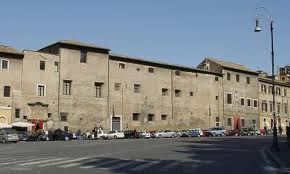
    Eventually the group of oblates got more organized and even obtained a monastery-like community house that is still active.  Here’s a picture from the outside:

    Images(source)

     Such community life, complete with white veils and black habits, seems kind of unusual for people calling themselves Oblates:

    In March 1433, she founded a monastery at Tor de’ Specchi, near the Campidoglio, in order to allow for a common life by those members of the confraternity who felt so called. This monastery remains the only house of the Institute.

    On 4 July of that same year, they received the approval of Pope Eugene IV as a religious congregation of oblates with private vows, under the authority of the Olivetan monks who serve at Santa Maria Nova. The community thus became known as the Oblates of Saint Frances of Rome. When her husband died in 1436, she moved into the monastery and became the group’s President. She died in 1440 and was buried in that church.

    According to this site run by Benedictine Oblates attached to St. Scholastica up in Duluth, “Some consider St. Francis of Rome to be a patron saint of all Benedictine Oblates.”  Her feast day is March 9.

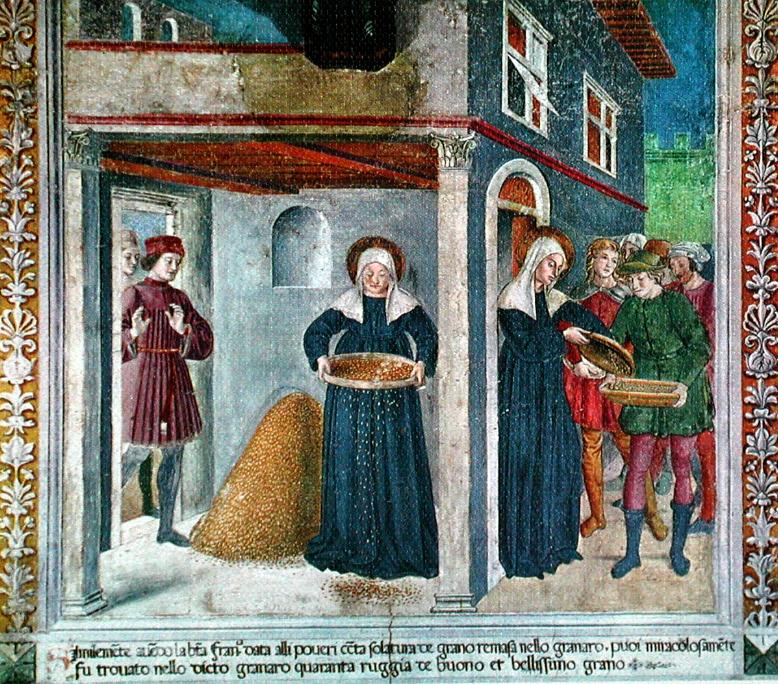
    This site has some photographs of the frescoes in Rome’s Tor de’Specchi depicting Santa Francesca’s life.  Here is one that shows the saint pouring out grain for the poor.  The writer of the site points out the lovely detail of the last of the grains spilling out, white “against her dark habit.”

    Frmiracle5

    From that site:

    Santa Francesca Romana’s Tor de’ Specchi is very strictly cloistered, only opened to the public on two days of the year. ‘We are not a museum’, they sternly and rightly said. But their work of charity continues, their cloister filled not only with themselves but the elderly poor and poor young students with whom they share their wealth. As Oblates they ask for no privileges from the Church, they pay all taxes, and hence are loved down the centuries, theirs the only convent not subject to attack by angry mobs. They continue Benedict’s Rule of work, study, and above all, prayer. Their faces today have the same contemplative beauty that is seen in these frescoes. 

    She was canonized in 1608 even though nobody knew where her body was buried because it had been hidden to protect it.  A search ensued, and her body was eventually found — I would like to know more about that particular mystery! — and reburied later.  Since 1869, when she was exhumed again, her body has been displayed in a glass coffin in the Church of Santa Francesca (was: Santa Maria Nova).

    So after all that, why is she the patron saint of automobiles and driving, and presumably of traffic?  What could have led to this situation, in which every March 9, Rome gets a little more congested as cars drive past the Church of Santa Francesca to get a special blessing?  Wikipedia sez:

    In 1925 Pope Pius XI declared her the patron saint of automobile drivers because of a legend that an angel used to light the road before her with a lantern when she traveled, keeping her safe from hazards.

    Because the Pope said so, capisce?  Nevertheless, I bet you won’t forget Santa Francesca the next time you are stuck in traffic, fuming about the chaos in the city, the car in front of you no faster than a stubborn horse.    And remember:  however bad the traffic is here, it’s probably worse in Rome.


  • Staying crunchy in oil.

    The busier I get, the more my standards erode.  Or maybe I just get better at seeing clearly what is important.  Or maybe sometimes I actually start to make more sense.

    In a post from a couple of months ago, called "Staying crunchy," I wrote,

    I was reflecting with Hannah the other day on how, as your family grows (and you as parents learn and grow with it), perspective and experience gradually clarifies your approach to how you live out your values.  Some ways of living, you get even more and more confident and sure you need to do as time goes on.   Some preferences, though, turn out to be more situationally dependent than you realize, and when you find yourself in a different situation, you may make different choices than you imagined you would.  Other times, a tension appears between two values and you must choose between them or somehow make the best balance you can.  

    And then, of course, occasionally you turn out to have been simply wrong-headed about something.

    At age 25, I was a fairly crunchy, "continuum-concept"-minded mother-to-be.  Four children and twelve years later, which of my crunchy practices have I stayed committed to?  Which have yielded to a less-crunchy (or perhaps differently-crunchy) lifestyle?

    The post got a fair number of page views and inspired a couple of responses, notably from Jamie  (I am sure there was another one out there, but can't remember it — lmk if you did one).  

    This morning I was thinking less about parenting practices and more about cooking and baking.  I love food and I love trying new recipes, but have had to cut back on my adventuresomeness these days. 

    An aside — If you want to feel really fulfilled and useful and thoroughly enjoy the vocation of homemaker, it does help to enjoy cooking, to love food, to be interested in good nutrition, and to get excited about trying new things.  Most days I'm happy to reach the end of the day and to get a chance to spend time in my kitchen, chopping and stirring and tasting.    But sometimes it can be a double-edged sword, because kids usually go through a long period where they just don't appreciate all of that, and you realize that you have to find a way to keep it all interesting to you even as you make the same (nutritious, tasty) things over and over again because that is what will make your family thrive happily.

    So anyway.  Standards.  For a very long time now, I have been extraordinarily firm about cooking oil.  I am not, you know, a low-saturated-fat person.  You might say that I drank the coconut-oil kool-aid.  For years now I have had the following oils in my kitchen and pantry:

    • virgin raw coconut oil (I buy it by the five gallon bucket from here but OMG I swear it didn't cost $250 the last time I bought some AAACK! need to start saving now because my bucket is almost empty!)
    • extra-virgin olive oil (I buy whatever's on sale, usually $19 for a 3-L can of Greek or Spanish stuff, from here when I am in Ohio.  Check out the website, you'll want to go to Fairfield, OH just for a trip)
    • butter
    • lard
    • occasionally, home-rendered duck fat.  That reminds me, now that the holiday season is upon us I need to tell Mark to watch for ducks on sale.

    No shortening (except a partial can that I think my mother-in-law might have bought to make cookies while she was here), no peanut or soybean or canola oil, definitely no margarine.  

    But then last week I was craving Christy's gingerbread, and I decided to make it for afternoon snack for the day that the kids are all here for co-schooling — it's a pretty easy recipe.  Normally I melt coconut oil for the recipe, but for some reason that just sounded like too much trouble for a co-schooling day, so I told Mark to buy me some canola oil or something at the store.  

    The gingerbread was lovely, and the oil method is easy.  There is no doubt about that.  

    So for today, having half a bottle of oil left, I decided to try cake.  Now, you need to know that while I am happy to make muffins and to use my bread machine to make all manner of rolls and bread, I do not generally make cake except for a birthday. Many good cakes require a stand mixer (or a strong arm) because you have to cream butter and sugar together.

     But my experience with the gingerbread had emboldened me.  I googled "yellow cake vegetable oil" and found a one-bowl recipe, which I made (with 100% whole wheat) very quickly this morning — I made the whole cake from start to finish while my rolls were rising.  (We haven't eaten it yet, but since I topped it with chocolate ganache I'm not too worried that it will be unpopular).

    Wow.  It's not that it's really all that much harder to make a cake with butter — but it does usually mean getting out the stand mixer, which I don't keep on my counter, and having to wash an extra bowl or two.  Apparently this slight change makes, for me, the difference between "Cake, who has time for that?" and  "Sure, why not bake a cake?" 

    So I found myself contemplating… gasp… keeping highly refined liquid vegetable oil on hand in my kitchen.  

    And I started to feel guilty.

    And then I remembered that, if I do use the veg-oil method to make more cakes, I will mostly be making them for afternoon snacks.

    Which are currently dominated by packaged cookies.

    So.  Maybe it isn't so bad.  I think I will store the oil way back in the pantry, next to that old half can of my MIL's butter flavor Crisco, however.  So it does not forget its proper place.


  • Spanish from Latin, update.

    So I decided to move forward with my idea and experiment with building on Latin to learn about Spanish.  Or perhaps you could say I am trying to explore Latin by looking at how it appears in the Spanish language.  We're not really sure which it will be.

    The first thing we have to talk about is basic pronunciation.  We have to know, at least in theory, what the Spanish words should sound like, or else we will reinforce the wrong pronunciation even when we talk about them.  

    By "what they should sound like" I mean at the most basic level.  Accent on the correct syllable; a recognizably appropriate consonant sound (e.g., pronouncing the letter "z"  as /s/ and not as /z/); vowels approximately right.   I'm not talking about accent, just avoiding mispronunciation.

    So I made a little chart of Latin words and Spanish words that are their cognates and that demonstrate the differences and some of the similarities between ecclesiastical Latin and Spanish pronunciation rules.  For example: 

    • In Latin gens (tribe), the g is pronounced like English /j/.  In Spanish la gente (race, nation), it's pronounced with a throaty /h/.
    • In Latin hora (hour), the h is pronounced as in English.  In Spanish la hora, it's silent.
    • In Latin signum (sign), the gn is pronounced as in English "lasagna."  In Spanish el signo, the g sound and n sound are distinct.
    • Vowels are similar: A: pater/el padre (father), E: cena/la cena (dinner), I: vita/vida (life), O: oculus/el ojo (eye), U: mundus/el mundo (world) and aqua/agua (water).

    So I figured I would work my way down the chart with the kids.  The emphasis is on similarities and differences between ecclesiastical Latin and Spanish.  I thought maybe Hannah, who knows more about linguistics than I, could talk to the kids a little bit about consonant shift and things — why filius became el hijo, why pax became la paz.

    But I am taking seriously the need to hear a native Spanish speaker pronounce the words, so I went looking for an online audio dictionary.  I think I will be pleased with this one:  SpanishDict.com .  It has audio pronunciations for most every word I tried, and short video examples for quite a lot of words.  The interface should be easy for the tween/teens to manage.

    One useful tip:  For most nouns, you can get it to give you audio with the definite article if you type in the English and ask it to translate (e.g. if you type in "rey" it will just give you an audio file that pronounces "rey," but if you type in "king" it will give you an audio file that pronounces "el rey."  

    I think we'll start with just a few words at a time — maybe some with "b" and "v" in them, just so that we attack a tricky phoneme right away.  My plan is to  recite the list of cognates in Latin first, and then listen to the recordings for each equivalent (or closely related) Spanish word, and then recite the Spanish words.  So we'll start like this for b's and v's:

    bonus, ambulare, laborare, vox, convocare, novem;

    (listen) bueno, (listen) ambulante, (listen) laborar, (listen) la voz, (listen) convocar, (listen) nuevo.

    (Yes, I know that ambulare is a verb meaning "to walk" and ambulante is an adjective meaning "mobile, traveling."  Ambulare was the only word having an "m-b" combination in the kids' Latin lexicon and ambulante is the closest Spanish cognate.)

    I'm going to incorporate these lists into our twice-weekly Latin oral drill sessions to begin.


  • It’s definitely autumn now.

    2011-10-30 Leo in the woods

    Thoughts:

    (1) Sometimes a boy just HAS to have his sister's hat.

    (2) And a stick.

    (3) Dang.  Time flies.


  • Keeping track of the freezer.

    Mark picked up our half-hog order from the farm yesterday and stowed it in the basement freezer.  I went down there this morning for a pork steak from the fridge and, as long as I was there, I unpacked all the individually wrapped cuts and counted them,  then restocked them in some semblance of order.

    Right now I know everything that's in there, but come March or April I'll be digging through the bottom of the chest freezer, wondering, "Have I already used all the ham hocks?"  I've tried, other times, making a list of the cuts that are in there, posting it on the wall, and crossing them off as each is removed.  It never seems to work for very long.  Mostly, I think, because I generally don't carry a pencil downstairs with me when I go to the pantry (and don't tell me to tie one to the wall, I promise you the kids will find a way to run off with it).

    So I had an idea today.  This would work for all you people who have a giant freezer or pantry full of stuff they need to keep track of, whether it's cuts of meat, once-a-month-cooking casseroles, or homemade preserves.

    Here's my list on the wall above the freezer:

    Baconsheet0

    But I don't need to bring a pen down to cross stuff off, because I took a cue from the flyers on the coffee-shop bulletin board I was looking at yesterday:

    Baconsheet1

    See — now all I have to do when I get a cut of pork out of the freezer is tear off one of the corresponding strips.  What's left on the list is what's left in the freezer.

    Tonight we had one of the pork steaks, thinly sliced, over a spinach salad with white beans and red onions, tossed in a dijon-cider dressing.  Homemade wheat rolls on the side.  Two kids opted for PB&J, so one pound of meat easily fed the whole family.  I have decided it's a good idea to let them choose a meatless protein alternative — as long as it isn't too complicated — whenever they want.


  • Pocket-sized religious art.

    I like prayer cards, a.k.a. holy cards, especially as items for babies to play with during Mass, as reminders scattered throughout my house, or as a pocket-sized text of a prayer I'm  using for a season.

     Here is a confession:

    …gosh darn it, I sometimes really hate the art that comes on them.  A lot of it is pretty schlocky, and when we know what a modern saint looked like from her photographs, the pictures are sometimes ridiculously unlike the real live person.

    I mean, come on:  St. Thérèse of Lisieux looks like this:

    Images 


    not this:

      Unknown


    Anyway, today I stumbled across a site that seems to produce a better sort of holy card:  CatholicPrayerCards.org.  For about a quarter apiece you can buy holy cards that look like, um, an actual work of art, like this:

    Card-_79-Angelus-front

    … or something a little more Eastern (remember:  icons are the anti-Thomas Kinkade):

    Card-8-front

    … or a photo of the saint in life, perhaps complete with leprosy sores:

    061609-F182-front-for-web

    The photographic ones are my favorites.  Take a look at these:

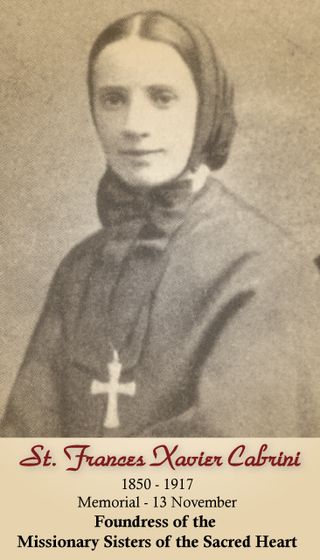
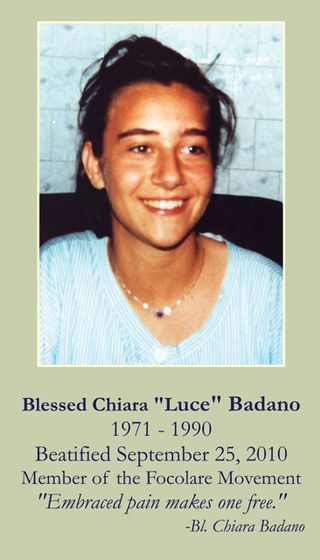
       UPDATED_Card-_61-front      UPDATED_Card-_36-front-1    Card_232_Chiara_1427-090810-C-final-front-web-1

    I think I'll go through my children's "decks" of cards in their Mass bags and perhaps replace some of the more egregious examples of bad art with these.  

    Because, really, folks.  We have Michelangelo in our court.  And Caravaggio.  And Raphael Sanzio. If you want something populist, I suppose you could go with Millet or something.  There is no reason Catholics should have to put up with bad religious art.  


  • How does she do it?!?

    Arwen has a reflection up at F&FL that I found was a good reminder:

    “A mom with four kids five and under does not have time to bake her own bread.”

    If someone had told me that before I was a mother, I would have agreed emphatically. That woman must be so worn out! She doesn’t need extra work. She should buy bread.

    Well, guess what? I have four kids; the oldest is barely five; the youngest two are twins, for heaven’s sake. I am worn out and I don’t need extra work.

    I still bake my own bread. (Not always, but regularly.)

    If I find myself with ten minutes where both babies are calm and the older kids are busy, I pull out the mixer and dump in yeast, water, flour, salt. I keep an eye on it as kneading happens, add more flour as necessary, prep the dough-proofing container. Later I carve minutes out of my day to de-gas the dough, to form it into loaves, to bake it.

    I do it because, as strange and possibly cheesy as this might sound, it soothes me. 

    Remember:  One person's "OMG how can you possibly find time to do that, you must be insane" is another person's "thing that keeps me sane."


  • Portable: Pseudo-pain au chocolat.

    On Tuesdays I leave the house by eight in the morning, to drive out to the suburbs so we can spend our co-schooling days with Hannah's family.  This school year I've been driving even a bit earlier, picking up the daughters of another family as well before swinging north.  The trip is not quite an hour long.

    The kids have to eat, of course, and usually in the car.  Normally if someone won't eat breakfast I shrug and say "Guess you'll be hungry later, then," but I had to put my foot down some time ago about refusing to eat breakfast on Tuesday mornings.  Hannah is happy to feed hungry kids a snack, but I wasn't so happy about my children snarfing up all her bread and milk once a week.

    Furthermore, my daughter is one of those people who can't bear to look at food before about 10:00, so her breakfast has to come along and be saved till later.  

    The emergency food is granola bars, of course, which I keep in my car.  And if we are really desperate (defined by:  I somehow wasn't able to secure a cup of coffee any other way), I am not above hitting a drive-through.  But I really do prefer making a portable real food.

    Now if it was  just me, it would be easy.  I love hardboiled eggs, that quintessential portable protein, or sticks of string cheese; and in the summer I would be perfectly happy to drop a pint jar of hulled strawberries and almonds into my cupholder (one of the cupholders; the other one has my coffee) and go.  Kids:  not so much.  Eating what's available because you have to get yourself fed is apparently a learned skill.

    Muffins are one solution; they are a bit crumbly, sure, but there are already so many crumbs in my car that I don't worry about it.  At least they don't drip, unless they are chocolate-chip.  I used to make them fresh on Tuesday morning, but these days I tend to bake them the night before.   I used to be intimidated by muffins, but now I can make them practically in my sleep.

    Another is quesadillas or their cousin, breakfast burritos.  I typically make plain cheese for one child, egg-cheese-salsa for another (and for me), and a pepperoni-and-cheese quesadilla for another.  They don't take very long and they are all right even after they have gone cold.

    I don't favor peanut butter sandwiches because the crusts tend to get left behind in the seats and then get smooshed.  Also, then everyone wants milk.  Which is banned from my car.

    Here is a new idea I haven't tried yet, and a new idea I tried this morning.

    First:  stuffed buns.  Yes, I know, there is nothing particularly creative about what is basically a sandwich.  Still, I like her nifty method of sealing the bun to keep things from falling out of it.  Check it out at The Big Red Kitchen (where there be photos):

    Go to your nearest bakery that bakes up the freshest and most tender Kaiser Rolls. Slice the rolls open leaving one edge intact- like a clam shell, and pull out some of the tender innards saving them for another recipe. Now here is the trick to getting those buns put back together and holding the filling inside. Ready for this?

    Fill the bottom well with your filling of choice and pipe beaten egg whites around the lip of the bottom bun, close bun, press lightly to be sure that glue has sealed the bun closed, and top with a slice of cheese of choice. Bake in a 375 degree oven for about 8 minutes. The meringue will seal your fillings in the bun…. 

    Brilliant.  Just brilliant.  I am a little bit afraid to try it first with a fresh, tender Kaiser roll, however, because I fear that if the kids get a hold of that, they will never eat one made of a leftover whole wheat dinner roll, which is exactly how I would do this for breakfast.   

    Now, on to my other new thing, with a little background.  The bread machine is sniffed at by many "real" bakers, including, sadly, some otherwise inspiring cookbook writers (Mark Bittman, I'm talking to you).  Yes, yes, if you are the sort of person who tosses about  "poolish" and "sponge" without a thought, or even if you are a devotee of the considerably more convenient no-knead Dutch oven breads or Artisan Bread in Five Minutes a Day, then perhaps bread machine bread will never be up to your standards.  But hey, if your family eats sandwiches or toast, especially if they eat a LOT of sandwiches and toast, it's hard to beat a constant supply of homemade sandwich loaves.  I think at this point I would do without my microwave, food processor, and blender all together before I would give up my bread machine.  

    So, given that I have a bread machine, it's really pretty easy to have fresh breakfast buns of all sorts, because the dough can be ready to shape when you get up.  I stumble down the stairs, turn on the oven, shape the buns or what have you to the sound of the coffee maker starting to hiss and burble, set them on top of the warming oven to rise, and stumble back up the stairs (it's harder than going down; try it sometime) to get dressed or shower or nurse the baby or whatever.  Twenty or thirty minutes later I come down, pop the pan in the oven, and drink a cup of coffee.  Most yeast buns only take ten minutes or so to bake, so breakfast is ready.  And since that (and maybe a cup of milk) is all the kids need to eat, well, it's actually pretty simple.  I think you can maybe get a similar effect with certain doughs that will willingly rise in the refrigerator overnight, but it takes longer for them to do their second rise.

    This morning I tried a version of pain au chocolat.   Yes, yes, it is traditionally made with croissant-type pastry, but my children don't know that, do they?  Milo was inspired to ask about it yesterday when we were reading a book called Let's Eat:  What Children Eat Around the World.  One of the children was a French boy, and a photo showed him and his restauranteur-parents sitting around the breakfast table drinking hot chocolate out of bowls.  "Why aren't they using a mug?" asked Milo, and I read the caption to him, which indicated that the family had dipped their pain au chocolat in the hot chocolate and then when the pain was done they drank the hot chocolate from the bowl, much as we order our kids to finish their milk after they have spooned up all the cereal.

    Well.  Hot chocolate with chocolate-stuffed bread sounded like a fine breakfast to Milo, so that's what's on the menu this morning.  And I mention this in the "portable" category because without the hot chocolate, the chocolate-stuffed bread is indeed quite portable, as you will see.

    (A side note before we go on:  Why haven't I ever thought before about serving, say, cookies and milk with the milk in a bowl instead of a cup?  Whenever they're going to dunk something in the milk?  It would be a lot less messy and it doesn't impede the drinking afterwards.)

    I searched for "bread machine pain au chocolat" and found this lovely British recipe, with the flour measured in grammes, and adapted it.  (The quantity of yeast looked ridiculously small, so I used the amount of yeast I would normally put in a cinnamon-roll type dough).

    Here's what I put in my bread machine for six pains.  Next time I'll increase it by fifty percent, I think, and try using a bit more whole wheat, since it turned out nicely with 40% whole wheat.

    • 2 eggs beaten (right in the machine pan) with 3 Tbsp milk
    • 2 Tbsp sugar
    • 2 Tbsp butter
    • Pinch salt
    • 150 g bread flour (sorry; I have a scale, so I went with her grammes)
    • 100 g Dakota Maid whole wheat flour (DM is a finely ground, hard winter wheat that is excellent for bread.  I don't think this would work with a coarse whole wheat)
    • 1 tsp bread machine yeast

    I cut the dough, which was smooth and elastic, into six pieces, rolled each gently out into an oval, and deposited eight Ghirardelli 60%-cocoa chocolate chips (that's a quarter of an ounce; I think a bit more would have worked okay) into the center of each.  Then I folded them over (like a business letter), pinched them to seal, and tucked the ends under like a little loaf of bread.

    I put four of them in mini-loaf pans as suggested in the recipe, and put two on a baking sheet to see if that worked okay.  Then I covered them and let them rise 20 minutes before baking 10 minutes at 425 degrees F.  

    Results:

    1027110641-00

    Aren't they cute?  They looked just a teeny bit overly browned; I might try 400 degrees next time.  And I don't really think that they needed the mini-loaf pans, as they all look about the same.  

    (Slight mistake:  I probably should have put them seam side down.  I was worried about the chocolate leaking.  I think seam side down would look nicer, although mine turned out kind of interestingly rustic-looking.)

    Of course anytime you have something stuffed with chocolate, you should have an interior shot.  Here is one that I managed to catch with my cell phone before Mark ate the other half.

     1027110710-00

    I thought the rich bread was lovely, but the chocolate was a bit much for seven in the morning.  Chocolate is good for you, insisted Mark, as he ate one and a half buns plus the chocolatey middle of mine.   Maybe next time I will fill my little bun with something else, like plum jam or cream cheese.

    Once they cool completely, the chocolate will solidify, and it will be a very nice, not-messy, quite portable breakfast bun.  


    UPDATE:  Oh yes.  Well-received.  And not perfectly un-messy, but not bad either.


    1027110850-00


  • Fifteen minutes to blog about the Marian consecration.

    I know, I know — where have I been for the last couple of weeks? The last post on trouble with weight maintenance was a desperate ploy to get something, anything, up on the blog. Else I would have gone nearly two weeks without posting.

    And there should have been plenty to blog about. The Ig Nobel awards came out, and I had a blast staying up late with my husband and a friend from grad school (himself an alumnus of an Ig Nobel-laureate's research group), reading about some poor researchers who spent six months training tortoises to yawn on command. My daughter started in American Heritage Girls, which brought back lots of fond memories of Girl Scouting. My husband's tibial stress fractures cleared up and he may start running again soon. I finished the Neal Stephenson book. I went to Iowa City for the weekend. I discovered a new way to feed nine picky children. Somehow, though, when I sat down to blog I was always too tired to think straight. Now, too. But I am determined to stick it out for fifteen minutes.

    + + +

    So, let's talk about that consecration. I did it. I aimed for Our Lady of the Rosary but wound up doing it on the day after, which was a Saturday, and which made it easier to get to Mass. This is unusual for me. Normally I am all about the Sticking To The Plan. But I decided that I needed to embark on a new campaign of Good Enough spirituality, and if that meant arriving 24 hours late to a Marian consecration, so be it.

    I got up early and went to breakfast at a neighborhood restaurant that opens at 6 a.m. And has wifi. I wrote out the act of consecration in my general-purpose notebook for keeping track of things. I went to Mass, I went to confession. I lit a candle and put all the folding cash from my wallet in the box — I don't think it was very much, but it should cover the candle with some to spare. St. Louis recommends an alms or a fast or a mortification: I went for the alms because it was easy and I, who overthinks everything, couldn't possibly overthink this.

    Then I sat in the church and read the consecration and signed it, and that was it.

    No, scratch that, in the middle of my reading, a confused elderly woman, wearing a set of keys on a pink lanyard around her neck, approached me and asked when Mass was. I told her it had finished some time ago and she looked disappointed enough to cry. "But Father is still hearing confessions," I told her cheerfully, "so you could go, if you wanted, and then you wouldn't have made the trip for nothing." She liked that idea, so I showed her to the reconciliation room and then returned, picking up where I left off. I finished it, signed it, and that really was it.

    I put on a cheap little chain bracelet I had ordered a couple of weeks before — thinking I would get something more permanent, maybe a medal or something — and then I went about my day. Wondering if anything would be different now.

    + + +

    The first few days afterward, I felt strangely light inside — porous, like sea foam, or more like pumice. A stone matrix, full of airy holes. And I didn't feel any desire to pray, not rosaries, not the LOTH, not even an Our Father. Nor — and this is odder — did I feel a duty to pray. I almost felt as if I had been given a few days off.

    But after three or four days, I resumed my normal sorts of spiritual life. And here is what I think about the consecration: for me at least, it doesn't (so far) add anything extra to my life. I have no desire, for instance, to take up saying the Little Crown of the Blessed Virgin, or to add any particular fasts and mortifications. What it does seem to do is transform, if only slightly, all the things I already did do. I find myself approaching the rosary, or the breviary, with a little fascinated trepidation each time. Will I see something new now that I am consecrated? Will it mean more to me today?

    One difference: I never was a huge rosary enthusiast, but now I definitely appreciate that form of prayer far better than I did pre-consecration. Another is that I have really taken to Montfort's formula: I am all thine, and all that I have is yours, O my sweet Jesus, through thy holy mother. I rather like repeating it. It has taken the place of the other things I used to blurt out for no apparent reason, such as My God, my God, why have you forsaken me?

    My cheap metal chain bracelet, supposed to be a physical reminder to me of my consecration in the service of Jesus through Mary, turned out to be a poor fit for me; the toggle clasp kept coming apart, and it fell off several times. So during one of the times when it was missing, I ordered a slightly less plain metal chain bracelet with a lobster clasp, not too expensive, from an etsy shop (link here). Besides the metal it is made of, it has one glass bead that adorns a small Miraculous Medal. So not perfectly plain, even a little troublingly in accord with my taste in jewelry, but not ostentatious either. The dangly end gets in my way a little while I am working, but that may be a feature rather than a bug. I decided I would try alternating the bracelet with a silver necklace I already have, with a Madonna and child pendant, depending on which was more practical for the particular day. Either should work as a "little chain" to wear according to the suggestion of St. Louis. At any rate, I find that seeing and feeling the little bracelet on my arm does recall my mind, does prompt me, to live my consecration in the moment.

    I am working, too, on some related projects. Writing out a prayer for before and after communion, for example, so as to follow the Montfortian method, but in my own words. But also watching and waiting. I have taken the step of saying, "here I am, I come to do your will," without knowing what that will is. I still don't know. I wonder if this feeling of expectancy is permanent.


  • Maintenance blues II — re-establishing on the new “default day” plan.

    I stayed up late for two nights finishing Reamde and now I'm paying for it.  There is not enough coffee in this pot.  

    + + +

    I just went back to my archives from May of this year and read through the "Maintenance Blues" post.  (It's number four of a short series on "accepting your body:" First post Second post.  Third postFourth post (maintenance blues). Fifth post.  Sixth post.  Seventh.)

    I wrote then:

    It's three years this week since my successful weight loss began.  And lately?  Weight maintenance has been hard.  

    I feel as though I'm slipping, right on the edge.  I weigh myself every day and faithfully plot each point on a chart.  The paper charts stack up in a drawer in my bathroom, one for every month since I reached my weight loss goal in November 2008.  The zigzag lines rise up through my pregnancy and back down again after the birth of #4, not quite as low as I was pre-pregnancy but back to where I decided to be.

    And lately I don't like what I see.   It's not that I'm not still at a healthy weight.  I am.  But after reaching my postpartum target, my weight crept back up, and I've been on the high side of it for months now.

    Worse, I can't seem to bring it back down.  Several times since just before the baby's first birthday, I have tried to lose just one pound.  Not because I needed to but because I wanted to see if I could still do it. 

    I haven't done it.  I haven't sustained the effort for more than a few days.  After about three days of sticking to my habits, I start feeling hungry and cold all the time, and shortly thereafter I find myself helping myself to a third plate of dinner, or eating all the kids' sandwich crusts.    I recognize this as classic "body defending its fat stores."  Still, it's frustrating — I managed to overcome it once, what's wrong with me now?  Have I lost my hard-earned habits for good?

    I thought maybe it was worth highlighting that now, a few months later, I seem to have finally gotten a handle on it.  Seriously, it took almost four months of false starts.

    Weight maintenance is not easy.  It is difficult.  It was especially difficult over this past summer, mainly (I think) because my husband had a lot of business travel.  That generally makes it harder for me to run the household, and I don't have much energy left over either for willpower or for necessary tasks like meal planning.  Also I tend to rely on packaged food and carryout more when he's gone, and those foods tend to be less satisfying in smaller portions.   And it makes it marginally more difficult (though more appealing) to get to the gym.

    So a lot of my strategies that require advance planning were not as helpful as they have been in the past.  I was seeing my weight stay about three pounds higher than I wanted it to be.  At the same time, I was waking up every morning and recommitting to following my good habits, then only marginally managing to follow them.  Would I be gaining weight, if I wasn't trying?  Maybe. 

    Back when I was losing the 40 pounds, there came a point when I sort of got into a groove with it.  It was still physically uncomfortable to resist gluttonous behaviors.  I felt hungry, I felt cravings, and it didn't feel good to resist them; but it felt mentally easy to resist them.  I had bought into the idea that I had already made my choices.  "I don't do that anymore" was all it took — I didn't like the experience of self-control, but I could do it and I did do it.

    But back in May, the groove just refused to come.  I kept "forgetting" that I was trying to practice good habits and self-control.  I would sit down in front of, say, a plate of pasta at a restaurant, and it would suddenly and quite literally seem not at all important that I was trying to reboot my good habits.  I wouldn't exactly make a fully conscious decision to abandon the habits — it was really like I was forgetting what I was trying to do.  And I wouldn't remember until afterwards, when I felt the overfull sensation.  And then I would feel awful.

    + + +

    I kept plugging away at the attempts, though.  (Like ChristyP says: It's a new day every day.)  I tried some different strategies, because it was plain that many of my old reliable ones were not working in the particular family dynamic that we had going at the time.

    And I think I finally hit my stride.  We'll have to see if it lasts, but I think I have gotten a mental handle on myself again.  I have stopped "forgetting."

    + + +

    The new strategy that has been most helpful in this season has been a radically simplified calorie-counting technique.  

    If you are a longtime reader, you may remember that periodically counting and journaling my daily calories (I used SparkPeople) was a very helpful strategy for me during my 40-pound loss.  I didn't do it every day, but doing so once every few days helped me maintain realistic expectations of appropriate portion size and of reasonable tradeoffs (an egg or a blueberry muffin, or half of each?).  I do think that having this realistic understanding of my body's needs helped me understand the line between gluttonous behaviors and non-gluttonous variations.  And, of course, on days I did it, following the plan literally controlled the calories.   I tended to count the calories the night before and make a plan that I would try to stick to, rather than counting things after I ate them.

    But even occasionally performing the calorie-count was too time-consuming for me in this season.  It takes about half an hour to sit down and make a calorie-controlled plan for a full day.  I just could not scrape together the time to make it stick.  Other things were higher on my priority list.  I worked on other important behaviors (not taking seconds, for example) but I couldn't shake the feeling that the calorie counting was a missing piece of the puzzle.  On the few days when I managed to squeeze it in, I found it much easier to keep my intentions in mind.

    Finally I found a technique that worked, because it eliminated the need to sit down and plan the whole day.  Essentially, I went from "It's a new day every day" to "It's a new meal every meal."  Here's what I did.

    1 – I identified a maintenance calorie target.  

    For me, the target that maintains weight reliably is about 1600 calories per day.  Probably I actually eat more calories than that (my guess is something like 1700-1900), but I have found that if I pretend that I'm trying to eat 1600 calories a day, I stay the same.  I guess you could say that a buffer of a couple hundred calories — the nibbles off the kids' sandwich crusts, the tasting the soup to check the seasoning, the "just one more" potato chip — must be built into that number.  

    Please remember that the 1600 calories is me-specific.  I am not a large person, and as I said, that number is probably lower than my "real" maintenance intake.  If you don't know what your maintenance level is, start with an online calorie needs estimator — don't just use mine.

    2 – I subtracted some calories. 

    I happened to be a couple of pounds heavier than I would like to be; my bad habits had caused my weight to creep up.  So my new target (temporarily) became 1450 calories per day.  This was roughly the target during my 2008 weight loss, by the way. 

    3 – I divided the calories among the meals and snacks that I would like to eat.

    I thought about the "meal" and "snack" habits that I would like to reinforce.  I do better if I have a couple of  snacks; I find that I am going to eat between meals anyway, so "no-snacking" is not a realistic goal.  But I would prefer to be in the habit of  keeping those snacks small.  I have also found that I do nicely on a fairly light breakfast, a medium lunch, and a heartier dinner.  So that's how I split things up.

    I made a little text file called "A Default Day" and wrote this in it:

    • Breakfast — About 250 calories
    • Lunch — About 400 calories
    • Dinner —  About 600 calories
    • Two snacks — About 100 calories each

    4 – I started to try to stick to those targets one meal at a time.  

    I didn't bother with trying to make up at dinner for overshooting at lunch.  (Just like during my weight loss I didn't try to starve myself on one day to make up for overshooting on the previous day).  

    This really is easier than trying to do the whole day at once, especially with years of calorie-counting under my belt.  I can use various rules of thumb plus the nutrition labels to estimate calorie counts while I'm preparing food.  I can tell you off the top of my head that one piece of toast with a little bit of butter, coffee, and a boiled egg will come in at about 250 calories for breakfast, for example.

    (quick fact check using SparkPeople:  1 egg = 70 calories, 1 slice whole wheat bread = 128 calories, 5 cups coffee = 12 calories, 1 pat salted butter = 36 calories, total = 246 calories.  CHA CHING.)

    5 – When I had time, I thought about the sorts of meals I like to eat, and I calculated the portion sizes necessary to hit the targets.

    So,  for example, I often have eggs and toast for breakfast, or a fried egg on top of leftover rice pilaf.  I sometimes make biscuits for the family and usually have bacon with them.  I like cottage cheese or yogurt with fruit.  If I'm in a hurry, I might have peanut butter on an apple or on toast.  I make pancakes and waffles from time to time.  And, let's face it, once in a while I have to hit a drive-through.

    So I made this list of 250-calorie breakfasts — it's almost like a list you might find in a magazine diet plan, except that it only has stuff I actually make and eat regularly (plus an emergency drive-through option).  No mini frittatas here, nor breakfast cereal (since I don't much like it at breakfast and tend to eat it for dessert instead), nor prepackaged items (another thing I don't rely on much at breakfast time).  But if you eat those things, then they could be on your list.

    • boiled egg, tomato juice, one slice toast, half a tablespoon butter OR jam
    • egg fried in 1 tsp butter, plus 100 calories of bread or leftover grains
    • 2 small biscuits and 1-1/2 strips bacon
    • Mix and match:  2/3 cup cottage cheese or 3/4 cup yogurt or 1 cup oatmeal, plus 1-1/4 cup blueberries or 1 cup applesauce or 1 sliced banana or 2 cups sliced strawberries.
    • 1-1/2 tablespoons peanut butter on either 1 apple or 1 slice toast.
    • Two pancakes (1/4 cup batter each) or half a waffle, topped with either one pat butter and one tablespoon syrup, or 2/3 cup berries.
    • McDonald's oatmeal without the extra brown sugar, or an egg McMuffin with no cheese.

    I made a similar list for 400-calorie  lunches.  Two examples:

    • Pile of veggies, 100 to 150 calories of bread or crackers, and one can of sardines.
    • Drive-through option:  One or two side salads with one packet of vinaigrette dressing and six chicken nuggets or a grilled chicken sandwich.

    And another one for 600-calorie dinners.  One example:

    • 3.5 ounces of pizza, plus a bowl of homemade salad.

    You see that I got less precise about the portions as I went later in the day.  I didn't specify the sort of pizza, or how big a pile of vegetables.  This kind of meshes with how I roll in calorie counting anyway.  In 2008, I had success even though I often would count the breakfast and lunch very precisely, and then (assuming I followed my plan) reward myself by eating whatever at dinner, just not more than one plate.

    And I didn't bother making a list of 100-calorie snacks.  It is not so hard to figure that out, especially since many of the snacks I have are prepackaged with labels.  Like ice cream.  (1/3 of a cup is roughly 100 calories for most of the flavors we buy).  And I can always get one of the six billion "100-Calorie Portions" that are out there now.  I have become particularly fond of 100-calorie ice cream bars, which we keep around anyway to give to the baby instead of the big ones his siblings are eating.

    + + +

    Anyway, this technique, for some reason, seems  to have done the trick:  I am back to not being as much of an idiot at the dinner table (mostly).  And my weight has come back down within the bounds it is supposed to be.  I think the reason it's working, where large-scale whole-day calorie counting did not, is simply because the effort fits into my day better right now.  It also makes the "yes! I did it!" reward of having stuck to my plan just a little bit more immediate.  And when I don't stick to my plan — when I eat four peanut butter sandwich crusts for dessert after lunch — it isn't too disheartening because the chance to try again is very soon.

    One caveat:  I decided not to bother counting alcoholic beverages in the calories as long as I waited to have them until after dinner.    I just had this vague idea that it would create a better incentive structure for me, since the biggest problem I have with alcohol is that I tend to overeat while I am consuming it.  This seems to have worked pretty well.  I tend to drink beer about three ounces at a time, though (I split beers with Mark), so maybe it just wasn't enough volume to make a difference.

     Key to the whole structure is something I learned in 2008:   I refuse to carry my failures over.  Not from day to day, and not from meal to meal.  My dinner goal is still 650 even if my lunch was 700 calories.  Because it is ultimately not about the calories, but the habit of moderation.  And alternately stuffing and starving is not moderation.