bear – ingn 1 the manner in which one comports oneself; 2 the act, power, or time of bringing forth offspring or fruit; 3 a machine part in which another part turns [a journal ~]; 4 pl comprehension of one’s position, environment, or situation; 5 the act of moving while supporting the weight of something [the ~ of the cross].
When I go to daily Mass in this town, whereever go, there are at least fifty people there. During Advent and Lent, far more.
Think about it – in your parish, during Lent, probably 200 people gather daily in a “small group.”
They enjoy catechesis through the language of the liturgy itself, the Scripture readings and the homily. They enjoy the deepest fellowship of all through the Eucharist – being joined not only to the others present but to ever Catholic throughout the world, in heaven, and to Christ himself.
That catechesis, grace and fellowship are real.
…..when considering “small groups” in a Catholic parish…start with daily Mass. Thank God for what happens there…build on it…stop trying to invent, invent and invent some more.
…and maybe follow the old guys for their after-Mass coffee at McDonald’s and then their morning at the St. Vincent de Paul thrift store. Fellowship? Check. Works of Mercy? Check.
Amy writes in the comments:
When we start from “Wow..there’s no community in this humongous parish..how do we create and build it?” we are rather subtley declaring our dis-believe in the sacramental life of the Body of Christ.
It should be more “We are in communion with each other and with the whole Body of Christ. That is so amazing and fantastic! How can we live this out and be Christ to each other and the world? How are we called to be like Christ crucified and poured out in love?”
Just jumping in here to say that I started reading that book on willpower that I mentioned in passing a couple of days ago and it's really, really interesting. I am only on chapter two and I'm riveted.
I will be writing about this one when I finish it.
I made a resolution last year to wait for new books to come from the library rather than making impulse purchases, but this one I couldn't stand waiting for any longer and after reading the review finally hit the "buy now" button for the Kindle edition. I think there's probably some irony there, but I don't want to look too hard at it.
Hallie Lord has a guest post at Elizabeth Foss's blog that is worth looking at. She has long argued on her own blog, Betty Beguiles, for a proper understanding of the pursuit of feminine beauty or prettiness, as part of the vocation of mother and wife. Generally there she takes the "pretty is good" side, since so many women have a sort of fear of pretty — either because they worry it smacks of vanity and materialism, or because they don't have enough self-esteem to think they can pull it off.
Here she argues for the enjoyment of, shall we say, "girl stuff" (bubble bath, shoes, lipstick) for its own sake, for the sake of the pleasures we find in it.
(To the extent that we like that kind of thing, of course. I'm not veryinto lipstick, for example. But to each girl their own girl stuff.
I was reminded of just how much joy there is to be found in these things as I watched my three sweet small girls celebrate Christmas. I was struck by the glee with which they sought out their most beautiful dresses for Mass on Christmas Eve, the quiet delight they found in brushing one another’s hair with the new hairbrushes that they found tucked into their stockings, and the long hot bubble baths they insisted upon on Christmas afternoon.
My daughters aren’t yet old enough to recognize that there might be value in doing any of these things for the benefit of others; they do them simply because they realize that which is easy for us busy Moms toforget: God created them (and us) for joy and the enjoyment of simple pleasures is their (and our) right.
So often the love that many little girls have for "pretty stuff" is brushed off and even condemned: as evidence of cultural sexism or materialism or vanity or premature sexualization. But it's so nearly universal that I think there must be something naturally good in there too.
I like the conceptof recapturing a little-child-like love for beautiful and luxurious things, as a way of guarding against vanity, by enjoying them as simple pleasures. So much better than raising them to more importance than they have, or else erring in the other direction by thinking of them as worthless or even dangerous. All beauties have their proper place.
I was talking to Mark this evening about trying to nail down the general principles of behavioral change — not the list of “handy weight loss tips,” but the general principles that I’ve followed to choose my new, permanent habits and to make them stick.
All right, I’m fessing up: I’ve been tossing around the idea of putting these disconnected eating-and-exercise blog posts into a longer and more organized form. What I’m not yet sure about is focus: gluttony [in a technical sense]? personal change in general? willpower defeating? straight-up weight loss?
Anyway, I was amused tonight to encounter this article from the NYT’s John Tierney, “Be It Resolved,” which is very much like the sort of thing I was envisioning writing.
IT’S still early in 2012, so let’s be optimistic. Let’s assume you have made a New Year’s resolution and have not yet broken it. Based on studies of past resolutions, here are some uplifting predictions:
1) Whatever you hope for this year — to lose weight, to exercise more, to spend less money — you’re much more likely to make improvements than someone who hasn’t made a formal resolution.
2) If you can make it through the rest of January, you have a good chance of lasting a lot longer.
3) With a few relatively painless strategies and new digital tools, you can significantly boost your odds of success.
Now for a not-so-uplifting prediction: Most people are not going to keep their resolutions all year long. They’ll start out with the best of intentions but the worst of strategies, expecting that they’ll somehow find the willpower to resist temptation after temptation. By the end of January, a third will have broken their resolutions, and by July more than half will have lapsed.
They’ll fail because they’ll eventually run out of willpower, which social scientists no longer regard as simply a metaphor. They’ve recently reported that willpower is a real form of mental energy, powered by glucose in the bloodstream, which is used up as you exert self-control.
Well, that explains a lot. Dieting is hard because low blood sugar depletes your willpower!
But this is the paragraph in the article that really resonated with me (emphasis mine):
One of their newest studies, published last month in the Journal of Personality and Social Psychology, tracked people’s reactions to temptations throughout the day. The study, led by Wilhelm Hofmann of the University of Chicago, showed that the people with the best self-control, paradoxically, are the ones who use their willpower less often. Instead of fending off one urge after another, these people set up their lives to minimize temptations. They play offense, not defense, using their willpower in advance so that they avoid crises, conserve their energy and outsource as much self-control as they can.
This. This. A thousand times this. Using willpower sucks, so you have to exert it in advance. So much of what worked for me is about this very principle.
The article goes on to give a somewhat outlandish anecdote and then from it derives some strategies that ring very true to me:
Set one clear goal at a time
Precommit (like Odysseus lashing himself to the mast, remove your options to break your resolution)
Be accountable to someone else, and plan to pay a real penalty if you don’t reach your goal
Keep track of how you are doing
Don’t overreact to a lapse by saying “what the hell” and figuring the day’s already ruined
Tell yourself you can have some later (rather than swearing off pleasures for good)
Reward yourself, or find reward in your actions, often.
I will have to spend some time thinking about this — but maybe the first step is to read the book about willpower that is referenced in the article.
Normally I am very pleased with the children's magazines put out by Carus Publications, producers of Cricket, Ask, Ladybug, and several other titles. Each of my children receives one subscription. Generally they're very child-positive, and the science articles in particular tend to be well done without much dumbing down.
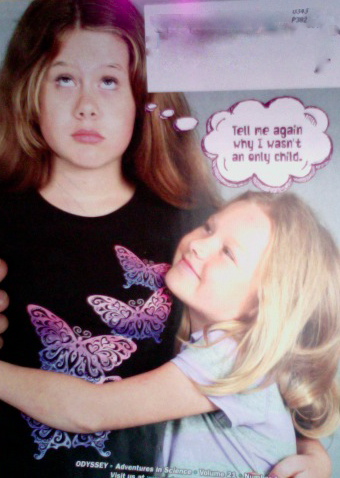
Boy, howdy, though, I couldn't let this one slide. This is the back cover of the January 2012 issue of Odyssey, the science magazine aimed at kids aged 10 to 16:
Yeah, you read that right. The little sister is hugging the big sister, and the big sister is rolling her eyes and wishing the little sister had never been born.
The context here is that this month's issue is about "annoyance." The consulting editor for the issue is a professor of psychology as well as brain/cognitive science. There are articles about the role of cortisol, about talking being more effective at calming oneself than texting, about how the sound of whining children distracts mothers more than the sound of whining table saws, and about how psychologists classify "annoyance" among five basic emotional states. There's even a sidebar explaining that some sounds, such as crying babies, are annoying for a good reason: because they signal a need that we're supposed to meet.
But that picture… I'm sure it's supposed to be funny, but I'm disturbed even by the notion that this appears in an educational magazine. If they had pictured a girl sitting in a desk rolling her eyes at a teacher and thinking, "Tell me again why I haven't dropped out yet," I bet they'd get an earful from the classroom teachers who make up a sizable portion of their subscriptions.
Anyway, I called. "I'd better leave the room," said the 11yo as I dialed the phone, "because I don't want to hear you yell."
"I'm not going to yell," I said. "It's not the fault of the person who answers the phone number published in the magazine." So the kids watched.
I talked to a very nice young woman named (I think) Kirsten, who when I said, "I have a comment about the January issue of Odyssey" told me to hang on while she got a copy of the magazine to look at. Once I got her onto the back cover, I described what I saw.
"I see a younger sister giving a hug to her big sister. The little girl is looking up at her big sister with a loving smile. The older sister is looking away and expressing regret that her little sister was ever born." I went on to explain that I found it disturbing, that my children found it disturbing (the 11yo was the one who showed it to me), and that I assumed it was supposed to be funny; but that the "funny" fell flat, because it's just not representative of the child-positive messages I expect to see in the Cricket family of publications. Children aged ten to sixteen are exactly the age group who are most susceptible to negative messages about the value of younger siblings, I went on. I am happy to have every one of my kids. My children are happy to have every one of their siblings. I want it to stay that way.
"See, I didn't yell," I pointed out to the kids after I had left my contact information, acquired the name and email address of the person to whom my message should be directed, and ended the call.
"Sometimes you yell," observed my 8yo.
I thought about it. "Yes, sometimes I do. It helped that I knew the person on the other end of the line didn't have anything to do with the cover, and that she was very polite and listened to me. It's much harder to keep yourself from yelling if the other person is rude."
The senior editor of Odyssey is Elizabeth Lindstrom, and her email is elindstrom@caruspub.com .
(NB. If you're reading this long past the issue date of January 2012, consider the post outdated.)
So I have this problem: I don’t actually need very many calories per day. This means that I should have smaller portions than are typically served. Logically, then, I should not eat all of most sandwiches, which are standardized to maintain (or, realistically, to fatten) a person much larger than me. And yet, the sandwich is a sort of a quantized food. Except in restaurants that do the half-sandwich, cup-of-soup lunch thing, you generally get an integer of sandwiches on your plate. And there’s a strong visual cue there that says “eat the whole thing.”
For a little while, in trying to maintain my new weight, I was trying out sandwiches that promised to be low in calories. Take the Subway “fresh fit menu,” for example. I happen to like turkey, so I thought: Well, maybe I will go ahead and have all of a nominally-six-inch turkey sub, with lots of pickles and hot peppers and spinach on it. Indeed, as fast food goes, it’s pretty good. Truthfully, though, I probably would have been more satisfied with half a nominally-six-inch Spicy Italian loaded with cheese and oil. Fat is satiating, after all.
But the real problem with the whole six-inch sub is that it is huge-looking; it reinforces the habit that says it’s normal and good for me to eat huge-looking sandwiches; and next time I meet a huge sandwich, it might not be as innocuous as turkey on wheat. Given that many restaurant sandwiches are huge-looking because they are, in fact, huge, it is a much better strategy for me, the terminally calorically challenged, to default to half sandwiches.
But when I started off on a mission to eat only half sandwiches, I was forced to probe my emotional obstacles to restrained eating yet again, and I discovered this:
I have serious reservations about eating only half of a sandwich.
Even if the sandwich is twice as big as what I actually want to eat, I am disturbed by the asymmetry of the undertaking.
The data suggests that aspect ratio matters. I don’t mind so much if the sandwich is long and skinny (aspect ratio >> 1), so that by cutting it in half it is transformed into two sandwiches that are still long and skinny (aspect ratio reduced, but still noticeably > 1).
Take a submarine sandwich, for example, such as the nominally eight-inch versions produced by Milio’s, which delivers to my house.
A nominally eight-inch sub (and yes, that is not half a sandwich already, that is a whole sandwich; a sixteen-inch sub counts as two sandwiches, I don’t care how many calories you are allowed to eat per day) is pretty skinny and long (actually it’s more than eight inches), and even after you cut it in half it’s still longer than it is wide. It is still, in other words, sub-shaped. It has preserved the essence of sub-sandwich-hood. I can eat it and say, “This is a sub.” I am supported in this intuitive conclusion by inductive reasoning: if there are sixteen-inch subs, and there are eight-inch subs, then logically there should be no reason why there cannot be a nominally four-inch sub, and so on and so on — too bad this name is already taken.
So I don’t have any problems with those.
And I don’t have too much trouble with wrapping up half of a sandwich made on wide-pan bread that is wider than it ought to be. Such sandwiches usually arrive already cut in half, the better to artfully arrange the halves so that they are embracing a cup of soup or a bowl of salad or perhaps a pile of potato chips. There, you’re taking an aspect ratio that is approximately 2 and reducing it to approximately 1, which is really the appropriate aspect ratio for food that comes between sliced bread.
So easy just to wrap up one of those halves and take it home.
But I find I have this horrible resistance to, for example, half cheeseburgers. Now I love a good cheeseburger as much as anyone, and I’m not very fond of little cheeseburgers. When I want a cheeseburger, I don’t want the kid’s-menu version. I want a thick medium-rare patty and a lot of lettuce and tomato and pickles and mayo and maybe some bacon. I would rather have half a grownup cheeseburger than all of a kids’ cheeseburger…
… at least till it is time to cut my big grownup cheeseburger in half. And then I am daunted by the prospect of sawing to pieces something so beautiful and complete, the Platonic ideal of a sandwich in all its circular perfection. I just know that the tomatoes and lettuce will slip to one side, lubricated by the mayonnaise, and the bun will be shredded to crumbs, and I’ll be left picking through the pickles and trying to distribute them equitably between two sort-of semicircular half-patties, no longer crisp all around a lacy edge, rapidly cooling and drying out as the juices run all out of the center, its tender pink cross-sectional area now exposed to the ambient environment, and to the disapproving eyes of any nearby E. coli researchers.
This is where Mark points out to me, “You never have any trouble eating the second half of a whole cheeseburger.”
(Too, too true. But cheeseburgers are about love and geometry, not reason and rhetoric.)
+ + +
N. B.: The above rant also applies to bagels.
+ + +
And then there’s the prospect of making one’s own half sandwiches from scratch, by which I mean cutting a slice of bread in half and then putting the fillings on one half and topping it with the other half slice of bread. Do I even need to explain why this is so abhorrent?
Nigel Tufnel can do it for me:
It’s okay to make a whole sandwich and cut it in half and share the other half with someone. But if there is no someone in sight, I have to make a half sandwich. And that is just wrong. Perhaps if I laid in a store of frilly-ended wooden picks.
+ + +
Mark: “Perhaps if it is the aspect ratio that bothers you, you should cut circles out of the middle of your sandwiches with a cutter, and eat those.”
Me: “Ummmm… I can’t drive and calculate at the same time… what’s the diameter of a circle that is half the area of a square of side 1?”
Mark (pulls out iPhone, calculates): “Approximately zero point eight.”
Me: “So I could eat a half sandwich that looks round if I cut off the edges, a tenth of the width on each side, and trimmed the corners, and only ate the middle.”
Mark: “Sure, why wouldn’t that work?”
Me: “Mark, I already eat all the children’s sandwich crusts. What makes you think I will be able to resist my own? Duh.”
+ + +
So this month, I decided to try to beat my irrational resistance to half sandwiches by making and ordering a lot of half sandwiches.
My first homemade half sandwich was a grilled ham and brie on pumpernickel rye with wedges of green apple melted inside it. There was no hope of getting anyone else in the family to share this with me, so I was unwilling to grill a normal sandwich and cut it in half. Nor did I wish to waste brie. So I carefully took half a slice of bread, cut the rectangular way (since the cross-section of my brie was rectangular) and folded up the ham, a little more deftly than Nigel up there. I kept the ham from unfolding by weighting it down with the three little pieces of brie. Then I propped my apple slices among them, and balanced the other half-slice of pumpernickel on top, and smacked it down with my spatula when it threatened to topple over. How am I going to butter the bottom of this mess? I wondered, but then remembered that I could put butter on the skillet instead. Somehow I managed to transport the whole topheavy mess to the skillet where it sizzled away, and by employing tongs as well as spatula I managed to turn it over to brown on the other side, only having to stuff one stray piece of apple back in between the chinks.
Once the sandwich had cooled it was pleasant and fragrant as any whole sandwich, and of course the brie had fused it all together so it didn’t want to come unfolded anymore. So that was a success story, though not without its trials.
+ + +
It has been slightly easier navigating restaurants, where I vowed to order sandwiches and only eat half until I had firmly established the half-sandwich habit.
Along the way I amended the rules somewhat: some naturally-small sandwiches, such as gourmet sliders or Skyline chili dogs, can count as halves (at least if normal people might ordinarily eat two or more of them).
But most of the time I stuck to it. On a recent road trip, I asked for my Subway six-inch Italian BMT to be cut in half, and I put the other half in front of the baby, who likes salami. I asked for a plastic knife at Chick-Fil-A and bisected my #1, hiding one half in the foil-and-paper sack (after harvesting the pickles from it) and consuming the other with a side salad. Once the sandwiches were safely gone, I found, I no longer felt anxious about their aspect ratios.
With practice, and a lot of sandwiches, I am optimistic that I will beat this thing. I’m learning all the time, and that gives me hope. The other day, at “Moe’s Almost World Famous Diner” in Osseo, WI with the kids (en route from Madison), I ordered a patty melt.
What a revelation: A patty melt is a cheeseburger on square bread that comes already cut in half! And here I have been eating patty melts on occasion my whole life, and never noticed that they break the don’t-cut-a-cheeseburger principle, and they still taste good.
I gave the other half to the baby (yes, it was cooked through, I checked), and I ate my half patty melt, savoring the taste of triumph.
I was going to blog about Tara Parker-Pope's recent article "The Fat Trap," but then I noticed a lively discussion at Megan McArdle's blog. I participated as "bearing." You may find that comment section interesting if you follow the weight loss/gluttony threads here.
Pope's article is about how hard it is for people to keep the weight off, when they have lost weight through medically supervised severe calorie restriction. Some people do it through obsessive calorie counting and abnormally high exercise regimes.
I am pinning my hopes on the "sustainable, real-life habit" approach to weight control, something that is almost the antithesis of the medically supervised fasting. But I still find articles like Ms. Pope's article depressing — and frightening. It's not that I can't keep my weight within a good range now. It's that I fear I will somehow lose the will to keep working on it.
It is resolution season, folks, and this is post two in a series…
Yesterday I wrote a post about distinguishing desirable habits from interventions, that is, from temporary deprivations. Habits are like puppies: if you like them and can live with them, you adopt them for the long haul. “Compensatory deprivations” are like spare furniture you get out only when necessary. They can be useful temporary fixes, but they are not something you want to live with permanently.
I think a lot of people slip up by resolving to deprive themselves permanently or indefinitely of something they really enjoy that is ordinarily harmless, or at least it is harmless in moderation. It would be better to identify habits that are really desirable, and try to set yourself up to fall into them, so to speak.
As for me, my biggest problem right now is that I have slipped into an indulge-gain-deprive-lose cycle, and I really need to get out of it and into a more balanced pattern. That calls for a look at habits I would like to re-establish for the new year: permanent changes that I really want to have.
So I made a long list of potential behaviors, and then I carefully considered each one. If I found it appealing, I put it on my list of “habits to try.” If I didn’t, I put it on the list of “compensatory deprivations” — and I don’t intend to touch those except on rare occasions, such as the morning after a day full of bad food, or as a needed kick start.
The habits list is surprisingly short. Remember that yours are not the same as mine…
I. Well-established habits I want to be sure to keep.
– One egg is enough eggs for breakfast. I wrote about this and other “mantras” here. – Keep the gym bag packed at all times. It has been a little trickier to juggle the schedule lately such that I get to the pool or treadmill, and so it is even more important now that I remain always ready to take the opportunity when it comes. – The right-size plate is 8-1/2 inches, which means the inner rim of a larger one. Switching to “luncheon plates” has been the easiest way I’ve tried to fight mealtime gluttony — it has totally been worth the cost of replacing our family dinnerware. Full-size dinner plates are do-able, though, because they often have an “inner” plate that is 9 inches or so; I just pretend the decorative rim is not there. – A “normal” plate has four quarters: two vegetables, one protein, one starch. I don’t mean to say that I always divide my meals up like this; I don’t, for example, dissect a portion of lasagna. It’s more of a mental habit for eyeballing the relative proportions of the main dish and the side dishes. I do follow it pretty frequently at lunch.
II. New habits I am excited about, to begin trying immediately.
– “Half a sandwich is enough sandwich for me.” This is potentially a new mantra to add to the ones at the link I mentioned above. I won’t go into it now, but I actually have a lot to say about how I came to this one and why I am excited (I know, weird word to use) about trying it. I will write a whole post about half sandwiches coming up soon. – A “normal” portion of sweets or dessert, for me, is a two-thumbs-sized slice or 1/3 cup. I would like to have sweets every day if I want them, and that only works if I keep the portions small, which is fine with me. I would rather have a little ice cream every day than a giant bowl on the weekends. This habit is not exactly new, as I also used it when I was losing weight in 2008, but I think I would like to make it permanent in order to eat ice cream more frequently (I have been cyclically denying myself dessert, and I am tired of it). – If I have alcohol with dinner or before dinner, it should be only a little: half a beer, or a quarter glass of wine. I can have more after I have finished eating and the plate is removed. I don’t want to give up wine or beer with dinner, but I have to face reality: alcohol makes me eat more. Keeping the amount small until the food is gone may just be the habit I need to establish to let me enjoy both in moderation.
III. Habits to try later on.
– Refuse to eat quickly. Everybody knows the conventional wisdom, that eating slowly and being sure to savor your food is good for portion control. I have never really mastered it — I am usually the first one done with any meal. This is a direct challenge to gluttony, so it’s a habit I really want to try — but I am saving it for later because I expect it will be rather difficult to establish. – Skip bedtime snack as normal practice. I had this habit before, but have fallen out of it. It needs a trial period; it might not be right for me at this time. – Notice my hunger level at the start of the meal, and adjust my plate accordingly. Up till now, I have tried to load plates consistently, each dinner about the same size, because for so many years my hunger signals were not reliable. I think they are more reliable now, and the way to test that is to carefully try serving myself larger helpings if I am hungry and smaller ones if I am not. – Strictly practice “no seconds” to see if it becomes a comfortable habit. I more or less eschew seconds at meals, but it is not really a habit; I feel a little deprived by it. I want to give it a good continuous try for a while to see if it can become something I can get used to.
– Reinforce the “no seconds” habit by serving dishes in the kitchen. This is something that might or might not work; because we have small children who cannot serve themselves, I will have to go back to the kitchen anyway, which could backfire. Maybe I will think of a way to set this one up so that it works in our family.
– Portion grains, soups, and breads to moderate carbohydrate intake. It isn’t sustainable to measure them every time, but maybe I can use a handy comparison to keep myself relatively honest, the way I use “two thumbs” to set the size of sweet desserts — perhaps stay below a fist-size volume of bread and grains or a two-fist volume of soup.
Thursday I met up with my good friend Kim from high school to wander around a mall for a few hours as a pretext for catching up. Just as it did back in junior high and high school, browsing around window shopping, in this case searching noncommittally for possible after-Christmas deals, is a perfect setting for having an hours-long conversation that ranges over all the various news that sums up “life in the past year.”
We did have a couple of items each to check off the list. Mine was new lingerie and a light wool sweater to replace one I put a hole in recently. Hers was shelving and racks for a kitchen cabinet, so we stopped into a Container Store that shared a parking lot with the mall.
There is a certain ironic tension about the Container Store and me. On the one hand, it is just the sort of store that I should never enter alone, because: Ooh! Bento boxes! Ooh! Pot-lid racks! Ooh! Melamine trays! They’re so black and so rectangular and so plastic!
On the other hand, on the face of it, the store is absurd. There used to be a SNL skit, one of the fake commercials, that advertised a bank that only made change. Sometimes I think that 20 years ago, SNL could have made a parody commercial of the Container Store: We don’t sell stuff. We sell stuff to put your stuff in. We even sell stuff to put the stuff that you put your stuff in in. There are echoes of the famous George Carlin bit, “My stuff is stuff, your stuff is s#it.”
But anyway, I was walking up and down the aisles with Kim, nattering on about this tray and that box, and checking out prices and saying things like “the thing you are looking for goes inside a cabinet, so you won’t want to pay extra for something just because it looks good,” and “oh, I have a bunch of these, they are really great because they stack,” and “don’t just look in the kitchen section, my one friend uses fridge ice-maker bins to hold school supplies in her bookshelves.”
We had stopped to scrutinize some sorters for racking flat things like cookie sheets and cutting boards in a cabinet and I was going on about “well, I have a metal one kind of like this, but it isn’t as well made as this one, mine doesn’t have the ends of the wires welded and so they get bent all the time, but look, this plastic one is less expensive, and if it isn’t big enough to keep them straight you could always get a second one and put it deeper back in the cabinet,” when a sales clerk came down off a ladder and tried to recruit me for a job due to my superior product knowledge.
(No way, I told her, but not before I asked to find out what the employee discount was. For the record, it is 40 percent).
I haven’t actually made any New Year’s resolutions, but ’tis the season for reflecting on good and bad habits, no? So get ready for a couple of anti-gluttony* posts, starting with this one.
+ + +
As part of marking my weight goal anniversary (three years this past November — can you believe it?) I took a step back and surveyed my eating and exercise habits: what was working? What wasn’t? Were there any good habits I had abandoned out of sloth and gluttony? Had I discovered any new ones, or thought of any potential new ones that might counteract problem areas?
It is a bit hard to tell if my anxiety is ill-founded (this being the nature of anxiety), but I still feel as if I only barely can keep my weight down. Probably I have an unhealthy obsession with it — but, to put it bluntly, I do not wish to let go of my possibly unhealthy obsession because I would rather be obsessed than put the weight back on again. The story of the last three years has been the story of trying to externalize the obsession, find ways to live and to see myself that are balanced less precariously. I think of wrapping little packages of anxiety up in my mind and transferring them somehow outside myself, one at a time, into tidy little stacks. Turning this balance into something that is maintained by things I simply do and forget about, rather than things I turn over and over in my mind. From head to hands.
+ + +
Here is my husband’s idea, which has merit: “Make a list of habits that you can add or subtract as necessary. Put them in order from the easiest and most painless to the most difficult and annoying. Then, if your weight spikes up, start adding habits in order, only one or two at a time. If that doesn’t help, add more until your weight goes down again, and then you can stop the habits, starting with the most annoying ones.”
The idea of ranking behaviors by annoyance level was a new one, and I thought I would give that a try. I started making a list of things like “don’t eat sweets” and “keep the serving dishes in the kitchen” and “put a stick of gum by my plate at dinner” and “one egg is enough eggs for breakfast” and the like.
But as my list of former and current and potential weight-controlling strategies grew longer, I began to feel uneasy about calling them all “habits.” And as I began to shuffle them around to figure out which ones I enjoy the least (“no wine with dinner” and “pre-count every calorie” are two examples of behaviors that work extremely well but that exemplify the life I do NOT want to lead), I became even more sure that “habit” is absolutely the wrong word for many of these behaviors.
What Mark is suggesting is not a ranking of habits, but a hierarchy of compensatory deprivations.
A habit is not like a toggle switch; it is more like a houseplant or a tropical fish or a puppy. It requires care. Yes-no choices do go into it, though. Choose often enough to feed it and it thrives; choose often enough to neglect it and it withers. Useful habits are habits to live with: not necessarily permanently, but for long periods. They can be tried for a while to see if they are pleasant to live with and if they have desirable effects, but this is not the same as toggling them on and off; it is more like a temporary adoption, to see if an attachment will deepen.
Compensatory deprivations are less like a companion pet and more like a spare folding table or a turkey roaster: an unwieldy, occasionally used piece of furniture or appliance that you get out of the basement from time to time when necessary. (e.g., at the holidays.)
We all know some person (a lot of us seem to be married to one) who decides he needs to take off a few pounds, gives up ice cream for a couple weeks and bam, problem solved,the lucky bastard. That is the idea we are going for. A useful compensatory deprivation is something that’s at least a little painful, but is temporary and effective. If it works but hurts, the working should be enough motivation to keep going just until it isn’t needed anymore. If it works and doesn’t hurt (or you find you get used to it eventually), maybe it should be nurtured as a long-term habit after all. If it hurts and doesn’t help, then there’s no point, now, is there?
One way to begin turning your life around is to temporarily foster new habits, patiently nurturing them and giving them a chance to take root and thrive. Not all will be good matches, it is true, but you must be careful not to let the trying and discarding become the habit itself; the end is adoption, the testing only the means. Compensatory deprivations don’t even need to enter the picture until a number of good habits are thriving comfortably.
+ + +
After I realized the crucial distinction between potential habits and potential compensatory deprivations, it was fairly easy to sort the items into two lists: one list of behaviors that either are already habits, or that I thought I might enjoy if I adopted them permanently; and a second list of behaviors that I thought would be helpful interventions from time to time but that I didn’t want to become my constant companions… something to store in my basement, so to speak.
Which behaviors are your potential puppies, and which are your potential turkey roasters? Tune in next time and I will share my lists. Just in time for the new year.
Editing note. Years and years later, I wish I’d done a better job distinguishing gluttony from other problems with food, like clinical eating disorders and other kinds of compulsiveness.
I want to emphasize that, whereas I identified some behaviors in myself that probably qualified as self-centered gluttony in the technical sense, I am not and never have been qualified to make that distinction for anyone else. I touch on what I’m talking about a little more clearly partway through this post.




 bearing blog