bearing blog


bear – ing n 1  the manner in which one comports oneself;  2  the act, power, or time of bringing forth offspring or fruit; 3 a machine part in which another part turns [a journal ~];  pl comprehension of one’s position, environment, or situation;   5  the act of moving while supporting the weight of something [the ~ of the cross].


  • Bishops got back…bone.

    Here's the official statement from the USCCB: (as of late evening, February 10)

    The Catholic bishops have long supported access to life-affirming healthcare for all, and the conscience rights of everyone involved in the complex process of providing that healthcare. That is why we raised two serious objections to the "preventive services" regulation issued by the U.S. Department of Health and Human Services (HHS) in August 2011.

    First, we objected to the rule forcing private health plans — nationwide, by the stroke of a bureaucrat's pen—to cover sterilization and contraception, including drugs that may cause abortion. All the other mandated "preventive services" prevent disease, andpregnancy is not a disease. Moreover, forcing plans to cover abortifacients violates existing federal conscience laws. Therefore, we called for the rescission of the mandate altogether.

    Second, we explained that the mandate would impose a burden of unprecedented reach and severity on the consciences of those who consider such "services" immoral:insurers forced to write policies including this coverage; employers and schools forced to sponsor and subsidize the coverage; and individual employees and students forced to pay premiums for the coverage. We therefore urged HHS, if it insisted on keeping the mandate, to provide a conscience exemption for all of these stakeholders—not just the extremely small subset of "religious employers" that HHS proposed to exempt initially.

    Today, the President has done two things.

    First, he has decided to retain HHS's nationwide mandate of insurance coverage of sterilization and contraception, including some abortifacients. This is both unsupported in the law and remains a grave moral concern. We cannot fail to reiterate this, even as so many would focus exclusively on the question of religious liberty.

    Second, the President has announced some changes in how that mandate will be administered, which is still unclear in its details. As far as we can tell at this point, the change appears to have the following basic contours:

    ·It would still mandate that all insurers must include coverage for the objectionable services in all the policies they would write. At this point, it would appear that self-insuring religious employers, and religious insurance companies, are not exempt from this mandate.

    ·It would allow non-profit, religious employers to declare that they do not offer such coverage. But the employee and insurer may separately agree to add that coverage. The employee would not have to pay any additional amount to obtain this coverage, and the coverage would be provided as a part of the employer's policy, not as a separate rider.

    ·Finally, we are told that the one-year extension on the effective date (from August 1, 2012 to August 1, 2013) is available to any non-profit religious employer who desires it, without any government application or approval process.

    These changes require careful moral analysis, and moreover, appear subject to some measure of change. But we note at the outset that the lack of clear protectionfor key stakeholders—for self-insured religious employers; for religious and secular for-profit employers; for secular non-profit employers; for religious insurers; and for individuals—is unacceptable and must be corrected. And in the case where the employee and insurer agree to add the objectionable coverage, that coverage is still provided as a part of the objecting employer's plan, financed in the same way as the rest of the coverage offered by the objecting employer. This, too, raises serious moral concerns.

    We just received information about this proposal for the first time this morning; we were not consulted in advance. Some information we have is in writing and some is oral. We will, of course, continue to press for the greatest conscience protection we can secure from the Executive Branch. But stepping away from the particulars, we note that today's proposal continues to involve needless government intrusion in the internal governance of religious institutions, and to threaten government coercion of religious people and groups to violate their most deeply held convictions. In a nation dedicated to religious liberty as its first and founding principle, we should not be limited to negotiating within these parameters. The only complete solution to this religious liberty problem is for HHS to rescind the mandate of these objectionable services.

    We will therefore continue—with no less vigor, no less sense of urgency—our efforts to correct this problem through the other two branches of government. For example, we renew our call on Congress to pass, and the Administration to sign, the Respect for Rights of Conscience Act. And we renew our call to the Catholic faithful, and to all our fellow Americans, to join together in this effort to protect religious liberty and freedom of conscience for all.

    I am not able to post much over the next two days.  Comments are open for discussion.  Consider these questions:  

    (1) Is there a substantive difference between an employer being forced to buy coverage for a drug/procedure, and all insurers being forced to provide them at no cost to all people covered by their plans?

    (2) Set aside the question of whether or not the rule is, as a policy matter, a good idea or a bad idea.  It was pretty obvious before that the rule was one that called for civil disobedience:  a Catholic hospital (for example) could not follow both the rule and its conscience except by shutting its doors.  Is that still the case?  Has this change created any plausible argument that Catholic institutions do not have the moral duty to disobey the law or shut down?  

    (3) If religious institutions ought to have exemptions from insurance requirements, does it necessarily follow that individual employers (say, the owner of a hardware store or a fast-food chain) ought to have right-of-conscience exemptions?  Assume that the beliefs that motivate a request for exemptions are sincerely held.  

    (4)  What about self-insured religious institutions?  And are there any health insurers that are religiously affiliated?  (I know we have our life insurance policies through the Knights of Columbus, so there are certainly some kinds of insurers that are religiously affiliated).  Does their conscience matter?

    (5) Is this whole debate just a particularly clarifying way of getting to the heart of the question:  What is insurance for, anyway?  


  • Project-filled day.

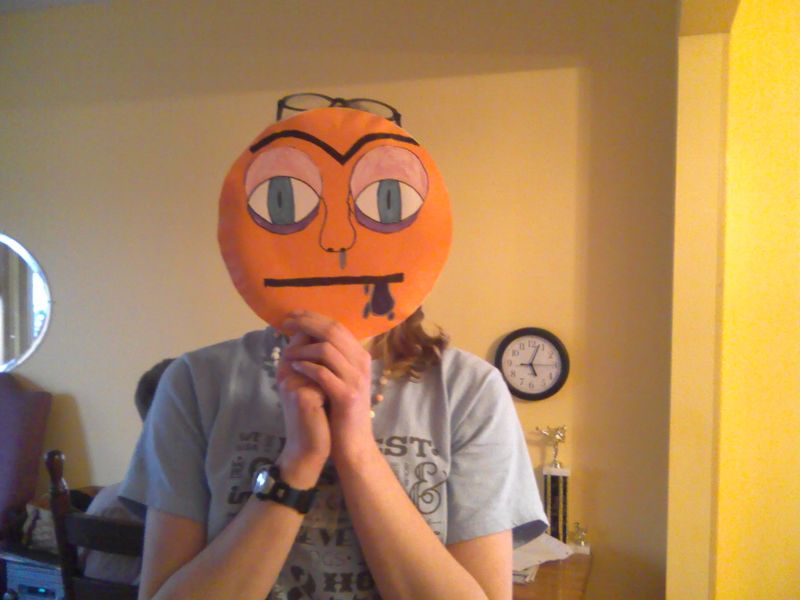
    The 6th-8th graders made modern, construction-paper takes on ancient Athenian theatrical masks:

    0209121704-00

    This stock character is "sick and tired."


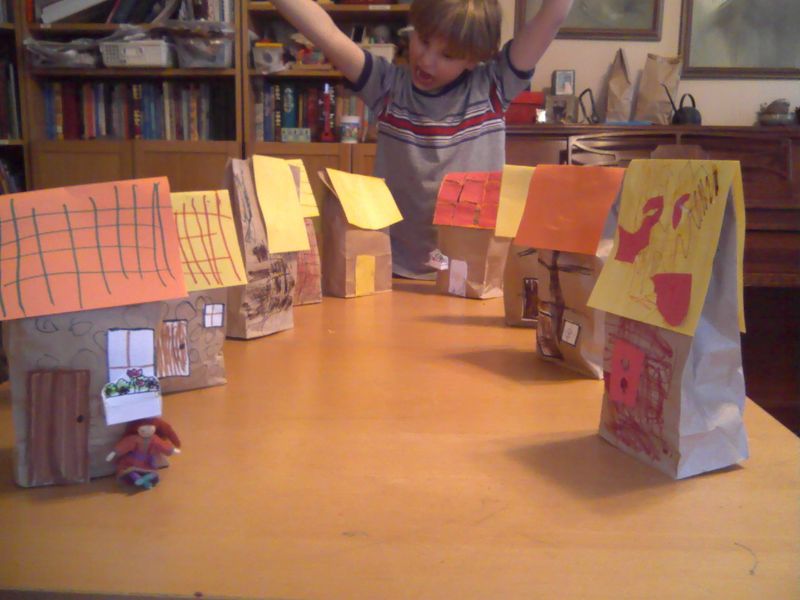
    And no elementary-school medieval village of paper-bag cottages is complete without its Kidzilla:

    0209121705-00


  • Justice Sotomayor appears on Sesame Street.

    Cute.

    I like the discussion of the case in the comments at the Volokh Conspiracy.

    "Since Goldilocks entered a house, one would assume that she falls under at *least* Criminal Trespass in the 3rd Degree…That’s in New York.YMMV, of course."

    "But would Goldilocks have any defense that she acted in the distress of being lost in the woods? Not to mention that as a minor child, it is less likely that she could face prosecution so much as her parent’s could be charged with negligence…"

    "Too bad Thomas wasn’t the guest justice; he could have tossed the case on standing, as Little Bear could not have been recognized as a person in 1789 and thus has no rights that the courts are bound to respect."

    "I am surprised to learn that Sotomayor is the first SCOTUS justice to appear on the show given that I have all along assumed that Souter was at least half-Muppet."


  • Something to be thankful for.

    Mark just returned from a business trip where he had been meeting with British colleagues who had been living in Switzerland.  

    The British colleagues bemoaned the lack of good food in Switzerland.  "It's great if you really, really like cheese," they said.

     So Mark, being that day in eastern Iowa rather than in the vast food desert that is French-speaking Switzerland, took them to a Vietnamese restaurant.  He says the imperial rolls with curry vegetables were quite nice, and the phở looked pretty good too.

    "We really take it for granted, living in the U. S., that lots of people will have migrated here and opened restaurants," mused Mark.  No kidding.  


  • Caucusing.

    I would have taken pictures, but that would have annoyed the kids more.  They weren't too happy about being left in the lobby of the community center with nothing but a foosball table and a few dollars for the snack machine, even for the twenty minutes it took me to go in and cast a vote in the straw poll and second a nomination for the delegate to the next step.  I offered to bring the kids in with me so they could view democracy at work, but they preferred to argue about the merits of Pop Tarts vs. Famous Amos cookies (which my eleven-year-old, amusingly, pronounced as "famous ammo" cookies).

    It was nothing — nothing — like 2008 in there.  In 2008, the caucus was standing-room-only packed, mostly with Ron Paul supporters.  This time, there were about a dozen tables, one for each precinct in the Senate district, and around each table were folding chairs — as few as eight (mine) and as many as 25.  People sat and chatted amiably about candidates and issues.  I saw all ages represented, almost as many women as men, and (while I didn't stop to take a detailed census) it was a fairly racially diverse crowd as well.  Probably not quite as diverse as the neighborhood we all live in, but more than I had expected.  I got the impression that the younger people were skewed more toward Paul and the older people more toward Romney.

    My precinct table only had eight people, but three of us were toting toddlers.   I thought that was interesting.

    "What do you have to say?" the gray-ponytailed man next to me asked as I took my seat awkwardly, shifting the two-year-old in the sling.  I said I came more to listen than to talk, which was true.  Unfortunately, I had that thing going where I had three kids out in the next room and one kid wriggling on my lap.  I'm sitting here with my fingers on the keyboard trying to record here the comments I heard people articulating, and I just realized I can't reproduce them because, I think, my higher brain functions were all going to keep tabs on the kids.   I did form impressions, though.

    Santorum:  respected, intelligent uncompromising, but not judged by my tablemates to be electable because of the perception of being too religious.  

    Paul:  similar to Santorum in that he is principled and uncompromising, but judged by my tablemates to be more electable because his principles do not come quite so obviously from a religion.  

    Romney:  part of the problem, emblematic of the broken system that is the collusion  of big government and big money; but could probably get the job done.

    The fourth candidate might as well have been called "He Who Shall Not Be Named" because nobody even mentioned him.

    Not that the table was uniform in its judgments — there was one guy who steadfastly insisted that all the candidates were equally awful, and he wrote in "Arne Carlson" for his straw-poll vote.  

    That is about as far as I got before I judged I had made the kids suffer enough (okay, before I heard the five-year-old wailing because she didn't have any bubble gum) and bowed out.  But I'm really glad I showed up.  One of these days I may actually offer to be the delegate — I might have done it this time, but our family's going camping that weekend.

    You could have knocked me over with a feather when it turned out that Santorum was such a clear winner in Minnesota.  I mean, I guess it makes some sense now that I think about it — I mean, it's not like the character of the state as a whole is representatively reflected in the sample that is "people who actually show up to a party caucus."  The state as a whole tends to vote Democratic pretty reliably, and I'm in the center of the metro area, so I never expect any segment to lean conservative — I reflexively expect to see moderate-to-left views most of the time, since that is what I am surrounded by.

    UPDATE.  Here's a decent and probably-accurate summary of why it isn't that crazy that Santorum swept Minnesota.  I would just like to point out that Romney won the state's caucuses in 2008, though, when there were still more socially conservative candidates in the field, so it's not like they reliably yield the most conservative option.


  • Political question: Minnesota edition.

    Ok, here it is.

    Is taking four children ages 2 to 11, all by myself, tomorrow evening at 7 pm, to the GOP caucus (yes, that is "caucus," not "primary" — no quiet voting booths here), in a parks building in our urban neighborhood, and doing my part to help take down the most horrible candidates, 

    (a) a valuable educational experience for the older children, and a way to model participation in the political process

    (b) admirably responsible, since otherwise no one from our family will be able to make our voice heard in the caucus/primary stage, which appears every year to increase in importance over casting a vote in the general election

    (c) courageously positive, as I make a stand for inclusiveness of people with small children to care for even at 7 pm in the evening

    (d) unnecessary, because everyone knows who is going to win the nomination by now anyway

    (e) certifiably insane

    (f) pictures or it didn't happen

    For the record, if I remember right, in 2008 my neighborhood caucus actually went for Ron Paul.  I had my husband with me when we went, and we took the kids (three of them, then) because we didn't really have another choice that night if we wanted to go.  It was the first presidential caucus I'd ever been to.

    The building in 2008 was absolutely crammed full, which fairly shocked me, because Republicans and conservatives are downright invisible in our urban neighborhood.  You never, for example, see any lawn signs.  The GOP usually doesn't even bother fielding any candidates to any significant local positions, although occasionally people running for school board will get an endorsement.  But that year there were a very large number of what appeared to be young libertarians, some of the hipsterish variety and some of the dreadlocks-under-my-oversized-toque variety, and many of them waving signs.  The oldsters who had brought cookies and punch — not that there was any left — were standing around at the edge of the room, blinking and wondering what had hit them.  I got the impression it hadn't been like this in 2000.


  • More on First Saturdays: the results of an experiment I didn’t know I was doing.

    Some time ago, while I was working on the Total Consecration, I wrote about my reluctance to enter deeply into Marian devotions — a reluctance that was brought into high relief when I encountered a certain online book by Fr. William Most that discussed Mary as "co-Redemptrix":

    "This is the kind of Marian writing that makes the tops of Protestants' heads blow off. …[A]s I read it, I found myself struggling with some of the concepts, precisely because of the Protestant, anti-Marian influence in American Christian culture. It was very edifying, because intellectually, Father Most's arguments make a great deal of sense to me. And yet the logical conclusion of his arguments suggests an attitude toward the Blessed Virgin that feels radical to me. Deep down, it seems, I feel a sort of repulsion against fully embracing the idea of Mary as intercessor, which as I search my history seems can only have come from contact with American Protestantism. I didn't even realize that I felt that internal repulsion until reading Fr. Most's arguments forced me to confront it."


    I have long had that feeling about many Marian devotions. Take, for example, the Five First Saturdays devotion. Originating in a request that Our Lady reportedly made in an apparition to Lucia Santos, it is a superficially pleasant-sounding-enough activity: Attend Mass, say a rosary, go to Confession, and spend fifteen minutes in meditation, all with the intention of making reparation for sins committed against the mother of Jesus. Do it five first Saturdays in a row, and you are done. A simple little thing, not terribly demanding, a one-time commitment, like making a pilgrimage.

    But I was always bothered by the fact that, in recommending it to us, the Church, or Mary, didn't stop there, but instead went on to promise something in return. Here is a direct quote of what Sister Lucia reports that Mary told her in her vision:

    "I promise to assist at the hour of death, with the graces necessary for salvation, all who on the First Saturday of five consecutive months confess their sins, receive Holy Communion, recite five decades of the Rosary, and keep me company for fifteen minutes meditating on the mysteries of the Rosary, with the purpose of making reparation to my Immaculate Heart."

    One resistance:  I felt that this promise …cheapened the devotion somehow. And that Mary had made it that much harder to do it with the purpose of making reparation, by dangling a carrot of promised graces before us.

    It felt presumptuous too. All I have to do is check off these items, and I get the graces necessary for salvation? (I hadn't noticed the subtle difference between promising salvation, and promising the graces necessary for salvation.)

    Finally, it seemed disturbingly superstitious, which is to say that I could not see any logical or natural connection between "do these things now, and when you die, possibly far off in the future, after who knows what temptations have assailed you and after you have failed in who knows how many ways, you will get something you don't deserve, just because you checked off the boxes." Even if I mean it now, suppose I become hard and unrepentant later? How can doing this now protect me and help me then? This put it in company with a number of other Marian devotions, e.g., the wearing of the Brown Scapular (what? Die with your magic necklace on and you're good to go? How does THAT work?)

    Okay, well, I decided to try to do it anyway. I get Saturday mornings off, at least if Mark isn't traveling, and so I didn't have much excuse not to give it a whirl. I prayed for the grace to purify my intentions, so that I really could do it with the purpose of making reparation; I found a local parish that had a Saturday morning Mass; and off I went, on the first Saturday in July, which turned out to be the feast of the Immaculate Heart of Mary. I went on to complete the devotion over the next four months as prescribed.

    For the benefit of anyone else who is creeped about Marian devotions because they smack of superstition, presumption, and illogical connections, I want to report back on two results that had the effect of removing my creeped-outedness completely. The caveat is that they are specific to me — I haven't the foggiest idea whether other people would get similar results. Another caveat is that I can only speak for this moment in time — for all I know I may think differently after life has thrown more curveballs at me. I am just throwing it out there, as a sort of personal testimony, in the now.

    Direct result #1 of doing the Five First Saturdays: I discovered that I rather like going to Mass and confession once a month. This was a bit of a surprise. I rather thought I would be ready to have a "Woo-hoo, I did it, now I'm done!" party. Instead, by the time I had been through five of them, I wanted to keep it up. And so now it is sort of an established habit of mine. I go to Mass on the first Saturday of the month, if I can. I show up early enough to say the rosary with the other folks who are there. I go to Confession. After my penance I stick around for fifteen minutes. I like it. I don't know why I never thought of going to Mass on Saturday mornings before, along with the trip to the gym and the library and getting my hair cut and running personal errands and all those other things I try to do in those few hours I have to myself each week. It was a great idea that I somehow never came up with on my own. I don't know for sure if I will keep it up for the rest of my life, but it has certainly lasted longer than the five Saturdays I originally signed up for, and who knows how much good I will get out of it? Maybe exactly what is necessary.

    Direct result #2: On the second Saturday, the priest in the confessional advised me to make the Total Consecration to Jesus through Mary. If you have been following along at all, you know that the Total Consecration, encompassing as it does pretty much all authentic Marian devotion, feels to me transcendently more radical than something like the five first Saturdays. Here I was, just trying to check off the boxes and asking please for the grace to do it with the right intentions and not the wrong ones, and now I was being invited to go deeper. I went away knowing I had at least a responsibility to find out more about the Consecration and to discern whether I should make it. You know by now that I did this, and that I made the Consecration in the fall.

    Has it changed me in any real way? I can't know that for sure. I hope so. But its totality, inherently, promises more than five Saturdays seems capable of promising. The Five First Saturdays seemed so mean a commitment; so much more might happen to me afterwards; it seemed insane to accept that in any natural way, in any just way, they could be part of the cause of graces received maybe fifty years from now or more. But the Total Consecration promises to be a bridge across the unknown future, between now and that hour of my death, across all the pitfalls that could still swallow me, across the pavement of my good intentions. It is not a guarantee, but it is an accessible path from here to there. And there is no doubt that the invitation came as a result of the First Saturdays.

    Obviously there is no way I can generalize from my experience to anyone else's. I only know what is inside me. And I have written before that I am fully aware of the proclivity of the human mind to see patterns wherever we want to see them. Perhaps I am only unconsciously justifying my irrational decisions by overlaying a perception of rationality that comes from outside myself and cannot be falsified by any external test. Like persisting in the belief that my spouse loves me; I can't prove its truth or falsity, but it is certainly convenient to think so.

    It is just that I tried something that I couldn't make sense of, and received a result that — well — not so much made it make sense, as left the possibility that it could make sense. And as a result, I am not sorry I tried. YMMV.


  • First Saturday.


    photo.JPG


    For some reason, I am fonder of this image than I usually am of painted devotional statues.  I think it is the way the Infant is tugging on the edge of Mary's veil with one little fist.  

    Whoever designed this one knew babies.


  • Teens/tweens and sleep.

    This isn’t new material for me, but something to think about anyway:

     As adolescents grow, their sleep cycles change (Carskadon, 1999).  During adolescence teens tend to stay up later and sleep later. Some of these changes are explained behaviorally…But some of the changes are due to intrinsic, biological changes. Even more seriously, researchers, doctors, and teachers are realizing that circadian rhythms and school schedules are out of synch (Carskadon, 1999). The result is excessive sleepiness, inferior academic performance, and even accidents.

    Pioneering research has begun to focus on circadian rhythms and circadian rhythm disorders …Measurable by biological events, like melatonin, circadian rhythms control the timing of rapid eye movement sleep (REM). Research is beginning to show that circadian rhythms are developmental and change with growth from childhood, to adolescence and adulthood.

    One of the most fundamental benefits of homeschooling is that it leaves families freer to choose their own schedules.  That includes sleep schedules.  Most days of the week, I could, if I chose, arrange things so that the children and I could sleep very late or take naps in the middle of the day — at least in theory.  We have no buses to catch, after all.  

    Kids generally don’t get enough sleep when they have to keep to a school schedule that starts early in the morning and leaves no room for a nap:

    Early survey research at Stanford University, showed that as pubescent girls matured they preferred evening to morning schedules… In other words, as the girls’ bodies changed so did their sleep cycles. This is more than staying up late to have fun. Changing sleep cycles are biologically based. Furthermore, parent surveys and teen sleep diaries indicate that during the school year, teens average about 2 hours/per night less sleep than in the summer. The effect is cumulative. So losing 2 hours sleep each night adds up to a total of 10 hours lost sleep by the end of the week.

    As adolescents’ bodies change, they stay up later but still show afternoon dips in alertness. Previously believed to be a sleep pattern of younger children, who once took naps in school, this “siesta” effect is pronounced even into later adolescence. Changing circadian rhythms of adolescent bodies and early school schedules are out of sync. 

    Looking back at my own late adolescence, especially my first experiences with setting my own schedule in college (my freshman year, of course, but before that I attended a summer credit-earning residential program for high school students)  — I vividly remember how quickly I (and many of the others my age) re-adopted the afternoon nap that hadn’t been possible since kindergarten.  Often, after returning from classes, I’d pass out on my bunk and not get up till the dining hall was about to open.

    Looking specifically at my preadolescent son — he is 11 — I could let him sleep as long as he wished almost every morning, and let him set his own schedule for schoolwork most of the time.  He’s proven himself responsible and capable of plowing through his daily to-do list with little supervision, and it is obvious that he has developed the ability both to self-teach and to know when it’s time to ask for help learning something.

    Typically, though, I haven’t given him total sleep/work freedom.  There are a few pressures that work against the “everybody can sleep as much as they need to” model, at least in our family.  The challenge is in finding the balance.

    (1) The rest of us may not have to be out the door early in the morning, but Dad does.  If a teen sleeps in late, he misses time with his father (or whichever parent is the breadwinner) that he could otherwise be having.  Of course, he could get more by staying up late — but many families prioritize early bedtimes because it gives Mom and Dad a block of time without interruptions.  

    (2) I like there to be a time in my day when I’m “done” with school.  I get a feeling of satisfaction when everybody has cleared out of the schoolroom early enough that I can straighten it up and leave it  in the late afternoon.  

    I realize that a mother’s schedule is not meant to conform to outside-world expectations.  But deep down I like the illusion of having something less like a vocation to which I give myself fully in my my every moment, and more like a JOB, because JOBS eventually have a quitting time, after which I can crack open a beer and put my feet up and chat with my husband about his day.

    (3) A fairly predictable school schedule is the tool that helps me give time and attention to each child over the course of the day.   This is a big deal.  I have to have enough time in the morning, and enough time in the afternoon, especially to work one-on-one with my five-year-old and my eight-year-old.  (Thank God my five-year-old learned to read precociously early, because that is one less time-intensive activity I need to work on with her.)  We have a rule around here:  “You may not interrupt me if I am teaching someone younger than you.”  If my oldest were completely free to set his own schedule, it would be trickier for him to work with mine.  

    Still, the daily schedule may not be optimized; perhaps I should re-evaluate it with tween-sleep as a high priority.

    (4) I try to do a couple of school subjects, as well as lunch, together as a family.  This means calling my older kid away from his own work — or his bed — and bringing him “in touch” with the rest of the children.  

    (5) We aren’t totally isolated from the outside world and its schedules.  There’s Sunday morning Mass, for one thing — and if we sleep in and go to late Mass, there’s just so much less of the day left to play.  Two days a week we co-school with another family, and that means getting up early (at least when it’s our turn to drive and car-pool) so we can start early enough to get the work done and get home to Dad.  When doctor’s appointments and such need to happen, first thing in the morning seems best because it interrupts our day the least.  

    (6) There is pressure to teach conformity with the outside world.  Someday he’s going to have a job, and it might make him get up in the morning and keep a traditional workday schedule, right?  

    In theory, I reject the “but he’ll have to learn it eventually, so we have to work on it now” philosophy.  Most lessons can wait for developmental readiness most of the time, and there is much more natural motivation to learn when the natural need arises.  Still, all homeschoolers (I think) have to make decisions like this all the time.  Even though as homeschoolers, our children don’t have to jump through the same hoops as all those “normal” people, when they are adults they will be expected to act like “normal” people some of the time, and we want to prepare them to be able to  conform by choice when it’s in their best interest.  

    Sooner or later most people will need the skill to arrange sleep schedules in order to meet somebody else’s demands.  The question is, do they need practice with this more than they need… well… sleep?

    It’s yet another are where we must decide how best to strike the balance among the natural needs of each individual living in the family, all with one eye to the sometimes unreasonable but often unavoidable demands of the outside world.  This is never a simple question, and parents encounter it and answer it — not always easily, and not always willingly — again… and again… and again.


  • A MrsDarwin review.

    MrsDarwin reviews a new book about chastity for adolescents and young adults.

    In my days as a young unmarried Catholic, I often suffered through chastity talks or had dating manuals pressed on me. The Protestant dating manuals (or, more accurately, not-dating, since apparently dating is right out in those circles, to be replaced by the nebulous concept of "courtship") were painfully earnest in their descriptions of hypothetical couples who were keeping their relationships 99.44% pure by following strict rules of behavior. Chastity talks were even more painful because you had to be there in person, squirming in your folding chair and wishing the floor would swallow you as the speaker hemmed and hawed, or, even worse, was wildly enthusiastic for Purity! There seemed to be no happy medium between  either rigid guidelines that seemed designed to minimize contact between a couple, or hazy exhortations to purity that gave one no practical guidance in the matter of a relationship rooted in reality.

    The book is How Far Can We Go? A Catholic Guide to Sex and Dating, by Brett Salkeld and Leah Perrault.

    …One thing I really appreciate here is that Salkeld and Perrault have a respect for their young audience, and don't treat the question "How far can we go?" as an attempt to find out how much whoopie one can get away with, but an honest query about what is right and appropriate at any point in a relationship. (I snickered out loud at their description of a youth group leader who answers this question from a young couple by saying, "I'll let you in on a little secret. Your relationship will do much better if, instead, you ask yourselves how pure you can be." If you haven't heard twaddle like that, you haven't been around the Authentically Catholic! youth scene much.) They emphasize from the start that their model of dating "presumes that those who use it are sincerely trying to live holy lives. If you're hoping to find loopholes so you can get away with as much as possible and still say you're following Catholic rules, this model isn't for you."

    Just what is this model? It relies on honestly answering the question "How much of myself does God want me to give to this other person?"

    I detest (detest!) Catholic twaddle even more than ordinary secular twaddle, and (unfortunately) there's probably more twaddle in Catholic material aimed at youth and young adults than in Catholic material aimed at young children.  

    So far the only anti-twaddle approach I had imagined was going to be to start reading Flannery O'Connor for bedtime stories (I might skip the "people being crushed under farm equipment" parts until they're older) but I submit that this could be an unbalanced approach.

    So I'm interested in adding this book to my library — because material that doesn't treat young people as people – people with the intent to live a life of integrity, but not one in a bubble — is not worth having, and this one sounds like a decent alternative.  I'll tell you what I think of it later.

  • Real work.

    Given a plastic toy "workbench" by a distant relative for one's second birthday, complete with plastic hammer and plastic saw and plastic wrench and an array of sound effects that ring out when one pounds the plastic pegs or cranks the plastic bolt or saws the plastic wood in the plastic slot —

    0202121015-00

    — obviously, it is much more interesting and worthwhile to locate the real recessed screws that hold it together, and then toddle off to find Mommy's real Phillips-head screwdriver so you can take the thing apart.

    Wouldn't you?


  • A theory of chewing-out frequency.

    Jennifer Fulwiler has a decent bit in NCR today called "Why My Big Family Is Not Overpopulating The Earth."  Personally, I have always liked Simcha's writing on her huge green family.

    I have a theory that the frequency at which you get chewed out for the carbon footprint of your children increases exponentially by the number of kids:  

    𝝓(n) = 𝝓1 ek(x,y)n

    where 𝝓(n) is the frequency of being chewed out for having n children, 𝝓1 is the frequency of being chewed out for having 1 child, and the growth constant k depends on where you live.  

    (The value of k is larger in San Francisco than in Peoria. Let's be charitable; maybe if you spent all your time in San Francisco, you'd probably think the world had too many people too.)

     So, in many places, one to three kids hardly raises an eyebrow.   At four kids, I only get a small fraction of the negative comments that a mother of five would have, i.e., 1/ek(Minneapolis).  

    Anyway, I often appeal to diversity.  "It takes all sizes of families to make a healthy, sustainable population distribution!" I say cheerfully.    

    I don't generally show them pictures of bell curves, although I'm tempted to.