bearing blog


bear – ing n 1  the manner in which one comports oneself;  2  the act, power, or time of bringing forth offspring or fruit; 3 a machine part in which another part turns [a journal ~];  pl comprehension of one’s position, environment, or situation;   5  the act of moving while supporting the weight of something [the ~ of the cross].


  • The difference between faith and belief.

    "I do believe; help my unbelief!" — Mark 9:24

    + + +

    Darwin excerpts a cordial discussion between some theists and some atheists about the meaning of the word "faith."

     It's worth reading on its own, and I am not going to respond to the entire excerpt, but just make my own comment and expand on it here.

    Some proposed definitions from the excerpt:

    • "Faith is knowing by testimony rather than by experience. I believe that the Earth orbits the Sun, because the scientists tell me so, and I believe them. "
    • "[F]aith is what fills in the gaps of the probabilities. If, say there is a 70 % probability something is the case then to conclude more than that 70% probability is faith…"

    Darwin chimes in to make two points.  First, what "faith" originally means:  

    The old Catholic Encyclopedia in its article on faith describes the Old Testament use of the term to be essentially "trustfulness" or "steadfastness"…. This usage still informs the way that we use the term in reference to interpersonal relationships. I have faith that my wife loves me. She has faith that I am faithful to her. Etc. 

    Second, 

    faith is an act of the will.

    Darwin's points are both correct, but he does not go as far as I do.  He classifies "faith" as being an act, and this is correct; but it seems that he identifies it too much with "belief," or with being convinced "enough" of something.  Here is the statement of Darwin's that I disagree with:

    This usage still informs the way that we use the term in reference to interpersonal relationships. I have faith that my wife loves me. She has faith that I am faithful to her. Etc. 

    Obviously, in this sense one can have faith in any number of things or people, and as it notes, faith in this sense necessarily presupposes belief. I can hardly have faith in my wife's love (as in, trust in its existence and steadfastness) if I don't really believe that I have a wife or don't really believe that she loves me. When Christians talk about "having faith" however, they're pretty specifically talking about "having faith in God" — that combination of believing in God's existence and of trusting in God to remain steadfast and trustworthy in His love for us.

    Darwin is failing — at least clearly — to make a distinction between "I am faithful to my wife" and "I have faith in my wife."

    The first is concrete.  The second is the metaphor.

    The faith that Christians are supposed to have is not the same thing as trust that God's love exists and is steadfast to us.  The faith that we are supposed to have, I am certain, is faithfulness *to* God — fidelity to the laws and precepts that He sets out for us insofar as we are aware of them.  When we are told to have faith,  this is not at all a command to believe something.  (How can you be commanded to be convinced of a truth?) It is a command to do  something:  to live your life, in your body, in your mind, in accord with the will of a God.

    Faith is not trust in God's steadfastness; it is a firm determination to remain steadfast to God.  It is as the original Hebrew meant.

    And the point that I want to make, the point where I disagree with Darwin, is that faith understood in this way does not presuppose belief.  

    Faith understood the way (I think) Darwin is trying to understand this would presuppose belief, because he is identifying faith with belief.  "I can hardly have faith in my wife's love if I don't really believe that she loves me."  Well, of course, if "faith in my wife's love" == "belief that my wife loves me."  

    But my understanding of faith does not presuppose belief.  Darwin could choose to remain faithful to his wife — by which I mean nothing more nor less than the earthy sort of "faithful," i.e., he could remain sexually faithful to his wife, forsaking all others, and not abandoning her or their children — even if he lost all confidence in her love for him.  Indeed, he could (and should) choose to remain sexually faithful if Darwin became thoroughly convinced that MrsDarwin did not love him at all.

    And what if he did not believe that he even had a wife?  Well, millions of still-single people find themselves in that situation every day, not having promised marriage to anyone, and yet they can still be "faithful" to the future spouse they might or might not have by living a chaste life.  Such is faith:  steadfastness.

    One may be "faithful" while having severely impaired belief, even no belief at all. (Which raises the question:  Why would someone who did not believe in God ever strive to live according to God's laws?  I will not answer the question here, and maybe will bat that question back to Darwin, but I will simply note that it is not logically impossible to be faithful in this way without belief; whereas if faith == belief, it does become logically impossible to have faith without belief.)

    The idea of "faith" as a purely mental or spiritual assent to a theological statement is, I suspect, a highly Protestant innovation.  Because if you understand "faith" to mean "faithfulness" or "fidelity," then there is no distinction, none at all, between faith and works.  The whole concept of "faith vs. works" presupposes that it is even possible to segregate a thing called "faith" away from the daily acts of living and interacting with other human beings and with our God.  I say, it is not possible.

    Here is the second chapter of James:

    What good is it, my brothers, if someone says he has faith but does not have works? Can that faith save him?i 15If a brother or sister has nothing to wear and has no food for the day, 16and one of you says to them, “Go in peace, keep warm, and eat well,” but you do not give them the necessities of the body, what good is it?j 17So also faith of itself, if it does not have works, is dead.

    18Indeed someone might say, “You have faith and I have works.” Demonstrate your faith to me without works, and I will demonstrate my faith to you from my works. 19You believe that God is one. You do well. Even the demons believe that and tremble. 20Do you want proof, you ignoramus, that faith without works is useless? 21Was not Abraham our father justified by works when he offered his son Isaac upon the altar?k 22You see that faith was active along with his works, and faith was completed by the works. 23Thus the scripture was fulfilled that says, “Abraham believed God, and it was credited to him as righteousness,” and he was called “the friend of God.”l 24See how a person is justified by works and not by faith alone. 25And in the same way, was not Rahab the harlot also justified by works when she welcomed the messengers and sent them out by a different route?m 26For just as a body without a spirit is dead, so also faith without works is dead.


    The Greek word for "faith" in James 2 (the faith and works discourse) is the same Greek word (pistis) translated as "belief" in the passage from Mark that I quoted above.   Does pistis mean "steadfastness" in any way?  Or does it only mean an intellectual assent?  It goes on to use pisteuis in the next verse to mean "believe" as in "You believe that God is one" and then "pisteuousin" in "Even the demons believe, and shudder."   The "faith" mentioned in James is then the same as the "belief" which even demons can have.  

    I don't really think of demons as "steadfast."

    Anyway, as I said in my comment to Darwin's post, the image of a faithful spouse is apt.  Faith in, and faithfulness to, a spouse are very precisely designed to be an image of faith in, and faithfulness to, God. They are so bound up in each other as to not be separable; but at the same time, it is possible to "be faithful," to "do faithfulness," even in times of doubt or — God forbid — abandonment.  

    This is what I would like to get across to anyone who says they wishes they could have faith but that it has never come to them. Anyone can, without committing a single act of intellectual dishonesty. It is simply a matter of becoming a faithful servant, or spouse, or child of God. To act faithfully — the precise nature of the "acts of faith" depends on our state in life and our circumstances — is to have faith. The ability to act faithfully, the possession of faith, both come from grace, the only thing by which we are saved.


  • “Colored Me.”

    A fascinating story that begins with a curious anecdote of family genealogy and leads to a discussion of the history of eugenics and racial classifications in midcentury Virginia.

    This [photo] is the mar­riage license of my great-great grand­fa­ther,  born in Ire­land in 1854 and mar­ried to a Vir­ginia native in 1884. His race, you’ll notice, is given as “col­ored.” Since when are Irish­men colored?

    My father found this when he started doing fam­ily his­tory after he retired. We mostly laughed, a lot, when he revealed it at a fam­ily Christ­mas party: that year he sent us all Kwanza cards as a joke.

    But being a his­to­rian I couldn’t help but be fas­ci­nated…. I thought the “Irish were not white” bit was wildly overstated.

    I was clearly wrong, and look­ing into it a lit­tle more resulted in a whole class les­son around the image of the Irish in the 19th cen­tury and the range of anti-Irish nativism. It focused on the mal­leabil­ity of stereo­types, and how what seems “nat­ural” and obvi­ous in one era seems odd in the next.

    But still how to explain this doc­u­ment? It was his mar­riage cer­tifi­cate: surely even the green­est Irish immi­grant knew enough to avoid being classed as “colored.”

    If you take a close look at it, it gets more and more interesting….

    Read the whole thing.  

    (h/t commenter HCCarey in this really interesting comment thread on Ta-Nehisi Coates's Atlantic blog about mutual cultural understanding, or the lack thereof, between American Jews and African-Americans.)


  • Perceived deficits in the homeschool.

    There are some good conversations going on in the comments on the recent post about the "one-room" schooling techniques and in the post about deficits in the homeschool.

    I want to talk a little bit about perceived deficits in the homeschool.

    What are you comparing your homeschool to, anyway?

    If you think you are comparing it to an institutional school, do you have a realistic idea of what goes on in your average institutional school?  Sure, many high school students have access to excellent teachers and a great peer group, but even in the good schools there are often mediocre teachers and bad classes.  I went to a pretty good high school, and I encountered some really excellent teachers there — my French teacher was absolutely top-of-the-line, my English literature teacher was memorable and engaging, my chemistry teacher could have taught Bill Nye how not to bore people.  I learned a lot in those classes.  But I also had some really bad teachers — substandard ones, or mean ones, or incompetent ones, or lazy ones, or possibly-mentally-ill ones — whose classes were a waste of time or worse.  A lot of it is hit-or-miss.  Few schools of any kind excel at everything.

    Is the problem that you cannot give enough one-on-one time to each student?  How much one-on-one time do you think students get in an institutional school?  It is not the equivalent of a full-time tutor every day of the week.  

    Certainly there are efficiencies in an institutional school that a large-family homeschool cannot match.  When one teacher teaches all the English classes and the curriculum is always the same, he just does not have to spend as much time on preparing and planning as we parents do when we are designing our curriculum and schedule to fit a family which forms a new configuration basically every year.   When there is a fully stocked chemistry lab available all the time, laboratory prep time is minimized.  It's easy to put together group learning experiences, like discussing literature or putting on plays or holding debates or setting up games, when there are many other students at the same level.  

    But there are different kinds of institutional schools with different strengths — set up purposely! — and that's often something we celebrate.  Magnet schools!  There's a performing-arts K-8 public school up the street from me, and within close walking distance is a small public high school specially organized for students who speak Spanish in their homes.  There are language immersion schools and schools designed as interventions for students at risk of dropping out.  There are vocational schools which specialize in turning out students who are already prepared to enter the skilled-labor workforce at age eighteen.  And yes, there are college-preparatory schools.   They all serve different purposes, promise a different educational experience, and turn out young people who are prepared for life in different ways.  Even within those broad categories there are wide variations in style.

    And this is a good thing.   People don't typically complain that their child graduated from a college-prep program without also learning in school how to rebuild an engine (though maybe they ought to).  It's not the college placement rate, but the job placement rate and job performance, that we're interested in when we measure whether a vocational-technical high school program is adequately preparing its students.  

    The homeschool, too, has its own essence, its own reason for being, its own niche in the educational ecosystem.

     The essence of homeschooling is not academic excellence (although homeschools can provide that).  The essence of homeschooling is not preparation for a job (although homeschools can provide that).  The essence of homeschooling is not "special" education for students with particular challenges that make institutional schools a poor fit or a toxic environment (although homeschools can provide that).  The essence of homeschooling is not that it can set its own schedule rather than being tied to external ones (although homeschools can provide that).  The essence of homeschooling is not its freedom from externally imposed ideological structures (although homeschools can provide that).

    The essence of homeschooling is simply that it happens within the family.

    That schooling happens as an outgrowth of family life and family work.  

    That the young person is surrounded by people with whom he has meaningful and permanent relationships:  parents, siblings, perhaps grandparents and cousins, friends who are connected to him through a web of relationships between families rather than a single point.  

    That the "curriculum" and schoolday is designed neither exactly to suit him as an individual with the perfect environment for his own personal success, nor to shove him along in a faceless crowd that on average receives an education adequate enough to keep trouble away… but for the best interests of the family as a whole, the innate natural grouping of the human organism, the grouping in which we can truly be known as human persons and in which we can learn the art of balancing needs and wants of the self and others.

    That is the essence of homeschooling.  That is its specialty.  That is where it shines.

    + + +

    H. said to me yesterday, "My standard answer, when someone asks me, 'So, how is the homeschooling going for you?' is "Great.  I love having my kids with me all day.'  It's true, and it's the reason I do it."  Even though H. is confident that she is providing a really excellent education to her three children, she said, it isn't the academic excellence that she chooses to emphasize.  Because that isn't the primary reason she does it.

    I laughed and said, "I could never get away with saying that I love having my kids with me all day.   Especially if it had been one of those days.  You know I have no poker face."  But I went on:  "My standard answer doesn't have anything to do with academics either.  I mean, if they press me I say so, and sometimes I tell them  that I enjoy the work of planning the curriculum and things, which is true.  

    "But most of the time I tell people, 'What I really love about homeschooling is that my children spend all day surrounded by their siblings, and that they have wonderful relationships with each other.'  Which is also true.

    "Sometimes I get the response, 'Oh, my kids drive each other crazy if they have to spend ten minutes in the same room.'  But it isn't hard for people to understand that if their kids spent lots of time together, they would probably understand each other better.  Most people get that."

    + + +

    Why do homeschoolers judge themselves so poorly, so often?  I really think it's because we are constantly  judging ourselves based on external standards, sometimes imaginary ones, and often ones in which the homeschooling paradigm doesn't make sense.  

    We shouldn't judge ourselves against the standards of the urban vo-tech high school, or against the wonderful parish school, or the impressive classical charter school out in the suburbs, or the neighborhood public school.  

    We definitely shouldn't judge our homeschools against the imaginary standard of an imaginary school that somehow provides the best of all those worlds:  immersion in a foreign language, and valuable real-world hands-on job skills, and a broad liberal-arts education, and time to go deep into the subjects that are most loved, and an opportunity to learn to play a musical instrument, and connections with other young people who live in the same neighborhood, and education centered within the family's own system of values and philosophies, and preparation for the best colleges, all at once.  

    Nor should we judge our homeschools against the imaginary standard made up of all the best things we read on the blogs of other homeschools, and none of their drawbacks, because who wants to write at length about those?  (Face it, homeschoolbloggers, we like to brag about our good ideas, not our bad ones, unless we can do it while sounding really Witty and Gritty and Real.)  So, please, let's not fret because we are not able to keep nature notebooks from age four through eighteen, and have all of our children in Suzuki lessons, and have a working wood shop, and collect and use all the official Montessori-method practical-life learning materials, and read the entire Ambleside book lists to the children, and co-school twice a week with another family, and have a field trip three times a month to a local museum/theater/zoo, and operate a working family business wherein the children will learn the Real Meaning of Money, and send them all to the National Spelling Bee…  because nobody else is doing all that either.  We can pick one or two things and do them really well and create massively cool experiences out of them.  We can't do it with everything.

    We are families.  Families!  As different as families can be.  

    We need to set our own standards for ourselves, and meet those.

    That's all.


  • Outdoor weather is coming back.

    Here's a well-thought-out, specific guide to putting together a "ten essentials" daypack for hiking.

    If you’re just getting into hiking, everyone is going to recommend that you pack the 10 Essentials when you go for a hike. Then they list about 30 pieces of gear that you should bring with you, but they never actually tell you WHAT to buy. If you find this frustrating or confusing, or worse, you’re going for hikes without the 10 Essentials, I’ve pulled together a few sample gear lists for different hike durations  (up to 4 hours and more than 4 hours) that I hope you find helpful. 

    When you're hiking with kids, you might need a few extra essentials, but it isn't hard to extrapolate them from the listed "ten essentials."  Have adult medications in your first-aid kit, like ibuprofen or antihistamines?  Maybe you need the same stuff in liquid-dropper form for your little people.  And if your kiddoes resist plain water when they're cranky, you might need some drink mix powder just in case you really need to coerce them to hydrate.

    In general, put together your emergency pack based on things that are likely to happen.  For example, I have already learned the hard way that if anyone in your party is hiking in newish footwear, it pays to dedicate some space in your first aid kit to blister care.


  • Some Saturday morning links for you, from yesterday.

    The Curt Jester goes all social-justice on us, reminding us of the duty and right to be a conscientious objector.  It is probably time to re-read the Compendium of the Social Doctrine of the Church, to strengthen our wills.

    ‎"Unjust laws pose dramatic problems of conscience for morally upright people: when they are called to cooperate in morally evil acts they must refuse….Such cooperation in fact can never be justified, not by invoking respect for the freedom of others nor by appealing to the fact that it is foreseen and required by civil law. " — CSDC #399


    +++

    Somewhat more women scientists than men are dissatisfied with work-life balance or put off having children because of it, but it is really a significant problem for both, says the Chronicle of Higher Education.  (And, of course, if higher-ups realize it affects men too, maybe they will take it more seriously.)

    Most research on work-life balance in …STEM field tends to focus on women… But… efforts to make the academic workplace more family-friendly for scientists will keep falling short as long as women are allowed to serve as the primary faces of work-life balance gone awry.

    +++

    Derek Lowe of In the Pipeline, guest blogging for Megan McArdle:  An anecdote about the divide between tech workers (specifically drug development chemists, but it applies to engineers and other scientists as well) and the HR and other management folks.  Emphasis mine, because I love this line:

    I remember trying to get this across to representatives of the managerial group pushing this new system. We kept hearing about how better goal alignment, "coaching for success", and a good dose of positive attitude would make this whole thing a success, and I couldn't take it any more. "Look", I said, "I can't 'just put down what I'm going to be working on for the year', because I don't know. I can't 'just focus on the projects that are most likely to succeed', because I don't know what those are. I don't care what it says on the org chart. I'm in research, and my real bosses are a bunch of cells in a dish and a bunch of rats in cages. They determine what I'm going to work on next. And they can't be coached for success, and they don't care how much team spirit I have, because they don't listen to me."

    This didn't go over well. My audience from HR seemed to think that I was either lying, trying to be funny, misinformed, or (most likely) just not enough of a team player. But the argument illustrated two different ways of looking at the world….


    + + +

    A list of four proposed reforms to reduce class divide includes this provocative tidbit:

    The bachelor’s degree has become a driver of class divisions at the same moment in history when it has become educationally meaningless. We don’t need legislation to fix this problem, just an energetic public interest law firm that challenges the constitutionality of the degree as a job requirement.

    After all, the Supreme Court long ago ruled that employers could not use scores on standardized tests to choose among job applicants without demonstrating a tight link between the test and actual job requirements. It can be no more constitutional for an employer to require a piece of paper called a bachelor’s degree, which doesn’t even guarantee that its possessor can write a coherent paragraph.

    (Besides ditching the B.A. B.S., the author suggests we should get rid of unpaid internships that mostly benefit those who can afford to work for free, drop the SAT in college admissions, and adopt colorblind socioeconomic affirmative action.)


    + + +

    From "Rebecca" in the comments on the REALLY REALLY GOOD post by Amy Welborn I linked yesterday:

    One of the most illuminating things I ever read on “talents” was in the book “The Gift of Faith”, by Father Thadeusz Dajczer. (see here at 

    http://www.inthearmsofmary.org/thegiftoffaithbyfrtadeuszdajczersoftback.aspx )

    He writes that an illness can be a talent; a misfortune, a loss, a cross can all be talents. Having nothing – as in, being deprived of something- can be a talent. Anything that can be turned into spiritual gold, as it were, is a talent, and is given to us as a rich resource if – if – we know how to use it.

    This little book is a quiet gem. I can’t recommend it enough.

    Yup — a talent in the Bible is a unit of currency.  Something that can be converted, and changed.


  • Santa Francesca Romana: The saint of traffic? (REPOST)

    In November, I discovered Santa Francesca Romana (St. Frances of Rome), and wrote a lengthy post about her.  Today is her feast day, so why not repost? (I added one photo and updated the text)/

    ——————————————————————————————————————

    My eight-year-old was maybe thinking about how he's going to be picked up to go to a slumber party this afternoon, just before rush hour, and so he asked me:  "Who is the patron saint of traffic?"

    I was (and am) sitting at the computer, having my coffee, so I googled it.  Didn't find the patron saint of traffic, but I did find the patron saint of automobiles and driving, Saint Frances of Rome.

    Turns out she is pretty interesting and cool, and would be a fine saint to recommend to your daughters. 

    Saint Frances of Rome, Obl.S.B., (Italian: Santa Francesca Romana) (1384 – March 9, 1440) is an Italian saint who was a wife, mother, mystic, organizer of charitable services and a Benedictine oblate who founded a religious community of vowed oblates.

    I'm a sucker for any saint who was a wife and mother.  It's not that virgin martyrs aren't cool, too, but at this point I have some difficulty relating to them.  Also the wives and mothers stand out because  there seem to be so few of them among the famous saints.  

    Frances was born in 1384 in Rome to a wealthy and aristocratic couple…When she was eleven years old, she wanted to be a nun, but, at about the age of twelve, her parents forced her to marry …Although the marriage had been arranged, it was a happy one, lasting for forty years, partly because Lorenzo admired his wife, and partly because he was frequently away at war.

    I'm also a sucker for arranged marriages that turn out to be happy.  Unlike the virgin martyrs, I can relate to that.  All true marriages are arranged marriages, because our younger selves set them up for the older men and women we will become.

    Frances experienced many sorrows in the course of her marriage with Lorenzo. They lost two children to the plague. In their case, it sensitized them to the needs of the poor….During the wars between the pope in Rome and various anti-popes in the Great Schism of the Catholic Church, Lorenzo served the former. However, in his absence during a period of forced exile, much of his own property and possessions were destroyed.

    Political intrigue and infighting within the Church:  you think it's bad now, how do you think it was in the early 1400s?  

    Here's a miracle story with some provoking subtexts.  (Wondering about the term "superstitious" used here?  It's from Wikipedia.)

    According to one legend, their son, Battista, was to be delivered as a hostage to the commander of the Neapolitan troops. Obeying this order on the command of her spiritual director, Frances brought the boy to the Campidoglio. On the way, she stopped in the Church of the Aracoeli located there and entrusted the life of her son to the Blessed Mother. When they arrived at the appointed site, the soldiers went to put her son on a horse to transport him off to captivity. The horse, however, refused to move, despite heavy whipping. The superstitious soldiers saw the hand of God in this and returned the boy to his mother.

    There's more of those back at the article.  Moving on,

    Although a mystic, Frances was not oblivious to the civil chaos which ruled the city …With her sister, Vannozza, as a companion, Frances prayed, visited the poor and took care of the sick, inspiring other wealthy women of the city to do the same. She turned part of the family's country estate into a hospital.
    On 15 August 1425, the feast of the Assumption of Mary, she founded the Olivetan Oblates of Mary, a confraternity of pious women, attached to the Church of Santa Maria Nova in Rome, but neither cloistered nor bound by formal vows, so they could follow her pattern of combining a life of prayer with answering the needs of their society.

    Okay, now there's something I'm really a sucker for:  finding some way to blend life in the world with the devout life.  Sounds like she and St. Francis de Sales would really have gotten along well.

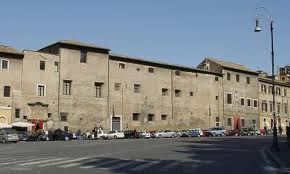
    Eventually the group of oblates got more organized and even obtained a monastery-like community house that is still active.  Here's a picture from the outside:

    Images(source)

     Such community life, complete with white veils and black habits, seems kind of unusual for people calling themselves Oblates:

    In March 1433, she founded a monastery at Tor de' Specchi, near the Campidoglio, in order to allow for a common life by those members of the confraternity who felt so called. This monastery remains the only house of the Institute.

    On 4 July of that same year, they received the approval of Pope Eugene IV as a religious congregation of oblates with private vows, under the authority of the Olivetan monks who serve at Santa Maria Nova. The community thus became known as the Oblates of Saint Frances of Rome. When her husband died in 1436, she moved into the monastery and became the group's President. She died in 1440 and was buried in that church.

    According to this site run by Benedictine Oblates attached to St. Scholastica up in Duluth, "Some consider St. Francis of Rome to be a patron saint of all Benedictine Oblates."  Her feast day is March 9.

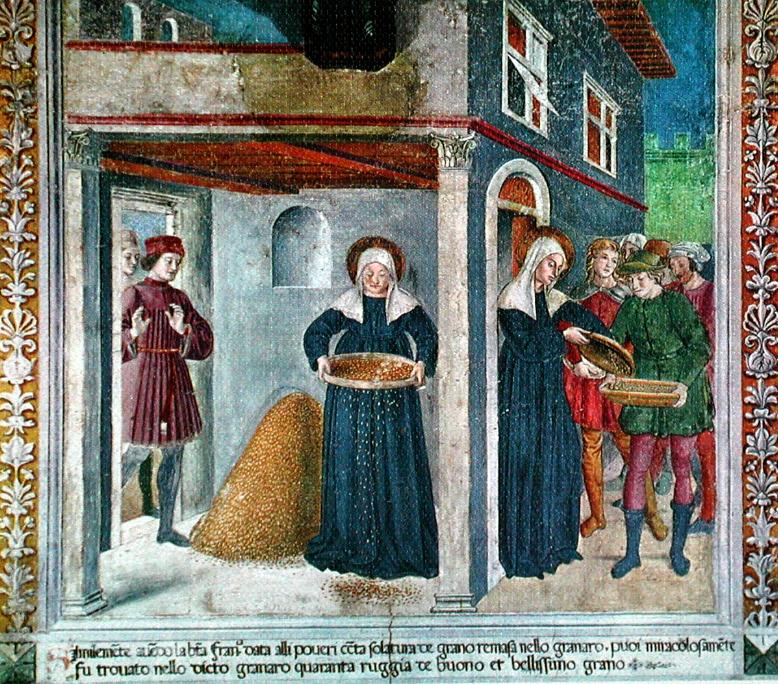
    This site has some photographs of the frescoes in Rome's Tor de'Specchi depicting Santa Francesca's life.  Here is one that shows the saint pouring out grain for the poor.  The writer of the site points out the lovely detail of the last of the grains spilling out, white "against her dark habit."

    Frmiracle5

    From that site:

    Santa Francesca Romana's Tor de' Specchi is very strictly cloistered, only opened to the public on two days of the year. 'We are not a museum', they sternly and rightly said. But their work of charity continues, their cloister filled not only with themselves but the elderly poor and poor young students with whom they share their wealth. As Oblates they ask for no privileges from the Church, they pay all taxes, and hence are loved down the centuries, theirs the only convent not subject to attack by angry mobs. They continue Benedict's Rule of work, study, and above all, prayer. Their faces today have the same contemplative beauty that is seen in these frescoes. 

    She was canonized in 1608 even though nobody knew where her body was buried because it had been hidden to protect it.  A search ensued, and her body was eventually found — I would like to know more about that particular mystery! — and reburied later.  Since 1869, when she was exhumed again, her body has been displayed in a glass coffin in the Church of Santa Francesca (was: Santa Maria Nova).

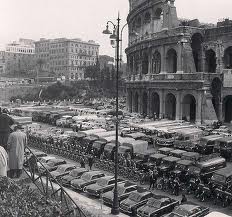
    So after all that, why is she the patron saint of automobiles and driving, and presumably of traffic?  What could have led to this situation, in which every March 9, Rome gets a little more congested as cars drive past the Church of Santa Francesca to the nearby Piazzale del Colosseo to get a special blessing?  

    Festa  (this is from 1952.  Source)

    Wikipedia sez:

    In 1925 Pope Pius XI declared her the patron saint of automobile drivers because of a legend that an angel used to light the road before her with a lantern when she traveled, keeping her safe from hazards.

    Because the Pope said so, capisce?  Nevertheless, I bet you won't forget Santa Francesca the next time you are stuck in traffic, fuming about the chaos in the city, the car in front of you no faster than a stubborn horse.    And remember:  however bad the traffic is here, it's probably worse in Rome.


  • Deficits in the homeschool.

    Lacking time this morning, I just want to pull an exchange out of the comments from the Moving the furniture post, and try to continue the discussion here more visibly.  It reminded me of a conversation I had on FB with another one of my commenters/friends.

    Tabitha:

    I am homeschooling an 8th, 6th, 4th, 1st, and preschooler. Next year I'll add in the now 3yo as a preschooler. I'll still have a barely 1yo at that time, too.
I consider this a one room schoolhouse, for sure.

    We're trying to make decisions for next year for high school for my oldest. The thought that keeps running through my head is that "There is a reason one room schoolhouses ended in 8th grade." I want to be able to make it work, and many families do. I'm just not sure I'm capable of adding high school into this mix.

    Any of your amazing readers have any thoughts?

    I wrote:

    Well, my plan for high school has been to try to get my kids as independent as possible before they get there! I figured that we would be spending a pretty big chunk of eighth grade working together — the eighth-grader and I and my husband that is — to decide what needs to be in the curriculum, which textbooks and other materials to use, and how we're going to put together his portfolio or whatever it takes for applying to whatever postsecondary institution he winds up being headed for.

     
    I haven't ruled out enrolling any of the kids in a traditional or nontraditional high school, if that is what it takes, to be honest. We are fortunate to live in an area where there are many schooling options, even à la carte coursework at a small independent Catholic academy centered around our parish.

    But we are also enjoying the benefits of co-schooling with other families, which has really opened up a depth of learning that I didn't think was possible to organize on my own, because we (the parents) have been able to specialize in areas of personal interest to us. But we're still maintaining the cozy familiarity of being among people who care about our kids and really know them.

     
    I guess what I'm getting at, with all that, is that the high school student ought to be taking on a lot of the responsibility for his own learning. He's got to. He needs to have the kind of self-discipline that most people don't have to show until they are a freshman in college, when Mama isn't around to make him do his homework anymore.

    I may be around, but I'm busy with younger kids, you know?

    Tabitha again:

     …My oldest 2 are already very independent.

    I thought my high school plan was going to work. 8th grade has shown me all the deficits, though, and I don't know if I can overcome them. She needs some one on one time and it's hard to make that consistently happen.

    I'm starting to see school through 8th grade as more general and high school as more specialized. I don't feel like I can do both justice. I've long envied your co-schooling set up. You are very blessed!

    Me again:

    "I'm starting to see school through 8th grade as more general and high school as more specialized."

    My theory: yes and no. You have to be somewhat specialized by that time, because there simply isn't time in the day to do everything, and so your student is going to choose to study some things and not others (or be constrained to do so in order to meet requirements she may meet later).

    But you can still be aiming for a strong liberal arts education, which is by definition well rounded and broad, with deeper "dips" here and there into areas of special interest to give a sort of taste of specialization. There is time for specialization in college or on the job.

    The proper place of high school is to develop the child's mind into the adult one, and to fine-tune the skills of self-teaching, the "lost tools of learning" that Dorothy Sayers wrote about in her famous essay. The subjects are just the material on which the mind cuts its teeth.

    Every school (home or institutional) has inherent deficits, and you could look at the ones in your own home school as teaching tools for learning how to learn — because identifying and remedying deficits in the resources available to you is a basic tool for self-teaching. I would say, bring the 8th graders into the discussion of what seems to be missing from their environment, and work together on the challenge of restoring it.


    There are a couple of different threads here worth picking up.  I wouldn't mind writing a co-schooling post discussing how it is that I (with my engineering degree) have so far "specialized" in teaching Latin and History to children, while my partner in co-schooling (with her English degree) has, maybe more predictably, "specialized" in literature and grammar, but also primary-school art appreciation, music theory, and handcrafts.  It all reminds me of the post that Amy Welborn wrote yesterday, "Gifts and Talents:  Overrated?"  To define my mission as "that for which I have been prepared" would be… rather limiting.   

    But what do you think, readers, about the idea of embracing the "gaps" in the available educational resources as an opportunity to learn how to learn?  Bringing the young person into the design of his own homeschool, understanding that no school can specialize in everything, every school of every kind has inherent limitations, and the home school is no different?  

    (Let's just take landscape as a starting point.  My homeschool is in the middle of the city, within easy reach of a huge library system, museums, theaters, historical sites, and parks… but I have a tiny postage stamp of a backyard, a neighborhood where people don't really send their kids outside to play, and not as much time as I would like to leave the city.  A rural child would get a lot more opportunities for gardening and in situ nature study, but maybe not so much museum and zoo time, or practice riding the city bus or walking to the library, or even my 11-year-old's beloved opportunity to study alone in a neighborhood coffee shop.)

    Anyway, my thought is that as you are approaching eighth grade and the start of high school, it is time to have a frank discussion:  What does the young person want to learn?  What external requirements must be met?   What can the homeschool provide?  What are its strengths and weaknesses?  How can the strengths be channeled best, and the weaknesses compensated for?  What resources does the homeschool have which remain untapped?  Where can the parent and the young person work together to bring them to fruition?  

    I know it's a bit cliché to recast a deficit as an opportunity — but in the case of the homeschool it strikes me as really true.  We are preparing these young people for life as a human being in the world.  The world is full of barriers, and human beings are full of deficits.  Learning to come up against them, and either work our way around them or live, constrained, with acceptance and humility, is a good thing.


  • Grabbiness.

    Attorney general Eric Holder recently gave a speech defending the extrajudicial targeted killing of American citizens overseas.  Emily Bazelon at Slate writes:

    We know now that the Obama administration thinks its lawyers don’t have to get a judge’s approval before a top government official makes the call to assassinate someone. As Holder put it, " 'Due process' and 'judicial process' are not one and the same, particularly when it comes to national security." …Holder didn’t explain how the administration arrived at the conclusion that due process within the executive branch is enough. He has refused to release the legal memo from the Office of Legal Counsel at the Department of Justice that must lay out how the administration got to here from there—the meat that was missing from his speech. And he didn’t say how the government arrived at the conclusion in September that it was OK to kill not just Anwar al-Awlaki, the radical American cleric in Yemen whom the government says is linked to underwear bomber Umar Abdulmutallab, but also Awlaki's son, Abdul Rahman al-Awlaki, who was also an American citizen.

    Emily Bazelon is hardly a right-wing critic of the Obama administration, I might add, and Slate is no Fox News.  

    I want to draw your attention to one particular point that Ms. Bazelon makes in her piece:

    … [I]f the Obama administration claims this kind of extra-judicial power for a few cases, what’s to stop the next president from expanding upon it—and citing this step as precedent for taking others that Obama wouldn’t countenance?

    Indeed.

    It's really gratifying to see this in print.

    This is the point that some of us have been trying to make about the infringement on religious freedom that is inherent in the HHS contraceptive mandate. 

    I'm not surprised that there are a lot of people who are happy to stick it to the Catholics here in exchange for "free" pills.  Oddly enough the same people seem to be fretting about the horrible theocracy that would be a Strawmantorum presidency.   So, like, I have to ask — does it even occur to people that someday, a right-wing Christian might make it into the White House again?  

    And, while I do not expect that a right-wing Christian president necessarily would stomp all over non-Christians' religious freedoms, I wouldn't be entirely shocked if he or she tried to.

    So, wouldn't it make sense not to set the precedent now?  Not out of sympathy to Catholics or other anti-choice weirdos, but just out of simple self-preservation, or perhaps…. deference to Constitutional liberties?

    + + +

    Let's talk mandate some more, this time the individual mandate.  We have the same problem outside the religious sphere, with the rather unprecedented infringement on economic freedom that is inherent in the very idea that the government can force you to buy a commercial product.

    This is another thing I don't get.  It's extremely hard to resist concluding that Democrats think this is a good idea… because the person in the White House has a "D" after his name.

    Okay, maybe they think it is a good idea because they like the thing that the person with the D after his name wants to force people to buy.  I can understand that.  I like health insurance.  I have some.  I am happy to have bought it.  I think it's a good bet for most people, most likely.  

    But it's like nobody has ever heard of "precedent."

    If this administration can force you to buy one thing, then the next administration can force you to buy another kind of thing.

    This is why people need to take a step back and think about the generalities.  Democrats want to grab power so they can do certain things that Republicans dislike.   Republicans want to grab power so that they can do other things that Democrats dislike.  There would seem to be bipartisan interest in preventing executive power-grabbing.  And yet, our team colors get so much more attention.

    Emily Bazelon, to her credit, noticed.  The precedent of executive secrecy that surrounds Holder's claim on the power to perform extrajudicial executions of citizens abroad — note, this means without trial – were set during the Bush 43 administration.

     [W]hen the executive branch won’t release the legal memos that underlie its decision-making, we’re blocked from evaluating how strong or weak the arguments are. When the federal government takes a bold and new step like this, testing the boundaries of the Constitution, it’s crucial for Holder and his lawyers to explain how and why. Instead, we’re being asked to take the wisdom of the president and his national security apparatus for granted.

    That’s a precedent that the Bush administration set in the bad old days of Attorney General John Ashcroft. It was this Department of Justice that produced John Yoo’s legal memos approving waterboarding and other interrogation techniques that amount to torture, the finding that the Guantanamo detainees weren’t prisoners of war protected by the Geneva conventions, and approved of warrantless wiretapping. Yoo’s legal innovations were dizzying—to put it kindly—and the leaking of his memos in 2004 was the first step toward official Department of Justice repudiation of them.

    I am a fan of transparency, and also a fan of judicial process, and consequently was no fan of George Bush's foreign policy in this area.  I acknowledge that national security needs make for a disturbing gray area both in transparency and in dealing with non-state military actors, but surely some accountability to the nation, through committees of our elected representatives, can be carved out even of our most pressing security needs.  

    I am not terribly surprised to see Bush's successor following in his footsteps here.  Democrats and Republicans may have significantly different ideas about how best to command a military, manage an economy, and lead the nation, but it is pretty obvious that politicians of all stripes never saw a power they didn't want to grab and hang onto for dear life.


  • Moving the furniture.

    Some time ago I attended a talk at our local Catholic homeschooling co-op, a lecture entitled "The One-Room Schoolhouse."  My friend The Road Scholar has put together an entertaining and informative presentation about how the teachers in American one-room schoolhouses in the late 1800s and early 1900s taught their subjects, managed their time, and maintained discipline in classrooms with dozens of children and young people who might be aged 3 through 20.  She  drew from her own family history and from primary sources like teachers' record books and employment contracts, and included lots of photographs as well as a sample daily schedule and a formidable sample eighth-grade graduation examination. (If you're currently looking for a speaker, I believe she's available for presentations to homeschooling conferences…)

    It turned out to be very inspiring, not in the spiritually uplifting sense, but in the kick-in-the-pants sense.  As in, If a twenty-year-old high-school graduate could provide quality instruction to twenty kids from kindergarten through eighth grade in the same room, then I can sit my five-year-old daughter and my eight-year-old son next to each other and teach them, too.

    There had been so much sniping and bothering each other, and also of each one disappearing from the schoolroom the instant I turn my back to attend to the other, that I had allowed my school day to become like this:

    MORNING:  Teach the eight-year-old, ignore the five-year-old

    NOON:  Hashslinging, decompressing

    AFTERNOON:  Teach the five-year-old, repeatedly shout at the eight-year-old to get back here and finish your independent work

    (Meanwhile, my eleven-year-old chugged through his to-do list without any input from me.  That kid spoils me.  But I should point out that he probably deserved more attention from me than he's been getting.)

    I sat down and thought about the differences between my schoolroom and the stereotypical One Room Schoolhouse.  

    (This is my schoolroom looking its absolute best:)

    6a00d8341c50d953ef0133f251090e970b-800wi

    There are a lot of them.  I don't have a big chalkboard, because I use lap-sized dry erase boards or printouts.  I have a thermostat instead of a woodstove.  I can send people around the corner to watch videos if that seems like a good idea.

    But probably the biggest difference is that my schoolroom has no place for me.

    In the one-room schoolhouse, the children sit and work facing the teacher, and the teacher works standing at the board or seated at a desk facing the students.  She can see all of  them at once, and this is true even if she is working one-on-one with a student at the front.

    My schoolroom has no "front of the room."  There is a countertop on which I prepare my lessons, but no place at the front for me to stand or sit.  Typically when I work with a child one-on-one, I pull up a chair next to him at his desk.  This works great for the child to whom I am attending, but then my back is to the others.  Distraction ensues.

    It isn't that I want to create "school-at-home."  I don't.  But right now I need to borrow a technique for helping two squirrely children stay on task while I work with them in turns.  

    Fortunately, the desks move (and are the same height and a carefully chosen aspect ratio):

    0306121335-00

    It's not great, but it is the best I could do in a pinch.

    See the desk with the dry erase board and marker on it?   I can stand or sit there.  Now my five-year-old can sit directly across from me, and my eight-year-old can sit at the desk on the right.   The eleven-year-old still has access to his desk on the left, although he has proven himself focused enough to be allowed to work anywhere in the house that suits him.

    I've been making my five- and eight-year-old plow through their work at their own desks, and insisting that they get permission before getting up to use the bathroom or get a glass of water.  (Trust me, they have plenty of opportunity; it is just that there has been a disturbing trend of conversations like this:

    ME:  Hey, 8-year-old, would you mind—

    8YO: I have to go to the bathroom!!!!

    [running feet]

    [faraway slam]

    [silence for the next 20 minutes])

    And I have a big basket of already-sharpened pencils on the counter behind me, so that excuse is gone.

    With the two of them right in front of me, it is much easier to work with them in turns.  When my daughter finishes a task, I can see it, and I can turn around and grab another assignment or at least a book for her to read.  When my son casually leans back to try and peek around the corner to see what his toddler brother is doing, I can catch him out.  For the most part, I can keep them on task, at least better than before.

    There is a lot of moping, and a lot of "Can't you make her be quiet?!?" but I am determined to allow them to learn how to work in the same room with each other, respecting each other's space and cultivating patience for the inevitable distractions.   Fortunately the bottoms of the desks are built like enclosed boxes, so they literally cannot kick each other under the table.  

    It's not that long.  Only about an hour in the morning and less than two hours in the afternoon.  With plenty of bathroom and glass-of-water breaks — between subjects.

    Speaking of subjects, I've aligned their subjects together now — which is to say that the 8yo works on his catechism during the same block of time that the 5yo listens to or reads Bible stories, that the 8yo has math lesson while the 5yo does math worksheets and vice versa, the 8yo writes in his journal while the 5yo prints in her copybook, and they both do independent reading at the same time.  

    This works shockingly more efficiently than my previous model, which was to teach one while the other (theoretically) worked quietly and independently.  The problem is that neither one of them seems to be developmentally ready to sit and work independently without help — not help with the math problems or sounding out words, but help staying on task.  Does it sound unrealistic to have a five- and eight-year-old sitting in chairs being directly taught for a two-hour stretch?  Trust me, it is more unrealistic to expect this five- and eight-year-old to decide where and how to sit and what order to do their work in, and yet complete their daily tasks.

    Still many bugs to be worked out, but I've got something that's going pretty well for these middle two right now.

    (And in case you are wondering what I am doing with the toddler, the answer is that I am coping as best I can.  He has a little table around the corner.  Today it has Play-Doh on it.  Tomorrow it may be something else.  I'm not above a video or two if it comes to that.  Sometimes I am lucky and he goes down for a nap just in time for afternoon school.)


  • “My Life as a Prison Wife.”

    Fascinating.  Inspiring.  Perspective-producing.  This short guest piece by Nicki Stapleton on the "Dear Wendy" advice column is worth a read.

    We got married on April 4th and just over a month later, on May 13th, my husband was arrested for armed robbery of two pharmacies. He didn’t take any money — just pills (and he didn’t actually have a weapon). I knew that he had a prescription drug problem but had been clean for over three years (he got clean about six months before we started dating) and I thought he was still clean. I was livid that he broke the law. I was livid that he didn’t come to me for help, but he said he was worried I would leave him because three things I don’t tolerate are abuse, cheating, and drugs.

    I was a criminal justice professional (I lost my job because of my husband’s arrest and conviction) and have a Master’s degree in criminal behavior. In four years of working with offenders, I have seen relationships survive prison but I have seen many more fall apart. If I had known that he was going to be arrested a month after our wedding (or at any point), I wouldn’t have married him. I love him, but love isn’t always enough. Less than nine months after he was arrested, and eleven months after we were married, my husband was sentenced to prison….

    The main question I get all of the time is “How do you remain faithful?” I used to take offense to this question, but I realize people are just curious. The answer is simple for me: I meant my vows. 

    Read the whole thing.

    An interesting clarification about her job loss from the comments:  

    I worked in a halfway house for sex offenders and had worked there for over 4 years. After he was convicted, I filed a fraternization exemption request (one of our policies was no one was allowed to be in a relationship with/live with/be involved with anyone who was under the supervision of the Department of Corrections) and they basically told me that they refuse to make any exception to the rule and told me either I had to not live with or speak to my husband or I had to leave. Thankfully I was already working elsewhere full time and was only working there on weekends.

    The rest of the comments are worth reading too.  I wish her and her husband well.


  • What grammar curriculum we use.

    A reader just sent me a question:

    What grammar book/series do you use? As you've noted on your blog about your dissatisfaction with pre-packaged science curriculum, grammar is my (and my husband's) "thing", so we're probably hoping for something that doesn't exist out there (grammar is so much my husband's "thing" that when he started teaching Latin at the local Catholic seminary, he wrote his own textbook because he wasn't satisfied with any out there).

    But I long-distance respect what you do, and I just thought I'd ask. We register at Kolbe Academy, entirely for the paper-trail it affords us, and then proceed to apply their "principle of subsidiarity" to substitute just about every single thing in their curriculum–either for same-series-but-higher-level, or for completely-different-book. I'm not averse to supplementing, cobbling together, etc. 

    My answer:

    Oh goody, here is a question I can answer.

    The big disclaimer here is that H., my English-major partner in co-schooling, has always managed the grammar. She teaches it from the (free! online!) K.I.S.S. Grammar books by Dr. Ed Vavra.

    (Warning: the website looks like it was designed in 1995.)

    You can download workbooks from the website and then print them. We printed them double-sided and took them to a copy shop to be spiralbound, and then worked with them as if they were conventional workbooks (which makes them not exactly free, I guess, by the time you pay for binding). The grade levels are not exact and have to do more with the reading level of the texts used for analysis

    I personally find it hard to navigate the website. It is probably easiest to choose which workbook to use if you just download the workbooks as .doc files from the links on this page and then open them in Word and page through them.

    I don't think H. even bothered to print out the answer key pages for the books, because she didn't need them, but they are there if you want them.

    Check them out and let me know what you think. I really think the K.I.S.S. Grammar is a hidden gem.  We have been particularly pleased with how well it dovetails with teaching Latin.  I recognize that a traditional, analytical grammar curriculum doesn't please everyone, but if you're doing Latin or a similarly heavily inflected language, it really saves teaching time overall, I think.


    UPDATE:  Here is a little extra information from H. who does the actual teaching, answering a mutual friend who was asking about using it for her 10-year-old son.

     …It should work well to learn along with the kids. The first few levels of KISS are a level of grammar that any person literate in English will be familiar with, so the learning part will be to learn the marking procedures and vocabulary if that is rusty. Once you get the hang of the marking, it should be smooth sailing. Either review the provided answer key before he does the sheet or complete the exercise yourself and use that as the answer key. ( I cheat and don't often use the answer key because of unnecessary grammar nerdiness). 

    In the first level, he'll only be explaining the basic 'skeleton' of the sentence: subject, verb, and the broad class called complements which includes direct and indirect objects, predicate adjectives and predicate nouns. KISS adds to the level of analysis fairly slowly. The kids get to watch themselves being able to explain more and more of the words in the exercise as they move through the program. [Our kids, age 12 and 11] have been working through it for three years. When they began they explained only two words in each sentence. Now they have gotten to the point that they can explain all the words in most sentences, even ones written by people like Jules Verne and Mary Wollstonecraft Shelley.

    KISS doesn't spend a lot of time on explaining analysis– it spends most of its time on making them perform the analysis, which is why I love it. 

    The material covered with the program is found in the links at the bottom of the "workbooks" page that are called the Master Collection of Exercises. The material is divided into six levels, which are subdivided into concepts.

    • Level One covers basic grammar, like subject/verb, prepositional phrases, adjectives and adverbs, pronouns, complements to the verb, compounding, and punctuation.
    • Level Two helps the kids through problems they may have encountered when applying the concepts in Level One. It introduces concepts like understood subjects, embedded prepositional phrases, phrasal verbs, and infinitives.
    • Level Three is primarily concerned with main and subordinate clauses in all their variations, and the function of subordinating conjunctions. 
    • Level Four covers gerunds and infinitives (in all their grammatical functions as single words, and also when they function as ellipsed or reduced clauses in the conditional or subjunctive)
    • Level Five practices everything they have previously learned and teaches the noun absolute as an extension of appositives.
    • Level Six allows for integrating their grammar practice into their wider reading, writing,and literature studies.

    The grade 2 workbook covers levels 1 and 2. The grade 3 workbook also covers levels 1 and 2 plus a few constructions from other levels. The grade 6 workbook covers levels 1-4.

    The main difference between the grade levels is the type of text they are given to analyze. A typical grade 2 text is taken from Beatrix Potter, Thornton Burgess, etc. A typical grade 6 text may be from Howard Pyle, Longfellow, Frances Hodgson Burnett, or Robert Louis Stevenson.

    The main thing to remember is that if you start with the grade 3 workbook, you *won't* repeat level 1 or level 2 when you move on to the grade 4, 5,or 6 workbook. You will skip the pages of that workbook that introduce level 1 and 2 concepts. You'll start at the level 3 exercises unless you think he needs review of the last concepts studied. They should never quit marking the things they've already learned about as they learn new things, so practice of older concepts is built-in.

    …There's no particular reason to start [a 10-year-old] in [the 4th grade level] if his comprehension and vocabulary are advanced. I bet you could start with the 6th grade book. Here is the first question of the first exercise from four different grades:

    Grade 2:

     1. The three little rabbits lived in the woods.

    Grade 3:

    1. Grethel shared her bread with Hansel.

    Grade 4:

    1. A King and Queen were perfectly happy.

    Grade 6:

    1. Her appetite grew amazingly.

    So, not much difference there.

    However, by the eleventh lesson in the sixth grade book the selections are more like this one:

    Perseus wondered at that strange cloud, for there was no other cloud all round the sky; and he trembled as it touched the cliff below. And as it touched, it broke, and parted, and within it appeared Pallas Athene, as he had seen her at Samos in his dream, and beside her a young man more light-limbed than the stag, whose eyes were like sparks of fire. By his side was a scimitar of diamond, all of one clear precious stone, and on his feet were golden sandals, from the heels of which grew living wings.

    The vast majority of the texts are taken from classics, and I can't think of objectionable material off hand in the sixth grade lessons outside of fairy tale violence like "Bluebeard", etc. I'm using a mix of 6th, 8th, and 9th grade lessons with the 11, 12, and 14 yr olds I'm teaching. Last year they all used the 3rd grade workbook, and they've had no trouble jumping from that to the higher grades material.

    So there you go.