bearing blog


bear – ing n 1  the manner in which one comports oneself;  2  the act, power, or time of bringing forth offspring or fruit; 3 a machine part in which another part turns [a journal ~];  pl comprehension of one’s position, environment, or situation;   5  the act of moving while supporting the weight of something [the ~ of the cross].


  • The Paleomom: Unmasked.

    She's no longer just a stick figure.  Go read her story.

    (A link I was saving for a slow day.  Paleo Mom is a well-written blog, mostly nutrition-related, by a self-described "scientist turned stay-at-home mom."  If you like me, you'll probably like her.)


  • Charting unmarried.

    Simcha is defending teaching cycle-charting to the unmarried, including teens, here:

    I responded in the comments with my story of learning fertility tracking in college:

    “I was in college and unmarried when I first even heard about NFP. I was a fairly new Catholic and I knew the Church opposed artificial contraception but it took a while before I found out that there was any kind of effective family-planning alternative. (Somehow, they never covered this in RCIA—either that the Church opposed contraception or that any licit recourse existed for married couples who judged it prudent or necessary to space children).

    As you can imagine, the months between finding out (a) that contraception was not, in fact, an option ever and (b) that NFP exists were somewhat freaked-out ones.

    When I did learn about NFP, probably from the little baby internet we had back then, my first thought was: “You have got to be kidding me! I have to try this!” Sort of in a “how cool is that?!” sense. So I tried to order a copy of a NFP textbook from a nationally known NFP teaching organization, and they wrote me back to tell me it was a BAD IDEA for a young unmarried woman to fall into the temptation of knowing how her cycles worked.

    I knew perfectly well where to get free condoms—I was a state university student, after all, they practically leave them like mints on your pillows at the dorm—so I concluded that whatever assumptions the NFP teaching org adviser was making didn’t apply to me, and persisted in my search to find out how to do this cool trick where you could find out when you would have your period.

    So I went to the library, where I found a slightly out-of-date edition of the same textbook (hint: it had daffodils on the cover), made myself a chart in Microsoft Excel, and about seven weeks later experienced the twin sensations of WOW IT WORKED THAT IS SO COOL and I HAVE BEEN LIED TO MY WHOLE LIFE ABOUT MY OWN BODY. The experience was faith-strengthening. I continued to chart until I was married several years later.”

    I am still about 6 years away from my second trip through female puberty, but it probably won’t surprise you that I am an advocate of teaching young people about NFP in adolescence. The details aren’t worked out yet, though, and so far none of the kids have thought to ask about the charts on the bathroom counter, which I would be too lazy to hide even if I were of a mind to hide them.

    (That is probably an exaggeration. I manage to put them away every month before the house cleaners come.)


  • Amy Welborn on why she is switching to un/home/roamschooling.

    From Charlotte Was Both:

    I highly recommend having babies in your mid-forties.  Being the parent of a second grader when you’re 52 is an awesome way, not only of working with @God to make more @humanbeings (always fantastic), but also of tricking yourself into thinking you are pretty much the same as the hot little 28-year olds driving their Rav4′s and XC90′s  to carpool and that you are not actually, you know, so freakin’  old.

    But, that wasn’t my point.

    My point was that I have been doing the – (deep breath)  – school supplies  - does your uniform fit? – your teacher wants what? we just bought all the school supplies – book covers? Why do we have to do bookcovers?  - welcome to our SCHOOL FAMILY –  parent/teacher meeting – beginning of the year orientation – parent/teacher conferences – giftwrap sales – please return these papers signed on Tuesdays – please return THESE papers signed on Mondays – I have to find an article for music class – but I get extra credit if you go to the PTO meeting! – make an adobe model out of sugar cubes – is your field trip shirt the green one or the blue one? – yes, I signed your planner – wait,don’t throw that away, we need the box tops – SCHOOL FAMILY – you need a check for what? – do you have hot lunch today or not? – candygrams – wait, is it a jeans day today – boosterthon? Try not to run too many laps, okay?  - please send cupcakes/cookies/goldfish but NO PEANUTS – POSTERBOARD – SCHOOL FAMILY.

    – thing for twenty-five (25) years.

    I get tired just  reading that!  

    Occasionally you will run into a woman who says she won't have kids because of what it does to your body. I'm sure there are other reasons for which this is just shorthand or representative small talk, but I've always found the comment silly.   Of course, one's body will eventually break down and quit on you whether you have children or not.  

     Similarly, I sometimes meet people who tell me that homeschooling "sounds exhausting."

    You've got to raise your kids somehow.  Frankly, all of the ways are exhausting.  You get to pick the way you want to be exhausted, not whether you have to get exhausted.

    I like my way.  

    I hope you like yours, too!


  • Just in case.

    In the "and now for something completely different" category — I always thought of the Swiss as having a military that was mostly good for ceremonially guarding ceremonial things.  

    But apparently that's just a front, because Switzerland's military has been busy building booby traps:

    [T]he Swiss military has, in effect, wired the entire country to blow in the event of foreign invasion. To keep enemy armies out, bridges will be dynamited and, whenever possible, deliberately collapsed onto other roads and bridges below; hills have been weaponized to be activated as valley-sweeping artificial landslides; mountain tunnels will be sealed from within to act as nuclear-proof air raid shelters; and much more. 

    From a 1984  book by John McPhee called La Place de la Concorde Suisse:

    "To interrupt the utility of bridges, tunnels, highways, railroads, Switzerland has established three thousand points of demolition. That is the number officially printed. It has been suggested to me that to approximate a true figure a reader ought to multiply by two. Where a highway bridge crosses a railroad, a segment of the bridge is programmed to drop on the railroad. Primacord fuses are built into the bridge. Hidden artillery is in place on either side, set to prevent the enemy from clearing or repairing the damage."

    And you thought the little knives were clever:

    McPhee points to small moments of "fake stonework, concealing the artillery behind [them]," that dot Switzerland's Alpine geology, little doors that will pop open to reveal internal cannons that will then blast the country's roads to smithereens. Later, passing under a mountain bridge, McPhee notices "small steel doors in one pier" hinting that the bridge "was ready to blow. It had been superceded, however, by an even higher bridge, which leaped through the sky above—a part of the new road to Simplon. In an extreme emergency, the midspan of the new bridge would no doubt drop on the old one." 

    By the time you get to the end of the blog post, you'll be convinced that the Swiss intend to singlehandedly repopulate the planet after the doomsday device goes off — and that they have some chance of succeeding.  But the book is Cold-War era; maybe they haven't been keeping it up for the last 20 years, who knows?


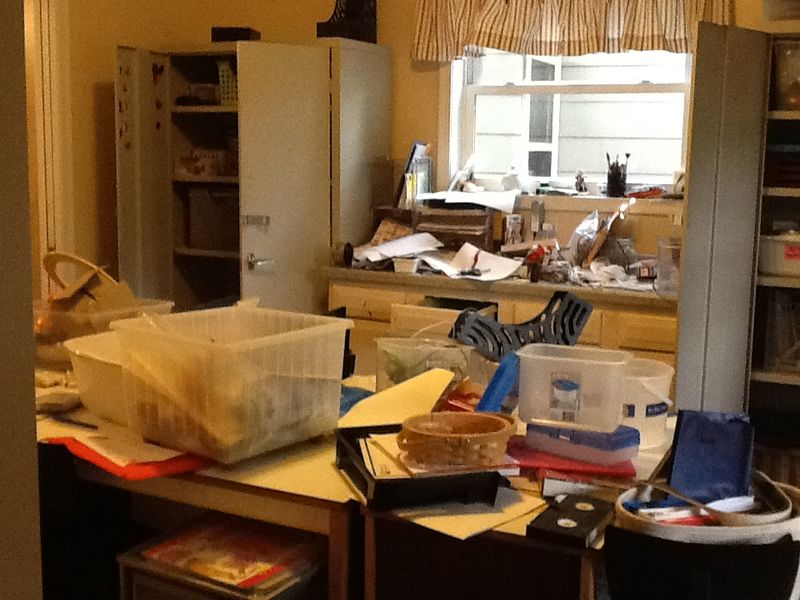
  • Five days into the schoolroom cleanout…

    Photo-20

    …this is what is staring me in the face.

    I finished emptying the tall cabinet you can see at left, as well as its out-of-the-frame twin.  

    There is a big pile of stuff on the floor of Mark's basement shop, on the grounds that it's one spot in the house which he will eventually insist that I reorganize.  Theoretically I will be pulling items from the basement and putting them into the schoolroom to use next year, and this will make room for the pile on the shop floor.  We shall see.

    Regardless, this kind of work, though tiring, and creating a demand for chocolate, is immensely satisfying.  I love emptying shelves of all their crud and getting in there with a dust cloth and then putting new things in.  I feel like going in with masking tape and marking the outlines of everything I put in there.  

    The children are watching a lot of movies.  Whatever.  It's the first week of vacation and they're spending the first three hours of the day at Catholic Vacation Bible School and by the time they get home it's really hot.  Could be worse; could be seals escaping and roaming the streets.

    OK.  Back to work.  


  • Mwahaha!

    Amy Welborn is one of us now!

    I will be really interested to hear about this "roamschooling," which is a great word that I never heard before but that I wish I had thought of.  Every once in a while, the possibility flutters to the surface that Mark may get sent to a plant start-up in some interesting place for many weeks in a row, and we muse about swooping the whole family off to Australia or France.  Then it flutters away again.  One of these days we may catch it.

    The nature of co-schooling, such as I do it, is that it pins us down a little more than I might otherwise like.  We have created ties to other families in our area, and so I turn down field trips and such if they happen on the wrong days of the week, etcetera, because I'm committed to teaching Latin and history to some kids who aren't mine.  But we are getting better at weaving in and out of our different family vacations and things, what with e-mail and Skype and the History Backup Plan, which can be summed up as:  "Uh — sorry we can't get together.  I was going to do Louis XIV today.  Google something for them."  

    (Here's an old post on what to do when you can't get together on a co-schooling day.

    Anyway, head over to Charlotte Was Both and be encouraging!   There are times when I think it would be so horribly hard to be a single parent homeschooler, and other times when I think — if I was a single parent, it would be soooo much easier to homeschool than to send the children away, if I could possibly manage to make it happen.  I cannot wait to hear how the story unfolds in her own family.  I hope she writes a book about it. 


  • “Don’t Eat the Marshmallow.”

    I stumbled across a three-year-old article from The New Yorker that is an entertaining read about the “marshmallow study” — the one in which four-year-old children were tested, about 35 years ago, to see if they would choose one marshmallow NOW or be given two as a reward for waiting a few minutes. The point of the test was to examine the successful children’s self-control strategies, but even more interesting results came many years later, when researchers followed up on the now-grown children and found that the self-control they exhibited as preschoolers strongly predicted markers of success as older children and adults.

    Here is the link to the article: http://www.newyorker.com/reporting/2009/05/18/090518fa_fact_lehrer?currentPage=all

    I recently revisited the book Willpower, which I have written about before in a sort of piecemeal fashion, and am working on a post summarizing the, I don’t know, tips that you might get out of it for extending self-control. Will follow up later, but for now, enjoy the marshmallow article.

    Previous posts on the book Willpower:
    Review part 1: http://arlinghaus.typepad.com/blog/2012/01/book-review-willpower-rediscovering-the-greatest-human-strength.html
    Review part 2: http://arlinghaus.typepad.com/blog/2012/01/book-review-part-2-glucose-and-willpower.html


  • Quick poll: Grocery store munching edition.

    Eating your groceries in the store while you are still shopping and before you have paid for them: okay, not okay, or "it depends?"

    Please discuss.  


  • Morning quote.

    I thought this bit was well stated and highlights a frequent error you see in science journalism.

    “Warning klaxons should sound whenever alleged scientists” [or science journalists — ed.] use the word ‘consensus.’ What we’re looking for is ‘evidence’ or ‘experimental results,’ not ‘consensus.’ I believe you could easily get a consensus among scientists that ‘my field of study should be better funded’ or ‘hot members of the targeted gender should find scientists more attractive’ or maybe ‘huge, throbbing foreheads should be the key marking of sexual desirability.’ Whatever. But nothing in a consensus indicates anything about that consensus being backed by science – only backed by *scientists*, a subtle but critical distinction.”

    (from a post at Yard Sale of the Mind — here: http://yardsaleofthemind.wordpress.com/2012/04/27/science-distinguishes-hard-thinking-verus-faith-using-the-ever-popular-smart-versus-stupid-cleaver/ )

    + + +

    The preponderance of the evidence pointing a certain way generally produces a consensus. But a preponderance of evidence is not the only phenomenon that can produce one — no, not even among scientists.

    As a lifelong geek who loves a good story, I count “history of science and technology” as my favorite nonfiction genre. Probably the biggest literary influence on my career choice was the collection of historical essays gathered together under the title _Asimov on Chemistry_, which I found in my public library when I was fifteen or so. It is a good thing I did not discover _The Making of the Atomic Bomb_ by Richard Rhodes until it was too late for me to major in physics. I am beyond pleased that James Burke’s _Connections_ series remains among my children’s favorite DVDs.

    To be deep in history is to cease to be impressed by consensus qua consensus. It isn’t the same as that disdain the public sometimes has for rapidly-changing headlines, such as you see as they cycle through the latest health-danger-warning (“so x is bad for you now too, huh? I remember when not getting enough x was supposed to be bad for you. Just goes to show they don’t know what they’re talking about”). Nor is it the same as the raised eyebrows that go with the often-too-swiftly connected dots between “Results” and “Discussion.” (Although spotting the exact point along that path when a paper author steps across the boundary of his expertise is always a fun pastime.) It is not even just the awareness of how many times a consensus has been overturned, nor a philosophical rejection of the idea that a “science” can ever be “settled” and still remain science.

    I think for me it is an interest in the paths to consensus. Every consensus has been arrived at by a certain sequence of events. When I was fifteen or so, I was captivated by Asimov’s essay “Slow Burn,” which could have been subtitled “How The Consensus Against Phlogiston Got Started,” particularly the ending (Priestley and Cavendish did not live long enough to be convinced that phlogiston was bunk). I think it rather programmed me to wonder about the backstory– all the time. Exactly how did we get where we are? Which are the key papers? Which personalities have championed which theories, and why? When some future, technically-adept storyteller sits down to pull it all together in a canonical account, one that (along with the technical insights, tests and conclusions) assesses the human strengths and weaknesses, quirks and mediocrities too, in all the key players, what tale will emerge?


  • Good idea, bad idea: Bargain-hunters edition.

    This one's so short it's practically a Quick Take.

    + + +

    Good idea:  Going to the used book sale and snagging a half-price deal on the pricey art workbook that's part of next year's curriculum.

    Bad idea:  Neglecting to check the table of contents or copyright date, thus failing to notice that it hails from twelve years and several complete revisions ago, and therefore doesn't match up with the assignments in next year's art curriculum.

    Boo.


  • Bubble wrap.

    Jamie's son took a hard fall at the playground the other day (sounds like a concussion to me) .  Here's her ER story.  

    Today she's getting back on the horse:

    I remember a college acquaintance opining that safer playgrounds were to blame for the decline of hardihood and determination in American youth. …My kids gripe about it too: one of the playgrounds near our house is much less fun than it used to be. 

     …For years I have wanted my kids to play hard on the playground: to get stronger, to figure out new skills, to wear themselves out so they would take longer naps. (Wait, perhaps I shouldn't admit my secret agenda.) I have rolled my eyes inwardly at parents who seemed to want to control the playground experience. "No, no, Sadie!" they say. "We go UP the steps and DOWN the slide." Isn't it more fun to go up the slide and then down the slide some more? Is there a rule against going up the slide? Aside from the Big Rule, of course: Don't Be A Jerk. If someone's waiting to go down the slide, or heading up the ladder in preparation for going down the slide, then you don't go up the slide. If there are littler kids around, you are vigilant about their safety even if you have to slow down your own fun. Courtesy trumps fun. But fun is the reason we have playgrounds, isn't it?

    And then. Friday. My little guy's little body, the body I bore and nursed and diapered and tended — motionless after that horrifying thud.

    I would insert a joke here about bubble wrap, but I can't even joke. We're scheduled to go back to that park for swim lessons tomorrow, and I don't want to go. This is the wrong thing to take from his accident. Even as I was biking home that day, grateful for a fast bike and strong legs and good health insurance, I thought, "This should teach me not to be so fearful, because it's so easy to fear the wrong thing and the actual disaster always takes you by surprise."


    I have to squelch the desire to say "No" to things all the time. I send the kids out on their bikes knowing full well that they could be hit by cars or accosted by random nasty persons or or or or….

    I remind myself daily that there is also a huge risk associated with never taking risks. This is the belief that sustains me.  And it's the sort of thing you have to hang onto, because you just know that, with everybody so focused on blame blame blame, an accident is never allowed to remain just an accident anymore.  Someone must always be at fault.   There oughta be a law.  Every mother harbors the knowledge, it seems,  that should something bad happen to one of your kids, God forbid something that makes the papers, not only will you be suffering your own regrets, but you'll be bearing society's evil eye and possibly charges of abuse and neglect.

    Still:  I firmly believe that to protect our children from every hazard is to refuse to bear one of the fundamental crosses of motherhood.    

    So it happens to be countercultural these days, to let kids explore their own limits.  Since when has cross-bearing been popular?


  • Handwriting for boys: good idea, bad idea.

    The following recent idea of mine appears, at the time of writing, to be a good one:

    + + +

    My eight-year-old son is squirrelly; wiggly; given to making random loud noises of gunfire; constantly doodling ninjas, sharks wearing explosive vests, gratuitously well-armed employment opportunities, and fantastic attack vehicles with all sorts of pointy bits sticking out; never voluntarily positioned in any way that could remotely be called "seated;" easily distracted; hard to hold onto.

    No, I don't think he needs a diagnosis of any kind.  I'm fairly certain that all this is within the normal range of "eight-year-old boy."  

    He wasn't very much different one year ago, when I was looking at the start of second grade for him, and amassing curriculum materials.  I picked up the second-grade handwriting workbook I had ordered for him.  I looked it over.  It started with review of printing, then introduced cursive, what we sometimes call "attached writing" around here.

     (No, I am not going to get into whether it was D'Nealian or Zaner-Bloser or whatever.  I just call it all "cursive."  Anything deeper is micromanaging.)

    Mind you, I think that neat and tidy handwriting is important.  Develops care and attention, is a type of artistic expression within limits, is an opportunity to fine-tune the motor skills, gives children a chance to practice a manual skill and work towards creating small things of beauty in their everyday lives.  And of course kids have to learn how to read other people's handwriting, even if they themselves mostly get by with typing and printing.

    But as I flipped through that second-grade cursive handwriting workbook, I knew that if I tried to make my then-seven-year-old sit still long enough to do all that… well… there wouldn't be much time for other writing.  It was hard enough, then at the beginning of the second grade year, to get him to write anything at all in any kind of writing.   I would turn my back and he would have wandered off, mid-sentence.  I would ask him to write a sentence and he would whine about how many words were in it.  

    I put the book away.   Maybe I won't even bother, I thought.  I was really the only person in the house who cared about handwriting.  My husband thought it bordered on archaic.  My older son printed everything.  I decided it was not worth the battle.  I did not teach him handwriting in second grade.

    Fast forward nine or ten months, to the last couple months of second grade.   The eight-year-old boy is still squirrelly and wiggly, and still doodles constantly, and still never sits down.  But he has (thanks to a lot of daily journal writing and composition assignments, which have steadily and relentlessly and slowly expanded in length and complexity over the course of the year) learned how to write five or six sentences in a row without complaining.  Much.  He has also learned to read for fun, which is a big help in the staying-still department.

    And meanwhile, his five-year-old sister has learned to write letters which are shaped well, if large, and has started begging to learn cursive like her older friend.  Also at the same time I have recently instituted a policy of teaching the five- and eight-year-olds together at the same table at the same time, which saves time and also cuts down on escapees.  Which gets me thinking:  Maybe I can teach them both cursive now, at the same time, at the same rate.  

    So I start talking it up, a couple of months before the five-year-old finishes her printing workbook.  "When you finish all the printing exercises, I'll get you an attached-writing book, and you can start to learn that kind of writing," I tell her, "and I'll get one for you, too," I tell him, "and I'll teach you both at the same time."  To my shock he seems interested.  And when the books arrive a few weeks later and I start them on A-a and E-e, to even more of my shock, the eight-year-old cheerfully copies the letters the way I show them, proudly shows me his best specimen, comments on how cool they look and how fast he can write them, and innocently suggests that his letters look better than his sister's (receiving a kick in return, which I pretend not to notice).

    It turns out that waiting a year to try cursive writing with him, even though all the curricula (it seems) start cursive in second grade, was a great idea.  He has more attention for it, and oddly enough, he actually seems interested.  I'm not sure how to explain this.   Maybe the smoothly flowing lines appeal to his doodly side.  Maybe it feels like writing a secret spy code, or like Chinese calligraphy.  Maybe it's competition with his sister.  Maybe he was simply developmentally ready for this task.  Whatever it is, I'll take it.  

    + + +

    This good idea does, incidentally, have a bad idea behind it.

    My oldest son (now 11) has always been a fairly diligent, seatwork-loving sort of boy, with an appreciation for symmetry and straight lines, and good fine-motor skills.  When he was seven years old and starting second grade, I thought he'd sit down and learn cursive from the copybook and that would be that.  I told him all about how he'd be able to write faster in cursive, how important it would be for him to sign his name on documents, how pleased his grandparents would be to receive handwritten notes from him.  I opened up the second-grade handwriting book, and we got started.

    He dutifully copied the letters, words and phrases in the copybook.  But when we started to get to sentences it began to take him longer and longer to finish.  I waited for cursive writing to appear in his daily journal entries, and it never did.  I started to suggest that he could try a little cursive in the journals.  No cursive appeared.  Finally I began assigning him to write in cursive.

    The journal entries got very, very short.

    "You'll get faster," I said.  He did not.  After a while printing started to appear again.  I reminded him he was supposed to write in "attached writing."  He stopped writing interesting and funny journal entries and started writing very short ones with very short words.  

    Time passed with this back and forth.  He got older.  I would assign him a piece of writing, and he would look up at me, worried, and ask, "Does it have to be in attached writing?"  The problem, from his point of view, was that he could not write in cursive very fast; he thought faster than he could write, and it took him so long to write in "attached writing" that he could not get all his work done.  Tears were shed almost daily for months.

    I fretted about the right thing to do.  What was more important?

     That I stand my ground and show him that I would not back down just because he didn't like a task?  

    That he be free to concentrate on learning the structure of paragraphs and sentences, on expressing himself clearly and correctly — obviously more important than cursive, and something that he had just been blossoming into (with printing) when I came along with my stupid cursive handwriting book and ruined everything?  

    That he endure the rough part of skill-building, painstakingly practicing, and writing slowly and uncomfortably at first, until he developed enough fluid comfort with cursive writing that he could start really using it as a tool to express himself?

    In the end I gave up.  It never seemed to get any easier for him, and I started to worry that my stubborn insistence that he write everything in cursive was going to hold him back from the real business of word-craft.  His printing was and is perfectly legible, and he learned enough that he can at least read the cursive handwriting of others.  I told myself that this was good enough.  His father certainly thinks so.

    But I still wonder where I went wrong.  Was it in assuming that seven was the right age to start, just because the book said so?  Or did he fool me into letting him get out of learning something he didn't want to learn, by pretending it was too hard?  Or am I still wrong in regretting that this particular learning attempt failed, because handwriting isn't all that important and obviously he had no intrinsic motivation, so it would have been a waste of time anyway?

    Somewhere in there is the source of the rot in this particular bad idea.  But at least I learned enough to pay attention to my second son, and to give the benefit of the doubt to waiting.