bearing blog


bear – ing n 1  the manner in which one comports oneself;  2  the act, power, or time of bringing forth offspring or fruit; 3 a machine part in which another part turns [a journal ~];  pl comprehension of one’s position, environment, or situation;   5  the act of moving while supporting the weight of something [the ~ of the cross].


  • Postsecondary education questions: the provider’s education.

    (This post is part of the series on postsecondary education.)

    + + +

    I am not completely pleased with what I am about to do. I recognize that education is about learning to be a "whole" human being, and about integrating education in the humanities with education in human craft and science to make a unified whole.

    But my gifts are in analysis, not synthesis, and my inclination, presented with a whole that I cannot completely grasp, is to take it apart. So I am going to do this with the necessary content of education. I want to take those pieces which seem most to be about this aspect of vocation:

    More practically, the vocation of all men and women is "to provid[e] the substance of life for themselves and for their families," thereby "performing their activities in a way which appropriately benefits society…unfolding the Creator's work, consulting the advantages of [others], and are contributing by their personal industry to the realization in history of the divine plan." [Gaudium et Spes, par. 34]

    So here is a carefully chosen subset of the items most directly and practically relevant to the act of providing for oneself and one's family. At the end, I will draw some conclusions.


    Provider skills that THE FAMILY is expected to inculcate and teach, or to delegate to trusted others

    That the human being is a person, not an object of trade.

    The family teaches children freedom with regard to material goods, and that man is more precious for what he is than for what he has, by a simple and austere lifestyle.

    The family must train the children to express calm and objective judgments which will guide them in the choice or rejection of media that is available.

    The family should teach by example how to care and take responsibility for the young, the old, the sick, the handicapped, and the poor.

    The family must provide for children an apprenticeship in self-denial, sound judgment, and self-mastery.

    The family should educate children to have a mature sense of responsibility with which they can follow their vocation, and in such a way that each may fully perform his or her role according to it.

    The family should, at the right moment, integrate the religious formation of young people with a preparation for life as a couple.

    The family should educate children so that, if they marry, they can by means of that education establish their family in economic conditions which tend to promote or facilitate the establishment of that family.

    The family, in proximate preparation, will assist individuals in gaining the basic requisites for well-ordered family life, such as stable work, sufficient financial resources, sensible administration, notions of housekeeping.

    The family will encourage in the proximate preparation for marriage the study of the nature of responsible parenthood, with the essential medical and biological knowledge connected with it.

    The family will acquaint a person, in that proximate preparation, with correct methods for the education of children.


    Provider skills that THE INDIVIDUAL is expected to develop in himself

    Each man has the duty to retain an understanding of the whole human person in which the values of intellect, will, conscience, and fraternity are preeminent.

    A Christian is encouraged to strive to understand the ways of thinking and judging of other men of their time.

    A Christian is encouraged to blend new sciences and theories and the understanding of the most recent discoveries with Christian morality and the teaching of Christian doctrine.

    A layperson is encouraged to receive a sufficient formation in theology.

    A Christian must recognize the legitimacy of different opinions with regard to temporal solutions.

    An individual learns control and right use of one's inclinations — based on the esteem for authentic human values instilled by the parents.

    An individual develops his authentic maturity by building on the virtue of chastity

    An individual develops the manner of regarding and meeting people of the opposite sex — based on the esteem for authentic human values instilled by the parents.

    An individual becomes capable of respecting and fostering the nuptial meaning of the body by building on the virtue of chastity.

    An individual grows responsibly in human sexuality by building on the moral norms that are taught by the parents.

    Young people gain sensible administration and notions of housekeeping — by building on the assistance they got in their proximate preparation for marriage.

    Young people gain stable work and sufficient financial resources — by building on the assistance they got in their proximate preparation for marriage.

    A person establishes his family in favorable moral, social and economic conditions by means of the education provided by the family.


    +++

    One thing I notice here is that in education, pretty much every economic good is explicitly connected to marriage and the family. Education that assists in obtaining "stable work," "sufficient financial resources," and "favorable economic conditions" all are integrated with marriage preparation.

    It strikes me that it's one thing to insist that the education dollar be well invested, to return a good value in future earnings. It is quite another to insist that the education dollar be invested so that a family can be well established.

    I am becoming more and more convinced that large debt is positively to be avoided in postsecondary education, because having a great deal of debt is a demonstrably unfavorable condition in which to establish a family.

    We can bring this full circle, by the way, recognizing that the young people establishing their own new family have the same responsibilities toward their children, and some of those responsibilities are vocational.

    Parents must make decisions carefully and wisely for the good of the family: they must "reckon with both the material and spiritual conditions of the times as well as of their state in life," and they must "consult the interests of the family group, of temporal society, and of the Church," in order to "thoughtfully take into account both their own welfare and that of their children, those already born and those the future may bring" [Gaudium et Spes par. 50]

    In fatherhood, "a man is called upon to ensure the harmonious and united development of all the members of the family… by work which is never a cause of division in the family but promotes its unity and stability" [Familiaris Consortio par 25].

    The work of a married man, in other words, is limited to work that promotes the unity and stability of his family. Different families can probably absorb different kinds of work in this respect.

    + + +

    An education that fails to give a young person the tools to find stable work and sufficient financial resources to establish a family in favorable economic conditions is, it seems, a failed education. An education that emphasized the wrong things. An education gone wrong. A miseducation.

    Can anyone disagree with this?


  • Post secondary education questions: Classical liberal arts in high school – a solution?

    (This post is part of the series on postsecondary education.)

    + + +

    Here is part of a comment from MelanieB. on this post:

    … There is much to be said of a profession which leads you to contemplation of greater truths, I'm not denying that. But it isn't exactly equivalent to actual training in the discipline of philosophy, to reading and considering the great philosophical thinkers of the past. Of course neither is it at all incompatible. But I suspect nurses and engineers both actively benefit from more classes in literature and art and philosophy to help them draw out those connections and to solidify that relationship between thinking and doing.

    The problem I see– from the other side of the fence, granted– is that utilitarian programs of education don't often leave much room for the liberal arts as a course of study. How many nursing majors are able to squeeze in actual philosophy classes– not just medical ethics but epistemology or metaphysics, not to mention classes in art history, or Shakespeare or theology?…

    In other words, I don't think it should be an either-or but a both-and. I think liberal arts majors do need training in practical skills and I think engineers and nurses and accountants need the intellectual disciplines that the liberal arts provide.

    If you look at the classical trivium and quadrivium you see a progression from the more practical to the more abstract. But medieval and renaissance scholars were almost always engaged in practical manual endeavors alongside the more abstract studies. The modern world has lost those connections because of our increasing emphasis on specialization.

    So I guess we're still left with the practical questions of how to both prepare our young people for the demands of the "real world", for the need to earn their living, to provide for their families, while at the same time ensuring that they are fully-formed in both the intellectual and spiritual sense.

    The problem to me seems to be that you really can't [fit] that kind of formation into a high school curriculum. Or can you? Looking back in the medieval university students began working on their bachelors degree at 14 or 15. Perhaps we could seek to make high school– especially the homeschool high school– more like a classical university?

    These are all very good questions, and among the ones that I am trying to find an answer for.

    One question that occurs to me: If the classical liberal arts education is so vitally important, then why would it be something that you have to go to college for?

    The parts of a liberal arts education that are truly necessary for full human development, it seems, ought to be provided before age 18. Otherwise, we're all but saying that high school graduates in all kinds of fields aren't fully developed persons. And I can't stomach that conclusion.

    High school, not college, is where we need to provide at least latent competency in all the areas of thought that are necessary components of a whole education. The tools of learning.

    One other thing that is interesting. You say that in the classical trivium and quadrivium there is a progression from the practical to the abstract. But it strikes me that when we specialize in a practical career in college, after perhaps having a more liberal education in high school, we are talking about a reverse progression from the abstract to the practical. This seems to be a much more fundamental shift in the understanding of what "education" means than merely the fact of specialization.

    Thoughts?


  • Post-secondary education questions: The necessary content of education — who provides it?

    (This post is part of the series on postsecondary education.)

    + + +

    Today I revisited the post in which I enumerated the necessary content of education.   I wrote,

    I think I'm particularly interested in teasing apart education within the family and self-education.  That is, the education that parents owe their children, and the education that people have a duty to seek for themselves.  Both are mentioned in the documents, but it isn't always clear where one starts and the other ends — in some cases the process must be begun by the parents and completed by the grown young person (or even continuing throughout life).  

    That is, I wanted to clarify the distinction between what the family (or teachers to whom they delegate the task) should teach the individual, and what the individual was responsible for developing in himself.  

    But when I wrote it, I organized the list of attributes mostly thematically:  education must put subjects in proper perspective, education must teach discrimination between good and bad influences, education should include sexuality education in the context of self-giving, etc.

    I've now been through that post yet again, point by point, occasionally double-checking against the source documents.  I tried to sort out what aspects of education — what knowledge, what skills — the church recommends the family provide, and what aspects the individual must obtain for himself.   

    Here's my assessment, re-organized.  The repetitiveness in some places comes from my dissecting multi-clause sentences into simple ones in order to enumerate each point separately.

    Remember that "the family" includes other teachers to which the family delegates certain topics.


    Knowledge, attitudes, and skills that  THE FAMILY  is expected to inculcate and teach

    That true happiness is found in God alone, the source of every good. 

    That the human being is a person, not an object of trade.  

    The family teaches children the correct order of things. 

    The family teaches that the material and instinctual dimensions are subordinate to interior and spiritual ones. 

    The family teaches children freedom with regard to material goods, and  that man is more precious for what he is than for what he has, by a simple and austere lifestyle. 

    The family should teach by example how to care and take responsibility for the young, the old, the sick, the handicapped, and the poor. 

    The family must teach children a sense of true justice, which leads to respect for the personal dignity of persons. 

    The family must teach children a sense of true love, understood as sincere solicitude and disinterested service. 

    The family must provide for children an apprenticeship in self-denial, sound judgment, and self-mastery.   

    The family must introduce children to personal dialogue with God.  

    The family must teach children to know God, to worship, and to love their neighbor.  

    The family must teach children the Gospel. 

    The family must teach children to avoid compromising and degrading influences.  

    The family must teach developing adolescents proper forms of human culture.  

    The family should educate children to have a mature sense of responsibility with which they can follow their vocation.

    The family should educate children so that they can choose their state of life.

    The family must educate children for life in such a way that each one may fully perform his or her role according to the vocation received from God. 

    The family should educate children so that, if they marry, they can by means of that education establish their own family in moral conditions which tend to promote or facilitate the establishment of that family. 

     The family should educate children so that, if they marry, they can by means of that education establish their family in social conditions which tend to promote or facilitate the establishment of that family. 

    The family should educate children so that, if they marry, they can by means of that education establish their family in economic conditions which tend to promote or facilitate the establishment of that family.  

    The family must begin remote preparation for marriage. 

    The family must train children to discover that they have  a rich and complex psychology. 

    The family must train children to discover that they are endowed with a particular personality with its own strengths and weaknesses. 

    The family instills esteem for all authentic human values in interpersonal and in social relationships. 

    The family must nurse an understanding of the whole human person in which the values of intellect, will, conscience, and fraternity are preeminent.  

    The family must take great care about civic and political formation of youth so that all citizens can play their part in the life of the political community.  

    The family must train the children to express calm and objective judgments which will guide them in the choice or rejection of media that is available. 

    The family is called to give children a sex education that is built on the premise that love is self-giving.

    The family that discerns the signs of God's call will devote special attention and care to education in virginity or celibacy as the supreme form of that self-giving that constitutes the meaning of human sexuality.

    The family is called to give children a truly and fully personal, clear, and delicate sex education.

    The family must guide attentively the child's sex education.  

    The family must educate the child for chastity.

    The family must teach the children to know and respect the moral norms of human sexuality.

    The family must show that marriage is a true vocation and mission, without excluding the possibility of priestly or religious life.

    The family builds the proximate preparation for the sacraments of Christian marriage* upon the foundation laid in the remote preparation for marriage.

    The family should, at the right moment, integrate the religious formation of young people with a preparation for life as a couple.

    The family will teach, in that proximate preparation, that marriage is an interpersonal relationship of a man and a woman that has to be continually developed.

    The family will encourage, in that proximate preparation, the study of the nature of conjugal sexuality.

    The family will encourage in that proximate preparation the study of the nature of responsible parenthood, with the essential medical and biological knowledge connected with it.

    The family will acquaint a person, in that proximate preparation, with correct methods for the education of children.

    The family, in proximate preparation, will assist individuals in gaining the basic requisites for well-ordered family life, such as stable work, sufficient financial resources, sensible administration, notions of housekeeping.

    The family, in proximate preparation, will prepare young people for the family apostolate, for collaboration with other families, and membership in groups set up for the human and Christian benefit of the family.

    The family must begin the formation of the child's conscience, awakening the child to the knowledge and practice of the interior law.

    + + + 

    That is as good a place as any for a segue into the parts of his education that the individual has to take on.  This is because the development of conscience, though begun by the parents and the teachers to which they delegate the task, is a lifelong process.  

    Many other parts of education necessarily build on latent competency that the parents must have introduced, but the individual is himself or herself responsible for acquiring that education.


    Knowledge, attitudes, and skills that the individual is expected or encouraged to cultivate in himself — building on the foundation laid by his parents

    Each person must cultivate the skills of interiority:  reflection, self-examination, introspection.

    Each person must form his conscience to enjoin him to do good and to avoid evil.

    Each person must form his conscience to judge particular choices, approving good and denouncing evil.

    Each person must form his conscience to bear witness to the authority of truth in reference to God.

    Each person must form his conscience to welcome the commandments.

    An individual develops his authentic maturity by building on the virtue of chastity.

    An individual becomes capable of respecting and fostering the nuptial meaning of the body by building on the virtue of chastity.

    An individual grows responsibly in human sexuality by building on the moral norms that are taught by the parents.

    An individual forms his character — based on the esteem for authentic human values instilled by the parents.

    An individual learns control and right use of one's inclinations — based on the esteem for authentic human values instilled by the parents.

    An individual develops the manner of regarding and meeting people of the opposite sex — based on the esteem for authentic human values instilled by the parents.

    Young people gain sensible administration and notions of housekeeping — by building on their proximate preparation for marriage.

    Each man has the duty to retain an understanding of the whole human person in which the values of intellect, will, conscience, and fraternity are preeminent.

    A person is encouraged to continue his education through the proper use of leisure, including through spontaneous study and activity, through tourism, and through sports.

    A Christian is encouraged to strive to understand the ways of thinking and judging of other men of their time.

    A Christian is encouraged to blend new sciences and theories and the understanding of the most recent discoveries with Christian morality and the teaching of Christian doctrine.

    A layperson is encouraged to receive a sufficient formation in theology.

    A citizen must cultivate a generous and loyal spirit of patriotism, but without being narrow-minded.

    A Christian must recognize the legitimacy of different opinions with regard to temporal solutions.

    A Christian must respect citizens who, even as a group, defend their points of view by honest methods.

    Those who are suited or can become suited should prepare themselves for politics.

    Some laypersons are encouraged to devote themselves professionally to theology.


    I hope this re-presentation has clarified the respective responsibilities.  It still might be useful to revisit ideas of developed competency, latent competency, and expertise, as I developed them in a previous post.

    ________

    A note on what is meant by "proximate" preparation for marriage and why parents are responsible:  

    Janet Smith writes, "Proximate preparation takes place as one moves into adulthood and begins to think about choosing a life partner.  This might include some education in abstinence or sexuality in the schools."  Adolescent age  is implied; therefore, even if the preparation takes place in schools, parents are ultimately responsible.  The term for pre-Cana formation, Engaged Encounter weekends, etc., is "immediate" preparation for the sacrament.   


  • Postsecondary education questions: Why parents may encourage children to be open-minded about college alternatives.

    (This post is part of the series on postsecondary education.)

    + + +

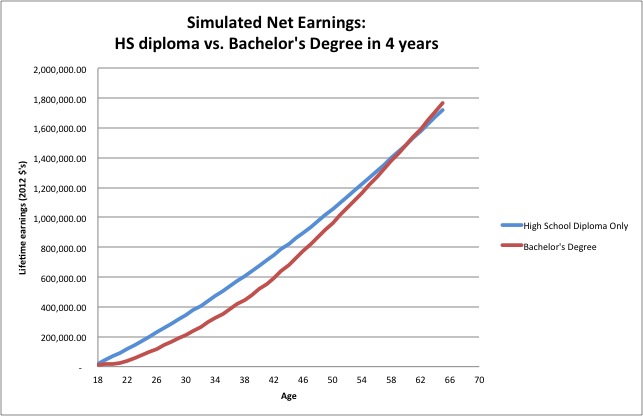
    Looking over Mark's post with its set of curves comparing the lifetime net earnings of one sibling who starts working with only a high school diploma and one who borrows money for college, I see one takeaway point from a Catholic perspective.

    They are not very different.

    Given the assumptions that Mark made, the college graduate catches up with the high school graduate eventually, fairly close to retirement.   Plugging in a different set of assumptions yields different curves.  Some college-graduate curves outperform some high-school curves.  Some high-school curves outperform some college-graduate curves.

    Mark may write about what he thinks parents (and prospective students) should take away from the calculations.  I'll tell you what I think you should take away from it.  And that's this:

    An individual person's choice to go to a four-year college does not automatically mean that person will be financially more comfortable than he would if he had chosen another path.

    I emphasize this because the opposite assumption appears to be rampant.

    Why is this what matters when Catholic parents consider what is their duty to their offspring?

     "Children should be so educated that as adults they can follow their vocation… with a mature sense of responsibility and can choose their state of life; if they marry, they can thereby establish their family in favorable moral, social, and economic conditions" [GS52]

     "[Education] will also acquaint those concerned with correct methods for the education of children, and will assist them in gaining the basic requisites for well-ordered family life, such as stable work, sufficient financial resources, sensible administration, notions of housekeeping" [FC66]

    The reason it matters:  Parents might well ask whether, if they encourage open-mindedness to a path other than college, they might be putting their children in danger of living without "sufficient financial resources" or "stable work" or "favorable economic conditions" to raise a family.

    I think the data shows that such fears are unfounded.

    The data just isn't there tosuggest that it's college that tips you from unfavorable conditions to favorable conditions.   

    Therefore, parents may with a clear conscience encourage children to consider other kinds of post-high school training.

    Financial stability is only one goal of education, of course.  It's still an open question whether college is necessary, or preferred, to fulfill any of the many non-material essential components of an education.  I hope to consider that later in the series.


  • Postsecondary education questions: 3 ways of being able, 3 ways of being unable..

    (This post is part of the series on postsecondary education.)

    + + +

    Robert A. Heinlein once famously enumerated a set of necessary life skills:

    A human being should be able to change a diaper, plan an invasion, butcher a hog, conn a ship, design a building, write a sonnet, balance accounts, build a wall, set a bone, comfort  the dying, take orders, give orders, cooperate, act alone, solve equations, analyze a new problem, pitch manure, program a computer, cook a tasty meal, fight efficiently, die gallantly.

    Let's take this — Heinlein's syllabus* — at face value for the sake of argument, and assume he is correct:  this list itemizes the necessary content of education that prepares for the vocation of "human being."

    What does it mean… "to be able to" do the things on this list?

    It isn't obvious.  I can think of several possibilities.  Let's consider to what extent I am able to perform some of the listed tasks.

    + + +

    Immediately, scanning down the list, I light upon "solving equations."  I can solve equations.   I can solve linear-algebraic systems, all sorts of algebraic equations, ordinary and partial differential equations, tensor equations — not every kind in the world, but a pretty significant chunk.  I can balance chemical equations too, even the tricky redox ones.  I'd be confident walking into an undergraduate mathematics class and delivering an equation-solving lecture, provided I had a little time to brush up on the specifics.  

    We can call that level of skill expertise.  I'm happy to possess it when it comes to solving equations.  Also changing diapers.

    But this would be overkill for everything.  Heinlein's pretty clear that expertise in the listed tasks is not what he's going for (the very next sentence is "Specialization is for insects"), so let's consider some things that I'm not actually an expert in.

    For example, I would never want to teach an undergraduate class in it, but I can program a computer.  I would put it on my resume without compunction.  I learned BASIC and LOGO as a child, took undergraduate courses in programming, and sat in on graduate seminars in computational fluid dynamics.  I'm competent in only one rather old-fashioned language (f77), but my PhD thesis contains many lines of code in it, plus some other people's code that I grafted on.  So, yes, not an expert, but I am able to program a computer.  I could do it to some extent this afternoon, if called upon.  (Hello, world.)

    Let's call that level of skill developed competency.

    + + +

    In an entirely different sense, I "am able to" set a bone.  The sense is different because… I've never done that before.  I've never watched it done before.  I've never read a set of instructions that tell how to do it.  I've never learned it as part of my job, or as part of a course of study.  I've never sat down and worked out a theory of bonesetting.  If I had to do it in an emergency today, I would likely mess it up badly.

    But…

     I'm confident, with reason, that if I decided to learn, I could and I would.  I see value in knowing how.  I have a working knowledge of anatomy, and the ability to learn quickly, and I have administered other kinds of first aid.  I have a firm belief that people ought to know how to take care of themselves and their dependents in an emergency.   I have a book on my shelf about backcountry wilderness medicine.  I could get my hands on more books, maybe even find some instructional videos, and I'm confident I could pass a course in wilderness first aid or maybe EMT training.  

    I don't have expertise, or even developed competency in bonesetting.

    What I have is a  latent competency.  I value the skill; I have enough background knowledge that I could map out a path to acquire it; I have confidence that I could develop the competency if I chose.

    + + +

    Does that mean I can check off everything on Heinlein's syllabus?  If latent competency counts, isn't everybody able to do everything?

    I don't think so.  Heinlein says, for instance, that a human being should be able to "conn a ship."  I don't even know what that means.  I have to go look it up.

    [pause]

    Okay, I guessed that it meant "to commandeer," but I am told that "to conn" means "to direct the steering of; to navigate, as a boat."  

    Let me state categorically that I am nowhere close to being able to conn a ship.  I do not even have latent competency at ship-conning.  I don't much like messing about in boats, I have next to no experience with watercraft of any kind, I have very little experience directing anyone over the age of 14 to do anything, and frankly the whole idea frightens me.

    It isn't that I don't see the value in conning a ship.  But should I ever find myself at sea, on a vessel whose crew has been stricken by norovirus or pirates or zombies such that some passenger must bravely step up to direct the steering, I'd rather take my chances on some OTHER unknown person being at the wheel.  I'll be sitting in a lifeboat, thank you.  With a PFD.  And someone else who doesn't mind conning a lifeboat.

    This, folks, is a kind of incompetence.  

    But let's be more specific:  It's prioritized incompetence.  

     Basically, I'm an incompetent ship-conner because I judge it so incredibly unlikely that the knowledge will ever prove useful, and the path to acquiring the knowledge so incredibly convoluted, that I quite reasonably prefer to spend my effort learning other things instead.

    In other words, despite accepting Heinlein's syllabus for the sake of argument,  I don't actually agree with Heinlein that ship-conning is a necessary component of my education.  I think it's a kind of specialization, not a basic human skill. 

     + + + 

    There's another sort of incompetence that I'd like to highlight, although I will have to appeal to an imaginary person (Mr. Straw-Mann) in order to describe it.  Suppose Mr. Straw-Mann is a confirmed pacifist, opposed to all sorts of violence.  When it comes to self-defense, Mr. S-M always turns the other cheek, and has since he was a child.  

    Mr. Straw-Mann is not able to fight efficiently, nor to plan an invasion.   He will not acquire this skill because he disdains it.  His incompetence at efficient fighting is a point of pride.   If the Heinlein Academy requires this skill for graduation, he'll drop out as a matter of conscience.

    This would be willful incompetence.

    + + +

    Finally, for the sake of completeness, let's postulate a person who, by reason of physical or mental inability, can never develop one or more of the competencies on Heinlein's list.  A quadriplegic cannot pitch manure, at least not the way most of us envision it.  A person with severe language disability cannot write a sonnet.   We could call it natural incompetence; or we could call it simply disability, since that has a gentler connotation.

    + + +

    So we have three ways of being able:

    • expertise
    • developed competency
    • latent competency

    And three ways of being unable:

    • prioritized incompetence
    • willful incompetence
    • disability.

    If we can talk about these different levels of competency, we can more precisely pin down the necessary content of an education, and the necessary preparation for life.

    _____________________________________

    *I probably should name the syllabus, not after Heinlein, but after his fictional character who, I am told, enumerates it.  But I have not developed the competency to get through a Heinlein book without rolling my eyes out of my sockets, so I'm going to stick with what I knew before looking for the link, i.e., that "Heinlein wrote it."


  • Postsecondary education questions: Why College Is a Bad Deal for America [guest post]

    by Mark

    Don't get me wrong:   for a small fraction of students, college is a great deal.  Engineering majors are still earning plump salaries, and many of the business and computer science majors were greeted with good job offers at graduation.  For most of the rest of the university community, the news is not so cheerful. Students have paid large sums of money to universities and received very little in return.

    The truth is that the kinds of people who are capable of graduating from college would have done just fine if they had never gone to college.

    For those not in top paying fields, borrowing money for college will, on average, make them poorer.

    How do we know this?

    Back in the 1990s, Ashenfelter and Zimmerman (1997) and Altonji and Dunn (1996) studied pairs of siblings to see how going to college affected earnings.  (Their research is summarized in this 1999 paper from the National Bureau of Economic Research.)  They took pairs of brothers and pairs of sisters and compared their earnings, looking at how education level affected their earnings.  

    The findings are clear: most of the supposed earnings boost that is attributed to college is explained by family income.  It stems from the fact that college students come from wealthier households compared to people who don't attend college.    

    (Simply put, the children of the wealthy will earn more money than the children of the poor regardless of whether they go to college or not.)

    The real earnings boost of going to a four-year college is only 20%.

    Going to college is a badge of wealth, not a significant creator of wealth.


    + + +

    Once you factor in inflation; borrowing costs; and the loss of four years' wages, a typical graduate of a state university (in my example, the University of Minnesota) will not pass his or her high-school-educated sibling in net lifetime earnings until he has reached age 57.


    4 year plot

    Borrowing for a private school means you will not catch up until age 67 –or older.

    + + +

    It gets worse.

    The above assumes you actually finish the degree you start in four years.

    But only 55% of U. S. students who start a degree program graduate within SIX years.  

    Once the real graduation rates are factored in, the financial benefits of college disappear.

    6 year plot

    The financial gains of the high-earning engineers, computer scientists, and business majors are wiped out by low-paying degrees and by those who start college, but never finish.

    We should stop talking about "going to college" and instead talk about training for specific careers.

    The return on investment (ROI) of a welding program might be less than that of a petroleum-engineering degree, but it beats a criminal-justice degree hands-down. If your son or daughter becomes a plumber, they can expect a wage as high as that of their friends who get an architecture degree.


    Assumptions:

    • The plots above show the simulated net earnings of two siblings: one who gets just a high-school diploma, and another who borrows money to pay for a four-year degree. 
    •  The net earnings include a deduction of $5,000 in job-training costs from the income of the sibling who does not attend college. 
    • The totals are adjusted to include 3% inflation.
    • The student's loan is taken out for 20 years at 7% interest. 
    • College tuition costs are assumed equal to current tuition at the University of Minnesota. 
    • The fraction of the loan that covers room and board is counted as income in the years that it is received.
    • The loan payments are deducted from gross earnings to generate the net earnings.


    + + +

    (This post is part of the series on postsecondary education.)


  • Vocations and altar servers.

    One somewhat-controversial topic in liturgical circles is whether altar servers ought to be all boys, or boys and girls.

    Serving at the altar used to be a no-girls-allowed thing until fairly recently. (Girls still can’t serve at Masses in the extraordinary form.) Even now, bishops are permitted to restrict altar-serving to males in their own dioceses, and where bishops have permitted girls to serve in this way, pastors are permitted to restrict it to males in their own parishes.

    Unsurprisingly, some folks would rather live in a parish with children of both genders serving at the altar, and some folks would rather it be only boys. I suppose the arguments on the side of girl altar servers are pretty obvious: Rome permits it, so there is nothing inherently wrong about it; men and women are equal before the Lord, and even if men and women properly play different roles it is rather complicated to explain that to children; girls who want to serve should be able to, etc. Arguments against it have to do with the reality that the priesthood is open only to men, that vocations to the priesthood are nurtured in altar service, and that more boys serve when altar serving is restricted to boys.

    I attend a parish in which only boys are altar servers (though adult men and women both assist as extraordinary ministers of the Eucharist, and sometimes assist with serving). Anecdotally, the notion that more boys serve when girls are excluded is supported here: We have upwards of a dozen servers at each ordinary Mass, and 75 is not unheard of.

    I think I prefer the boys-only tradition, as long as it is accompanied by careful catechesis, because it is more supportive of our male-only priesthood — it echoes the reasoning, and it brings more boys into close contact with the Eucharist, and it is a seed for vocations. I think the dearth of altar servers today (typically only one to three at many parishes) is an unintended consequence of opening the role to girls. (Who would have expected that fewer children would serve if twice as many became eligible?) But I don’t fault pastors and bishops for choosing to permit girls to serve, now that permission is available. Rome permits it, and that means the decision is theirs to make.

    I wonder if perhaps a more fruitful attitude would help both boys and girls who serve at the altar. Pope Benedict recently gave remarks to a pilgrimage audience of French altar servers, both boys and girls:

    Pope Benedict told the young people they were blessed to be “particularly close to Christ Jesus in the Eucharist. You have the enormous privilege of being close to the altar, close to the Lord.”

    The pope prayed that being an altar server would help the young people deepen their friendship with Christ and enthusiastically share God’s love with their friends and families.

    “And, if one day you feel called to follow the path to the priesthood or religious life, respond generously,” he told the youngsters.


    Luckily for you, I can read French, so I can give you the whole quote from the Vatican website. Here is my translation:

    It is with affection that I greet the dear altar servers, come from France for their national pilgrimage to Rome, as well as Monsignor Breton, the other bishops who are here and the chaperones of this important group.

    Dear young people, the service that you faithfully carry out permits you to be particularly close to Christ Jesus in the Eucharist. You have the enormous privilege to be near the altar, near the Lord. Be conscious of the importance of this service for the Church and for yourselves. Let it be for you the opportunity to grow a friendship, a personal relationship with Jesus. Don’t be afraid to transmit with enthusiasm to those around you the joy that you receive from his presence! Let your entire life be resplendent with the happiness that comes from this nearness to the Lord Jesus! And if one day you hear the call to follow him on the way of priesthood or the religious life, respond to him with generosity!

    To all of you I wish a good pilgrimage to the tombs of the Apostles Peter and Paul!

    I generally accept that one of the purposes of having young boys serve at the altar was to nurture vocations to the priesthood, and that’s why I generally support the decisions of pastors to restrict altar service to males (though, as I tried to express, I am not hostile to the pastoral decision to permit girls to serve at the altar). I know there are plenty of traditionally-minded Catholics who feel similarly to me, that boys-only altar service will better serve the Church’s need for priesthood vocations.

    But Pope Benedict’s remarks make me wonder if we who feel this way haven’t perhaps lost some of our focus on vocations in general. After all, vocations to the priesthood are not more noble than other vocations to religious life (or than marriage, for that matter). Perhaps part of the lack of reverence and lack of appreciation of the importance of altar service is not really caused by the admission of girls, though perhaps that change might have triggered events that revealed more symptoms of the problem. Maybe the problem is that we aren’t looking on altar service as a place where religious vocations of all types are planted and grow.

    At least in our parish, where the connection between vocation to the priesthood and service at the altar is preached explicitly, and where the pastor has made it clear that he is deliberately reinforcing the connection by restricting altar service to boys, families willingly and joyfully encourage (or require) their sons to serve at the altar and hope that from among these boys new priests will step forward.

    But why not, in a parish where girls are permitted to serve, still try to make a connection between service at the altar and vocations to the priesthood, or to consecrated virginity, or to contemplative religious life, or to active religious life as a sister or brother? Why couldn’t it be, in such a parish, that families willingly encourage sons and daughters to serve, and express hope that from among these boys and girls that new priests, brothers, sisters, vowed lives of service to the Lord, will emerge?

    I admit that I have never really seen such a connection made explicitly, except in the parish I attend now. I have always attributed it to the boys-only policy. But maybe the real reason is something deeper than which of two permitted pastoral choices the pastor has made.


  • Postsecondary education questions: A summary sort of post, before moving on.

    (This post is part of the series on postsecondary education.)

    + + +

    In this post I came to a conclusion about parents' responsibilities toward helping adult children finish their education:

     Parents have a certain minimum education and preparation that they owe their kids; if they don't manage to do it by the time the kids are adults, the kids have a right to ask for more help; but adults who are continuing to receive help from their parents to continue their education, rightly continue to be subject to their parents as they were when they were minors.

    A lot of what the Church documents go into has to do with religious development and character development, but economics is part of it too.  I think these (both from Familiaris Consortio) are the key economic features of a minimum education for a child who may marry :

    • it will enable them to "establish their family in favorable…economic conditions." (53)  
    • it  "will… acquaint [them] with correct methods for the education of children, and will assist them in gaining the basic requisites for well-ordered family life, such as stable work, sufficient financial resources, sensible administration, notions of housekeeping" (66)

    (I propose to stick, for now, with the case of a child who likely will plan to support a family.   We'll get to other vocations eventually.)

    I also wrote that (morally rather than legally speaking) a child is emancipated 

    • when he is accessing what he needs to know
    • and is doing what he needs to do
    • to fulfill the duties of his vocation,
    • and has embarked on independent life.

    We can combine these definitions of "necessary education" and "emancipation" to arrive at something like this (economically speaking) for a child who may marry:  

    Parents must teach the child, or delegate that teaching to another, so that he knows what he needs to know and can do what he needs to do to establish his family in favorable economic conditions.  That education must assist him in gaining stable work and sufficient financial resources for supporting a family.  It must also assist him in learning to run a household and acquaint him with correct methods of educating children.

    I think everyone agrees that parents owe their minor children an adequate education.  If all the adequate choices cost money, and the parents can reasonably afford it, then they might reasonably conclude they have a duty to pony up for elementary-school or high-school tuition.   

    Given that, parents might reasonably conclude that they also have a duty to contribute materially to a child's postsecondary education — if that postsecondary education will complete the "minimum" education that a child needs.  That is, if it will teach him adequate knowledge and skills to establish his family in favorable conditions, to gain stable work, to gain sufficient financial resources, to run a household, and to educate his children.

    Here's what's coming up:

      – On the theoretical side, I have a post in the works on what it means to have "adequate" skills and knowledge.  Not a list of necessary skills and knowledge, but the meaning of "adequate."

      – On the cost-benefit side, Mark is working on a guest post (okay, right now it is in the form of several spreadsheets) about the lifetime economic differences between hypothetical sibling pairs, one of whom gets a 4-year college degree, one of whom does not.  I got a preview of the data last night.  I think you'll find it very, er, educational.  

    The point of working these things out, both on the theoretical and the practical side, is not that it is foolish or wrong to choose (or to fund) a less-lucrative path if it will make you happier; the point is to make your choices (a) within the bounds of duty to your family and (b) with your eyes open to the range of consequences. 


  • Postsecondary education questions: A tricky conundrum about parental responsibilities.

    (This post is part of the series on postsecondary education.)

    + + +


    So Mark and I went over my last post about parents' responsibility to help finish their kids' educations, and we identified — in Catholic teachings, not in my meandering attempts to synthesize them — a tricky bit:  three things that are hard to synthesize.  

    + + +

    Here's what we have to reconcile.

    From Gaudium et Spes, par. 52:  "Children should be so educated that as adults…if they marry, they can thereby establish their family in favorable moral, social, and economic conditions" 

     From the Catechism, par. 2230:  "Parents should be careful not to exert pressure on their children … in the choice of a profession …." 

    and from the same paragraph:  "This necessary restraint does not prevent them – quite the contrary from giving their children judicious advice."

    + + +

    So tell me:  How do you "give judicious advice" and  "educate" your children so that "they can establish their family in favorable economic conditions," without "exerting pressure" in the choice of profession?  

    Clearly some people can't make certain choices and still remain able to establish a family in favorable economic conditions.  Is educating, advising, against these choices not a kind of exerting of pressure?

    Discuss.


  • Mysterious nouns.

    Why do we say “the Annunciation” and “the Visitation?”

    Why don’t we say “the Announcement” and “the Visit?”

    I mean, look at the other Joyful Mysteries. Sure, “nativity” and “presentation” are kind of highfalutin words, but with “Presentation” there isn’t any common synonym I can think of, fand as for “nativity” I am sure I have heard people announce the third mystery as “The Birth of our Lord” without so much as a hiccup. And come on — we have never to my knowledge used a fancy word for the fifth mystery. It’s “the Finding.”

    If “Finding” is good enough, and we don’t have to say things like “the Location of Our Lord in the Temple” then why can’t the first mystery be “the Announcement” and the second “the Visit?” As far as I can tell, Mary is unique not only by virtue of her immaculate conception — she is also the only person in the history of the English language ever to “visitate” anybody.

    Yes, this is what passes for meditation in my brain sometimes. I have to roll with what works.


  • Postsecondary education questions: Parents’ responsibilities surrounding emancipation and helping support adult children.

    (Slightly edited and expanded since first posted, but before any comments showed up.)

    (This post is part of the series on postsecondary education.)

    + + +

    I've spent a few posts now gathering facts and summarizing Catholic teaching with respect to education.  In this post I'm going to try to synthesize all that into answers to the following questions:

    Do parents have an obligation to help a child finish his education, to the point that he can fulfill the duties of his vocation, after age 18?

    May they set conditions on that help?

    Do the offspring have an obligation to accept the help (and any conditions set upon it?)

    + + +

    In one recent post, I posed the question: "When is the child 'emancipated?' How do we know he is ready to be launched?"

    I wrote about practical and legal definitions of emancipation here.    In part because our legal system limits parents' control of their offspring,

    …Parents can't guarantee that their offspring (even assuming normal intelligence and physical/mental health) will acquire all the skills that an adult human being should, not even if they throw all their best efforts at the task. That's because the young person is a person, with free will, and — news flash — persons with free will sometimes decide not to cooperate, or come up with their own lists of "necessary skills." So even if there comes no point when a parent can say , "You are done, I did my job" — there must eventually be a point when a parent can rightfully say "I am done — I did the best I could, and now it's your turn to finish your growing and education on your own — if you choose to."

    I further noted that morally speaking (as opposed to legally), a child is truly emancipated

    • when he is accessing what he needs to know
    • and is doing what he needs to do
    • to fulfill the duties of his vocation,
    • and has embarked on independent life.

    (Remember that definition, because we are going to come back and unpack it.)

    If a child is emancipated when he is doing this, then the pre-emancipation education properly includes all the preparation: learning what he needs to know to fulfill his duties (so he can access it when he needs to know it), and acquiring the skills he needs to have to fulfill his duties (so he can call on those skills when he needs to do them).

    The final step to emancipation is independent living. Even if a person has the knowledge and skills to fulfill his vocation, he isn't technically emancipated if he is still living with significant material support from parents.

    (Note that "prepared to fulfill the duties of his vocation" doesn't mean "qualified for the exact sort of job he wants" or "makes as much money as he wants." See here for my post on "what is the vocation for which education prepares us?"  We are not — yet — talking here about whether parents have a duty to help their child get a graduate degree, or whether they have a duty to pay for an expensive private college…. we are talking about a "complete enough" education.)

    As I noted here:

    "Children should be so educated that as adults they can follow their vocation… with a mature sense of responsibility and can choose their state of life; if they marry, they can thereby establish their family in favorable moral, social, and economic conditions" [GS52] "The family must educate the children for life in such a way that each one may fully perform his or her role according to the vocation received from God" [FC53].

    This kind of education is part of parents' responsibility:

    Parental authority is "unrenounceable" and should be "exercise[d]… as a ministry…, a service aimed at helping [children] acquire a truly responsible freedom" [FC21]. The primary way that parents express respect and affection for their children is in the care and attention devoted to their upbringing and in providing for physical and spiritual needs; later, in educating them in the right use of reason and the right use of freedom [CCC2228].

    I believe this implies that parents have a positive obligation, as far as they are able, to employ parental authority to help their child learn what he needs to know to fulfill the duties of his vocation; and help their child acquire the skills that he needs to acquire to fill the duties of his vocation.

    Once a child attains legal majority, it is not possible for parents to force their child to submit to parental authority for education. But legal majority is arbitrary with respect to the determination of emancipation. So what if, at that point, the grown offspring is still not adequately prepared to fulfill the duties of his vocation or to live independently?

    Let's consider two possibilities, and I will try to flesh out my personal conclusions:

    1. The offspring requests help. If at the age of majority the offspring's education is inadequate, and the offspring requests additional help from parents (whose responsibility it is to prepare the child to fulfill the duties of his vocation), I think the parents are bound to continue offering help, insofar as they are reasonably able. In return, I judge that the offspring still owes filial obedience to parents, since he isn't emancipated and is still dependent on them.

    In other words, the parents are perfectly free to set conditions on the assistance that they offer, as long as they remain within the moral constraints imposed by the responsibilities of parents toward their offspring. They also have a responsibility to offer help that is aimed at being, um, helpful. (If it's really no good, the legally-adult offspring is free to reject it, after all.)

    2. The offspring declines help. If after the age of majority the offspring declines to accept the help that parents can offer towards preparing him to fulfill his vocation, then parents are no longer "able" to employ parental authority to continue educating him. In my opinion, that is when It's time for the parent to say, "I am done, I did what I could while I had the chance to do it."

    +++

    Bear in mind that a grown son or daughter might well reject help at first, but come back later and ask for help then. I think that if the son or daughter is still not adequately prepared to fulfill the duties of his/her vocation, the parents still do have a responsibility to help prepare their child, insofar as they are able to help.


    You could think of this argument as going like this: parents have a certain minimum education and preparation that they owe their kids; if they don't manage to do it by the time the kids are adults, the kids have a right to ask for more help; but adults who are continuing to receive help from their parents to continue their education, rightly continue to be subject to their parents as they were when they were minors (and parents owe them the same kinds of considerations as they did back then, such as love, a good example, and the freedom to choose their vocation and profession and a spouse without coercion.)

    +++

    Two more notes:

    Obviously there is a fine line to walk between illegitimate coercion, and legitimate use of parental authority to guide the child's education and preparation, e.g., to set conditions on the help offered. There are no clear rules here. It is going to be a judgment call that requires self-examination on everybody's part.

    And a child asking for help to finish an inadequate education is a distinctly different situation from a child who has already been emancipated but who has fallen on hard times and asks for material help from parents. The parents have already fulfilled their duty to educate the child. I am not going to consider this situation any further right now, but will restrict myself to conditions surrounding emancipation for the "first" time.

    In the next post I am going to consider what it means to "have the necessary knowledge and skills." Not so much a list of which knowledge and skills are necessary… as what it means to "have" knowledge and skills at all…

    …and hang in there for a promised guest post from my husband on economics.


    +++

    UPDATE.  I want to make it clear that this post does not reflect Catholic teaching.  This is me trying to figure out the implications of the teachings that I summarized earlier in this series, so that I can move forward and feel reasonably confident that I'm not way off base.   

    Anyone come to any different conclusions?


    SECOND UPDATE:  I think about this topic some more here.


  • Frugal wardrobe-building advice.

    I am no fashion blogger, but! Great advice here at Squawkfox entitled “Frugal fashion: 12 classic pieces every gal should own.”

    I do know something about this because after my weight loss necessitated a complete wardrobe overhaul, I tried very hard to plan my purchases for maximum utility.

    Of the 12 classic pieces that Squawkfox identifies, I am proud to say that I deliberately acquired 9 of them as part of my wardrobe overhaul, with a few modifications (my classic trench is black, not beige). I am also pleased as punch that this “budget” site has the same taste in designer shoes as me — I own a pair of black heels exactly the same as hers, from the same designer, except that mine are peep toe. And I bought mine used on eBay, sweet!