bearing blog


bear – ing n 1  the manner in which one comports oneself;  2  the act, power, or time of bringing forth offspring or fruit; 3 a machine part in which another part turns [a journal ~];  pl comprehension of one’s position, environment, or situation;   5  the act of moving while supporting the weight of something [the ~ of the cross].


  • Balance and the buffet.

    Last evening we all got back late from the gym after swimming lessons.  I knew there were lots of leftovers in the fridge, so I didn't make dinner; instead, I pulled out all the soup and deli meat and cheese and breads and fruit and arranged it on the kitchen peninsula to make a sort of buffet.  It was an unusually good set of leftovers because we'd been feeding houseguests over the weekend.

    I've learned that it engenders a panicky rush if we set all the children on the Leftover Buffet at once, so we called them up one at a time (beginning with the pickiest) to choose items for their plate.  Mark and I were tired and not in a mood to argue, so we didn't bother "helping" them, or enforcing any rules about vegetables, and let them put together anything they wanted.

    I always think it's kind of interesting what they come up with.  I think we must be doing okay in the "how to make a balanced meal" department.  This is what they chose (in order):

    The 8-year-old boy:  

    • Peanut butter and jelly sandwich on wheat bread
    • an orange

    Two-year-old boy (okay, he had help):  

    • Part of a homemade blueberry muffin
    • Rolled-up slice of deli ham
    • Sliced oranges

    Six-year-old girl:

    • Three corn tortillas
    •  spread with cold canned refried black beans 
    • and rolled up with lettuce and diced red bell pepper

    Twelve-year-old boy:

    • Homemade bean-and-ham soup
    • Turkey, muenster, and tomato sandwich on a bought whole wheat bagel

    Me, I had curried butternut squash soup with added diced raw cabbage and peppers; some Scottish cheddar cheese; a wedge of cornbread; and a widget-can of English ale.  I think Mark had a dinner similar to Oscar's, plus an ale like mine.  

    In our house we have a rule that the children may have juice boxes with dinner if Mark and I are opening a bottle of wine or if we're each having our own beer (standard practice is to split one, since I am a horrendously light lightweight).  This keeps the juice-box consumption low while retaining a sort of celebratory feeling about it.  Also it leads to the children constantly asking us, "Don't you think some beer would go really well with that dinner, Mama?"  So they had juice box with their leftover buffet as well.

    I guess they are internalizing the things we teach them after all.  We really weren't supervising much, and they could have chosen nothing but blueberry muffins if they'd wanted that.

    (Here's another post about leftovers:  Leftovers with Attitude.  Contains links to a few good ideas for leftover night.)


  • Postsecondary education: Can the signalling game be fixed?

    (This post is part of the series on postsecondary education.)

    + + +

    In my last post about postsecondary education, I enumerated the four things you're buying when you buy education:

    1. Signals of quality
    2. Required credentials
    3. Vocational skills
    4. Valued experiences

    After I finished the post, I got up from the computer and sat down next to Mark, and explained what I had come up with to him.  He thought maybe I should have lumped "required credentials" in with "signal value" — and there is some good reason for that, as you'll see — but otherwise agreed with the list.

    "So, if those are the four things you're buying, then how do you game the system?  How do you win the game?" I asked him.

    "I guess you do it by paying as little as possible for the signal," he said.

    And this seemed pretty reasonable to me at the time.

    + + +

    But I wanted to know more about the signaling model, so I started googling around.  I found out two useful things.  

    First, I learned that the model was devised in the 1970's by American economist Michael Spence, who developed it — in part — around the same scenario that we are discussing here:  that employers use education level as a proxy for valuable abilities.  

    Second, that Spence, along with two others, won the "Nobel economics prize" (technically it is the Sveriges Riksbank Prize in Economic Sciences in Memory of Alfred Nobel) for this work, and his acceptance lecture is online and gives an overview of the work.

    I haven't tried to digest the entire thing, but I read enough of it to find something funny about Mark's suggestion.  In the simplest signalling model, Spence explains, there are two kinds of workers:  those with high productivity, and those with low productivity.  There are two salient features that distinguish the  two groups:

    1. Employers are willing to pay more to get high-productivity workers.
    2. Each "unit of education" costs a low-productivity worker more than it does a high-productivity worker.

    This is the whole reason why — in the simplest, pure signalling model — education serves as a "signal" of productivity:  because it costs the undesirable workers more to acquire each unit of education, at each successive level of education the pool of employees is more concentrated in the desirable employees.  Employers will pay higher wages for more-highly-educated employees because at those levels a randomly chosen employee has a higher chance of being one of the desirable ones.

    But the whole reason this works, in the simple signalling theory, is that low-productivity workers pay more for education.  This is almost like defining a low-productivity worker as "one who pays too much for education."

    So when Mark suggested that you could beat the signalling game by "not paying too much for the signal," he was basically suggesting that you could beat the game by being the kind of worker that employers want to hire.

    Which rather gets you back to your starting point, doesn't it?

    Those who have, get more.  Those who have not, lose what they have.  I think I have heard this before.

    + + +

    Anyway, that is about a pure-signal system, where education confers zero added value on a worker — its whole value is to the employer as a sorting mechanism.  In reality, education can confer value on a student — though whether it can turn a low-productivity worker into a high-productivity worker is questionable, and it may be that some students gain no valuable skills at all (or that they have difficulty getting connected with the employers who might value what they have gained).  

    I'm tempted to go off on a tirade about the inefficiencies in the system.  Spence's theory, if you go on reading it, is that the signalling system is made more efficient if you tax education (which in the theory doesn't confer any value, only signals it).   This raises the cost of education, so people buy less of it with the same out-of-pocket costs, and the tax revenues can be distributed to all the people as refunds; but it preserves the signal.  Of course, we don't tax it, we subsidize it, which is the opposite of taxing it, and maybe that makes the system the opposite of efficient.  

    And of course there is the problem of the third party not mentioned in Spence's theory (at least as far as I read), namely, the people who are selling the education; they don't have an incentive either to make the signal more useful or to confer skills on people; you might say that they have an incentive to attract as many low-productivity customers as possible, because those are the ones who spend the most for what they get.  Maybe, if you are selling educational units for their signal value, you only want as many high-productivity people at your educational institution as you need to keep the prestige of your institution high, so you can attract lots of low-productivity people, who are paying your bills.  It costs less to sell them education.

    + + + 

    But the question before us is not whether we should change the current system; it's what kind of education the individual should buy, given the system that we have.

    It seems like it might be useful to know yourself.  Are you low-productivity or high-productivity by nature?  Are you already the kind of person that employers want?   Will you be paying too much for a signal that  says "I'm high-quality goods?"  Will you be found out in the end anyway as the impostor you are?  Or are you the real deal, and will stand out from the crowd?

    It seems like it might be useful to know whether you have what it takes to get the required credential.    What are the chances that you'll sink a lot of money and time into education, only to drop out before acquiring the degree/certificate/license that the gatekeepers require?

    It seems like it might be useful to consider how education might build your measurable skill-set.  And watch out for promises that education will build a set of skills that are "intangible" or "unmeasurable" but that are nevertheless, supposedly, valuable… the emperor may not have any clothes.

    Finally, what about those valued experiences?  It seems like it might be useful to consider how much you are willing to pay for each year of a multi-year vacation.  Because, you know, you could spend your money getting valuable experiences a lot of other ways, too.


  • Middle-aged.

    A couple of days ago BBC News published an article about a recent survey (in the UK, so) that determined that "middle age" begins at age 55:

    Never mind the ridiculous language about "research suggests" and "pinpointing," here is the lede:

    Middle age starts much later than previously thought – at the age of 55, research suggests.

    And Britons do not see themselves as elderly until they are nudging 70, the survey of 1,000 UK adults aged 50-plus for the Love to Learn online learning website says.

    Previous studies have pinpointed the start of middle age as early as 36.

    The research suggests that as the population ages, new cut-off points are being drawn.

    Whatever.  Let's not take this too seriously, but use it as a jumping-off point.

    This isn't the first time I've mocked the inflation of "MIDDLE-AGED."   I have been known, for instance, to go around casually calling myself "middle-aged" in order to upset old people.  Basically, as I do for much of the degeneracy in society, I blame the Boomers, who are using their numbers to abuse the language so they don't have to call themselves "old" yet.  What, do you think you are going to live to be 110?

    I know, unfair.  These are Brits.  Being a "Boomer" probably means something entirely different to them.  What about Americans?  When does middle age begin for us?  I went googling around and found an interview with Patricia Cohen, the American author of In Our Prime:  The Invention of Middle Age, who was asked:  When does middle age begin?

    That’s the first question that everyone asks.

    Forty has long been the traditional turning point in adulthood in the West. The New American dictionary defines middle age as “the period between youth and adulthood, generally 40 to 60,” while the U.S. Census Bureau define middle age as 45 to 64.

    Extensive surveys reveal that the definition frequently depends on a respondent’s age, sex, class and ethnicity. Those with more schooling tend to mark its onset later, as do those who are older; men think it begins earlier than women. Men between 25 and 34 say middle age commences at 40 and ends at 56, for example, while women between 65 and 74 say it starts at 48 and lasts until 62.

    As life expectancy has increased (by more than three decades in the 20th century), people have stretched the ribbon of middle age like a rubber band, extending it into their seventies. In 2009, a survey asked people between 50 and 64 when midlife ended. Most chose age 71.

    Middle age is like a Never Never Land — a place that you never want to enter and never want to leave.

    I think we are a little safer in the United States against all that inflation because of the persistence of the "black balloons on your 40th birthday" meme.  The greeting card industry will also help us here.

    I tease about the "living till 110" thing, but "middle age" obviously doesn't go by life-expectancy number-crunching alone.   The life expectancy for American men is (as of 2006) 75, for women 81, so let's call it 78.  

    • We could suggest that middle age begins halfway through the life expectancy, I suppose — that gets you to age 39 — which might be about right — but it doesn't tell you much about the end.   
    • Or we could suggest that "middle age" is the "middle third" of the lifespan — but that makes it 26 to 52… nope.  You're not middle-aged at 27 unless you are an exceptionally crotchety person.
    • Mark suggested it may describe the middle third of adulthood.  Okay then… subtract off the first 18 years and divide the remaining 60 by three, and you get 38 to 58.  This is definitely more promising, but something about the upper end is unsatisfying to me.

    "[N]early one in five" of the Brits thought middle age didn't begin until after age 60 (!) but about the same number thought middle age was a "state of mind."  This terminology — it's all in your head! — I also find unsatisfying.  Partly because I suspect — can't prove it, but suspect — that this is the doing of the "You're only as old as you feel!" people, whose fault is all this "when I'm an old lady I shall wear purple and wear a red hat" business.  

    One reason I think this is silly, is, well,

    Redhat

    (photo from here)

    But another reason I think this is silly is the obvious implication that it's important to think like a young person your whole life, and do your damnedest to feel like a young person (in your heart, dear) as long as you possibly can, and, well… You know what?  There's only so much plastic surgery you can get, and how much pretense you can put on.

    The fact is, you're going to die sooner or later, you might as well accept it.   Being old is, in part, getting ready for death, and there is nothing whatsoever wrong with that.  You don't have to go gently into that good night, but you do have to go, and it's possible to do it gracefully instead of, um, the opposite of gracefully.  

    + + +

    A better definition of middle age, I think, comes from rites of passage and stages of life.  The only thing inherent in its name is its "middle-ness" — it is between something — by implication "youth" and "old age," but I think it's something else.

    As a mother I'm inclined to think that middle age begins somewhere associated with the child-raising years — some would say, "When the kids are out of the house!" but I'm reluctant to say so, because with people having kids later that can be quite late indeed.    Unless you want to put your foot down and say that middle age begins at menopause (and that's not an unreasonable place to put it, for women) you could be having babies in middle age, and have them not out of the house until you are old.  

    That's not really fair to the people who don't have children, though — to mark middle age entirely by child-raising.  I would like to give it a more generally applicable spin.

    Right now, at 38, in what I think is my early middle age (unless you buy the menopause thing, in which case I'm not there yet) I think the start of it has something to do with confidence.  They are the years when you realize that this is the life you are leading, and (hopefully) by now you are comfortable in it and have developed some skill in it.  

    When people fight against believing they are in middle age, I think they are fighting against the idea that the "anything is possible" time is over.   I think it's kind of nice to get past the "anything is possible" time, myself, because the vast array of possibilities are so paralyzing.  I am happy that I have roots now.  I feel that I am hitting my stride as the matriarch of a family.  

    I want to believe that this is the start of middle age, in part because — if it is — I am off to a seriously great start.  


  • Self-nightweaning.

    This month it seems that the 32-month-old is night-weaning himself, on his own initiative.

    This is the first time that we’ve been through this. Each of my three older children was still co-sleeping and night-nursing right up until I became pregnant with the next younger sibling. Pregnancy made me want to crave the soundest sleep I could manage, so I asked Mark to get up with the toddler (each was age two at the time) and offer milkshakes or snacks or WHATEVER IT TAKES AS LONG AS YOU DON’T WAKE ME UP, and within a few weeks they weren’t nursing (or waking) at night anymore.

    My current two-year-old has no in-utero competition, and I am really quite happy to continue nursing him at night for the time being. But a few months ago, he unexpectedly begin asking me to nurse him to sleep “in the little bed” — the twin bed that’s pushed up next to the queen-size bed in our bedroom, to give us a little more room for children who sneak back in the middle of the night. I would nurse him to sleep there, and then I would move back to my spot on the other side of Mark in the queen-size bed.

    In the wee hours of the morning he would sit up, call “Mommy!” and I would say, “Over here,” and he would clamber over his sleeping daddy and nestle in between us, and I would nurse him down again, both of us falling back to sleep together. Very sweet.

    A couple of weeks ago, though, he didn’t wake until it was nearly time for the alarm to go off. This happened again a few times — then, days ago, he slept right through in the “little bed” until Mark had gone off to work and I was downstairs drinking coffee.

    So it does, eventually, happen on its own.

    + + +

    One of the things that pleases me about this is that it doesn’t look very different from the nightweaning that I purposely put my older children through. Whenever I decide, deliberately, to mess with a comfortable life process, I like to try to mimic — if I can — the state of nature, so to speak.

    So, I prefer a longer, later, and closer-to-child-led process of full weaning, for example; I had quite a lot of input into the day-to-day process of course, but my first child stopped nursing (all the time, not just at night) more or less on his own schedule, around age 4. When I weaned #2 deliberately starting at age not-quite-3, I looked around for various pieces of advice on how to do it peacefully, but in the end I decided to mimic my first child’s more hands-off weaning.

    I had observed that, that first time, the time between nursings got longer and longer. Eventually he would forget to nurse for a whole day here and there, and then two days, and after a while we would go more than a week between nursings. Finally the day had come when we nursed for the last time, although I didn’t realize it had been the last until many weeks later when the next request never arrived.

    So when I set out to wean #2, I decided to copy that process — deliberately distracting him from nursing for just an hour or so at first until the gaps between nursing stretched to a few hours, then half a day, then a day. I would tell him when he finished, “Now the next time we’ll nurse will be three o’clock,” or, later, “The next day you’ll get milk is on Thursday.” And I stuck to it. I don’t remember it being all that difficult. I was free to stay at one frequency for long enough to let him get used to it before pushing for a longer gap. Also, once the process got going and he was nursing less, it alleviated a lot of the pressures I had been under that had made me decide to wean him in the first place, so after a while the was no need to hurry him.

    All in all, I recommend it to anyone who has decided to wean (as long as it doesn’t have to be over quickly, because it isn’t a quick way to wean — just a fairly peaceful one). It seemed like a good compromise between what I needed and what he needed. If you are going to try some different ways to wean, I suppose my method is as worthy of a trial as any other.

    + + +

    My three previous children, however, got night-weaned without the benefit of any maternal experience with hands-off nightweaning. But I am pleased to report that my youngest is cutting back his night nursing not too differently from how his older siblings were made to do it.

    First of all, he is around the same age that they were at nightweaning. My first was probably about 30 months old, my second was 28 months, and my third was 34 months. Number 4 is now 32 months.

    Second, I always started by putting them to bed on the other side of Mark, then moving back to my spot. (I think one of the times it was me who moved into the “little bed” to sleep by myself, but it is still basically the same arrangement). And here is my youngest voluntarily asking to sleep in his own little bed.

    Third, he is wanting to be nursed to sleep in the little bed — which I did two of the other three times. (One of them tended not to fall asleep until after latching off, so I would nurse him and then we’d be done and turn out the light.)

    Fourth, I usually did nurse the others once in the morning before we’d get up and start our day.

    + + +

    So this hands-off nightweaning looks a lot like my deliberate night weanings. If I wanted to cement it — and I might yet — I guess I could add the part where, when he wakes up and asks to nurse, Mark takes him downstairs and offers him ice cream instead. That is the main missing piece so far…


  • Postsecondary education options: The four things you’re buying.

    (This post is part of the series on postsecondary education.  Are you getting tired of this yet?  I noticed that the comments dry up over the weekends.  Well, I have a lot more of this coming, because it is clarifying my thinking marvelously, and I really needed my thinking clarified before I start kids in ninth grade.)

    + + +

    I think we can break down the value of a college degree — or any form of postsecondary education, really, including trade-school studies, apprenticeships, intern experience, military training, studies for licensure exams, and the like — into these sources.

    1. Signals of quality
    2. Required credentials
    3. Vocational skills
    4. Valued experiences

    Let's talk about these one by one briefly, and then I'll look more closely at the ones that warrant separate posts.

    + + +

    Signals of quality.  We discussed the "signalling" value of education in the comments on the post where I linked to Megan McArdle's Newsweek piece.   Megan sums up the "signalling model" like this:

     It’s hard to prove to employers that you’re intelligent, conscientious and persistent, and so you use a diploma to demonstrate it.

    Or you could look at it this way (this is me talking, not Megan):

    It's hard to figure out which potential employees are intelligent, conscientious, and persistent, and so employers use a diploma as a proxy.

    Megan says in her related blog post that there is signal value even in having had "some college." Different degrees (e.g. an engineering degree versus a communications degree) have different signal value to potential employers. The prestige or perceived difficulty of the university also provides perceived signal value.

    Whether we like it or not, possession of signal value is an economic good.   It is also, in principle, measurable.

    Required credentials.  At first glance it may seem that a credential is just another kind of signal, but they are distinct.  Credentials are different from signalling because they are codified by the gatekeepers of a profession.    

    Whether a "required degree" is a credential or a signal depends on how much discretion the employer has.   An employer may write "B.S. required" on the job description for a lot of reasons; but if the employer is allowed to hire an impressive, skilled candidate who didn't finish his degree, the degree is not a credential.  You can imagine this happening in fields like technical sales or journalism:   a sufficiently interesting candidate who can get himself noticed might be able to land a job despite lacking the "required" degree.

    But whether they want to or not:   hospitals aren't allowed to hire nurses who aren't certified as R.N.s or  L.P.N.s.   Engineering firms aren't allowed to assign certain tasks to engineers without their P.E.   Trucking firms can't hire drivers who don't hold a commercial license.  Rite Aid can't hire a pharmacist who doesn't have a Pharm.D.   These are credentials.  No amount of experience, demonstrable skill, or character can substitute for them.

    Vocational skills.  These are the abilities and knowledge, acquired through education and training, that are really called upon in daily work.  

    It includes things learned in specific coursework that apply to a job or to managing a household or other economically valuable activity.

    It also includes generally useful learned abilities such as quickly digesting technical information, or communicating clearly, or discreetly handling a delicate situation, or staying up all night to meet a deadline — as long as those are skills that are really used and needed.  

    I would expand it, broadly, to include skills that underlie latent competencies:  the learned ability to acquire more competencies as needed.  For instance, I took a minor in French; I rarely get to speak French; but in learning French I acquired skills that enabled me to teach myself other Romance languages, which I am now teaching children in the homeschool.   Speaking French didn't turn out to be a vocational skill, but "the ability to self-teach a language" did.

    Valued experiences.   All the other good things you hope to get out of a postsecondary education.  This category by its nature is subjective, broad, and difficult to measure even in principle.  It includes things like learning to get along with roommates, immersing oneself in a subject for pure love of the subject, staying up late arguing with friends over beer and pizza, building character through hard work, exposing yourself to culture, opening your mind through difficult thinking, and acquiring skills that are valued without necessarily being evidently valuable  to others.  

    + + +

    When I was telling Mark about this yesterday, I listed the first three categories — signals of quality, required credentials, vocational skills — and then said, "And then there's a fourth category.  It includes everything else that you can't put your finger on quite as easily.  Learning to analyze great literature — of course, for English teachers that will turn out to be vocational — or having good class discussions — or sitting in coffeeshops really diving into a difficult math problem, if you like that sort of thing — or –"

    He laughed and told me, "It's the error term."  He took a pull of his beer, apologized for laughing at me, and said, "I can't help it.  The differential equations book is open on my desk right now."

    I hung my head and admitted, "Yes.  Now that I think about it, it's the error term.  I guess I can't break anything down into a list without including one."  

    I suppose that remembering to include a "…plus everything else you can't measure or forgot to include" term at the end of a list is, after all, a vocational skill for me.

    + + +

    The benefits of an education = S + R + V + E, where

    • S = signal value,
    • R = required credentials,
    • V = vocational skills,
    • E = experiences valued for their own sake (or E can be for error, if you ask Mark).

    These four things are what you hope to buy with your money when you set out to purchase a postsecondary education.  

    If you are lucky, you may get components of each term that you did not expect but that turned out to be a bonus and that did not cost you anything extra.

    Your money will also buy you things that you didn't necessarily want — things you never wanted in the first place, purported vocational skills that turned out not to be useful, experiences that you thought you would enjoy having but that ended up disappointing you.  

    How do you win this game?  How do you maximize the return on your money and your time?  And how do you judge the relative importance of the four terms in the equation — because different educational choices will give you a different mix?

    More on that later…


  • Postsecondary education questions: Alternative means of parental support past 18.

    (This post is part of the series on postsecondary education.)

    + + +

    At age eighteen, a young American acquires the legal right to leave his family of origin and strike out on his own. But it is a rare young American who awakens on his eighteenth birthday ready to "establish a family in favorable moral, social, and economic conditions."  

    Oh, sure, there's a few situations where a young person will by age eighteen have something approaching latent competency to establish a family.   That is, the fundamentals have been learned, "financial means" are secured one way or another, and the path is clear to acquire the rest.  Mark and I sort of had that, each of us, when we finished high school, before we met each other.  We had a lot of maturing still to do, but each of us started college with a full scholarship, a decent work ethic, and a declared major in a fairly practical field.  It wouldn't have been wise for us to get married and start a family at age 18 or 20!  But neither would it have been crazy to look at either of us and assume that we would make it out all right, assuming we didn't screw it up along the way.  

    (Now, of course, we shake our head and wonder how we managed NOT to screw it up.  But that is another story.)

    Lucky individuals aside, most eighteen-year-olds aren't all set for the future.  If it's the parents' moral obligation to educate a child until they can "establish a family in favorable moral, social, and economic conditions," then I think we parents maybe should expect to continue offering educational, financial, moral, and social support past age eighteen. 

    But…

    Because an eighteen-year-old is legally free from his parents' control, he can decline that support.  And so at age eighteen, the parent-child relationship enters a new and strange phase:  one in which the parents have a responsibility to offer appropriate, judicious guidance and support, but the son or daughter no longer has the obligation to accept it.

    It is easy to see how the mutual responsibilities can become confusing, particularly if communication is poor.  It's also easy to see how new power struggles can develop.  The young person may need her parents' help and support acutely as she tries to cement the skills of independent living; but at the same time she may resent much of their advice and the things they ask of her.   The parents may be eager to see their children move on to independence, and eager to help; but at the same time they may feel dismay at their sons' and daughters' choices, and wonder if they ought to use the power of the purse to compel "right" choices.

    The Catholic documents give some guidelines about the mutual responsibilities of parents and children.  (See here and here.)  But ultimately, parents and their grown children have to find shared values in order to move forward in a way that satisfies both. 

    + + +

    What kinds of support might parents provide for their children past the age of eighteen in order to help them complete their education so that they might "establish a family in favorable moral, social, and economic circumstances?"

    The one that most of us are talking about around here is paying for college.   After (maybe) receiving a need-based offer of a financial aid package from a school, there's usually still a price to be paid.   

    Paying for college, for an eighteen-and-over son or daughter, is the functional, continuing equivalent of delegating your underage child's education to an elementary or secondary school, or of putting in the work of homeschooling them.  And parents must delegate that education responsibly:  they maintain some responsibility over this education, because a young person is not "emancipated" in any sense of the word if his parents are paying thousands of dollars a year for his upkeep.

    • "As far as possible parents have the duty of choosing schools that will best help them in their task as Christian educators" and that correspond "to their own convictions" [CCC2229].   
    • It isn't a foregone conclusion that the school they choose will be a school friendly to the faith:  If "ideologies opposed to the Christian faith are taught in the schools," parents ought to "join with other families and … help the young not to depart from the faith" [FC40]. 
    • But at the same time, "parents have a grave responsibility to give good example to their children."
    •  They should cultivate "a simple and austere lifestyle" to promote the correct attitude towards material goods [FC37].  
    • Parents must "consult the interests of the family group, of temporal society, and of the Church," in order to "thoughtfully take into account both their own welfare and that of their children, those already born and those the future may bring" [GS50] 

    I read in this that parents who are paying for a postsecondary education have the right and the responsibility to take part in the selection of a college.   It would not be appropriate for a parent to completely control their son's or daughter's education, because "parents should be careful not to exert pressure on their children… in the choice of a profession,"  but they are perfectly within their rights to "set a good example" by carefully considering whether the money is well spent according to their own values.

    Because parents owe their unemancipated children discipline:   Paying parents are also perfectly within their rights to set conditions on the money, such as maintaining a certain academic performance, sticking to an agreed-upon plan to graduate on time, or staying out of certain kinds of trouble.  The choice of conditions requires careful thought, though.  The catechism implies strongly that parents should not require obedience except for the good of the child or the good of the family, and that instructions to the child should be reasonable [CCC2217.]  Parents must not provoke their children to anger [CCC2223].  Parents must not force a person "to act contrary to his conscience" or "prevent him from acting according to his conscience, especially in religious matters" [CCC1782].

    + + +

    Parents can also support sons and daughters during the postsecondary education years by allowing them to continue living at home.  In some ways, this arrangement can look very much like it did before the child's eighteenth birthday, but really something fundamental has changed, because the arrangement is now, legally and morally speaking, voluntary on both sides.  Either parents or young adult could choose for the good of the family to terminate the arrangement; and the young adult is free to terminate the arrangement in order to establish a new family.  Because it's voluntary, it's appropriate to negotiate the terms.

    There are a lot of economic and social benefits to the living-at-home-with-parents arrangement.  The family who considers this option presumably already knows how to live together in some peace, so there are no unknowns associated with finding new roommates; the total rent/mortgage cost paid by the family members is smaller; there are no transaction costs associated with obtaining a new living space; many common items can be shared instead of new ones having to be bought; economies of scale are preserved in the purchasing of food and groceries. 

    Offering to pay for college is an economically significant gift to the young person, at a steep cost to the parent; welcoming their son or daughter's continued presence in their home is also economically significant to the young person but (unless they would otherwise downsize to a smaller home or rent out a bedroom) at a quite low cost to the parent.  

    If the young person is living at home and has not yet learned how to have "stable work, sufficient financial resources, sensible administration, [and] notions of housekeeping" — part of the necessary content of education — then a period of living at home after age eighteen is a good, if late, time to start.  Acquisition of these skills by contributing to the running of the household and demonstrating progress on a plan towards self-emancipation (working and saving money, studying for a degree or certificate, rehabilitating oneself, etc.)  can be a condition of this kind of support.  Remember, parents have a responsibility to educate their children who are living at home, and children living at home still have the duty of obedience towards their parents' just requirements.

    + + +

    A third means of support that parents can provide are certain incidentals that are often of low cost to the parent but high value to the young person.  Two common examples are health insurance coverage on the family plan (where the young person is eligible) and use of a family-owned  and insured automobile.    These aren't generally cost-free to the parents (for example, health insurance premiums for an employer-provided plan are higher if they include dependents), but they are often much, much less expensive than a separate plan for the young person, and so it may make common sense for parents to provide them — even if they require the young person to reimburse them for some of the extra cost.

    Depending on the total amount of support, it doesn't strike me that a young person's accepting this kind of help from his parents necessarily means that he isn't emancipated from them (particularly if he reimburses them their out-of-pocket costs). 

    + + +

     Some parents may be so positioned as to be able to offer their son or daughter a job.  Maybe they are business owners, or own rental properties that require management.  Maybe the parents hope the young person will join the family business and eventually take it over; maybe it is just a good means to help him ride out a recession with a secure job.  Or maybe there's a service that they could really use — caring for younger siblings or other relatives still at home, cooking and household projects for the family, etc.  Either way, it's an opportunity to directly help the young person acquire work experience or life skills. 

    + + +

    But what to do if there is some money to help the kids get started in life — a "college fund," if you will — but college doesn't look like the way to go?  There's always straight-up gifts of cash.  The difference between a gift that's enough to pay for college tuition, and "paying for college," is that a gift doesn't have strings attached.  Except, of course, on the honor system:  "This gift is for you to use wisely so that you can establish stable work and sufficient means to support a family."

    This is the ultimate in "being careful not to pressure" young people, and it communicates a lot of trust in the young person's wisdom and willingness to listen to advice.  

    Probably not a good idea for some young adults.  Maybe a good idea for others.

    A similar option, a little safer, might be to set up a trust fund.  Let a young adult start off with a nest egg, and encourage him to learn about investment strategies and long-term money management, so that he can turn it into something meaningful.

    + + +

    But besides paying for college, there are other strings that could be attached to cash money — always remembering that the goal is to give the young person the means to, by way of his education, "establish a family in favorable moral, social, and economic circumstances."  

    Maybe the parents would be willing to put up seed money for a business start-up (perhaps in exchange for a share in its ownership).  

    An alternative to paying for college, if the son or daughter's college "plans" are nebulous and unformed or suspiciously low in bang-for-the-buck, might be to subsidize — not the college semesters themselves — but tuition for a shorter-term vocational degree or certificate intended to bump up the wages that the young person can command before going to college.  The average student doesn't graduate in four years anyway — why not make the first year or two as lucrative as possible, by making them years of vocational training?   There will still be time to go to college afterward, but the difference is that (a) the young person has a skill she can fall back on to support a family if need be and (b) the young person might actually be able to command a high enough wage to work his way through school or to pay off the loans he might take out. By the time the vocational program is complete, the student will be emancipated — a couple of years sooner than he might have been had he depended on his parents to pay his way through four-plus years of college — so young people who are itching for true and total independence may prefer this option.




  • Another higher education bubble: scientific journal pricing?

    Derek Lowe at In the Pipeline has been blogging intermittently about the scientific journal publishing model, which sometimes seems insanely archaic now that we live in an age where so much information is practically free.

    It’s seemed that way to this home-based end user for years. Sure, they have to make a profit on their content somehow, but I’ve noted before that they seem to be losing out on some income because they don’t have a market segmentation mechanism by which persons unaffiliated with an institution can pay a small fee to download single articles for personal use. Currently articles in ACS (American Chemical Society) publications cost $35 each, and those in Elsevier publications cost $31.50. But millions of people attempt to download articles from scientific journals each year, then don’t do it when the pay wall pops up: JSTOR reported 150 million attempts per year. You’d think that if they could charge single-digit dollars per article, some of those 150 million potential users would have paid the fee to get their article, and some of them might have come back to buy more.

    When you consider how much of the research that appears in these journals is performed at taxpayer expense, with federal grants and often in state-supported institutions, you have to wonder: Why does the individual have to pay quite so much money to the journal publisher to access the results?

    But it seems that individual academics and universities, too, are rebelling against the standard journal model. Earlier this year, scholars organized a boycott against the large publisher Elsevier. (Here is a post at Inside Higher Education explaining the reasons.)

    Anyway, blogger Lowe points to this post from Jenica Rogers, a librarian at SUNY-Potsdam, explaining why her institution is walking away from ACS — dropping subscriptions to the ACS online journal packages.

    In our discussions, the librarian stakeholders noted our support for this approach, but argued that while their tiers are reasonable and based on arguably sound criteria, the base price underlying those steps is unsustainable and inappropriate. (In the case of SUNY Potsdam, the ACS package would have consumed more than 10% of my total acquisitions budget, just for journals for this one department.) We also learned that their base price and pricing model, when applied to much larger institutions, did not produce the same unsustainable pricing…

    Given that there was no apparent ACS-based solution to our budget crunch in the face of what we feel is unsustainable pricing, we went to our Chemistry faculty and discussed all of this with them. … I laid all the facts out. We described our subscription history in support of their scholarship, teaching, and learning needs, pulled out the costs for ACS content when we first subscribed in the early 2000s and referred back to the discussions we had then… laid out the current cost of ACS publications and the price increases over the past five years, and estimated what our 3-year prices would be. Based on our discussion, I think that some of our faculty were surprised, some seemed resigned, some were horrified, and they were all frustrated by what seemed to be a plate full of bad options. However… I believe that we all agreed that this goes beyond having a tight campus or library budget: this is simply not appropriate pricing for an institution like ours.

    One of the things that makes this situation egregious is that ACS is not just an academic society and a publisher, it is an accreditation body for university chemistry programs — and indeed, they can set journal subscription access as a condition on accreditation.

    If enough institutions simply refuse to play the game, the numbers will have to change. Meanwhile, it is one small part of the cost of higher education — and in this case, it is not an expensive frill like a fancy rec center or a cushy dorm, but an unsustainable price charged by private corporations in order to provide a service that is part of the core mission of a university.


  • Beer for beginners, part VI: Belgian witbier.

    (part Ipart IIpart IIIpart IV, part V)

    I can't decide whether it's apropos or just silly that I am simultaneously working on one series about college and another about beer.

    At any rate, I finally finished all the witbier that I bought the last time I was in a nice big beer store, and I'm ready to comment on it.

    + + +

    Belgian wheat beer, a.k.a. witbier, a.k.a. bière blanche, is similar to German hefeweizen except it is typically less hoppy and a little lighter, and it is brewed with citrus peel and spices such as coriander.  I have had some mass-produced American versions (Blue Moon, which is really a Coors beer, is the most famous), and found them drinkable; Mark generally turned up his nose at the idea of spiced beer.

    Garrett Oliver recommends drinking witbier with salads of all sorts, especially those with citrusy vinaigrettes.  This seemed so odd that I was eager to get started, especially back in the heat of August.

    I picked up a six-pack of Hoegaarden Original White Ale first.  Hoegaarden is pretty easy to find in the U. S., it seems.  We had the first bottle with a homemade Caesar salad, which worked great, actually.   The beer had a lemony kick to it.  

    For some reason, as I put my nose into the glass and inhaled, I was transported back to the scent of beer from my childhood.  I haven't the foggiest idea which of the adults around me, if any, would have been drinking wheat beer or spiced beer when I was a little girl; maybe it was just that its pale crisp scent reminded me of whatever pale yellow beers were around in Southwestern Ohio at the time.  I have no explanation for that one.  I may have to ask my dad.

    I liked the Hoegaarden a lot.  Here is where I have to admit — in case you can't tell already — I actually kind of like pale yellow beer.  No, I'm not a fan of Miller or Bud, but I have been known to suck back a Corona with my enchiladas from time to time.  This beer was light and crisp, so you could drink it cold and have it be refreshing; but the spices were present, along with an obvious citrusy tang.  It really did go with the salad, garlic and parmesan and all.

    + + +

    The second beer I tried was Ommegang Witte, an American witbier from New York State.  The first time I had it was all by itself, and I noted:  "Very boring and flat."

    But the second time I had it, I was eating crackers and herb cheese spread and buttered asparagus tips (it was lunch), and I noted "Pretty good!"

    So I have decided that this is a good rule for witbier:   Do not drink a witbier without food unless you know it.

    Or, I guess, unless you are thirsty and hot.  It'd probably be good then.

    + + +

    The third witbier I tried was a large-format bottle of Dogfish Head Namaste.  The bagger at the large foodie supermarket in Ohio where I bought it got all excited about my cart full of beer (witbiers and stouts) and told me I had excellent taste (duh, everything I was buying was on recommendation), and got even MORE excited when one of the beers was the Dogfish Head.  He really talked it up.  Now that I think about it, maybe he was trying to hit on me.  But that's neither here nor there, because I decided that the Dogfish Head was another BORING beer.  That is all that I wrote in my notebook:  BORING, double underlined, like the Ommegang was before I had it with some food.  Only I was having the Dogfish Head with food.  And it was so boring I didn't bother to write down what food it was.

    + + +

    And the fourth one I tried just the other day:  Epic Brewing Co. Wit Beer out of Salt Lake City.  I had only a single large-format bottle to try, but after we finished it I wished I had more.  This beer pleased both me and Mark, because while it was nicely spiced, it had a more pungent hoppiness than the other Belgians we had been drinking.  That hop bitterness, plus the lemony crispness, was perfect for the evening's dinner.  We were having a light supper of French bread and salad — a "BLT salad" with, well, lots of bacon and lettuce and tomato, plus red onion and cucumber, tossed in a creamy avocado-lime-basil dressing.

    (This recipe is close, except WTF?  Only four slices of bacon?  I used half a pound.)  

    Bitter, hop-dominant beers are supposed to be good with rich, fatty food, while the witbier is supposed to be great with all things citrus-vinaigrette, and so this hoppier-than-usual witbier was really quite perfect with a fatty avocado-lime dressing and all that crunchy bacon.  I would happily buy it again, and pour it at a party, and the thing I would serve it with would be a giant bowl of guacamole and some good salty tortilla chips.  I bet it would be good with tabbouli, too.  If there was bacon in it.  And I bet it would be good with something quiche-like, too.

    All in all, though, the Hoegaarden will probably be my go-to witbier, because it's easy to find and not terribly expensive (the Epic Wit Beer is a limited edition beer that is produced in rotation).  The style really does work with citrusy salads, and since I love citrusy salads, I think we'll be having Belgian wheat beer again.


  • Postsecondary education questions: Megan McArdle on “Is College a Lousy Investment?”

    (This post is part of the series on postsecondary education.)

    + + +

    Ah, this is timely.

    While you wait for my next post (which will be about parents' options for meaningful support past age 18), and possibly another guest post by Mark, take a look at this week's Newsweek article by Megan McArdle entitled, "Is College a Lousy Investment?"  

    A lot of ink has been spilled over the terrifying plight of students with $100,000 in loans and a job that will not cover their $900-a-month payment. Usually these stories treat this massive debt as an unfortunate side effect of spiraling college costs. But in another view, the spiraling college costs are themselves an unfortunate side effect of all that debt….

    Unsurprisingly those 18-year-olds often don’t look quite so hard at the education they’re getting. In Academically Adrift, their recent study of undergraduate learning, Richard Arum and Josipa Roksa find that at least a third of students gain no measurable skills during their four years in college. For the remainder who do, the gains are usually minimal. For many students, college is less about providing an education than a credential—a certificate testifying that they are smart enough to get into college, conformist enough to go, and compliant enough to stay there for four years.


    When I was a senior, one of my professors asked wonderingly, “Why is it that you guys spend so much time trying to get as little as possible for your money?” The answer, [economist Bryan] Caplan says, is that they’re mostly there for a credential, not learning. “Why does cheating work?” he points out. If you were really just in college to learn skills, it would be totally counterproductive. “If you don’t learn the material, then you will have less human capital and the market will punish you—there’s no reason for us to do it.” But since they think the credential matters more than the education, they look for ways to get the credential as painlessly as possible.

    She has a companion blog post up here:  Are We Paying Too Much for Higher Education?

    A sample from the blog post:

    It’s not necessarily a problem that we’re spending so much on education–and putting more people through school–if we’re actually adding value to the workforce.  In fact, if education is adding value to workers, then maybe it’s great: we’re upskilling our workforce, preparing them and our country for the 21st century.  That’s basically the thinking behind the president’s goal–now, I believe, part of the Democratic Party platform–of having the highest percentage of college graduates in the world in 2020.


    But there’s a fly in the ointment, which is that higher education doesn’t only provide education: it also provides a credential.  This is known in economics as the “signalling model”: it’s hard to prove to employers that you’re intelligent, conscientious and persistent, and so you use a diploma to demonstrate it.


    If you think signalling is a small component of degrees, then the extra investment in education is probably a good thing (although we might look askance at athletics and other non-curricular amenities, which have clearly been getting nicer and nicer over the years).  If you think that signalling is a large component of the value of a diploma, then the extra spending is worrying: we’re mostly just bidding up the cost of the credential, not investing in greater economic productivity.


    There’s no slam-dunk data on how much of higher education is signal value…

    (McArdle is one of my favorite econ-bloggers.  She used to be an excellent writer for the intelligent Atlantic Monthly and now, oddly enough, is part of Newsweek.)

    Any comments, or is this just more of the same?


  • 27:15.

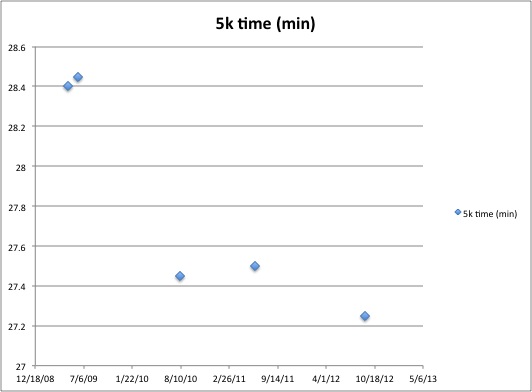
    My latest 5k time, from Saturday morning.

    Unfortunately, I can't prove it because I showed up as "NO NAME" in the results for some reason, which has me kind of annoyed (and scratching my head, because I was standing behind the woman from Anderson Race Management, watching eagerly over her shoulder, at the moment when she entered my race number into the laptop, and I saw my name, age, and 27:15 on the screen).

    I also, of course, saw the Big Red Clock as I approached it and crossed the finish line.

    I suppose these things just happen.

    + + + 

    I've run five 5ks now.  The following is for my personal archive:

    • May 2, 2009:  28:24
    • June 13, 2009 28:27
    • August 7, 2010 27:27
    • June 11, 2011 27:30
    • September 8, 2012 27:15

    5ktimes

    "Time to shoot for the 26's!" says Mark.  I suppose it's possible…

    + + +

    Trail running feels very different from flat road running.  There is the constant fear of stepping in a hole and turning an ankle.  There are the hills up and the hills down, the choice between the grassy margin and the sandy middle.  There is less room to jostle for position.  

    Saturday's run was mentally difficult because I didn't have a way of pacing myself.  I had forgotten my stopwatch, and there were no mile markers; I'd never run the trail before, had no means of measuring how far I'd gone, and quickly became disoriented as the trail meandered through the park, crossed bridges over leafy ponds and looped through the woods.  After a while I wondered how long I'd been out, and couldn't tell if it had been ten minutes or twenty.

    I felt pretty bad, huffing and puffing, and — as usual — wanting to stop.  I figured I must be going pretty slowly, because I felt awful.  But what do you know, when I rounded a corner and there was The Clock right there — 27:04, 27:05, 27:06 — I realized immediately that I had the causality all wrong, and I felt awful because I had been going pretty fast.  I picked up the pace for ten seconds (evilly, everything after you could see The Clock was up a steep grassy hill) and pounded across the finish line.

    And then someone put a water bottle in my hand and I wobbled over to the grassy spot by the EMTs, because I thought I might keel over, and if I did that I wanted to do it right in front of the people who were supposed to take care of me if I did.  

    But  I didn't keel over, and after a little while I could breathe normally again, so I wandered back to the refreshments where I discovered that the race sponsors had provided, among the expected bananas and granola bars, packets of wasabi peas.  Joy.

    + + +

    The race was a fairly small one — 176 runners competed —  to benefit a lupus charity.  I had signed up for it because it sounded like a pleasant race on a day when I had time to run one, but it was pretty clear that the majority of folks there had a personal connection to the cause; there was a higher-than-usual proportion of runners and walkers with tee shirts that said things like "Team Jessica" and "We're Running for Brenda" and the like.   While I drank my water and munched my wasabi peas, I listened to some of the post-race program.  

    A couple of patients living with lupus got up to thank people who had come out to support them that day.  As I listened to their stories, sitting there exhausted on the grass, I thought how it gives some perspective:  here I am all tired out by choice from my run, listening to people who battle chronic fatigue every day.  I'm glad I showed up, and I'm thankful.


  • Postsecondary education: Darwin weighs in, and I explain the pitfalls I’m trying to avoid.

    (This post is part of the series on postsecondary education.)

    + + +

    Check out Darwin's take at DarwinCatholic.  I'll probably have comments later in an update, but I have to go read a bedtime story.

    …..LATER…..

    Every once in a while, a critic will say of some hawkish Senator, "Well, is he going to send his kids off to war?"

    This rhetorical device annoys me, because in this country, no one sends his own kids off to war.  Adults (and sometimes older teens) decide for themselves whether or not to enlist in the U. S. armed forces and to accept the possibility of combat.     "Sending someone off to war" is the purview of the DOD, not of parents.

    When we imagine helicopter parents, we are generally not thinking of Black Hawks.

    A better question would be, "Well, is he going to teach his own kids to value the contributions of the U. S. military and to consider it as a potential calling or career?  Is he going to communicate to his kids that the choice to serve in one of the branches of the U. S. military is an honorable one, that to take on the risks of combat is brave and selfless, and that he would be proud to call a sailor, soldier, or officer Son or Daughter?"

    But somehow the critics never phrase it that way.

    + + +

    As Mark and I have been writing our pieces on postsecondary education questions, I find myself imagining an imaginary reader challenging us,

    "Well, if college is such a bad deal for America, and if there are as they say too many college students, are Mark and Bearing going to keep their kids out of college?  Are they going to send them to trade schools instead, or send them off to one of the other alternatives Bearing mentioned?"

    And of course we can't keep our kids out of college, even if we wanted to, because eventually they'll be adults.  We can't send them to trade schools either. (Although we could offer to pay for one and not the other).

    But a better set of questions might be:

    Are we going to encourage our children to take a broad view of "post-secondary education" that includes alternatives to college?

    Are we going to encourage our children to view all kinds of productive human labor as honorable and their practitioners worthy of respect? 

    Are we going to give them a chance to work with their hands during childhood as well as with their minds?

    Are we going to encourage our children to consider the costs as well as the benefits of the different educational paths open to them?

    Are we going to encourage our children to delay spending money on education until they have a plan for how to establish themselves, and eventually a family, in favorable financial conditions?

    Are we going to encourage them to have a backup plan, or an escape hatch, in case their first plan unexpectedly becomes untenable?

    Are we going to try to communicate to them that our approval and love is not contingent upon the "status" of their chosen profession?

    Are we going to try to raise them to strive for excellence, and not limit "excellence" to mean only academic achievement or prestige?

    + + +

    As Darwin points out, it's pretty likely that each of our children will have the inclination and the necessary preparation to attend a four-year college right out of high school.  Mark and I both graduated from college, and I hold an advanced degree; we directly supervise their education and are inclined ourselves to make that education a college-preparatory one; we have some funds to support post-secondary education, including college; in short, we come from a "college culture."  

    But we want to avoid the pitfall of assuming that four-year college will be the default choice, or even the best choice, for each of our children.  

    In his post, Darwin has identified some bad outcomes of this assumption.  

    (1)  Many people start college who are not actually able to finish, and these people "end up with debt and lost time, but don't have appreciably higher income and lower unemployment than those with only high school [diplomas]."  

    I add to that:   it's not just "lost time" — lost time in the workforce represents lost wages, lost savings, lost interest on those savings, lost experience that could have been leveraged into higher income now.  It's not just that they failed to gain economic benefits.  They really lost an economic good.

    (2) Those who graduate but who were in the bottom quintile of academic ability also end up with debt and lost time (and lost wages, lost savings, lost interest, lost experience….) but are unemployed at rates similar to those with only high school diplomas.   These people also really lost an economic good.  You might well argue that as a group they would have been economically better off if they had dropped out (like the group in point one), also known as "knowing when to quit," because they would have sunk less of their time and money into an endeavor which wasn't paying off.

    (3) "Borrowing tens of thousands of dollars is a bad way to avoid making decisions." Darwin is referring to graduate school, not undergrad, but I think the point stands for undergraduate education as well, because many people go to college after high school only because they have to do something while they figure out what they want to do with their lives, and college is the default option.  How many people start their college career with their major "undecided?"  How smart can that be?  Wouldn't it be better to do something that made money instead of  cost money while you are trying to decide what to do when you finally grow up?

    + + +

    And here are some more pitfalls:

    (4) If you assume that four-year college is the best choice, then you won't devote much time to learning about other kinds of careers and training paths.  If you are ignorant of these, you may miss something that would have been a perfect fit for your personality and talents.

    (5) Assuming that four-year college is the default choice, especially insisting that it is the only acceptable choice as many families do, communicates that people who choose different paths are less worthy.  Darwin implicitly identifies this when he points out that people make "unspoken assumptions" about those who don't have college degrees.  It's true that we have to teach our children to navigate a world that makes value judgments about people based on their occupations and education level, but we don't have to contribute to it.

    (6) Assuming that four-year-college immediately follows high school — the so-called "traditional student model"  – is to reject a number of viable paths in which alternative education precedes  or leads into a bachelor's degree from a traditional institution.

    For instance, Darwin writes that "urging [kids] to skip the college degree they want and get a certification in some skill like plumbing or welding instead is probably not a good idea."  Well — who says it has to be "instead?"  A welding certificate could be the means to earn a high hourly wage with which to "work your way through school."  It could be the backup plan so you know you'll always have a skill to fall back on if that English degree doesn't work out. (Most students don't graduate on time anyway — why not spend one year getting a certificate and four years getting a degree, instead of five years getting a degree?) Or it could be the first half of an associates degree in welding, which itself could lead to a bachelor's degree in welding engineering from a traditional four-year university.


    UPDATE FROM THE COMMENTS:  " I just wish I had felt like there were other options for a nice upper middle class girl."


  • Post secondary education questions: Alternatives to college.

    (This post is part of the series on postsecondary education.)

    + + +

    This might be a good time to switch gears and consider what a young person, high school diploma in hand, might do other than enroll immediately in a four-year university.

    I'm going to start a list. Help me finish it in the comments.

    Alternatives to College (or at least to "college right away")

    Learn a trade. This can be done through local unions (in my area, for example, the St. Paul electricians' union has a five-year on-the-job apprenticeship program) or postsecondary trade schools and institutes. Some programs take less than a year, while others culminate in associates degrees, still others can lead into specific bachelors programs, and others are multiyear apprenticeship-journeyman-master sequences. Acquiring a valuable skill could boost your hourly wages enough to let you work your way through traditional college afterward.

    Start a business. It takes initiative and research, and sometimes several failures precede success, but it's open to anyone.

    Join a national or community service initiative, either public or private. On the public side, for instance, Americorps is still around; private organizations such as religious denominations may have service programs too; and there may be something in your community.

    Join the military. Technical or professional training is often paid for by the government, and there's job security and benefits; the level and length of commitment varies.

    Work hard and save money for a while. Instead of going straight to university, spend a year or two in the workforce, wherever a job can be found. Acquire an appreciation for the value of money and time; learn about an industry or business from the bottom up; see your own community through the eyes of a responsible adult.

    Self-education. If you happen to have a source of funds, consider whether part of it could be put towards supporting yourself while you pursue a non-traditional means of broadening your horizons — travel? Community-based language learning? Self-guided study? Fine arts? Some kind of internship?

    Local government and politics. Run for office, or work in the office of a local official, or throw your lot in with a candidate, or with an organized political group or party.

    Take a health year.  Break an addiction — or just some bad habits.  Run a marathon — or just get off the couch.  Set a year-end goal, plus some medium- and short-term ones, and arrange your life to support them.  Invest in a longer and better-quality life.


    Any more ideas?