bearing blog


bear – ing n 1  the manner in which one comports oneself;  2  the act, power, or time of bringing forth offspring or fruit; 3 a machine part in which another part turns [a journal ~];  pl comprehension of one’s position, environment, or situation;   5  the act of moving while supporting the weight of something [the ~ of the cross].


  • “Collectors of antiquities or novelties.”

    Here's a report on Pope Francis's chrism mass, with video.

    (I seriously can't get enough of this guy.  My apologies; recipeblogging, parentblogging, and kid pictures will return shortly.)

    I haven't watched the full video yet or made a transcript, but even in the two excerpts on the listed site I found something I wanted to share.  Recall that this is the Chrism Mass, where the oils for anointing are blessed and distributed to parishes.

    First quote:

    “The Lord will say this clearly: his anointing is meant for the poor, prisoners and the sick, for those who are sorrowing and alone. The ointment is not intended just to make us fragrant, much less to be kept in a jar, for then it would become rancid … and the heart bitter. ” 

    I'm pretty sure when he says "not intended just to make US fragrant," he means the people entrusted with the oil for its use.
    He is talking to priests, but I think the lesson is more general than that.  The oils stand for all the gifts of the Church and of faith.
    Second quote (I took this from the full text to give context):

    A priest who seldom goes out of himself, who anoints little – I won’t say “not at all” because, thank God, our people take our oil from us anyway – misses out on the best of our people, on what can stir the depths of his priestly heart. Those who do not go out of themselves, instead of being mediators, gradually become intermediaries, managers. We know the difference: the intermediary, the manager, “has already received his reward”, and since he doesn’t put his own skin and his own heart on the line, he never hears a warm, heartfelt word of thanks. This is precisely the reason why some priests grow dissatisfied, lose heart and become in some sense collectors of antiques or novelties – instead of being shepherds living with “the smell of the sheep”, shepherds in the midst of their flock, fishers of men. 

    I'm the one who bolded the brilliant phrase "become in some sense collectors of antiques or novelties" 

    "Antique" collectors.  "Novelty" collectors.  He is pointing to anyone who fails to bring the good news and the acts of mercy out of themselves:  whether they be labeled traditionalists (collectors of antiques) or whether they be labeled progressives (collectors of novelties).

    They're both liable to gather dust. 


  • Going out on a limb.

    I am still chewing on stuff that was going around in my head about “intentional spiritual poverty,” coupled with a few things Melanie wrote — one comment here suggesting looking to the Litany of Humility, and a post about what rankled her when Heather King suggested (yes, I am oversimplifying) that if you didn’t hang around with drug addicts and ex-prostitutes, you aren’t getting out enough.

    The problem with Heather’s point is just that it wasn’t general enough. The Christian life has to be, at least in part, about hanging around with people who are not, shall we say, respectable. And treating them as worthy of respect.

    To give one example: Children are not very respectable. And yet, they deserve respect as persons. They deserve to have their needs met, to have the chance to voice pleasure and displeasure, to be seen and heard, to be loved as persons. Not petted as if they were toy animals, nor exploited for the whims of adults, nor stowed away when inconvenient; rather, loved as persons, talked to and heard as if they were intelligent creatures, protected and at the same time loosed to experience the world; in short, brought along with us.

    Children are not the only unrespectable people we are bound to offer human respect to. How about the embarrassingly ignorant? How about the rude boor? How about the insufferably wrong? How about the laughable narcissist? The home-wrecker?

    I understand disdain. I do. For me it has always been a protective mechanism.

    There’s no point in reasoning with him.”

    “He’s just a toxic individual and I stay as far away as possible.”

    “Typical behavior coming from her. What do you expect?”

    “Don’t feed the troll, you know what I mean?”

    “I just try to ignore him.”

    Okay, so it can be psychically dangerous to engage with so-called “toxic people.” And sometimes it is your duty to protect other people from harm, I get that, and of course you have the right to protect yourself from real harm.

    But what if the risk were overstated? And what if we are enhancing the risk by following the wrong rules?

    + + +

    You know what else I understand? I understand the deliciousness of well-crafted snark.

    (And it isn’t like our generation invented it. Not even Catholic snark. Ever read Chesterton?)

    There’s probably a proper place for snark. It is good to hunt down absurd arguments and lay their absurdities bare. But it seems to me the snark is properly aimed at the arguments and not at the arguer. And even then, it’s blunted by overuse.

    And if you really just use it to score points or to look smart — to the “respectable” people — well. That is a problem.

    Let’s take a look at that Litany of Humility again.

    It asks deliverance from the desire of being praised and extolled, and from the fear of being rebuked and humiliated.

    It might just as well ask deliverance from the desire for +1’s, Likes, and retweets.

    It might just as well ask deliverance from the fear of letting somebody be wrong on the Internet.

    It might just as well ask for the grace to desire that others make wittier points.

    Tough, that.

    + + +

    We are supposed to look past exterior appearances. Instead we are supposed, it is said, to welcome and value people for the content of their character, for their invisible traits of kindness and intelligence and good humor; to look past the exterior appearances.

    But wait — perhaps we have to look even past the content of character. Perhaps we have to look past whether someone is physically attractive or ugly — but not stop at whether a person is intellectually and morally attractive, or intellectually and morally withered. Perhaps we have to value and welcome into discourse an even more central core of common humanity. Not just the physically repulsive and morally attractive, but the morally repulsive, are human too, and deserve to be treated as such.

    That is a tall order. Imagine the most horrible person you can think of. The leader of a Klan rally, or a serial rapist, or someone who made a fortune selling size 6x sweatpants with the word “Juicy” written across the butt. Imagine shaking his hand and looking him in the eye.

    + + +

    Pope Francis is already upsetting respectable people. Did you read the text of his first general audience? Rocco Palmo has it posted at Whispers.

    What does this mean for us? It means that this is my, your, our path. Living Holy Week following Jesus not only with the emotions of the heart; living Holy Week following Jesus means learning how to go beyond ourselves – as I said on Sunday – to reach out to others, to go to the outskirts of existence, to be the first to move towards our brothers and sisters, especially those who are most distant, those who are forgotten, those who are most in need of understanding, consolation and help. There is so much need to bring the living presence of Jesus, merciful and full of love!

    Living Holy Week means increasingly entering into God’s logic, the logic of the Cross, which is not first of all that of pain and death, but of love and of self-giving that brings life. It means entering into the logic of the Gospel. Following, accompanying Christ, remaining with Him requires a “stepping outside,” a stepping beyond. Stepping outside of ourselves, of a tired and routine way of living the faith, of the temptation to withdraw into pre-established patterns that end up closing our horizon to the creative action of God. God stepped outside of Himself to come among us, He pitched His tent among us to bring the mercy of God that saves and gives hope. Even if we want to follow Him and stay with Him, we must not be content to remain in the enclosure of the ninety-nine sheep, we have to “step outside”, to search for the lost sheep together with Him, the one furthest away. Remember well: stepping outside of ourselves, like Jesus, like God has stepped outside of Himself in Jesus and Jesus stepped outside of Himself for all of us.

    …God always thinks with mercy: do not forget this. God always thinks with mercy: our merciful Father. God thinks like a father who awaits the return of his child and goes to meet him, sees him coming when he is still far away …

    Really, read the whole thing. It is exactly apropos to what we’ve been turning over this week.


  • Some beautiful writing on language.

    From Ta-Nehisi Coates at The Atlantic.

    The back story on this is that for some months, TNC — whose story is worth reading, by the way — I highly recommend his memoir The Beautiful Struggle — has been learning French for the first time.  Not without some struggle that he's chronicled on the blog, in many good posts about language and how, in learning a new language, you craft a new sort of identity for yourself.  

    I wish there was a single link to the entire series of posts dealing with language, but I can't find one, so this Google search will have to do:  site:theatlantic.com ta-nehisi coates french 

    The last few posts have been the interior commentary while traveling for the first time to Paris.  I'm loving them, because they are more than a travelogue, they are an extended commentary on the existential  questions raised by the experience of speaking a new language and being a new kind of "other." n Here they are:

    I.  Jeudi


    At 8:45 I will board a ship. It will punch through the sky. At some point, God willing, that ship will emerge over airspace far from the beloved West Baltimore of my youth.

    Something is happening in this world. I think of my grandfather, lecturing from the daily newspaper, drowning in alcohol, addicted to violence. I think of my father, working all summer as a child, saving his funds for a collection of recordings that promised to teach him French. He didn't learn French, but he learned to compel his son to want to learn French. I think of my grandmother pushing up from the Eastern Shore of Maryland raising three daughters in the projects, somehow sending them all to college.

    I think of what these folks might have been had they not lived in world intolerant of black ambition. The world has changed….

    Je ne sais pas. What I know is I live in a time that people who made me possible only dreamed of.   And then yesterday I almost lost it all….


    II.  Vendredi

    I have come to regard anyone who speaks more than one language as the bearer of great and unearned power. You say bilingualism and I imagine ice sleds, healing factors and flight. In New York, I am surrounded by the secret schoolmen of Salem. They speak and and my fingers dabble at the inhibitor collars. 

    I am deep in my dark and twisted lab. I am building a machine of fantastic power and awesome savoir-faire. Soon I shall flip a switch, and all those who laughed at my "Parlay-vouz" and "Jay Nay Say Pahs" shall turn, light leaping from them into the cone of my terrible device. Then they will stagger before brilliant me, blinking and depowered. For now I just murmur "Mutie scum" under my breath and bide my time. 

    I am in Geneva, like the only human on Asteroid M. They told me that the people would switch to English as soon as they heard my French. But this only happens when we are discussing money.


    III. Samedi

     I walked to a pâtisserie, ordered a pain au chocolat and a coffee (it's becoming a ritual) and thought mostly of my wife. I was watching the people come and go. I was watching the children here, lost in their strange freedom unlike anything I've ever known. They range the city–embracing, grazing, laughing. 

    When I was a kid in West Baltimore the cops called this loitering. Childhood was a suspect class always bordering on the edge of the criminal. You play football on the traffic island and the cops chase you off. Never mind that it's the only long patch of green in your neighborhood. You fly your kites from the second level of Mondawmin Mall and the les gendarmes are in effect. Go back to watching the Wonder Years and dreaming.  You nail a crate to a telephone pole, because all the courts near you have been stripped. The city doesn't send people to repair the courts, but to tear down your crate. 

    Perhaps somewhere in Paris it is the same. But what I have seen is a place with a different sense of the Public, with children loosed in such a way that I have not seen even in wealthy areas….


    IV.   Dimanche

    A month ago I was giving a talk at a college where someone asked my why it was wrong for white people to use the word "nigger" in a friendly way. I responded, as I always do, by pointing out that the names people use depend on their relations. That I should not expect to call another man's wife "honey" by pointing out that he calls her the same thing. That my wife and her friends use the word "bitch" between them, but that is not a name I should expect (or want) to employ. That whatever they say, I have no desire to address my gay friends as queer. If you respect the humanity of black people, then you respect that they get to do what other humans do–ironically employ epithets in a communal way.

    But walking through le jardin, I saw the problem from another angle….

    I'm looking forward to more of this.


  • Still more on poverty.

    Father Dwight Longenecker gives us some more to think about concerning Franciscan-style intentional poverty — contrasted with Benedictine-style “communal living.”

    A Benedictine monk takes three vows: obedience, stability, and conversion of life. He doesn’t take a vow of poverty. However, the Rule of St Benedict does forbid private ownership of any kind. A Benedictine monk does not take a vow of poverty, but he lives under a rule of no personal possessions. The monastery owns stuff. In fact, a monastery could be very wealthy. However, it is all owned in common, and each individual monk makes use of what is owned in common, but does not own it himself.

    This is a radical attempt at communal living which commands personal poverty, but does not elevate being impoverished as if it were some sort of virtue simply to be poor.

    St Francis, on the other hands, wanted to marry “Lady Poverty” and claimed that it was indeed a virtue to be poor. He was probably reacting to the Benedictine monks of the day who may not have technically owned anything individually, but who did live very well in their plush monasteries. The problem with Francis’ embrace of literal poverty is the reason he was suspected of heresy–if poverty is a virtue for its own sake, then by implication private ownership is evil and by further implication the heresy of Manicheanism is there–the belief that the material world is somehow tainted or evil. Francis corrected this by embracing the goodness of all things which could be best enjoyed by not owning them or grabbing them for oneself. His poverty was therefore an affirmation of all things rather than a rejection.

    While the Benedictine approach does not embrace poverty as a virtue, it does hold hands with the Franciscan approach in it’s rejection of private and personal ownership. Both ways call for a radical rejection of private ownership in order to develop within the person a proper Christian detachment.

    …The Christian is called to be detached from material things in order to be properly attached to all things. The poet Thomas Traherne says, “Can a man be just unless he loves all things according to their worth.” Thus a Christian should be detached from all his belongings so that he can love them–and all things–according to their true worth.


    More thoughts applying things like this to spiritual poverty?

    And by the way, does this have anything to do with being “poor in spirit?”


  • More on “spiritual poverty.”

    Melanie picked up my ball in the last post and ran with it:

    Especially in the online world it can be so hard to see others’ humanity, to risk being flamed at by approaching what seems like a scoff as if it were an invitation to a dialogue, to risk seeming like a fool for enagaging a “troll” instead of dismissing him with scornful words. And in Catholic comment boxes you also risk being chided by your fellow Catholics for engaging with such angry hurtful people. “Don’t feed the trolls,” they warn you. But perhaps that’s exactly what we are called to do? To feed them? Couldn’t it be that the troll who regularly hangs out at Catholic sites someone who is hungering for the truth but afraid of rejection so is preemptively rejecting those who he feels have already shut him out?

    Mind blown by the sudden new meaning of the term "to feed trolls."

    You still have a responsibility not to feed the troll on the property of the person who has the "don't feed trolls" rule, i.e., in their comment box.  But you could invite them to your own blog or you could contact them off-blog.  And you could certainly engage respectfully (and skillfully) in a manner designed to be peaceful, all light and no heat.

    Having started down that line of thinking, how there is a need for the spiritually impoverished to be fed, especially online I began to imagine that some individuals might have the vocation of doing just that. Then as I talked it over with Dom he said, it couldn’t be individuals. It would have to be people living in community. And as we talked I began to envision a new sort of religious community: the Missionaries to the Digital Continent. A cloistered contemplative order who live the Benedictine motto ora et labora whose days are ordered around the monastic hours and Eucharistic adoration and who are dedicated to bringing Christ to all the darkest corners of the internet. 

    Aw, man, you beat me to it.  I've been thinking of this for a long time but haven't written about it here.  Instead I wrote it in Dorian Speed's Facebook comments.  This is what I wrote after she went on her rant about that Vatican website using Comic Sans:

    Dorian, I think you're just the person to take this idea and run with it (when you are done with Electingthepope.net of course): The Church needs a new religious order of blogging and HTML-savvy monks and nuns. We need to set up a cloister with high-speed Internet connection and excellent tech support. In between praying the Liturgy of the Hours, attending daily Mass, and working in the refectory and gardens, they'll do pro bono web design for struggling Comic-Sans-using parishes and church organizations everywhere. They'll also surf the Internet looking for combox discussions into which to inject a note of charity and wisdom. Also they will pray for trolls.

    and in another comment, an afterthought:

    We can put the adoration chapel in a Faraday cage so they don't get distracted from what really matters.

    Anyway, not to get too distracted about it: 

    Melanie suggests organizing the effort to be "spiritually poor" around the seven traditional Spiritual Works of Mercy.  (You can find these enumerated here.) Since we're talking about an analogy anyway, let me list the seven Corporal Works of Mercy first:

    • To feed the hungry;
    • To give drink to the thirsty;
    • To clothe the naked;
    • To harbour the harbourless;
    • To visit the sick;
    • To ransom the captive;
    • To bury the dead.

    The seven Spiritual Works of Mercy are

    • To instruct the ignorant;
    • To counsel the doubtful;
    • To admonish sinners;
    • To bear wrongs patiently;
    • To forgive offences willingly;
    • To comfort the afflicted;
    • To pray for the living and the dead.

    Just as the charism of the Franciscans was to perform works of mercy from a position of being intentionally corporally poor, we are envisioning a charism of performing works of mercy from a position of being intentionally spiritually poor.  

    The intentional corporal poverty was a means of demonstrating (among other things) that none of us can pat ourselves on the back for acheiving our material riches, because so much of it was out of our control and all of it, our physical life itself, is a gift.  We may have had a hand in taking and shaping God's good gifts to our profit, in making good decisions along the way (we do believe in free will after all, and that God lets us participate in the development of our own futures) but in the end we owe it all to God.  "No shroud has pockets" indeed.

    So the intentional spiritual poverty would be a means of demonstrating (among other things) that none of us can pat ourselves on the back for achieving whatever spiritual riches we have.  The intellect with which we absorb the deep theological musings of the doctors of the Church, and craft arguments to defend her teachings?  Gift from God.  The desire we have to come closer to God?  A gift.  The gift of emotions, of sorrow at the Passion, of joy at the Resurrection?  A gift.  True contrition?  Gift.  Gratitude to God for all his good gifts?  A gift in and of itself.

    I am not sure how to demonstrate it outwardly except, as I said, by a radical non-judgmentalism of the person.  Even the most objectively horrible people must be reached out to with love and compassion and a recognition of "there but for the grace of God go I."   

    It strikes me that, if the contemplative wing of this order be called to Internet surfing and commenting, that the active wing be called to prison ministry.


  • Pastoral care of the poor: both kinds.

    Once I was traveling and I went to Mass at an urban church, a little jewel, run by Franciscans.    I was younger, and I was moved to see the brown habits, the combination of simplicity and reverence.  Since then I am always pleased to see the Franciscans.  I have always sensed that the exterior poverty goes all the way to the core with them.  That they inhabit jewels of churches and brocaded stoles as pilgrims and servants.

    So I was privately thrilled to have a pope, if not a Franciscan, a religious who takes the name of Francis.

    + + +

    We are starting to see hints of what "Francis" means to Francis, and it is more multilayered than we all originally thought.

    The name of "St. Francis" brings up images of embracing material poverty and rejecting the trappings of material wealth, and bringing Christ directly to people who themselves live in material poverty.

    I think it's very easy to fall into the trap of assuming that St. Francis's reason to embrace poverty was so that he could "relate better" to the poor people he was preaching to — or worse, so that they could relate to him.  This idea reduces St. Francis's poverty to a show, something put on for effect:  "Look, I am poor like you, I am one of you, therefore you should listen to me."  

    We should take St. Francis at his word:

    When I was in sin, the sight of lepers nauseated me beyond measure; but then God himself led me into their company, and I had pity on them. When I had once become acquainted with them, what had previously nauseated me became a source of spiritual and physical consolation for me….

    When God gave me some friars, there was no one to tell me what I should do; but the Most High himself made it clear to me that I must live the life of the Gospel. … Those who embraced this life gave everything they had to the poor. They were satisfied with one habit which was patched inside and outside, and a cord, and trousers. We refused to have anything more.

    …we were only too glad to find shelter in abandoned churches. We made no claim to learning and we were submissive to everyone. I worked with my own hands and I am still determined to work; and with all my heart I want all the other friars to be busy with some kind of work that can be carried on without scandal. Those who do not know how to work should learn, not because they want to get something for their efforts, but to give good example and to avoid idleness…. When we receive no recompense for our work, we can turn to God's table and beg alms from door to door. God revealed a form of greeting to me, telling me that we should say, "God give you peace".

    The friars must be very careful not to accept churches or poor dwellings for themselves, or anything else built for them, unless they are in harmony with the poverty which we have promised in the Rule; and they should occupy these places only as strangers and pilgrims….

    God inspired me to write the Rule and these words plainly and simply, and so you too must understand them plainly and simply…

    St. Francis is known as a "man of the poor," in part because he voluntarily joined the ranks of the materially poor.  It seems to have been an inward choice manifested outwardly, a sign of transformation, of separation from the materially wealthy world that he belonged to, of stripping off his old identity and taking on a new one.  The symbolism embodied in a religious "habit" was made manifest in St. Francis, who literally renounced his old life by making a public act of stripping himself naked in front of his disapproving father.

    But it seems to me, from comments that the Holy Father made to the diplomatic corps, that Pope Francis has something else in mind as well when he takes the name of St. Francis for himself.  

    As you know, there are various reasons why I chose the name of Francis of Assisi, a familiar figure far beyond the borders of Italy and Europe, even among those who do not profess the Catholic faith. One of the first reasons was Francis’ love for the poor. How many poor people there still are in the world! And what great suffering they have to endure! After the example of Francis of Assisi, the Church in every corner of the globe has always tried to care for and look after those who suffer from want, and I think that in many of your countries you can attest to the generous activity of Christians who dedicate themselves to helping the sick, orphans, the homeless and all the marginalised, thus striving to make society more humane and more just.

    So far, so good.  This is the plain meaning and connotation of "Francis."  But then:

    But there is another form of poverty! It is the spiritual poverty of our time, which afflicts the so-called richer countries particularly seriously. It is what my much-loved predecessor, Benedict XVI, called the “tyranny of relativism”, which makes everyone his own criterion and endangers the coexistence of peoples. And that brings me to a second reason for my name. Francis of Assisi tells us we should work to build peace. But there is no true peace without truth! There cannot be true peace if everyone is his own criterion, if everyone can always claim exclusively his own rights, without at the same time caring for the good of others, of everyone, on the basis of the nature that unites every human being on this earth.

    So, here is my question.

    We know what "St. Francis" is to the materially poor.

    How does the St. Francis to the spiritually poor appear?

    I myself was raised materially wealthy, but in comparative spiritual poverty.  I know something, a little, about this.

    And many people are raised in spiritual poverty that goes far beyond what I encountered:  a poverty that not only fails to transmit the concept of divinity of God, but also fails to transmit the concept of humanity in persons.  Abuse, hatred, exploitation, violent acts against the dignity of human beings are everywhere; and a quieter kind of deprivation that simply values objects more than people and communicates it in a thousand daily acts of obeisance to things.

    It has always been a struggle for "respectable" people to acknowledge that physical, material poverty is not generally a punishment inflicted by God on the deserving, or even inflicted by the undeserving on themselves.   It is a severe temptation among the comfortable of all stripes to assume that a poor man is poor because he did something to deserve it, or because he failed to do something and he should have known better.  It goes that way for many types of physical poverty:  the healthy love to blame the ill for making themselves sick through poor choices, the safe blame the endangered for endangering themselves.  

    When Francis and his followers embraced holy poverty, they became a sign of contradiction.  They did not, I think, do so, each of them, in order to be a sign – I think they were doing so in order to become new men and women, in order to transform themselves inwardly by conforming their choices (tastes, even) to Christ, in response to a highly personal, inward call. But become a sign they did, as so many invisible transformations do.  The sign of contradiction is simple and yet ancient as Job:  here is someone both miserable and holy.  Someone whose poverty is as self-inflicted as can be, and yet, undeniably, steeped in the love of God.

    What can it mean to be "Francis" to the spiritually poor?   Can this kind of poverty be embraced, the way that Francis of Assisi embraced the materially poor?  Can spiritual poverty ever be a kind of holy poverty?

    And don't go telling me that there's a big difference between the spiritually impoverished and the bodily impoverished, because the spirit is important and the body is not, or some such nonsense.  We are not Albigensians here.

     If we can say that the materially poor are poor because of a mix of choices (often forced, coerced, and not entirely free) and accidents that played out in a materially impoverished environment —

    …then we can say that the spiritually impoverished are impoverished because of a mix of choices (often forced, coerced, uninformed, and not entirely free) and accidents that played out in a spiritually impoverished environment.

    Is Pope Francis saying that he means to find a way to look to St. Francis to reach out to those of us who live lives that are wealthy, yet rotten at the core?

    What can that be like?

    It seems to turn St. Francis inside out, somehow, yet I am intrigued. 

    I keep thinking of one image.  From Rubin, Corpus Christi: The Eucharist in Late Medieval Culture:

    A story current within the Franciscan order told of St. Francis' desire to have friars distribute to all the order's provinces good metal boxes for their hosts, since these were all too often left scattered and neglected.

    I picture the Franciscan friars, barefoot in their ragged brown cloaks, carrying and distributing these "good metal boxes"  – whatever they were made of, they cannot have been cheap! — for proper safekeeping and display of the Eucharist.

    Anyway, there is a paradox here that I cannot quite grasp.  I think Pope Francis may be trying to remind us all that the "spiritually impoverished" are not to be written off by us, any more than are the materially impoverished.   The "preferential option for the poor," perhaps, extends to those who dine well, carry designer bags, boast of the finest educations, and yet remain — invisibly — empty, fearful, and alone.

    Spiritual poverty, the leperous sicknesses that permeate the culture of death, nauseates us, no?   

    So can we let God lead us "into the company" of those who suffer it?  Risking by that our own infection?

    Can we, there, discover pity and transformation? 


  • Special; connection.

    Every once in a while you find a bit of half-wisdom in an unlikely place, and it sticks with you and becomes a sort of recurrent theme.

    For instance:

    Back when I was going through toddlerhood for the first time, I found a pretty helpful book about child discipline.  This book was a little more transcendent than the average discipline book, I think, because it was actually more about self-discipline:  developing the fortitude to restrain your own unhelpful impulses, and to walk between punitiveness and permissiveness.  Anyway, one of the questions that the author suggested asking yourself along the way was:

    "Do I want to be special, or do I want to connect?"

    Never mind the context.  The simplicity of this dichotomy stuck in my memory.  Often we get a choice between being special (which necessarily sets you apart from others) or connecting (which necessarily emphasizes commonalities.    And when you are a parent or caregiver, overseeing multiple children, often there is a choice between emphasizing specialness and emphasizing connection.   It comes into relationships with people you meet, too:  are you to treat such-and-such a person as special or are you to connect with them?

    Leaders are "special," and with the "specialness" comes a distance.  They aren't like us.  They have different responsibilities.  Celebrities are made "special," and that makes them seem less human.  Winners are "special," afforded rewards that the ordinary person can't share (or else there wouldn't be winners).  

    It isn't necessarily better to desire connection than to desire specialness.  Those of us who want to be leaders, want to be famous, want to be winners — want to be special — are wanting good things.  It's just that they are good things that come at a certain cost.  And those of us who want, mostly, connection — well, that comes at a cost too.  It is not possible to have it all, or at least not all at once.

    On the surface, there is a tension between specialness and connection.   They seem to be opposites, poles that you can travel between, coexisting only in the sense that you can compromise between them or that you can emphasize one or the other at different times.  

    But there are some remarkable situations where the two overlap, are two sides of the same coin:  where something is made special through connection, where we connect more intimately by an act of setting apart.

    + + +

    1.  Unique connections.

    Consider a person wishing to marry:  The community is full of potential partners, all (more or less) of equal stature.  But when our individual chooses one — when the act of choice is made, which is to say, the marriage vow — that spouse is set apart, is made "special."  (Reciprocally special, of course — the one is special to the other, and vice versa.)    "I set you apart from all others:  I choose you."  And it is in that choosing that a particularly intimate and transcendent connection is made:  a connection that would not be possible if it were not for the setting-apart, the relinquishing of all those other potential partners.  Marriage is a connection that is made possible only by "specialness."

    And, of course, it makes possible other special connections:  mother-and-child, father-and-child, siblings-to-each-other.  In the family each person is known as special.  My children each only have one mother in the world; I am the only, the unique; I am irreplaceable; I am distinct from all other women and also from the other members of the family; I get a pedestal, you might say.  But that pedestal exists only because of the particular and intimate connection I have to each one of them.   I am special to each because of my relationship with each.  And the connection exists only because of who I am to them:  Mama.


    2.  Unique communities.

    Consider Israel:  not the modern nation-state, but Israel as it understood itself in the biblical sense:  a chosen people, a people set apart.  Israel felt a duty to maintain a severe separation between itself and the other nations around it; intermarriage with people from other nations was generally forbidden, tolerated only under strict regulation; adopting cultural and religious elements from neighboring groups was unthinkable, and regarded as bringing down punishment on the whole people; careful practices were developed to emphasize their differences.  They regarded themselves as a holy people, and of course "holy" and "sacred" and "consecrated" and all such words have to do with "this thing is set apart as special for a special purpose" more than they have to do with goodness and rightness.  They were supposed to be very careful not to make too much connection with other peoples.

    But:

    They were "a people" made up of "people," a whole community, and within that community there was deep identification and connection.  Because they were so set apart, because the boundaries between Us and Others were clear, because they kept strictly to traditions that identified them as a people, they had a particular connection with one another and also with their ancestors and their descendants.  Insulation from the surrounding peoples was accomplished through deep connection — not to mention all the ordinary sorts of connection that make a collection of persons a community rather than, well, just a collection of individuals.

    + + + 

    Those are two examples.

    Specialness – in its form sacredness – and connection are attributes of the elements of the Trinity toward each other:  one and differentiated at the same time.  And they are attributes of the Dual Nature of Christ:  Man and God, one of us and unutterably holy and Other from us at the same time.  Nothing on earth has ever managed to be "special" and "connected" more perfectly than the Christ.  

    And so when we relate to Christ, we have somehow — at the same time — to treat Christ with perfect respect for His sacredness and perfect unity and communion with Him.

    This is manifestly difficult.

    + + +

    Marriage is one image that show us how we might do that.

    A "chosen people" is another image used to show us how we might do that.  

    + + +

    We have a Eucharist, and that is one such way.  

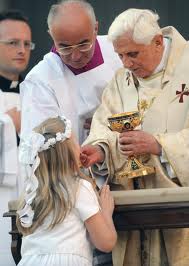
    We have this stuff that looks like bread that we can treat with intense reverence.  Keeping it in objectively beautiful containers of only the finest materials (as St. Francis of Assisi is said to have encouraged); allowing it to be touched, except when necessary for good reasons, only by consecrated hands; preserving silence in its presence.

    And then we eat the stuff.  Connection most intimate:  It becomes part of ourselves, fuels our motion, incorporates into our own bodies.  It's almost anti-holiness, because anti-separation:  or if you like, it incorporates ourselves into its holiness and separateness.

    + + +

     All this is to say that the following is a false dichotomy:


    Images-1

    Holiness

    VS

    Images-3

    Connection


    One can just as easily see

    479699_10200882652894910_1998537882_n

    Holiness

    and

    Images-2

    Connection


    There is no opposition here.  There is none.  Connection and sacredness are united in one Person perfectly, in the rest of us imperfectly, and that includes whoever happens to be Pope; and it's precisely because persons are unique, unrepeatable, holy for that reason, that we should expect to sense different qualities of connections to different persons.  

    NOT more connection with one, less with another.  

    It boggles the mind:  that Christ entrusted His mission to human beings at all.  


  • You don’t have to overdo it.

    Article in the NYT Well Blog: Why 4 Workouts a Week May Be Better Than Six.

    And how about just two workouts a week? Really — almost as good.

    A common concern about exercise is that if you don’t do it almost every day, you won’t achieve much health benefit. But a commendable new study suggests otherwise, showing that a fairly leisurely approach to scheduling workouts may actually be more beneficial than working out almost daily…

    [R]esearchers at the University of Alabama at Birmingham gathered 72 older, sedentary women, ages 60 to 74, and randomly assigned them to one of three exercise groups.

    One group began lifting weights once a week and performing an endurance-style workout, like jogging or bike riding, on another day.

    Another group lifted weights twice a week and jogged or rode an exercise bike twice a week.

    The final group… completed three weight-lifting and three endurance sessions, or six weekly workouts.

    There were, remarkably, almost no differences in fitness gains among the groups. The women working out twice a week had become as powerful and aerobically fit as those who had worked out six times a week…

    However, the women exercising four times per week were now expending far more energy, over all, than the women in either of the other two groups….

    “We think that the women in the twice-a-week and four-times-a-week groups felt more energized and physically capable” after several months of training than they had at the start of the study, says Gary Hunter, a U.A.B. professor who led the experiment. Based on conversations with the women, he says he thinks they began opting for stairs over escalators and walking for pleasure.

    The women working out six times a week, though, reacted very differently. “They complained to us that working out six times a week took too much time,” Dr. Hunter says. They did not report feeling fatigued….Rather, they felt pressed for time and reacted, it seems, by making choices like driving instead of walking and impatiently avoiding the stairs.

    I have long advised people who want to become “one of those people who works out” to start with twice a week, and try to keep that up for a good long while. I only manage three times a week myself, and that is if I am lucky and nothing derails me. Twice a week can be life-changing — it is frequent enough to see and enjoy progress, but not enough to cause burnout. Whether it requires stressful schedule juggling depends on how full your schedule already is, and on what you are currently filling your time with.


  • Live streaming.

    Lately, I’ve been overtaken by an odd sort of nostalgia, or maybe just an awareness of passing time: these kids I’ve got are getting bigger, and the clock keeps marching forward.

    That’s true, of course, but in a way the sense is detached from the reality of the now. A bus lumbers through the intersection in front of me, bearing an advertisement for a local urgent-care clinic, with a photo of a smiling eight- or nine-year-old boy, his hair mussed from having just taken off his hockey helmet. And I think: Ah, those were the days! But that’s ridiculous, because I actually have an eight-or-nine-year-old boy, not a hockey-playing one (Deus avertat) and two younger ones coming up behind him, and I am only 38 and Still Have It, at least in the way that “It” matters for the purpose of this question, and for all I know there may be more.

    Is it that my oldest is nearing thirteen? That I have lost the innocence of the mother-of-littles-only, and passed through that stage where your parenting theories are all still shiny, new, free of scuffs and dings? But I am thankful for that gift of experience, of wearing down the edges and corners of myself.

    Maybe it’s the slouching onward from being the young mother (not that I was ever super-young — I had my first at twenty-five) to being the lady with all the kids (not that four is really all that many).

    Part of it I think I know.

    I am about nine years in, homeschooling, and just in the last couple of years I’ve felt myself hitting my stride. My third child is in first grade and so now I am doing some curricula for the third time, but I’m still tweaking and innovating and discovering the differences that different children bring to the schoolroom, and that they’re really all getting individualized educations. I’ve got a great co-schooling routine twice a week; at the same time that I’m working on lengthy translations with the teens, I’m now back to amo, amas, amat with a batch of young elementary-school children, and am midway through my second trip through American history. And on the other side of co-schooling, I’m at peace with letting go of the control and allowing someone else to teach my children entire subjects. I’ve recently had to rough out plans for a high school curriculum so that I could get eighth grade squared away, and it looks do-able, not overwhelming.

    All this happened slowly and with a great deal of focused work. Everyone who tackles the task of managing her own children’s education brings something different to the work — we are all entrepreneurs, free agents, distributed, running on our own operating systems. I brought an intense preference for tweaking curricula to suit my vision, for careful scheduling so there would never be a question of “what should we do today?” I brought a need to figure things out in writing, a thrill at learning while leading kids through subjects I don’t have a strong background in (why would I want to teach French? I already know it), and a penchant for flow when I stay up at night, fueled by coffee, books splayed out on every surface, working out which passage to read when, and which concept needs more coverage to balance the other concept.

    I do not have a penchant for flow when actually teaching children, except maybe when I get to sit next to just one child and teach math. I have some hopes to catch a little bit of it when I teach high school-level geometry next year.

    Anyway — who else out there is nine years into their career? After nine years, we should all be hitting our stride, getting better and better at the thing we do, and each thing we do prepares us better for the tasks ahead, right? Having invested so much time and training and experience in ourselves, we are specialists, confident, experts.

    This is clearly, by now, the thing that I do. And I survey my younger children — my daughter’s got eleven years of education yet, and my youngest son hasn’t started yet, I suppose there are fourteen or fifteen years ahead for him —

    — and don’t forget that I Still Have It —

    — and, while the future may bring many things and I could make a different path at any time if necessary, it’s apparent that this, this up-at-night-with-the-history-spreadsheet, this sitting-down-with-the-pattern-blocks, this hey-you-put-that-iPod-down-and-come-write-your-journal-entry, this will go on being the thing that I do.

    And I am okay with it. I really am. I enjoy it. It is truly challenging, in the best way that an occupation can be challenging. I am one of those people who never stops moving — that can be a character flaw, and is for me sometimes — but one thing about that, it suits this thing I do very well.

    But occasionally I find myself astonished by what I have done, and by what I plan to do.

    I am living in a life that once seemed too improbable to even give voice to desiring. And I have tossed myself in, senselessly. And it’s exhilarating, and difficult, and way more messy than I can stand, honestly.

    And I have slowly realized that nine years of specialization helps, but that it doesn’t guarantee that I will be an expert in whatever happens in the future. And eventually, no matter how expert I am at teaching my small children, biology will say to me, “You’re fired.”

    Nothing in this life looks like an advertisement, that’s for sure.

    The astonishment is that (a) this situation is permanent, and (b) that it never stops evolving. Though I may have many years left of it, I now know from experience that nothing in it can be held firmly, it is always slipping away, and that is what makes it so very, very important, every minute of it, present, now.


  • At your service.

    A video detailing something I've never heard of that made my jaw drop.  The Atlantic Monthly headlined their short piece on it, "How 4,000 Men Hand-Deliver 175,000 Lunches Around Mumbai in One Day:"

    Dabbawalla from The Perennial Plate on Vimeo.

    “Dabbawalla” comes from the term "tiffin dabba," referring to a tiered lunch box and “walla,” a carrier or vendor. As Saritha Rai explains in The New York Times, India’s dabbawalla network originated during the British colonial occupation after cities were flooded with new, regional workers as a way to bridge the distance [both literally and figuratively] between their work sites and their homes. Each morning, after the recipient has gone to work, family members who remain at home (mothers, wives, grandmothers, and sisters) prepare a freshly-cooked meal to be picked up by a dabbawalla, sorted and distributed at railway stations, and hand-delivered to their loved one at the office.

    Today, Mumbai is home to approximately 4,000 dabbawallas who deliver tens of thousands of lunches via an intricate, 125-year-old coding system without fail. 

    The NYT article is here.


  • Habemus papam.

    Yesterday was an interesting day in the homeschool, I'll tell you that.  The kids were on after-lunch break and I had just settled down to work like mad on some planning for history lessons when I heard a roar from a crowd a quarter of the way around the world.  I looked up to see the chimney in the video feed in the corner of my screen belching smoke.  I called for the children and they came rushing down.   

    At one point they were singing "We just got a pope" to the tune of the Blue's Clues "we just got a letter" song.

    + + +

    I had Facebook, Twitter, and IM going all at once — oh, that was so much fun, all the tweeting and status-updating back and forth.  Cracking stupid jokes about whether the conclave was peanut-free  and #conclaveseagull and #reasonsthepopeislate (my favorite: he has to go through that really big packet from HR.)

    + + +

    I was watching the vatican.va feed yesterday when Pope Francis came out for the first time, and so I watched the first speech in Italian, with no commentary whatsoever.  

    "Fratelli e sorelli — buona sera…"

    "Brothers and sisters — good evening!" I whispered to the kids.  After French, Latin, and Spanish, I can get that much.  I also caught (mostly) the joke about the bishops going to the ends of the earth for their cardinal.  We figured out pretty quickly what they were up to with the prayers and joined in in English.

    Here's what I watched, and Vatican Radio's translation follows:

    Brothers and sisters, good evening.

    You all know that the duty of the Conclave was to give a bishop to Rome. It seems that my brother Cardinals have come almost to the ends of the Earth to get him … but here we are. I thank you for the welcome that has come from the diocesan community of Rome.

    First of all, I would say a prayer: Pray for our Bishop Emeritus Benedict XVI … Let us all pray together for him, that the Lord bless him and Our Lady protect him.

    Our Father …Hail Mary …Glory to the Father …

    And now let us begin this journey, the Bishop and people, this journey of the Church of Rome, which presides in charity over all the Churches, a journey of brotherhood in love, of mutual trust. Let us always pray for one another. Let us pray for the whole world that there might be a great sense of brotherhood. My hope is that this journey of the Church that we begin today, together with help of my Cardinal Vicar, be fruitful for the evangelization of this beautiful city.

    And now I would like to give the blessing, but first I want to ask you a favor. Before the bishop blesses the people, I ask that you would pray to the Lord to bless me — the prayer of the people for their Bishop. Let us say this prayer — your prayer for me — in silence. 

    There was more — the blessing Urbi et Orbi – but the video I have stops there, alas.

    + + +

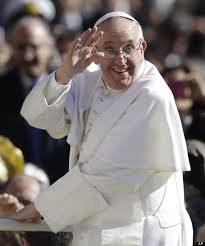
    That weird little smile.  He looks downright bemused, doesn't he?  Like the pope hat doesn't fit quite right.  This went around yesterday:

    483697_169874703162280_371106000_n

    + + +

    This is my favorite cellphone video from the crowd:

    I love the news going through the crowd:  "Argentina!" (Italian accent) followed by "Argentina?! A South American!" in an obviously North American accent followed by "Ar-hen-tin-a!" by the exuberant and apparently Spanish-speaking man behind the videographer.

    + + +

    We don't know a whole lot about this man yet, but I'm sure some details will come out in the next few days.

     At the moment, I would just like to point out that horror is emanating from all the right places.  

    And no, I don't just mean the let's-have-women-priests-and-contraception bunch.  A friend of mine messaged me yesterday to point out that the uber-traditionalists are also horrified at the new pope's ecumenism, at the S.J. after his name, and a number of other things. 

    Any pope that has the uber-progressives AND the uber-traditionalists foaming at the mouth, and — what's more important — the journalists confused, is probably not so bad.

    + + +

    We don't know very much yet.  But I know this:  the Spirit is in charge, and we can trust a Spirit that managed to get us through the Borgia popes.  I think He can handle an elderly Argentinian soccer fan for a little while.


  • Window open on the chimney.

    I hope they elect a pope soon, or I'm not going to get ANYTHING done this week during after-lunch recess.

    + + +

    Yesterday was pretty cool — watching the cardinals take the oath of secrecy in Latin. 

    You got to hear all their native accents.

    New York City Cardinal Dolan sounded like, "Yo Adrienne, ego Timothy Cardinalis Dolan. Spondeo, volveo, et juro."  

    + + + 

    We complained a lot, like the children of Israel in the desert, about the lack of "meat" on the live video feed.  Chimney chimney chimney boring.  

    So God sent us quail.  I mean, seagull.

    Images

    Hello, birdie.

    Oh wait, it's gone now.

    Back to the chimney.  

    + + +

    I don't have a dog in the who's-going-to-be-pope fight, actually, although I kind of hope they continue to steer clear of Italian cardinals for the next couple of hundred years.  And French cardinals, too.  Those guys are trouble.

    + + +

    Secretly, though, I would like the new pope-name to be Leo.  That would make things kind of exciting around here.  We might have to have cake.

    + + +

    UPDATE.  White!

    Seriously.  I have to close this window and get back to work.