bearing blog


bear – ing n 1  the manner in which one comports oneself;  2  the act, power, or time of bringing forth offspring or fruit; 3 a machine part in which another part turns [a journal ~];  pl comprehension of one’s position, environment, or situation;   5  the act of moving while supporting the weight of something [the ~ of the cross].


  • Unmagical thinking.

    Okay…. talk me down from this place that Twitter, news site comments, and FB have stranded me on.

    Repeat after me enough and maybe I'll believe it:

    The country has always been going to hell in a handbasket.  There has never not been a time when the country has been going to hell in a handbasket.  The country will always be going to hell in a handbasket, at least from someone's point of view.

    There's nothing particularly special about the fact that right now, it's my point of view's turn.  Right?

    + + +

    Andrew Jackson refused to enforce and abide by the law as interpreted by the Supreme Court and nobody did anything about it.  Local, state, and federal laws and practice, in north and south, enshrined written and unwritten policies that literally stole wealth from generations of nonwhite families well into the twentieth century.  FDR thought it would be a great idea to put a few extra justices, something like ten more, in the Supreme Court.  For forty years the most concrete manifestation of a "right to privacy" has been a license to commit murder.  And for all of these outrages and more, there have always been a large number of American citizens who said, "Fine with me," or what's maybe worse, "It doesn't affect me, so, who cares?"

    + + +

    It comes down to this:  I don't think that the country has enough political will to put the brakes on the federal government's expansion of powers that arguably violate the fourth amendment.

    There are too many people who espouse "If you don't have anything to hide, you don't have anything to worry about."

    There are too many people who espouse "Anything that makes us safer is worth doing" without asking the question, "How will we know if it makes us safer?"

    There are too many people who espouse "So-and-so wouldn't be in trouble if he hadn't done something wrong."

    In my sleepless nights I worry that there are a large number of people who figure that there are a lot of benefits to living in a police state, so long as the people with the correct letter after their names are in charge of the police.  

    There are so many of these people that, I fear, the anything-for-security people will win.  The political will will not be there to protect the free expression of unpopular ideas.  The political will will not be there to protect religious minorities and to guard against preferential treatment in accommodations for favored groups.  The political will will not be there to maintain Fourth Amendment protections.  And the decisions will be made in secret, with the public's blessing, because the majority of the public will never, never accept that cops and schoolteachers and tax collectors and prison guards and regulators and presidents (with the correct letter after their names) could ever use secrecy in any way except to take good care of us and all the other good people, the ones who follow the rules and like it.

    + + + 

    Privilege.  Privilege.  Privilege.  This is what the don't-have-anything-to-hide, anything-to-make-us-safer, he-must've-done-something-to-deserve-it people have in common.  They are speaking from behind a cushion of privilege so soft and warm that they cannot even tell it is there.  The privilege of people who have never been singled out, who don't have something they might prefer quite reasonably to hide, who are the acceptable people.  Who have never had the misfortune to make an enemy with a government job, who have never been embroiled in the justice system or family court, who are content to play by rules without questioning them and have never had the rules come back to bite them, in large part because they belong to the class of people who make the rules.

    + + +

    I don't have anything to hide, so why should I care about privacy?

    I'm white, so why should I care about racism?

    + + +

    The Bill of Rights — and I confess that I'm here thinking mostly of the first, fourth, fifth, sixth, and eighth amendments — nominally restrain the power of the federal government with respect to the individual.    

    It's not hard, however, to read them as a restraint on a pervasively flawed and twisted aspect of fallen human nature, one we would all do well to root out when we find it within ourselves.

    And that is our tendency to convince ourselves that bad things do not happen to good people.

    If you need Scriptural evidence that this is, indeed, a Big Problem for the human race that we have been well advised to work on, please refer to the entire book of Job.

    "Bad things don't happen to good people" is a comforting thought for a number of reasons.

    1. Bad things don't happen to good people; bad things have not, so far, happened to us; therefore, all evidence suggests that we are good people.
    2. Bad things don't happen to good people; we are good people; therefore, bad things won't happen to us.
    3. Bad things have happened to those people; bad things do not happen to good people; therefore, those people are not "good people," and we have no obligation or ability to relieve their suffering.
    4. Bad things don't happen to good people; good people are people who follow certain rules; therefore, if we follow certain rules, bad things won't happen to us.

    You see how thinking this way is a temptation to many people.  It is also called "magical thinking," because it causes so many good people to believe that they, somehow, can prevent bad things from happening to them by behaving the "right" way, where the "right" way is equivalent to "what good people do."

    Go find any news story about a person who has suffered a terrible accident or crime.  Dive down into the comments.  Someone, somewhere, is convinced that the sufferer suffers (or lost his life), fundamentally because he did something wrong.  Cyclist hit by a drunk driver?  You'd have to be an idiot to be riding your bicycle on the street at that time of night.  Injured in a fall while rock climbing, and carried out by county SAR?  We shouldn't be bailing out these thrill-seeking dummies.  Killed in a building collapse caused by shoddy demolition next door?  There's no way I would even have gone to work in that store, it was so obvious that the wall was going to fall down.  Lost a son or daughter to a drug overdose?  Maybe if she spent more time parenting and less time blogging this wouldn't have happened.  

    It's an impulse that may seem merely provincial, perhaps ignorant, certainly common.  But it's a root of pure evil, because it convinces us we ought to do nothing to help the poor and suffering, because they probably deserve it.

    + + +

    It's this tendency in fallen human nature that the writers of the Bill of Rights were writing against.  They wrote it to restrain the government, because the "bad things don't happen to good people" mentality is particularly dangerous when it is held by the people who have the power to enforce the "rules for being good people."

    For instance:

    Bad things don't happen to good people.  Being accused of a crime is a bad thing.  Therefore, the accused is a bad person.  

    (I mean… just look at him.  Do you really need a jury to figure that out?)

    Or:

    Bad things don't happen to good people.  We are good people.  Therefore, there are no downsides to permitting random searches of private papers or property or what-have-you, because we are good people and it would be a bad thing if the government used something they found against us, or pretended to find something that really the government agent planted there, because maybe he had a quota to fill or something, and we cannot imagine that ever happening because, like I said, we are GOOD PEOPLE and bad things don't happen to good people and they wouldn't try that quota thing on us because, come on, aren't there some BAD PEOPLE out there, and wouldn't it'd be a lot easier to get away with planting contraband in THEIR personal effects?  

    And before you know it, we're okay with that sort of thing.  And it all comes down to … what?  

    I thank you that I am not like other people: thieves, rogues, adulterers, or even like this tax collector.

    + + +

     As usual, human nature contains multitudes.  There is another, opposite temptation called "bad things that happen to me are someone else's fault," and since humans are nothing if not adaptable, it is entirely possible to hold both of them at once.

    This complicates the proposed solutions, to be sure, to the problem of magical thinking.


  • Fessing up.

    All righty then…

    I got the impression that some of you have been wondering what’s up with the posting frequency, or infrequency as the case may be, here at the bearing blog.

    Time to make excuses! Or, rather, an excuse. The fifth of its kind!

    An excuse which should show up, oh, around mid-January 2014, but which is already making itself — I mean, himself or herself — plenty evident around here.

    Pass the saltines and ginger tea.

    And maybe a little later, the champagne!

    + + +

    How did the kids take it, you ask?

    • The 12-year-old: I knew something was up when you kept skipping dinner.
    • The 9-year-old: I thought you were starting to look fat!
    • The 6-year-old: Mama, I’m so proud of you!
    • The 3-year-old: New babies can drink cow milk, you know.

    I have some time to work on that last one. Meanwhilllllllzzzzzzz…….


  • Scariness is relative.

    I was reading and laughing at the comments on Calah’s giveaway post that asked, “What terrifies you about homeschooling?” Parents confessing that they are afraid their children will grow up not knowing how to do long division, or that the kids will hate their parents for schooling them. We have all been there.

    Then I clicked over to the local news and read, “Hopkins High senior charged with sex-trafficking cheerleading teammate.” The sixteen-year-old victim receives special education services. The eighteen-year-old senior prostituted her on Backpage-dot-com and deposited the money into her own bank account. When the case came to light at the suburban school, parents weren’t notified “because it didn’t happen on school grounds” — even though the 18-year-old tricked school officials into releasing the 16-year-old from school so she could take her to meet johns during school hours by impersonating the 16-year-old’s mother.

    Yeah. Let me know when there’s a giveaway about that kind of fear.


  • Using persons as rhetorical means to an end.

    The smart but acerbic Mark Shea has posted, believe it or not, an apology for his tone and attitude in writing in recent months. It’s a beautiful example of a real-not-fake apology, and I am probably not the only person who is glad to see it; Shea is usually, I think, correct, but sometimes I can’t stand to read him even when I agree with him because, well, he can be mean. Smart, but dismissive. So I am glad to see this apology, and sincerely wish him fruitfulness in his efforts to respect persons more.

    I wanted to highlight part of it, which I think is a good statement of an error that many persons fall into when they write or post about politics (or entertainment or economics, for that matter). It has to do with the notion of “using persons as means to ends,” which in Catholic moral theology is an absolute no-no. (It is probably also forbidden in other systems of ethics, and should be in more, as it’s more protective of the weak than is your standard Golden-Rule-driven system). A pithy way of putting the same principle is “The opposite of love is not hate; it’s use. The opposite of loving a person is using a person.”

    Mr. Shea writes that he has a strong compulsion to fight against any notion of reducing persons to a means to an end, and yet he himself is guilty of the same crime in the rhetorical arena:

    Observant readers will grasp that this has more than a little to do with my intensely strong reaction to the notion of using people as means to ends–as though the person himself is merely a tool. Hence my intense reactions to such questions as abortion, torture and the whole Live Action thing[*], all of which involve reducing people to things or means to an end.

    But there’s a bitter irony in all that too… I really saw this weekend that I have myself long had a habit of reducing other people to means to ends, depersonalizing them, and treating them with little or no respect. It works this way:

    If I am arguing with somebody who seems to me to merely be in intellectual error…, I will treat that one with respect. But when I feel as though I am engaged with somebody who is wilfully refusing to get the point, I will generally reach a point where I decide “Okay, you refuse to listen honestly or reply honestly, so I will henceforth respond to you only for the sake of those third party bystanders watching the conversation who will listen. You have just been reduced to a Thing: a means to the end of talking to them.”

    In addition, my attitude toward Public Figures is much the same. I tend not to see them as human beings, but as sort of semi-fictional characters. People who don’t fully exist but who are In the News and therefore symbols or representatives of ideas.

    That last bit is significant: the Public Figure as a nonperson, someone who has surrendered part of his or her humanity. It is so common that we hardly think about it. Sometimes it may be naturally necessary, a simple consequence of being in the public eye; for example, our legal system literally strips public figures of some of the privacy and defamation protections that “private citizens” enjoy. That may be necessary to balance their rights against the rights of a free press in a country that highly values freedom of speech and information. But it’s not generally necessary for individuals to treat public figures as nonpersons.

    It’s so very difficult, though, to avoid seeing them — and using them — as mere symbols. Look at the vitriol people spew towards political candidates from the party they oppose (yes, indeedy, it goes both ways). Spend a few minutes reviewing political posts from your friends on Facebook and ask yourself, “is the subject of this post being used as a means to score a political point?” Has your friend reduced a public figure’s personality to the content of one statement or one political position? Has your friend extrapolated the figure’s entire intellectual or moral character from the content of one political position? Is your friend mocking a politician or celebrity in a way that offends human dignity — denying the individual humanity of members of a group because of their sex, sexuality, race, religion, or class? Has your friend singled out a particularly unattractive individual as a convenient representative for a whole group of people? Has your friend perpetuated an assumption of malicious intent behind an act, when a benevolent interpretation is far more likely to be accurate?

    Yeah, I am seeing a lot of that. And over the past year or so, I have developed more and more distaste for it to the point that I don’t enjoy posting anything with political content. I rarely even openly criticize them, because in social media, to criticize is to widen the audience (my followers see what I reply to on Twitter, my friends see whatever I comment on in Facebook).

    It’s surprisingly difficult to criticize public figures for their political stance without falling into the easy habits of mockery and, well, using people.

    And yet, political speech is important speech, and moral speech is one of the duties of the Christian. So how do you post anything at all that involves a public figure without using him or her as a means to an end?

    I think one important principle is to restrict your criticism to actions, behavior, and decisions without trying to see into someone’s heart and criticize his character. Christians ought to be much better at this than the average person, and much better than we are. My observation is that it’s very common for the general public to conflate identity and behavior, but we have a long tradition of distinguishing between “sinner” and “sin.” We fall into this error too, and we need to catch it and root it out wherever it exists. It’s difficult, because for various reasons right now, the conventional wisdom is extremely suspicious of the notion that it’s even possible to “hate the sin and love the sinner;” right now, for instance, Catholics are engaged in defense of our beliefs about marriage, and a large number of people have an interest in portraying us as holding those beliefs not because of our theological convictions about marriage as an image of the life-giving reciprocal self-gift that is the relationship between Christ and the Church (pfft! who can follow all that?), but because the Catholic Church “hates gays.”

    Another principle is to take care with adjectives that modify the person rather than their actions, statements,or positions. This is one of my pet peeves. I occasionally follow a group blog about Catholicism in American Culture, but have mostly stopped reading it because one of the bloggers thinks it’s fun to repeatedly refer to a particular Democratic politician as a “worthless hack.” I don’t care how odious her political positions are, and I don’t care how intellectually vapid her justifications are for what she does. No one has any business describing any other human being with an adjective like “worthless,” and for a Catholic blogging as a Catholic to do so is an offense against God to whom we are all beloved. Period.

    Rooting out depersonalizing adjectives while still making a legitimate point is largely a matter of recasting the sentence. Does it sound like there’s not much difference between “Smith is disgusting” and “Smith disgusts me?” Still, the first is a statement about Smith and the second a statement about your feelings toward Smith; the latter’s more defensible, and represents a rhetorical habit that holds the line against depersonalizing adjectives. Still better, if it’s an accurate characterization, would be something like “When I heard about Smith’s vote on the House bill, I felt disgusted.” To write something like this reminds you not to let your feelings generalize from action to person. If you find yourself disgusted by a person — that is to say, by the sum total of all that they are — then you have a beam in your eye.

    I don’t think the prohibition against using persons as means to an end entirely rules out satire as a rhetorical tool, but satire must be deployed carefully lest it devolve into dehumanizing mockery. We have a long history of trenchant political cartoons that make their point concisely by depicting real persons (or groups of persons) in symbolic or representational ways; by extrapolating certain general conclusions from specific statements; and by isolating specific political positions while at the same time putting a face to them. The same kinds of shorthand are at play in circulating memes and carefully selected unattractive photos. When is this okay and when is it not?

    Unfortunately, I think a good deal of it has to do with how skilled you are at making your precise point. Let’s say that you wish to make a point of your opinion that a certain politician’s well-received statement “A,” if taken to a logical conclusion, leads to the statement “B” which would not be so popular; you hope to show that holding “A” is equivalent to holding “B” and thereby convince many people to reject “A” who wouldn’t otherwise see the connection. You have a tough line to walk: you need to show that the politician’s position on “A” is consistent with “B,” without actually mischaracterizing him as explicitly stating “B.” Political cartoonists get a certain amount of leeway, I think, because we’re supposed to understand that a cartoon is a form of shorthand. But the line can be tricky to draw. Take this cartoon that appeared in the Sacramento Bee soon after the still-under-investigation ammonium nitrate explosion in West, Texas:
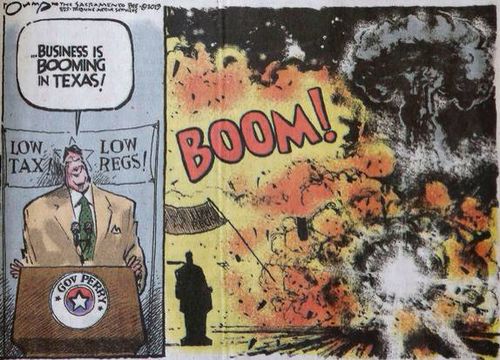
     

    The point of the cartoon is clear: Texas Governor Rick Perry promotes industrial deregulation as a means to encouraging economic development, but deregulation can reduce industrial safety and perhaps lead to incidents like large facility explosions (coming so soon after the explosion in West, the unstated implication is that loose industrial regulations may have been a factor).

    Now I happen to lean toward erring on the side of deregulation in a poor economy, I support the notion of states being able to set some of their own levels of regulation according to local needs, and until the investigation is complete I am reluctant to jump to conclusions about whether the West explosion points to a need to tighten Texas’s safety rules. That is to say, I ought not be inclined to cut this cartoon any slack. But I happen to think this is a well-crafted cartoon that makes its point very effectively. I think it follows the general tradition of political cartoon shorthand, arguing that the logical conclusion of reducing regulation is accepting more risk of industrial disasters.

    But it’s not so clear-cut. Other people (not surprisingly, including Gov. Perry) argued that the cartoon is beyond the pale: that it exploited the victims of the West explosion to make a political point, “mocking the tragic deaths of my fellow Texans and our fellow Americans.” You could also argue that it is unfair to Governor Perry, if you think that it implies that Perry approves of industrial disasters; here’s an example of another artist’s cartoon that I think does cross that line.

    The SacBee cartoonist, Jack Ohman, defended the cartoon, writing, “My job… is to be provocative.” I think he’s right, but we have to ask what the political cartoonist is supposed to provoke. Second thoughts about previously unexamined opinions? Yes. Dehumanizing or false beliefs about a person or persons? No.

    + + +

    So how do we push back against dehumanizing political speech? The first step is, as always, attention to the beam in our own eyes — the kind of self-examination and purging to which Mark Shea has just vowed to recommit himself. Refuse to return a blow for a blow, and commit yourself to scrupulous attention to the ethics of your own writings.

    Only then can you turn your attention to charitable correction of others’ failings. And even then, you have to distinguish between the bad thing So-and-so said, and the badness of So-and-so himself.

    One principle is to remember to push back against dehumanizing remarks from the people on “your side” just as fervently as you would push back against similar remarks from the people on “the other side.” Maybe more fervently, because the argument might carry more weight coming from you.

    As much as I would like to, incidentally, I can’t give up on anyone; can’t roll my eyes and sigh, “You just can’t argue with him.” It comes down to that theological virtue we call Hope: no person is beyond reach. On the other hand, I might well be the worst person to try to reach a particular individual, so interactions with other’s errors mean constant discernment of whether my decision not to engage is correct (because what I’ll choose to say is unlikely to make things better) or cowardly (because I’ve given up on their ability to see reason at all). It’s not easy, but then, staying true to truth often isn’t.


    __________

    [*]Footnote for those who aren’t familiar with this reference. “The whole Live Action thing” refers to the “stings” carried out in Planned Parenthood offices by the group Live Action, in which a young woman posing as a client who sought an abortion tried to catch PP workers violating the law; for example, she might pose as an underage girl pregnant by an older man. Shea has argued forcefully against these and other tactics that rely on deception to produce bad publicity.



  • A box that fits well enough.

    Let me tell you a story.

    When Mark and his buddy were out in Colorado a couple of weeks ago, they hired a mountaineering instructor and climbing guide named Russell. Over the first couple of days of the trip, the three of them had plenty of time to chat — during the initial what-kind-of-climber-are-you conversation, during lunch, while driving up into the mountains — and Mark got to hear some of Russell’s life story.

    Russell used to be an accountant. He went through business school, did well, had a well-paying job behind a desk. After six months, he decided he didn’t want that kind of life, so he quit his job and moved where he could work in the mountains. The work is hard and the money is unpredictable (besides all the guiding and instructing gigs, he also works as a substitute teacher), but he’s happier, he’s outdoors all the time, and he has more freedom — enough to be planning a five-week honeymoon in Europe, climbing the Alps with his bride.

    + + +

    Russell’s story sounds like a trope, even though Russell is real. Maybe the story isn’t accurate — who knows? Maybe Russell really quit accounting because he wasn’t any good at it, or felt like a failure, or struggled with depression. Whatever the background, this is the story that Russell tells his clients — at least the ones who are athletic, professional-class middle-aged men.

    It is a good story. I think it is a very acceptable story. In our culture at least, one way for a person who does not work a white-collar job to pass the “I am not a loser” test among white-collar people is to have this kind of story: I once was one of you, but I decided to escape the rat race and live a life with more freedom. Crucial to the acceptance-level of the story is some indication that the speaker could have chosen the conventional route — in this case, had actually chosen it for a while — but then freely decided to walk away from it. I’m a climbing guide sounds exciting enough, but I used to be an accountant, but now I am a climbing guide lends a whiff of adventurous respectability.

    It works, I think, because enough professional-class people are dissatisfied with the frustrations of their daily lives that the story touches some unspoken fantasy of doing the same thing; or at least, a fair number of people can easily see how the mountains might call more compellingly than the spreadsheet. This is why so many people have hobbies.

    + + +

    It occurred to me that my professional life story could be made to fall neatly into a similar trope — only instead of sailing the wide accountancy, I was embedded in engineering academia, and instead of quitting to head for the hills, I left to have babies and teach them as they grow. To me, the story has a similar “feel” to the accountant-turned-mountain-man trope. I passed the entrance tests, so to speak. I spent enough time on the inside to have a grasp of the kind of life I might lead if I stuck to my original plans. Importantly (for the narrative at least) I stayed long enough to acquire a credential, the proof that I walked away from it all by choice and not because the system chewed me up and spit me out. And I did behold two possible futures that stretched out before me, and reached out my hand and chose the one that I foresaw — for me — meant greater peace and greater happiness. Less money, and more freedom (of a certain type), and more love.

    The trope doesn’t quite match up with the truth. (And who knows what details Russell the mountaineer left out of his story, to make his story ring so well, so that his listeners will slot him into the “ditched the rat race, found true happiness” box, which in America is a Good Kind Of Box To Be In, a noble working-class designation, if not the deserving poor, then the deserving mostly-broke). There is anxiety in the truth to my story; and an identity crisis; and the slow, terrifying grasping of Catholic teaching on marriage and how it was going to apply to the particularities of the marriage I was in; and the simultaneous appreciation of the needs and realities of children; and the trying-out, along the way, of unworkable halfway solutions where, I hoped, I might be able to keep one foot in each world.

    The true story lacks the casualness of “I decided to walk away from all that.”

    The casualness is a key feature of the narrative’s acceptability. The narrator establishes the self as cool and detached. I was anything but detached while it was all going on. I am, actually, pretty well detached from the old life now that it is so distant. I project that detachment back into the past as if I had it all along.

    But maybe the pleasant trope, incomplete picture that it is, can be exploited. People will make snap judgments because this is what people do. Might as well get comfortable in a box that is reasonably close to the truth and has a fair chance of being looked upon with approval.

    So.

    I quit the rat race, and now I’m a somewhat-crunchy homeschooling mom, and I like it. That’s my story, and as long as you know me only superficially, I just may stick to it.


  • Detailed plans for peace of mind.

    Last week I unwittingly worried a friend of mine in Facebook chat.  

    I'd mentioned that Mark was out in Colorado on a climbing trip.  The last exchange of the chat went like this:

    FRIEND:  Prayers 'till Mark gets home!

    ME:  Thanks! If he doesn't call by 11 pm I have to call search and rescue.

    Would love to chat longer but have to teach history now. Take care!

    + + +

    On Sunday at coffee and donuts she mildly chastised me for joking about the search and rescue.  "I wasn't sure whether to be worried about you or not!" she said.  

    Of course, I hadn't been joking, but I also hadn't thought that it would have been the kind of thing that would worry a friend.   Why did I throw the offhand comment out?

     I suppose it's one of those things you do in the Twitter age.  We are now masters of the Short Enticing Comment Intended To Give The Appearance Of Having A Much Longer Story Behind It.

     The idea is, of course, that in your interlocutor's imagination, the story you merely hinted at will grow to hilarious proportion, and your interlocutor will project their own imaginings onto you, and you will be lauded for your sparkling wit.  When in fact all you wrote was something like "OMG NO NOT THE MOLASSES #twoyearolds #bathtime #gin"

    +  +  +

    Anyway, the truth is that I was not, in fact, joking about the search and rescue — well, I did abbreviate a bit, as one is wont to do.  My actual instructions were to wait until 11 p.m. for contact from Mark, and then start calling these numbers in order:

    1. Mark's cell 
    2. His climbing buddy's cell
    3. The backcountry guide's cell
    4. His climbing buddy's wife back at home in Tennessee
    5. The mountain climbing school and guiding service
    6. A climbing gym that serves as the after-hours contact number for said service
    7. The county search and rescue (SAR) dispatch

    If you're wondering whether it isn't the job of the mountain climbing school and guiding service to decide whether it's time to call SAR, you're right — the service has a protocol for keeping tabs on their guides in the field.  If one doesn't check in after a trip, they are supposed to follow up.   (That's why I'm supposed to call the guiding service before going straight to SAR myself.)

    But redundancy is a good thing, and nobody's more interested in having Mark come home safely than I am, so nobody's better suited for the task of checking up on him should he go missing.  Besides, he was planning to climb a different mountain two days later with his buddy and no guide, and in that case there wasn't going to be a mountain school looking over his shoulder.

    + + +

    "I'd be so worried if my husband gave me a set of instructions like that," a different friend said to me on a differnet occasion.

    I said, "I'd be more worried if he didn't."  

    One of the first rules of safe backcountry travel is to let someone else know exactly where you intend to go and when you intend to get back.  You'll find this advice everywhere; here it is in a well-written .pdf about backcountry safety:

    One important rule too often forgotten is to let others know exactly where you are going, with
    whom and when you can be expected back. I hate to sound maternal, but search and rescue
    teams often spend hours driving around on back roads looking for a subject's vehicle before they
    know where to enter the field to begin a search.

    By letting someone know EXACTLY where you intend to go, when you expect to return and where
    your vehicle will be parked, you can eliminate the possibility of searchers having no idea of where
    to look. Should your plans change in route to your destination, stop and notify that person of your
    new itinerary. In addition, if you leave pertinent information on the dash of your car (e.g. name

    and phone number of your contact in town, location of travel/campsite and so on) search teams
    will have a very timely idea of your plans. Otherwise, search teams can be of little assistance
    when all that is known is that you "went camping somewhere in the Gore Range." 

    And then, it's nice to have specific instructions.  That's one of the things I insist on, whenever Mark heads off to go backcountry skiing or climbing — guided or not:   a specific set of "deadlines" and directions for what to do if he misses each one.

    If he were to tell me, "I'm parking at the such-and-such trailhead and planning to summit such-and-such a peak; we're going to turn back by 11 a.m. at the latest and I expect to be back in cell phone range by 5 p.m.," that would be … a good start.  But that doesn't answer the actionable question, which is… so what do you want me to do if you haven't called me by 5 p.m.? 

    I can't read his mind (too bad, that would come in handy for backcountry travel), and I'm hundreds of miles away and not familiar with the area he's in.   Furthermore, it's his job to set up the safety procedures for his trip, not mine — even if I have a role to play in those procedures.   

    Some people might think that the right thing to do is call the authorities the minute someone is overdue.  But this would be premature.  SAR is expensive, and part of backcountry ethics is being prepared to deal with delays and unexpected events.  You're not supposed to have SAR be your first line of defense if anything goes wrong; you're expected to do what you can to aid in your own shelter and rescue.    So, for example, if there's a signficant chance that a delay could force you to spend the night on the mountain (rather than trying to follow a difficult trail down in the dark), you bring bivy gear and extra food, and you instruct your contact person that your arrival time could be delayed by twelve hours or whatever with no cause for alarm.  It would be silly to send out the dogs for someone who's comfortably ensconced in warm waterproof layers, seated on an insulated pad, munching energy bars, and waiting for nothing more dramatic than daylight.

    In this case, even though he expected to be back in cell phone range by 5 pm, he definitely didn't want me calling SAR at 5:01 .  He figured on giving himself several hours of leeway time — time to accidentally go down the wrong trail, figure it out, and backtrack if necessary; time to sustain an ankle injury and  slowly crawl back to the vehicle, should that happen; time to arrive at the climb, find it occupied by another party, and wait for them to finish before starting.  None of those delays, not even an injury, are an emergency that requires calling out the authorities; they're all the kind of things that you're supposed to be prepared to deal with yourself.  And if you wind up dealing with something like that, you'll be delayed.  And that's okay.

    It's not terribly fun to have to wait the few hours between "overdue time" and "call out the dogs time," but it's much better than sitting there wondering, "Should I call out the dogs, or is it too soon?  I wonder how long I should wait?  If I make the wrong decision SOMEBODY COULD DIE."  

    I told Mark, he has to own the when-should-I-call-search-and-rescue decision.  And he owns it by giving me specific instructions about when to call, and whom to call.  And also by telling me everything pertinent:  where he's starting, what he plans to do, and even what he's carrying (I like to know, for example, if he's prepared to spend the night outdoors and what weather he's prepared for, and for him to confirm that he has a GPS, map, and compass).

    + + +

    Every once in a while I run into the opinion that it's irresponsible for anyone, but especially a parent of young children, to engage in common adventure sports at all.  Backcountry hiking, black-diamond skiing, rock climbing, etc.

    (Occasionally this extends to activities as banal-sounding as bicycle commuting.  There's a lot of victim-blaming in the comments to news stories about cyclists who get struck by cars.  It's very depressing.  I have a theory that a large number of people simply don't believe that bad things can happen to good people.)

    I think it's irresponsible to think you can remove all risk from life.  Every day we're surrounded by common risky activities:  from the acutely risky, like riding in cars or taking showers in slippery bathtubs, to the chronically risky, like occupational exposure to low-frequency noise or sitting around getting no exercise.  And many culturally-not-considered-extreme hobbies carry a surprisingly high risk; for example, recreational boating is well accepted here in Minnesota, but it's also relatively risky (one estimate from Ohio:  about 1 fatality per million operator-hours; another estimate has 1 canoeing fatality per 720,000 outings.)  

    Rock climbing is riskier than boating, but not the OMG IT MUST BE MANY TIMES RISKIER HOW COULD YOU EVEN THINK ABOUT DOING THAT WHEN YOU HAVE SMALL CHILDREN AT HOME!!! that you might expect from all the teeth-gnashing about it.  Do you ever hear anyone say, "Gosh, I'd never have elective surgery under general anesthesia while I still had young children at home?"  Well, that's more likely to kill you than a rock climbing trip.

    All this is to say:  Hobbies are important.  It's good to have them.  And it's okay to have hobbies that carry some risk.  The important thing is to diligently take reasonable precautions and follow well-accepted safety protocols; to keep your head and know your limits; and to talk about safety and comfort with the people who depend on you, to make sure that no one is forced into a situation where they're uncomfortable with the level of "adventure."   Mark and I have worked pretty hard over the past few years to create an atmosphere in which I'm always on board with what he's up to, and if I'm not, we work together to figure out what needs to change until I am.  

    Hypothetically, this works the other way round as well, even though these days I'm rarely mounting any expeditions further than the grocery store.  But hey, I expect my time will come.


  • Prayer request. (UPDATED)

    Particularly at 3 p.m. Eastern time on Tuesday, for longtime online friends facing an uncertain future and the prospect of uprooting their young family after a completely-unexpected denial of tenure, which means having to look for another job quite soon. The field is not one with lucrative alternatives in the private sector, so they face considerable hardship and a difficult job search. They are shocked and unprepared.

    Three o'clock Tuesday is the hour of a crucial meeting that is part of a Hail Mary tenure appeals process. Please hold them in your hearts.

    UPDATE FROM MY FRIEND.  

    "Back from meeting. There is tangible hope. We have a plan forward.

    "It is still stressful and scary and is not for sure, but we were given some good advice from [COLLEGE DEAN] and it is more clear now what needs to happen and the size of the mountain we need to climb.

    "It's huge. But at least it looks like there may be a chance to climb it, instead of there being no chance at all.

    Thank you everyone so so so much I really felt strong going in there because of your prayers."  

    Thanks, all. Sounds like they could still use your prayers for the next step, whatever it is. I'll update when I can.


  • Profiles in marriage.

    My friend Margaret at Minnesota Mom has posted a beautiful profile of her parents today. Twenty years ago, she interviewed them as a university assignment; this is a sort of update.

    It’s really lovely — go read.


  • In which I try to make up for lost blogging time, and only wind up being sort of pitiful.

    I need to do something like what Jamie's doing over at Light and Momentary:  blogging something, anything, every day.  

    Today she's got 10 Reasons to Love Confession.  If you always thought of confession as weird, scary, or depressing, her post might be the antidote.  Check it out.

    + + +

    So I think the main reason I'm having trouble blogging is the end-of-the-year fog.  I've got one foot planted in 2012-2013, trying to wrap up all the school subjects, and the other foot in 2013-2014, trying to sort out all the things I'll need for fall.  I just sent a hefty payment to Rainbow Resource now that I've made up my mind about the last couple of subjects, and I'm sure I'll be buying some other thing that I forgot in just a couple of months.

    + + +

    Plus, just last weekend we had The Great Split-Family Camping Trip of Spring 2013.  That would be the one in which Mark, committed to help lead a Boy Scout climbing outing, went one way with half our camping gear and our two oldest boys; while I, committed to our 6-year-old daughter's AHG spring campout, went the other way with the other half of our camping gear and our two youngest.  

    I was intimidated, but I managed tent camping with my 6- and 3-yo.  I had dibs on the smallest tent, thank goodness, because I am too short to put the other ones up by myself.   I also led 14 elementary-school girls in learning to strike matches — both wooden stick matches and book matches — safely so they could earn their Fire Safety badge.

    How do you do this?  Cookie sheets on picnic tables, two girls to a cookie sheet, each with a package of matches and an adult and a can of water to drop their matches in after they successfully light them.  Also you give away a bunch of colorful ponytail holders so they can pull their hair back before they start striking matches.

    Incidentally, this is the first elementary-school-girls demonstration I've ever performed in which I had to stop at a local smoke shop for supplies.   The boxes of kitchen matches were easy to find at the hardware store, but I could not find book matches anywhere else on short notice.  The tobacconist charged me fifty cents a book for the normally complementary matches, since I did not buy any of his wares.  I went home and pasted colorful stickers over the tobacco company logo on the matchbooks.

    Anyway — between planning safety demos and managing a 3-year-old safely around campfires in darkened wooded lots, I had kind of a stressful weekend!  I meant to drop an email to commenter Christy P. to see if she had any tips for being intrepidly out camping singly with small children, but I forgot.  The one thing I did remember was to bring lots of food that makes the little people happy; so the little ones lived mainly on banana nut granola bars, because by some fantastic quirk of random chance there are NO NUT ALLERGIES IN MY DAUGHTER'S TROOP.  Now when was the last time you heard of that happening?

    + + +

    In an hour or two I expect Mark home from the Great Fortieth-Birthday Climbing Trip of 2013.  We all got home from our camping trips, turned everything around (mostly — there's still a tarp in our backyard that keeps getting rained on just when we've been meaning to bring it back in), and then on Tuesday he flew off to Colorado to go climbing with a buddy from work, well, actually, a buddy who works at this other plant in a different state that might as well be "a buddy from work" considering how much time my husband has spent at said plant in said different state.

    So they had a day of Skills Training in which they hired an instructor to teach them how to do things like stop themselves from hurtling off precipices — yeah, this is different from the lessons where you hire an instructor to teach you how to hurtle yourself off precipices on purpose — those are so passé in May.  And then a day of climbing Mt. Lady Washington with the same instructor acting as guide and lead climber, and then a nice relaxing day of only hiking in the woods, and then a day of hiking nearly to the summit of Flattop Mountain (I guess they got to a point where it was just sort of flat and they decided that was good enough, so they went back down again), and from what I hear it was a fun time.

    Me, well, it was Tuesday through Saturday.   I did hire a babysitter on Friday night so I could go out and sit in a coffee shop and look at art supply catalogs with my hands wrapped around a warm drink, because it is only 45 degrees in this insane state.

    + + + 

    But all of that has kept me from blogging, because I hardly have time to think.  I'm sorry.  I'll try to do better.  Please don't drop me when you port over from Google Reader to whatever it is you're going to be reading now.  I'll be good.


  • Sunk costs and fractional success.

    Brief article on the psychology of sunk costs in the Atlantic:

    The costs to a person who does not know when to quit can be enormous. In economics it's known as sunk cost fallacy, though the costs are more than financial. While we recognize the fallacy almost immediately in others, it's harder to see in ourselves. Why?

    There are several powerful, largely unconscious psychological forces at work… But the most likely culprit is this innate, overwhelming aversion to sunk costs.

    Sunk costs are the investments … that you can't get back out. They are the years you spent training for a profession you hate, or waiting for your commitment-phobic boyfriend to propose. They are the thousands of dollars you spent on redecorating your living room, only to find that you hate living in it. 

    Once you've realized that you probably won't succeed, or that you are unhappy with the results, it shouldn't matter how much time and effort you've already put into something. If your job or your boyfriend have taken up some of the best years of your life, it doesn't make sense to let them use up the years you've got left. An ugly living room is an ugly living room, no matter how much money you spent making it so.

    Recent research by Northwestern University psychologists Daniel Molden and Chin Ming Hui demonstrates an effective way to be sure you are making the best decisions when things go awry: focus on what you have to gain by moving on, rather than what you have to lose. When people think about goals in terms of potential gain, that's a "promotion focus," which makes them more comfortable making mistakes and accepting losses. When people adopt a "prevention focus," they think about goals in terms of what they could lose if they don't succeed, so they become more sensitive to sunk costs. This is the focus people usually adopt, if unconsciously, when deciding whether or not to walk away. It usually tells us not to walk away, even when we should.

    Many of the folks in the comments seem to think the takeaway is "you should always walk away and never press on," and are arguing, "But sometimes the right thing to do is press on!"

    That's not the lesson here.  The lesson here is that "sunk costs make people irrational when they try to decide whether to quit or press on, and usually nudge them in the press-on direction."

    The evidence seems to be that, if people emphasize future benefits as they weigh the outcomes of different possible paths, rather than emphasizing thoughts about what they have that might be lost, they more often choose strategies that include walking away from sunk-cost situations.  

    Sometimes walking away will be the better choice and sometimes it won't be.   But once you've identified a source of systematic error, it's good to check for it when you're making a decision.  Hindsight is 20/20, they say; and you can't get that in advance; but what you can cultivate is detachment from the past, and all kinds of detachment help you see with clearer eyes.

    "I'm having trouble figuring out whether I should make a change.  Could I be suffering from inordinate attachment to the status quo?"

    I think part of the problem is that we think of the effort we've spent in the past as being, somehow, part of what we possess.  We see the wished-for outcome, and know that we've expended effort and resources in pursuit of it, and we think of it as possessing a fraction of the outcome.   

    With many, very simple goals, it makes a lot of sense to think this way.  If I have a goal of stocking up six months' supply of canned food and dry goods for emergency preparedeness, then after I've expended effort for a while I may have three months' supply, and a little more and I'll have four months' supply, and so on.  If I have a goal of educating my five-year-old through high school, several years later I'll likely have educated my child through the third grade.   Having extended part of the effort, I have made a real achievement, which happens also to amount to part of my original goal.

    But a lot of goals aren't that way.  Partial success is meaningless.  If your goal is to get a certain job that requires a bachelor's degree, but you quit your degree program with half the credits you need — they're not going to give you your job part-time.  I think we have trouble thinking about these because, unlike "save food to eat later," these all-or-nothing games are often artificial constructs, consequences of complex society.

    I've certainly been through big decisions.  The kind where you can see two really great paths ahead of you, and you must choose one or the other, can sometimes be the toughest.  Because you know that you will lose one of those two futures, and somehow you wish you could stay in the now, and cling to them as bright possibilities, equally possessed.  The thing that might be gained seems as if it is also the thing that might be lost.

    But of course it is not a thing that might be lost until it is a thing that you actually have.  What you stand to lose by choosing the path to the left is not the path to the right.  What you will lose is only the moment of standing at the crossroads and knowing that you could take one or the other.  

    Guess what.  You lose that no matter what you decide.


  • The problem’s not that we sexualize breasts, but that we’ve lost the sense that sexuality is ordered towards self-gift.

    Marc Barnes is a college student who writes with admirable boldness (sometimes heading down a path of “oops, I tried to make a really clever, shocking analogy but it all went wrong” in my opinion) over at Bad Catholic. Sometimes I think Marc blogs what G.K. Chesterton might have penned if he hadn’t had the good fortune to have an editor. It falls on his combox readers sometimes to push back and say “dude, what you just said? No, and here’s why” and to his credit he listens to them and often corrects himself.

    His latest is called “Is Female Purity Bullshit?” and it is shaping up to make some good points. I am looking forward to the promised followup posts. However, what I wanted to point out today is to pull out a complete comment from an anonymous commenter who signed herself “a mom.” Responding to a male defender if public breastfeeding who argued that men “should not always consider breasts as sexual,” she wrote:

    As a woman and a mother, I’m really grateful to see/read guys defending public breastfeeding as a chaste action 🙂 But I do have a recommendation, and that is to not balk at the idea of breasts always being “sexual.” They are. Accepting that is one step closer to rightly integrating one’s sexuality.

    I’m going to make my case short and sweet:

    “Sexuality” is the quality of being either male or female.

    Women have breasts that are able to nourish a child. Men don’t. Breastfeeding is, therefore, an inherently “sexual” capability. In other words, it differentiates one sex from another.

    The essential difference between the sexes points to our complementarity, and our complementarity points to the fact that we are called to sexual unity. This is the logic built into our sexual — male and female — bodies.

    So yes, it’s perfectly “natural” that that which differentiates us helps to attract one sex to the other. It’s perfectly “natural” that there would be an element of awe, an element of attractive beauty attached to what is “other” or outside of our own experience of life. “I’m made for you. You’re made for me. We see this in our bodies. We belong together.”

    But that logic of complementarity, in the mystery of its imago dei, does not simply feed one into the other, as if it were a matter of filling a mutual void. No, the logic of complementarity that we read in our bodies necessarily pours outward in new fruitfulness, increasing wonder upon wonder.

    Thus, when men (or women) make the argument that mothers ought to cover up when breastfeeding “because their breasts are sexual,” my heart aches for the vision they lack.

    By reducing “sexual” to “that-which-arouses-me,” they have reduced complementarity to an exchange of self-serving use, and have severed its fruitfulness. In saying the “erotic” value of the breasts trumps the nurturing, self-donative value, they have shown their ignorance of the meaning of “sexual” in the first place, and in doing so have shown their poverty. And those who insist upon this poverty, as if it is “just how God designed men,” are missing out — not just on the full beauty of the sexuality of women, but in the dignity of the sexuality of men.

    That child breastfeeding is the crown of our sexual complementarity — a gift that completes the sexual logic of our bodies and showcases it in all its glory. That child is a reminder to a man that a woman is his equal in dignity, not his object of pleasure or his toy. That child reminds man that together he and she have poured their lives out to one another for neither simply his sake nor hers, but for that of another.

    A man who is truly attracted to the full sexuality of a woman should see in the act of breastfeeding the epitome of her sexuality — and his response should be awe, gratitude, and respect. It should be the same awe and gratitude with which a father watches his wife gently tend to any of their child’s other needs with the special grace bestowed upon her.

    It should never be a jealous, “I wish I were in the child’s place,” nor an uneasy battle with an interior desire to “have” or “own” her, nor disapproval or disgust. The latter, sadly, are too often the reality for those who make the argument that women ought hide themselves away while breastfeeding. They are the mark of a man who wants to keep woman for himself.

    Yes. Breastfeeding is sexual. It is something only she can do. And we should thank her for it, as it is a reminder that we all exist for the good of the other.


    I really loved this.

    I think sometimes people point to the relative comfort and ease that it appears (from our perspective) other cultures have towards breastfeeding and assume that our culture’s leering, mocking horror of it results from “they don’t think it has anything to do with sex, and they’re right and we’re wrong, because breasts aren’t for sex, they are for feeding babies.” I think the relationship is a little more complex than that, and I don’t recommend pretending to read the mind of any other culture so that we can make noble-savage assumptions about it. Every human culture has its own gifts, but also its own insidious pathologies, and I doubt any of them have the perfectly correct attitude toward human sexuality, which is to say, the correct attitude toward human-ness.

    Part of it is, I am certain, our culture’s insistence on refusing to acknowledge the connection between sex and babies. The act of breastfeeding is a squirming, snorting reminder that the reason humans have sex is because sex makes babies and sex prepares a home for them, and that is where they come from. The culture rejects this public, explicit, naked sign.

    Some reject it from the “babies are good, but we don’t want to talk about sex, because sex is private and fraught with danger” end. Some reject it from the “everything about sex is good and wonderful and should have free expression, except for making babies from it” end. Both of those ends tend to be disgusted and/or alarmed by the public, united mother-baby pair. Hide them away. They’re embarrassing us.

    There is, perhaps, an argument to be made (from the babies-are-good end) that, though open breastfeeding is good and in a perfect world there would be no problem, the poisonous culture has created an environment where it isn’t “safe” to openly feed babies in public. The culture with its ambitions (“your-sexual-identity-is-for-my-pleasure-and-profit”) has declared war, of a sort, on the brazen, public nourishing of children.

    I wonder if the divisions between those who say “hide it away to protect mother/baby/onlookers,” and those who say “do it anyway because it’s right,” could be summed up as a difference between battle tactics. One, an impulse to retreat; the other, an impulse to advance.


  • Semiannual maintenance post, May 2013.

    Five years ago this week, I woke up one day and decided to try being hungry for a change.  Those of you who've been through my archives know that this decision eventually led to my dropping 40 pounds and 6 pants sizes, and returning myself from BMI-obese to BMI normal.

    I guess it's sticking for now.  I guess it's real.

    I try to remain detached from the number if I can.  For instance, I always keep in mind that if I have another pregnancy, or when I go through menopause, I could wind up at another weight.  Mostly I think I've learned to manage that detachment, but from time to time I forget.

    + + +

    Last month I forgot for a while.  

    From time to time I think back to the months while the number on the scale was dropping.  During those months — May to November of 2008 — I was, frankly, obsessed and controlling and fearful (that whatever magic was working would stop working).   I was developing good habits, but at the same time I felt very driven by the numbers.  And yet I look back at that time with amazement at my power and self-control.  

    Sometimes I start worrying, "What if I gain weight and I need to lose it again?  Will I ever be able to do what I did then?  Maybe I'll never recapture it, if I ever need it."

    And I say to myself, "I know how I can make myself feel better.  I'll prove I can still do it.  I'll lose 1 pound, starting right now.  Even though I don't objectively need to lose any pounds, I'll just lose 1.  If I still have what it takes, it won't take long, just a couple of weeks, a month at most once I get back in the groove again.  I'll crack down really hard on myself and I'll lose 1 pound, and I'll prove to myself that I could still lose weight again any time I want to."

    And then I can't "crack down on myself" as hard as I think I should, and the little line I still plot on a chart most days goes down a little and up a little and down a little just like it always does, and I fret some more.  Maybe I'll never get that groove back, even if I need it.  If I can't make it happen whenever I want to, whether I need it or not, will I be able to make it happen someday if I do need it?

    And then I imagine a future where everyone makes fun of me because I blogged about overcoming gluttony but then I got fat again.  Seriously?  This is what I worry about?  Becoming a data point on the nobody can lose weight and keep it off side?  Or is it being proven wrong?  Am I a thin-person impostor?  Are the size 2's only a disguise?

    This is not a healthy mental space to be in.

    + + +

    So, last month I confessed to Mark that I was trying to lose ONE POUND and I couldn't manage to do it.  

    (I mean, obviously my weight fluctuates day to day, but I wasn't seeing a permanent shift downward that would stick.)

    And he reminded me:  

    You are getting it backwards again.  

    If you are worried about putting the weight back on, look at your behavior, not at the numbers.

    Look at your habits.  Are you developing habits you don't want to develop?  Are you losing good habits you wanted to keep?

    Because if you are slipping back into old patterns that you associate with the time when you were heavy and when you ate constantly, then that is a problem.  And it's a problem you can do something about.

    But if all your habits are good, then you don't need to try to force the numbers to do ANYTHING.

    + + +

    He's right.  He's absolutely right.  And I know this.  I don't know why I keep forgetting it.

    But I do forget it from time to time.

    I cannot directly control the number on the scale.  

    I can directly control the choices that I make.

    And I want to make choices every day that are compatible with living out the rest of my life in a healthy relationship to food and physical activity.

    That's what I want.  To make choices now that are good for the rest of my life.

    I can't really go wrong doing that, no matter what the numbers do.

    + + +

    Fretting about the numbers often accompanies feelings of loss of control over those good habits.  And I usually find that, if I can remember to examine the habits instead of the numbers, I find that I have some places I should re-commit to.

    The "diet mentality" has always been a mistake for me.  The idea that I can or should deprive myself strictly for some temporary period and then return to "normal" eating once I've acheived some number.   This has only been destructive.

    (The only exception:  On occasion, I've found it helpful to cut out sugar and cut back on carbs for a few days, just to break a spiraling descent into a carb-craving cycle.   I don't think of it as dieting.  I call it detox even though I know that's a stupid word for it.)

    Instead, I need to look at each behavior I engage in, and ask:  

    Do I feel confident that repeating this behavior, regularly, for the rest of my life, would be good for me?  

    If I made it to the end of a long life and looked back, what habits would I be telling everyone were my secret?

    + + +

    Here are some of them, I think:

    • Eat just enough at meals so that I have a real appetite when I sit down at the next one.  Pay attention to how much that takes, and learn.
    • Have sweets and desserts at any meal time that I wish, but keep them small.  
    • Go to bed a little bit hungry.  Have a drink in the evening instead of a snack. 
    • Keep alcohol portions modest at dinner–or at least put off the drinking until the food's cleared away.
    • Sugarless gum after meals — good for teeth, and good for reminding me not to nibble as I clean up.
    • Prefer dressed vegetables to carbs.  Use carbs judiciously to extract the maximum textural experience from each portion.
    • I only typically need one snack, in midafternoon:  make it small, balanced, pleasant, and on a plate.
    • Share my food with people who ask.
    • Half sandwiches.    Most sandwiches are too damn big, at least for me. 
    • Graciously accept some of whatever I'm offered, but I don't have to eat all of it.
    • Refuse to think of an occasional, deliberate choice to enjoy food for pure pleasure as a "failure." 

    These are not difficult to live by and don't represent deprivation, but they do take a little bit of attention.  And when my attention slips, I make choices that aren't as good.  It's as simple as that.  I need to pay a little attention to make good choices regularly, but the choices I want to make are choices I can feel happy about for the rest of my life.