bearing blog


bear – ing n 1  the manner in which one comports oneself;  2  the act, power, or time of bringing forth offspring or fruit; 3 a machine part in which another part turns [a journal ~];  pl comprehension of one’s position, environment, or situation;   5  the act of moving while supporting the weight of something [the ~ of the cross].


  • Gratuitous belly pic.

    Not even seventeen weeks, here:

    Photo on 8-11-13 at 10

    Sorry about the blur.  I was rushed on my way out the door to church this morning and decided to take advantage of being all dressed up.  

    You do realize that the baby is only the size of a turnip at this point, right?  It seems that I have swallowed an entire sack of them.


    UPDATE:  I don't know why it says comments are closed at the bottom of this post as of right now (Sunday night).  I don't have comments closed as far as I know.  Am checking with Typepad.

    UPDATE AGAIN:  I think it's fixed.  Some kind of billing snafu. 


  • Elisabeth Leseur’s “A Little Essay on the Christian Life” for her nephew: II, getting through the adolescent crisis with help, prayer, and work.

    Last time I wrote about the beginning of this essay, the theme of which is "Orare et laborare."  Just as a quick recap:  

     I want to say in a few words how prayer and work ought to exist together in your life and never be separated, and how spirituality and work ought to be combined together during the three major stages of your career.

    The three stages of life that Elisabeth outlines are these:

    • the time of adolescent crises, intellectual and moral;
    • the time of adulthood, of seeking and living out one's vocation;
    • the time of venerable old age.

    In the last post I showed how Elisabeth described the adolescent crisis of faith.  She comments that the crisis is difficult and many don't survive as intact Christians, but that it's perhaps necessary to temper and harden strong Christians.

    I find this to be a very interesting opinion to hold, one that is directly related to the problem of free will.  The problem of free will, in a nutshell, is that authentic love requires an environment in which we have the freedom to reject love and to do evil.  Here Elisabeth posits that authentic growth requires a hardening-off stage that some may not survive; a weeding-out, so to speak.  It is a stumbling block to many that God allows evil in the world.  A similar obstacle is raised by the idea that  God throws up dangers in our path, risking that we will not pass through them.  

    But of course Elisabeth is working from the observation that some people "become depressed and irremediably disturbed" — an observation we must, after all, grapple with — and proposing that these are foreseeable casualties in a necessary struggle.  They are the cadets who are struck down in the training exercises that make soldiers for Christ.

     In this post I'll begin by showing her advice about how to navigate the weeds so as to emerge safely on the other side as a "strong apostle." Here we go:

    But before you can reach this goal, you must face the struggle, (and we must discuss the methods to be used) if you are to pass through this crisis unharmed.  This accomplishment will make your faith conscious and mature.

    Elisabeth's first advice to her nephew is to seek help in times when the intellect and the faith appear to conflict.

    I find it very interesting that Elisabeth names the boy's mother, and herself, as mentors. Recall that Elisabeth framed her nephew's most important privilege of birth as being "son and grandson of Christian women."  Along the way she gives us a glimpse into her own concept of identity.

    Above all, never forget that you have a mother to whom you can always unburden your heart; do not hesitate to tell her about … ideas… doubts… difficulties… and all that affects your moral and spiritual life.  

    Do not forget that I, too, can help you on the basis of my experience, the fruits of long, interior effort, and the grace God has done in me with no merit of mine.  He refused me a son like you, but I think he intended me to be your spiritual mother and perhaps of others as well.  He prepared me for this task by giving me experience of spiritual things and bringing me into contact with people of all sorts who either deny the faith or are hostile or indifferent to it.  By his grace the world within and the world without have made my faith indestructible…

    I ask you, therefore, to come to me any time that intellect and faith appear to conflict.  

    Here Elisabeth interjects a little discourse on faith and reason:

    You have no idea how easy it sometimes is to disperse the clouds that confuse the mind.  It is quite possible for a beautiful harmony to exist among all the powers of our being… Nothing on earth is as beautiful as this union of human reason and faith, of earthly and divine knowledge, of an intense spiritual life and a very active outer life, entirely dedicated to the good.  A man who has achieved this excquisite unity of his entire being is truly strong… he is an apostle…

    Elisabeth's second piece of advice, after seeking help from others to resolve apparent conflicts between faith and intellect, is to make use of "the two means" at his disposal:  prayer and work.  It's orare et laborare again!

    First, prayer, particularly interior prayer, which Elisabeth calls "all-powerful":

    When you face temptation, doubt, or cowardice, you must not argue or hesitate, or give in to the enemy, but throw yourself into God's arms…

    [T]he life of reason and the spiritual life do not have the same methods and are not nourished by the same food.  The soul lives by prayer, just as the intellect absorbs intellectual nourishment and the body material substances; the soul dies when it lacks divine warmth, just as the body dies for lack of food and the mind for lack of an education… [P]rayer is the soul's breathing in God.  Never lose this breath by abandoning interior prayer, which is called grace in us and which gives us life.

    Second, work, "which draws its efficacy from" prayer and which is "most useful:"

    Work, serious work, prepared for and sustained by prayer, will help you to pass happily through those early years…

    Begin to prepare for your future career by means of rigorous study.  It does not matter so much that you achieve brilliant success, for this is often due to innate ability and does not always involve sustained effort and energy.

    I like Elisabeth's "no excuses" attitude towards a lack of innate ability.  After all, this is an essay on the Christian life, not the particularly-smart-and-talented-Christian life.

     Work conscientiously, doing what you can do… Be convinced that this is your absolute duty.  Christianity needs men of solid worth to represent it.  In the world few people are able to form a personal opinion about doctrine.  They look to its representatives for guidance, and the best way to make others appreciate and love Catholicism is, perhaps, to show simply by one's example what a Catholic is.

    You will demonstrate once more that a man may be learned and highly cultured while remaining a humble, fervent Christian.

    Elisabeth is, remember, writing to a specific person whom she expects to excel in the educated class.  But I think we can extend this with a sort of implied permission, since Elisabeth made the point about innate talent not being as important as self-application.    

    In general, the Christian who works conscientiously can demonstrate that a man may be learned and highly cultured — or an honest producer of quality work — or interesting and engaging, kind and friendly — or a successful and respected businessman — or any manner of success in worldly endeavors — while remaining a humble, fervent Christian.

    The strength of your convictions joined to a delicate respect of for the consciences of others will, perhaps, contribute toward breaking down the absurd prejudice cultivated against us, and you will show successfully that all human knowledge collectively cannot obscure the pure light of God but, on the contrary, can only become more resplendent from its radiance.

    But she is not only, or not primarily, talking about setting a good example in career-oriented work.   She means service as well:

    By work, dear child, I mean the activities your age and studies allow you to do.  Persons of good will always have some spare moments that may become means of saving others.  I know no more touching sight than that of young people… who give their free time and their Sundays to visit poor families, to look after young apprentices, or to organize popular lectures and meetings that will bring them into personal contact with their less fortunate brothers and sisters.

    Thes young men work for social peace and true charity… These are not merely political pipe dreams… rather, they are real reconstructions, built up on the cornerstone, which is Christ.

    Last, Elisabeth encourages her nephew to appreciate how an environment that is full of positive influences will help him thrive:

    You will be surrounded by affection, which will protect you from evil;

    you will be sustained by prayer and… the sacraments, too.

    You will be prevented from frequenting bad places of amusement and harmful acquaintances by serious activities and… good works.

    So, to sum up, we have the following implicit advice for the turbulent adolescent years:

    1. When troubled by apparent conflict between intellect and faith, ask for help from wise mentors.
    2. Constantly pray interiorly, especially when assailed by temptation, doubt, or cowardice, and to prepare for and sustain the duties of your work.
    3. Work conscientiously, doing what you can do, at studies or a career and in service of others.
    4. Fill your life and your time with affection, prayer, the sacraments, serious activities, and good works.

    In conclusion:

    Consequently, I hope that you will happily navigate this period of youth and reach the age when your active life begins, not without having encountered evil (for you must learn to recognize it), but without its ever making you alter your route, and without your giving it anything but a glance of pity, reserving your heart for your future life and work.

    I like how Elisabeth acknowledges what all young, eager people feel, that "real life" has not started yet, that what is "real" is the life to be lived in the future as a grown man or woman.   But Elisabeth identifies it with a more precise term, "your active life."  

    At the same time everything that has gone into her essay so far demonstrates that Elisabeth takes the lives of young people quite seriously, and that the struggle of adolescence can only be won by manly courage.  It's obvious that she doesn't think of adolescence as an inactive life, or a dormant one.  I think the metaphor of the military training ground is apt; one does one's time there before entering "active" duty, and yet it is not a place free from peril.


  • Information theory.

    Tuesday morning we drove out to see the midwives for the first time this pregnancy. It seemed like such a long time to wait — but sixteen weeks is finally here.

    There is certainly something to be said for being in touch with your own body and not dependent on machines that go bing to tell you that everything is okay. Still — I admit it! — I must not have really felt like the pregnancy was really real until the Doppler came out, the wand probed at my belly, and there it was, the unmistakable whoosh whoosh whoosh at 140 beats per second.

    I almost can’t describe it. The whole rest of the day I felt as I ought to have felt the moment the two lines turned pink. Exhiliarated and apprehensive and — happy. I have been holding back, apparently.

    (The fetoscope didn’t pick up the baby’s heartbeat, not unusual at 16 weeks. I am glad the midwife will dust off her Doppler for me.)

    + + +

    Today the whole family came along. The three-year-old and my daughter who turns seven tomorrow played with the old, gentle house dog; the nine-year-old and the oldest who turns thirteen in two days stayed up in the little bedroom with us to chat with the midwives. Yes, I am feeling fine. No, no hemorrhoids or varicose veins. No, I am not feeling any movement yet. No, actually, I am not perfectly sure of my dates. I had brought a photocopy of my last chart to show, all marked up — here and here, it isn’t the clearest temperature pattern but I am guessing that the temperature rise is either this date or that one. Split the difference between them and that’s how I calculate that I am sixteen weeks along. I handed the copy to J. (midwife no. 1) and she looked at the numbers and fiddled with the pregnancy wheel, asked for a clarification to some of my notes, then nodded and agreed with my guesstimate.

    “Planned, or happy accident?” asked V. (midwife no. 2), leaning over to take the chart from J.

    “Planned,” I answer (as if you couldn’t tell from all the check marks). “In all my other pregnancies I had a much better handle on the temperature patterns, but I am seeing the cycles starting to kind of go perimenopausal, I think, and they are getting harder to interpret. So I can really only nail this one down to a two-week window.”

    Maybe I should have felt weird about explaining all that in front of my two older boys, but I found that I didn’t. I suppose that a good deal of the chart-explaining was mysterious, if they were even paying attention. They neither asked questions nor interrupted. I decided not to press them, but just to let them be, there on the periphery.

    + + +

    Afterwards we stopped to have lunch at a nearby Noodles and Company. I had originally planned Getting Lunch Out as a specially indulgent treat, in honor of the first midwife appointment and the unusual excitement of having Mark home with us at lunchtime on a weekday. But my growling stomach made it known that I couldn’t have waited till home anyway. I was ravenous, drained.

    Such a happy occasion and yet so exhausting. I think that happiness, or perhaps changes-in-status-of-happiness, must take something out of you. Or maybe I was burning up energy with apprehension. By the time we got home I needed a nap.

    But I feel better, so much better, now that I have heard back — in a fashion — from the little, quiet inhabitant. I suppose I am dependent on technology, and information. Why wouldn’t I be, at least a little? It is the sea in which I swim.


  • Comments were down, now back up.

    Reader Tabitha let me know there were some commenting problems, which I think I have now fixed. So if you tried and failed to leave me a comment on my plea for calendar help or the latest on Elisabeth Leseur, please come back and try again!


  • Help me, I’m a calendar luddite.

    So this is kind of a plea for help.  

    It isn't that I'm not reasonably geeky.  Really, I am.  Very comfortable in the Internet, cloud computing age.

    But.  This is the calendar app that I use:

    0801131641-00

    (I thought I'd make sure to include in the photo the background skin I selected, complete with pirate ship and wildebeest.)

    I have tried in the past to transition to a shareable online calendar and I have always failed.  Something about the paper-and-pen — about the memory cues that are triggered by the color ink I used or by the scrawly arrows that mark off a whole week — the way the month looks hanging up on the wall — the fact that it's always visible in the same spot in my house — something in there comforts me and makes me feel as if I am On Top of Things. I do not get that feeling from electronic calendars.  And I thrive on that feeling.

    But it is starting to get annoying (not to ME — to those pesky OTHER people) that I am always saying "I can't confirm that right now, I have to go home and check my calendar" or "ha ha, sure I'd love to share my calendar with you, let me find a photocopier and a stamp."

    I think I might have to go cold turkey in 2014.

    Does anyone know of a twelve-step program for making the transition?  And what's a good app to use?  How do I do this painlessly?

    If this helps at all:  

    • of the two people whose calendars I am most in need of being in touch with or sharing, one uses Outlook and one uses Google Calendar.  
    • Our family mostly uses Macs and iOS devices, but we do use Windows PCs on occasion.

    Thoughts?


  • Elisabeth Leseur’s “A Little Essay on the Christian Life” for her nephew, I: Orare et laborare.

    Continuing a series on the writings of Elisabeth Leseur, which I started here.

    + + + 

    I just finished up a few posts on Elisabeth's "Essay on the Christian Life of Women," written for her only niece and goddaughter Marie on the occasion of her first communion.  Elisabeth also wrote a similar essay for her oldest nephew André, and intended to refine it for the younger boys in her extended family.  (Note again that at the time of this writing, French girls and boys typically received their first communion at ages 12 to 14).

    As I wrote in the last post, the second letter is not called "on the Christian life of men," but simply "on the Christian life." I think it clear that in the later letter she meant to give general, non-gendered advice; and indeed the letter contains good advice for either men or women; but it still has a masculine sort of tone, a frankness to it, which I appreciate very much. 

    Let's take a look.  After a personal introduction Elisabeth begins her catechesis:

    My dear child, the words Orare et laborare ["To pray and to work"] ought to be the motto for our whole life….

    If you can understand and practice these two things and make your existence one of work and prayer, there is nothing to fear.  Your life will be useful and your death blessed and your influence for good will last for years to come.

     The theme of orare et laborare runs through the whole letter.   She begins by saying a little bit about each, and then announces that she is going to apply them to different stages of life.

    To pray is to believe in and worship God and to acknowledge that our existence has a supernatural goal, and that we have not only a bodily byt also a spiritual life;

    • we put God first, 
    • others before ourselves, 
    • and ourselves before worldly things, before all that is transitory…

    To pray is to live in constant, calm, strong, and lasting union with God, to look at everything from God's point of view, and to be so peacefully anchored in eternity that annoyances… have no ability to disturb us or to drag us down.

    …I am not encouraging you to neglect your human responsibilities.  When life is established on a solid foundation of faith and when grace sustains us daily, we can live on earth and do our part in building up society… We are still able to enjoy the happiness and love that come our way to a degre scarcely known to those who do not put a little of eternity into their love and pleasure…

    Prayer calls for action, just as action requires prayer to inspire and direct it.  Orare, yes indeed, let us pray a great deal.  Laborare!  Let us always work with courage for ourselves, for our brothers and sisters, and for God.  

    I want to say in a few words how prayer and work ought to exist together in your life and never be separated, and how spirituality and work ought to be combined together during the three major stages of your career.

    The three stages of life that Elisabeth outlines are these:

    • the time of adolescent crises, intellectual and moral;
    • the time of adulthood, of seeking and living out one's vocation;
    • the time of venerable old age.


    Elisabeth on the moral and intellectual crises of adolescence

    Right now and for the immediate future… you wil continue to live… influenced by your first communion.  Make the most of this time; you will be strengthening not only your intellect but your heart for the struggle… 

    Store up reserves of spirituality, of humble, confident faith, of intense charity and kindness…. [Y]ou must have an abundance of good grain stored up in the granary of your heart if you are not to die of hunger during the lean season.

    How long will this period of your life last? A year, two years, or perhaps a little longer, but certainly not much more.  Then… you will begin the time of moral transformation and individuation, a time of temptation and struggle.

    I like this characterization of adolescence as "a time of moral transformation and individuation."  She makes it sound like a positive and necessary battle, a kind of death to one kind of self — the dependent child — that, it is hoped, will lead to a rebirth as a strong and confident adult Christian.

    And yet young people cannot escape the difficulties:

    What is the use of denying it or of trying to hide it from you?   You will experience temptation under many forms, as varied as the forms of evil itself, and, if you desire to overcome it, you will undergo a harsh struggle from which you will emerge strengthened and prepared for the task God wants for you to do, which is, in the precise sense of the word, your vocation.

    …[T]here is for every young man, every young Christian, a time that is absolutely decisive with regard to his physical and moral being, his future here and in eternity.  

     – One who wants only to save his soul and has no higher ambition can always entrust himself to God's mercy.

    —  And even thouse who have wasted the gifts of nature and grace may hope to become laborers at the eleventh hour, provided they do not die before this hour strikes.

    — But you, son and grandson of Christian women… you may possess holy ambition.

    Elisabeth charges her nephew with the possibility of accomplishing great things, due to the great privilege of his upbringing.  And what is the essence of that privilege?  Not wealth or a fine education; but being son and grandson of Christian women.

    You ought not to be a laggard in the Christian army but one of those courageous leaders who encourage others to plant their standard, the cross,…everywhere in the world and in the souls of others.  Therefore, when the crisis of which I am speaking comes, you must remember that … your own future and that of many others influenced by you depend upon your hard work and the decisions you make then.

    Here we see Elisabeth's recurring theme that nothing we do is fruitless, that we can't know just how much influence we have.

    What is this struggle to look like?

    This crisis may take two different forms; it may be exterior, due to human temptations, or interior, affecting your mind and faith… [A]part from a very rare and special grace, temptation will attack you under both these forms.

    I am reminded of one traditional interpretation of the second and third Sorrowful Mysteries of the Rosary:  that the scourging at the pillar is meant to make us think of the temptations and outrages against the body, and that the crowning of thorns is meant to bring to mind the temptations and outrages against the mind and heart.

    Elisabeth on the first moral crisis:

    First of all, you will have to struggle against the world, evil suggestions, bad companions, and a terrible thing that few resist — sarcasm.

    I don't think we had sarcasm yet in the United States in 1906.  It figures the French would be ahead of the curve on that one.

    To be able to stand firm in spite of a disdainful smile is a sign of great moral strength.

    She's not kidding.  How often do those who warn our children against the temptations of adolescence pick out that one?  And yet to be infected with the need to be sarcastic about everything — a type of cool that distances you from one and all, that puts up a protective shield around your heart — is possibly one of the most dangerous of all infections.  I know when I am evaluating media for my kids, there's a certain kind of sarcasm — of meanness — even in supposedly "family-friendly" books and shows that I rank as more dangerous than a great deal of explicit sex and gratuitous violence.

    For you, dear child, I dread a companion who makes fun of you more than one who attacks you.  The latter will disgust you, but the former will disturb your peace of mind, and this agitation is often the first sign of defection.

    …For the present I  only want to tell you that every thought and deed you would not like your mother to know may be regarded by you as evil.  This is the great criterion.

    A criterion that, of course, depends on the boy's mother being an honorable person whose judgment he trusts.  Not all mothers, not all parents would be.  I would be careful of trying to generalize Elisabeth's advice to "a boy should regard as evil whatever he would not like his mother to know."  This is highly personalized advice; the counselor who wishes to give similar advice to another boy would need to consider which, if any, of the boy's role models would serve as this moral role model.  

    At the same time, I wish to advise you never to be afraid to tell to your mother everything that might disturb or surprise you.  She will understand everything, share and explain everything; she will always be ready to do this, and this loving confidence will certainly protect you against many faults and failures.

    Now, as a mother of boys, I feel like Elisabeth is giving me advice.  I wonder if she meant for the boy's mother to read this?

    Let us turn now to the other form that your moral crisis may assume, namely, the intellectual.

    The time will come when you will encounter, more or less unexpectedly, the shock of hearing out doctrines contradicted.  Even if the shock is not violent, you will, nevertheless, be aware of the intellectual atmosphere of our times, and perhaps unconsciously you will breathe in the air that surrounds young men of the present day, and in time you will be surprised to find that it has intoxicated you, and that you feel uncomfortable in the atmosphere of faith.

    I like the two-atmospheres metaphor.  It's apt.

    You will notice that an outwardly spiritual life does not correspond with your interior reality, and undoubtedly, in your surprise and discouragement, you will be tempted to leave behind what will seem to you burdensome and a hindrance to the free development of your intellect.

    I like the point about noticing that an "outwardly spiritual life" doesn't match an "interior reality."  Isn't one of the reasons for departure from the faith — or departure from so many other things, marriages, jobs, responsibilities to others — the dislike of so-called hypocrisy — the idea that we should never go on acting outwardly differently from how we want to feel, how we do feel? 

    The term "faith" in English is so impoverished compared to its Latinate counterpart fidelity.  "Fidelity" is exactly the faith one can go on having when one has difficulty believing, or feeling the once-held truth to be true.

    Elisabeth goes on with a stirring appeal to manly courage:

    Few people, especially few young men, escape this crisis of faith.  

    Perhaps we should not regret it, were it not that so many become depressed and irremediably disturbed spiritually.   Those who, by God's assistance and by the means about which I now speak pass safely through this dangerous time,

    • possess from then on a courageous spirit 
    • and really understand what faith is.  
    • They have what Saint Teresa used to call "experimental knowledge" of spiritual things;
    •  they understand the sphere of faith and how it differs from that of science, which it may be said to extend beyond, since it possesses methods and experiences proper to itself.  
    • These young men arrive at that stability in faith, certainty in intuition, and vigorous charity that God alone gives when we have earned them by our previous work and humble good will. 
    • These men are strong apostles; a single one can influence all around him the members of his own family, of society, and also the hearts of others.  

     I am sure you will be one of those strong men, not a coward or a weakling, as are unhappily only too many of those who call themselves Christians.

     With that I'll stop here, and next time discuss Elisabeth's advice for surviving the battle as one of these "strong men."


  • An affirmation for especially hectic times.

    A friend who has a lot on her plate right now — multiple diagnoses in her family — told me a story the other day. It was an anxious story in which she had to get her four children, ages 4 through 15, to their four simultaneous occupational-therapy appointments (thankfully, all in the same location) at 8:30 in the morning, and in which she must not be late lest she be levied an expensive fine.

    This story is re-enacted every week, and, she said, she has never quite managed to Do All The Things: feed all four of them breakfast, make sure all four have clean clothes and neat hair, supervise toothbrushing, get herself fed and dressed and neatly groomed, and ensure that everyone has taken his or her meds. “I just can’t do all of it. It is hard enough getting just one of my children out the door. And then I feel terrible because I can’t do all these things that I have to do and still get them in to the appointments on time.

    “And then of course, the therapists and teachers give me work to do with each of the children at home — and that is another thing I can’t do all of. I have four kids with challenges. I just can’t do what they all need.”

    She finished her tale, complete with detailed descriptions of real, difficult struggles, and asked me: “How do you figure out what to do and what to skip, when you just can’t do everything that you have to do? How do you — filter the things that have to be done? And how do you not feel bad afterwards that you had to skip things?”

    I couldn’t answer, so our other friend who was there answered for me. “I know one of the ways you do it. You look outside yourself for some kind of role model, another example of a person who seems to be doing all right. Or, I notice sometimes, you might ask Mark what he thinks is the most important, and if he gives you his opinion, you’ll go with that. And you’ll carry that out and you don’t generally second-guess that decision once it’s made.”

    “You’re right — I do that,” I mused. As I reflect on the conversation, I think perhaps I am often concerned that the perceptions inside my own head of what accomplishments are important — and what deficiencies other people will notice and judge me for — are theoretical, not connected with reality. I sort of double-check them, by comparing them to what another admirable or at least “normal” person would do, or else by running the question by my husband (since he has to live with more consequences of my decisions than most other people do). And once I am satisfied that I have arrived at a possible, not-crazy solution, I enact it, and move on.

    Reflecting more, though, I think this power is available to me in some contexts but not in others. I remember feeling very at-sea back when I was in graduate school and still trying to cobble together All The Things so I could finish my thesis and acquire the experiences that would help me get a good postdoctoral job. It was clear that doing All The Things was not possible, particularly after I had my first child, and I never did feel confident that I chose them correctly.

    So even though I don’t have nearly the kind of challenges on my plate that my friend does with her children — I do remember a time when I felt I could not do all the things that I was “supposed” to do, and I remember the feelings of impotence that went along with it.

    + + +

    One of the things I noticed while my friend was talking to me was the frequent occurrence of the phrase “I can’t.” It bugged me (and I know, this isn’t about me, and it isn’t about my comfort with the words she chooses; still, I couldn’t stop noticing it). I wondered if maybe some different words to call on would help. I thought about the situation overnight and the next day dashed off an email suggesting this:

    Instead of speaking or thinking the words

    “I can’t do everything I have to do/ought to do”,

    try these or similar words:

    “I have a lot of responsibilities, so I have to prioritize.”

    This strikes me as useful, I wrote to her, because it is

    • (A) true
    • (B) honors the huge amount of work she accomplishes every day
    • (C) is a good personal mantra that anyone can repeat to herself especially in overwhelming situations
    • (D) is a useful “script” that would be helpful if it were the first thing that comes out of her mouth when someone tries to pile on some additional work or yet another expectation.

    So, to take an example my friend described, if the therapist were to say,

    “I’d like you to go home and take a photograph of every chore and activity that your kindergartener has to do every day at home, so that we could make a visual aid for him to use in the therapy room.”

    instead of saying immediately “I guess I could do that” (and thereby committing to following through), or else protecting herself by saying “I can’t do that” (which might not even be true), the first reply could be

    “Well, I do have a lot of responsibilities, so I have to prioritize.”

    Which should be a cue for the therapist either to give her more information to judge exactly how important and helpful the visual aid is, or to suggest a less involved project. And it gives her time to think: How much time would I have to commit? When would that block of time come along? Maybe saying no to this is the best choice. On the other hand, if it turns out that it would be worth my time, maybe I can do at least some of it.

    + + +

    Another example could be about expectations. This example is something that my friend told herself:

    “You ought to make sure that all four children have had a good breakfast before they come to therapy in the morning.”

    But there is a reply to that:

    “Maybe. I have a lot of responsibilities going on at once while we are getting ready to leave, so I have to prioritize.”

    And indeed, it may not be worth the effort to make sure that they all eat breakfast and that the breakfast they eat is a “good” one before therapy. After all, there will be other chances to eat throughout the morning, so perhaps forcing food into the ones who aren’t hungry enough to spontaneously eat would be counterproductive, and the time could be better spent helping them find clean clothes and managing outbursts.

    + + +

    I added two notes.

    (1) Take care that the statement “I have to prioritize” doesn’t represent an additional burden (another thing you “have to do”) but instead represents a simply true statement that follows from the normal limitations of human beings. Perhaps you might prefer language similar to

    I have a lot of responsibilities, so at all times I am going to prioritize among them.”

    …just because it lacks the possible emotional trigger words “I have to.”

    (2) Prioritizing happens in the time that is available.

    Sometimes you have sufficient time to sit down and analyze the competing responsibilities carefully according to the goals that make the most sense.

    Sometimes the available time is short, and the prioritization happens with only brief thought. This still counts as prioritizing.

    The minimum deliberate prioritization is to stop for a moment to ask yourself “wait — what is the reason that I have all these tasks to choose from in this moment? Which ones, if not done, will really keep me from accomplishing that goal?”

    (So, for example, on those hectic pre-appointment mornings, the entire reason my friend is rushed is so the kids can get to their therapy sessions. Therefore it’s reasonable to assume that having a fruitful therapy session is the main goal of the morning. So one prioritization strategy would be to skip, abbreviate, or postpone all tasks that don’t actually affect the quality of the therapy session.)

    But on the rare occasions that we don’t have time even to ask ourselves that one question and answer it briefly, we do prioritize without deliberation (maybe instinctively, or maybe using some other habitual, unconscious rule). Because we find ourselves choosing tasks until we run out of time or strength to choose any more. And then when it’s all over, no matter how much time you had and no matter how conscious we were about our choices, we can say about our actions in that overwhelming moment,

    “I had a lot of responsibilities, so I prioritized them.”

    It’s also true, also a mantra, and also a perfectly acceptable answer to anyone who questions the judgment that went into the prioritization.

    Indeed, there is no sensible retort to this statement. If challenged, the best response is probably just to keep repeating it until the challenger backs down. This is a way to set a boundary: you get to claim the right to use your own judgment in a difficult situation, and there are very few people who have the right to criticize that judgment without your permission — only the ones who are very close to you, directly affected by your choices and so in possession of potentially useful feedback information, or who have demonstrably walked in your shoes.

    If it feels emotionally safe, I think you can revisit how you prioritized in retrospect. Faced with responsibilities to do A, B, and C, you chose to complete A, to do a half-job of B, and to discard C; why was that? Maybe exploring whether there is a habitual or unconscious rule that you follow will help you construct conscious, examined rules of thumb that you can quickly call upon. Maybe that will give you confidence that you can prioritize wisely.

    But unless it helps you look forward and move forward, looking back might not even be worth doing — depending on your priorities.


  • Elisabeth Leseur’s “An Essay on the Christian Life of Women,” IV. Responsibility to society.

    Continuing a series on the writings of Elisabeth Leseur, which I started here and continued here.

    Working our way out through her presentation of the Christian’s duties, we began with the intellectual and continued to the familial. Now on to societal.

    Elisabeth Leseur on the societal duty of Christians

    Just as important, every Christian woman has a responsibility to society. Because of your education, you will be able to accomplish more and must work with all your strength to improve the material and moral condition of others, especially of the dispossessed masses that, though often deceived and taken advantage of, are, nevertheless, still good hearted and are the great reserves of the nation and of the church. You see, we must never forget the tender words spoken one day by Jesus on seeing the crowd gathered around him, “I have compassion on the crowd” (Mark 8:2).

    Like him, let us be compassionate, and love these people…

    Two notes here:

    (1) Elisabeth mentions here a second, practical purpose of education (“you will be able to accomplish more”).

    (2) This is an important reminder not to look down on the masses, the crowd, what we often call today the “mainstream.” We often mistake “deceived” and “taken advantage of” for “stupid”, “hopeless,” and “bad.”

    Let us go to them as brothers and sisters, not as superiors or benefactors, and show them

    • that real equality is found only in the teachings of Christianity, which recognizes the same human dignity in all people, assigns to them the same end, and promises them the same happiness.
    • …that the church alone carries out the ideal of fraternity and imposes it as a law upon her children, and
    • that she alone, according to the sayings of Jesus assures us true freedom: “You shall know the Truth, and the Truth will make you free” (John 8:31).

    (Yeah, I see what you did there. Liberté, égalité, fraternité.)

    Quite soon… you will be able to share to a greater degree in the social action that is emerging everywhere, choosing those [activities] that are at the same time the most spiritual and the most practical….Never be one of those who want to be the command and not an ordinary soldier, who want only to participate in the good projects they create and only recognize as good anything that is done in their particular way according to their own procedures. Here, as elsewhere, you should have a broad mind and generous heart; put up with the contradictions and difficulties that are the price of success; work day by day without looking for results, but be confident that God will make something of your efforts.

    This is all quite practical advice about working with and for others on visible things out in the world. Don’t be a control freak; be broad-minded and generous; expect hardships to result even from successes; don’t get discouraged if the payoff is smaller than you wish.

    Remember, however, that… during this period of transition through which we are passing, in order to work to bring about a new Christian social order, you must prepare yourself by making a serious study of these very difficult problems, bringing to any attempt at their solution very great prudence together with Christian courage.

    I confess I am not exactly sure what “period of transition” she is referring to exactly. At the time, there would have been public controversy and debate that several months later would culminate in the 1905 “Law on the Separation of Churches and the State.” I suspect (based on some cursory Wikipedia research) she is writing to counter a notion that French Catholics must be monarchists á la Action Française. Wikipedia says: “The Dreyfus Affair gave some Catholics the impression that Catholicism is not compatible with democracy.” But Elisabeth says:

    Catholics are not afraid of democracy; they know that the church baptized, transformed, and civilized barbarians, and that the masses of our people still retain a rudimentary seed of Christianity, capable of growing and developing into a tree with spreading branches. Catholics love these sister souls and long to make them Christian.

    Even if they make themselves liable to be thought to be socialists or revolutionaries by their embittered opponents,

    — and here, my amateur analysis makes me think Elisabeth is thinking of opponents who would be right-wing monarchist Catholics, not the left-wing anticlericals (her husband Félix included) which were angling to get rid of the establishment Church —

    they would continue their work of social progress, saying to themselves that after all they are content to be socialists in the company of Saint Thomas Aquinas, or revolutionaries with the fathers of the church,

    Love that! Elisabeth seems here to be outing herself as a political progressive — progressive not in spite of her orthodox Catholic beliefs (which are at this time popularly associated with the French right wing) but because of them. She invokes Aquinas and the church fathers and implies that Catholic tradition is — or at least can be interpreted as being — on the side of democracy.

    (At the same time, don’t forget that she earlier urged her niece “to bring about a new Christian social order.” Maybe she foresees the defeat of antidisestablishmentarianism*, and already envisions a transformed French church, no longer protected by the state but also no longer in thrall to it. If that’s the case, maybe she would say to those faithful Catholics who are disappointed with the political situation in the U.S. today, Take heart.)

    Repeating myself for clarity,

    after all they are content to be socialists in the company of Saint Thomas Aquinas, or revolutionaries with the fathers of the church, and that only the people who do nothing at all can hope to avoid being called unpleasant names.

    At this cost, what Catholic worthy of the name would want to avoid such epithets?

    Sounds to me like Elisabeth subscribes to the political doctrine that if you’re pissing off both the left and the right, you must be on the correct track. I can drink to that.

    + + +

    The very next letter in the collection is written about a year after this one, and to a young man — “A Little Essay on the Christian Life.” Like the one we’ve just gone through, this letter was composed by Elisabeth for the occasion of a god child’s first communion. This time the godchild is her oldest nephew, André Duron. The editor has noted that although Marie was Elisabeth’s only niece, she had several nephews, and she intended to further develop the thoughts in the latter essay as her other nephews came of age.

    The second letter is not called “on the Christian life of men,” but simply “on the Christian life.” I think it clear that in the later letter she meant to give general, non-gendered advice; and indeed the letter contains good advice for either men or women; but it still has a masculine sort of tone, a frankness to it, which I appreciate very much. I will take a look at her letter to André next time.

    ____________________

    *It’s taken me a long time, but I finally managed to use this word in a blog post.


  • Elisabeth Leseur’s “An Essay on the Christian Life of Women,” III. Duty to family: immediate, extended, neighbor.

    Continuing a series on the writings of Elisabeth Leseur, which I started here and continued here.

    Last time I quoted some of Elisabeth's advice to her niece:

    From now on you ought to prepare yourself for this great task that is required of each of us… All Christians have the same aim and ideal, in every age… But circumstances require them to adapt their mode of action…

    As a matter of fact, our Christian duty appears under a threefold aspect–

    • intellectual,
    • familial,
    • and social.

    I went on to cover the section about education and intellectual development, and now I want to move on to the other two aspects of Christian duty.

    Leseur on a Christian woman's familial duty

    Your second responsibility is for your family… With the church, I believe that the whole structure of our moral, national, and social life is based on the family, and I am convinced that everything done for the family enhances the greatness and strength of peoples and societies; on the other hand, they are irretrievably destroyed as soon as the family, the cornerstone of the structure, is attacked.

    Thus, you will do all you can to strengthen in every way respect for family life. 

    Elisabeth here develops the theme of concentric circles, from the private to the public, where development of an "interior" aspect illuminates the "exterior" aspects.  That "light-flowing-from-center-to-outside" concept appears explicitly in her following directions:

    Later on, when you have your own family, you will make your home a warm and lively center of influence, and you will be a guiding spirit for those who live in the light that you spread.

     You will be a friend and companion to your husband, and a guide and model of moral strength to your children.  

    For the woman of faith, the return for such perseverance, Elisabeth promises, is "one of those mysterious compensations, unknown on a purely human level but known only in God:" 

    You will possess that precious treasure… a serenity and peace of mind that nothing can destroy, neither trials nor losses, since God is their source, and God gives them [serenity and peace of mind] sometimes in proportion to our sufferings.

    To me, this sounds like more development of Elisabeth's theme that the gift of faith adds to and transforms the gifts (and corresponding responsibilities) that are natural, without taking anything away from those natural gifts.  I get the impression that Elisabeth would also advise a "natural" (unbelieving) woman to strengthen respect for family life, to make her home warm and lively and influential for the good, to befriend her husband, to guide her children.  These duties can be difficult by their nature; but because Elisabeth trusts that her niece will have faith, she promises that the experience of difficulties will be transformed.

    (The difference, I think, is that in the light of faith the difficulties we encounter — our suffering — is not meaningless, but has meaning.)

    Then, and even now, in the midst of your extended family —

    (clever with the "even now!"  Elisabeth represents, of course, Marie's "extended family" at present.)

       – you will develop the habit through daily effort and the help of God's grace to "possess your soul in peace," to be gently and lovingly composed in your attitude towards events, people, and life itself.  

    Sometimes managing to smile requires true heroism; may your smile, whether thoughtful or joyful, always do good.

    I like the distinction between "joyful" smiles and "thoughtful" smiles.  Nothing there about fake vs. real smiles; it's more like "spontaneous" vs. "deliberate."  

    You will meet many people throughout your life, but by preference go to the weakest, the most embittered, and the most marginalized, and regardless of your trials and sorrows, you should know "to rejoice with those who rejoice," and to share in the happiness of others.

    I find this last bit interesting, appearing as it does in the section of the letter devoted to "family – extended" rather than in the section which follows about "society."  Perhaps Elisabeth meant only a stylistic segue as she moves outward from the family, to the extended family, to the society.  I also see in the placement of this mention a notion that the people whom we encounter "in person" are more like "extra-extended family" than they are like faceless representatives of "society."  I think the word we're going for here is "neighbor," anyone who can know us and be known by us.

    So the advice we have from Elisabeth as regards family — although she expresses it more as a confident prediction than as counsel — is:

    • Do all you can to strengthen respect for family life
    • Make your home a warm and lively center of influence
    • To those who live in that influence, be a "guiding spirit"
    • To your husband, be a friend and companion
    • To your children, be a guide, and a model of moral strength
    • When family duty is hard, expect faith to supply consolations
    • In reaction to events, people, and life:  make daily effort to achieve composure, asking for God's help
    • With effort — sometimes a heroic one — you can manage a "thoughtful" smile that may do good
    • By preference go to "the weakest, the most embittered, and the most marginalized"
    • Even in the midst of your own trials, "rejoice with those who rejoice"

    Elisabeth's center-to-outward theme expands in the next part, duty to society.  Next time!


  • Profiling.

    Victor Davis Hanson writes approvingly in National Review of his father's policy of teaching his kids to employ age-and-racial profiling when evaluating the threat posed by passersby:

    [Attorney General Eric] Holder[, in an address to the NAACP,] noted in lamentation that he had to repeat to his own son the lecture that his father long ago gave him….about the dangers of police stereotyping of young black males….

    Yet I fear that for every lecture of the sort that Holder is forced to give his son, millions of non-African-Americans are offering their own versions of ensuring safety to their progeny.

    In my case, the sermon — aside from constant reminders to judge a man on his merits, not on his class or race — was very precise….[H]e once advised me, “When you go to San Francisco, be careful if a group of black youths approaches you.” Note what he did not say to me. He did not employ language like “typical black person.” He did not advise extra caution about black women, the elderly, or the very young — or about young Asian Punjabi, or Native American males.  In other words, the advice was not about race per se, but instead about the tendency of males of one particular age and race to commit an inordinate amount of violent crime.

    It was after some first-hand episodes with young African-American males that I offered a similar lecture to my own son. The advice was born out of experience rather than subjective stereotyping. 

    There's so much wrong with this.  I hardly know where to start.

    (1) "The advice was not about race… but instead about the tendency of males of one particular age and race to commit an inordinate amount of violent crime."

    Let's deal with the misdirection first.  It's rather precious to claim that a statement about "males of one particular age and race" is, not in fact, about race.    Especially when you take care explicitly to point out that males of the same age but of different races are excluded.

    Second.  A "tendency" is something an individual, not a population, has; it means a "proneness to a particular kind of thought or action."  There are certainly individuals out there who have a tendency to commit an inordinate amount of violent crime.  An example of a person who had a tendency to commit an inordinate amount of violent crime would be Ted Bundy, who certainly committed more than his share.  You can, I suppose, generalize to some groups by using a bit of circular reasoning, and truthfully say, "Serial killers have a tendency to commit an inordinate amount of violent crime."

    But you don't get to say, "young black males have a tendency to commit an inordinate amount of violent crime."

    You can say something like, "Statistically speaking, young black males are overrepresented among perpetrators of violent crime."  This is, sadly, true.

    And it is not equivalent to the statement that Hanson made, which implies that any young black male has a tendency to commit crime — not just A crime, but "an inordinate amount" of it!  No evidence of malfeasance visible?  The tendency must be latent!  It's just lurking deep inside him, waiting to leap out!

    Am I being pedantic?  Yes, because I believe that words have meanings that matter. 

    Perhaps Hanson was being careless with his language, but perhaps not.  Perhaps the lesson sank in exactly as he describes it.  Young black males are dangerous.

    (2) "The advice was born out of experience rather than subjective stereotyping."

    More misdirection.  What Hanson means to say is that his decision to stereotype was born out of experience — anecdotes that he, personally, lived through.  It's understandable that Hanson wants to justify himself by explaining where the decision came from.  It's laughable to pretend that somehow that makes it not "stereotyping."

    (3) These are the words of someone who doesn't live in a neighborhood with many young black males.  I live in the residential urban core of a medium-size American city.  I live blocks away from several public schools and charter schools and a Catholic school whose stated mission is to serve students from underprivileged backgrounds.  If I was to "be careful" every time I was approached by a group of black youths, I'd have to "be careful" every time I went outside.  Especially right after school let out.  

    It would be positively ridiculous for me to give this advice to my kids as they head out the door, because it would have to be enacted so often as to be entirely useless.  Roughly a quarter of the other children on the playground, many of the people they pass on the way to the convenience store for candy, the motorists who stop at the light to let them cross, will be "young black males."  

    Hey, I understand human nature.  The unfamiliar sets off internal alarms.  That's one of the ways we protect ourselves and our kids:  by "being careful" when we see the unfamiliar.  When you first move into a neighborhood where lots of people are a different race from you, or culturally different from you in some other way — if it's the first time you've ever lived in a place where that's the case — the internal alarms are likely to go off way more than they should.   Because all the people are unfamiliar in some, obvious, way, and you haven't learned — as you will with familiarity — to ignore this red herring and returned to judge the safety of people in more useful ways.

    And there are many more useful ways.  There are, in fact, other cues that you should be looking for to tell you whether someone, or a group of someones, is up to no good.  There are environmental cues that you should be looking for to tell you whether you are in a place that is relatively safe, or in a place that is relatively dangerous for you.  A good overview of these cues can be found in Gavin de Becker's The Gift of Fear.  Ta-Nehisi Coates, in his own reply to Hanson's piece, gives some examples:

    Those of who have spent much of our lives living in relatively high crime neighborhoods grasp this particular stupidity immediately. We have a great many strategies which we employ to try to protect ourselves and our children. We tell them to watch who you are walking with, to not go to neighborhoods where you don't know anyone, that when a crowd runs toward a fight they should go the other way, to avoid blocks with busted street-lights, to keep their head up while your walking, to not daydream and to be aware of their surroundings.

    When you start getting down to particular neighborhoods the advice gets even more specific–don't cut through the woods to get to school, stay away from Jermaine Wilks, don't go to Mondawmin on the first hot day of the year etc. There is a great scene in the film The Interruptors when one of the anti-violence workers notes that when she sees a bunch of people in a place, and then they all suddenly clear out, she knows something is coming down. My point is that parents who regularly have to cope with violent crime understand the advantages of good, solid intelligence. They know that saying '"stay away from black kids" is the equivalent of looking at 9/11, shrugging ones shoulders and saying, "It was them Muslims." 

    (4)  When police release a description of a suspect who's been seen in such-and-such a neighborhood, the description usually includes age, race, and gender.  I have heard people use this as the rationale for evaluating the threat level of passersby via age-race-gender profiling.  But here's the thing:  The reason for including very obvious but general characteristics like age, race, and gender in a suspect's description is not to pinpoint a suspect ("young black male" or "middle-aged large woman" would describe a large number of the inhabitants of many neighborhoods) but to quickly exclude people who do NOT fit that description from the search.  It's like reading resumés:  when the pile is too big to deal with, you make it smaller as simply as possible, by throwing out all the people who obviously don't have the credentials you're looking for.  The pile that is left may or may not contain your target, but at least it's more manageable.

    Apply this concept to the "be careful of young black males" advice, thinking, "Well, it's just a quick way to size up the situation, maybe you don't have time to conduct a more thorough evaluation," and you're treading in dangerous territory indeed:  the unspoken belief that people who aren't young black men can automatically be trusted not to be dangerous!  Here's the thing:  If safety is on the line, you owe it to yourself to conduct the thorough, reality-based evaluation, not the cursory evaluation based on externals that aren't actually predictive.

    (5)  Still not convinced?  Still think it's a handy safety rule to teach your kids to avoid young black males?  (After all, they are overrepresented among perpetrators of violent crime!)  

    Let's suppose, for a rather awful moment, that growing up with an ingrained fear of young black males would, in fact, marginally increase the safety of our youngsters.  Suppose what Hanson seems to believe were really true.

    Would the end justify the means?

    Would a tiny increase in safety — caused by an increase in caution around Those People — caused by drumming into our children a fear of Those People — be worth the damage we would be doing?

    I don't want my kids to grow up judging random people's dangerousness on superficialities like age, race, and gender.*

    I'm not confident that you can undo the damage from "young black males are potential trouble" by following it up with "but you should always judge a man on his merits"  (as Hanson claims his father did).

    I think it's a short mental step from "that kind of person is likely to be more dangerous" to "that kind of person is likely to be less worthy."

    I think it's a short mental step from "sometimes, judging people on looks alone is the right thing to do" to "often, judging people on superficialities is the right thing to do."

    I think kids might take that extra step without their parents knowing.

    I don't believe a marginal increase in safety justifies even every useful precaution one might take.  I enjoy downhill skiing, and I don't stay on the easy slopes just because they're safer.  I could keep my kids physically safer by locking the doors and never letting them outside; but they have growing to do, and that growing will be so much healthier if they can do it out in the world where there are dangers as well as wonders.

    Even if teaching them to be more fearful of people who are of particular races would make them safer on the outside — I won't risk what it might do to their hearts.

    (My heart hurts when I think about how many times I have not been able to shield their ears from some other adult saying to another, "You know how those ______ are," in some family gathering or another.  Or the jokes.  I'm not anti-joke.  Humor is complicated.  But I am anti-make-impressions-on-my-impressionable-kid.)

    And, frankly, I haven't seen a whit of evidence that it would make them safer.  I can think of many reasons why it wouldn't.  I have to agree with Coates that "this is the kind of advice which betrays a greater interest in maintaining one's worldview than in maintaining one's safety."


     __________________________________________

    *She says, although admittedly she tells children that when they need to choose a safe person to ask for help in a strange situation, they should seek out a woman.  A mommy in particular.  (This is advice straight out of de Becker's book.)  But I maintain that the situation of "you are vulnerable and need help in a stressful situation, choose the right person to ask for assistance" is a bit different from "you are not in any particularly dangerous situation, choose which people to be afraid of".  Correct me if I'm wrong.


  • Elisabeth Leseur’s “An Essay on the Christian Life of Women,” II. The threefold duty, and advice concerning education.

    Continuing my series on the writings of Elisabeth Leseur, which I started here.

    This is the life of faith, understood not as passive acquiescence on the part of the mind, but as an active acceptance, a lively assimilation of truths that surpass the mind and which constant experience, suggested and directed by grace, impresses upon us. You will possess this life, and it is now going to begin in you… You will be a link in the long chain that Christian tradition is slowly forming and that will last to the end of time. You will, in a greater or less degree, enrich the collective consciousness of Christianity by your effort, energy, and sacrifices.

    With this Elisabeth Leseur makes a transition from the introductory part of her letter to the meat of it: advice and instruction to an adolescent niece about to make her first Communion. In the beginning, she described how the faith of a Christian enriches and transforms the natural human life — itself something worthy and full — into a new life that is invisibly and immeasurably valuable, because animated within by new motives and intention. Now she turns to counsel.

    From now on you ought to prepare yourself for this great task that is required of each of us… All Christians have the same aim and ideal, in every age… But circumstances require them to adapt their mode of action…

    As a matter of fact, our Christian duty appears under a threefold aspect–

    • intellectual,
    • familial,
    • and social.

    And indeed, the counsel that Elisabeth will offer Marie is neatly divided into a description of the Christian woman’s duties in these three spheres.

    Before visiting each one, though, let’s look at the next sentence, because of what it reveals about Leseur’s philosophy:

    I do not add its spiritual dimension because the other three [that is, the intellectual, the familial, and the social] are only different forms of the religious responsibilities imposed on us all.

    An interesting definition of the scope of the spirit, to say the least!


    Leseur on a Christian woman’s intellectual duty

    You ought to be a woman of real worth, well educated, with your mind open to every argument from outside. You ought to know how to discern among incoherent and varying ideas and systems that which is true or fruitful in each…. In this patient search for the truth and a habit of fairness that we ought to have towards others and their ideas, we need integrity of mind, clear judgment, and solid learning.

    These are the words of a woman who is completely confident in the reasonableness and attractiveness of her faith — and in the reasonableness and good will of the young lady who will read her letter! Elisabeth has no fear that any outside argument, system, or idea will tear her niece away from her proper destiny. This is not cautionary advice about keeping away from dangerous notions or dangerous people. This is encouraging, ennobling advice to get out there and fight the good fight — with the sharpest of weapons.

    Consequently, you need a serious education; there should be nothing superficial or mediocre, not only in your literary and scientific studies, but also in the intellectual knowledge that you ought to have of all things Christian.

    I am sometimes shocked to see how completely ignorant most women are of the religion they profess… its living and imperishable dogmas are to them a dead weight that they drag around, and their appalling narrowness in matters of doctrine shows how completely they fail to recognize the heart of Christ beating for them under the veil of rituals and symbols…. a woman who ‘practices’ her religion, but who has nothing of that nobility of spirit, that interior beauty and liveliness of soul that every Christian woman ought to display.

    …Devotional practices ought never to be anything other than the manifestation of what lies in one’s depths. We must first thoroughly grasp the truth that such practices help to enliven within us. So, too , we must grasp the harmony of the Church as a whole, the vitality and power of Christian teachings, and the moral and social value of Catholic doctrine.

    I hope… that… you will be a thoughtful Christian and that you will understand the reasons that undergird your faith and the grounds that you have for hope and worship. Then, when you will have matured…. you will bring a real spiritual and theological awareness to your religious practices, and you will reject all that might lead others… to suppose Christians to be eccentric and narrow-minded.

    Here is a vision, not of spirituality coexisting with intellect, but of spirituality AS intellect. Human understanding of the theology under worship, plus the light of faith that is a gift from God, plus attention to devotional activities, plus maturity, equals a fully developed Christian spirit.

    You must also make every effort to increase your depth of human learning; I should like you to be very well educated or even learned…

    A woman is responsible for her intellectual development… so as to be capable one day of simultaneously fulfilling her role as a mother and her duty toward the society in which she lives. For it stands in need of illumination, faint though it may be, from all of us.

    When we work not for trivial satisfactions but to strengthen our minds so that others may benefit from our work, we can be sure that it will be fruitful, and that God will bless it….

    Once more let me remind you that none of our disinterested or generous efforts is ever lost.

    Here is another echo of this threefold religious duty. This time she places one in primacy over the others. For Elisabeth, the intellectual duty — the interior transformation of the self — comes first. It prepares the way for the exterior manifestations that are the familial duties (motherhood, for women) and the social ones.

    (Much as, in the previous paragraphs about religious education, Elisabeth insisted that devotional practices must be grounded in a thorough understanding of the faith.)

    Here we find out a little of why Elisabeth believes in women’s education. The education of Christian women is not to fit them for making money, or to give them better parenting skills, or even so they can teach the next generation. No, it is vastly more important than that! The education of Christian women is to make them into sources of “illumination” — or, rather, channels of an illumination of which the true source is God. The illumination comes from the interior, invisible development of the self, and cannot help but transmit outward to fall upon the family and on the society through her actions.

    No one with Elisabeth’s conviction that every human action has incalculable value and consequence, could ever dismiss the worth of a woman’s education.

    So here is a summary of Elisabeth’s program of the intellectual duty of Christians:

      • Acquire the best education you can
      • Be open to listening to all kinds of ideas
      • Thoroughly understand the doctrines and teachings of the Church, and understand the reasoning behind all your devotional practices
      • Work “not for trivial satisfactions but to strengthen” your mind so that others may benefit

    Next time, we’ll revisit what Elisabeth advises about these external duties.


  • Elisabeth Leseur’s An Essay on the Christian Life of Women, I. External and interior realities.

    A couple of days ago I received my copy of Elisabeth Leseur: Selected Writings, which I ordered almost immediately after I “discovered” her in a blog post last week. I briefly scanned through the diary entries that form the front part of the book, and then I decided to skip them and go straight to her essays and letters — writings that were meant by her at the time of writing to have an audience, composed syntheses of the thoughts she may have recorded in bits and pieces in hr diary.

    (I always feel it’s better to get to know a writer first via the voice she presented to the world, before turning to something more intimate like diary entries or even letters. It’s after I become intrigued by the themes found in stories, novels, and philosophies that, hungry for more, I have the motivation to look deeper inside a mind and see the rawer, scattered threads from which the big-picture was woven with labor. Just to name two such writers in my library — why would I want to read the collected letters of Flannery O’Connor before I became fascinated by the mind which could produce such characters and stories, or the letters of Richard Feynman before being charmed by his eccentric and clear way of setting out the principles of advanced physics?)

    At any rate, the first piece I turned to was An Essay on the Christian Life of Women, which Elisabeth wrote to her goddaughter Marie on the occasion of the child’s first Communion. I didn’t see any mention of it in the book, but from what I know about French Catholic culture around the turn of the century, it’s likely that Marie was twelve to fourteen years old when she received this letter; delaying first communion till adolescence was at that time a common practice that would not be condemned until 1910 (Quam Singulari, Pius X).

    This little letter turned out to be a great introduction to Elisabeth’s thought, as we might expect since she wrote it as a sort of “introduction to the Christian life” for a young person.

    I’ll starte with one tiny detail which charmed me. Elisabeth Leseur was opposed to “indiscreet proselytism,” and strongly believed that her calling was to preach the Gospel in hidden ways. I love the way she first plainly testifies about God’s work in her own life, but then, pauses to express respect her niece’s intellectual autonomy by, essentially, acknowledging that she hopes for Marie’s permission before she writes to her openly about Marie’s own interior life:

    Now, I want to talk to you and pass on to you some of my most important thoughts and deepest convictions, which by God’s grace and inspiration are the fruit of the effort, meditation, prayer, and work of many years. All the good in me I owe to God alone, whose parental and continuous action is so visible in my life that, in spite of great trials… I can still fervently thank him and try to transform myself and my life for his service in the future.

    If it is all right with you, I will talk to you about your first communion, and especially about your Christian life that will follow from it. I will talk about what you can and ought to do to become spiritually strong, to make your life fruitful in good works, and to share with others, according to the great law of Christian solidarity, the gifts that you have received.

    It seems a small thing, but it stood out to me as emblematic of the degree to which Elisabeth felt she was called to understand and respect other people, who necessarily walk a hidden interior path.

    Here is another passage that makes reference to an “other,” in this case not Marie, but human beings who do not share the Christian faith. She is laying out her theological understanding of what faith is, by contrasting people who do not have it with people who do. But note the positive, fully-human way that Elisabeth describes all people; she doesn’t say that unbelievers are any less, nor does she suggest that they are endangered or that God loves them less. Rather, faith adds something to the fully human, subtracting nothing.

    Every individual is a thinking, reasoning being, illumined by that natural light which is the first degree of the divine intelligence, as you will learn later from Saint Augustine. This is the light that Saint John says enlightens everyone who comes into the world. Those who know no other will be judged by God according to this light. We, too, possess it, and it leads us to the place where the light of faith begins, to that point where, as Pascal says, “reason’s last step is the recognition that there are an infinite number of things which are beyond it.”

    This light of faith comes directly from God and shapes our supernatural existence. It gives our actions, which appear to resemble those of other people, an end that the actions of others do not have, and it gives an incomparable value to ourselves and to souls. Our bodily and rational lives differ in no way from those of the other members of the human race, but there is something “beyond,” not, as all too many people imagine, antagonistic to this life. There is a higher life, which permeates our entire selves, transforming them, giving them motives for action, supernatural like itself, and fashioning our outer lives into the likeness of our innermost being, so as to create an harmonious unity.

    This supernatural light never overshadows the human mind and its learning. Rather, shedding its rays upon them, it illumines them more intensely… It reaches the soul within and gives it a motive for living and acting…

    Elisabeth writes with profound respect for the natural human intelligence and reason which exists prior to the gift of faith. It is clear that she regards those who enjoy the “natural light,” and no other, as fully realizable human beings in a natural sense.

    There is, too, a remarkably Eucharistic vision of the human person here. I love her insistence that the actions of Christians “appear to resemble” those of other people — on the outside, they look the same and perhaps have the same effects as the actions of other people. The exterior has a natural appearance. But in those who have faith, a divine gift alters something wholly invisible, and not demonstrable to others — the motives, the intention, the end-goal behind those actions.

    Can any of us prove to another what were our motives and intentions behind such and such an action? No? Are motives real, are or they imaginary? Do they matter? I think they are real, and that they do matter, although they are not material. Is there a sense in which our comprehension of the reality of an action is transformed by knowledge of the intention that motivated it? I think so. But, again, motives and intentions are not material and can never be demonstrated — only testified to. The reality is transformed, has meaning, although the externals appear the same.

    I know many people, Christians included, find themselves asking — either in general or about some specific matter: Do I have faith? Has God given me any? There is nothing I can see to point to — how can I know if I have been internally transformed?

    Leseur’s comments here make me wonder if one sort of test is to ask oneself: Although I look the same and act the same, have I new motives and intentions that I would not have were I merely a “natural” man or woman?

    Another riff on the same Eucharistic theme of hidden interior reality that emphasizes, by contrast, the vast significance of our external choices and thereby the value of every human person:

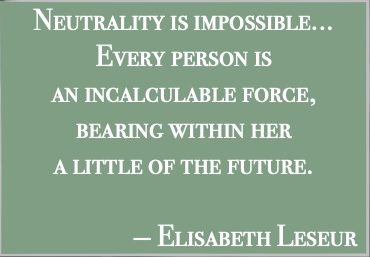
    [N]eutrality is impossible where it is a question of doing the good… Every person is an incalculable force, bearing within her a little of the future. Until the end of time our words and actions will bear fruit, either good or bad; nothing that we have once given of ourselves is lost, but our words and works, passed on from one to another, will continue to do good or harm to later generations.

    This is why life is something sacred, and we ought not to pass through it thoughtlessly but to understand its value and use it so that when we have finished our lives we will have increased the amount of good in the world.

    This is an astonishingly clear vision of the value of every human life and the import of free will. I found an echo of the same theme reiterated in a quote from an earlier letter to Charles Duvent which appeared in the introduction to this part of the book:

    The first thing to do is to try to become our best selves… And God will do the rest. Our effort, our sacrifices, our actions, even the most hidden, will not be lost. This is my absolute conviction: everything has a long-lasting and profound repercussion.

    This thought leaves little room for discouragement, but it does not permit laziness…. I am unable to despair of humanity.

    With that, I’ll stop for now, and next time write about the advice that Elisabeth offered to Marie as the younger girl was about to set out on the Christian life.