bearing blog


bear – ing n 1  the manner in which one comports oneself;  2  the act, power, or time of bringing forth offspring or fruit; 3 a machine part in which another part turns [a journal ~];  pl comprehension of one’s position, environment, or situation;   5  the act of moving while supporting the weight of something [the ~ of the cross].


  • Crisis mode: holding down the ‘off’ button.

    I generally think of myself as the stony type. In the last 36 hours I have received a reminder of what it is to have a heart of flesh.

    I’ll give you the short version, and start with the ending (so far) so you don’t have to read nervously ahead for the ending. She’s alternately dozing and playing with a lender iPad in a hospital bed next to me. She is doing as well as can be expected. She is scheduled to get a dose of oxycodone in a little while.

    She is seven. She is mine.

    + + +

    Saturday we thought it was a stomach virus. When she woke crying at 5 AM yesterday morning, Sunday, I thought it was a urinary tract infection. Mark was an hour and a half drive away with our oldest at camp, so I took the two other boys with us to urgent care when it opened at 9. Not till almost 11 did the lab come back negative for UTI. By then she could barely walk. I hoisted her on my back to carry her to the car so we could get to the ER. Mark met us there, still reeking of campfire; I took the boys home for food and to pack overnight bags, and then to H’s. I rejoined Mark in the ER, learned that her white blood cell count was high and that her C-reactive protein (an inflammation marker) was high. She was sent out for ultrasounds, and waited, and cried for water, and then when the u/s proved inconclusive she was sent for a CT scan, and waited.

    At 5 PM, twelve hours after I resolved to take her in as soon as possible, we had the answer: the appendix. And an hour after that she was in surgery and we were waiting. And a couple of hours after that we had talked to the surgeon. The appendix had perforated and made a mess of her abdominal cavity. He described how he tilted the table around and washed her out.

    “The solution to the pollution is dilution,” he cracked dryly.

    We must have not looked amused enough because he said “You’ve heard this before?”

    “Yes,” we said together, tiredly.

    + + +

    At 11 pm I fell into bed at home, my pelvis and legs and feet one long ache, and slept. At three this morning I woke, thirsty, and stumbled downstairs to down a Gatorade. Back upstairs I couldn’t lie down comfortably, what with the Gatorade sloshing around and the baby kicking me, so I sat up in bed to get a few deep breaths. They went in all right, but they came out all wrong, broken and wet, and I was done for. No one else was home, the boys in sleeping bags at our friend’s house across town, Mark on the futon in her hospital room not many blocks away, and I did not have to be quiet.

    This was a good thing, as it turned out.

    + + +

    Something I knew but had forgotten, as it had been a long time since we had a frightening time with one of our children: In crisis, this mother’s heart can handle almost anything. It barely suffers, while there are things to be done: bags to pack, foreheads to stroke, soup to be stirred, cars to be driven across town and back again; even sleep to be slept. It is when there is nothing left to do for anyone for a time that fear and worry descends blackly and wraps around and clenches.

    + + +

    Earlier this week I wondered aloud to Mark if I knew what it was to be grateful, specifically.

    I often wonder about whether it is possible to make oneself feel the right feelings. He thinks we can encourage them; I think so, to, but one needs some raw materials to work with, and I wonder sometimes if I don’t have the right raw materials or if maybe I just don’t nourish them enough.

    Today I think it certain they are there. It is just that I spend quite a lot of time fooling myself into thinking I am in crisis mode, and must act and cannot waste time or effort or thought on them.

    Nothing like a real crisis to shock you: what I thought was real wasn’t anything like real at all.

    + + +

    I don’t think the heart metaphor is corny, by the way. Our feelings are largely corporal, after all; it may really be more of an endocrine thing, of course, but the circulatory system is involved, and anyway the point is taken. We can nurture them or fight them with the will, but they are largely body-things.

    + + +

    This is just to say that, some time after that but long before dawn, I got up and put in a load of laundry so that I could bring a clean change of clothes for everyone the next day, and found my daughter’s doll and her bathrobe and flip flops. And then I went back to bed and slept some more.

    And to say that we will be here a while, because even though there are no current signs of anything going poorly considering what she has been through, it will be several days or a week before we can say she is out of the woods.

    My challenge is to suppress the crisis-mode for now, because it is really waiting-mode.

    And one way I am doing that is by reflecting on how much there is to keep you busy when you are actively mothering the suffering, and how much harder when rest and quiet comes.

    You might not think the mother’s heart works that way, but it turns out that it can.


  • Update on Julia and her peanut-sniffing dog fund.

    Remember Julia and her campaign for donations to help her pay for the training of an allergen alert dog?

    With nearly three-quarters of the money raised toward the goal, Julia’s family has been able to reserve a labradoodle puppy from a breeder in western Canada and set him up with a trainer from I Smell Trouble, LLC in Montana.

    Meet Quincy, the eager freshman student with the $8,000 nose:

    Says Cathie, Julia’s mom:

    Here’s Julia’s guardian angel. He is tiny now but we know he will sprout wings and keep her safe.

    After a few months of preliminary training, Julia will take Quincy home for socialization training around Christmas. I will keep you all updated on his progress!

    Thanks to all readers who shared the link, donated, or said a prayer.


  • The wheel of the generations.

    Last weekend we went to stay with another family we have known since I was in graduate school. On Saturday afternoon I found myself at the elementary-school playground, watching my kids run around on the grass. The youngest one was literally running around — in circles — and the older ones were playing ultimate frisbee with the other kids and dads.

    Me? I was too tired to run or kick a ball or throw a frisbee or do anything but gestate. In mid-to-late pregnancy, everything is growing so fast that it sucks up all the available energy. And even if the rational mind knows why this is, and understands the deep reasonableness of to sitting and take it easy for a few minutes or an hour between doings, sometimes it weighs heavily.

    Oof, I am a good-fer-nuthin’ sluggish loser. It affords a marvelous opportunity to feel slightly sorry for oneself.

    Out on the grassy field, my seven-year-old daughter, the only girl on the field, sprinted after the boys, leaped for a catch and missed, skidded to a stop and ran back the other way. She is a confident girl-child, strong and bright, more than a little ornery these days.

    I am ornery too, swelling and tired. I have written before: I wake up many mornings, astonished to find myself here, having chosen to throw all my best efforts into raising and educating five children. Plenty of other worthy people save some of their best efforts to build other things. Often very worthwhile things, and indeed things that serve families in many different ways.

    “…the family constitutes one of the most important terms of reference for shaping the social and ethical order of human work…. In fact, the family is … a community made possible by work…

    “…Man must work out of regard for others, especially his own family, but also for the society he belongs to, the country of which he is a child, and the whole human family of which he is a member, since he is the heir to the work of generations and at the same time a sharer in building the future of those who will come after him in the succession of history, All this constitutes the moral obligation of work.” — Laborem exercens 16

    (I am trying to get across, in case you can’t tell because pregnancy has stunted my communication skills, a notion of “there are a lot of different ways to lead a life of good service to the human community that helps children and families to flourish.” It is meant to be an inclusive sort of expression. I am trying to insulate myself from accusations of taking a side in the mommy wars here.)

    Even so, I am haunted by a rat-racey sort of element. All that time, effort, and emotion I invested becoming an educated person, now poured into the education of more little persons, some of whom in turn might simply pour all their effort into the education of their own young. Turning, turning, turning through the years. Get ready, get ready, get ready for a real life, when you will grow up to do Important Things and be respected. And then: when readiness is achieved, toss it all lightly aside in favor of a more centered life… one spent helping little ones get ready, get ready, get ready.

    A treadmill wheel, so to speak.

    I think the vague disquiet comes from having grown up with the notion that the most important thing for a bright girl to do is to grow up and achieve. Other than making plenty of money and living in interesting places, the details were often missing. Perhaps it all only meant “achieve more than those other people do.” Instead I am achieving something that anyone with working reproductive organs and enough time on her hands can do, and do just as well as I can.

    + + +

    “Poor kid,” I say to my husband later about my youngest, as I decompress in a recliner, “by the time i have this baby he’s not going to be able to remember a time before I was practically an invalid.”

    “‘Poor kid’ indeed,” says my husband, “he is going to have a new sibling to play with.”

    “Yes, and that will be worth it,” I say. I suppose it is a different sort of treadmill, one a little closer to nature. Raise kids to raise kids to raise kids, on and on, one generation after another.

    On this treadmill, the primary directive is to keep children, then adults, whole: by keeping families whole, by passing on the habit of living examined lives dedicated to forming the next generation. These families are “made possible by work,” and so it’s also to serve that prime directive that we pass on diligence, care, a knowledge base, and skills.

    It’s so easy to mistake the means for the end, isn’t it?

    You look outside and work on the world outside the circle of the family, always in order to strengthen and support and form your family, so that your children grow up strong and can do the same. But the circles are interconnected and the work we do also (if it is good work) serves other families through the medium of society and an economy. It all hangs together, and the whole thing will be stronger the more of us who acknowledge that the purpose of all that work is to prepare the next generation and also a place for it to thrive — and each individual has a place in that scheme whether he or she passes on genes or not, and whether he or she takes a place willingly or not.

    And that? That is even before you bring eternity into the mix.

    Every act, thought, and word has unimaginable consequences: a truth that is accessible to all honest philosophy.


  • On getting one’s body back.

    Jamie has a lovely meditation on weaning her youngest child.  

    Timely, for our extended family!


  • Workaholic.

    One problem with living by pithy aphorisms and proverbs:  they aren't one-size fits all.  

    This ought to be obvious considering how many of them are diametrically opposed.   Consider "many hands make light work" and "too many cooks spoil the broth," for instance.

    Anyway, one of my current besetting character flaws could be characterized by an excessive adherence to "Never put off until tomorrow what you can do today."

    Or at least a selectively excessive adherence to it.  I had better not pretend a fake character flaw, the kind that people spout in job interviews when the interviewer says, "Tell me about one of your worst traits" and they say things like "Aw gee, it's embarrassing but sometimes I'm a perfectionist."   Because it's not like my problem is lack of procrastination.  

    Just ask my mother-in-law, who recently cleaned out my cupboards for me. 

    + + + 

    Here's one of the things about homeschooling.  At least when you are in the middle of it, as I am —

    — no wait, I'm not in the middle of it yet — I'm nine years in and I have at least eighteen to go, unless I quit —

    — I mean we — or they — whatever — point taken – 

    — OK, at least when you are in the thick of it, as I am, it seems to stretch on forever into a boundless foggy future.   But you can see a while down the road, maybe a couple of years out, and… you've got to be ready for it, right?

     Especially if you're like me and you kind of hate winging it.  You need a Plan.

    So you look out there and you think…

    …my oldest will be starting high school in a couple of years, I need to get ready to set up a portfolio and a record system.  

    And my second-grader just isn't clicking well with the same history program that her brother did, she needs something different or at least a break, maybe a geography program, I should look into those for next year.  

    And I wonder what books I should have my kids read in high school for American Literature, I know it's several years off but it would be nice to have something in mind, should we do it in historical order or organize it by region, or maybe even some genre stuff , or how about the theme of how American literature fits into a world-literature canon, I almost don't care as long as we don't have to do The Scarlet Letter.  I should make a list now.  

    And next month we're going to do some science labs that could use it, it's about time I start shopping around for a good used microscope.

     And I really hate making those spelling worksheets that I started on this year, but they're working so well and I'm seeing real results, I should just sit down and crank out as many as possible so I won't have to do them again for a while.  And I should and I should and I should and I should….

    It doesn't ever have to stop, if you don't want it to.  You can spend your entire weekend, in the nice weather, if the kids are occupied, researching curriculum and churning out worksheets and syllabi.   Particularly if you kind of miss doing work at a computer, sitting down, the way you used to.  And which is even better in 2013 with Reddit just a click away whenever you get bored.  

    And all of which is more fun than cleaning out the cupboards, and easier in many ways than actually interacting with one's children.

    (I know.  Many of you have the opposite problem.  You play and enjoy your kids and your home and the outdoors, but then you never get around to any planning or school-prep, because that's not the  and so you feel really disorganized when it's time to sit down and do schoolwork.    I understand.  We are not all the same.  Except that everyone has something they wish was better about themselves.)

    + + +

    Anyway, I decided I work too damn much, so I resolved last week (while I was walking around the lake with Mark, on a gorgeous autumn Sunday during which my in-laws were watching the kids while we escaped for a few minutes) to set some time limits and stick to them.  I can do advance school planning on Wednesday evenings while the kids are at religious ed and Mark is grocery shopping, and on Saturday mornings at the coffee shop during Erin's Weekend Sanity Hours O'Solitude And Breakfast, and in the leftover time on Sunday evenings — if I have some after I've done my get-ready-for-THIS-week stuff.  

    That's like six hours in total.  I'm tempted to write "…and that ought to be enough," except that it probably isn't and won't feel like it and it will feel like I am leaving ten thousand things undone that, if only I would do them in advance, would make everything run so much more smoothly.

    But I have to shut off the damn computer and come to bed sometimes, you know? Whether I've done "enough" or not.  Truth is, I'll never do "enough" because I could always do "more."  In all the areas of my life.  It's time to do Not Enough on purpose in this one.


  • Service dog support.

    Here's a little vignette that, I hope, will inspire you with gratitude and perspective.  And perhaps some generosity.  Share the link and enjoy.

    + + +

    My friend Cathie (who's also my three-year-old's godmother, by the way!) has recently turned to GoFundMe to beg funds for a peanut-sniffing service dog, ASAP, to protect her teen daughter Julia.  I thought I'd put a plug in for them here.

    + + +

    Julia is a lovely young woman, fond of crafts, children, chess, and literature.  She is Cathie's oldest daughter, number two in a family of six.  

    664194_1379730301.2842


    Homeschooling has been the right choice for their family, in part because Julia and her sisters and brothers live with numerous different food allergies and sensitivities, some of them immediately life-threatening.   Tree nuts, finfish, shellfish, wheat, eggs, dairy, rice, you name it — somebody in their house is sensitive to it.   

    Julia's mother is, as you might imagine, an extremely versatile cook, and very good at streamlining and doing things such as making one kind of meal for one child and a different kind for another and a third kind for herself.  I have had lunch at their house and personally observed three different pizza crusts being prepared at the same meal.  

    Very tasty pizza crusts, I might add.  If anyone could rock multiple food sensitivities in a family of eight, it would be Cathie.

    + + +

    But while one can adapt meals for kids and adults with "mere" sensitivities, peanuts (along with a few other things) have to be Protein Non Grata in Julia's household.  

    Everyone knows some people are allergic to peanuts, a few of them quite severely.  Lots of kids have epi-pens stored with the school nurse.  It seems that more and more parents every year have to carefully vet each good-faith proffered piece of candy or baked goods.  We all know it's a growing problem.  

    But Julia has one of those instant, frightening, call-911 peanut allergies that make it hard even to enter public spaces.   Here's Cathie, recounting the event that caused them to bite the bullet and start raising money for a service dog:

    On Sunday we called 911 after arriving home from our Montana vacation. Julia had touched something with peanut residue at a restaurant on the way home. Within minutes, her fingers, knuckles and hands were swollen and covered with hives. She must have also brushed her lips because they were swelling up, too….

    …We are quite certain that the contact happened when she touched something in the bathroom at the restaurant, possibly the bathroom door.   Whatever it was, it was small enough to not be visible or smell-able because she is overly scrupulous about what she touches.

    Cathie has told me that Julia cannot shop in grocery stores that have an open bin of bulk whole peanuts because the tiny dust particles sent into the air from the shells as they are scooped and poured trigger an allergic reaction in her airway.  Some time ago, at a friend's house that had been thought "clean," Julia (walking barefoot on the carpet) stepped on a fraction of a piece of dry cereal, just a crumb, on the carpet.  "Her entire foot swelled up," Cathie told me.  "Within minutes."

    + + +

    Julia is of high school age now.  She is active in a scouting organization, in church, and in several academic clubs, and hopes to attend college, hold down a job, travel, serve the community, and all the other things that young people dream of doing.  But at this point, she and her family have had to reckon with severe limitations on her activities in public spaces.  

    • Young people with allergies as severe as Julia's cannot safely hold many typical teenagers' jobs, such as food service or babysitting.  
    • Looking to the future, it's impractical to expect that prospective employers would be willing to enforce peanut-free policies.  
    • It's unrealistic to expect that the young people she might meet while away at college will carefully keep peanut products off the surfaces in a college residence hall.   
    • Maintaining a social and professional life will be challenging if she cannot safely enter most restaurants, coffee shops, or break rooms.

    Of course,  most restaurants, coffee shops, and breakrooms are not, in fact, contaminated invisibly with peanut residue.  Most of them are, in fact,  safe for Julia to enter and use… but she doesn't have a good way of finding out when they're not safe.  

    This is why a service animal seems to be an appealing choice for Julia.  Service animals are allowed to workin most public places by statute.  We are most familiar with dogs that have been specially trained to assist people who cannot see well enough to safely navigate public spaces and streets, and with dogs (and a few other animals) that perform routine tasks for people that have limited mobility.   

    In Julia's case, an "allergen alert" dog — using capabilities similar to those exploited by police dogs that detect narcotics or explosives — offers her the hope of quickly assessing her environment as she moves through it.  Rather than avoiding EVERY place and event where she MIGHT come into contact with dangerous residue or dust, she hopes to be able to enter spaces freely, and rely on the service dog to alert on particular contaminated objects and surfaces.

    + + +

    Julia's family recently returned from a trip to visit I Smell Trouble, LLC, a trainer of allergen alert dogs in Bozeman, Montana.   Julia's pictured above with one of their dogs, which I guess they were taking out for a test drive.

    (Some care had to be taken before the trip to identify a breed whose dander would not trigger sensitivities in any of the family members. Fortunately there are a few viable choices, so they do not find themselves in the especially unenviable position of being allergic to all the allergen alert animals.)

    Here's Cathie:

     The trainer has an opening for a dog for Julia if we can raise the money quickly and locate the breed we need – an Australian Labradoodle or Standard Poodle, due to their hypoallergenic properties. This is an almost two year process to get a puppy and have it fully trained and certified as a peanut detection dog…

    We've been contemplating getting a peanut detection dog for Julia for almost a year now, but there is just no way we can afford it. 

    Today we decided we just have to ask for help.

    Please check out our fundraising site. 

    I thought I'd lend my blog today to tell Julia's story, raise awareness of severe and immediately life-threatening environmental allergy, and — perhaps — encourage readers to pass the story on and help Julia raise the funds she needs to get on the list to acquire a service animal.  

    Julia would be about sixteen years old by the time her service animal is ready — the perfect coming-out gift for a young woman who has a lot to offer the world, as soon as she can move freely in it.


  • This is what we do at our house instead of decorating a nursery.

    Climbing walls in the basement!

    1375691_3360490469174_10968281_n

    Check out the hinges on the side of that overhang, so we can use it for storage space.  (No, the hinges are not weight-bearing.  The triangular "door" is screwed shut — it won't be for frequently accessed storage space).  

    Next job is polyurethane on everything.  Then the floor mats, parts of which we are buying used (from a local climbing gym).  Then those boxes of jumbled climbing holds that have been gathering dust in Mark's shop will finally start getting put to use…


  • Four months to go.

    0924132134-00

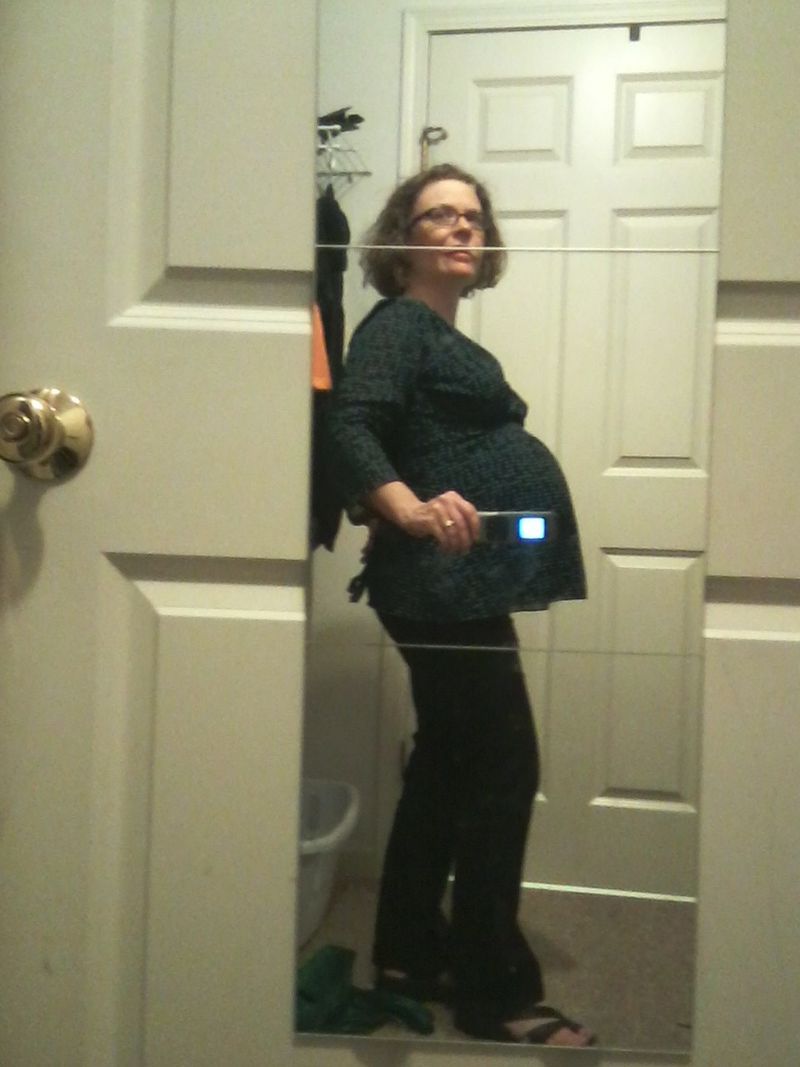
    Well, this is just ridiculous.

    + + + 

    I'm all dressed up (such as it is) in the photo because we went out to dinner last night, since my in-laws are visiting and offered to stay with the kids.  

    I wore comfortable shoes because I thought maybe we would take a walk across the Stone Arch Bridge before or after dinner.  It was a beautiful autumn evening, clear and mid-sixties with no wind.

    Mark said, "I don't own shoes that aren't comfortable."

    I said, "All my shoes are comfortable enough for expected performance windows, but not all of them are expected to perform on a long walk when I am heavily pregnant."

    + + +

    We didn't walk across the bridge because we didn't have time before dinner and afterwards I felt too waddly.  Here is a picture I stole from the internet instead of taking it, so you can imagine what we planned on doing and didn't do.

    Unknown-2
    (If you took this, and you ask me to, I'll take it down)

    + + + 

    You can't see the stone-archiness from the bridge itself, of course.  This is what it looks like from a place where you can see it:

    Unknown-1

    Only it was dark, and clear.  Lovely night to be out.  Instead we wandered around the university area and looked at construction sites and the big warehousey factory of the Metal-Matic corporation, where they turn metal sheets into custom-ordered metal tubing.  It was the end of the workday and the big sliding doors were open, and you could see onto the floor.  

    So that was interesting to look at, and it's not the kind of thing I can steal pictures from the internet about, unless maybe I took it from the company's website (she says, and then checks, and finds that it's a little short on glossy stock photos.)

    + + +

    We went to Restaurant Alma, which I think will now be my go-to recommendation for people coming in from out of town and wanting upper-end good food.  Its schtick is a prix-fixe three-course dinner of fairly small plates where you select each of the three courses from a list, and then you can add a wine flight which they will match to your dinner.

    Mark had a bison carpaccio with a sweeter-than-I-expected chenin blanc, and a sweet corn soup with smoked salmon that came with what I think was a pinot grigio, and a really outstanding poached sturgeon with potatoes and bacon that came with a red wine that I failed to taste.  (I commented that I could probably recreate the sturgeon dish with cod if he wanted me to give it a try sometime).

    I had a dish of kohlrabi-apple slaw with glazed pork belly, and a mushroom farrotto (very like a risotto) with shaved asiago cheese and a soft-boiled egg on top — I am a sucker for soft-boiled eggs, love them at all hours — and a crispy trout with sticky rice and coconut-ginger-chile broth.  I wished for more sticky rice, but the meal was otherwise close to perfect.

    I said no to the wine flight, because I was delighted to find my favorite sweet stout on the beer list — Left Hand Brewing Company's Milk Stout — and I drank that happily with the pork belly and the mushroom thing, and then switched to sparkling water to go with the fish since one beer is really, quite seriously, my upper limit.  (And stout with crispy Thai-flavored fish?  Um, no.  But it was really perfect with the pork belly.)

    + + +

    I could have claimed this as my birthday dinner out, but I told Mark I wanted to go out somewhere with the kids for my birthday.  They like a party, and this way I won't wind up baking myself a cake.  I suggested brunch at a local place that does an outstanding brunch with these caramel roll ring things.  

    And then I remembered that we will be spending my birthday with friends.  So that complicates things.  But maybe we can still manage to do something festive.  Or maybe we can do it on not-really-my-real-birthday.  I don't mind having multiple birthdays. 

    + + +

    The other project of this week:  Mark is taking several days off work — they had been saved for a family vacation that fell through — to do some projects around the house.  This is why my in-laws are up visiting, so that Mark's dad can help him.  They pulled a fence and some young trees out of our front yard and put in some winter rye grass seed to try to halt the front-yard erosion, readying it to plant sedum in the spring.  And then they started working on our basement climbing wall:

    0924131403-00

    It wraps around three walls, the overhang bit, and part of the ceiling.  

    Route-setting will have to wait until the wall-to-wall padded floor is complete, which won't happen this weekend.  The key was to get all the heavy pieces of plywood up while my FIL is here to help.

    + + +

    All right… time for breakfast.  I have some fresh plums and pecans to put on my cereal that my in-laws brought up for us.  Lucky me!


  • Enacting mercy, whether or not it exists.

    The works of mercy are all the works of almsgiving or "charity." According to the Catholic Encyclopedia:

    The traditional enumeration of the corporal works of mercy is as follows:

    • To feed the hungry;
    • To give drink to the thirsty;
    • To clothe the naked;
    • To harbour the harbourless;
    • To visit the sick;
    • To ransom the captive;
    • To bury the dead.

    The spiritual works of mercy are:

    • To instruct the ignorant;
    • To counsel the doubtful;
    • To admonish sinners;
    • To bear wrongs patiently;
    • To forgive offences willingly;
    • To comfort the afflicted;
    • To pray for the living and the dead.


    From Disputations:

    Rocco Palmo quotes Pope Francis:

    "We cannot follow Jesus on the way of charity if we don't love those around us first of all. It's necessary to do the works of mercy with mercy! The works of charity with charity!"


    Which is probably why I don't often find instructing the ignorant and admonishing the sinner brings me much peace.

    Um.  Yeah.

    So here's the question of the day.   If you can't summon up mercy and charity in your heart as the reason to perform any of these works…

    …if you have some other reason…

    …is it better to try to fake it and perform them anyway, or is it better to refrain?


  • Technology, productivity, and unemployment.

    Interesting musing here at Engineering Ethics Blog.

    The ways that people make a living today are very different from what they were a generation ago.  In 1970, Detroit was still a bustling manufacturing metropolis, thousands of women earned a decent living as telephone operators, and many newspapers provided employment to linotype operators who spent their days at the keyboard of a clunky pile of machinery that molded molten type metal into sticks.  Needless to say, you will have problems finding a manufacturing job in Detroit these days, and the other jobs are history too….

    And we are by no means done…almost half of current U. S. jobs could eventually vanish as they are taken over by "computerisation."


    What so often goes completely unmentioned in discussions of technological unemployment, is the question of anthropology: what is your model of the human being?  


    I think the model that most secular economists and researchers use is something like this.  All life is basically economic in character, and the ultimate good in this life is a smoothly functioning economy, wherein everyone capable of contributing to it works to the best of their ability and receives in turn the material benefits of their work. That is a nice picture as far as it goes, but as a philosophy of life it's somewhat lacking.


    For a completely different take on technological unemployment, you should read one of a number of works that were popular in the 1930s.  Even in the teeth of the Great Depression, writers such as C. C. Furnas in The Next Hundred Years went into optimistic technophilic raptures about how the increasing efficiency and productivity brought about by technological advances would let most people earn all the money they needed by working only one or two hours a day, leaving the rest of the time for leisure pursuits such as art appreciation and charitable work.  


    We have certainly gone beyond Mr. Furnas's wildest dreams of increased productivity.  So what went wrong with his vision?

    I'm not entirely sure, but one factor seems to be the social consensus of what kinds of work and lives are to be desired, and what kinds are to be disparaged.


    Go ahead and read the whole thing.   I think he's correct about that social consensus, incidentally, but another piece of the puzzle is — in my opinion — the rise of the two-income (or n-income, where n is the number of adults) household in all economic classes.

    That's just a link for thought this Monday morning.  See you later!


  • Temptation at home.

    It’s been a long time since I was writing a great deal about weight loss and gluttony*….

    (believe me, I will probably need to write more about it sometime after I have this baby… maybe even sooner, because while trying to lose weight isn’t appropriate right now, dealing with old impulses always is…)

    … and it’s been an even longer time since someone emailed me with a question inspired by those old posts!

    (Excuse me for my enthusiasm.  I’m a little thrilled to have someone give me a reason to add a blog post.  Lately, what with the homeschooling, the pregnancy, and the head lice, it’s been hard to get to the computer with enough energy left to write.)

    So, anyway, reader Katherine emails:

    I…  have been following for the last few months.  Since May when I read your semiannual maintenance post. I began reading more of your posts about weight loss.

    A nice amount resonated with me. I’m a food addict and I’ve been trying to make lifestyle changes to improve that. But there is one area that does undermine me and I just wondered if you had any tips or suggestions on how to deal with it.

    I struggle to not eat when I’m making meals for my kids, even if I’m not hungry. It can smell good, look good and sometimes I even need to taste it to make sure it is cooked or seasoned or the right temperature. And it can be hard for me then not to, “Oh I’ll just have a little bit.”

    I know you said you chew gum cleaning up after meals, but what about when making meals for others? Do you chew gum then too? Is there a better snack you keep on hand for that? Some other trick I’m not thinking of? I enjoy a piece of gum now and then, but chewing all day would give me a headache. 

    Chewing gum all day would give me a headache too.  I resort to the gum-after-meals because I personally have a bigger problem with cleaning up afterwards — with ending my meals — and because there’s a plausible socially acceptable excuse to do it for other reasons: an after-meal stick of sugarless gum, especially kinds that contain xylitol, reduces cavities.  So, hey, good all around. 

    So, what to do about eating during food preparation for others.   I guess it would depend on (a) why you perceive that it’s a problem and (b) why you think you do it anyway.

    I can think of at least two different published systems that are effective for many and that recommend going cold-turkey on eating outside times when you have deliberately chosen to have a “meal” (where we allow that some meals are small and happen between breakfast, lunch, and dinner).   One of these, quite simple, is No-S and the other, more complicated, is the Beck approach.  

    No-S is summed up as “no snacks, no sweets, no seconds except on days that start with S.”  It emphatically does NOT define liquids as snacks, even rich and caloric ones like milkshakes or beer, because it’s a behavior modification technique rather than a calorie-counting one.  Chewing gum — unless it tended to exacerbate cravings for sweets and is problematic for that reason — would be compatible with that system.   But taking a bite of foods  you’re cooking (except, I suppose, liquids like broths or sauces) would be incompatible with the system — yes, even in order to find out if there’s enough salt.   And it would also be incompatible with the system to eat other snacks while cooking, even something like celery sticks.  The whole point is to condition you not to eat when it isn’t mealtime.

    The Beck approach is based on cognitive-behavioral therapy.  It’s quite different from No-S, as it’s a controlled-calorie system that writes “snacks” and “sweets” into the budget, while teaching techniques to help people discontinue unhelpful behaviors.  One of the pieces of advice I remember about it — a piece that I didn’t end up following — was not to rely on a crutch like gum or sugarless candy to keep your mouth busy so you wouldn’t eat things.  Beck thought that in her system, it was preferable to learn to cope with cravings and temptations some other way besides putting something in your mouth.   

    I mention these not as diet-book recommendations (though you could certainly investigate them) but to point out that each system hangs together in its own way, and what makes sense in one doesn’t make sense in another.  Ultimately, of course, everyone who needs a system, needs a personalized one.  

    One person can’t touch chips without eating every chip in sight, so it makes more sense (at least temporarily) to expose herself to chps with caution; another person reacts to food restriction with binging, so it makes more sense for him (at least temporarily) to give himself permission to have some of whatever he wants, until “forbidden” foods lose their power over him.

    + + +

    So, let’s examine some of what you wrote.  Starting with this one.

    …sometimes I even need to taste it to make sure it is cooked or seasoned or the right temperature. 

    I challenge this assumption.  When you’re ferreting out unnecessary eating, I have found it helpful to question every instance of “I need to put this in my mouth because…”   Often they aren’t really “need tos.”  And this one sounds like a false “need to.”  

    • If you’re unsure whether something is cooked through, tasting it isn’t safe.  Make sure it is cooked by cutting into meat and observing the color and texture, by using a thermometer to find out if it has come up to the prescribed doneness temperature, or by paying attention to how long it has been cooking.
    • Whether something is correctly seasoned or not is subjective, especially if you’re talking about salt or hot pepper.  Even if it tastes the right amount of “salty” to you, it might not to others.  So there’s no need to taste food for that reason.  Follow the recipe for herbs and garlic, err on the side of under-salting and under-spicing food, and pass the salt and pepper at the table.
    • Temperature can be tested with a thermometer or a fingertip, or you can touch a spoon to the outside of your lip.

    If you are the sort of person who generally struggles with “just one taste” turning into “just one more bite” and then into a whole serving’s worth of bites — and let me say that I am one of those people too, so believe me, I get it — it will help you avoid the second, third, and nth tastes if you steer clear of that first “just one taste.”  That holds true even if you are tempted to think that this “just one taste” will be different somehow because you have a  “good” reason to take a bite of the food.  But it will not affect you any differently just because it can be defined as “good.”

    I struggle to not eat when I’m making meals for my kids, even if I’m not hungry.

    I think to figure out what about your situation is especially tempting, you need to ask yourself… what’s actually wrong with eating the food you are preparing for your children?   Is it because you’ve already had your own meal?  Is it because you think the kid food is not good for you and you should eat something better for you?  Is it the “I’m not hungry so I shouldn’t eat” thing?  

    Because what jumps out at me is the “when I’m making meals for my kids” part — not “for me and for my kids,” or “for my family,” but “for my kids.”  Are you eating at a different time from your children?  Different stuff, because of different tastes or dietary needs?  Or are you doing something like packing lunches for them for the future, or making things to go in the freezer?

    Is part of the problem that you’re making two sets of meals — one for yourself and one for your kids — and that gives you two opportunities to eat a meal?

    In any case, you are unhappy with this situation and it is probably time to shake it up a bit — experiment with trying different things.

    Would it help if you made meals for your kids at the same time that you are typically making a meal or a snack for yourself?  So that you have in your pocket the ability to tell yourself:  “I deserve to have a real meal on a plate.  I’m not a dog who gets fed on table scraps.  I’m going to have my lunch in just a moment, when the children are eating their lunch, and my lunch will be just as good or better than what these guys are having.”

    Or… you could decide that you DO want to have the food you are making “for the children.”  And then you could commit to it.  There’s no shame in eating a peanut butter and jelly sandwich for lunch, with a glass of milk (or chocolate milk!) and an apple on the side.  Just commit to it!  Put it on a plate, say “This is my lunch,” eat it, and be done with it.

    After all, if the food you are making for your children looks good and smells good and you want to eat it, why not… plan on eating it?

    I think if it were me, I might try an experiment of just eating the same food I’m making for my kids for a couple of weeks (but on a plate, not standing at the stove).   “After all,” I would reason, “here I am eating bits these pepperoni pizzas and grilled cheese sandwiches day after day, even when I’ve already had a lunch.  Clearly I must WANT them on some level, and telling myself not to eat them isn’t working.  So I’ll just eat them.  Not in addition to my ‘real’ lunch, but AS my ‘real’ lunch.”

    If you know I am going to have a full serving of the meal I am preparing, on a plate, like a grownup, I find it is easier to tell myself, “hey, I don’t want to eat this standing next to the stove.  I want to sit down and enjoy it like a human being. ”  

    A sociable person might say, “I want to sit down with my kids and reconnect with them over a meal!  Or with family and friends!”  

    A person like me in the middle of the school day might say, “I can’t wait to send the kids away for Break Time and take this grilled cheese sandwich and bowl of soup and sit down with it in front of the computer in peace and quiet and enjoy it while I check my email and then have a cup of coffee and really relax for half an hour before going back to work.”

    + + +

    As a side note, I admit that feel a little at sea when trying to answer reader questions.

    The context in which I have chosen to interpret my food issues is “gluttony.”   I had a great deal of personal success framing them in that way.  There were elements of addiction over which I had little control, but interacting with those were also elements over which I did have control.  I tried to tease them apart and, where appropriate, accuse myself.

    I’m loath to tell anyone else where addiction (the disability) ends and gluttony (the weakness) begins.  That (besides lacking details) is why I didn’t use the word “gluttony” while writing about Katherine’s question.

    But it is possible to step back and, without naming the cause as either addiction or gluttony-the-personal-weakness, identify acts that are objectively gluttonous.  There is no self-shaming to be implied in this.  Only “hey, here is something I do, and I am identifying it as a problem that I want to work on.”  To see your activities with clear eyes.

    Aquinas says that gluttony is the act of eating too soon, too expensively, too much, too eagerly, too daintily, not counting when you “think it necessary” for yourself.  One of the reasons I have found that definition less than useful is that it’s shockingly easy for me to convince myself that eating some thing “is necessary.”

     (“Needing” to taste food repeatedly to make sure it’s seasoned properly is only one example.  I would tell myself things like “I only had pastries for breakfast, now I ‘need’ to eat my second breakfast which will provide me with protein and necessary minerals,” or “I don’t know if there will be food where I’m going and I might get hungry, so I ‘need’ to eat a full meal before I get there” followed by “I ‘need’ to eat because it’s what everybody else is doing.” Now I’m pregnant and I still struggle with what I “need” to eat because I’m pregnant and I “need” more food and better food.)

    Dissatisfied with the way that this “necessary” loophole keeps undermining my resolve, plus the vagueness of the “too”‘s in that discussion, I proposed an alternate categorization here.   I found it a lot more helpful in accusing myself and in changing my behavior.  

    But that’s me.  It’s not necessarily you, or the reader, or anyone else.

    + + +

    Anyone else have some ideas for experiments to try, in order to break the habit of eating while preparing children’s meals?  My suggestion — to plan on eating the apparently desirable children’s meal as one’s own meal — can’t be the only one.

    [Editing note.  Years and years later, I wish I’d done a better job distinguishing gluttony from other problems with food, like clinical eating disorders and other kinds of compulsiveness.  

    I want to emphasize that, whereas I identified some behaviors in myself that probably qualified as self-centered gluttony in the technical sense, I am not and never have been qualified to make that distinction for anyone else.

    I hope to add some commentary to all the posts that have this problem as I find the time to review them.  Here’s a more recent post where I acknowledge some of the problematic material I wrote and set new ground rules for myself going forward.]


  • Comment tightening, hopefully temporarily.

    Typepad is experiencing a surge in spam, and I'm having trouble keeping up with it, so I'm temporarily requiring commenter authentication instead of just a captcha.   

    Hoping to have a new post out in a couple of hours.