bearing blog


bear – ing n 1  the manner in which one comports oneself;  2  the act, power, or time of bringing forth offspring or fruit; 3 a machine part in which another part turns [a journal ~];  pl comprehension of one’s position, environment, or situation;   5  the act of moving while supporting the weight of something [the ~ of the cross].


  • I have no idea where he got this.

    Yesterday afternoon my almost-four-year-old was angry at his brother, so he ripped up one of my paperback books.

    I said, "Don't rip up my book!  It makes me sad!"

    He said, "It's okay, mommy.  It'll be fine."

    I said, "No, it won't.  The book is broken now.  I can't read it anymore.  It's ruined.  That makes me sad."

    He said, "I was mad at [the 10-year-old]."

    I said, "I'm angry at you!"

    He looked concerned and asked:  "Will you be mad at me all of the times?"

    I was mixing up medicine for his sister and I paused.  "I will be mad until I calm down," I said.

    He looked at me quite seriously and then said firmly:  "Mommy!"

    "What?"  I was back at the sink.

    "Take a deep breath!"

    He pronounced it "breff."  

    I paused again and turned around.  He was standing there, his head level with the countertop, looking at me expectantly.

    I inhaled.  

    He pantomimed exhaling, exaggerating the motion of his chin and head.

    I exhaled, feeling the corner of my lip curl upwards.  I suppressed it.  "Now what?"

    "Take a deep breath again," he told me.

    I inhaled.  He pantomimed exhaling.  I exhaled.

    "Now what?"  I asked again.

    "Now you are all calmed down," he said.  And he went off to play.

    And you know, he was right.


  • Emily Oster on the conventional wisdom of pregnancy.

    Darwin of DarwinCatholic recently pointed me, via Facebook, to an interview with author Emily Oster hosted by EconTalk host Russ Roberts.  

    Oster is the author of Expecting Better:  Why the Conventional Pregnancy Wisdom is Wrong–And What You Really Need To Know.  

    I have been meaning to pick it up for some time;  now, thanks to the instant-gratification feature on Amazon (aka the Kindle store) I should be reading some of this book later today if I get a chance.

    Here are a few interview quotes gleaned from the transcript highlights posted on the EconTalk page.

    OSTER:  I think that patients sometimes will just say: "Look, I just want you to tell me what to do. I don't want to have to make this choice"….in combination with doctors sometimes saying: "Look, I don't have 45 minutes to go through all this with you; I'm just telling you, you should make this choice." 

    I think those two things….interact poorly in a way that makes us not always make the best choices. 

    [Y]esterday I was on the radio with a doctor who said: "Well, statistics is really hard, and so …we shouldn't really expect people to be making a lot of these decisions with data."

    And I think … "Are you kidding? You *have* to make these decisions with data."

    +++

    OSTER:  I think one of the things that is definitely true is there is variation across doctors. And there is also this very clear set of constraints that I think doctors face, some of which just has to do with not having that much time and some of which has to do with legal issues. 

    …And I think for both of those reasons, it is in some sense incumbent on women to think through these choices for themselves.

    And this extends past pregnancy into other parts of medicine: that there just isn't really a choice–you have to do this, to some extent, by yourself. There isn't another option.

    On one of her examples, caffeine use during pregnancy:

    OSTER:   [I]n a lot of what I researched in pregnancy there is a very clear problem with causality….

    So, the concern with having too much caffeine in pregnancy is that you might have a miscarriage. …. And so the way that this is studied early in pregnancy is you look at women who drank some coffee early in pregnancy; you ask them how much coffee they had; and you look at their rate of miscarriage and you compare them to women who didn't have coffee, and you look across different amounts of coffee. 

    [W]hat you find is…

    • that up to 200 mg, which is about 2  eight-ounce cups, is fine….you really don't see any increased risk of miscarriage up to that level.
    • When you start looking at, like, 8 cups of coffee, you see ….that there is an increased risk of miscarriage.
    • When you look in the middle, like 3, 4 cups a day, the evidence is a little bit mixed.

    So … it's clear a little bit is okay; it's probably the case that a lot is a problem; but in this intermediate stage it's unclear.

    And part of the issue is that when you look at these studies, the kind of women who drink coffee are just different from the kind of women who don't. And this is a problem in any observational study like this. And they are different in ways that are also, themselves, linked to miscarriage.

    [W]omen who drink coffee tend to be older. Age is the biggest issue with this.

     In addition, in the case of coffee–and this was in some sense the most interesting thing for me research-wise–there is also a problem with nausea. So, if you are nauseous in early pregnancy it's a very good sign about the health of the pregnancy. Women who are nauseous–good news, ladies: you are less likely to miscarry. But women who are nauseous are also more likely to avoid coffee.

    So when you look at women and you see some of them drink a lot of coffee, those women are also on average women who are less nauseous. And when you see that they then miscarry at higher rates, it may well be just that not being nauseous is a sign of miscarriage and caused them to drink coffee, but it's not that the coffee caused the miscarriage. And I think getting around that kind of challenge is very complicated. 

    There's more, on epidurals, alcohol, deli meat, and cats, among other things.  Unfortunately the interview transcript is poorly formatted, but you can also listen if that's your thing.


  • A scary Halloween story.

    My daughter is feeling much better now, to the point where she hasn't quite stopped complaining about pain from her incision, but we are starting to notice that she tends to do it when it's time to unload the dishwasher.  So it's about time I start buckling down and blogging a little more if I can.

    I'll start with a story that doesn't have me in it.

    + + +

    On the day before Halloween, Mark dropped the three big kids off at religious ed and then rushed off to do the grocery shopping as quickly as possible so that he would have time to stop by the hardware store and buy dowels for my nine-year-old's Archer-Cloaked-In-Black-From-Head-To-Toe costume.

    1031131814-00

    Note the dowels emerging from the quiver on his back.  Mark is now an expert in duct-tape fletching.


    Anyway, Mark rushed my three-year-old in the Car Cart through the grocery store, made it to the big-box hardware store, grabbed dowels and headed for the checkout with the 3yo in tow.

    Just before they got to the checkout, Mark remembered that the three-year-old had been extra-wiggly back in the grocery store, and asked him:  "[Three-year-old], do you need to go to the bathroom before we check out?"

    "No, Daddy."

    But that's always a dangerous question.  Much as one should not point a gun at an aggressor unless one is prepared to deliver a disabling shot, one should never ask whether a three-year-old child needs to go to the bathroom before entering the checkout lane.  All asking does is begin the process of percolating the idea through the brain and down to the nervous system, eventually to find its way to the bladder.   One should either issue a firm parental command ("Time for the potty!") or else remain silent.

    Mark entered the self-checkout lane and began scanning dowels.  Three-quarters of the way through the transaction, the three-year-old informed him:  "Daddy!  I need to go to the bathroom!"

    Uh-oh.  "I'll take you to the bathroom as soon as I'm done paying for this stuff," Mark told him.  Then he let go of the three-year-old's hand to extract the credit card from his wallet.

    A moment later, the 3yo darted out of Mark's peripheral vision.  Mark looked up and saw him running toward the front of the store, where the big sliding entry doors are.

    And also where the displays are.  Display shower enclosures, and display vanity sinks, and…

    There was an attendant there to assist people in the self-checkout lanes.  Mark handed her the dowels, screeched, "Hold these!" and sprinted after the three-year-old, who was already lifting the lid (and the seat) of a display toilet and pulling down the front of his pants.    Mark scooped him up from behind just barely in time.

    "He was so very, very confused," Mark told me later.

    Mark carried the objecting three-year-old back to the checkout lane and one-handedly retrieved his dowels from the attendant.  On the way out he passed a sign that said "Ring Bell if you received excellent service!"

    Mark rang the bell.  After all, he did get his dowels back.


  • Proselytizing vs. evangelizing.

    So, the word "proselytizing" has acquired in the last few generations a negative connotation (relative to "evangelizing") that it did not previously have.

    Disputations has a list of "negative" aspects of witness-to-the-faith, which he — quite interestingly — found in an ecumenical document composed in conversations between Baptist and Catholic groups.  It serves as a description, if not a definition, of "proselytizing" in the modern, negatively-tinged sense.

    We also admit that there are negative aspects of witness which should be avoided and we acknowledge in a spirit of repentance that both of us have been guilty of proselytism in its negative sense. We affirm that the following things should be avoided: 

    •  every kind of physical violence, moral compulsion and psychological pressure (For example, we noted the use of certain advertising techniques in mass media which might bring undue pressure on readers/viewers);
    • explicit or implicit offers of temporal or material advantages such as prizes for changing one’s religious allegiance
    •  improper use of situations of distress, weakness or lack of education to bring about conversion
    •   using political, social and economic pressure as a means of obtaining conversion or hindering others, especially minorities, in the exercise of their religious freedom;
    • casting unjust and uncharitable suspicion on other denominations; 
    • comparing the strengths and ideals of one community with the weaknesses and practices of another community.

    Sounds pretty good to me.

    The term "evangelist" has some negative connotation in the wider culture thanks to "television evangelist," but if it's used in its historical, more narrowly technical sense (i.e., to describe the authors of the four Gospels) that's generally avoided.  


  • Why it’s important for science teachers to teach theories that aren’t “true.”

    At Gravity and Levity, a defense of teaching the Bohr model of the atom (at least as a prerequisite to teaching more modern models).  

    The Bohr model has been discredited, but it's still very useful.

    A few years ago, at a big physics conference, I was party to an argument about whether we should be teaching the Bohr model of the atom in lower-level physics classes.  The argument in favor was that the Bohr model is easy to teach and gives a simple way to think about the structure of atoms.  The argument against was that the Bohr model is completely outdated, conceptually inaccurate, and has long been superseded by a more correct theory.  The major statement of the opposition argument was that it doesn’t do anyone much good to learn an idea that’s wrong.

    How strongly I disagree with that statement!

    What follows is an explanation of the Bohr model and also an explanation of a similar problem in physics (Landau levels) that, in the blogger's opinion, itself justifies the teaching of the Bohr model.  But he says — and I agree — that there are deeper reasons:

    I can’t resist making a larger comment here about the idea that certain scientific ideas shouldn’t be taught because they are “not true.”

    Science, as I see it, is not really a business of figuring out what’s true.  As a scientist, it is best to take the perspective that no scientific theory, model, or idea is really “true.”  A theory is just a collection of ideas that can stick in the human mind as a useful way of imagining the natural world.

    Given enough time, every scientific theory will ultimately be replaced by a more correct one.  And often, the more correct theory feels entirely different philosophically from the one it replaces.  But the ultimate arbiter of what makes good science is not whether the idea an true, but only whether it is useful for predicting the outcome of some future event.  (It is, of course, that predictive power that allows us to build things, fix things, discover things, and generally improve the quality of human life.)

    It is undeniable at this point that the Bohr model is decidedly not true.  But, as I hope I have shown, it is undoubtedly very useful for scientific thinking.  And that alone justifies its presence in scientific curricula.

    I would like to add that it's pretty impossible to understand what makes a revolutionary idea (like quantum physics) revolutionary, unless one has some concept of what came before.


  • Six small things.

    (1)

    I think my brain is de-stressing.  Mark and I saw his parents off at 5:20 this morning, then went back to bed.  Soon I fell back to sleep and promptly had a detailed dream about applying for a library card.

    (2)

    I was amused by this.  Summary in bullet points:

    • Solo ultralight backpacker's wife suggests that the two of them take up car camping in order to foster togetherness and have fun together.
    • Unsurprisingly, this leads to the need to BUY MORE GEAR!!!


    (3)

    Speaking of gear.  After I tucked the seven-year-old into her own bed for the first time in a week and saw her off to sleep on a dose of pain medication, I told Mark that I kind of missed the beeping machines.  "I think it'll be hard to sleep without wanting to get up and check on her breathing," I said.  "I almost wish I had a pulse oximeter."

    He got an evil-genius look and said "Reeeeeeealllly?"  

    I wasn't really thinking of the model from Brooks-Range Mountaineering, to tell the truth.

    (4)

    My nine-year-old turned ten near the end of his sister's hospitalization.  The night before his birthday, I sat him down and had to explain that we had not done anything whatsoever for his birthday, neither bought any presents (or thought of one) nor prepared to bake a cake nor planned a special outing.  

    And no, this was not a setup for a surprise reveal on the big day, either.  We are last-minute people when it comes to holidays and birthdays, and we had nuthin'.

    "You'll have to wait a few days for us to pull something together," I told him.  "Probably when the weekend comes around."

    He put a brave face on it, but his eyes were wet.  Poor kid.

    (5)

    I did manage to get the younger kids' Halloween-costume supplies ordered while I was keeping vigil in the hospital over my sleeping daughter.   The girl wanted help with her "Egyptian cat" costume; I ordered a cat-ear headband and tail and some black clothes for her, and some yellow fleece to make a golden neck collar/shawl type thing and some glue-on plastic gemstones.

    Amazon Prime has revolutionized Halloween costumes for me.  With free two-day shipping, I can order stuff faster than they can change their mind about what they want to be.  And I don't have to take a number at the fabric store.

     My 3-year-old, when asked about his costume, had announced he wanted to be an "orange knight."  (Last year my then-seventh-grader, having been immersed in the tales of Sir Gawain for some weeks, went as the Green Knight; I'm assuming this idea was related.)  I agreed quickly before he could change his mind, because "knight" is easy.  I ordered a cheap set of plastic knight accessories and some orange fleece.

     When they arrived yesterday, I draped the orange fleece over him to check size, cut out a rectangle and a long narrow strip, cut a hole for his head in the middle of the rectangle to turn it into a "tunic" (really more of a scapular) that hung down in front and in back, tied the strip around his waist, and then opened the Amazon box and gave him his helmet, shield, and sword.

    Unspeakably happy boy.

    This has got to be a costume-making record.  It took me about four minutes, not counting two-day shipping.  I didn't even need the hot glue gun.

    (6)

    This has been a wonderful object lesson in how homeschooling forces you into a different pattern than the common one.  Better or worse, it does not really matter, but it's definitely different.  If my older boys had been in school, they'd have gone on with most of their normal routines and kept up with their schooling; and we'd have had less worry about who was going to "watch" them, since they'd be occupied in a school building part of the day, but there would still have been the getting them to and from on time.  

    As it was, school was entirely suspended for them on the first day of the crisis (as it was for the homeschooling family who took care of them for us).  The second day they had some assignments cobbled together from my hastily-scribbled list and from the things that the other family had on hand.  After that, my thirteen-year-old, lacking specific assignments, went on with Algebra by trying to select problem sets for himself that looked like the sort of mix that I would have selected.  My nine-year-old (ten now, gotta get used to that) went on with his math with the standing instructions.  Both read books.  Their grandpa taught them to play five-card stud.  

    The lesson here is that our lifestyle choices are designed to make us interrelated.  We work together.  They stop working together.  We can adapt, but it takes time.  We are not an "institution."  We are a family.  We live like a family, and we learn like a family, and that means that sometimes we have a crisis, and it affects all of us, and we all have to pitch in, and — even if we would like to — we cannot pretend to make life "normal" for the other members of the family until the crisis is over.  It would exhaust us to try.  So we don't.

    Anyway, all the public school kids in the state were off for a couple of days last week because of a gigantic statewide teacher's union meeting that cancels school in Minnesota for two days every single year.  I figure that if my kids operated on 60% power for a few days, they aren't any worse off than the rest of them.


  • Discharged.

    After a full week in the hospital, we are home. And feeling grateful all around.


  • Satisfying bleakness.

    I left Mark and his dad with my sick kiddo in her hospital room yesterday afternoon so I could go to Mass at a parish on this side of town. The rest of the family will go this morning, the usual place, the usual time. Now that the 9- and 13-yo boys are both serving Mass, we have a little less flexibility than we used to.

    I’m not naming names, but when I opened that door I walked into the bleakest-looking sanctuary I have ever seen.

    + + +

    It isn’t ugly, per se; there was a symmetry and a proportion to it that satisfied the mathematical eye. And it isn’t haphazard or cluttered; clearly someone had inflicted this design with a sense of purpose. So I wouldn’t call it painful to look at.

    But it isn’t a place of spareness and simplicity, either, which has its place, if only among monks. It is more like a basketball court repurposed as a tasteful dungeon.

    The sanctuary there has no foyer; one walks through the double doors and finds oneself immediately at the entrance of the center aisle, face to face with a smiling usher handing out photocopied 11×14 sheets with a couple of hymns and the Nicene creed printed on them. The pews are arranged in forward-facing ranks. The space is a large box, with recessed can lights in the ceiling far above, pointed straight down. There are square windows crisscrossed with bars that break them into triangles, of frosted glass that filters the light to thin gray, around the very top of the walls. The total effect is very dim despite the large number of can lights. The quantity of light is enough to see by, but its quality is that of a late afternoon, with thunderclouds gathering but never releasing their rain.

    The walls themselves are beige brick all the way up to the ceiling. A couple of wide rectangular pillars, the same beige brick, rise on either side of the altar area. Low on the broad face of one is bolted a dull metal Madonna-and-child, symmetrical, hooded, expressionlessly gazing straight forward from mask-like, slot-eyed faces. This piece is surrounded by tea lights each also bolted to the wall.

    There is a crucifix, too small for the vast space, hanging on a surface that serves as a signifier of a reredos. This reredos rises in a peak — so it also serves as a signifier of a sanctuary-shaped space — and is made of vertical bands of dark wood. The bands are so high-contrast that if you gaze at them or at the crucifix for more than a few seconds and then look away, their ghosts stay imprinted on your retinas, casting stripes everywhere that then disappear.

    The tabernacle is a cube with a square pattern of black squares, tucked behind the Madonna’s pillar. The altar cloth is plain. Behind the altar are hung three plain narrow banners, off-center, for Ordinary Time. There is a single pot of orange mums next to the priest’s chair.

    I took a seat in a pew near the front. I was ten minutes early, and there were maybe five other people in the pews. I put down a kneeler and tried to kneel on it, but the kneeler was set so close to the pew in front that my pregnant belly could not fit, so I had to sit back down.

    An older man carrying an iPad and wearing a tie was dashing about asking questions; his voice echoed in the space, muffling his words, but it was clear enough that he was tasked with filling vacant slots, perhaps trying find a parishioner who would agree to serve as lector. He leaned over and asked a question of the woman behind me; she said she didn’t have her reading glasses. Meanwhile, parishioners were starting to come in through the double doors from the parking lot. They spoke to each other and the reverberating rumbles of their voices in the bare brick box grew louder and louder, their words still indistinct.

    “Father.” The one clear word came from behind me and startled me so that I half turned. The speaker was a youngish man seated in a pew back and to my left, leaning forward over a metal rubber-tipped cane. I supposed he had been greeting the priest, whom I could not see but who might have been the man dressed in a black short-sleeved shirt and black pants disappearing just now behind the reredos. When I turned the young man with the cane stared back at me and I turned back, a little embarrassed.

    Even though the space objectively offended my sight and hearing, something about the sanctuary atmosphere felt weirdly appropriate. I have had a bleak sort of week, starting out by missing Mass in favor of signing in to the emergency room downstairs. I have been plunged into knowing what it is to be sinful and sorrowful; I think a piece of the Memorare has fallen into place for me this week. I have been tired and afraid and lonely, and anguished, and watched my child be tired and afraid and lonely and hurting. I have not done any of the things I meant to do this week, and I find I don’t care.

    So I sat there and thought: Maybe this is perfect, the cherry on top. I get to go to Mass here in this place. God is here too, and I know that, and maybe this is just the reminder I need, that God is in the bleak places.

    I sat back, thinking to myself in an Eeyore sort of way, that it was a rather satisfying end to the week.

    Then the dashing-about man walked up from the side and put the book of the gospels on a stand at the edge. Next the priest, vested, came out in front and announced that the pianist had not shown up and so the Mass would be “somewhat abbreviated.” “Please rise,” he said cheerfully. And he climbed right up the steps and launched into “The Lord be with you.”

    And Mass started, processionless, music-free, chant-free. Readers, there was no Gloria, not even a spoken one. There was no Alleluia, not even a spoken one. I found myself somewhere sparer even than Lent.

    Well. I wasn’t even sure if this was allowed, but I guess (in an Eeyore sort of way, or perhaps by now we were crossing into Marvin the Paranoid Android territory) it was even more satisfying than I had originally thought.

    + + +

    The readings being the story of Aaron and Hur holding up Moses’s arms until Joshua defeats the Amalekites, and the parable of the widow pestering the corrupt judge until in exasperation he rules in her favor, the homily turned out to be an exhortation on spiritual persistence.

    Okay then.

    Afterwards, after kneeling for a brief prayer of thanksgiving (well, sort of, with my butt on the pew to make room for my belly), I determined to leave quickly and quietly, getting back to my other child, in the hospital. I remembered what St. Francis de Sales wrote in the Introduction to the Devout Life:

    When you have finished your meditation, take care to keep your heart undisturbed lest you spill the balm it has received: in other words, keep silence as long as possible and transfer your attention to other things quietly, trying to retain the fruits of your prayer as long as you can.

    A man who carries a vessel full of some precious liquid walks very carefully, looking neither right nor left but straight ahead to avoid stumbling over a stone or making a false step, making sure that the vessel is well balanced.

    This is how you must act after prayer, trying not to be too quickly distracted; for example, should you meet someone you must speak to, accept this as unavoidable, but keep a guard on your heart, so that you spill as little of the balm of prayer as possible.

    As I passed by, the young man with the cane looked straight at me and said: “God bless you.”

    I looked back at him and replied automatically, “You too.” I didn’t stop but went on out to the car, pondering, hefting my balm.


  • Collision of housekeeping standards, plus update.

    Mark’s parents are taking care of our boys at our house while he and I keep vigil at the hospital with our post-appendix-rupture daughter.

    This is wonderful and something we are grateful for. This also leads to exchanges like the following:

    MARK’S MOM: Erin, what do you use to wipe up the bathroom floor?

    ME: What do you mean?

    MARK’S MOM: I just want to wipe up the floor.

    ME (alarmed): Why? Did someone spill something?

    MARK’S MOM: No…

    (Pause while we stare at each other uncomprehendingly for a moment)

    + + +

    The 7-year-old is doing well this morning. We hit a lot of milestones yesterday, and the whole day felt wonderfully positive until after dinner (she ate dinner! That she asked for and selected herself!).

    Later that evening she had a routine nursing-care event that turned out to be much more unpleasant for her than either of us or any of the nurses on duty expected or had warned her about, and she accused us of lying about it, became recalcitrant, and refused to take her pain meds for the rest of the night.

    But this morning she appeared to understand that in order to go home, she has to drink the amount of fluids we tell her to drink (even if she does not feel like drinking any of the things we offer and cannot think of something else to ask for) and she has to eat meals (even if she is not hungry and none of the choices sound appealing) and she has to go to the bathroom (even if she is tired) and she has to take the pills we tell her to take (even if she thinks she is better without them).

    Mark’s mom has come in to visit this morning to help her feel more willing to do all those things. There is no substitute for Grandma there, let me tell you.


  • Big-person questions.

    Yesterday morning my daughter, who was sitting in a wheelchair next to her IV pole, looked across the rumpled hospital bed at me and asked, with a nearly expressionless face, “Is this the kind of sickness that can make me… that can make people… die?”

    I said: “When people have an appendix that gets as sick as yours did, if they don’t get the surgery you had, then yes, they do sometimes die. You were very, very sick before your surgery. But we took you to the hospital, and the radiologist figured out what was wrong, and right away you went into surgery, so you are going to get better. Almost everyone gets better after they have the surgery you had. And this is a very good hospital.”

    She thought about that for a while.

    I said: “Were you worried about that?”

    “Yes.”

    “I’m glad you asked me about it so I could answer you.”

    She looked back at me with almost no expression on her face. There had been no hint of weeping or of anger or of anything else.

    Then she said: “Why does God make some people get sick?”

    My first thought was: Am I living in some kind of schlocky TV show where children get sick and ask “Why does God make people get sick?”

    And then I thought, I just got handed a major Catholic-parent pop quiz. Better get this one right.

    So I said something I keep in my pocket to buy myself time:

    “That is a question that many very smart people have been talking about and discussing for a very long time. It is one of the most important questions that people have ever come up with. So I am glad you are thinking about it, because everyone has to ask it eventually.”

    And then I said:

    “Some people think that it isn’t God who makes people get sick. They have the idea that it was when original sin came into the world, that sickness and suffering came into the world with it.”

    She looked at me expressionlessly.

    I continued: “And other people say that God lets some people get sick so that all of us can learn how to be compassionate and kind to each other. By helping the people who are suffering.”

    She nodded — not in a “yes, I agree with you” way, nor in a “That makes sense, Mom” kind of way, but in a “That’s enough out of you” way. She looked down into her lap.

    I waited a moment and then I added, “That really is an important question. People have been talking and wondering about the answer to that since before Jesus was born, even. It’s in the book of Job.”

    She asked to be put back in her bed. I helped get her in — she is able to scoot herself around a little bit, and I am able to lift her a little bit, so together we can do it — and soon she dropped off to sleep.

    + + +

    I sat back down in the vinyl recliner in the dimmed room — the sunlight filtered through the curtains we had drawn across the east-and fired up iBreviary for the first time since we got here. Yesterday was the feast of St. Ignatius of Antioch, one of my favorites. I clicked the “Lauds” button and decided on the common of martyrs.

    The reading was second Corinthians 1:3-5:

    Praised be the God, the Father of our Lord Jesus Christ, the Father of mercies, and the God of all consolation! He comforts us in all our afflictions and thus enables us to comfort those who are in trouble, with the same consolation we have received from him. As we have shared much in the suffering of Christ, so through Christ do we share abundantly in his consolation.

    What do you think? Did I pass the quiz? I think maybe I got a fifty percent.

    + + +

    This morning things are looking up. Catheter is out, although she has a job to do before she can be sure that she won’t have to have it in again; also, she has been promised a chance to try mashed potatoes at lunchtime. Mark went to work for a couple of hours. I am about to comb her hair while she sits in a wheelchair and watches The Price is Right.

    The surgical team is optimistic that she will not develop a secondary infection, since there has been no fever. We are basically waiting for the digestive system to start working again, including fluids in and out, before she can come off the IV and be discharged.

    Thanks for all your prayers. If you feel moved to add more, let’s all ask that she not need another catheter because that part wasn’t any fun at all….


  • N observations about the hospitalization of my 7-year-old.

    1. I have to call it “N” because I do not know how many I will get through before we are interrupted.

    2. Seven-year-old girls who tend to be a bit stubborn anyway discover a new power when some of their medication must be given orally. It turns out that you can lead a horse to narcotics, but you cannot make him swallow them. Today we had a spitting-the-pain-meds-back-in-our-faces incident. And then it was six hours before she could try them again, because we had no way to know how much was swallowed.

    3. Bribery works for a while, but it has a limited shelf life. Eventually the price of compliance rises enough that there aren’t any more stickers and Barbies left in the children’s bribe room that will adequately compensate for having to swallow nasty-tasting medicine.

    4. Fortunately, in the case of pain meds, the natural consequences method of discipline is on our side.

    5. At the end of four days of earnestly discussing my daughter’s case and advocating for her comfort to every person who walks into the room, my people skills are absolutely spent. Even though the people here are kind and encouraging and compassionate and positive, I can’t stand being around any people any more. I want to be able to communicate to everyone via text message.

    6. I am also starting to suffer from Good Parent Impostor Syndrome.

    7. When a hospital side table and a hospital-bed-lowering motor come into conflict, the hospital-bed-lowering motor wins. Fortunately they had a spare table in another room.

    8. Grandma is the best medicine:

    9. It has been a long time since I had a vending-machine burrito and a bag of chips for my dinner at 9:30 p.m.

    That kind of dinner wasn’t as good as I remembered.

    10. On a later day I remembered to eat breakfast at home, pack a lunch of homemade soup and wheat bread and apples, and get hummus and yogurt from the cafeteria before it closed. That day was better. Self care is still pretty important. I am kind of glad I am pregnant, otherwise I would probably not be bothering.


  • Dramatic tension, and a hospital plug.

    Throughout my daughter’s hospitalization, one thing has become crystal clear:

    Back in the 90’s, I watched too damn much “E. R.”

    I am a pretty visual person, and there are any number of episodes I wish I could go back in time to un-see.

    This is not actually a new phenomenon. (Ever since I started having babies, for instance, there was THAT ONE IN PARTICULAR. You know which one I mean, I bet.).

    Not that it wasn’t a great show, some of the best writing I remember ever seeing on broadcast television. It’s just that I wish someone had issued me a warning: “Almost 20 years from now, you will be a parent, and your small daughter will be hospitalized after emergency surgery, and every time some good news comes along and everything is going fine and smoothly, you are going to reflexively expect that this is actually a sign that very soon, the music will pick up and it is ALL GOING TO GO WRONG, right before the commercial break, and so you will be constantly jumpy and looking for foreshadowing around every corner, and it will be all because of this show.”

    In truth there is no soundtrack here, no musical score or laugh track. And this floor is pretty quiet and boring (and frankly, so was the ER while we were in it; the most interesting thing was that we ran into a family we knew, who was there because the teen daughter had broken her leg).

    Other expectations that turned out to be inaccurate or at least out of date:

    – There is no all-night diner visible through the rain across the street. If you forget to get dinner before the cafeteria closes, it’s vending-machine burritos for you.

    – It turns out that to be realistic, all the scenes involving sick children should have spent approximately 75 percent of the time showing parents attempting to convince the child that she really will feel better if she will just swallow the oral pain meds, using techniques such as “You can wash it down with any clear fluid you want,” “It will hurt more later if you don’t,” and “Did you know that this medicine works SO WELL that they have to lock it up so people don’t steal it?”

    – So it used to be that the siblings of the hospitalized child were made jealous to hear about all the ice cream that the young convalescent got to eat. Today they are jealous because she gets her own loaner iPad preloaded with games and apps.

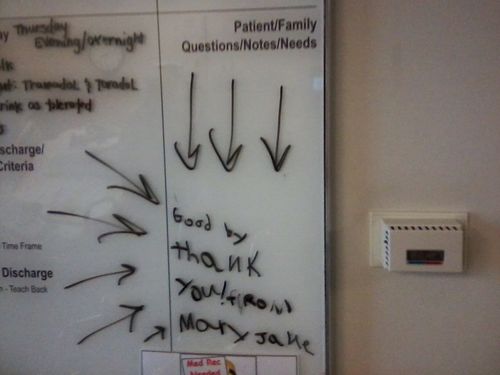
    Jokes aside, though, I will add here that Children’s Hospital in Minneapolis really has been completely awesome. Everybody has been just great. The nurses and the aides and the anesthesiologist and the ER doctors and the housekeeping staff — every one of them. I have no doubt that my daughter is getting top-notch care, and I can tell you that they have worked hard to give us the information we ask for, to listen to the information we have, to follow our cues about how to talk to our daughter about what choices she has and what choices she doesn’t have and what is going to happen and what we do and don’t know. We have been an equal partner in making decisions about how her pain is to be medicated. We have also been visited from time to time by staff who are monitoring hospital practices as part of systematic quality control efforts — for example, a team that checked for skin problems like bedsores and IV issues, looking for hospital-wide issues. The inpatient rooms are spacious and comfortable with a decent bed for parents to stay in (if I was not pregnant, it would almost be wide enough for both of us to stay together in it.) And I see good hand washing practice, and efforts to time procedures and checks so that they can be convenient and comfortable.

    All in all, things could be worse. I am feeling grateful.